
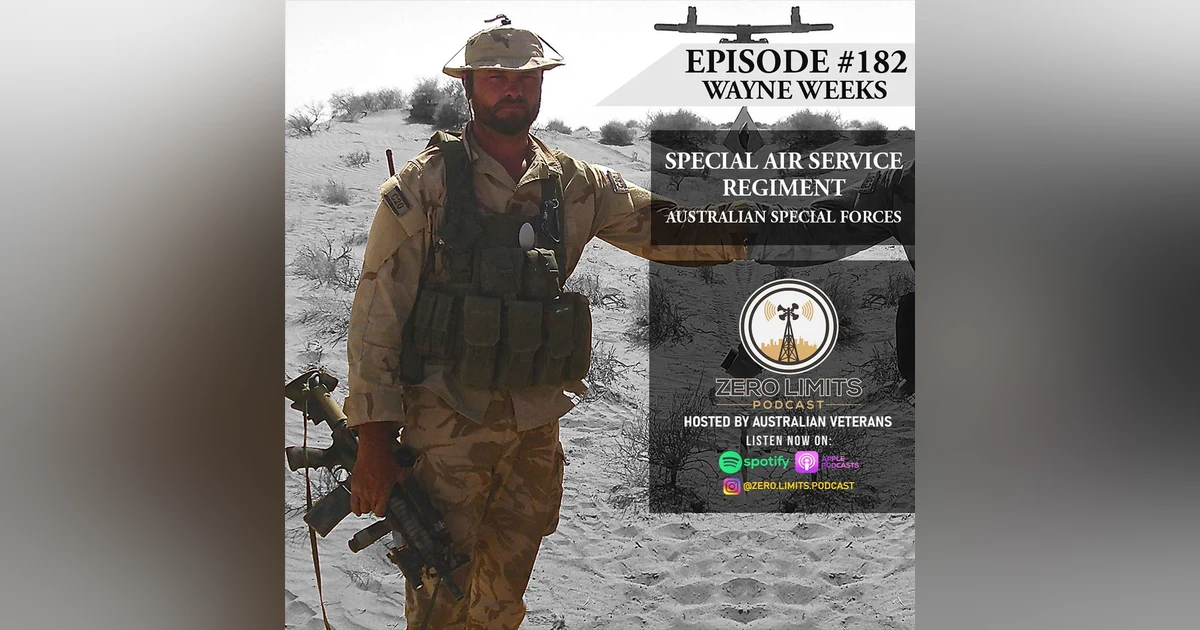
Ep. 182 Wayne Weeks Special Air Service Regiment Australian Special Forces

 Apple Podcasts
 Spotify
 On today's Zero Limits Podcast I chat with Wayne Weeks Special Air Service Regiment operator retiring after reaching the position of RSM SASR.
Wayne joined the military on the 6th April 1988, after completing year 12 and served a total of 33 years. Wayne started out his career in the Corps of Signals for the first couple of years and during his time at Signals, He heard about the SAS and what you had to do to get there, as well as the roles and tasks they performed. Wayne attempted and passed selection in 1992, after which he completed a series of specialist courses that were required to become a qualified operator.
Wayne spent a couple of years in the UK (Special Boat Service) and deployed with them and SASR with 15 overseas deployments with SASR. From Kuwait, Timor, Iraq, Afghan and Belize through to Balkans, Solomon Islands, Cambodia and Bougainville, he managed peacekeeping efforts and stabilisation operations across multiple task missions.
Wayne with other SASR operators are working towards making the tell all documentary Bravery & Betrayal.
A truth telling documentary
It has been over a decade since the last SASR combat operation in Afghanistan, and over two years since the disastrous coalition retreat from Kabul. This lost war in Afghanistan has become the SAS’s Vietnam. SAS soldiers, some with as much combat experience as their Anzac forebears from World War I and II, now find themselves fighting on a new battlefield – a war for their legacies. Maligned, scapegoated, and callously discarded by their own leadership, the men of the SASR have suffered in silence until now. With your help, a small group of highly respected SASR veterans will embark on a mission of national importance.
The aim: to produce a documentary that lays bare the human dimension of this war and its impact on those who did the heaviest lifting.
Donate below to help get this documentary completed
https://the-wandering-warriors.giveeasy.org/bravery-and-betrayal
Website - www.zerolimitspodcast.com
Instagram - https://www.instagram.com/zero.limits.podcast/?hl=en
In a world filled with fast-paced living and constant demands on the aging body, it's easy to forget some of the simplest yet most essential elements of our well-being, hydration and nutrients. As you know, when I'm not in the studio recording a podcast or in the gym or out the scrub hunting, putting rounds downrange, I'm somewhere in the world on a security gig putting in the hard yards, any up on TikTok. So the legends that get some keep me advancing forward joco fuel supplements. More specifically, I've been smashing the Jocko Hydrate Sachades, which helps me replenish my electrolytes and other critical vitamins while boosting energy, supporting recovery. Also, just like my kids, my appetite for veggies goes as far as hot chips from the kernel. However, every morning I'll mix a scoop of joco greens, joco creatine into water, which helps me supplement my lack of and delivers all the nutrients for better gut health, immune support, cognitive function, and physical performance. And not to mention tastes bloody good. So head over to www.getsum.com.au and use the code ZeroLimitsALLINCAPS for a discount. I'll leave you with this for the day. Hard work, clean fuel, stronger, faster, smarter, better. Let's go.
SPEAKER_00It's time for the Zero Limits Podcast, hosted by Australian veterans. Chatting with high-charging humans with hectic stories from around the world. We'll give you the motivation to take on whatever life throws at you in the cake to complete any goal you set your money to. Let's go.
SPEAKER_01Zero Limits listeners, on today's Zero Limits podcast, I am joined by an SASR veteran. I think he finished at the Dizzy Heights of RSM, which is uh up there with that pay stick, smacking people as they do. However, um 33 years as as I said, uh quite an extensive career within the Australian Defence Force. And uh we've been uh put together uh essentially what he's gonna be doing uh down the track, and I guess we've all seen it. It's been on Sky News, is this new documentary that's gonna be coming out uh entailing uh you know the about the war on terror in Afghanistan, uh more specifically with the SASR. Uh however, let's get him to talk about it. Wayne Weeks, mate, how you doing?
SPEAKER_03I'm well, matey. How are you?
SPEAKER_01Mate, really good, mate. Really appreciate you coming on. I know it's not easy for you uh cats out west to talk about your careers. As you know, you've all been very secretive.
SPEAKER_03And however, as we know puts you a bit out of your comfort zone, mate, that's for sure.
SPEAKER_01It does, mate. It does. However, as we know, you know, within the last 10, 15 years, all this war crimes, bullshit that's come out, uh, you know, it's time to put uh a counter-narrative out there and tell the Australian public exactly what happened in Afghanistan from the guys that were on the ground. So mate, uh before we crack on, let's let's just have a quick little chat about you know the the alleged war crimes, I should say, and obviously the documentary that you're basically putting together.
SPEAKER_03Yeah, mate. Look, it's the it's there's so many guys, you know, like and I, you know, I don't know about the numbers. I think we're over 160, 170 guys now uh out of a very small unit that have been pushed out, you know, just because there's a there's a narrative out there being led by the media. It's just all one way. So look, uh I thought it might happen for now, and um, but I'm I'm probably the idiot that's gonna stick my head up the parapet with a couple of other blokes that are really keen to help out. But uh we're just trying to get a counter-narrative to you know what's going on from the media, you know, Willisie and those clowns. Um so we just you know want an opportunity for the blokes to have their say. There was a ton of great stuff that went on, you know, from helping, you know, the people of Afghanistan to serving Australia. And yeah, we think there's some great stories to tell out there. Uh and you know, as you said, mate, they're all alleged. It's been a long, long, long time and nothing's happening. Um so I think you know, the Australian people are sick of that and it's about time they heard what you know what really went on.
SPEAKER_01Yeah, exactly. Exactly. Is it i are there any officers involved with this?
SPEAKER_03In the DOCO?
SPEAKER_01Yeah, just in regards to DOCOM, yep.
SPEAKER_03There is yeah, most definitely, mate. Yeah, so we've got some uh some great blokes that that are helping out, you know, from uh Bernsey and Bando and a bunch of the guys there, uh all the way up to some generals actually. So um we've been like well fortunate enough to have uh Johnny Howard's gonna make an appearance and Tony Abbott. So we've got some hard hitters uh and yeah, definitely some officers in there. They're keen to have a say as well.
SPEAKER_01So yeah, nice. That's good. That's good, mate. Uh as we know, some officers uh like to stay below the parapet and uh don't want to do anything. So it's good to hear that they are coming out. Anyway, let's uh let's let's save this for the end of the podcast. We'll definitely have a uh in-depth uh chat more about uh the issue and obviously the uh documentary that you guys are making. However, let's get back to you, mate. Let's find out who Wayne Weeks is. Now, before we do get back to the younger days, mate, 1969, young Wayne Wayne Weeks uh growing up in Dubbo.
SPEAKER_03Yeah, young Sprop. Uh look very much um, and you know, I've listened to some of your, or I've listened to a few of your podcasts now, mate, but and sort of as we know, and I know you talk about it, a lot of people come from a you know a bit of a rough upbringing, you know, uh school. Uh, but I actually had a really good upbringing. Uh great family. I had a younger, younger brother, older sister. Um dad was a banker, pretty steady. Um and mum was did a bit of nursing. Yeah, grew up in uh been in a round dubbo, country town. Uh so yeah, really, really enjoyed it actually. Um got to go do a lot of sport, a lot of shooting, all that good stuff. Really enjoyed, well, we didn't travel much, we didn't have a ton of money, but uh when we did travel, you know, loved doing that. Um so yeah, really, really enjoyed uh sort of country life.
SPEAKER_01In that schooling, you know, you're moving into primary school and high school, how'd you go at school?
SPEAKER_03Uh not that mate, I definitely not the sharpest tool in the shed. But um, yeah, I I went away all the way through to year twelve at the time, so finished my HSC back end as it was, and you know, probably slightly above average, but nothing spectacular. Um but yeah, did okay. But I probably could have probably could have put a bit more effort into the schooling. But yeah, I think uh back in those days sport took priority getting out and about, having fun. So yeah.
SPEAKER_01Yeah, right. Um family history, mate. What what do you feel in regards to family history, uh, you know, maybe the defence force or first responding, anything?
SPEAKER_03Mate, really interesting. Now look um I've done a fair bit of research and you know, uh I again fortunate enough to be, and we'll talk about that later on, but posted to the UK and I did a lot of travel around, you know, around the old the Liberally sites and you know, World War I around there and had a look around my name, and it's even that's spelled WWKS. Um it's quite rare, and I couldn't track down too much of a history, you know, back to back to me. I had a cousin who tried to get in the defence force, but after they gave him all his injections, he got quite sick um and put him out of action even before he finished Kapuga. And then I think my old man got drafted right towards the end, but uh didn't end up going, so like Vietnam sort of shut down. So um not not a big history that I can find. Probably the the thing that piqued or you know, sparked my interest was um my my Nana Herb, you know, he wasn't my real poppy, it was a herb boyfriend, but um, you know, he was an ex-World War II vet medic. Used to tell me some war stories and used to take me hunting a lot, so that probably piqued a bit of my interest.
SPEAKER_01Yeah, right, yeah, right. Now uh when did you what year did you finish school?
SPEAKER_03Uh 1987.
SPEAKER_0187. So you finished 87. Did you have any what was your plans?
SPEAKER_03Mate, uh I was you know, I was a bit lost to be honest. Um, you know, dad sort of said, well, just get some plenty of school into you, and then you know, he he didn't really care what I did. Uh just wanted me to make sure I went to school. Like dad, you know, he's he was a bit unfortunate. He his own old man died when he was 14, then he got a new stepdad and he was killed in a car accident. So it was he finished school when he was 14, also looked after the family. So his his motto was just you know, get into school, do as much as you can and see where they lead you. But didn't get a lot of direction, you know. I knew I I was interested in the services, I was in the air training corps for a while because we didn't have too much in the way of an armed reserve, so but really fortunate. I got got my glider's license out of that. Um and the RSL back in the day were pretty keen to have have a hand in that. So um sort of stuck when I finished. I was thinking about uni, had some friends, then I thought, buddy hell, I don't want to study for another another four years. Um looked at policing, um and then yeah, just uh I probably did a bit of reading around the Falklands, you know, reading some of the books there, and that was probably my first intro to SAS or special boat service back in those days. And then that um again, I think that piqued my interest and thought, well, maybe maybe the military might be the way to go and try that. Yeah, so in the end, took took about eight months off after school and then joined the military more, joined the army after that.
SPEAKER_01Yeah, right. So you joined the army, mates. Uh any of your mates, we were you talking to your mates, were any of them interested in the army, or was it just a just a you thing and that was it?
SPEAKER_03No, just just me, mate. None none none of my mates whatsoever. Most of them went to uni. Um some couple of really good mates took over their, you know, well, ended up working for their old man in their business. Like had a good mate. His his dad was in the liquor distribution and cranes. He stayed and helped his old man with that. Another good mate was um his father owned a big trucking business, so he went into that. Um yeah, so I was sort of the only dickhead that thought about the army.
SPEAKER_01As you as you said, mate, your your family was kind of, you know, a really stable family. So how were your parents about you joining the military? You know, they probably expected you to go to university.
SPEAKER_03Yep. Dad, dad dad never said too much, so he he seemed okay. Um, but mum was mortified. More about me leaving home, you know. Not saying I was a mummy's boy, but uh um, but yeah, mum did not like it at all and still doesn't to this day. So I I really, you know, I re I enjoyed it. Like I I actually um I think I got swindled a bit. Like I I actually I did all the testing to become an officer back in the day because I'd done my HSC pretty much past that, but um because I when I did the testing, I was only 17, uh still in school. And then the um I think I got the marks, but then by the time I was gonna uh be 18, I would have missed the intake for that year. So I was still looking at about eight to ten months away before I would have got in. And some uh some crafty recruiter uh hoodwinked me, uh, came with the Queen's shilling and said, Why don't you join the army and then transfer over to officer later on? But so uh yeah, I went in, just joined the army.
SPEAKER_01Yeah, right. So that that that recruiter basically saved you from a lifetime of torture.
SPEAKER_03Well, quite possibly, mate. Um, yeah, look, did Kapooga and then uh got recommended it, you know, to be it to go to RMC at the time. Um that after I'd done a little bit of time, yeah, I you know, I saw what officers did, and I think that's why the word officers in officer, because they spend most of their time in the office. Um so I yeah, I didn't after a after a year of serving just as a as a Dick, I um I didn't really want to change, I was enjoying what I was doing at the time.
SPEAKER_01So now just just back to Kapuka, obviously at this stage, uh this you're not going in a specific call, you get allocated your call. Is that right?
SPEAKER_03Yeah, correct, mate. Um, and like because I'd done HSC, and again, I didn't have a freaking clue as you didn't back in those days. Um, you know, I I got asked actually to go into uh survey call. I'd done photography at school or I'd had my HSC. They got they would twist them on saying, hey, it's the highest pay level, we need some people in there. I think I got to work at 11. We had our tabs and ready to march out, and uh they said, Hey, look, they're not doing that anymore, pick something else. And I said, Well, I've been wanting to get infantry all along, so um, but they'd filled all the positions, so I ended up in actually ended up in Signals Corps, uh, which is um not what I'd expected at all. But one of the corporals there said, Hey, look, you know, attach yourself to um, you know, one of the battalions at one of the cities and transfer later on. So that's later on that's sort of what happened, but not quite like that.
SPEAKER_01So you finish Kapuka, then you move on to your IETs, mate. How'd you find the IETs? Like specific for handbags?
SPEAKER_03Yeah, well, mate, that was uh one of the biggest diatoners. I I don't know if you remember a docko called Women in the Lines. Yeah, mate, yeah. So yeah, most of those girls ended up on my first course, and believe it or not, my you know, here I was thinking I was gonna be a hard charger, you know, infantry hardcore, um, ended up on a typing course with 19 girls and three blokes. So um, yeah, but look, you know, so I ended up there was a whole bunch of other stuff. There was computers and back in the day and all sorts of stuff. But uh one of the girls went AWOL and one of the blokes was going at one of the girls, and they ended up ramming a bust up, he broke his hand, so it ended up being 18 girls and a couple of blokes. But um, yeah, look, it was it was an eye-opener uh for a young fella. Um that went for three months, then got posted to one seat regiment, and then I ended up back at the school a few months later doing my radio course, like all my Morse code stuff. So um yeah, that was it was interesting. You know, looking it was good, it was good, it was young, having a good time.
SPEAKER_01And did you ever think about SA SASR? Like, was there any thoughts about that at that early stage?
SPEAKER_03Man, I I didn't note I didn't know too much about it other than what I'd read in, you know, some of that books about the Falklands. And then um the second time I went there for my radio course, um we were, you know, as you do on a Friday, you do a parade in polys and all that sort of stuff. And I remember there was uh, you know, one of the 152 guys that was was badged better qualified guy. Um won't give him his full name, but Johnny his name was. And he was dressed and he looked like a bag of shit. And I remember the RSM walking past, didn't even look at him twice, and then he got to me and just smashed me for so I thought that's all right. No Sass Blace get left alone a lot. But um, and oddly enough, I ended up catching up with him and having a chat, and then he was telling me a bit about it. And that was sort of my first inkling, you know, and just understanding that 152 SIG Squadron, you know, sort of served and you could do selection. Um, and then after that course, headed back up to Brizzy. And again, I was fairly fortunate. Um, another guy from 152 was the SSM. Um, he had a bad parachute accident and ended up back at 1 SIG regiment in Nobra. And um yeah, he he was a barrow qualified guy as well. So he said, Hey, look, you know, go over, head over, you want to do that sort of stuff. I think they actually ran their own mini selection, those guys, the old Mill Skills comp.
SPEAKER_01Yep.
SPEAKER_03They got us and they used to smash us for you know weeks on end training for mill skills, and I think there was their own mini selection, and then before we'd head over to Perth.
SPEAKER_01So 1992, this is when you attempt your first uh you attempt selection.
SPEAKER_03Yeah, mate. Yeah. Um well I I posted in I was lucky enough or fortunate enough to post into one's uh 1526 squadron in 91, and then was able to do a bit of training, and then yeah got um but the 1991 selection had a heap of sigs on it, you know, took had like from memory 14 or 15 sigs, and they took 11 of them. So they were too keen to let us go, but you know, the um me and another boat named Tomo, and it was like there was a few of us, and they let us go on in 1992, yeah. So um and yeah, managed to pass that first crack and yeah, went from there.
SPEAKER_01And how long was that selection back then? And you know, what did you know about it? Because again, mate, internet doesn't exist. There's not much, you know.
SPEAKER_03No, it doesn't. Uh you get well look, you know, Ben at 152, mate, was you know helpful, and then he bought guys previously just been on the course. Uh, but again, they they were pretty good, they didn't give too much away. And uh you just had to go on with that mindset of, you know, I'm just never coming off. And look, I I honestly didn't know what to expect, to tell you the truth. Um I was, you know, I was never strong in the old upper body, so I was always worried about push-ups. Um, you know, and again, it was I think it was more of a physical game then, but definitely, you know, there's a mental aspect to it compared to now, very, very different. But yeah, there's a lot of yelling, a lot of screaming, which sort of that sort of drove me on, I suppose. And it was back in the old days, like in Northam, um, send the old Northern military camp. So it looked, it was bloody hard. And it was uh it was 21 days. So funnily enough, the year before they they'd shortened it to 18 days, but they'd put RTI, so resistance or interrogation training, on the end of it. Um, and then my course came along, they said, no, we'll add them both together. So we did the full 21 days and then RTI straight after. And mate, we were a bunch of withering idiots into that. Like they were just uh, you know, we virtually didn't eat in Happy Wanderer for about four or five days, and then I think we had half a ration pack left or something, and they said eat that, but stomach and trunk already, couldn't fit anything in. There was other blokes coming in left, right, centre, so we're handing out what food we had, not to be jack blokes, and then uh roll straight into RTI and had another three days without food, so yeah, like bloody hell man, I looked like a skeleton when I'd finished it.
SPEAKER_01So And there was no time frame for the selections back then, it was just they'll finish it when they finish it. Like it could be 23 days, 24 days, 25 days.
SPEAKER_03Yeah, we came just after that, mate. So it was it was set by then. So 90, I think that was sort of very late 80s, early 90s, they'd set at 21 days. So um, but you're right, mate. They um they they some of them used to go for 25, 30 days. So yeah. And look, it was it was hard all the way through. So, you know, I've been fortunate enough to look at a whole bunch of selections around the world. They've all they're all unique in their own ways and they're hard, but a lot of them are much shorter than ours, you know. Kiwis, uh JTF2, they're all around 11, 12 days. Don't be wrong, they're they're body hard, but ours is 21 days and it's full-on hold time.
SPEAKER_01So and was there any point during that selection where you're like, nah, fuck this. I'm going back to I'm going back to SIGs.
SPEAKER_03Um not yeah, look, mate, definitely there was a time I I think I I still had an SLR back in those days, and I think I threw it. Um we were meant to go to Sterlings and they had Stirlings was um and I'd been down there and had a look. Not really done much down there, but you know, sort of having a sneaky peek before I did selection. And um, but there was a whole bunch of dieback growing through some you know, plant disease, so they they canned it and they put us up at Lanceland. And you think Lansling would be reasonably easy, but it was just this two and a half meter high scrub, and it was just like, you know, it was like going through wire. It was just horrible. Um at one point there, just to make some distance, you know. I'd literally turn around, fall over on my back with my pack, get up, pick my pack back up, take a couple of steps, fall over. I reckon that's as close as I come. I reckon I reckon I had a hit tear in my eye then and I was swearing and cursed, and I think I threw my rifle. Uh but um no mate, it was just you know, like I said, right at the start, I just said, you know, the only way I'm coming off is if I've got two broken legs and they're dragging me off. But um, so yeah, look again, very fortunate. Didn't suffer any injuries. Um but yeah, look, it was tough. It was mine was uh oddly enough, it was a winter one, just tons of rain, which was fucking horrible. Um we went to Collie and it was just it was miserable.
SPEAKER_01And how many blokes uh how many started and how many finished?
SPEAKER_03Oh mate, it was a it was a big selection that was I think it was panel for about 220, one of the biggest in a long, long time. And then I think mate, it was it was brutal. So we were out at Pierce Air Base, and um most of the boys were flying in from these case, they had like two or three Hercloads of them. And um because I was posted there, we were sitting there waiting, and the first thing that we did was like gonna be the 3.2, which as you know me is just horrible, even when you're super fit. And these guys lobbed off a long Herc flight, probably seven, eight hour flight, and it was straight into a 3.2 on the tarmac. And um, yeah, the blowster didn't make it, just fall straight back on the Herc. But I think we by the end of the we ended up with about 30, don't quote me, about 36 or 37. And then they canned probably 10 of those golds, uh, just you know, for whatever reason, um not the right attitude. Um just sort of so we ended up with about 26 out of I think about 190 that showed up.
SPEAKER_01Fuck mate, that's that's a feat in itself, uh, just to finish the course like that and end up, you know, being the last uh 26. From there, you move on to your reinforcement cycle, mate. You know, run us through how that that entailed, obviously it changes over the years multiple times, etc. So how was it back then?
SPEAKER_03Yeah, look, mate. It again very, very different than it is now. It's um you know, we we sort of talk about you sort of survived a lot of those courses, you didn't thrive in there and look, and the and the guys teaching that stuff didn't know any better, they were just Doing what they they were that were what was done to them. Um but look, the and you didn't get a break, so you you pretty much went from selection course where you just you know, like I said, you you got your eyes hanging out of your head, you your body's just busted up really, really badly. And then you get probably three days of doing admin, um, cleaning shit up, and then you're straight into the patrol course. Um that was six weeks. Again, that was a collie in the winter. Um again, being a SIG, I didn't but I did a little bit of work with infantry lads with six R and eight, nine RR at the day on the in the day when I was Aper and Brizzy, but not to this extent. And you know, I struggle with the patrol course. Um, like, you know, I said I considered myself not an idiot, but you know, I wasn't I wasn't getting a lot of feedback. So I was probably about uh um week four of the six-week course. I remember the the the SSM at the time, he's like, Oh, how do you think it's going? And I said, Oh, look, no one said anything to me. So I said, I'm assuming okay. I'm doing okay. And he goes, Well, you're fucking not. He said, You're on wood cunt. And it was a it was a I was like, holy shit. And I was like, Well, what have I done wrong? And um, you know, he said, You weren't camming up enough. Were you walking in the sunlight instead of walking in the shadows? And and I'm going, well, somebody just needs to tell me that and I'll do it. But um, yeah, so look, I think he he was really good actually. And um he he actually listened to me, um, came out a couple of trolls with me, and I said, look, just tell me what to do, I'll do it. And I did, and uh made it through that one. So could have been the end of a career early on. Then mate, we did the the standard, you know, Dems course. Uh I was already a SIG, so I did the medic course, which I loved. I absolutely loved the medical side of it. Uh I think I was a medic for about seven or eight years, actually, after that, you know, or held skills. Um ended up being a water operator. We did all our roping, you know, your static mind parachuting, that sort of stuff. Um, which was good fun uh travel around, especially as a young bloke. I I did selection really young, mate. I was, you know, the average age for most SF groups was about 27, 26, 27, and I was 21. So for me, that was, you know, just loving life, doing some cool stuff. And um ended up being a water operator, mate. So went down, did all our dive courts down at Garden Island on the old rebranders, the old R6s back in the day. And yeah, just really, really hard yards, but just good, good fun.
SPEAKER_01Just back to your training, mate. Did you obviously you're uh the defense force is still reeling from that Vietnam era? Obviously, a lot of training is still uh tailored towards that Vietnam style back then. Were any of your instructors Vietnam veterans?
SPEAKER_03Were they, you know, obviously sharing stories and look we um we had you know blokes like Kaz, Kaz Merckney was you know fantastic, Joe Van Droffler, just hard old bastards, Arch Foxley, you know, just been there, done everything. Um and but again, you know, like if you take away if you take away their training methodology, that's one side of it, but their experience was just phenomenal, you know, and um how they you know what they passed on, you know, when we came to Timor later on down the track was just uh just absolute gold, you know, just put us in a really good position to you know make that work really, really well. But yeah, it looked very different than the way we teach today, but um just the experience they had was you know phenomenal.
SPEAKER_01Yeah, exactly. Now uh at the end of this reinforcement cycle, as you said, you become a water operator and posted to two squadron. Uh mate, how was that obviously getting your beret, getting badged, and being you know, somewhat a qualified SSR operator?
SPEAKER_03Yeah, look, mate, it um back in back in that day, you know, it was a big thing. Um and again, that's evolved the way we do that. And what we do for the for the blokes now is really awesome. The way we we give the I'll talk more about that later, but um, yeah, look, I was proud as punch, mate, you know. Back in those days, you know, like now most of the families get to come along and have a look. And back in those days, like, you know, my family on the East Coast, I couldn't get them over, but um really sort of proud moment, I suppose. Uh I sort of, as we were going through and after that 18 months of Rio and sort of understanding a little bit more about the unit, getting some briefs, um, you know, and then realizing very, very few, very few people get, you know, the honour of doing that. Uh yeah, so you know, I'm you know, I'm not an obly emotional bloke, but that was a very proud moment, mate. So um yeah, really enjoyed it. Um had a good night out on the piston again, mate. I'm not a big drinker. Um, but uh yeah, boys had a great night, really enjoyed it.
SPEAKER_01And what was the talks going on through the regiment, mate, in regards to deployments or anything obviously the Gulf War had already happened, uh 91 first Gulf War and Somalia and all those things were you know starting to kick off.
SPEAKER_03Yeah, there was there was lots of little bits and pieces going on, as you know. Um but look, I was still, you know, just looking to get in some good training. My my first couple of years, um I I stayed on teams and you know they were counter-terrorist duties, uh, which was you know fairly high on the agenda at the time. Um you know, that all evolved out of the old Hilton bombing back in 1978. You know, they created a counter-terrorism force. We were trained by the POMs at the time. Uh, then a maritime capability came along a couple of a couple of years later. So just getting your skills up for that, and you know, the skill sets that you got from that, you know, put us in a good place for later on down the track, you know, some from the shooting, driving, Dems, uh, you know, again, it was just like big boys' toys, mate. It was bloody awesome. Um so yeah, we did did a lot of that. And look, I stayed on team for nearly I think it was two and a half years and rotated through the squadrons. Um, fortunate enough to do some sniper stuff there, driving, medical dems. Uh yeah, so it was just lots of good fun, but there wasn't much going on in the way I watched you know, like it was talk here and there. But yeah, I I think I went for about seven years before I deployed anywhere, mate, like significantly, you know, as far as um a major deployment. So but then it just kicked off and never stopped or seemed like it never stopped.
SPEAKER_01Yeah, yeah, right. Now, mate, uh just just quickly, June 12th, 1996, two black orcs crash, obviously, uh 18 fatalities, 15 from the SASR and three from Five A Aviation Regiment, mate. How did how did that reverbern uh obviously when that happened? Yeah.
SPEAKER_03Yeah, mate, look, um typical, typical SAS blokes. Uh you know, we we wanted different things. Um, you know, we'll we back in those days you used to we used to fly from Earth, you know, up to Townsville a couple of times a year for that sort of training. And as I said, you know, I I was on teens, so I did this quite regularly. And you were just mainly keeping your skills up, doing a lot of roping and you know, uh getting the pilots, you know, a lot of the a lot of them was about accreditation for those guys, you know, so get you know roping out of Helos, landing on targets on small targets and that sort of stuff. Um so look, we did a like a big planning session. Again, I was only a young fellow, so I wasn't involved too much in the planning. But um the good thing was, you know, that the the passage of information was pretty good. So we got a lot of briefs on it, and they said, look, we wanted to, you know, go off to high range and try something wasn't out of the ordinary, but something slightly different. And look, they basically put the helicopter's you know line abreast, I suppose, as opposed to offset. Um and then we did did a couple of daytime rehearsals, all went fine, and then it wasn't even dark actually when we when the accident occurred, we was like right on last light. Um, but we were on NVGs, and the um I think black one and black two basically we had markers out, so for the three HELO, for the three assault heelos, we had markers out, like IR strodes out for them to aim at. And basically what it came down to is black one and black two unfortunately looked at the same strobe. I think the second one was slightly obscured, and they just slowly started converging by the time they realized you know that they were close, it was a little bit too late, and then black one's rotors hit sort of black two, sort of uh round the round the engine casing, sort of at the back end. Um, yeah, look, and I was sitting in black three. I was at the time I was throwing, I was the black that threw the rope out, and then we fast ropes. I was looking straight at them. And at the time I thought, geez, yeah, they're close. Um, and then next thing you know, black two became a bit of a fireball, sort of spun around, hit the deck, and because it was dark, everyone sort of fixated on that chopper. But what we didn't realize is black one had basically lost all its rotors and just plowed into the deck. I mean, they said it hit it about 17 G's, and we didn't pick that chopper up. You know, people would say it exploded on impact, but it didn't, it caught fire later on. Um, so there was me, a couple other medics, Newie, George, uh, Nick, we all sort of landed straight away, ran over. There was a ground force element there for safety. They were already there. Um, raced over, and we again we all ran to Black Two because that was a thing that was on fire straight away. Um, and then as we just got there, um block one caught fire, and then we got fucked, there's two heelos down here. And that was ultimately that was Black One was the one I think the majority of the guys passed away. Um I think JJ, JJ Moore and um Jerry were the only two survivors out of that chopper. Um but black black two that landed sort of that we got to. There was a few of the guys, but made it was horrendous. You know, um, you know, it was on fire in that stage. There was guys trapped in there. You couldn't get close. We were carrying live ammo, uh, we were carrying live explosives. Um as you were sort of running in, I remember just ammo going off, the detonators going off. So they didn't set the charges off, luckily. They're on um on no-nelt. So when the when the fire um melted with no-nil, that didn't didn't set the charge off, thank God. Um but yeah, every time a bloody round went off, you'd be sort of high on the deck thinking, oh shit, here we go. And again, you're trying to drag guys out. Um what was really interesting, mate, you know, for a bunch of blokes that we carry knives, that was was one of those funny things that we we ran out of very quickly. You'd hang your knife to someone to try and cut someone out or do some you know first aid. Uh, and you know, we our our medical kits were woefully you know underdone at the time for something like that. You probably could have had two or three ambulances there and you would have gone through a ton of kit. You know, we were ripping ripping seas out of Land Rovers or to make us stretchers uh to get the guys out. And you know, interestingly, you know, one of the guys I worked on, he seemed fine, but he ended up being big Russ, he ended up being one of the worst casualty of his a whole lot. So just had basically every rib broken off his uh broken off his spinal cord. So you know, just incredible. Uh but he's still around, still functioning black, you know, hardest nails. Uh but yeah, sort of put a put a damner on his, you know, a full career thing to do it, to do everything. Um but yeah, look, and then again, the guys just did the guys that were there that were left did an amazing job, got as many out as we could. Um, and then uh got as many of those guys to hospital as quickly as possible. And then yeah, it was just a bit of a blur after that, mate. You know, we once we cleared as much as we could, we ended up back at uh Garbit Air Base there. And um, yeah, there was a big no comms, you know, the media were sitting outside, the big speakers trying to hear what we were talking about. And look, it was just quite surreal. You were there, especially for the land troop guys, you know, they'd lost the majority of their troop. Um you know, and I think they flew a 707 in for us the next day that flew us home. But yeah. And then all the funerals started not long after that. Uh uh for our guys, I think I think I got to about of the 15, I think I got to about eight or nine of the funerals, just you just couldn't get to them all as much as you wanted to. Um yeah, it was uh it was a shocker.
SPEAKER_01How did that uh affect the unit? You know, was it uh did it you know did it last for a while or you know, did you guys have a Yeah, a long time, mate.
SPEAKER_03Yeah I honestly don't think I don't think we recovered for a you know and like just numbers-wise, you know, of course placing 15 guy takes a long time, you know, and and I don't mean that in a bad way, obviously, but just uh probably took five, seven years just just to build up the numbers, let alone the experience that came with those guys, you know. There's you know, sergeants in there with just amazing experience. Um a couple of my good mates, you know, there's a couple of SIGs in there uh from that perspective. And then just the families, mate. So, you know, like just that's always you know, we always go into these things thinking, you know, you you don't want to be injured, you don't want to be killed, but um you you know there's a risk there. But seeing the families, the kids, uh that's just just horrendous, you know. And that's probably the worst thing. And and interestingly enough, you know, death does, you know, funny things to people. So um it's hard to explain, but it's just uh a horrible, horrible time. And yeah, look, I think probably that you know one of the best things come out of it, and I think he touched on it right at the start, Maddie, was you know, it changed the way we compensate soldiers and all defence force people to date, you know, because what was there was absolutely atrocious. But you know, for soldiers, air force, navy guys and girls that go out and and do the business, it the uh our pension system was pretty woeful. Uh and that was probably a big catalyst to get it changed.
SPEAKER_01So mate's um moving on uh 1999, mate. This is where your first deployment comes up, East Timor Inner Fett kicks off. Mate, what's it like? You're tilling up, ready to roll, thinking you're going straight into a war zone. What was what was the what was the talks before you were you know about to jump on this plane and head out there?
SPEAKER_03Well, mate, we we did actually a deployment uh in '98 to Kuwait prior to this, which was going over thinking we were going to Iraq and never never kicked off. So we went over for well probably four months, did some amazing training, um, got to work with the Yanks, did a lot of Li Fire, did a lot of you know desert work. So that was a real good build-up. And uh, but sort of a you know, big letdown. So we thought, oh yeah, we're getting a getting to run. Uh, but it never kicked off. So yeah, look, then funnily enough, um you know, Tmort came along and again, sort of we were getting briefed on that fairly early on for a while. Um, and I was listening to Andy's stuff. He sort of we sort of knew, depending on what squadron you're in and where you're sitting, you sort of know who's going first if it if it if it kicks off. So at the time, um we were we were doing a ton of build-up for the Olympic Games. So we spent, you know, the squadron I was in at the time, we spent a ton of time in Sydney, uh living out in Manley, actually, um having a great time. But yeah, so uh one of the L squadrons deployed on the first first crack, and again, just really good as far as the communication side goes. You know, they would we knew we were going to go after that. So we were late 99, I think. Um, and they'd feed stuff back for you know, for the comms we had back in those days, they'd feed stuff back um to us and say, this is what we're doing, this is how we're doing it, um, this is what you'll need. Um, you know, all the stuff we trained through that, I mentioned it before, through that those Vietnam days, from a an SOP perspective, and that really, really spot on. But the boys got down to you know, much lighter weights. Obviously, the the the fighting or the the threat wasn't as bad as we thought it would be. So we're able to scale back and you know, and do all of that and and prep really early. So that's probably the beauty for us as and again, as in Joe and all those guys were still around, so we bought those bloke in to help us out doing a bit of prep. So we'd go out to Bindune, do a heap. Um, and yeah, by the time we stepped into it, it just felt like, you know, yeah, we were doing the same thing, but we're just doing it a different country. But yeah, look, it was exciting, mate. It was again just putting everything you'd learn into practice uh and seeing how well it worked, you know, just some of the stuff you can get away with, and you know, we sort of coined that phrase, you know, getting away with it, some of the training, you know, like you'd be cammed up, being stealthy, sneaking around, and mate, you literally get within metres of people. And it's just awesome to see what you can do. Um, you know, sort of sit on the border sometimes, uh, watching the ind ons sort of roll in and out. Um, yeah, never had a clue we were there. It's very awesome.
SPEAKER_01How long was that uh deployment?
SPEAKER_03I think that was about just on five months that one for me. Um, yeah, so had a it was interesting. I had a whole bunch of trips planned to the east coast and uh had to cancel them all. So I think I was gonna do a bit of island hopping up the east coast, but uh uh all went out the window. But yeah, look, just good fun. I think I remember being there on uh on uh New Year's Eve and just you know the innons were firing green trace everywhere, and there I was stuck in an OP cam cream on and we got a great photo of us just eating green frogs, as in the the the lolly green frogs, not real green frogs. But uh yeah, but um yeah, so different, but uh good times, you know. Just again, getting to getting to put all your skills in practice is awesome.
SPEAKER_01Yeah, right. And just obviously I'm just reading your uh bio here, uh Balibo, was that uh a different rotation or was that the same one?
SPEAKER_03No, different rotation, mate. So we that you know that was a big year. So I did that five months, came back, and then we do a you know, we we have a big hand in a lot of training assistance teams, as you know, all the all the sort of our northern neighbours, whether it be PNG, Malaysia, uh Indonesia, um, you'd sort of head up there. So I did one in Malaysia for a month, not long after coming back from Timor. Um, came back to Perth for about three weeks, and I went and did another one. And then my next tour straight out the door was back to Balabo. Um so I think I was gone for about 10 and a half, 11 months of that year, uh just just deployed, mucking around. Uh, but Balabo was very different than uh the Dilly one. Like Dili was probably we were going out for 10, 12 days at a time, uh, you know, long patrols, uh, come back for four days and you go on what they call REST for that response force. Um, and you just you just tool around Dilly, you know, just making sure everything was safe, get out of the range, do a lot of good training. Um, but Balabo was very different. It was um very a little bit more strategic, you know. Um we were right on the border. Uh Australia wanted to keep a good eye on, you know, so what whatever was going on, what was happening on the border. And we did a great job um just watching a bunch of IDPs, you know, nationally displaced persons sort of coming along a boat. Um, but they'd just cruise around from the Indonesian waters into into you know East Timor at the time. Uh so just doing a lot of really good stuff like that, you know, a lot of um comms, a lot of technical, you know, listening to what was going on, that sort of stuff. Won't go into too much too much detail, but yeah, just seeing what was happening. So we'd take out buddy, you know, some spooks every now and again, and they just sit on their on their kit and uh listen to what was going on.
SPEAKER_01Yeah, nice.
SPEAKER_03But yeah, very different.
SPEAKER_01Yeah, and how long was that that deployment?
SPEAKER_03Yeah, just short of five months, I think. Yeah. So you're right. So that was nine months in like those two tours are about nine months, nine and a half months. And then I did two one month, you know, uh training assistance teams in there. So yeah, it was bloody nearly 11 months worth.
SPEAKER_01Bloody hell. Oh, yeah. So you get back, uh obviously you get back to birth, mate. You're cashed up as well. What are you doing with your money? Are you saving it or are you blowing it?
SPEAKER_03They didn't give you that, they didn't give you that much money back then, mate.
SPEAKER_01Fair. Oh fair.
SPEAKER_03But yeah, the old dilly dash for cash, that was funny.
SPEAKER_01Uh mate, uh, and then moving forward, late August uh 2001. Yeah, this is obviously before September 11 uh cracks off, uh MV Tampa.
SPEAKER_03Yeah, mate, mate. I wasn't I wasn't directly involved. Like I saw a lot of the planning for that thing. Um, but again, there's probably you know the Tampa and a few other issues, and it's probably what I wanted to link to later on when we'll discuss was you know, um good good old Johnny Howard was um pretty much using you know SAS as you know that sort of force of choice, I suppose, and just just that flexibility, always training, always ready to go. Um but yeah, so the boys launched out on that, you know, at really short notice and then did did an amazing job. And again, a lot of people don't hear you hear a lot of the media hype about what was going on, but the guys did a great job, you know, and when they got on that ship, you know, typical, you know, all the all the blokes were you know hiding in the shade and all the women and kids were stuck out on the deck in the heat and they'd taken all the food, so the the boys fixed that up. Um and then yeah, it just sent them off, you know. Unfortunately, um Australia had fairly strict, you know, laws back in those days about where you were going to go and what you're gonna do. But yeah, it caused a bit of an uproar. And I mean we copped a we copped a fair bit of heat for that. But um that was part of that thing where, you know, we were that force that you know could deploy that fire out and get out there and had the tools and the ability to do it. So yeah, we sort of became you know John Howard's uh force of choice to get out there and do those sort of things.
SPEAKER_01Yeah, yeah. Oh, Johnny Howard he had quite uh strict rules, didn't he? He was basically just turning these boats around and Send them back where they come from.
SPEAKER_03Most definitely. Yeah, yeah, you know, ended up, you know, can't remember what was my daughter, Mannis Island, but uh yeah, basically no one was coming in back there. And look, it had a had a fairly significant effect. You know, that just stopped sending boats eventually, you know, regardless of your thought process behind the you know, the rationale behind it. Um it definitely uh it definitely worked.
SPEAKER_01Yeah, it definitely did, mate. Now they get cars and houses. Mate, uh moving forward again, uh September 11, 2001, only you know, a week or two later, uh a significant point in uh turning point in the world. Obviously, you end up in Afghanistan uh down the track. Mate, run us through this day, mate. Obviously, a defining point once again.
SPEAKER_03Yeah, mate. Funnily enough, I think I was I think I was I was distracted doing something. I think from memory, I was doing PT and I think my my old man actually rang me. Um and he goes, have you seen what's going on? You know, he's East Coast. Um so he was a couple hours ahead of me. So I'm like, no, what are you talking about? And he goes, It's you know, that classic, turn on your turn on your fucking TV and have a look. Um so yeah, it just literally as I turned on, I think uh I think the second plane went into the tower, like that like directly saw it. I was like, holy shit, no, no, and mate, I just probably like everyone else, I was like, is this fake? Is someone setting us up? Is this a movie? Um, what am I seeing? You know, and then it was like, what does that mean? Um yeah, and I remember, you know, a heap of us got called, like I was only I think I was only a corporal back in those days. Um actually no, oh yeah, the corporal sergeant was close, but so I got called in and with with a lot of other guys just to have a look at what was going on. And again, it wasn't it wasn't too much coming out of the time. It was a lot of a lot of hurry up and wait at the time. But that was initially, and then literally a week later, then you know, everything started happening. You know, the US wanted to, you know, get get out there in a hurry. Um, and then they were obviously relying on that alliance, you know, for Australia to give a hand. And then so, yeah, look, again, Australia being Australia wanted to help. And SAS, you know, because we're on fairly short notices to move all the time, um, yeah, we're in the firing line for that one as well. So, and yeah, people boys rolled out uh early on in 2001, late 2001, I think it was. Yeah, yeah, and September or something, was it? September. Um yeah, the boys got a got a got one of the squadrons out there.
SPEAKER_01Yeah, and how was that? You know, obviously they were sending the squadron out. You boys already roll as well, just Keenan Mustard, and everyone's like, nah, only this one's going.
SPEAKER_03I I think everyone thought it wasn't gonna be too long. Obviously, as you know, the Yanks were fired up. Um so I think people were thinking, oh, we're gonna miss out. So there might have been a little bit of backstabbing. There might there might have been if you're if you're out away on leave, you know, the boys might have been spreading the story that you were never coming back on leave just to get a foot in the door. But look, all I every squadron got away in the end. I think they did one rotation. And again, it was very much classic SAS stuff, which is you know, utilising the guys for long-range patrols, uh, long-range reconnaissance stuff. Uh, you know, Matty B uh ended up in that big, massive firefight, uh, you know, calling in lots of bombs. So um, yeah, like everyone, you know, every squadron got a got a got a hit out on that one. Um strangely enough, mate, I didn't I didn't go on it, like I I did that like a two-week stint um as a replacement. It was really weird, but I didn't actually go on all the initial ones. So uh I just had to hear all the good stories. I had there was five guys in the wing, so we were responsible for all the driving training, and uh every bloke around me went and I ended up sitting in the office by myself for a little while.
unknownYeah.
SPEAKER_03So uh but yeah, that was uh bit of any climax, but yeah, then everything changed not long after that.
SPEAKER_01So well that's it, you know. Little did you know they uh each squadron would do uh almost a hundred rotations per per squadron down the you know over the 20 years, so mate, it uh it worked out fine. Mate, but going back to obviously those early rotations uh on the 16th of February 2002, uh Andrew Russell's killed.
SPEAKER_03Yeah, mate, it was uh very sad moment because I yeah, I was in the same squadron as him in Timor, um, and we did a lot of patrols together actually. Like um we'd just uh you know worked alongside, you know, we'd gone out, done a lot of mobility patrols in Timor. Just a really great, great bloke, you know. Um and we had so we had a water troop and a land troop mixed together, which is unusual. But um we were out doing a bunch of stuff and yeah, just very professional, uh always had a good sense of humor, had a good laugh. And uh yeah, so I was really, really sad to hear that. Uh and then you know, again, just sort of stopped everything as it does when you know when you lose a member of the family and they got him back to Australia and massive, massive funeral for that sort of thing. And um yeah, and you know, Kylie, his other half you know uh is all around, still helps out. You know, we have we have an amazing you know, support network around SASR from the auxiliary to the you know resources fund uh from that and again that those sort of things, and that was after the black hole, help manage that. And you know, like nothing's ever going to replace your husband uh or family, but it can just make it that little bit easier. So, but yeah, again, really, really sad, real shock too, mate. You know, sort of no one was expecting it um for the amount of time the boys have been out there. So uh and again, just unlucky too, you know. As I say, you can always get unlucky.
SPEAKER_01Does does it add a bit of um fuel to the fire? Did it make you want to get overseas?
SPEAKER_03Yeah, mate, it did. Like you here, you know, you you you what you you're trying hard to you know control everything and the emotions and that sort of stuff, and you know, part of the reason you selected, you know, for SASR is you know just managing those motions and you know, keeping the clear head, being able to make good cognitive decisions about doing the right thing, and you know, that's no different than when you're back home. But yeah, look, the boys were pissed off, and you know, at the time it's horrible to say that you know everyone wants to get a bit of bit of payback, but um, you know, so yeah, the the guys were keen to get back in and there. And then when we we got pulled out, um yeah, everyone was a little bit pissed off, felt a little bit ripped off, I think.
SPEAKER_01So and then uh 2003, you know, March-ish, uh the invasion of Iraq kicks off now. It just this is where it just gets even more spicy for the for the regiment. Everyone's thinking there's just more obviously for a war fighter, this is what you want. At the end of the day, as bad as it is, this is what a war fighter wants is war.
SPEAKER_03Yeah, mate, and exactly. And you know, I've heard a couple of guys say it on yours, you know it's like you you train for years and years and you want to see if everything you plug and done, you know, works, um, and put it to the test, I suppose. And you know, everyone used that analogy of training for a rugby match for 20 years and never get to play one. So, and look, you know, no one condones war, but no, unfortunately, you know, that's just part of human history, isn't it? And I think as we can see, it'll just keep going that way. But um, look, mate, we we got away on that fairly early, and that was probably one of the more secretive things as far as deploying goes. Like we went out quite early. Um, you know, again, for for the sake of relations, you know, through that, you know, sort of the Arab community there. Um we, you know, we stationed out at Jordan, and that was, you know, that was fairly secretive as far as you know, basing you know, coalition forces out of that location. Um but again, did some amazing training and again we deployed very, very quickly, uh, again, with the help of the US, got all the LRPVs over there and everything, and all the kit. Uh, but did some amazing training, some build-up training. And then again, sort of I was a bit wary of their 1998 scenario where we did a heap and we weren't sure it was gonna go off. And then we got went to the Fort Mounting Bakes and thought, no, fuck, this is getting real. Um, and so yeah, look, just sat around there for a couple of days. But everyone was super excited. Um, everyone was, you know, usual story, good, good, good black humor going around, getting ready to go. Um tons of intel briefs. I just remember getting intel brief after intel brief till the head was going to explode. But um, and again, we were just look at that stage, we were looking for a place to cross the board. Um and then ended up that getting identified. We forward staged there uh over overnight, spent a sort of a day lying up there, put the cam nets out, just sort of hanging around, and then and we thought at that stage, I don't think we still thought it was gonna happen. And at the time Bernsey, uh, it was the OC, um, gave an awesome speech. It was like something you see out of a movie, uh, with the whole the whole squadron there, and then um, yeah, and then rolled into that evening and got the green line. So literally drove over the burn and we're into it. Uh, I think pretty sure our squadron was the first actual contact of the war. So we've been driving for a couple hours and ran into some poor unfortunates that were trying to piss off heading back to Baghdad in a bus, um, fired some rounds at us, and they just ran into a whole squadron. They were armed at the teeth, so it didn't go well for them. But um, yeah, so we were straight into it, mate. Um, but that was just and again, very different, you know. Like we're there's a lot of people out there, a lot of armchair critics who were going, oh look, this was a conventional task. But there's no way in the world it was a conventional task. Like one, the time it took us to deploy, even just the access to um, you know, the information that you need, you know, like the we're working closely with the US, a lot of the stuff's at the top secret level, so you know, you just you just can't get that. Then you know, to deploy another group over there, you know, probably just wasn't viable. And then again, you know, most of your regular infantry guys, there's got to be a logistics chain and a backup chain. When we went in, there was nothing. You know, if once the like a troop got flown in, like right in close to you know, right the edge of our AO, which was one of the closest guys to Baghdad for weeks on end. Um when we went in, our whole job was to actually go and find trouble as opposed to you know laying low. So we had to stop the old weapons from mass destruction. But it was to get in to get into as many fights as we could to get these guys um to unmask, really. So yeah, look, had a ball. And again, really fortunate we didn't lose anyone. Um so yeah, but we're sort of for the first five or six weeks, it was you know, into it every day.
SPEAKER_02Oh were you?
SPEAKER_03Yeah, yeah. We like I think the next day we had a massive four and a half hour tick or contact. Um yeah, we it was around a radio relay station, and we'd gone in just to give this clear it. Um and there was a couple of locals in there, nothing, nothing out of the ordinary. Uh, but as we were there, we're just pulling out, and then a whole bunch of um we can only assume they're Fedoin guys, like six white SUVs, they'll had seven or eight guys in the back, had their dushkas in the back, um, deployed all guys along the road. Um, we ended up in a four and a half hour firefight. And again, mate, it was sort of one of those funny moments when you're getting your first shot at, you know, sort of like, oh, sort of like, are they really shooting us? How dare they? So that sort of thing. Sort of um, but yeah, look, mate, we, you know, as you know, we had in each each pair of cars, we had a 50 car and a Mark 19, and like I said, we just I think we had double front line almost. So the boys went to town on those poor basses. Um didn't end up too many of them left. I think that was the first time a javelin had been fired in anger as well, like my guy, uh Nukes. Um we're sort of for the first couple of hours, we were running around, lots of shooting backwards and forwards. And um we had air, but our JTAC, who was a US guy, couldn't get cons for some strange reason. So we couldn't use the air. Um so I said to the bicep, I said, let's, you know, it's a bit of a stalemate, we're going through a fair whack of ammo, let's let's rip a javelin into them. And um this car was coming at us at probably the max range at the time. And I was on the binos and newts was on the javelin, and he goes, I can't get a lock, and I said, No, mate, they're coming, they're still coming at us. Um there was like there's a guy in the back on the on the P Gay M, and there were three guys in a car. You could see him as plain as day, about two Ks away. Newt's finally got a lock on him, let this javelin go, and mate, and I gave the old command firing now, and the whole battlefield just stopped to watch this thing. Like, you know, imagine you know, eight cars just stopped firing, and this javelin launches, and they saw it coming too, mate. Like the old car did like a almost like a handbrake turn, the bloke on the gun in the back fell out. Um, and the car was driving away, and the javelin went in back through the back window and just cleaned this thing up. And the bloke fallen out, another car came to pick him up. And like if they gave out you know, Iraqi PCs, he would have got one. So he drove in, picked this guy up. All the cars, you know, all the other LRPVs arced up at this bloke, and there was bits of Toyota panels flying off everywhere, and he he ran out of there. And as far as I know, we never hit him. We fired some ordinance at him, but um, but yeah, the three blokes in the car, and when we had a look at that, could not think we found a tiny bit of bone, mate, and that was it. There was just absolutely nothing left of the big javelin, you know, just changed the course. You know, you you talk about regaining the momentum in a battle, mate, and that was a cracker. Um, because we had we had a whole heap of javelins per car because we're expecting potentially to hit tanks at some day. That remember eventually then so. But yeah, mate, it was uh so that was just sort of day in, day out for quite some time. Uh, I think we went three and three and a bit days without any sleep, and in the end, just like had to say to the boss that we just need to put our heads down and get get you know, get an hour's worth of shut iron, we're gonna something bad's gonna happen. So we ended up doing that, and then straight back into it.
SPEAKER_01So essentially you're just just looking for a fight, just going straight out there, looking for a fight, and if you pick a fight and fucking finish the fight.
SPEAKER_03Yep, pretty much like we're just you know, like the whole idea was to stop, you know, at the time, rockets getting fired into Israel again, so trying to drag them into the war. So we'll run around looking for scuds, looking for weapons of mass destruction, uh, you know, anything that would you indicate that sort of thing. You know, one night we did a we there was a big factory, I think it was uh not a chemical factory as in what you'd think, but it was more like for um plants and you know growing growing crops and that sort of stuff. So we did a massive clearance on this thing. It was the first time we actually got into the old mop three. Uh we hadn't had gas mass off. We did this massive clearance of this joint um in uh NBC kit. It was friggin' horrible. But um yeah, so that was another one, you know. So it was bloody good fun. And how long was that deployment? I think in total, like we were over there for about four months, but I think we're only in country for about six to eight weeks. We, you know, pre-started doing a lot of um um well uh what do you call them, just VCPs, I suppose. So we just ad hoc there's people running in and out. Um one of the classics was we we stopped a truck, or a troop stopped a truck, and imagine a semi-trailer, a big semi-trailer, and it's just packed full of guns, RPGs, AK-47s, ammunition, just I mean, to the to the top of this thing. It was literally thousands of these things. The only thing we could do was burn it. But then oddly enough, not long after, um, six busloads of Syrians, you know, came came along, and you know, we were assuming that they were going to catch up with the truck, be armed, then they'd go and fight in Baghdad. But all of them, all of them were um, all of them had been issued passports within four days of one another. Uh all of them were fighting age males. Uh so we pulled them up. Uh and the funnel enough, the Brits ended up coming in and flying most of them out, but you know, destroyed the buses, um, took them all away, never saw them again. But uh, yeah, just lots of funny little things like that happening. Um we stopped the, I think we stopped the Russian envoy on the way out. They were leaving Baghdad. Um it was quite humorous actually that they had fake bandages on their head, and there was a couple of bullet holes in their cars, and they said the Yanks had priced them up, but there was no Yanks up there. Um anyway, look, that's interesting because he got on the sat phone and he caught Colin Powell at the time. Holy fuck. We've put a foot in it here. But uh, yeah, so the Yanks said let him go. So we did. But uh yes, lots of funny stories around that one.
SPEAKER_01Yeah, right. So a full-on six to eight weeks in country, just this, you know, full-on.
SPEAKER_03Yeah, it ended up ended up at Al-Assad Air Base. Um the the land trip ended up doing, we were still running around the desert, and the land trip ended up securing that base, and we all ended up there. And again, they did some amazing stuff, you know, like you know, typical vehicle-mounted guys. Um, they fixed up all the tractors, fixed up all the runways, um and then just you know, so it hurts and that stuff could land, and we ended up, I think we had to come in and visit right at the end, flew in, uh flew in and to say hello. So yeah, it was bloody mad.
SPEAKER_01Bloody hell. So you do that uh deployment, you get back uh to Perth, mate. How you how you feeling? You know, this is your first time full-on combat. Uh not taking it easy. Uh how how did you get it?
SPEAKER_03Just catch more. Yeah, pretty much. Oh, yeah, just oh the moon, it was a great tool. Like we came back, um they had a big uh a big get-together at that stage, uh set up in the the old gym, basically, and uh had some politicians there and um met us all, had all the families. So yeah, you know, everyone came back. Like I said, we were very fortunate, didn't take any casualties on that one, which was amazing. And then uh yeah, just like a heap of blokes left after that. And you sort of a lot of the blokes thought, well, it's not gonna get any better than this. Um, just you know, cracking deployment, some great jobs. And uh yeah, we lost a ton of guys out on the circuit. So when, you know, obviously Iraq kept going and we wanted to stay, but you know, typical Australian government's a wisdom took us all out of there. You know, there was heaps of opportunity to leave some guys there and help out, or even you know, and we'll talk about this later on, mate, it's heaps of opportunity to get some experience for some of our senior officers running around that joint and understanding, you know, what would what was end up gonna be the war on terror. Um, but yeah, we we pulled everyone out and then you know had to start again eventually.
SPEAKER_01Yeah, right. Mate, um moving forward, 16th of April, the Pong Sioux, North Koreans try to smuggle in a whole bunch of heroin. This is not long after you get back, really, isn't it?
SPEAKER_03Yeah, yeah. And the boys deployed on that one. Again, this is and again, mate, I'm just trying to bring up a point for later on when we get there. But uh, you know, we're just getting thrown at every job known to man at this stage. So uh anything that came along, there's that. I know you're gonna talk about the Patagonian toothfish one. Yeah. So Australia wanted to send a strong message that if you come pick our waters, you know, we won't let you do it. So, you know, whether that be running drugs or illegally fishing. So um, but you know, like that should have been uh what is now Border Force's job, but you know, uh we were just getting thrown at everything. But again, it was just I suppose it was just easy for us. You know, we were training that sort of stuff all the time. So uh the boys launched out that really successful, um, you know, took the ship very, very quickly and then handed it over. So um made the PM look great.
SPEAKER_01Exactly, exactly. Now it's uh also during that time Solomon Islands kicks off and there's deployments going there.
SPEAKER_03However, you don't get to No, I mean just regularly, yeah, regularly and again the just helping out, um just rotating out, and I only didn't I only did a couple like some of the guys went in and out of that, you know, seven or eight times. So they do regularly, you know, a lot of you know short, short notice, well not short notice, but short rut turnaround deployments. So you go out on the ship, do a bunch of training, help out, um, and then come back. And we do a lot of them, but I was like that's around that 2003 uh time. So again, we were away for a fair chunk of that. Uh didn't get didn't get too many runs, but yeah, the boys did some good training, you know, lots of funny stories. Working with the Navy, always funny. But um yeah, sometimes they liked us, sometimes they didn't, and you you had.
SPEAKER_01Mate, uh, is there any talk of Afghanistan at this stage? I've that that's uh still in play. Everyone thought it would have ended by now, by then, 2003, but it's it's still raging.
SPEAKER_03Yeah, mate, yeah, it was still going on. And and look, we as we do, we we were always asking why aren't we there? We can get back in, help out. Um and I think a lot of knockbacks, especially at that political level, didn't want to get involved. And then but yeah, look, I ended up being again fortunate enough to head off to the UK when that decision was made. So I didn't see too much of it and what sort of what transpired and what changed their mind over here to send the send the guys back in. I think it was around 2005. Deployed Australian, you know, Australian SAS back back there with obviously with the task force. I'd headed off to the UK by the sign, so I didn't see too much of why, why and how that came about.
SPEAKER_01So and when you talk about going to the UK, you're working with uh the Special Boat Service?
SPEAKER_03Yeah, mate, we've been doing an exchange with SBS, especially if you're a water operator, for nearly 50 years now, probably more actually. So that's been ongoing. So you'll do an exchange, they'll send a sergeant over for two years, they'll slim on over to us, um, and you just uh slide riding with those guys and do whatever they're doing. Um and yeah, uhwesome experience. Uh get if you've got a family, you get to take family. Um and you know, a lot of the POMs that come over here, just you know, especially with their wives, they see the lifestyle from Perth and compared to the UK, and a lot of them come back, you know, we've had at least five or six of those waves come back and you know, after they've finished their time in the UK, head back and live over here. So um, but yeah, it's good good experience.
SPEAKER_01Yeah, right. And how long was that for?
SPEAKER_03Two years, mate. Two years employees.
SPEAKER_01That's a decent stent.
SPEAKER_03Yeah, go out to well for us SB, you're out at pool, out at um, you know, like obviously SA22, SAS that's up in Hereford. Um SBS is down in pool, right on the water there, uh, which is a beautiful part of the country. Um and so yeah, end up with them. And again, I was right place, right time. Um, usually, and it's not always the case, but you as you deploy, you usually go into C Squadron. Um but Sea Squadron had just been away, so they were out, they're on a lot of leave. And I just happened to know one of those guys that did the exchange, he was the SSM for M Squadron, and he said, uh, do you want to come out to Iraq with us on TF Black? I was like, over Catholic. I'm like, Yep. So we did uh we did a Hebrew training uh up at Hereford actually, and probably on that, and it's probably the best handover training, you know, for guys that have been there and to prep the next group coming in. It's probably the best thing I've ever said, like I've come across as far as other than you're you weren't in Iraq, but you're in you know in Hereford uh training, but the prep around you know the SOP at his what they were doing, how they were doing business and what was going on, what to expect was like second to none, and it was it was brilliant. Um and then yeah, and then as a I was a they call him TL's team leader and as a postal patrol commander. Um I went off in the advanced party and we'd been over we you go in before the squadron for a couple of weeks, and at the time, um, you know, it was purely targeting operations, it was all Saddam's, you know, the old remember the old playing guards from back in 2003. Yeah, they were still trying to catch those guys uh and all HVT. So you had the we all we were all um in the green zone, but we're in, you know, uh Saddam's sons, Lud and Kusay. They had a whole bunch of palaces just on the I think it was the western side there, and you had either SEALs or Delta, you had the Iraqi SF guys and us. We all stayed in there, and uh then you just run missions out of there, you know, and that was you know, every couple of days you'd be out in the ground. So I went um tragically, um the SB guys or UK SF, they'd lost one of their SF herks in that what they call it, the muted triangle there between the airport sort of green zone and that. Um it got shot down unfortunately. Um so when we were doing the handover with the 2-2 guys, they were just on a mad mission to try and catch as many of those guys we could. So I did my handover was literally three jobs in a row. I think the first. So I'd done a lot of training on you know, shotgunning doors and method of entry and that, but never really done it on an operation. And uh that night I think I shotgunned about 40 doors off. So I was an expert by then. But yeah, we we hit about 20, 20 houses or alphas as they called them, um, just bouncing from one to the next. And like we we left at sort of six in the afternoon, didn't get back till eight o'clock the next morning, and I was in the lead hummer, and that's when you know hummers were getting blown up left, right, and center in those days, and I thought I'm not even gonna last one trip. But we did that three days in a row, mate, and I shattered um just every night went out and hit probably eight to ten houses just to catch as many back as we could. Um but yeah, it was just full on, and then a bit of a lull period till the rest of the squadron came in, but uh it took me three days to recover from that fucker.
SPEAKER_01With hitting all those houses, mate, are we talking gunfights as well? Is this firefights?
SPEAKER_03Rarely, like um yeah, yeah, a few shots here and there, but nothing nothing uh uh nothing significant. So, you know, like using explosive charges to get in. Um typically you know, you'd move to a at a house, get on the rooftop. The next team would then make entry into the house, clear it, and go on. But yeah, look, any minor gunfights, nothing major. It was just yeah, nothing major at that time, but again, that picked up a little bit later on in the trip.
SPEAKER_01So yeah, did you uh on that uh deck of cards, mate, did you pick up anyone off those cards? I did, mate, I got three actually. You're right.
SPEAKER_03As a team later, I I think I got three of them. Um and they're worth a lot of money, but when you're in the military, you don't get paid for it. Um I think in total it was about back in the day, I think one was like 40,000. One only 10,000, but one got one that is like worth a couple hundred thousand bucks US. Um, and we targeted, I think I got three of them pretty short. Um and but never got never got any coin for it.
SPEAKER_01Assholes.
SPEAKER_03I felt ripped off.
SPEAKER_01Mate, how long was that uh deployment, that one?
SPEAKER_03That was uh five months. That was that was a good one. Um and it was just full on it. About I'm gonna say we did about 40, 44 jobs on that one uh in total. Um mate, it was just a just a massive learning curve for me. You know, like I'd very different than the way we trained in Toronto and I learned a ton about targeting. There was a guy there, he was quite amazing. He set up all of the UK, uh, the UK system for over in Open Americas and a whole bunch of other places, got himself an OBE for it. Um, but I sort of latched onto him to learn everything I couldn't. Great, great bloke, just really sharp operator. Um, so just everything we did targeting, you know, it'd sort of bounce ideas off with him. And look, it was the full gamut makers. Like, you know, we had some SRR guys or equivalent SRR guys, but they're actually operators back then. Um you get all dressed up, you know, put the paint, you know, the face paint on, different coloured eyes, roll out, you know, in a shitty old wagon and go on to your go and do your wreckies of your target areas. Sometimes it was too far away, too dangerous, you'd get in the chopper. Uh, you'd you'd go do an airborne wrecce. Uh, but mate, it was like nothing really that was seen before. Like you had helicopters on call. If you caught a if you caught a bad guy, you would uh they'd go into Abu Grave prison. You were allowed to go and TQ those guys, like tactical question those guys uh with your handlers. They had immediate access to all their intelligence. You had you know, you had blokes assigned to you to help you target. Um, yeah, it was just the operation was incredible, uh, how they'd run it. And they again it just evolved every rotation. You know, uh there was a big push. I think um Baraka Farm was in power, like towards them as they put it a ton more soldiers on the streets, put in a lot more roadblocks and a lot more checkpoints. So that pretty much canned any vehicle movement. So everything became helo-borne operations. But you know, we took those SOPs, you know, you like it was just incredible. Good fun, um, exciting. And you know, I think Douglas Wood, the Australian guy that got captured, we had a couple of Australian patrols come out from SASR and joined us. And we did, I think we did a couple of jobs looking for him, didn't find him. I think it was actually the local Iraqi uh military that found him in the end. But um yeah, I think I think we claimed it, or the Australian guys claimed.
SPEAKER_01Mate, and then uh following year you deploy uh you do your pre-deployment in Oman and uh deploy to Afghanistan. Is this with the SBS as well?
SPEAKER_03Yeah, yep, same, same, same group, mate. Um, but yeah, very different, very different circumstances. So um, you know, everyone thought 2-2 SA would end 2-2 SAS would end up there. Um but they were wrapped up in some, you know they were still wrapped up in Iraq, and they didn't want to move them out, so they said SB would go. Um and look, there was there was a lot of friction over that one. We ended up taking all their super cats out to Oman, doing a lot of training. Um and then we were meant to build up, our build-up training was about six weeks in Oman, and we were meant to go back to the UK for a couple of weeks break before we went in. Um at the OC and his wisdom, he let the he let the boys go, but all the uh team leaders had to stay, so we were just barrel straight into Afghan from there, um, which was friggin' hard because that was an eight-month tour, that sucker. Um so yeah, that plus the extra six weeks, so it was a long, long trip. Um we in Kandahar, based out of Kandahar, and this was early days, there was no real fusion of uh Intel. And the OC we had, he was he was actually a two-two guy. Um he was our OC. And again, real sharp operator, but he was the first guy that galvanized everyone's intelligence reports to one thing, which ultimately became the JPEL, as you know, that joint priority FS list. Um, but he was the first one guy that said, look, hey, we're all bidding for these assets. A lot of times we're after the same individual. Um, let's let's combine our let's fuse all that. Um so again, sort of ahead of his time, that guy. And again, in some base market mode, we had in the early days we had no choppers. Uh we used to use the old brown ring run to get around, visit bases. We had vehicles, and the IED threat wasn't too bad back in those days. But yeah, so we were just learning as we went. But probably the big lesson for us is we took the same SOP we had in Iraq, you know, in an urban environment and tried to overlay those SOPs in Afghan and had our asses handed to us on a number of occasions. You know, it took us a little while to realise, hey, this is not working. Um, yeah, we got some huge gunfights over that. Um and look, at the time we sort of learned our lesson, but then later on, that was a pretty rough trip that we UK squadrons are much smaller than ours, and much you're talking about 50 or 60 guys as opposed to a squadron in Australia might be 90 or 100. Uh, and that break them up. So we had one patrol would go up to just above Kabul, a place called Fort Hunter, where they used to train all their indic forts. Then we'd have another group that would be responsible for like we used to do with our ASUS guys, and also perform uh CPP duties for, you know, like type of defence minister would come and visit. And then what was left was the fighting troop. So you you might have three three patrols or four with headquarters on it. Um, so we weren't a very big force. Um and yeah, look, so even that's what I mean. We ended up losing we had one guy seriously wounded, but we lost four killed on that on that trip. Two, one was an SRR operator um that was out with us. Another one was a sergeant who was actually filling in for me at the time, uh Paul Bartlett, in a massive big firefight. And then really sadly, we um we lost two two guys. They used to use a Nimrod. I don't know if you remember those things, big ugly thing. Yeah, yeah. Yeah. It was doing some air to air refueling on a task getting ready for us, and uh it caught fire mid-air and exploded. Yeah, just obviously killed everyone on board. But um we got I think them I think there was a bunch of marines that were on the they had the ready reaction force to go in and secure the area, and then we flew out of the world. But yeah, mate, that the wreckage on that thing was you know spread for miles and miles. But um really, really sad thing was that community, the Nimrod community, it was very, very small. And the got hold of, and then they said, hey, one of these things has gone down, everyone's dead. But that was before it was officially released, uh, before the families were notified, so that must have been fucking horrific for them. So like I said, only a small community, and ten of those blokes have have passed away. So, you know, imagine being the families trying to work that one out. Fucking a nightmare.
SPEAKER_01Yeah, fuck. That's crazy. Are you the only uh Aussie on this?
SPEAKER_03Funnily enough, no, mate. Um like that that group of blokes, we had a South African, we had, you know, you know, this is UK forces, but you know, you had Welsh, Scottish, um we had a we had another guy, Kiwi, uh, and a good mate of mine named Jeff, he was on Longwell and got him over. So it was just, you know, a band of merry men riffing from all over the place. Um, you know, the Scottish blokes, you couldn't understand them. South Africans, you know, they were a pain in the ass. But uh it was just a real, real mixture of blokes, actually. Um, but yeah, so uh only a small group and we were stationed at in Cando, we're stationed at a place called Camp Fireway, and it was it was far away from the main camp. Um and you'd sort of roll around our headquarters or at our targeting uh place was sort of a couple of kilometres, had to jump under the eagles, used to go down there and do all our targeting. But um, yeah, it was just a different cattle of fish, and it was it was a bad area even then in the early days, you know. Like obviously my time with um our deployments with the Australian forces, um, you know, that built up and got bad very quickly. But this was just bad straight off the bat. You know, they'd come in from a place called Barancha, which is right in the southern area. They'd run a uh, I think we call it route gold, blue, and red or something like that. And they'd do different works up there, and we'd try and interdict them on the way up, but invariably they'd get into you know places like Goresh and they'd end up in Sangin, and it was just a really, really bad area. So yeah, lots of lots of firefights just on a daily basis with you know the POMs and uh I think the Marines had taken over, and just you know, the casualties they took was just phenomenal.
SPEAKER_01So you have any uh close calls yourself?
SPEAKER_03Oh yeah, yeah quite a few. Yeah, yeah. Um we we were going after a high value target, and and mate, we were doing, you know, because we didn't have dedicated assets tilts at the time, we were just working out how do we how do we get out of this blog. And then I think I think there was uh like a an evacuation out of Iran for British personnel, and the choppers that came back from that just happened to stay with us for a couple weeks. So we had some choppers to use for a little long. Um and then so we planned this job and we're thinking he was a new target and he had three bodyguards, and we'd identify these guys. We had a pred uh doing some airwatch look, this guy, and he had three bodyguards, and they were all probably from his like from his backation, they're probably all like a surrounding but a kilometre apart. And some bright spark thought we'll drop a 500 pounder on each bloke, and um, but what they didn't tell us is once you drop that 500 pounder, you've got to wait for two to three minutes for the debris to fall back down before the helos are flying. So so we below this plan, dropped it in. Um, and I was in charge of the uh cordon force at the time. We had some SFSG guys, some pretty parrots. So the boys are going to do the hit. I was gonna surround them, you know, with the cordon force. Um, and but we're flying around, the bombs had gone in uh on the on our system. We're watching these all these bad guys running around. I'm like, you need to get us down on the ground, so we're meant to be protecting the the assault force. And uh he's going, we can't, we've got to wait for the debris to fall. Would have been nice to know that before we planned it. Anyway, as we were flying in, we were just taking rounds left, right, and center, like the hilo was all armored. But it ended up technically you'd say we got shot down, so we couldn't fly the hilo anymore, so had to land out in the desert a couple of caves away. And I'm fly I'm on the comms to the boys, they're getting their asses handed to them. Uh again, luckily we didn't lose anyway. Um, but yeah, they're in a massive shit fight. It took them hours to uh extract them so I was out of there. And I'm sitting there in the middle of nowhere, I couldn't do a thing. So but yeah, with a with a chinook full of hole in it. So yeah, leave them learn. Let them learn.
SPEAKER_01Yeah, yeah. So that deployment we're pushing eight months, so quite an extensive deployment uh to be in uh hostile environment, very kinetic, it sounds like mate. And then from there you get back to Australia, is that right? You finish your two-year term back.
SPEAKER_03Finish the two years there. Yeah, like I mean, uh as you said, that was a two-year, two-year trip. Um, but I reckon I was out of the 24 months, I reckon I was deployed for nine months of that so um between Iraq, Afghan, they do a lot of other stuff away. And again, because it was a short time period, mate. I think I was just trying to jump on everything I could. You know, we did did eight weeks in the States, a lot of mountain Arctic warfare stuff over in um over there with the US guys at the Marine Training Center there. Um, head up to Norway and did some ice climbing, you know, some slow stuff up there. Um we went over to Belize while we were there, and um and we were teaching uh anti-drug running stuff to the Belize military. Um, and just again, some amazing stuff, you know. The POMs have got their finger in it, everyone's poly has, you know. Um doing some brilliant stuff, you know, they had sort of three lines of operation there where they would interdict, you know, something like off Miami Vice, those big cigar boats with motors on it, they'd have helos out interdicting them. They did the land operations, and then they'll do some other stuff which I I can't talk about. Um, but yeah, they're in that all the time. So I was away for a phenomenal amount of time and then got back to Australia. And I think I was think I was back for Christmas. Then I deployed a couple months later. It was my first trip, proper trip, uh to Afghan with Australia, SF with S A S. So that was in 2007. So yeah, it was just kept going on and on and on. It was good.
SPEAKER_01Just non-stop, mate. And just quick quickly, sorry, mate, I just want to talk about the SBS. How did you find the difference between obviously the SBS and what uh Out West does?
SPEAKER_03Oh look, mate, I'll I'll probably send some around and do a hit on me for saying this, but look, when you when you're talking about personal skills, you know, like you know, like literally gun running, uh, you know, parachuting and that sort of stuff, I think our blokes are probably some of the best in the world. You know, we get a lot of time to train that. Um but they get exposure to so much more, as I said earlier, mate. They're the POMs got their finger in everyone's pie, uh, and and they'll stay there unless there's you know there's an absolute reason not to be there. Um so just when it comes to experience like that, yeah, they've got an access on that one. But you know, you give our guys a little bit of a chance and they'll be there with them. But uh SB very, very similar to us. 2-2 SAS, and I think I was listening to Andy's podcast, you know, the keyies do all the work with them. I think there's a slightly better relationship there. Um, and we did try and exchange for that guy, but it lasted a couple of years and that was it. Um, but again, good guys, but uh very different. Um but the SB guys are very similar mentality to us, uh, same sense of humour, uh, good bunch of lads. Um, but yeah, look, getting your finger and getting your fingers dirty or getting your hands dirty, I should say, um, around the world, they're all over us. But when it comes to personal skills, I think we're right up there.
SPEAKER_01And what uh what squadrons you get back to uh in Australia?
SPEAKER_03I went back to came back to three, like I've been in all the squadrons, but you know, when I came back, I ended up in three squadron, I troop, as the troop sergeant. Yeah, so um yeah, just settling into that one, working out how all that worked. Now you're responsible for 25 blokes that uh keen as mustard and very strong-willed and uh very energetic and very opinionated. So yeah, it was something different. Probably that you know when you're running a patrol, it's five, six guys, you're very close-knit, and you know, you don't really have an awful lot to do with the other, you know, the rest of the guys, even in even at that level. But when you're the troop sergeant, you're um you've got to manage them all. So it's uh it was it was something new for me, put it that way.
SPEAKER_01And was mo most of the uh regiments uh deployable? Uh as in sorry, have most of the regiment have they deployed to Afghanistan already? So did everyone have a lot of experience with Already.
SPEAKER_03Yeah, I think all but at that time they went back in two thousand five and I think so yeah, I think they were all getting to their second rotation. And look, Matt 2007, um you know, that some really stuff going from there. I think it was uh 2006 they did that big bloody big drive through there. Um I think Maddie Locke, you know, got his medal of gallantry around that time, but there was a massive big push, and I think, you know, there were some big, big fights, but again, they were more classic SAS stuff with it. We were still doing around and around vehicles and uh still conducting um not so much strike action, but you know, more OPs and reconnaissance of the house, but getting in some fights. Um 2007 was different. We we did the O Perth, I think it was called, um, just running around and you know, trying to find these does. But again, we it's probably a point I'll make later on, mate, and go into more detail, but which for what for the job we were there for, we weren't very well supported. You know, we had you know, we were asking why we didn't have any rotary wind support, you know, why we didn't have a lot of Intel, you know, access to drones, all those things that help you do that. And that, you know, again, Australia didn't really know what it was doing, to tell you the truth. Um, so we were almost making it up from an SF perspective. Like, what are we what do we got to do to protect the Australian task force? Um, you know, and that's sort of just you know, we started from scratch and the boys the guys set pretty good uh baseline back in the the early days, but now we're back in TK and it was like, how do we build a bubble around the Australian task force so they can do their job? Um and so you know, we pretty much came up with taking out the leadership is probably the best way, you know, keep them keep them off balance, take out their networks. Um again, we came up with them, no no one told us to do that. But it was just like what we're you know, we're coping hiding for it because everyone says we're making up our own making up our own jobs, but you know, we thought it was the best way to protect us, you know, Australians at the time so they could do the you know the mentoring and the reconstruction side of the house.
SPEAKER_01Yeah, mate. Obviously in that 2007 trip, how kinetic was that? Was that uh another just busy set you know few months?
SPEAKER_03Yeah, busy, but not not overly, mate, not overly. It wasn't uh not like it was, you know, sort of as you get to 2009 onwards, um I think the bad guys were too trying to work out what we're doing and how we were doing it. Um so yeah, definitely, definitely, you know, some interesting times, but nothing like it was later on. Um so but yeah, just more often than not, they just you know, if you got close because that because they knew we were coming in vehicles, they'd become dirt farmers again. Uh sort of blend into the blend into the scenery. So it was hard work, mate, trying to, you know, we still took a lot of blokes, uh caught a lot of blokes. But um, you know, we had for years, and you know, it wasn't until 2011 we got some sort of detention facility. And look, Australia, uh, we had the Dutch then. The Dutch weren't interested in taking anyone. Australia had a problem with us giving, you know, pucks to the Dutch because the Dutch would hand them to the NDS, the National Directorate of Security. Uh, they had a bad name, you know, around um not you know, human rights, I suppose. So unless it was a high value target, you know, the Yanks didn't want to know about them either. So yeah, it's like, what do you do with these people? So we used to take a lot of them and catch a lot of them, and they just let them go. So which, you know, ultimately sort of that's another thing we're in trouble for. We'll catch and release, you know. We caught some blokes, same blokes, at least four times.
SPEAKER_01Fucking hell. Mate, you finish that trip, get back to Perth, mate. However, you're straight back into it. This is where it's just becoming a bit of a theme now where it's just in and out, in and out, in and out.
SPEAKER_03Yeah, and look, we've got uh I think six months there was and I think I I think Andy mentioned it on your previous uh when you on his chat, we used to do five months, two weeks. So if you were in the advanced party, it'd it'd work out to be five months, two weeks. You wouldn't do that six months, so all those impotlements that you get as soon as you hit six months, we never got those. And look, we knew that. But um it was probably something, you know, from a mental health, you know, capability and you know, burnout, it's probably something you know that probably should have been looked at a little bit better, but there was no one else to go, you know. I mean you had three squadrons to rotate in and out, and so we just kept doing that. Um but yeah, so it had had some time off. But the whole time you're back at work, you're still working and you're working hard, uh, you're developing capabilities, you're still deploying to, you know, doing still doing those training assistance teams I was chatting about. And then actually no, back we're back out in 2008, you know. So, and that was this is probably where it started to pick up. We were getting a little bit small, bit, bit, bit more support from our coalition partners. Um, so we were able to target a little bit better. Um still everything was done at this stage, everything was getting done by vehicles, so we had a lot of IED strikes, you know. I think this was the one I was our last LRB, LRPV patrol. So we hit an IED uh with me, Moff, Sean McCarthy and our turp in it, and unfortunately Sean was killed. Uh so yeah, that was the last time we went the IED threat was getting prolific and LRPVs just weren't cutting it.
SPEAKER_01So yeah, yeah, that was what 2000. I I actually I was uh just in the Blue Chiefs Valley and I'm I remember hearing that explosion.
SPEAKER_03Uh yeah, yeah, look, uh it was not a big day, mate. Like we'd been up, we've been tooling around, uh again trying to get out, make some stuff happen. Um having a look, and I think we'd stopped stopped overnight uh at FOB Lock, or what is now FO what was Fob Lock. Um came out there and we'll get a lot of smack talk over the icon, uh, all sorts of weird and wonderful stuff. Staying off the main roads, we were sort of working our way back. And um, yeah, we thought thought we were okay. Uh we were off way off any major tracks. And um yeah, I think I think we're the sixth vehicle. My vehicle was the sixth vehicle in line. We had the whole troop out. Um, yeah, we got whaled. Uh just um look, and I there's still a bit of conjecture over this one, Nate, but uh, you know, I think it was I think it was a remote control one. Uh like the guys came out and did a check and they couldn't find any pressure plates. Uh, but it went right off underneath Sean. And look, to my surprise, I thought, you know, there's there's armor plating where the driver and the the Koei sit in the LRPV. There's some armor plating there. Um there was some armor plating under the um under the gunner, which was Sean at the time, but there's not. And you know, Paul Bloke, you know, lost both his legs. Um so uh and there was some other other dumb shit that went on. Apparently it was uh can't remember what they had the obviously is like a code red, so Helos couldn't fly from Kandahar or other places. They still fly from um from TK, but so it took a long time to get him extracted. Um, you know, we had moved the vehicle a significant distance, like just picked the vehicle up. And I remember one of the boys had one of the other squadrons had been hit by an IED and one of the guys, the engine block landed on his shoulder. And I distinctly remember, I distinctly remember flying through the air, and that was in my head as I was flying. So wherever you land, just just roll. And it was like slow-motion, you know, they talk about time sorting when things like that happened. I didn't, I don't remember hearing the blast at all. But as I was flying through the air, I thought I'd hand land on my hands and knees and just crawled as fast as I could. Um waited for the dust to clear and you know, then went back. I'd I would see the turp. He was he was about 30 feet away from the car. I was about 25 feet away from the car. Um, and then yeah, just checked him through. I'd turn the car. I could see his leg wasn't in a good way. I think it was just hanging on by a thread. Um, crawled back over the old 5125, um, saw him off, and he said, I think Sean's, you know, I think his words mean, I think Sean's fucked. So crawled over to Sean. Um, and but again, it took me a couple more minutes to check the rest of the beetle. Um, and then got on the radio and called the book, called the medic in. And oh wall, he did an amazing job. Um he's out, okay, I called medic. But um, yeah, look, he and I think blitzers said this before, probably could have had him outside the surgery when we hit that thing, and they still wouldn't have saved him. So, but uh yeah, look, that was a shit day.
SPEAKER_01Follow on from that, what what happens from there? Because I remember you guys, you come to uh Kudos, uh, you stopped in Kudos, regathered yourselves, and you just went straight back out.
SPEAKER_03Yeah, mate, yeah. Like I'd look, um yeah, I I I didn't want to go. Like I was like, fuck, I should stay. But again, you you're all bravado and that sort of stuff, but you back sort of realise the concussive effects of those things, you know. I thought I was still with it. But you know, the boys are telling me I was fucking in La La Land. Um, but yeah, like I I broke three bones in my left wrist, busted my kneecap because I sort of like I landed on all fours uh and it re cracked my back like a dull back injury. So through L5, it re-rebusted that. So in the end, they put me on the chopper with them off and we flew out. But yeah, the boys um pretended when they got back, and they said, you know, every time a vehicle scraped or bumped and they were like shitting themselves, but yeah, it stopped in, um, re-gat it, had a few words. I remember the OCs, you know, had a few words to the boys, and then they went back out to trying to find those guys like patrolling that night, I think they were, to try and go and get them. Um, yeah, look, we we were in uh I ended up being the hospital for a couple of days and then got out and ended up doing a couple of weeks in the ops room. Um unfortunately Moff had to head back. He had he got a severe infection, nearly lost his leg himself, actually. But um, after about two weeks, um, you know, I had a gut full of my arm was in a cast, I was limping around and I just set the boys. We actually got a really good target. It was like something out of black hawk down, and I was like, I was threatened to cut the cast off my arm so I could go out on out on this job. And uh we got we got out on the job, and um we were uh at a seven kilometre stop in and so I'm out of a cast, still got a bung knee, bad back, and I've got a ratchet by the time we didn't got to the target, and we we caught the guy, and he was a hot he was a high value target, and I think Mark Donaldson and um horse at the time route spoke and uh we got him, but because we were in a bit of a it was only a minor scuffle, but then the vehicles wouldn't come and pick us up, so I had to walk seven Ks out as well. That was a 14k round trip, man. I was ratchet. Couldn't hold that gun properly, arm was still fucked up, knee was still fucked up. Fucking hell. But um yeah, it was a good yeah, it was a good win that one, that night.
SPEAKER_01Yeah, yeah. Now, and uh September 08, that big incident happens, and uh Dono obviously subsequently uh down the track is awarded the uh VC, mate. Yeah can you run me through this?
SPEAKER_03Yeah, mate. Yeah, look, so we and funnily enough, it was a bit of a lull. So we were like, what do we do? You know, like you know, we're um again, lack of support through some uh through Helos and uh and targeting. There was a bit of a lull, and the boys up at Casaguer is going, there's a whole bunch of ODA guys here, and they were getting wailed all the time. And we said, Well, look, let's go up and get a man. Um so we sent the troop up there and met up with those guys, and it's like the uh the good old, you know, good old hillbilly whoopies down there, like they're just unreal. You know, they're um just a great bunch of blokes, they can't do anything. Um, but they're not not my version of Green Berets, not what I thought they'd be, put it that way. But they're penis mastered. And um, so they just we said said, hey, look, how about we do some uh do it do some of this? We'll we'll go out sort of where Kazaruzgan base is, so that you could sort of head north, east, south, and west from that base and stir up some trouble. Uh so we actually went on, I think we went on cholera, but we hit a dry hole. And then after that, we'd go out and um pretty much use the Yanks were pretty happy to be like the tethered goat. So we'd go out of a night time, set up in an ambush position, they'd go out and roll around and then start drawing some file, and then we'd react to that. And look, that worked really well the first three times. And this is where we're we're a little bit of uh, you know, in what's that saying? Never do the same thing twice. Yeah. Um, so we'd done it three times, but when we went up to the west, um, there's only one way in and out there. So I don't know if they expected that, but they they smashed us. So we'd split into two groups. So one group was in the vehicles, which was Dono's crew, and then there's another group that was on foot. Uh so we went out, uh, got an OP position and Dono's patrol. And again, we're trying to stir up some shit basically. Um, so we had a like a separated task group, if that makes sense. The Yanks and some of the Australian boys were on that one. Yeah, and look, then it all just went south for there, mate. And where I was at, there's nowhere in the world we could get to. We were on foot a couple of K's away. So we could just hear this rain gun metal going on for hours and hours and hours. Um, again, really disappointing. The Dutch would not get involved. So the boys, probably for about an hour and a half, we had some Dutch Apaches, wouldn't fire a shot, um, just making up every excuse under the sun. So the boys were just getting hammered for an hour. In the end, the Jack Tack got shot and ended up in Germany. Um ended up fucking the Dutch off, and we ended up calling in bloody F-15s and US uh F-8X off bloody carriers, would you believe, um, just to get the guys out of the shit. Um and that and off roadism we were we were trying to get back, but as I was like, there was no way where we were at, we were going to get involved, we could couldn't get there. So by the time we got back, you know, and we were hearing this shit out, oh, you know, we've got Australians being wounded, or you know, there was an American guy killed sadly. Um it was just like fuck, how do we get there? You know, we couldn't get a helo to come and pick us up and then put us there. Probably wouldn't have been a lot of help anyway, mate. But um anyway, so we ended up eventually everyone got back to the actual base. Um when we got back there, mate, like some of the vehicles were like you that scene at a Black Hog now with just hosing shit and blood out of the cars, it was phenomenal what the guys had gone through. Um so at the time the OCD, I'm sorry, the OCD, the troop commander himself went around just getting your own story, trying to you know get it all together and work out what had happened. Uh and then you know, just all went from there. But um lost lost Sabi, the dog on that one as well. Um we wanted to stay around, but they wouldn't let us go out uh to get Sabi, so we did it anyway. Uh, but then got brights up doing that as well. Um but yeah, I mean good story, good news story. The dog ended up making it back. But uh Yeah, yeah. Look, we think that night the dog actually came back to the bus, but the two uh the two Afghani guards um probably didn't realise and shoot it off. Um so we went out and asked if we could do a bit of a search and headquarters in their whiz and said no, you can't. Um so yeah, the as you know, you know the story, and that's an amazing story. Um but uh yeah, so we got out of there, got back, but yeah, with copter hiding, you know, we had um had quite a few guys injured. No, obviously one really seriously ended up in Germany. Um and you know, he's he's back now, made it, thank God. Um and but yeah, look, we got some new guys in literally straight off straight off the reinforcement cycle, and we're in a shootout the next couple of days, in Dark Award, I think it was. So one of those guys took a round, took his hat off and gave him a good scalping actually. It's an awesome picture of him. Um yeah, look, so that was that was just the the tempo. And I think we got three replacements, uh, yeah, and they were all in the firefight a couple of days later. Uh so yeah, it was it was formed, and yeah, and as you know, later on, all the reporting the boss did at the time got sent up the chain, and you know, it was a couple of Kongs out of it and Don A VC, so well deserved. But look, you could have given a heap of those guys medals for doing what they did.
SPEAKER_01So fucking hell, mate. Mate, and look, I just want to touch on obviously at this stage too. There's been multiple uh KIAs of Australian soldiers, you know, dating back to uh Dave Pierce, obviously with the RTF. Matthew Locker's obviously killed in 2007, October uh 25th. Worsley Marks uh from the uh 4RR back then, obviously now to Commando. Sean McCarthy's killed, and then it made it from there, it's just obviously that list just continues to grow. Mate, how's that affecting you guys on the ground? And you know, obviously, again, mate, it's all about you know that I wouldn't say the the revenge word, but you know, you want to get out there and fucking end some of these motherfuckers.
SPEAKER_03I suppose we were we're in a really fortunate position that we could do that, mate. And I remember at Joel watched that and we we saw some infantry guys and there was a there was an IED that they discovered, and it was, you know, when their senior leadership just wouldn't let them go and take out the IED. Something they were eminently trained to do and could do. But they got they got stuck there for hours. At that same time, we flew in, did the job flipped right over these guys, about two K's further down than they were, landed, got in a shootout, grabbed a bad guy, then flew out, and they were still there, like you fuckers. Um so from that perspective, you know, uh I suppose we had the ability to go and catch bad guys and do that, and we weren't hamstrung as much. So, you know, you talk about you know getting a bit of payback. I think much easier for us to to manage that than than most, you know. Like, but still that I think probably probably by my second trip to Afghan, I you know, for me, that altruistic view of you know, helping the Afghan people, and look, don't get me wrong, we were trying, but I I reckon this is me personally. My whole focus switched to hey, how do I keep the boys safe? But in doing so, how do we keep Australians safe? And that was our whole goal. So if an Australian got injured, especially through an IED, or if an Australian got shot through a green on blue often, we took that really, really personally. I mean, and that that case that you talk about where uh the the young cook got shot, um we were we got prep ready to go within 10 minutes to get that guy with the yank, said, Yeah, hey, we'll give you some heelows to go up, and we couldn't nail that down. And we just got held up, held up. Our senior leadership wouldn't let us go. Um, but then they wanted us, you know, we said this guy will be gone. Uh and in the end, they didn't let us go. And they said, Oh, we'll send you in the next day. And we said, no way, like, you know, the place will be booby-trapped, there'll be IEDs, they'll be waiting for us. And look, so just no concept of how to do those sort of operations, unfortunately. But yeah, look, we took that really, really personally. And look, that story there is a is a cracker because we had a we knew where that guy was for a couple of months. And in the end, the Egg Twin got him for us. But the beauty of that was there was an Australian guy on that task force and he did all the shooting. So that's my sort of safe.
SPEAKER_01And that was uh that was that was that was 2009, was it?
SPEAKER_03Yeah, yeah, somewhere around there, mate. I then that I'm not a hundred percent sure, but they all mold into one. But uh yeah.
SPEAKER_01Yeah, and just just on the regimen itself, with it with you know, how was everyone uh coping uh mentally at this stage, you know, 2008-ish?
SPEAKER_03Oh yeah, back probably then, okay. Um, you know, you there was because of the tempo, you you could have a bit of a rest, um, you know, you could train. Um so from about 2008-2009, probably 2009 onwards, it started to kick off, and you've probably heard already, you know, like we all we ended up getting pushed into the position where we weren't allowed to operate at night. So, you know, we had a good routine. We had we're doing some amazing, like when we could get some in and we could catch some bad guys, it it you know, that was about as SF as it got. It was like, you know, sneak in, drop off, um, you know, parachute sometimes, halo, offset, uh, walking, and you'd literally catch these blokes in bed, you know, you'd be tapping your muzzle on their forehead saying, Hey mate, get up, time to come with us. Um, yeah, you know, cool as and then but then uh Carzo made some rules uh all about you know not upsetting the locals, which I can't see in, but they were talking about big-scale raid, you know, like going into whole villages and the locals getting pissed off, and probably rightly so. Um, but you know, when we went in, we were probably going to one place or maybe one or two places, and most of the time most people didn't know we were there. But um when that rule came down, mate, you know, we were all kicking and screaming. So any sort of technological advantage we had was gone. Um so any sort of surprise factor gone. And then, you know, and look, mate, ultimately I'm gonna say it, uh it probably costs Australia at least six Australian lives making that decision to go to daylight operation. So we probably would have been working at night. But as I said, you can get unlucky that you know there was a number of gunfights we were in in the middle of the day, and you know, you put civilians at risk, you put
SPEAKER_01yourselves at a massive risk and you know and then you know doesn't give the bad guys many options other than to fight so you know you put air assets at risk so it's just it was just the dumbest fucking decision that you know I think Australia could have made or didn't support no one no one asked us no at no time did any send you what what are the consequences of us just making you guys out in the day and the boys literally transitioned from night to day in the space of a month so we had to get that shit sorted had to change all your SOPs uh yeah mate and that it was fucking hard yard so we went from you know you're hardly getting the shoot out to literally getting in the shoot out every time you went out so um yeah yeah it's it's crazy because you know obviously I've I've had a couple of SEALs on a couple of Delta guys on and obviously that was pushed towards them as well but they they basically their rank structure said it's not fucking happening we don't care we're we we're we're doing what the fuck we want. Yeah exactly that's what they did. Well why didn't the ow why didn't our fucking structure do that you know generals etc why didn't they say you know what fuck you it's not happening you otherwise we're just gonna leave Afghanistan we don't care fuck you yeah look I think probably maturity lack of maturity like and at this stage I think you know you you know if you read some of those excerpts out of you know from politicians you know they're on the when they're in when they're in parliament time you know and having a chat they're all support but in the back channels and you can read the stuff that's written you know like they're going this is a shit fight there's there was no exit strategy and this is like sort of 2009 2010 like how do you get out of here um not to say they didn't care but they just didn't know what to do I reckon like but again like no one asked no one came to say fellas how would you do this you know even at a at an operational level but at that strategic level you know we had some look I'm gonna bag the generalship out of here mate they're probably just not experienced enough to go back hey look you know yeah you know regular operations will maintain that daylight side of the house uh but our SF group that are you know doing all the uh high level stuff those guys are gonna operate at night don't care what you say but they didn't do that mate so yeah we went out and changed everything um and they obviously they would have known the risks that obviously it presents by operating during the day you know we own the we did we we did own but we did own the night we had the technology to own the night they they knew that they can't they can't be generals and not fucking know that yeah look I'd like to agree with you but that'd be really really obvious wouldn't you it's like okay we're gonna send you out in the daylight now and we're gonna fly around some helicopters that aren't ours the Americans are doing it for us and they were risking their necks.
SPEAKER_03But like we were very good with that we'd always made sure we wouldn't put US helicopters at risk but uh so I just don't think they understood the level of fighting that was going on that you know that developed uh with the Taliban in that in that area you know it's some just mad mad gunfighting um where you you're in there for hours like uh not many people talk about it like 2011 tour like Garde like that was a like a troop went in there against 50 bad guys um the troop got broken up and we had a we had a hilltop you know blakes up on the hill so there's a patrol there we had a group they landed on Ashore so they had to secure those blakes so about 10 or 11 blakes took on 50 and they they took out about 27 of them wounded another 14 didn't get a scratch on them but you know they were fighting for about six hours so um just dumb shit by that man and it just didn't have to be that way. But you know like you know I I don't know what the statistic is but as far as civilians getting injured I know more civilians got injured just they're you know they're running around farming kids are playing and then all of a sudden a bunch of sass blokes land in your village to come and catch a couple of bad guys and where they go obviously they run away and try and hide but makes life a lot harder for them.
SPEAKER_01So yeah and like just on that should this top you know just quickly should this top end brass should they be held accountable essentially having blood on their hands?
SPEAKER_03Yeah there needs to be some accountability somewhere somehow mate um you know you know we'll talk about part of that doc o piece um you know to make that decision and again I you know I could sit up at that level but you know maybe they did talk about it and maybe they did but like I said no one asked us and no one said hey you know what are the consequences of of doing this uh yeah the consequences were you know you transferred the risk from the senior leadership level down to the poor fucker on the ground because he's the one that's getting shot at uh and ultimately we lost blokes you know in that you know fighting on the ground in the daylight.
SPEAKER_01Yeah exactly mate which we'll you know we'll talk about it uh down the track uh uh at the end of the podcast mate's uh moving back you uh finish that deployment you get back to Perth mate by this time actually you are a six figure digger and making a lot of money uh what are you doing with this what you know and what rank are you at this stage too? Mate I was a troop sergeant in sort of 2009 2010 married and yeah married one kid yeah yep yeah uh didn't see much of that um I think my daughter always pulls a piss out of me I think I'd I was away for 16 of her 17 birthdays so by the time I'd started to slow down but yeah she was uh she was right in that period of when I started deploying and when I left and look she's a great kid but uh she doesn't let me forget I was I was away for a lot of it but um yeah I think by the time she was 14 I think I'd miss nine years of her life so yeah I obviously want to highlight that you know like uh you know your service to the country doing what you did around the world to you know keep the world safe you know you had to sacrifice the home life which is a which is a big you know there's no bigger sacrifice I don't think especially when you've got a child and and and it is mate you know and my wife at the time we've separated since then but my wife at the time she got three shitty phone calls in the night so once obviously when I was blown up I think we fucked that right up we um the notification team was you know I said I wanted to talk to her first because I was all right so the first voice you'd hear would be mine.
SPEAKER_03And then you know again the way the system just worked they said oh no look we need to notify her first and and it got all confused anyway so I'm on the phone I'm laying in a hospital bed at this stage. I got the Padre and the SSM at the end of my bed and I'm talking to talking to my then wife and uh she's like just talking to me telling about her day shopping and I'm like yeah yeah all good and this went on for about five minutes and then I said look has anyone been around the house to have a chat to you and she's like what the fuck's wrong um I said oh it's been an incident and uh she started screaming and yelling at me and she knew exactly what would come and I said look I'm all right I said unfortunately I said one of the guys passed away and she's still yelling and screaming down the phone and Padre's going do you want me to speak to her and I held the phone up said do you want to talk to that and he's like okay I'll not not not yet so then the notification team went in and they copped fucking hiding as well from the missus. Um yeah so I didn't go well uh but then when I was that trip I was telling you about in Belize I had my gun shot out of my hand doing it we're doing an OP and it went wrong and copped a bit of return fire and shot my gun handed up with a barch a frag in my face. And the POMs are really strict about that. So they called my missus back in the UK at the time um which I think was two in the morning and woke her up and said yeah your husband's been shot so she've obviously lost lost lost a lost a mind over that one. And then I had another incident in the UK as well where I was um I was in a fadadi incident and I was well I had second second water drowning we had it like we were in some massive surf doing some bloody uh zodiac work I suppose you could call it in some massive surf and that all went wrong and uh ended up overnight in the hospital you know for secondary drowning because I took on a bit of water but um yeah she got another shit phone called so yeah the the families do it fucking tough mate and they do it really tough and then yeah and my door you know that's it's time you cannot get back. Look and saying that I I don't regret what I've done because I love my time and I love the service and you know I felt like I was doing the right thing at the right time but there's a massive price to pay you know so exactly mate and you know at at the end of the day someone someone has to do it.
SPEAKER_01So it's got to be done.
SPEAKER_03Uh but yeah mate I just wanted to highlight you know this is uh one of those things that you've got to sacrifice and it's uh the real world and living a normal life and obviously family uh that that obviously you know cop it the most at the end of the day they do mate mate just looking at your timeline mate uh you finished that deployment you're back to Australia mate 2009 2010 you kinda you kind of get a bit of time off in a way you get a bit of time off you know from gunfight that's funny that that that was the busiest time my life oh was it yeah look good in the fact that I wasn't overseas fighting yeah that's what I mean yeah I went I went to battle troop mate um and then I'd seen all this training obviously I've been through a lot of training been exposed to a ton of it and just look ultimately I wasn't I don't know what triggered this in me mate but I just thought we can be training our guys better than we currently are and I went to Battle Troop um it was meant to be a year off sort of type thing and you move there for two years as a I think I'd just been promoted to Warrant officer at this stage Wo two uh so you run the wing and you know you have the JTAC cell sitting under you have the dog circle sniper cell uh Dems and obviously the the CQB side of the house so that all sat under me and I just thought in you know back in the old days I think you know when I was saying you know our training methodology wasn't great. So I was trying to change that and I had some ideas but again mate I didn't have the education I didn't have the understanding and I really didn't know how to go about it. I knew what I wanted to do um and look I probably fucked it up more than anyone I was trying to all my AIs or my assistant instructors at the time because we're in so many fights they were just being really really selective about who they wanted to get through and you had to make a certain grade and you know we talk about cribbing excellence so the boys were putting more and more layers shit on these students that probably was unnecessary but you know from their point you know they just want to make sure the right people went into the squadrons with their mates uh that they were going to be fighting with so well that I think that CQB or it's called target prosecution continual TPC I think you know here I was trying to change it. I think we lost we had it we had about 30 guys in the course. So we had some from a previous year and this year's uh Rio uh I think I lost about 11 was the most ever you know like blokes that failed the course and I was like fuck what's going on so I sat down on just trying to work out how to train people better mate so I started a degree in training development I did a cognitive coaching course we had uh we went over to Mid South and did some shooting stuff uh just to understand how to shoot and train people better had a bloke named Ken Murray come over talk about reality based training and then again I had some really good guys with me and we started to put all that together but um as luck would have it I only lasted a year in there and then they pushed me back into a squadron as an SSM early probably a year earlier than I was expecting so ended up you know ended up going back on team for a year and then we back to Afghan 2011 again. So yeah but it was it was busy mate really busy.
SPEAKER_01Yeah and as you said you spoke about your your you know your ex-wife when did that when did that fall apart?
SPEAKER_03Was that all part No much after much after everything had finished mate so I've sort of left the fence COVID time um you know and I and I said you know we communicated well and all that sort of stuff so um but yeah well I think we're going in two different directions. That wasn't till 2021 you know I've I've been I've been with my current partner for you know three years now and she's a fair bit younger than me and she's she's uh just and that's probably one of the things you know she's just opened my whole my eyes you know because I've just been in a bubble which is you know combat SASR at the barracks sometimes I feel like I don't even know Perth you know I've been here for 30 years and you know you know uh Tiff my my new partner she's like taken me out to all these places I didn't know existed so uh yeah just just interesting you know just you know living a living a city life and having a great time going out yeah yeah now back seem like life's outside the military yeah there there is a there is a world outside the military yeah and I man I I probably didn't know that to be the honest truth.
SPEAKER_01No which is uh you know which is wild again because all you knew was was war fighting which again is another highlight you know I want to highlight on a you know a person like yourself that's all you guys knew was military war fighting and that was it it was nothing else.
SPEAKER_03And I and I think this is where you know your senior leadership or your politicians just don't understand that. The guys that go into that unit mate they're just they are almost like single-minded zealots about they just they want to develop capability you know they want to be the best at what they're doing and you know they want to serve their country you know so um and you know as we find out later on they they get treated like utter dog shit you know for doing it in the end. So um but yeah that's the blokes that end up in that place that's that's what they're like that's what they want to do. So and you know and you know sadly you know a lot of times family comes second uh you know life comes second and it I used to have a hard time and I was you know here's me we're tick trying to approach you know preach you know you need to take some time off use your leave and I was just bad you know blokes get FOMO that come in off their leave and want to see what was going on or what was the latest and greatest. So yeah you know we didn't help ourselves sometimes.
SPEAKER_01Yeah now you're just back to that 2011 trip now during this time 2009 2010 there's been multiple KIAs for Australia multiple uh wounded in action on you know plenty of uh SASR and two commanders obviously getting a lot of injuries out there but battlefield uh injuries and uh again mate uh the KIAs how's that weighing on everything again mate you guys are just just raring to get back into it and 2011 comes on yeah look we um like you know because it was all daylight at this stage is like how do you how do you make this effective you know how do you get in there catch a bad guy you know still without the full support of needing you know like to do those targeting operations like the amount of intel whether that be drones helo support again the Yanks had been supporting us for some time now that you know we used to get Helos four Helos and two Apaches I think it was every every four days we'd get them for four days so our targeting cycle would go around that so we just you just plan plan plan and train for those three or four days plus sometimes they go into other stuff and then you'd get them and every day you would go out like those four or five days you'd go out doing a task and typically get in the ship you know doing it.
SPEAKER_03But that 2011 trip mate we again it was another five and a half months um but probably the thing with there was I was able to with the boss that I was with then at the time and I won't mention but we'd both been in Iraq and we changed changed the system of targeting I suppose and both of us had a really good understanding of how to target. So we changed it significantly from what we were doing previously and I can't go into too much detail but um mate it was highly successful. So on you know within the first couple of weeks we'd knocked off about seven or eight JPEL list of guys that was more than the last two tours previously um I mean I'm talking about JPEL guys here. And then by the end of that trip I think we'd knocked off over 20 of them like I think we'd I think we'd taken out about 80 or 90 blokes in that one trip. You know if you'd you stack the US the UK two commando us we were we were capturing killing 300 blokes a month. So and they were still coming so um you know they used to sit in Quetta Aramjar just filter in as as they felt like it um so there was there was just no end of work mate and you I suppose for us at that stage I suppose blokes are just like you know when's enough enough you know like we we feel like we're doing we're we're winning we're winning all the battles but that classic you know we're winning all the battles but we're losing the war what's going on you know where's the plan and still nothing was coming uh nothing from higher and as we said you Australians are taking more and more casualties and you know as I said earlier we're just we're just getting shittier and shittier that you know we couldn't do as much as we wanted to and there was no general that lobbed in and said hey fellas you know we're just here to support the Americans slow the fuck down um not that we would have but um yeah every time someone got injured or hurt as I said we took that very personally uh and you know just wanted to do more so fuck it's just it's just wild mate absolutely wild um with that uh that deployment um and uh more talking about uh these people that you're capturing these high value targets mate well what are they doing like what are the crimes they've been committing you know are they commanders or are they you know they're murdering civilians what are they doing good question mate and this is this is the part I want to highlight so not a lot of people understand how the Japel system worked and again I'm just gonna go into it basically but you know for a for a bad guy to get on a Japel you had to derogatorily uh derogatory report on for 30 days I think it was so you had to be staying some bad stuff you know like I'm you know I'm gonna attack some Australians I'm gonna kill some locals I'm gonna run some guns so you had to report you know in a bad way for 30 days then you get on the list uh then we could target you but you might not necessarily be in yeah Afghan at the time but you'd be on our radar then so then we could start assigning assets to look at you look for you um to try and track where you're at uh if you're in Afghan and you're in our area you know in our AO um we could target you. So then we'd build up a plan uh and this is where I had all our patrol commanders are doing a great job. We had all our primary and alternate uh areas that they looked after so had a really good understanding was who who was in and out uh in and out of the country. And then once we got the the green light for those guys we'd submit you know we'd submit some orders to hire they would give us the approval to go out. So unlike some of these clowns you know like these media characters and you know we were just making shit up and doing our own thing it was never the case like every job we went out on had to be approved. So that would go up we'd get some assets if we managed to get them we'd watch the guy and then we'd go and target him and like I said it just got the amount of barriers that were thrown at us in the end were just unbelievable. So from our partnering force ratios, you know again the Yanks and the Brits they took a couple out um but you know we were at one stage I think the boys in 2013 got up to about 40 or 50% ratio. So there's no way in the world you're risking your life to go out on a job like that with half the force that you know you take them with you are useless. So you know we were I think we were at 2011 I think we were at 30% so you had to take these guys out and we were again we were at daylight so we would try everything known to man. So we I think one we parachuted some guys in the dark and they just sat outside because they weren't allowed to go into the village until it was daylight and it's probably 4 30 in the morning at that stage and then we would fly in and the bad guys they'd either run into the the wooden force or they'd run into our guys or we'd you know we'd fly in on first light. So you know we'd bring we'd bring our partnering force in on the second turn so the boys would fly out go to ground try and secure as much as they possibly could at great risk themselves and then the Helios would fly back and grab the partnering force. So again we're just trying to get around these rules to keep ourselves safe no matter what we did but just every time you know something changed and it just put more risk on us mate so yeah mate um right so how long was that deployment again that what are they like four or five months you said sorry was that four months that that that deployment 2011 about four months I know it's five and a half standard five and a half months five five and a half yeah yeah but it was like again it again for us it was a good one we didn't take any take any casuals that one I was telling back before mate out of the troop the previous one um we had one kill which was Sean as 2008 but we had 19 of the 24 operators were wounded in some way shape or form so out of 24 guys it's just unbelievable. But um but this one I think it went you know the boys are doing a great job he had a ton of experienced blokes um knew exactly what they were doing like that you know they were extremely good at what they were doing even though we were operating at daylight. The boys are all over. Didn't make it any less hairy, but that's probably what kept a lot of blokes alive. If you had a, you know, because Afghan evolved the way it did, you know, blokes got very good, understood what they were doing. And again, you get these guys that down, oh well, you know, you're shooting this, you know, he's a farmer in the field. Like I can tell you, mate, we we knew the difference between a farmer and a Taliban, you know, so they dress differently, they look different. Um, yeah, so we're we were very good at what we did. So that none of that went on.
SPEAKER_01Yeah, and and assuming let's uh, you know, this is this is 2000 late, you know, 2010, 2011, etc. When the when the locals see helicopters coming into land, I'm sure they knew that there was gonna be some military guys kicking out here for something and targeting against someone on that JPEL. Uh generally they're not gonna be standing around waiting and you know, taking photos, you know, like we do here in Australia. They're they're taking cover, you know, they're they're in there.
SPEAKER_03You're dead right, mate. And and this is the thing that was shitty about the old catch and release. Like, as I said, it took, you know, we were there for 11 years before Australia decided to build attention facility. And even when we put that in, it wasn't a true, you know, in the true sense of the word a detention facility, it's like you'd send the guys there for three days, if they didn't speak, um, you know, we'd give them 50 bucks, put them in a cab, and send them back. But what they didn't realise is if he was a bad guy, so for all those reasons we targeted him first. So if you got on the Japel and you're a bad guy, and I ID'd you through voice or I ID'd you through photos, and I knew it was you, you know, I could drop a bomb on you without even seeing you. But if I'm standing there in front of you, I can't shoot you, you know. So I've got to take you in as a prisoner, knowing full well that they're gonna let you out the door in three days if you keep your mouth shut. Um I couldn't go and TQ that bloke. I couldn't couldn't use him for evidence. You know, like I said, every now and again one might get sent away with the Yanks or something, but so but then those guys would go back to the village, mate, and just cause mayhem, you know, potentially, you know, bash or kill the local mullah, you know, raping, you know, women, just doing horrendous shit because they thought they'd been daubed in by the village and you know, and we couldn't keep them.
SPEAKER_01So and how much of a how much of that did you see?
SPEAKER_03You'd hear about it all the time, you know, like continually, you know, after these guys, and so you'd get it in reporting all the time that you know some of that we just released had gone back and done some bad shit. Uh and you're just like, fuck, we're just you know, senior leadership just playing games with us. So, you know, guys got sick of that very, very, very quickly.
SPEAKER_01So fucking hell, that's crazy, mate. Uh yeah. So i is this your last deployment to Afghanistan?
SPEAKER_03Yeah, mate, it was finished up late, late 2011. So yeah, that was my last one, mate.
SPEAKER_01So you get back to Australia, mate. Uh, how are you coping uh mentally? I don't know.
SPEAKER_03Good because no one got hurt on that tour. Uh those you know, the boys that we were with then um they went back in another tour and they were even more successful, you know, like they just like they took what we built then and just took it to the next level. It was just unbelievable what they did on the next tour. Um but I stepped out and I got my retest, or I say it's my retest, back in battle troops. Um, all that stuff I spoke about before about wanting to teach and train blokes. Um, I said, hey, look, you know, if I'm stepping out of the squadron, I'd want to go back to battle troops because I'm gonna continue to train the guys are gonna continue to go there. So, but by that stage, mate, I was I was a little bit smarter. Um, I took some really good blokes with me, uh, a good mate of mine named Mort, you know, I had Dono, Horse, uh, Andy White, you know, they all came through that cell as young corporals with me and helped me out build that thing. And yeah, we just pretty much changed the way we run training, you know, to this day. You know, it's like just no longer, you know, once you've done selection, no more are you getting beasted on the all your other courses were actually and look, sounds a bit horrible. You were learning before, but you were learning in spite of this the system, I suppose. You were you were getting resilient guys and they would just learn anyway. Um, but now we were actually truly giving them you know proper information, proper proper TTPs about how to do business and proper training methodologies, a little bit of academic rigour sitting behind it. And mate, the the results we got are hard to describe. Like the the blokes that come out at the end of the Rio or just even at the TPC, they're just nothing short of spectacular, young, you know, you know, blogs, really. Yeah, yeah. So more of a machines.
SPEAKER_01More of a conventional schooling method.
SPEAKER_03Yeah, yeah, if you call it that. Yeah, look, there was, you know, your your normal it was an academic academic piece, and so there was some science, science behind how we were training, I suppose. So and look, once you did that, you know, because we'd ask questions like, why were we doing that? And that might be something from a Vietnam era stuff that we were shown and it was still in our curriculum. And we're going, why are we doing that? Is it is it still relevant? And if it was, keep it. If it wasn't, move it on. Um, and let's come up with something better. Uh and look, there was a lot that we had to change. And sort of once you start doing that, once you start asking that why question about why are we doing stuff, it's a lot of work involved. So, you know, we were redeveloping the whole program, whole syllabus, how we train blogs, had to educate those guys. But once we saw the results we're getting, right, it was just phenomenal. And that's where we started that mad push to get out. And we thought, this is too good to keep this to ourselves. So let's go and show you know some of the batan boys that are, you know, they're deploying, let's get out there and show them some stuff. And if we did that, we used shooting as a medium, but it wasn't about the shooting, uh, and that's where a lot of people got it wrong. It was about the training methodology that underpinned all the shooting that went with it. But you if you can train guys correctly, you can do it for anything. You know, if you're digging a pit, you can do it better than that, you know, or you can shoot better than that. So we just used shooting as a medium because it was good fun and the boys loved it, but it was all about the training methodology.
SPEAKER_01Yeah, definitely. And you can you can see, obviously, you you would have seen it yourself, the transition from the military, how it pretty much flipped on itself from training, you know, from that reeling from that Vietnam era through to early days of Iraq, you know, early days of Timor, still that same methodology from Vietnam, and then obviously Afghan kicks off. First couple of years is still reeling from Vietnam, and then all of a sudden it just flips completely, and all this new training's come in obviously from wealth of experience. Not to mention, you you look at those regular batons, you know, 5RR, 7R, all of them, 3RR, etc. Just the base standard of a soldier now is it's incredible. It's kind of like where, you know, uh an early day SF guy, early 2000s is, you know, was so their base training level. Yeah, their base training is it's all it's incredible to see how our base soldier now is like just next level. They're shooting obviously components come from what you guys developed.
SPEAKER_03But yeah, you you're dead right, mate, Matty. Uh but the thing I want is their thinking is different, you know. Like you know, they're you know, they're they're combat oriented, their mindset's right. Um, so and then that just leads into everything they do. They'll they'll ask questions about why they're doing what they're doing, and if it's not right, they'll make it better. And that's always been that that precursor to an awesome Australian soldier. Is, you know, they've got a lot of usually got a lot of good common sense and they'll make shit happen for you. And the stuff, when you see that all the boys, you know, I think one area did it with their thing called the yard, you know, there's a little training facility, you know, from everything from medical to shooting to reality-based training, and then that filtered through the rest of the battalions. Um, but it's amazing because obviously you see the guys that come off selection and they'll come in through the TPC, for example, and uh they're shooting, they're shooting better than I ever did, you know. So that's one less thing, you know. If I if they're shooting and their gun awareness is all great, then I can concentrate on their combat skills, you know, so I don't have to don't have to worry about all that other stuff. It used to take us weeks to train guys on guns. Now I can put that couple of weeks into making them a better, you know, combat soldier. So yeah, look at it's paying dividends, and like I said, but probably the biggest thing I see is just as you said, that that baseline level is just lifted. You know, we want a good thinking soldier, we want good combat behaviors, you know. So we just don't want bad combat behaviors, and and that we still see that to this day. It's bloody awesome.
SPEAKER_01Yeah, exactly, exactly. However, discipline when you need to discipline.
SPEAKER_03Uh yeah, well, I think boys will be boys, won't they?
SPEAKER_01So yeah, exactly. Mate, uh, you know, where's your mind at from, you know, leaving Afghanistan for the last time, you know, pretty much deploying for the last time? Combat operations. Are you thinking about staying in the military? You're thinking about getting out, what what are you thinking? And obviously you get uh promoted down the track.
SPEAKER_03Yeah, mate. That well, I stayed in I stayed in battle trips. And my my whole mindset now had changed to how do I take all that experience, the education I've got, and how do I produce a better soldier? You know, how do I get that training into the system? So I stayed in battle trip for nearly just short of five years, mate. So and typically you're only there for two. Um, but I wrote a letter to my RSM of the time and said, hey, look, this take this is going to take a while to change and embed it. Um, you know, military being military, and we swap people around, you know, regularly. It was very, very easy to go back to what we'd been doing poorly if I'd posted out. So I asked to stay for an extra couple of years. So that became my whole focus was just how to train blokes better and um get a better result out of the other end, mate, for the time in the time we had. Um, you know, and then so I loved that, enjoyed it. Um just, you know, even even this day and age when I'll get guys calling me up saying, Hey, Weeksy, you know, thanks for all that work you did, thanks for the training, it's bloody awesome, just a different way of looking at things, just open up some minds, you know, to educating themselves a little bit better, you know, reading some more books, that sort of shit. So mate, I love that. Um, but then the military ends up taking over, and yeah, and then I got posted to Adelaide University Regiment as an RSM, got promoted to RSM and uh went there for a couple of years. And yeah, I think everyone thought there was a conspiracy theory. Like, what's it? SAS RSM doing at little old Adelaide University Regiment. So it was one of those things So Command did where you know if you wanted to be competitive to be an RSM back in So Command, you had to go out of So Command. And I ended up in Late for a couple of years, mate. Looking, I love it. It's a little uh officer cadet training unit there, some super bright young kids that you know want to do well. Um, but yeah, can look, did it help me in the SF world? No, but did it, you know, it probably gave me a bit of a break, mate. I finished off a lot of my study, um, got a bit of home time, even though I was posted away from my family for another two years. But uh they didn't come with me because my daughter was in year 11, year 12 at that stage. So they stayed in Perth. I was over there for another two years. Um but it was still, you know, it was a qu a quiet period, you know. I was I was able to, but I was still running around training as well. I'd just run out and you know, get a I'd run up to battalions, help out, do a bit of that. So, but yeah, that sort of settled me a little bit. And then, yeah, and then back to I think 1819, back to SASR as the RSN.
SPEAKER_01Yeah, mate, so you know, how did you in 1988 did you ever think you'd be RSM of SASR?
SPEAKER_03Mate, in in I think in 2014, I still didn't think I was gonna be the RSM. I wasn't aiming for do that.
SPEAKER_01Yeah.
SPEAKER_03Um, but yeah, look, it was you know, um, no, look, and I don't think any I don't think anything prepares you. Definitely not an RSM's course, doesn't prepare you to be an RSM. Um you there's just you know, it's such a wide breadth of, you know, things you have to be able to do as an RSM and and look at you know, I don't know, I I took a very different approach as an RSM, and it got me in a lot of trouble in a lot of places. Um, you know, I remember having guys come and go, You're you're the most different RSM I've ever seen. I'm I'm not one for yelling and screaming. I rarely ever carried my pay stick around, which upset a lot of people. But you know, it was was all about you know getting the best out of the team at the time. And you know, look, if I'm honest and probably a lot of blokes might like me saying, you know, I I'm very much I'm very much for stewardship, but I'm not much about tradition. So, you know, like carrying a pay stick around was an old artillery thing. So as an infrared bloke, why am I carrying one? You know, I know it's just it's a symbol, it's a bit of symbology, but um, yeah, look, I'd if I didn't have to carry that, I wouldn't. It was more about, you know, I'd rather I when I was a young fella and I saw a bloke with a big stick, I'd run away. I'd run on the other side of the road or I'd run the other way. And I thought, if I'm if I'm doing the same thing, how am I gonna get to interact with people? How am I gonna know what's pissing them off or understand them better if they think they're talking to the RSM and they don't want to speak to the RSM? So yeah, I took a very different approach to that, and maybe I tried to. Um and look, I think it worked. So um, but yeah, look, I'd you know, I'd get out with the boys and train, but that comes at a cost, you know, because you do have a lot of work to do. So I'd get in early, do a few hours with emails and sort my shit out, and then try and get out and visit the guys for a while, you know, get out amongst the squadrons, have a chat, see what they're doing, see what they're up to, travel away. Used to get a PNG, uh East Coast, see where the guys are training, and then um, yeah, and then you come back in the afternoon and do a couple more hours worth of emails. Um yeah, it's yeah, it's it's a different lifestyle. But again, I was just very fortunate. And the time I was the RSM, IG ADF was really kicking off. Um and we're you know, me and two others, so my exo at the time, Nick and the S1, we were sort of the ones where we'd get the phone calls from Burreton and all those guys, you know, who had to do interviews, that was really hard. So that was a very enjoyable bit of my job. Um, but yeah, the rest of it, you know, as an RSN, for what it's worth, was good.
SPEAKER_01Yeah, right. So as you just spoke about, maybe it became uh a bit of a a point where uh Wokeye and his cronies, uh Burriton, all those sacks uh started uh targeting. This is where you know, obviously they wanted to dish out more medals to more generals, and uh God knows what was going on. But how how was the unit taking it?
SPEAKER_03Not very well, mate. Again, it and I'm not I'm not defending those boats in any way, shape, or form. But I'd just no one that was currently certain had really been through anything like this. So I just don't think anyone knew what to do. And look, mate, there was some logical shit that people should have done, which was one, look after your soldiers, you know, army's care values just went out the window. Um, you know, but you know buddy our our values of you know, courage, teamwork, respect, and all that sort of shit just weren't there. There were simple things like, you know, when a when a young follower would get caught up and he had to go and do an interview, you know, I didn't even have a one pager to say, hey, look, here's your support officer, here's your legal officer, um, this is the expectation, this is what you have to do. And I'm like, I'm going back to Sokoma and going, is this my job to do this? Or no, they go, no, no, it's our job, and I'm going, well, fuck, where is it? You know, they get called up, or a young fellow get called up in front of the IJDF, and they'd have access to everything. And we put in, I don't know how many Freedom of Information Acts requests, and not one was ever approved. So you had to sit there in an interview, you know, they had all the information up behind you on a screen, and then they just smash you. And I mean, this wasn't like just a normal, you know, question and answer session. This was the those clowns yelling and screaming, like nothing what I expected. You know, like a couple of probably four or five interviews were held, and I was just fire outside my office. And that, you know, there's multiple walls between that and my office. These guys were yelling, swearing, screaming, and I thought, fuck, that's not what I thought it would be. Uh so yeah, look, it was pretty horrendous. And unfortunately, morale in the unit went downhill rapidly. Um, you know, and that's I think it's only just changed around now, mate, this many years later. Like, you know, I still keep in contact with the guys, and those whites haven't changed. There's some great blokes there, there's some great leadership in there. They're just they're just very heavily governed now. Um, but yeah, a lot of our capabilities now out the window.
SPEAKER_01So what was the turning point for the government to uh turn it straight into a witch hunt? You know, there was, you know, we we were so quiet for you know multiple years after Afghanistan, you know, it kind of died off what, 2016 was kind of the last fighting rotation, or maybe 15, 14, 14, you know, was kind of the last fighting rotations. Why did it take so long for this to and and then when the government did turn it on, they turned it into a witch hunt where, as you said, they started rejecting uh freedom of information, you know.
SPEAKER_03Yeah, look, but I wish I was a fly on the wall and I could answer that for you really well. But again, my opinion only is that I think ultimately once rumors started flying and once you opened that, you know, that can of worms, yeah. Well, you know, maybe you take the lid off the genie bottle and you can't get it back in. So I mean, once they were committed, they had to do it. Um, but I just I don't agree with I don't agree with the way they did it. Um, you know, the US and the UK have been through similar things like this, but again, handled them much more maturely and professionally than we ever did. Um, our military let the media get hold of them and had them by the balls, uh, which was pathetic. Like they could have just told the media to fuck off. One of the things that defense doesn't do well, in my opinion, is like we have this no, don't talk the media policy. But at some point, we need to speak to the media. Um, you know, we need to put them in their place. We need to say, hey, look, we're looking into it. Once we find out some stuff, we'll get back to you and you'll be the first to know it. But until then, they should have gripped it up. And look, ultimately, I think from a military perspective, I think it's about protecting the institution, mate. No one's big in the institution, which is army. Um, and ultimately, I think anyone that had anything to do with it, they just wanted them to go away, you know. And over time, um we'll all forget about it. Well, everyone else will forget about it, except for the blokes who are involved, um, even though they're destroying hundreds of lives, hundreds of families' lives. Um, I think it's just about protecting the institution, which is army. So very sad.
SPEAKER_01Yeah, exactly, mate. And going back earlier in the podcast, you spoke about uh, you know, we both spoke about uh officers. You said that every job was signed off by obviously headshed, by brass.
unknownYeah.
SPEAKER_03So everything was everything had a formal, formal system that went up through the chain, mate, to get approval.
SPEAKER_01How high did this go? A lot of some of these jobs go. Some of them obviously are I guess uh high value targets, I'm sure they're going right up to the top.
SPEAKER_03Yeah, well, every every job that I know of, mate, like that involved targeting or assets, were signed off at a 633 level. It'd usually go through the CO, like the task force CO, up to 633, or ISAF soft. So yeah, like I said, we weren't making sh we've looked we came up with some weird and wonderful ideas on how to get in and catch people, but you know, they were all signed off, mate.
SPEAKER_01So you're telling me that uh at that 633 level, they knew exactly what was going on.
SPEAKER_03Yeah, look, and and again, probably people don't understand 633 is very much an administrative function, you know, like they were getting people in and out of country if you know if stuff went wrong or people were injured. They did a lot of management of that. ISAFSOF were probably the guys that you know were helping us target and do that piece when when we had access to it. But look, they still knew everything that was going on. You you had to report that up the chain, yeah, for sure.
SPEAKER_01Yeah, interesting. So uh yeah, right. So they get uh DSMs and DCMs and uh the diggers on the bottom.
SPEAKER_03Oh god, don't even start me there, mate. That that system is well and truly broken. Well and truly broken.
SPEAKER_01It's wild, isn't it? It's wild. Uh you know, I just uh you know, obviously before we crack on to the documentary, mate, uh yeah, and just it's just it's it's it's just a confusing time for uh any digger on the you know on the lower end.
SPEAKER_03I'm give me an example, mate. And I'm I'm picking on our guys here, but they're in no shape, this is not meant to be negative, but it's just to give you an example. Like, you know, most of our officers at some time or another went in the field, you know, but they're in the headquarters element, you know, some of them got into f fights sometimes. But I think in our at our historical collection, you know, there's there's over 40, 40 plus DSCs, uh Distinguished Service commendations. Um but then for the sergeants that ran the work and were out there every day, there's like 10 or 11, maybe 12. So it just you know, should have been the other way around. But um, that's not the way the ones an award system works. Like I said, mate, it's well and truly broken and needs an overhaul, massive overhaul.
SPEAKER_01That's not how officers work, you mean? I know. Oh yeah, I'll say, mate. I'll say, mate, uh, all right, let's uh let's quickly get back to your um end of your career and then we'll move into the documentary, mate. So you're you know, you your RSM, SASA, you're going through all this IGADF uh stuff, and it's just I'm sure it's burning a bit of a fucking wick uh quite quickly. Yep. Um and you know, 2021 you decide to pull the pin.
SPEAKER_03Well, I got pushed, mate, if I'm honest. Um I was probably one of the group that, you know, had I was a little bit outspoken. Um, to say the least, and didn't know where the way things were going. I wanted to stay. Um, but really, my my final report as an RSM, I went from you know, rating usually the top RSM wherever I was to probably pretty much last, thanks to my two-up commander at the time. Um, so yeah, it didn't leave me a lot of options, you know. So I was going to go from the RSM SASR to Pucker at the time, I think it was, was what they offered me. So I was just like, not for me. If I can't, if I can't stay in So Commander I can't help, or I'm not being I'm not helping the system, or I'm not being productive, I'll I'll go. So and made the decision to go to City Wall, mate.
SPEAKER_01So can you can you talk about the reason why you're pushed? You know, if you can expand on it a little bit?
SPEAKER_03Look, mate, and this is probably hypothetical in my mind, but you know, like I just wasn't given any options to stay within this Okoman. So I you know, it's my belief that um anyone, you know, or most people that were around that time had a lot to do, you know, with Afghan. Just they didn't want them around. Uh so and that's why so many bikes have been pushed out where they've taken med discharges, moved on, uh, not been supported. So, you know, my my career advisor didn't have a fucking clue what was going on, didn't care either. So um it's just like I said, if you if you'd been in the number one rating RSM for five years, and then you get a shitty report your sixth year when I should be killing it, um wouldn't you ask the question, hey Weeks he had to step on your dick so badly? He didn't even know, didn't care. So yeah, I think let's just let him let him go, basically. So yeah.
SPEAKER_01Uh yeah, like it just leaves me speechless sometimes, mate, only because you know you're such an experienced uh you know, what you contributed to the military post-Afghanistan with all this training, etc. After 33 years, you're pretty much just shunted out with with how many did you say, about 150, 160?
SPEAKER_03I think it's well over 160 operators, mate. So but I mean you think you think of the colour of the blokes there, the sergeants with the experience, the corporals with the experience in combat, that's just you know, there's hundreds and hundreds of years worth of experience there that is no longer in the unit or no longer in defense uh for that matter.
SPEAKER_01Um and obviously this is this comes from the top when obviously Wackeye was uh in full control. So he's sitting at the round table and his methodology was to push all these very, very, very highly experienced operators out of the unit and replace them with brand new ones that well that's another thing, mate.
SPEAKER_03We I think we've only in that same amount of time we've probably had taken about 60 or 70 guys in. So you can work that one out for yourself.
SPEAKER_01Yeah, yeah. And you know, no discredit to these new guys, but you know, zero war fighting experience.
SPEAKER_03And like I said, I I go in, I still do some reserve time and try and help out as much as I can. And there's no different, mate, that we select them for the same reason. They are super sharp, super motivated uh individuals. Um, but yeah, there's just no one to pass on a lot of that experience, mate. They still do an amazing job, don't get me wrong, and they'll work it out.
SPEAKER_01Of course, yeah, definitely.
SPEAKER_03It's just, you know, they do they're just it's gonna take years and years of development now, which could have been handed over in, you know, days and weeks.
SPEAKER_01Yeah, and mate, and before we crack on with the the uh Docker, mate, yeah, where do you see this ending or going? All these uh investigations.
SPEAKER_03Look, mate, I I'd like to think in my mind it'll just fizzle out. Um, you know, the people are getting really, really pissed off that you know it's still ongoing, nothing's happened, you know. Um Schultz is a Schultz's a good mate of mine, mate. And uh, you know, I can't go into any detail, but you know, like he's just you know, I think it's death by a thousand cuts, you know, regardless of what happens in the end, you know, his life's fucked, his family's life's fucked, you know, and they're doing an awesome job, you know, look after kids, you know, stay employed, you know, earn a living, be a part of society, mate. And they're just getting pumped left, right, and centre. If if the general public knew what was going on to, you know, fucking war hero, mate. Just, you know, people should, you know, if you're in another country, they'd they'd take you out of them back and you know, hang you, you know, for the shit that's going on to these guys. It's just um, you know, we're you know, we're God knows what it is, eight, nine years down the track and no other charges have been laid, you know. You sort of wonder where this one goes, you know.
SPEAKER_01Like uh pretty disgusting. And not to mention, uh, you know, as much as I love the cops, there's some uh filthy brass that are raiding these guys' houses every few weeks.
SPEAKER_03Still the OSI are the ones that make all the decisions that are. Yeah, the coppers just have to do what they're told, unfortunately. And and yeah, look, mate, most of the time they're really good about it. So, you know, just oh yeah, yeah, definitely.
SPEAKER_01I've I've heard plenty of stories. It's been good.
SPEAKER_03Yeah, but uh yeah, the yeah, OSI and just you know what that was intended when when Dutton brought that in, what it was intended to do and what they're doing now is just two totally different things. So yeah, okay.
SPEAKER_01Well, so hopefully, hopefully it does fizzle out, but you know, uh yeah, I don't know. I just don't know. Who knows? Walcai's gone now, so that fuck. Yeah, he's an oxygen thief. He's an oxygen thief.
SPEAKER_03Absolutely thief. I won't even go there, mate. I just I've got nothing good to say.
SPEAKER_01That's what all right, mate. Let's uh let's move into this doco now. Obviously, this is this was brought to uh everyone's attention you know a couple of weeks ago now, especially with uh all through Sky News, uh Aaron Molin, I think, did a piece on it. Awesome. Uh Andy White's been pushing it on uh social media and which you know I'm more than happy to use this platform to share more information on it and what the plans are.
SPEAKER_03Yeah, mate. So, you know, again, this I think as we said right at the start, this is just an opportunity for a bunch of blokes to change a narrative. You know, we've just been getting it from one side, which is the media, which is totally biased. It's you know, 99% of the information they got is wrong. Um, you know, and you know, the other 1% they're making shit up. So it's just you know, we've done about 20 interviews already. Um, and you know, for a lot of those guys, it's very cathartic for them. You know, they've just said, hey, look, this is an amazing opportunity, just you know, to be heard. And unfortunately, we're not going to get everywhere and then we want to get on there, but it's about changing that narrative, you know. But it doesn't come for free, unfortunately. So we're just trying to raise some money through, you know, blokes like yourself that you know can help us out. Uh, it's sponsored by Wandering Warriors, which is awesome. Um, any of the money other than paying for you know the production of this thing, all the money goes to charity, so it goes straight back into veterans uh to help them out. We're hoping um once once we get a fair bit done, we'll do uh a couple of short clips and we'll show it around and hopefully we'll get picked up. You know, it'd be nice to see if it got picked up by streaming service, um, earn some money and then that again that goes back to veterans. But again, it's just about changing the narrative, giving guys a chance to have their say. But it's where, you know, about those things where you know we've covered some of that in this talk and made so you know just lack of generalship, you know, not experience, our generals weren't fit for purpose, you know. In a lot of ways, our government didn't support us to do the job they wanted us to do, which was ultimately to protect Australians. So, you know, we didn't have iStar, we didn't have HELO supporting you. After 20 years, you've got to ask yourself, why didn't Australia send, you know, I we sent two Chinooks, but they weren't in direct support of us. They got stuck in the brown ring run and you know, we got access to them every now and again. But why didn't we send our own own little fleet of HELOS? So we had, you know, we had a bunch of them. Uh could have done that. We didn't build a detention facility for 11 years, so we ran the catch and release policy. We got moved from night to day. So there's a whole bunch of shit that's gone wrong on so many levels. Uh, yet ultimately the people that are paying the price are the diggers, you know, that are being thrown under the bus at the moment.
SPEAKER_01So what I'm just blabbering here, mate. Uh sorry. Um this documentary, like what are we talking about? It's it's gonna be like an hour long, is it gonna be like uh like a four corners but a better version?
SPEAKER_03Yeah, look, we we sort of agree it it's it's meant to be 90 minutes. There's a great bloke, my name is Simon, and he's got a obviously a background in making dockos uh for a long, long time now. So he's funnily enough, his old man was a Vietnam veteran who got you know tarred with that brush, you know, from the Vietnam days. Uh being a you know, as we all know, so it'll be 90 minutes, uh, a bunch of people, bunch of stats, uh, and a bunch of guys just telling their story. You know, as I said, there's there's a ton of good stuff that happened out there. There's an um a ton of amazing stuff. Um, but yeah, just to give the Australian public the opportunity to hear what really happened, you know. Um at the moment there's just been fair load of bollocks um, you know, from them from some people in the media.
SPEAKER_01Is um the operators are going to be on this? Are they gonna be all unmasked? Is it all gonna be full and transparency? They're all gonna come out and this is me, I'm not, I'm not I'm not private uh trooper and anymore. I'm I'm this guy.
SPEAKER_03Yeah, bloody oath. So as I said, mate, we you know, again, that's been the old protected identity status is a bit of fallacy. So, you know, that's been spruoked to us for years that you'd always have protected identity status until defense and politicians didn't want you to have it, and then they'll name you or throw you under the bus without it. So uh look, you know, it's not legislated. It's not legislated, and we try our best to do that. But um, you know, I think at one stage in COVID, you know, Angus said, and you know, Hamilla Pilos, but basically blokes that were operational, he made them, you know, when they put soldiers out on the street to police COVID, he made sure SAS blokes are out there as well in uniform on the street. So um did. Yeah, yeah. Um just but there's a whole bunch of shit like that. Maybe we get on for another hour about some of the dumb shit that you know has been done. But just just to prove a point. Um, but yeah, all the guys will be all faces, um, will be shown. Yeah, so and look, you know, it's that we're not just probably get this thing straight. We're not trying to bag any individual about this. Um, we're not trying to bag the media. We're just trying to have a say. Look, that that may come out as part of the part of the story, but this is just about us telling our story about, you know, the great work that was done, the risk people take, you know, obviously, you know, feeling let down because we weren't supported to do the job we're asked to do. Um so yeah, hopefully that'll come out clearly. And you know, we've got a I think the first cut will be done in a in about a month. Um and we're hoping to have it ready to go by maybe Fed next year. So a little bit of work to do. We we need a little bit more money. We've actually again, you know, for everyone that has donated and that listens to this, we'll just you know, awesome thanks. There's been some good great contributors in there, and every little bit helps. So yeah, look, really appreciate that. Um probably takes about 300,000, 350,000 to make one of these really, really well. Um, we've got more than half of that so far, so we're doing pretty well. And then other people, you know, great guy over here by the name of Todd, I won't mention his full name, but he um let us use his studio normally about seven or eight thousand bucks a day, gave it to us for four days for nothing. So, you know, people like that just helping us out, which is great.
SPEAKER_01That's awesome. That's awesome. Mate, just quickly, is it is it going to be any uh anything about the high profile stories that have come out of Afghanistan, you know, the high profile investigations, you know, the the BRS and the you know Schultz stuff.
SPEAKER_03We are trying to steer clear of that for a number of reasons. One, Schultze. Um anything we do, we don't want anything to affect RS or Schultz in any way. So we you know we want perk we're purposely steered away from that. Um just so you know nothing come back, you know, on on those guys or potentially anyone else that may face something in the future. So um no, I'm purposely stayed away from it, mate.
SPEAKER_01Yeah, gotcha, gotcha. So it's all about just uh sharing obviously what what happened on the ground from the people that were on the ground, not not some channel nine newsreader or walkie and his cronies. It's the guys that are on the ground pulling the trigger, doing the job, getting shot at, getting wounded, getting blown up, getting their mates killed. It's the story from you guys.
SPEAKER_03Pretty much, mate, spot on. Well said.
SPEAKER_01Yeah. Mate, bloody hell. I think uh I think we're coming up to the end of the podcast, mate, but it's been absolutely incredible to hear your story, mate. Not to mention, again, mate, reaching the dizzy heights of RSM, SASR. It's no, it's you know, not many people have, you know, a a handful of human beings get to that position. Uh very very fortunate, mate.
SPEAKER_03Very fortunate.
SPEAKER_01Yeah, exactly. Especially for a you know, Tier 1 operational unit, you know, one of the best units in the world, uh, especially when it comes to uh operational uh tactics and obviously war fighting, mate. You know, what we did in Afghanistan was extraordinary and what the guys did and the lives lost. Uh you know, it's it's just um the whole spectrum of Afghanistan for this has uh paved the way for future wars. I'm sure there's gonna be future wars as this world's gone to absolute shit. Mate, uh before we uh finish the podcast, just want to end it with a few uh final questions. Uh first question what advice can you give to people just to keep on keeping on, completing any goal they set their mind to and just to crush it in life? Mate, again, for you, 1988, you had no idea that you were gonna be RSM SASR and uh fully just an absolute warrior. So, mate, what advice can you give to people, especially if someone wants to join SASR?
SPEAKER_03Yeah, mate, like I probably and this is really hard to do, but don't be afraid to be wrong, you know. And just, you know, if you if you're unsure, ask, you know, like we one of those things we used to say in the military all the time, if you're unsure, ask, and no one would ever put their hand up. But the one thing I've learned to do, you know, is if if I don't know something, you know, I'll I'll find people that are smarter than me, you know. That it's that um famous saying, you know, you know, if you're the smartest person in the room, you're in the wrong room, you know, and if you're not surround yourself with smarter people. So, you know, learn to leverage if off of off you know really good people, um, and but ask questions, mate, you know, and and listen and don't be afraid to ask. Don't be afraid to be wrong. And you know, have that, you know, that mindset of yeah, gonna do this at all costs. But yeah, come into selection. You know, I've heard guys say before, selection's very much a mental game. Plenty of blokes are fit enough to do that. But you know, it's it's it's all it's just a mental game, basically.
SPEAKER_01So accountability is one of the things you're putting out there. Yeah, bloody ow, I wish our government was listening, they probably are. Uh mate, second question, what is the plans for the future, mate? You're again, mate, you're what only a couple of years out. You're hey how you actually how are you coping with transition? Are you are you almost at city now or are you still doing surprisingly, yeah?
SPEAKER_03I'm coping pretty well, mate. Like, I mean, you know, I I have moments and you know, like I you know, like some guys, you know, that wear the heart on their sleeve. I think I'm very good at com compartmentalings, and you know, like the psych we used to have he was great, he's like, you know, SAS SAS cats are great at denying shit. I think I'm still in that mode. Like, not saying I won't go off the rails completely at some later stage, but you know, at the moment I, you know, I think I manage stuff pretty well. As I said, you know, TIFF, my my current partner, um having a great time, just doing a lot of different things. Um, so that kicks down my job. Um, you know, I've been the a good mate of mine who was an ex-regiment guy, started an amazing company called ERS. It's doing really well. Um, I've been the CIO or the chief operations officer for that the last couple of years. But he's just moved me into a new role uh as in the director of training. So it gets me back into that training world. So now I've been understanding about the commercial side of business and that. Um pull that into the training side. So hopefully get out there and you know, again, I'd love to be helping defense out with some of the training piece, heading off the land forces conference in a week's time. Um, but also still do a lot of training for AFP, D FAT, um all those sort of you know, groups and just helping them be better at what they do, you know. If you're in that line of work, you know, I think the training that we run is really, really beneficial for them. So and I've seen the I've seen the benefits of it. So yeah. So if I can do more of that, it'd be great.
SPEAKER_01Yeah, nice, mate. Do you reckon you just get a normal job one day? I don't know, maybe work at the post office or I don't know, butcher. Just something.
SPEAKER_03I thought about a gym's mowing, mate, but I fucking hate gardening.
SPEAKER_01So yeah, right, mate. Uh third question. Now, outside of being, you know, a badass SSR operator, you know, you've I'm sure you've knocked over a few dudes in your time, not in a gay way on the battlefield. Who knows? Who knows? Who knows what you do out west? Um mate, tell us something about you that people don't know. You know, some young trooper out there is like fuck Wayne Weeks, he was the old RSM, he's he's a badass. But then it turns out you know you wear your jocks at night and you watch the people cry.
SPEAKER_03Or I'm a chocaholic, huh? I like for a bloke who likes fitness, I eat an amazing amount of chocolate. Everyone pulls a piss out of me about that. And and I don't like fruit and veggies, mate, at all. So I can I can I can go right in a survival course and eat shit if I need to, but if I don't have to, or I won't uh I don't like any fruit and veg at all. Yeah. But I'm I'm not s I'm not I'm not I'm a little bit surprised I'm still here actually. Yeah. Not not a great diet, mate.
SPEAKER_01Unless it's on a hamburger.
SPEAKER_03Yeah, yeah, yeah, exactly. Well no, even even then, mate, people will watch me, I'll pull a hamburger apart and take the take the tomato off it, take the cheese off it. Just bread and meat, mate. Bread and meat.
SPEAKER_01Bloody hell. Yeah, right, mate. All right, it's uh fourth question, movie, TV shows. Now I know that a lot of army guys do.
SPEAKER_03Look, I love music, all genres, but probably the one thing you know, I I love classical music. Um if there's not too many people around, I'll I'll whack some classical music on, love it. Um but happy to listen to any type of music, mate. Probably my least favourite's jazz, but I'll still listen to that, but maybe only a bit. Um and best movie, mate. That's again hard one, but look, if I'm gonna be up front, uh Top Gun's probably uh both of them actually, probably one of my favorites. Um I love the I love you you guys mentioned another one, that Fury was just really well done. But probably prior to that, I think the thing that set those type of moves up was that saving Private Ryan. I think just that just gave you know the a real insight to you know just the horror of you know battle, I suppose, and just you know how well that was done, but it also had that piece, you know, that uh the mental health piece in it, you know, you know, the loneliness, all the shit that comes with combat. I think that was probably that groundbreaking movie that started that. So yeah, mate, that um, you know, Black Hawk Down, love that one.
SPEAKER_01Oh yeah.
SPEAKER_03That's a that's a tough question.
SPEAKER_01Yeah, Black Hawk Down, mate. I've actually had uh a couple of the Black Hawk Down guys on, especially Mike Durant, mate. Had Mike Durant on.
SPEAKER_03What a cracking story. I've read a lot, I read a lot of their stuff, read a lot of books around those guys and you know other stuff like that. It's quite amazing.
SPEAKER_01Yeah, yeah, right. And obviously, mate, the final question was about music, and obviously you answered already. Classical music. Got idiots. Wait, what like what are you talking? Classical? What are we talking like? Mozart or yeah, Mozart, Bard now.
SPEAKER_03Yeah, yeah, right. You know, all those. All those guys. Yeah. Especially uh, especially the um string side of the house, violin, you know, cello, all that sort of shit. I'll go and see if there's someone playing that live here, I'll go and watch it live, mate. Just uh very stirring stuff, you know, like all your you know, your stuff around your brave heart and your last mob beater, all that, you know, that music they're playing now, you know, but then there's the classical piece as well, so love that.
SPEAKER_01Yeah. I actually uh I went to I was in Vienna a few weeks ago and obviously got cut short for a reason. But while I was there, I actually got a bit of time. Obviously, something didn't go on, so I had a bit of time to go explore. So I went to Mozart's house. Oh yeah, right, yeah. Yeah, actually uh pretty cool. I don't know if you've been there, but it's uh pretty surreal.
SPEAKER_03No, I don't think I've been to Mozart's house, but you know, like Monet, the painter, I've you know, been around spent a you know a fair bit of time in Europe and just seeing those places and you know, you you know a lot about the people, but when you see where they live and their inspiration, that was uh quite amazing.
SPEAKER_01Yeah, exactly, mate. Exactly. Now, mates uh that's it. Now, if people want to get in contact with you, how can they find you?
SPEAKER_03Yeah, um get me on a bloody on an email. Uh like I I still stay in contact with a ton of people I've trained, you know, get almost emails weekly about hey, Weeksy, why are we doing this or what are we doing that for? Or um yeah, just weeksy33 at hotmail.com. Um I'll leave the work one out of it, but that's I've had that email for years and years, and that's the easiest one to get me on. Um yeah. Probably the best way to do it.
SPEAKER_01Yeah. Mate, I'll answer it. Just just on on emails, do you remember your first email account and what you called it? Everyone had something stupid.
SPEAKER_03No, that was it, mate. Was it? No way. That email's probably probably from when the internet was started.
SPEAKER_01Yeah, right. It wasn't like sexyboy69 or something at Hotmail.com.
SPEAKER_03I got a bunch, I got a bunch of I got a bunch of mace with those sort of emails, and funny enough some still use it, but no, let's I was misplaying Jane, mate. Weekly 30's tree, that was it.
SPEAKER_01Yeah, gotcha, gotcha. Mate, and just in regard to the documentary, where can people donate more specifically?
SPEAKER_03Best place to do is jump on the wandering wandering warriors website and it'll it'll have a link directly there. That that at this stage it's called Bravery and Betrayal. Uh so yeah, you can jump on there if you if you would love to make a donation, that'd be fantastic. And uh again, appreciate any help we can get. But uh yeah, Wandering Warriors, Bravery and Betrayal.
SPEAKER_01Yeah Yeah, perfect, mate. I'll uh link it in all on socials so everyone can uh hot tap it straight away and throw it up on a few stories and uh definitely uh donate what you can. Again, let's get this documentary out there and uh throw it back at uh all those media outlets and all that rubbish they spew. Mate, uh again, really appreciate you giving your time. And again, I know it's not easy, especially for someone of your stature, to come on this podcast and share your story publicly. Again, mate, we know all SASR is very tight-lip and trooper end this and trooper T and whatever. It's all secretive. Uh, but again, mate, really appreciate you coming on and sharing it to the listeners, mate, because they need to hear this.
SPEAKER_03I look, mate, thanks, thanks for what you do, and you know, and you know, enabling blokes to have a voice and be heard, mate, and support things like this. So look, no, just as much, you know, I'd like to thank you and the time and what you're doing, mate. It's bloody awesome.
SPEAKER_01Cheers, mate. Uh we'll Daphne have to catch up for a brew one time. Actually, one quick question. Did you spend a bit of time with Fat Ladies? Shit ton, mate.
SPEAKER_03Like you can't you you cannot sit here and tell me soldiers can't go to war and not have a drink, mate. Did you dress up? Sorry?
SPEAKER_01Did you dress up at all?
SPEAKER_03No, I no, I never did. When I was when I was there, I was like, I was meant to be setting the example, mate, but I definitely let likes have a drink, that's for sure.
SPEAKER_01No, exactly right, mate. You know, there's there's time and place, and you can't expect people to be at uh you know that level in and it's not a normal job, again, it's not a normal job. So you gotta relieve that stress somewhere. And males in general, it's just yeah, you've got to let them de-stress, otherwise you're just gonna turn into absolute animals.
SPEAKER_03Yeah, mate, you're in a you're out in the field, you know, getting shot at most days. You come back and you're in stuck in a tiny little camp in a shitbox room with five of your mates stuck in the same room, the only outlets, the gym, maybe the range, or you know, having a drink and talking talking through the shit you've been doing. So yeah, exactly. Yeah. They need to they need to rethink that one.
SPEAKER_01Yeah, no, fucking.
SPEAKER_03All right, mate. Hey, thanks for your time again, Maddie. Been awesome.
SPEAKER_01Mate, thanks for that. Appreciate it. Wait, wait, wait. Now, quickly, just before you go, I want to tell you about 30's coffee. As you know, I like my coffee hell a lot, my men. Long and black. However, lately I've moved into the cold brews. I'm loving it, obviously, because the weather here in Australia at the moment's quite hot. So, what I've been doing is using the seasoned campaigner, pour over filter bags. Literally rip open the packet, put the filter bag over my coffee mug, a few ice cubes, pour in some hot water, let it cool down, add a sugar or two just to make it sweet, and I fucking love them. Honestly, you get the kick that you need out of the caffeine and the taste is great. So if you want to get yourself a supply of coffee, head over to 30'scoffee.com.au. From there you can choose whatever you want. You've got the beans, you've got the pour overfilter bags, you've got some merchandise. And just to let you know that a percentage of their sales is forwarded to organizations that support first responders. So while you're getting your coffee, you're doing a good deed by getting some of this money to the first responders and where it needs to go. While you're there, don't forget to use the discount code 3Z Limits. Now look in our buyer, you see that discount code, use it, get your discounts. So again, jump onto 30scoffee.com.au and grab yourself a supply.