
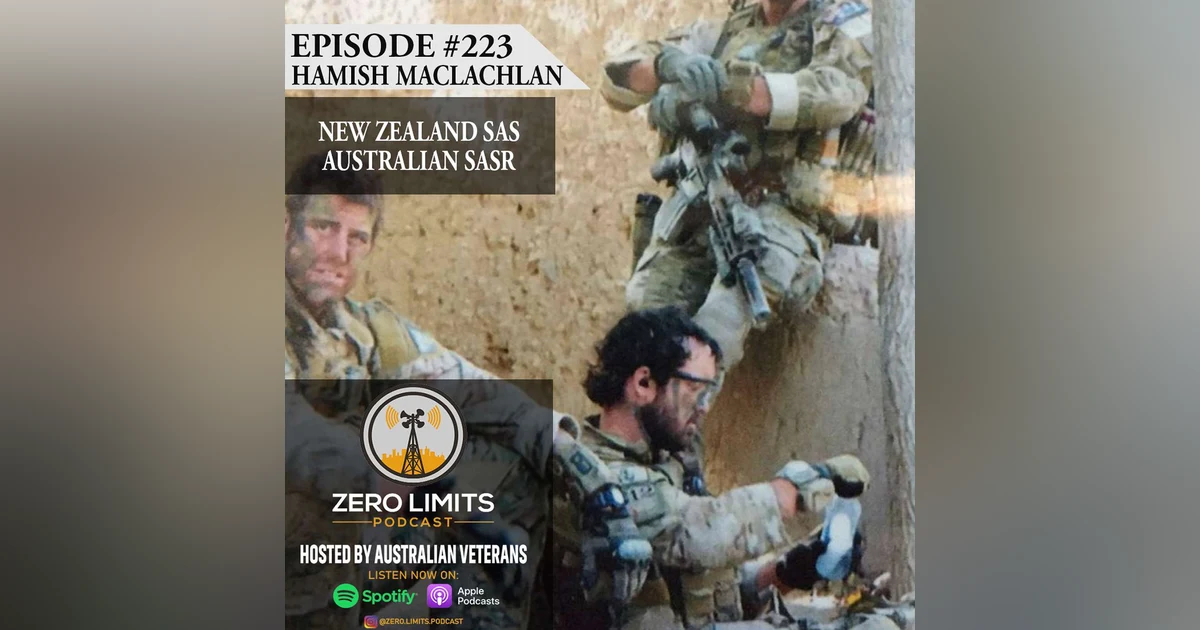
Ep. 223 Hamish Maclachlan New Zealand SAS and Australian SASR

 Apple Podcasts
 Spotify
 On today's Zero Limits Podcast host Matty Morris chats with Hamish Maclachlan New Zealand SAS and Australian SASR
Hamish enlisted into the NZ defence force in 1997 as an infantry soldier posting to 2/1 RNZIR. Hamish deployed twice to East Timor as an infantry soldier. During this deployment in Timor he encountered the NZ SAS which led to him attempting and completing SAS selection and training cycle and was badged in 2003. In 2004 he deployed to Afghanistan and during this rotation he was there on the day and witnessed when Willie Apiata VC displayed acts of gallantry which led to be long awarded the Victoria Cross.
After a joint training exercise with the Australian SASR Hamish decided in 2008 transferred across to the Australian SASR and deploying on multiple Afghanistan combat rotations fighting the insurgency. During one rotation he was part of the famous battles in Gizab and Tizak both very successful SASR operations. Whilst in Tizak Hamish again witnessed actions by Ben Roberts Smith that led to being awarded the Victoria Cross.
www.3zeroscoffee.com.au
Instargram @3zeroscoffee
Discount Code
3ZLimits
Website - www.zerolimitspodcast.com
Instagram - https://www.instagram.com/zero.limits.podcast/?hl=en
Host - Matty Morris
www.instagram.com/matty.m.morris
Sponsors
Instagram - @gatorzaustralia
www.gatorzaustralia.com
15% Discount Code - ZERO15
(former/current military & first responders 20% discount to order please email orders@gatorzaustralia.com.au
Instagram - @getsome_au
GetSome Jocko Fuel - www.getsome.com.au
10 % Discount Code - ZEROLIMITS
Break a break a break. Just a quick one about Gators I wear. For the last few months I've won the polarised Deltas, whether from that shooting at the beach, at the park with the kids or on a security gig around the world. And I absolutely write them Gators. Use of aluminium allows a thin, adjustable temple without compromising strength. These unique features make comfort and compatibility with Avid gear more superior than any other eye protection on the market. Gators can be worn under a helmet, they don't pinch while wearing hair protection or communication devices, and they serve as a dual purpose eye protection in a combat or first responder scenario with the ballistic option. Doesn't matter if you're a farmer, labourer, trady fisherman out hunting or a cop just about to kick a door in, these are the sunnies for you. I'd also say the most important rule out of all of this is to always look cool and that's exactly what these do. So head to the website gatorsaustralia.com or hit the link in the buyer and make sure you use the code zero 15 all in caps for a 15% discount. Now just as a reference, if you were to get the Delta polarised sunnies just like I've got, you'd get about 50 bucks off. Also, if you're a former current military or first responder, verify your status and mention zero limits via email to orders@gatorsaustralia.com dot AU and you'll get 20% off. Check all the links in the bio For more information. And let's get back to it. It's time for the Zero Limits podcast, hosted by Australian veterans chatting with high charging humans with hectic stories from around the world. We'll give you the motivation to take on whatever life throws at you in the kick to complete any goal you set your mind to. Let's go. All right, zero limits. Listen on today's podcast and in a different country recording a podcast. This podcast is going to be pretty exciting. Now we spent the last couple of days with this bloke out in the mountains. It was like Mount Everest and he's an absolute mountaineering God because I was shooting myself a few times. I'm a bit of AI guess a donkey sometimes, but again, we're in a different country. Bit of a guest in the remote studio Skoda, he's here in the background just talking about this guest. 23 years in two defence forces, New Zealand and Australia, a bit of time as an infantry soldier IN21, which I've had a couple of guys on the podcast that have served in that unit from there seized the SASR, sorry, the SAS, New Zealand SAS in Timor and it's that mysterious figure, the black sonnies and black boots and you're like, oh fuck, those dudes look cool. I want to be I want to be one of those guys. So he end up doing selection passes that get into SAS eventually does Afghanistan. He's probably the only dude that has witnessed 2 VCs or been part of two VCs from two different armies, one from New Zealand SAS, which was Willie Apiata. And then moving down forward, he joins SSA in Australia and on the same deployment with BRS Ben Robert Smith when he received his VC for the axe on the day in Tizak. Tizak. Tizak. Hamish Tezak. Yeah, Tezak. That's the one. Hamish. Hamish McLaughlin. Yeah. How are you mate? Hey, thanks heaps for having me on the on the podcast man. And yeah, loved going out with you guys and having a hunt over the last three days. It was actually got some good weather, walked a few miles and he ain't got a ball on the end. So yeah, man, we're stoked. It was absolutely epic. Like you, you know, me and Skoda spoke about it and we're just like, that was some of the most incredible stuff we've done. And obviously you run a business that entails around that, that market. So we'll, you know, we'll definitely talk about it after the whole Defence Force, both defence forces lives, you know, what you're currently doing. As I said, mate, like your career within the SAS and SAS have been incredible, not to mention the multiple deployments that you did and being part of two VCs, which is it's astronomical, like the, the white of that. And, you know, we'll get into both of those, you know, I guess contacts, because that first one, you know, was that that was your initiation into war fighting and, you know, obviously taking life as well, which we'll definitely talk about. But mate, before we do, let's get back to the younger days. Obviously you can't have been a Mad Dog like you are now back in the younger days mate, But rummy through like growing up here in in Kaziland. Yeah, man, so I grew up in the central North Island and on a sheep beef family, 8 so I've got five other five siblings. I got four brothers and a sister, three of us, 3, three other of my siblings ended up joining the military, someone NZ, someone in Australia, someone in the UK. So they've all been out and about again going back. Yeah, school was pretty standard, played rugby, wasn't that good at it but enjoyed it. So that didn't go anywhere. And then, yeah, join the join the sort of join the Army as a young bloke. I think I was about two weeks after I turned 17. And then it signed up and yeah, recruited out of Hamilton. And then basic training and infantry core training. Yeah, yeah. Down and, and then post down the second first Battalion down just out of Crossroach and Burnham and then Alpha Company initially. And then, yeah. So then everyone, everything's pretty quiet in the late 90s there. And then Timor kicked on just. Before we crack on the team, well, let's just I just want to break that you're growing up. I want to just want to break that because that's a it's a one of those things to do with all the podcasts. We try and figure out how someone gets into the SSN. There's obviously something, you know, growing up in these younger days that made you hard, made you resilient, made you, you know, I wouldn't, you know, I don't know, subliminally or there's something in there that sparks that fire, you know what I mean? Like otherwise you could have gone the other way and become, you know, unless a lefty. Or something. Yeah, yeah, maybe. Yeah, maybe. Yeah. So, you know, like brothers, sisters, have you got, you know? Yeah, second, yeah, second eldest, but I suppose, Yeah, growing up, growing up farming and that it does, it does teach you, you know. Yeah. It's a, it's a good upbringing, man. I love that, you know, like you're outside all the time, you're in elements, you're working until the job's done and you're often working, you know, from sun up to sundown. So I guess that sets you up pretty well for life in the military. To be honest, man, when I turned up to basic training, I didn't think it was hard at all. It was just, you know, it was pretty crazy, actually. Yeah, Yeah. And then. But yeah, I don't, yeah, I don't know. I just, yeah. Like you always you read books and that I suppose in, well, back in late 90s, you wouldn't just had to read books because there's nothing else. But yeah, you read books about the essays, I suppose. And you think here it looks pretty bad ass. And then what? What about school? Like, how are you? You again? Like majority of the podcast, most of the guys were not stupid, but they just never applied themselves. Always in trouble, you know what I mean? Like teacher always says, if you applied yourself, you'd be awesome. Yeah, that definitely got said to me once or twice from memory. No, I did all right. They did OK at school. Like then, yeah, grades weren't anything to write home about, but but now, yeah, did did a ride at school. But I think even from a young age there was like, Yep, the army. I mean, I don't want to sound like an old cunt, but yeah, like the 1991 stuff and they got first Gulf War, the old B20 yarns and all of that. Was sort of like that was, you know, when I was growing up. You old enough to see that on the news and and hear some of those tales and it's pretty cool, you know, get into that. Yeah. And what about family history? You know, we spoke about, I think on our car ride. You'll tell us about. Yeah, a lot of family history, Yeah. A lot of family history, especially from on, on both sides. Mum's obviously Australian. That's how I had Australian citizenship, made the jump across the ditch easy. Pretty proud. Military service history all through there, going back to World War One and Two and then Vietnam and then on the old man's side, a lot of a lot of work in World War One and then World War 2 and then and then not too much after that. But yeah, so the like there's, there's pictures of the old, old guys in uniform through the house and things like that. Yep, Yep. And then there's we spoke about you joining the New Zealand Defence Force in 1997, mate. What's the process? You know this again, this is pre, you know this slow Internet back then. Yeah, no Internet back then, yeah. Yeah. What don't you do? You just signed some. Yeah, You just went to the recruit centre. There was always those Rd shows around the schools there and they would, you know, they'd show you your style and you think, oh, that's pretty cool. And you find out it's not later on. But anyway. But they, yeah, you just fill out, fill out the old forms, medicals, physicals and that and then and then you're in there. It was a pretty easy process from, from memory, didn't take long. Like I probably started it when I was 16, you know, like halfway through 16. And then by the time I was 17, I was all done, dusted and I was ready to go. So. Yeah. So from there, you obviously you enlist, move down to basic training. Yeah, you know, or how, how Long's that basic training? And as I said, you thought it was quite because you're like, you're a fit dude. Like you're 47. And the way you were mountaineering, like I was like an old Clive down at the back, sky Joe's in the middle. You're charging long. You hopefully for a few years yet, no. Fuck, what were we? What were we just? Yeah, basic training. Yeah, basic training. Yeah, it was three months, I think, Bob, from memory. And then? Any shock to the system like discipline or or did your parents give you? A Nah not. Really give you a marching man. I'm a fucking Quambi man when it comes to marching, man, Always one of those pricks that would fucking just fucking square gate that shit. And I was teared and they ripped into me too. I was, yeah. I was a spastic Yeah at that stuff, yeah. Could shoot a rifle, could run fast enough. Yeah, no good. And on on the programme. Terrible. Yeah, yeah. So from you finish your three months and sorry back to the basic training, is it just inventory or is it? Yeah. Compared to where it's at all called and then from the split off you move into you know your specific you know inventory training mate. How did you find that moving from that basic, you know, boring? I wouldn't say boring, but you know, basic military getting you ready for the military moving into that IET where it's guns, grenades, rocket launchers, the. Yeah, yeah, I enjoyed my everyone, the Thai teas in Australia, but my infantry core training in New Zealand, man, I enjoyed that man, I thought it was cool. Yeah, yeah, we we actually trained not too far mountain wise from from where we were hunting just out of Ticopo and that you did a lot of infantry training down there. And I used to think that place was asshole in the world because it was cold as fuck in the winter time and it was hot as fuck in the summertime. But yeah, I'd probably live up there now. It's awesome. And what did you think about, you know, was there any thoughts of where you're going to move into like down the track in your military career or did you just think you have joined the infantry and just the inventory life? No, I was always no I. Was always set on. Yeah, I was always set on 40 forces. Yeah, I was always going to do. That any idea about the like the Australian because obviously you move into the Australian side down the track. Did you have any idea about what they were doing the Aussies? Yeah, No, no, not a clue. It was just Kiwis. Yeah, yeah. Gotcha, gotcha. So you finish your Rifleman inventory training, you obviously move into two one. Roll. New Zealand Inventory Regiment. Yep mate. How'd you find? And again, I've come from that infantry background and moving into a battalion can be quite a daunting experience. So I moved to the three area and tell you what, back in those days was a rough, rough old place. How was it for you guys? Yeah, probably it was pretty. It was probably pretty similar. The old Baggies bar, the like the junior Ranks bar in Burnham. And it was, it was pretty live like yeah, it was an interesting place. Like, yeah, man, I, yeah, I thought, yeah, I really enjoyed my time down there, man. I thought it was. I thought it was pretty cool. Was there any talks what 98 Timor kicks off? Is there any talk of is it 9899? 90 late 90 yeah, mid late 99 that, that all kicked off. And from memory, the Kiwi, the Kiwi's face and all these face went in there first and behind them went first, First Battalion out of Linton in the North Island. They, they were over there for, I think it was 6 to 8 months, I suppose. And then we, we, we changed out with them when they, when their trip was done in sort of like I think May 2000. So that was kind of the, that was kind of the, the first big trip. We, the first big trips we'd had. And for the army back in NZ, like before that, there was really just like a few, few company groups went to Bosnia for some of that peacekeeping in the early 90s and it was all pretty quiet after that ones and twos went to say Somalia or Wanderer. Oh, sorry, yeah, smiling or wandering that same as Aussies. But it was, yeah, it was crickets. And a little did you know like you know 2001, that's when it just. Oh yeah, and then. Game changing, obviously the rest of your career was, you know, all based off 2001, September 11. Also in 1999, obviously you met your wife. Shannon, Yep, Yep, we met her. Yep, she was, she was signaller in the in the army down there in Burnham. Yep. And yeah, I actually met her just as I was going into military prison. Yeah, I'd been a rat bag with a mate of mine. And we had a few beers one night and decided it'd be a good idea to pull out the platoon science litter box dragged down the street. And my Falcon Ute and yeah, yeah, it wasn't. The MPs didn't have to work too hard to figure out who it was. And then, yeah, so we got 30 days in the big house, and I actually met my wife Sharon, just as I was going in there, and she must have liked bad boys or something. So yeah, recent history. Yeah, right now shout out to your wife. She just whipped us up a brilliant meal up there, so and hopefully we'll get her on the podcast and talk about her life and career, especially being the spouse of a SAS, SAS soldier, trooper, I should say. Now from there mate, you obviously spend a bit of time in the infantry company and then as you said 2000 you get your trip to East Seymour. Yeah, we, yeah, we replaced. First deployment? Yeah. Guns, Bullets. Yep. Bombs. Yep. How was it? How was that like? Talk me through like the. I guess I know what it was like for me when I got my first trip. You know, you carry a lot of. Yeah, a lot of weapon. You're like, oh fuck, this is cool. And the boys, everyone's pumped. Yeah. Everyone, everyone's exciting. Everyone thinks you're going into. War. Yeah, exactly. Yeah, that's exactly what they think. Yeah, it was, yeah. It was pretty exciting. You know, it would've been only just 1020. And yeah, we replaced the first battalion over there. And, and I remember driving into landing there in Timor and then driving into sewage would like grab some gear and then fly up to one of the Fobs. And that bit we, we were going to replace one of the companies with. And yeah, it was, it was exciting, man. Like, you know, it was like, oh man, first trip. Yeah, it was sort of, but it was, it was sort of dead quiet. Like it was like all that excitement sort of just drained away and it was like, oh, there's not much really going on here. And you know, a few prisons patrols and used to check on the locals and yeah, it was all, it was all pretty standard. I suppose. That all finished for us actually 25 years to the day today actually, that a mate, a mate of mine who I joined up with Golene Manning, we both recruited together from Hamilton. And yeah, he was, he was killed in action over there on, on a, on a tracking patrol. And he was from, he was not in the same company, obviously. He was in Bravo Company. I was in Delta Company. And then, yeah, they were, they were tracking patrol. They'd picked up some, they'd picked up sign. They were close to the border. They'd pick, they'd cut some sign, followed it up, found a whole lot of flattened areas that, you know, they, they deducted were like sleeping areas. So they got started to get a rough gauge in numbers and then they decided to pursue the sign up towards the high ground. And then when they went up there, as they were going up there, they were engaged. And from memory, yeah, Lin Lin was killed in the first sort of volley of fire. And then the team broke contact back down the hill. The lead scout checked on the checked on Lin. He was, he was gone. It's probably the terrain way to firepower the numbers they had on the high ground and, and the, and the small team. I mean, they couldn't get his body out. So he was initially listed as Mia. They cut the platoon I was in. We flew out to support Broadway Company coming up the hill and trying to conduct a search for for Lynn and for any, any other remaining forces that were up there. The boys and Broadway Company located his body up there, not, you know, not far from where he fell. Yeah, unfortunately, the militia there mutilated his body. By the time the boys had got to it, they they bundled him up and got him down to the road and, and then and then repatriated him. Yeah. But it was a bit of a it was certainly a wake. It was certainly a wake up. Were you back in in New Zealand? No, no, I was. Are you in team or at that stage? No, I was on the hill. Were they? Oh, were you? Yeah. Yeah. So our platoon and Bravo and one of the teams and Bravo come here. Yeah. She gone up and yeah, we stayed the night up there and then see if there was any other, any other movement. There wasn't. I think those guys dipped back over the border wasn't far away. And then, yeah, then we flew back. And yeah, the whole tone of the trip sort of changed in a bit and went and, you know, sort of leant away from that sort of presence patrols. And then we're sort of after trying to get our heads around where these guys were moving to and trying to sort of interdict them. So a lot more sort of traditional like like sort of long duration patrols and a lot of ambushing a lot of like all night ambushes and that on, on sort of avenues of approach and things like that. And but yeah, it was, yeah, it was certainly a lot more interesting than. And just like just on that, obviously, you know, moving down the track, you know, you lose a lot more friends, especially in SSR, You know, how was that first time losing, you know, one of your mates Like it's, it's got to be a yeah. It's a, it's a, yeah, it's an interesting thing, man, because I always like, you know, and I knew Lynn pretty well and he was a ^2 away dude, man, you know, and he was like, he was a great soldier. He was on top of everything. And I, and I wasn't, you know, it was just some fucking shit bag. And and then you sort of sit in there and think, fuck man, you know, fucking mate. It's, he's a switch on dude, man. And he and he didn't come back. And then sort of makes you think and then and then you sort of start to work it all out and you realise a lot of it, man. It's just like so much of it's luck, really. Like you can train and you can train hard and yeah, it certainly helps. But often you need a bit of luck on your side. So yeah, that's. But that's all that was. Always remember thinking about that, about Lynn and yeah. And as we spoke about right at the start of the podcast there, this is where you have your first interaction with, you know, the Oakleys on the head and the black boots. And you're like, oh, who are those? Yeah, those dudes. Yeah. So we, we start the, we start a lot of a lot of patrolling trying to pick these guys up. And we're not having, from memory, we weren't having much luck. And at some point the QSA returned to to East Timor and in the form of tracking teams. And then they grabbed infantry platoons from either of the companies to come down and provide extra security as they were tracking. And yeah, our platoon was fortunate enough to get tapped on the shoulder to do that. And yeah, going down and seeing those guys, man, because in New Zealand you never saw the SAS. Like they were up in Pepakura and you were down in another island. And yeah, often I'd gone 3 or 4 years and I'd never seen one. And then suddenly there's, you know, these guys are rock rocking into camp and they're calling the shots. And yeah, I was always, yeah, I was like, shit, man. It's like rock stars turning up to you, your BBQ or something. That's what I always thought anyway. And yeah, it was great. It was great working with a man, just real professional, like everything was, you know, everything was just even just work like clockwork with those guys. And it was certainly, yeah, certainly. So that was. And so the, the spark, the the flame was there. But this is like, yeah, yeah, yeah. There's more oxygen. Yeah. Absolutely. Yeah. I want to be those. It's funny you say that because it's the same thing in Australia. You know, you never see the cats because they're so far West. Yeah, on the East Coast or, you know, up north, you'd only ever see them maybe on a junior leadership course or, you know, a mortars course or a parachute, you know, course or whatever. Yep. So from there mate you how long do you spend in teamwork? Did six months on their first trip. Six months, that's a long, long gig. Yeah, yeah, right. So just back to your parents, what do they think about you joining the Defence Force? Yeah, they were all supportive. Because obviously a lot of your family end up joining the Defence Force. Yeah, yeah, yeah, yeah, yeah. Right. So you do six months, head back to New Zealand and obviously Taymor is just in full swing now, pretty much. You get back, get ready for actually you do Recon. Yes I do my do my Recon course then send over to support company and enter Recon platoon. And this is you're only, what, three years in? So now you're somewhat a senior soldier. Yeah, yeah, yeah, sure. That's a worry, isn't it? Yeah. People might be looking at me for some sort of guidance or inspiration. No, yeah. So yeah, did the, did the Recon course, enjoyed that. That was good fun. And then worked up and then we went back in the back end of 2001 for another six months and. And how was that you know this is how long is it between rotations? Yeah, bang on a year. Much change, much focus change. I think the, I think the enemy activity over there had had disappeared. Like there was like we did a lot of, we did a lot of patrols on that second, on that second trip. And yeah, it was like nothing significant to report every time we were just looking at leaves and sticks. So. So the whole Six Mile was just a it. Was crickets man just. Peace time. Yep, it. It was, yeah, we were still going out for decent, decent stints and just. Like a hearts and minds key type thing. Well, we were, we were doing, we were doing just a lot of AO clearances and O PS on, you know, like river junctions and crossings and things like that. But so we weren't interacting too much with the locals in any way. But yeah, but it some of those patrols, like I still rate some of those patrols as some of the harder patrols I've done in my career, you know, and then holding, you know, comparable with selection, you know, so some of them were some of them were proper grinds on that on, on some of those longer duration patrols. So although I reckon I got a lot out of it, looking back, yeah, it was. No, it was good. Did. You go back as Recon. Yeah. Oh, yeah, yeah. Yep, Yep. Gotcha. Yeah. So that's where all that met nearing and all that again. This is where it all starts to. Yeah, well, we used to train a fair bit, like not too far from wheel hunting there on the West Coast. We spent a fair bit of time over there in the battalion. Yeah, right. Yeah, you just got soaking wet. And yeah, but. Shave your legs. Yeah. What's that? No, no, it wasn't the thing back then, wasn't it? Yeah, it was. Been in Australia? Yeah, yeah, we were. Yeah, we were probably too poor. Too poor to buy razors to shave our legs. Barely bought it to bloody shave our faces. Yeah, on that, obviously, you know, again, you look at Australia like the money was really good once you got on deployment. Yeah, money turned out to be pretty good even back in those days. How was it for? Terrible. Was it? It was terrible, yeah, it was horrible. Yeah, we are. We we're often. We had quite a bit of interaction on both trips with the. With the Aussies. With the Aussies and it was like, it was, it was apparent. I mean, you've got to make way more money, yeah. Yeah, right. So you do that six months again back to New Zealand and again Taymor's still going. So the following year, 2002 actually just quickly 911, September 11 happens. Yep, 2001. Yes, we were doing build up training for. That second, your next, next second. Trip into Timor, late 2000. Yeah, late 2001. So yeah, so November, we went over there for our second trip and yeah, so yeah, September 11 happened there. I think we watched it while while we were out on exercise or something, someone was aiming and turn the TV on. Look at this shit. And he was like holy fuck and. What was the talks? Because again, like New Zealand is kind of like the, the little brother of Australia when it comes to obviously military size, et cetera. And you know, was, was there any talk? Everyone's like, oh fuck yeah. Like in Australia, everyone's like, oh fuck yeah, we're going to War I. Don't, I don't reckon, I don't reckon anyone in the regular army thought that, yeah. But everyone sort of figured all the DSS will go, go, go and do that. Once it turned out that there was going to be, you know, subsequent action after September 11th, I was like, Oh well, they'll get into that. And then, and it did. And then yeah, but no, for the regular Army, no one was really sort of like, yeah, no, we're definitely going like, no one's like, we're going to go back to Timor and look at bushes. Which you did, yeah. 2002 you're back to Timor again, mate. You're pretty much a local now. Yeah, yeah, speaking to them everywhere. Yeah, got a class for my one of my medals that says I spent a year there. Great reminder. So how long was that third deployment? Nah so I only did 2 to Timor so but that was on the back half so. Got you. Got you. You know, O1 into O2 was my second trip there. So in the other six months and then got back and then that year, so 2002, the QVSS ran 3 selections because they're starting to sting for numbers and they wanted a larger reinforcement cycle. So they run one at the start of the year which obviously we missed and out and they ran 2 quite close together in the back half of the year and and I got on the one in November. What age are you then 22? So young, fit, fit, fit. You have been Yep. But you try. You obviously did like a bit of a training prep for it. Or Yep. Yep, but mainly just around counting pack and then you know, just pack marching definitely and put. It up in the hills? Yeah, Up in the Downs. Yeah, just doing that and then, yeah. And then it's just normal like you, you look at all your, your barrier tests, what you, what you call it a barrier test and all the, but all you like your basic stuff like your RFLS, your Bfas and all your, you know, your 2.4. And we have a, a similar event to the 3.2 which is like a, like a, a force run in your patrol order and, and rifle. So you work up to that stuff and you get a rough gauge of what you can do. And and then, yeah, we're just really concentrating on just caring that caring that pack. That's a big thing. Yeah. Especially you're not. You're not, you know, you're only how, how tall are you? Yeah, Oh my. On a good day I'm about 169 centimetres. Yeah, yeah, yeah, yeah. It's always harder for little guys 'cause they've got, you know, they've got little, little steppers. Yeah, yeah, yeah. But out in the snow it's a different story. Yeah, I'm, I'm, I'm the struggler. Yeah, mate. And so you head on to selection. How Long's New Zealand SAS selection? Kiwi. Kiwi selection. 17 days is a week of pre selection and then there's 10 days of actual selection. Yeah. And how did you find selection? Yeah, man, it's, yeah, it was tough, Yeah, like that man is you won't find too many people to say it's not, but yeah, it was tough, man. But you know, if you all like to think of it, all I like to think of it of is like an exercise you know you're doing. You get stabbed to do an exercise in the battalion and then you don't just pull off on day 2 of that exercise because you, you know, missing home or you've had a gut feel. You keep doing it, don't you? Because you don't really have an option to just quit unless you're a pussy. And then so yeah. So if you approach selection the same way as like, hey, man, like this 24 hours and this day is just as long as the 24 hours yesterday, man, it'll come to an end eventually. And then you just hear just one day at a time, and yeah, you just chip away, I think. That's what most dudes say. Is that just one, one foot at a time? Yeah, yeah. Just just keep going. Just keep going, man. Just keep being. Was it, was there any stage where you're like, you know what, I'm a bit sore here or. Yeah, your Dick. Injuries coming up. And I, or I can, I can distinctly remember when anyone talks about hitting that wall. And I can distinctly remember hitting the wall and going, holy fuck, man. I've got another, you know, I've got another, you know, 5-6, seven days of this and you think ship, will I be, you know, will I still be there? But you just keep going and you get there in the end, Yeah. Yeah, yeah, right. So you get to the end of the selection, how many? So how many guys start? I think we had about 55 guys on our particular selection start. And I think, I think from memory between sort of 6 or 10 past. Yeah, right. Maybe a few less. Yeah, maybe it was under 10. Yep. And from there, what happens? Yes. So that was sort of the start of, I think selection finished around the start of December. And then, yeah, went on, went and saw the CEO, yeah, told her you'd been selected for the training and then the reinforcement cycle will start, you know, and he gives you a date. I think it was like the Jan or something. And then, yeah, you got here, it went away and basically just packed your shit up and and headed up to Auckland for for the cycle. And like comparing, obviously we know a lot more about the SSR cycle. How was it, you know, for New Zealand, is it similar, you know, 1218 months or whatever it is? Yeah, Yep. It ends up around, it ends up around 12 months once you've taken to once you get qualified in your troop insertion. But yes, it's around 12 months. The format's not too, not too different. I mean, over the years, the cycles have changed to focus on particular areas that need more that they feel like need more work or more important. But and ours was ours was pretty. Ours was pretty standard with the first block of it would be like most of your green roll skills. So you do all your your Med sigs com serve your patrolling, your ESF weapons and your and your patrol procedures or your patrol calls. And then the back half was more of your back roll or what was black rolls back then. So more your DCT stuff. So all your breaching MO, your manual and explosive Moe, all your sneaky bee stuff and yeah, words or stuff. Yeah, it was. Yeah, it was good. Anything you struggle with threat selection at the cycle I should say. No, no, not too bad. Not too bad. I was, I was pretty fortunate. Didn't really pick up too many injuries and yeah, yeah. And we got there and then I suppose at the end of towards the end, or, you know, in that second part of the cycle, you'll go and do a small boat, your small boat handlers. We powered our PTCO course in Australia, but small boat handlers in New Zealand and your climbing course. And then you pair a course right at the end. And then sort of, if you had display a bit of a, you know, a bit of a, a flair for either one of those 3, then then they sort of steer down near the amphib mountain or, or free fall. And for me, I, I went to went to mountain troop. It shows, yeah. So I went there and then with a couple of other boys and yeah. And so we did mountain troop training after we got mountain Berrys and then and then was. And how was that, you know, looking back, getting a Berry and after all those years of wanting to do it, you know, initially wanting to join the SS, Yeah. How was it like receiving a bury? Yeah, man, it was like the proudest point. Yeah, man, it was awesome, man. It was right. Great moment. And then when and I was fuck, I was pretty fortunate, like one of the originals from the Kiwi assassinated by Dan Ogilvy, who was the honorary Colonel at the time. When I when we got badged, he gave me my, he gave me my bury man. So I thought that was cool, man. He was one of the the original guys that was stood up back in the 50s to form the New Zealand SA. So yeah, you handed my Berry man. It was one of the proudest moments of my life. Yeah, right. So from there, mate, as you said, you move into the mountain troop. Yep. And again, September 11th happened. Yep, Afghan is spooling up mate. It already has spooled up at that stage, isn't it? Yeah, there'd been, there'd been a number of deploys 2. 1002 was the first yeah. With obviously Aussie SAS, same thing. Yep. Yep, Yeah. So there'd been a number of deployments for the Kiwis over there. And then and then, yeah, we got told that yeah, they're likely to be a trip and O four and and B Squadron, which squadron we were in, was going to go first. Was it just on So your selection 2002 was air stories coming back from, you know, that first early deployments of Afghanistan? Not, not much, man. There wasn't too much. And like, nothing was really mentioned. Obviously, nothing's really mentioned about it on selection. And then, yeah, you'd hear that. But once you started the cycle, you know, some of the instructors would share shares from yarns in there about what it was like over there and that. And of course, you're like a sponge at that stage and you just want to know everything. And did you hear about Andrew Russell's death in Australia? Obviously, that was February 2002. Yep and I think from memory, and obviously this was before my time, there was a similar similar incident with the Kiwis as well. Fortunately, the bloke didn't lose his life, but he lost lost a limb. ID. Yeah, I think so, yeah. Yeah, Pretty sure I it was either an ID or was an old Russian mind. I'm not too sure which, but yeah. So we did. Yeah, we did hear about that, but we didn't hear, we didn't hear too much from the Aussies back, back in those ages. We still had a Nanzac exchange. And so there was every now and again there was a couple of Aussies would come over and then, yeah. But no, I didn't hear too much of what they were up to though. Yeah. Yeah. And so 2004, this is where you get spooled up. Yeah. How was this? You know, this is this is a different ball game. It's not E Timor, it's not peacekeeping. There's an active war going on. And obviously you look at Delta and or CAG is I should say Navy Seals, all them are in the thick of it getting getting right into the thick of it, especially with the CIA. Yeah, yeah, no, it was, yeah, it was exciting man, getting told Oh yeah, you boys would be going over there and we did our build up training in NZ and and then here we got ready to go and yeah, I was, I was bumped man. I was like, I was going to be exciting. Flew into yeah, we it was pretty yeah, actually not too much different than the Aussies flew straight into aimed, sorted our shit out, flew into CAF and then Kiwis being Kiwis man, we had to sort of big bar and steal some Humvees off the Americans because we didn't have any like vehicle like we didn't have a vehicle mounted capability like back in the NZ, not at that point. So the previous rotations had just basically just cannibalise some Humvees man, and then rigged them up for like a long duration patrol and, and hit it out. And we did the same thing. And so there was plenty of guys in the in the squadron that had done it before and they sort of like sort of showed everyone what to do. And you'd grip the back of the Humvee off and take off the doors and take off the roof. And then you'd make some boxes for your ammunition and your food and, and lay all your water and fuel out and, and that was it pretty much strap a bike onto the back of it and, and off you went. And then because we didn't have vehicles back back in NZ to train on, we actually headed out to, while it was Mullah Omar's old compound on the other side of Kandahar, I can't remember who owned it. A number of different American organisations, like had like sort of stewardship of a place, but I can't even remember the name. It was Gracelands, I think, when the Canadians might have been there. But it was just a big, big mountainside where you could go out there and you could train. And we just went through a few drills and that vehicle mounted drills and stuff like that, mobility drills, and got all that sorted out. And then, yeah, drove out on our first patrol not long afterwards. Yeah, right. And run me through I guess that first if you you can recall it, that first patrol mate, you know again this is stepping outside the wire to to thick of it. Yeah. So we, yeah, the first one was pretty, yeah, it was pretty uneventful. And yeah, we just heated up that main MSR from Kandahar to Kabul from memory and then cut into the mountains West and then sort of came down. Fuck. Strangely enough, we actually drove through TK when there was almost nothing there. And then because we come down through Casaruz gone and then sort of patrol down that way and and hit TK when it was just a dirty airstrip and there was some some just Constantine of barbed wire around some border leaves. And yeah, there was a few US guys there and not much else. And then, Yep, that, yeah, it was cool. And then headed back down through what would I suppose, become root beer, and then down, and then down, down, back to CAF. How sorry, how long is that deployment? I think we did about 5 months. So it's quite long. Yeah, Right. And, you know, as we spoke about right at the start of the podcast, mate, your first engagement turn out to be, you know, something that's locked into New Zealand history. Yeah. Yeah. So that was the. Yeah, it was the second or third trip, I suppose, third patrol and we'd gone and this is the when you look back at it now, it's pretty, pretty crazy when you think we'd drive out of of CAF so and into Kandahar City and then out West towards what would be be Bastion where the Brits were or would be eventually stationed. And we'd drive out there and we'd head up north, sort of up the Helmand and then up and would come sort of up round the top and then come down into the what is now that or what we become, not what was COD Valley and but all through, you know, that area that was so costly for British and and US servicemen there in the later stages of the war. We were driving through there and it was crickets like. And this was in 2004 and we were an unarmed vehicles and well, I don't think we got a shot fired at us all through the helmet in 2004. But once you got up into like that COD Valley, Shahidi, Assas area, then that's you knew that it was going to be a fight. Everyone knew that that well, you'll get into a you'll get into a fight up that way because they that's just what was what happens up there. And yeah, the night, the night, yeah, we got we got lit up there. We'd we'd gone in initially into the village. I think there was a short KLE and then maybe? An I like with an idea of having assure the following day, just trying to get the layer of the land because that was what most of those long range patrols were, was just trying to figure out who was who in the zoo really and. Just quickly KLE for the listener. Key leadership engagement, Yeah. So just a bit of a meeting of all the elders and stuff like assure and then, yeah, so that was the idea. So we just pushed out of the pushed out of the village and then up onto a bit of high ground. And then what's the idea of coming back down there in the morning? And then those dudes obviously had other ideas. So about it would have been it was pre dawn but it wouldn't have taken them too long to move in there and. And you guys had no MVGS? That's right. No, we had. No, we had MVGS. Was it single or double? I was running singles, yeah. Yeah, At that stage, yeah. I was just running a single. Single tube, no, we had no thermal. We didn't have just. Primitive technology. Yeah, yeah, just yeah. Good old. Yeah. Early days. Early days. And then now, yes. So yeah, they basically moved the, the, you know, the Taliban moved into the utilising a bit of low ground and a some dried Creek beds that moved into moved in pretty close proximity to where we were, split their force into fire support and then assault group. And yeah, commenced commenced the attack just on just before first light and. So traditionally, like that's what a traditional attack was going to be or it's always going to be. Well, yeah. Because right on first light, you've got to have a bit of light to see what you're doing, don't you? And then and then, yeah, so the initial, the initial burst from that fastball was heavy like a lot of RPGs, a lot of pecan fire. And just the way that the the the troop were laid out in six different cars from memory, two or two or three of those two or three of those cars bore the brunt of that because they could be seen. I think if they were right down the bottom, they there must have been a silhouette or something and they were able to see what was going on, see the see our vehicles. And obviously the Ford vehicle was the one that Willie was in and then that copped A flogging and then and then the one just behind it and took hits as well. And their patrol or their vehicle commander was injured. And then the one in the centre was pretty much well suppressed as as well. The vehicle I was in was back down with the other three on the other side of the Ridge. So we were, we were in cover so we could see the rounds and everything flying over the top of us and then off into the distance. But nothing was effective for us. So we were, we were out of it. The my, my vehicle commander switched on to like real switched on to be real quiet, real unassuming bloke. But just everything was what that dude was just, you know, 100% real good dude. And I like, I like, I look at the way he sort of ran, you know, like he, he ran out. It was just a three, three man vehicle team. I look at that and the way he did it and a lot of his mannerisms, man. And like a certainly, certainly a big mentor for me, this bloke real, real good. But he, he could tell that there was no fire coming back because you couldn't hear the mark 19 going and you couldn't hear the 50s firing or any of the, the GPM GS on the on the door. And he made a, he made a call. We had a, an analyst guy doing our driving because we weren't really getting too much in. So we had this guy out with us. So he basically told the man to drive, drive their vehicle up and park it right, right on that forward slope. And then that's what we did. And then so we drove straight into that contact just as William was making his run back up that hill with with his wounded team commander on his back. And you could see that, yeah. And so just as we parked up, he, he ran past us and always remembered, even in the, it was probably low light at that point, but Willie was covered in this dude's blood, Man. He was, he was not in a good way. I mean, there's no doubt at all that Willie saved his life that that morning, one of the other guys that was on the vehicle that was hit badly, that Willie was also on a good mate of mine. We did the cycle together. So we were badged together the previous year. He come running up to he come running up to me as soon as we pulled up and just reached up and grabbed my M4 off the off my turret because his one was on fire in his car. Whole whole vehicle had lit up and the ammunition was starting to cook off and rockets were starting to fly off and I think that gas bottle blew up too. What they were cooking their food on that was yeah, the whole bloody car just started to started to cook off. Yeah, but so we, as soon as we parked up the poor old end guy man, he just put the handbrake on man and he got out of there to be fair to him was probably he wasn't going to be much use anyway. So he just ran back over the hill and yeah, me and the vehicle managers hooked in and yeah, we just keep suppressing the main, what we could see was the main fire coming in, which is a fire support on the on the other Ridge. So we're starting to fire at that. I think the guy that grabbed my rifle alerted us though to the fact that there was someone coming up the hill. And as we turned and looked down, you could see that assault force coming up to to roll up our position. And we both fired back down on that position and fortunately got the got the leader of that group, man just by she had luck. And what you on the 50? Yeah, and he went, he went down, and I think that's what probably broke that assault. That close well. He almost got hands on the vehicle. That close. Yeah. So he was probably, he'd probably, he was probably maybe four or five metres down in front of us. Like from memory, it wasn't. It was close, man. Yeah. And then and. Obviously with the 50, you've got to pull the pin to yeah to. Reverse it down and then and get it down there and then. So that close and then like how many at the vehicle is it just just that one? Yeah, that. One guy, and there was a couple of others scattered around. And they all got cut down. Yeah. And then so it was just the one in front of our our vehicle. And then that assault broke up and then they moved back down into the dead ground and then out back towards the village in the MSR. And at some point I suppose the old fire support collapsed as well. And then? Were they carrying a KSRAGS? Is the. Regular and then most, most of the way back down the Wadi when we when we followed up drag Marks and wounded and and bits and pieces of military equipment just ditched and and then they basically got into a vehicle and headed South. We yeah, we weren't really in much of A position at that point to, to to pursue them. We had two, two prior ones pretty much and two of our vehicles were, were just pretty much destroyed. One was burned down and one was 1 was inoperable or taken an RPG straight through the the side of the vehicle. Yeah. But interestingly enough, I know he, he's been mentioned on the podcast before. Steve Askin, good mate of mine, he was and we did the same cycle and that he pulled up on his motorbike during that gunfight and started hooking in. And then when it had finished and then the casualties were sort of like starting to be stabilised and everything. And that's starting to call in AME. He he said to me, so we should probably pursue these guys. So I jumped on the back of Steve's bike and we hear it off after in the direction of where the Taliban had fled and. Like how long is this after that initial not? Too long afterwards but we didn't catch up with him and then another vehicle eventually. Fucking what do you? Mean like you should, you just jumped on the back of his dirt bike and used to just just just peer off into the mist looking for these. That's. Yeah. And obviously we spoke about like, you know, I had Jamie Penelon and he spoke about it. That was what Steve was like. He was just at a high charging human being he was that wanted to do the job. Yeah. Yeah, he was a great, Yeah, he was a great bloke. Like, yeah, fact. Brave as fuck. Like he was a fucking top two. Yeah, he can't speak hardly enough. Yeah. And then obviously, you know, as we know, Steve was killed in a. Helicopter crash later on, yeah. Fighting fires, yeah, here in New Zealand. Yeah. Yeah, he's absolutely animal. I'm sure you've got a few more stories which we can talk. About yeah, there's no shortage of Steve's stories. That's and they're all good. There's no bad ones. They're they're all good stories. Yeah, yeah. But yeah, no, we consolidated after that after that contact. And then, yeah, the patrol didn't finish. The other thing we kept, we got a couple of vehicles falling out to us and sort of salvage what we could of some of the of one of the vehicles, one of them was just gone. And then interesting thing about Mark 19 MO when it cooks off, it doesn't go too far. Like they were just like sounds like popcorn going off. And then all around the vehicle there was just probably about 3 or 400 gold tops. And then I think we picked them all up and then just put them into a pile and then then blew the whole lot. But yeah, so yeah, keep patrolling. And I think from memory, fuck, did we hit SI? Think we headed South? Look, just quickly, hey, was it for you? You know, again, this is your first contact, first engagement. Obviously you've had to take life. You know how it like you, you guys just obviously just regroup Yeah. And it's it's just the mindset to carry on like you have to carry. Yeah, you can't go back to the base and cry, but. No, no, no. Still had another couple of, well, I think we had another couple of weeks to go and that now it was, it was well, yeah, well. Fuck, I don't know. And little did you know, there was AVC. Yeah, yeah, yeah. I mean, you know, it was Yeah. I don't know if you, I don't know if you dwell on it too much. You just there's yeah. It wasn't like you could head back to basin sort of re think about it too much or you just keep keep doing the crack on with the cracked on. Yeah. Because you're already in. You haven't even complete completed the mission yet, so you're still. Going to No, we still have. Carried. Did you obviously have the two prior ones? One of them was a trooper. Nah. No. Both troopers, vehicle commanders, man. Yeah, right. Yeah. When you said they brought out new vehicles, did they bring out new? I don't think it did, you just run too less. Yeah, no, we just buddy. Yep, we just buddy. I think we just loaded across and then some of those trucks may and may not have been fully manned. Like yeah, I'm not too sure. And how did those guys go? Obviously the prior one this is. Yep. No, they both. Yeah, they both were. Covered. Yep, Yep, gunshots. One was and and the other guy was RPG freak. Yep, he was. Yeah, right. So you carry on with that and how long is this in on that deployment, that five month deployment? Oh, I think we're probably about a month and a half, maybe two months in. And how was the rest of that deployment then? Yeah, quiet. So it's usually been one massive engagement and it's just a quiet period. Yeah, then it went pretty quiet again and there was like, you know, you, you know what it's like when you're driving through there. Sometimes there'll be shots fired here and there, but nothing, nothing like that. So that was the stand out sort of point there and and the trip so. And just moving forward like when do, when does Willy, when does that all start ramping up? I forgot. The award. Yeah, like when does it all get I? Think it was, I think it was a couple of years later. Yeah, they, yeah, they they sworded. Yeah, they got that sworded out. Was it O6 or O7? I can't remember. Yeah, and it's pretty wild that you literally witnessed it with your own eyes when you're like him running past, just covering the blood. Yeah, it was. Yeah, you did a great job. Yeah, fire. And just on that enemy force, how big were they? They seemed to think it was between 18 and 18 and 20. Yeah, yeah, right. Yeah. And heavily armed. Yep. And how many were killed in that engagement? Fuck, I couldn't tell. You maybe 10/11/12. No, no, it wasn't that many. Wasn't it? Wasn't it? Wasn't that many. Most of them around your vehicle. No, yeah, there was, there was very few, there was very few confirmed. It's wild how close they got, yeah. That's yeah, I know. Yeah. Which like, yeah, fuck. And it was only by chance. Yeah. Really. Yeah. Yeah. Just. There we actually saw them like we were told, hey, they're down there. And then from one of the boys that was already that had come up with with Willie and then. Yeah, Amen. And you had no option to grab your rifle. Because it's not there given it's already given to him, mate. Yeah. So you've got 350. Yeah mate, absolutely wild because that that could have turned bad quickly. I think yeah, once, yeah, like it, Yeah, once. If they'd gotten into that sort of and, and taken one of those not taken like, you know, taken over one of those vehicles and then they were inside your harbour, yeah. Mate, moving forward 2004 so that trip ends five months, you head back to New Zealand mate, how is it now? You know how it is coming back from Timor, You know, we look down the track now, you know a lot of guys have had issues with deploying etcetera, especially losing their mates etcetera. How'd you go assimilating back into, I guess you know, going to the the local convenience store and. Yeah, Yep. You know, just. Just silly life. Yeah, it's definitely, Yeah, I reckon it's definitely something. You get better at it the more you do it. And I think a big one, you know, looking back is, and the, the easiest way to describe it is like when you're overseas and you're on deployment and it doesn't matter if you're infantry or, or special forces or whatever you're doing, it wouldn't matter. I would imagine on a, on a boat or, or wherever that you're with, all of these things are real important. You know, like for, for infantry guys and for special forces, it's, you know, you know, you're briefed up or you're all over your mission, You know, are you, is your gear sorted? Are you sorted? You know, you've, are you fit enough to do the job? Are you maintaining that? And then, you know, whatever specialist skills you've got that you bring to that, whether it's an infantry section or whether it's a special forces team, are you all over those skills? You know, are you given how to do to hand? And all of those things are constant and you get up in the morning and those are the things you do. And the things you don't do is like pay the bills, mow the lawn, go and pick up the groceries, shit like that. So they're not important. And then suddenly within, you know, 24 hours of or less, you're back home and all of those things that suddenly were, that were really important for six months aren't important anymore because you're home and your team's not there and the job's not on at the moment. And then all those things that weren't important suddenly are. And I reckon that that catches a lot of people out because, you know, you just want to, when you come home, you just want to probably catch up with the boys and talk about something. And then, but there's all these other jobs and responsibilities that you've got for your home. And I think the more you do it and the more trips you have away, then you get better at that. Of course you get used to. You get. Used to it. You go hang on back now. So I gotta put that shit aside and now I'm gonna put this shit up. But looking in as a civilian, you know they're looking and go fuck these guys. Like, how can you stay at the top? And we've seen it with the, you know, SSR or two commando where they're doing back to back rotations and, you know, 24 hours you're getting into a gunfight at the Taliban. Next 24 hours you're back in Coogee Bay Hotel sinking beers and getting pissed off with the nightclub bouncer. You know what? I. Mean Oh no, it's yeah like it's a it's a hard thing to it's a hard thing to bounce, bounce between and and the thing with those short, you know those back to back trips when you're back for a short period of time, you don't really like reintegrate back into you can't into society because you're always you're going into work and you're training up for the next gig. So you get briefed on the next jobs. You're looking at the news, you know you're doing. You're always trying to keep keep up with whatever events are happening on that on that deployment that the boys are overdoing. And so you don't really have any time to to seek and press, decompress and then come back. So, you know, and actually just sit down and unwind and you know, and then there's always something to do. And even if it's not important, like a fucking promotion course or something, oh, you've got to go and do this and like. What do I really have to do that? I mean that and they're all, they're all words up. But I think what I think that war, though, was quite unique in that sense where it just kept going on and on and on. And there was no real, like, no one, no one really could tell us what victory was going to look like. Yeah. Or, or how it was going to end or how it was going to wind down. Like, it was just like, oh, we're going back and doing it again, aren't we? You know, So yeah, another trip, another trip after that. Yeah. And it's funny because we just look moving forward again, you're moving to the SSR and then there's deployment, Deployment. And there's no time to let off steam back in Australia when you're in the SSR. So you got to let off steam. Yeah, and the fat lady's arms, you know what I mean? Yeah, well, that's true. Yeah, keep. That we that turns into your own little world of, you know, that's that's our bar and that's kind of like being it yeah, you know, the colours are like. Yeah, well, that's it. And then the and the fact that we had like when we did that trip in O four, we had a boozer. Yeah, we had a bar and we shared the base with the Seal team that were there and that with that coming for beers and you know, and everybody, it wasn't a secret thing. It was literally out the front of our compound and it was under some cabinets and there was a bar there. And I think it's needed. I think one point, your decompression, I think one point, Al Mundef was over there and he gave an award to one of our terps for helping out in that battle. So it wasn't like it was like some hushed up thing that you needed to keep away. I mean just. For the regular Army, can't do that. Yeah, well. Yeah, I don't me personally, I don't understand the the fear of alcohol. I've always thought that alcohol on a deployment is like that Canary in the mine shaft. If you look at one of those boys over there and he's absolutely just tying one on at every opportunity he's got. There's probably something that you need to talk to him about me or he probably needs, you know, he needs support. Yeah. And without that, then you know, well, how do blokes, how do blokes wind down and decompress and coming back after a job and nothing matter what happens on that job? It's not a normal job. But having a beer at the end of the day is normal. And that's a good way to just get out, man. That's a good way to process some shit. I always thought anyway, you know, you don't need to destroy yourself, nor should you when you're overseas, but you should be able to have a beer at the end of the day. You're an adult too. Yeah, like you know what I mean? Yeah, I like, I think so. Now, 2005, I guess this is where, you know, you get a bit of a team trip out to West and this is where you meet some cool dudes. Yep. And you're like, you know what, Australia's better. Yeah, yeah. Yeah, I did, yeah. Got a trip out to Campbell Barracks and probably like the winter of of 2005, I think. And we were over there doing like ACT exercise, sort of symposium sort of thing. There's a whole lot of other countries that were supposed to turn up and bring a team to like do a lot of combined training and stuff, but we were the only other team that that actually turned up the risk to send officers and shit. So anyway, yeah, we turned up. It was, I think it was 3 squadron that was there at the time and, and say sort of took us under their wing and we sort of, and then, but I was impressed man with that base. Like there was cool as fuck. Like, oh, look at these guys live right next to the beach. I mean, like South Auckland, you know, I know some people like South Auckland, but there's stray dogs eating your rubbish in straight in South Auckland. We don't have wheelie bins back then and they were just pulling those rubbish bags open. Like, I didn't have that in Cottesloe. I'm just saying. And I was impressed, yeah. And then, Yep. So you know, you made a couple of polarising figures. Yep, that has. Entered the news in the last few years? Yep. Bumped into the few of the the old and bold that well, we're the old and bold become the old and bold and three squadron and then bumped into Bannon and talked to him. Surely he actually taught me how to make a a breaching charge that I took back to New Zealand and then and that wasn't, Yep, that was fucking cool. And then, yeah, good, good trip over there with those boys. We didn't steal that much stuff, like a little sold a little bit of stuff, because that's what Kiwis do when they deploy somewhere where there and other armies got more money than them. But yeah, came home, man. And yeah, just, yeah, just keep chipping away. But yeah, definitely impressed with with Australia, man, when I was when I was over there, I was like, oh man, it's. Did it plant the seed? Did it was it? Was there thoughts at that stage or was it? Yeah, Yeah, it was. Yeah, that. Just because there's no, yeah, no dogs rummaging. Yeah, no dogs rummaging more rubbish. And then and then the beach was real nice. Like I can't, can't go wrong with Cottesloe Beach. And then, yeah, no, it did. It's like it did plant a bit of a seed and then came back and but we'd just come off that trip in O four and then we had we're on team in O 5. So that's pretty standard. And then we thought, oh, you know, following year we'll probably be back there. So that was sort of at the front of your mind. But but the unit, the Kiwis at the time went to a bit of a quiet period. Our the other squadron had a trip that year. We were in 2005, but then after that from sort of 678 and probably maybe, yeah, it was a long time between drinks for for the Kiwis. Oh, was it there? Yeah. And for the SAS, Yep. Because the regular Army, obviously they deployed. Yeah, they did they, yeah, they did. The Army and private. And private stuff up there with the reconstruction team. But yeah, it was a little bit quiet for the for the Kiwis SAS for a bit. Why that don't I? Yep. Because this is where, you know, I guess for Australian special forces, this is where it started. Yeah, it started to wind up. It started. To wind up yeah, in the regular army as well. Yeah, 2000 and six 2007 yeah really got busy and and onwards but so yeah, sort of made AD when there was no trips at the start of 2007 so end of 2006 was all right this is it on me. They're gonna head over and give 22 SAS a crack. And then I had a good mate of mine and had come back from ANZAC exchange from Perth and he said well fuck, why don't we just, he goes, I'll, I'll probably head back to Australia. And I was like, well yeah, we could give Australia a go. So we contacted them. Through we did just make a phone call. Yeah, contacted them. Well, pretty much because he'd come back from exchange and, and, and he said, well, we'll just, I'll just reach out to him and see what the selection dates are and then come back to us a little later on. And they said, hey, well, this is the deal. They'll, they'll do electoral transfer, you can come over, you won't have to do selection, but you'll do part of the Rio and then they'll send you to a squadron. And then, and then we started that paperwork process and we had to sort of keep a sort of like on the down low for a bit because we didn't want anyone raining on our parade. But yeah, now we did all the paperwork seen all across. And then, yeah, got the electoral transfer signed off. And then, yeah. So start of 2008 I got out of the New Zealand Army for one day and I joined the Australian Army the day after. Yeah, right now just quickly back, we spoke about Willie before he gets his VC. What, 2000 and six 2007? Yeah, I think so. How's that, mate? Like, yeah, to to be, to be a part of it. Yeah, it was like, it's yeah, it was. And it was real. It was quite hush hush. Like when he got us a like no one, no one knew about it. They did a great job keeping it under wraps because no one had a fucking clue. And then all of a sudden, like, oh, Yep, he's been awarded the VC and it's like, oh fuck yeah. And yeah, so yeah, got a hand there or Ki Kiwis or OPSEC there. As you said, made 2008 move into the Australian SASR made. How was that and which squadron to move into? So we're down to initially we were just sent down to OSS like the the training squadron there and then while we did a stack of courses and while they married everything up. And then so we sort of finished off the back end of the TPC and we were doing a bit of that. And then what's TPCS? Target prosecution continuum, Yep. Fancy word for CDB course. Yep. And then so finished all that and then got all that stuff ticked off. And then and then it was we had to all do it, an assertion course. Obviously no mountain troop in the Aussie essays. So so I ended up doing the AMFIB course. I was already freefall quo back in the with the Kiwi says, although didn't have I'd done the course. I hadn't really done that many jumps afterwards, man. So I was sort of just I was pretty junior that sort of shit. But yeah, I did the assault swimmers course and then ended up end up going to E troop and two squadron and then Yep. And you went there? How did you find a lot of the training and I guess SO. PS Are they? Were they similar or were? They, a lot of, it's real similar, Yeah, a lot of it's real similar. They the, the layout of, of Campbell Barracks and the budget was something I probably noticed a lot. Like you can literally walk out of the hanger and then go to go to a range and you can run there on foot if you want to, and you'll be there in a few minutes. Everything's right there and then and I suppose the big thing with that is like you haven't got any of this travelling time to to go to venues to train. It's all just right there. And I think the amount of hours that you extra hours that you can train in the day because everything's so close. Ammo is just there, the ranges are just there. You know, the beach is just there. You know, everything's like PS air base is just on the other side and that's everything's like you could get. I felt like there you could just, you could really just drill down into that training and you could just, yeah, you could really get sharp, yeah. And you said there was a couple of other guys that come with you. Yep. So two, yeah, two other guys that one of the guys that had done the ANSI exchanged previously, he went, he went to 1 Squadron and then another good mate of mine that I'd actually been in the battalion with since 1998 and en Recon together. And we did selection together and he come, he come as well. So and he was, he went to three squad, yeah. You're right. So they kept us all out in different squadrons so we wouldn't form some sort of like like a little collective thieves Guild or something. And SASR, at this stage you've done multiple deployments to Afghanistan. Was there any talk of deployment coming up for you? Yeah. Well, so at that point the troops were ongoing. So there was a squadron oversea, you know there was the sorry a troop overseas when when we were doing that initial training and then our our insertion course training. I think that that cleared I think the back end O 8. Obviously they had the, they had a lot of guys injured from the ID strike that took Sean McCarthy's life. And I think they flew a few reinforcement guys, junior guys over there to to replace the blokes that have been injured on that or it was. And then they had the engagement with when Mark went his VC and then there was a lot of wounded there. So there was other guys going over the backfill fulfil those blokes as well from memory. And then so, yeah, there was literally no question about a trip because you knew that. Oh well, we were going at the start of next the start of 2009. Yeah, right. And what's the training entail of moving into a again, that you're in a different army this time? Yeah, yeah. Yep. So yeah, it was always quite. Yeah, it was quite. It was different, man. They just, they had a like the, you know, the hit, the hit the sort of senior leadership in the squadrons, they knew what they needed to do to get their boys up to speed. So they get hit, hit those deployments running and yeah, there was very little time wasted and like, you know, long field exercises or any of that sort of shit. It was like, this is what we're doing. We're concentrated on parachuting a lot because we, look, we were looking to use that over there. And yeah, just a lot of a lot of range work, plenty of time I've been doing just going through some of the urban facilities and stuff, all the breaching stuff and all of that. So it was, yeah, it was, it was. I reckon it felt like it was a real slick process. You know when you turned up there from and then the you did notice the budget difference from moving from the Kiwis to the Aussies, man, Yeah, like, yeah. And the like over the years, the evolution of training as well, because there's, you know, we look at that 2008 period, This is where Afghans started transitioning to more ID, you know, slowly gravitating towards that. And obviously that's the reason why, you know, the SF moved into that Hilo born operation side of things. You finish this pre deployment and then you get your first trip over to Afghanistan with the Aussie SASR mate. How was how was this? Yeah, it was good. It was good. Yeah, it was good. Yeah, it was good trip like the 09 trip. And I enjoyed that trip, man. It was great. Yeah, yeah, we were busy and then just sort of started to really, yeah, So yeah, like that, that sort of that era of the old, you know, the LRPVS out on patrol and that had sort of wound up and then it was moving towards more of the more the targeting the JPLS and stuff. So that was the focus and then we were just sort of moving into that O9. We'll probably like big barn and stealing like Rotary wing a bit. I mean, I think that Brits flew us and a couple of different platforms, the Chinooks and the old Sea Kings on some stuff. And then we'd sort of get a bit of the Aussies did fly us on a few jobs. The Aussies, Chinooks moved us a bit. And then, but towards the later stage of that trip, that's when the US turned up with the combat aviation, Combat Aviation Brigade and TK. And then that was that was probably a bit of a game changer when those guys, when those guys turned up, because now you had four Black Hawks and you had two Apaches they escort. Run me through the first time, you know, your first JPL, you know this is something you probably didn't do in the NZSAS. No, no. So this is the first time, you know, landing in. Yeah, yeah, we're also. Knocking over a target. Yeah. So the first, the first one that the squadron got and it it took it took a decent amount of time and, and a couple of false starts to actually get it to come off. I mean, I think we've moved out and this is all vehicle. This is all vehicle born in the in that initial stage because there was no helos there. And then, yeah, the first one was probably in the Mirrenbad Valley. And then yeah, we got, we got that guy depth charger didn't have a lot to do with it. We were sort of holding back our team was tasked with like some the security of the the offset VDOP while while a couple of teams moved in on that and they and they prosecuted that and it was a success. And yeah, I think that gave everyone the confidence that it could be done. And and they used some like they used some technical means there and and then achieved it. So that was, yeah, it was, it was pretty good. It was and majority of this is all by night. That one was yeah, yeah, yeah, yeah. Back then. Yeah, back. Before it changed. Yeah. Back then everything was was night. That's not to say we didn't do stuff during the day, but if, if it was generally if you were targeting an HVI or something, it was at night. You were doing that thing at night. Yeah. And he said this was quite a high tempo deployment, a lot of engagements with the enemy. Yep, yeah. Yeah, we're busy enough. Yep. There was always just a steady, Yeah, there was a steady, there was a steady amount of jobs. I mean, and you know what, we, we had our fair share of dry holes as well. You know, still what I think we really lacked over there and it didn't really get, it didn't really improve that much was our, our we didn't have enough ISR like we needed to do to do that sort of job effectively. You need layers of ISR, not just one that you might get tomorrow. And it's, you know, after a certain job that it's been doing somewhere else that's come and come and give you a hand. You need it dedicated and you need it to be yours, really. I reckon that's why that's what makes the US guy so good at it. They've just everything there, you know, and it's just like, and it's, they've got backups on backup and yeah, that's how they get it done. SF in general, I think 2 commander have lost a couple of guys at that stage. I think the regular army lost one or two guys as well. Yep, you know, are you guys copying any casualties or? Not for that, no, not for that, not for the O Nine trip, no. We're pretty fortunate there. I know. I remember a couple of the, there was, there was one of the engineers, I can't remember his name. He was, he was Kia at the start of that trip. And then there was another infantry bloke, Hopkins. Good. Was it Hopkins? Matthew Hopkins. Matthew Hopkins, just give me a SEC. I'll just add a bit of respect. Let's give me a second. Sorry, listeners, we will just quickly just, I do this every time too. I just want to make sure, you know, just give them the respects that they're owed what you were talking. 09. That's right, 09. So obviously Greg Sherman, one of my good friends, 4th of January 2009. And then Matthew Hopkins, 21 year old from the 7th Battalion. Yeah, that's 16th March 2009. Yeah, right at the start, right at the start of the trip. Yeah, does it with with those deaths, do they give, you know, a bit of fuel to the fire or, you know, what is it like a, you know what I mean? Like just fuck these pricks like. Yeah. It's got to be because this that's at that stage, just 99 deaths. Yep, it's a growing list. Yeah, yeah, no. And you certainly feel like, yeah, whenever, whenever they occurred me and you're like back. Yeah, we need to, you know, is there something more we could be doing out there to bloody, you know, to try and target that, you know, that group that's, you know, that's doing that. I mean, there's always going to be the odd angry shot, isn't it, man, that gets blokes. But yeah, you certainly want to try and be out there having an effect and you can't do that back at the FOB, yeah. And then obviously a couple of days later, the Bret's Hill, yeah, yeah, yeah. And I think who was speaking about that? Scotty Mack, he's got the nine line. He actually wrote the online for Bret's Hill, which I'm going to try and get in the warm while when we get hands on it. I know one of the one of the solar guys that was with us on that deployment was obviously real good mates with him and he was out on on a job with us and not it wouldn't have been long, long after he was, he was Kia and we rolled over an ID in the in the Bushmaster and did Sony sort of half went off and it had blown off a bit of the the back of the beam, but no real damage. But there was a crater in the ground. And I always remember watching this engineer go like get out and he had a dart in his mouth and he walked up to this crater and he's just looking into the crater. And then he gets on his guts and he's just scooping around with his with his product and he just pulls out this half detonated ID and he shakes the dirt off. It still got the dart in his mouth. And then he carts it back and he, you know, he's an expert man. He knows it's. He's. Just looking at it going, yeah, this thing's no no longer a threat to me. Carter back puts it in one of the bins in the in his Bushmaster, and he takes it back as a learning tool for some of the junior engineers and his team. And I always remember that man, because we're watching this guy walk up there and like, man, look at that fucking dude. That's ballsy. Yeah, yeah. And again, I've had a lot of the I double arrow soul dudes on a couple of them like Hemo. They they those guys are nuts. They how often did you guys use a lot of those solo guys? They they, yeah, they came out with us like every if we were vehicle mounted, they were always there. And then if the only time where they started, we started to try to have to thin them out as if we were restricted with lift in the Hilo. But they were, yeah, they were, they were always there. There's only a handful of jobs where where we wouldn't bring them out. Yep. And what was the the area of operations for you guys? For us, mainly for that trip, we'd be all out, Kazu's gone all up towards Gizab, the bowl, obviously Bellucci and then Chora and then I'm trying to think where else didn't go. Didn't go South too much on that 09 so they. Did get up to Gizab from that one. Up that. Yeah, up that way. Yeah, little did you know. Yeah, but I'd actually been there with the Kiwis and oh, did you know 04? Yeah, we're driven across quite yeah. Oh, you crickets. Yeah, crickets. Yeah, we did a we did an OP task up looking into Giza. So we walked in, I think the 160th guys flew us in there. Night stalkers. Yeah, in an O4 and we did a 2/2 day, sort of two night walk in and set up this OP looking down into an area in vicinity. The geezer. Geezer. Yeah. And man, it's one of the hardest fucking walks I've done in my life. I think I had some fucking ridiculous amount of water in my pack because it was like the middle of the, you know, it was the middle of the year. It was hot as fuck. Yeah. You're right made to end how long is this deployment? A shorter 1, so 4 1/2 months or four months. Yep. And so you finished that deployment, made 2009 back to Perth again. How did you go get back into the swing of being back in Perth? Because Perth is it's a really relaxed place. Like it's just, yeah, it's like, it's like mountain time over there, out there. Yeah, people just just. Long Yeah, I locked it over there. And yeah, I mean, it's a pretty special place there, right by the beach in the in the Golden Triangle. What they're talking? About Are you married at this stage? Yep, Yep, marriage. Yep, Shannon's left the. Yeah, we came. Yeah. So he. Left the New Zealand Defence Force. Yep, she, she left the, the New Zealand Defence Force quite a bit before we packed up and moved to moved to Australia. And I always remember moving to Australia because we, we lived in the army housing in New Zealand and they're old chip boxes and they're damp as fucked. They're full of mould and I think they were made in the 50s or something. And then we moved to Australia and we had this lady from DHA come out and, and she's shown us around the the patch and and Swanbourne and the 1st house we walked into, my wife comes out and goes, there's an en Sweden there. We're taking it because we'd never seen an en Sweden an army as before. And then and then, yeah. So yeah, we'd we'd moved in there and then yeah, did that own on trip and then there, then back. And then I think we'd already we we handed over. I think in in O 9 we handed over a three squadron I'm pretty sure and then we come back and then we knew we were going back there at the start of 2010 so that it had already been been ironed out. In 2010, you know reading every bio and obviously spend the last couple days with you talking about it and turns out to be one of your craziest deployments. Yep. Yeah, yeah, definitely. Yeah, yeah. Definitely and obviously the birth of your son. Yeah. So your first son? Yeah, Yep. So Yep, first, first child on the way, found that out in O 9 and then and then Yep. And then back back overseas in the start of 2010. And did the, I guess again, like we spoke about early with Timor, was there a different, you know, method of, you know, operation? Did it, did it change much? Yeah, so. I don't, I don't know when exactly we got, we got told, but at some point between 09 and 10, the, the ability to conduct night raids got harder and got become harder and harder and there was more restrictions placed on it. And I from memory, it was an agreement between the government, the Afghan government and the, and the Aussie government that we weren't really allowed to raid at night unless there was like an extreme circumstances or there had to be like a high level of justification to be able to conduct a, a raid by, by night. And you know, the other coalition partners that were conducting the same operations as us, they obviously. The US and British. Yeah, the US and Brits, they didn't do that. Like they obviously, I don't know if they just said no, no, I think they may have just said no and just continue to do it, to do it or Yeah, I don't. Yeah, I don't know what what discussions were held there, but yes, when we came, when we came back there in, in 2010, most of our almost all of our jobs. Were and just explain to the listener how that shapes and changes your operation or what you're doing. Yeah. So if, if we were like, if you go back a year and then if you've got approval to conduct a, you know, to target a compound of interest to order to kill, capture a JAJPL target, then you know, you would think, you know, the, the senior, the senior guys in the troop would go away. And that, that plan, that plan and the main emphasis on that plan was keeping that your, your Fe, your troops move in there as clandestine as possible and then setting up a cordon around that, that compound of interest and then conducting, then conducting that, that mission. Then the advantage that if you have of doing it in the middle of the night is pretty obvious. We've got technological advantage, thermal, the training and, and, and, and our MVGS and our systems to follow them. And, you know, you walk into an area in the night and everyone who's walked any distance in MVGS will know you're sitting there with, and you can gain situational awareness and pattern of life by simply observing that area as you're walking through it. You're not disturbing anyone because you're being quiet and you know, you've reduced everything down in terms of your, your rates of movement and everything's slow and methodical. And you can watch a person out in the field for, you know, 5-10 minutes. And is that guy a threat? Well, no, he's not. He's just sorting the water out in that field or he's moving from there to there, but he can't see us. And that's not suspicious behaviour. So then, you know, and then you disregard and you can, everything's slow and everything's methodical and you own the night and, and then you take that same compound and then you hit it by day with four helos and then you're audible at 4 minutes. So you've got 4 minutes, which is a long time. You've got 4 minutes that those people in that area that you're trying to target, they, they know something's coming. They can hear that those helos coming up the valley or coming over the mountain or whatever. And I mean, and that's best case scenario because most of the time there was a spotter network backup base that alerted them when 4 Black Hawks and two Apaches left and what direction they were going. And so they probably had sometimes up to 40 minutes notice that someone was potentially coming and they could take measures. 1st at night they can't see where their heroes are flying. They don't. The heroes don't fly in and onto onto that compound at night because that's not how you do it. You walk in, drop in short, Yeah. And yeah, so that same, that same compound of interest, you suddenly you've got seconds to decide, you know, is that person running for their lives or are they running for, to lift a, to lift a weapon or something like that. And suddenly now you're, you've got, you've lost all and you've lost all initiative in there. You're trying to trying to gain it back. And, and the success that we had was, would have been far greater if we continued to, to work at night. Of course we had. We would have lost less, less guys. That's. That's it. Yep. And then we would have inflicted less casualties and we would have been more surgical because the our, our, the advantage we have with our training and technology meant that we could be, we could have been more precise. Yeah. That's that's the biggest thing. As you said, you would have received less casualties and obviously inflicted less damage. Yeah, because it's concentrated at night, because again, you're literally landing 500 metres out, stomping in, hitting that one target in that one compound, that one koala, that's it. Whereas they, they said there's going to be a network, you've they've had a 40 minute warning by the time you get out there, there's going to be people running and scattering. And again, by that stage you don't know who's who and that's correct. It changes everything. So just quickly on it, like it, I've spoken about it again on multiple of the podcast and it does piss me off because like, why did the Australian government know who's responsible? Like who is responsible with saying, Oh yeah, no, we OK, it sounds great. That's a great idea. Yeah. Whereas you know, the US like fuck off, the British, like fuck off. Yeah, that should have been our response. Yeah. From whether if it's the chief of the defence for us or one of our gutless prime ministers that we've had over the last fucking forever. Yeah, yeah, 100%. Man, they need to figure this shit out because this, that stuff should be investigated because that led to further action down the track. Yeah, Yeah, exactly. You don't. Yeah, I don't. Yeah. I never understood why you would why you would handicap or hobble your, you know, your guys going out there to do those high risk, those high risk missions with something like that man that serves that serves no purpose. Man, I I never understood. And the Australian Defence Force been the most risk averse Defence Force, yeah, one of them in the world. You wouldn't. You wouldn't think they'd sign up to it. No, but no. Exactly right. Yeah, you're like, no. Yeah, no, you do, right. Mate, it's absolutely crazy. Who was like we spoke about the J Pell stuff before, Who designates that stuff? Like where does that? Where does that come from? Like is it a, you know, ACO thing or is it a NATO thing? Right. You know, we're talking NATO and. Yeah, goes right to the top. Yeah, that's and it's like a multi force because it's obviously the US they pretty much give his JPL for the US here's the JPL for or is it just for those area of operations Well. No, because you could if if someone, if one of those individuals came into your area of operations and he may not necessarily be on your list, but he would still, you could still go out and prosecute that target. You can still do that. Yeah. And then other like other F ES, like whether it was the Brits or the US guys would often, you know, they would come, you know, if there, if, if that person that they were after was in, in your AO, they would come and they would hit you up and gotcha, gotcha. Do you want to do this jointly? And sometimes we did that and. But these were constructed at the top. Yeah. They were like, I'm talking top, top like 2 stars, three stars, 4 stars, 5 stars. Yeah, right there on in their comfy air conditioned rooms. Yeah. Well, that's all offices. Yeah, it's a whole lot of other agencies come together. Yeah. And then they put that. Yeah, it's not. Just one philtres down. Yep. And then it's just, yeah, this is spread. Out to the different just yeah, different. I just want to clarify that because, you know, this is where we've fallen short with this side crap. You know there well. People seem to think that it was something that was. You're just made up by a team leader. No, it's not. It's fucking. It's some nerd up the top. Yep, some fat general like giving the order again, this is what you guys are doing, just following the orders. And that's what you have to do in the military. Yeah, right. So we talk about these night raids. They start transitioning into this day raid and again, there's 2010. This is where it this is where you make your money and your money, I should say. And I remember we, a handful of us went over as a bit of an advance party in 2010 to just to sort everything out sometimes, Yeah, you know, I don't sometimes those, those lines, man, like the Effie Alpha and Effie Bravo lines and then the other neighbours lines and some of the stable areas and that where we kept all our vehicles, some of them got rat fucked over the Christmas period. Man, I don't know. I'm not pointing fingers at anyone in particular who did it. I don't know, I don't care. But sometimes you turn up there, man. It's like, man, this fucking place looks like a fucking tip. So we went over there early and we got did a bit of a clean up, got some stuff ready and then and then so we did that. So I was over there probably on the tail end of winter. So maybe it could have been late Jan, early Feb. So I was over there and interestingly enough, because of the one of the we've been, we've been looking at, we've been looking at an alternate rifle aside from the M4 because we were going into daylight operations. We're trying to get our hands on the H and K417 and some of them were coming in, but not many of them. And I think the, the Navy Seals gave us or lent us a whole lot of Eprs, the, the mods, the Mark 90. Oh, sorry, Mark 90. Fuck Mark 1414. Yeah. And yes, I grabbed one of them, man, mainly because they look cool. And yeah, I wanted like A762 rifle battle. Rifle. And this is like an open bolt, yeah. Yeah, yeah, it's badass, man. It's like, yeah, it's like driving AH key holding around. It's a modern day M1. Yeah, it's just then you just it's proper gangster gun and. Calibre is it? 762 Yep Yep just a big twenty round magazine and then open bolt so you can see the action working and people some people hated them. I personally liked it. I thought it was a great, great rifle, but. Like that with any rifle, some people love them, some. Yeah, yeah, yeah. You can't keep, you can't keep SAS blokes happy. That fucking one person loves it and the next one hates it. That's just normal. Yes, I'll get managed to snatch one of them and had that. So you got that from the seals? Yeah, yeah, they they just dropped the whole lot off. I don't know. I don't know how. America, they left. Yeah. Doing the dolls worth at the end of the. Day yeah, they turned up at Campbell Barracks and they'll just like oh, who wants one of these and one Yep. So, yeah, no, that was all good. And then. Just on that, like we, we talk about these firearms, do they become kind of like your personal weapon that goes in your cage and that's it? Yep. Yep. That's yours. Yep. No one touched. Yeah, yeah. Yeah. And I, I guess, you know, inside your cage, yeah. Do you have an M4? Do you have your ABR? Yeah, you have both. Yeah, you could have both there or you might just tuck the the M4 away in a in a case somewhere and. Was there a choice with pistols as well? Said it's the same thing it. Was really just what if if you get your hands on Yeah, the old the old Browning high power, the old 9 millimetre had it stay in the sun. Yeah, probably with your granddad, but now you've. Only just got rid of it so. Yeah, yeah, that thing. Fuck that. Thing going around like it's 2025, we've only just transferred. Yeah, it's probably there's some of them there that'd be 100 years old. Must be easily, easily a century of service. It's a. Billion rounds to. Give it an award. It needs an OAM, Yeah. Yeah. So your pages, your cage at the barracks is pretty much, you know, whatever is in there, that's your stuff. The batteries do. That's right. I remember. Yeah, that's, that's your stuff for the entirety that you're going to stay in the SASR. Yeah, yeah, yeah. So and then overseas we had like a ready room where you just had like a locker space. Like say, if that was your shelf, you'd just have everything sitting in there. Your armour, Yep, or your gear, your rifle, helmet, MPGS, blah, blah, blah, everything there. And then you'd go in for a task and then you'd receive orders for that. You'd go out, you'd rig up and you'd, in fact, you'd hit out vehicles, be waited and I'd take you down to the ramp and then you'd board the helos and then you'd launch and then. Yeah. So that was, yeah. So all that stuff was yours and for the for the duration, Yep. Now, Geezab, This is where you finally return back to Geezab, however. Yep. It is a rainstorm. Yeah, Yeah. So. No one's really spoken about this. So again, I've had a lot of cats on the potty. Yeah, one or two have been around, but no one's really spoken about it. So let's. Yeah, so get started. How it kicked off was, we had a good, we had a good working relationship with the ODA guys over and who were based in TK as well. And for some reason they would, they would do a stint and then they'd rotate home and then we'd both come back together and it was like seeing you bloody your neighbour again, man. It was awesome. And then so we we had a good relationship with those guys. They had a couple of guys up in, well, a guy up in Gizab that would supply them information about stuff and no idea what his affiliations were, but he was a source for the ODA blokes. And then this guy and one of the got another bloke up there who happened to be a JPL got into a, a shooting match over, I think it was hobby fields or something. And it was getting pretty spicy. And then the bloke who's who's been talking to the ODA had his compound attacked and rings up for an assist. And ODA, well, like we probably can't get up there in time because it's probably about a four hour drive, but we'll send word to the Australians and they can probably come up and give you a hand. And then so we, we got the word that we're going to go up there and give them assist because it's the way it sounded or the way it, it was sold to us. It was like, hey, man, like this here's some just good, honest farmers, good, honest opium farmers just trying to make good. And they've been bullied by the local Taliban thugs. So we, yeah, so we launched and I think we, we crashed through some real quick orders. I think we were probably out the gate in about 20 minutes or something. And then two commander were going to reinforce us on the second turn. So we flew, flew up there not really knowing what we were sort of in for. So we sort of bought enough gear to sustain ourselves for a few days, but enough fighting gear as well. And the helos landed and I think one team moved straight away, straight into a like a fastball position, Overwatch. And then three teams started to assault forward where you could hear the gun, the gun battle between the the two factions were were happening. And then one team held held the rear. But as soon as they went wheels down, they were contacted in the rear. So they started to break contact and kept up with the assaulting teams. As we got closer to the village and where the fighting was and we pushed off the pushed off the the guys that were trying to roll this what we ended up calling the geezer good guys and then we pushed them off and then called in some cares that was successful and then and then everything went quiet. I'll always remember that job as we are sold in forward when we took a couple of compounds and then started to suppress the guys as they were withdrawing and then subsequently called in the cares. But you could see a compound with movement in it just off to our right. And we went around there and made entry in there. And I remember cracking that door and there was just armed Afghans in there. And they were like, we both had that sort of pause and we're looking straight at each other. We're both armed. And then one of the guys, I think he was the leader, sort of came over and just waved his hands and like, ushered us in for a cup of tea and what, Yep, this, this is the Gizab good guys. And then? How like how close were you to like raising? Oh man, like the gun was up the safety was up visiting man oh man, would like really like you can only yeah, and then fuck and then but that they were the Gizab good guys. They weren't the bad the. Gizab good guys. And then yeah, so that we we did that consolidated all of that. I think by that stage, yeah, if you Bravo had come up and then and then that landed as well. And then I think at some point we'd we'd intercepted the the comms that they were going to do a stand off attack on our position the next morning. So we the troop pushed out basically within like our just on RPG, what we assess as RPG range and laid an laid an ambush that night as a troop and which is, you know, I've never done a no fuck, I've never done a I've done plenty of like ambushes, never actually like sprung one, but it was pretty exciting. So he's moved out there about 2:00 in the morning, took up five positions and our pairs just along the tracks. And yeah, sure enough, first light, just after putting our MVGS away, guy comes walking down the track with an arm load of rockets and a launcher. And as you come around the corner, yeah, we engaged and then to IC and myself and he went down, searched the body, pulled the Rockets and the, and the launchers off and then, yeah, collapsed, waited a little bit, nothing. No one else has come in and then collapsed back and moved back to our compounds, these sort of patrol areas. And yeah, it was quite a thing because the, the old RPG is sort of sought after device there for, for the guys that the Geez had good guys. So we quickly gave that to them and they were pretty stoked with that. We'd cut up a a marker panel and hung like a paracord around it for all the guys that were coming out from the Geez had good guys and we just hung it over them. So they had like a little mini marker panel on them. So we knew who was who in the zoo and then they'd accompany us out on a few patrols and that and we got into a few more engagements with those guys and yeah, they were, they were good. Always remember one of those engagements with we're moving towards I think the bizarre area and Giza on the northern bank. And the first sign that we knew that something was up was the AMP partner force was running like back down the track away from us. And then as soon as they'd gotten right behind us, then and. Everything. That's the national police. Yeah, yeah, yeah. And then SO didn't decide to try and fight, they just ran off and and then many. There's time. Just fucking dipped. There was, yeah, they just like maybe six or seven of them and they beat it. They were straight down the track and couldn't stop them. And then the geez, they have good guys. They shook out. And then we, we, we took up five positions. They had a short engagement, but I don't, I don't remember the the outcome of it. But yeah, I always just remember the AMP running away, Yeah. Far out. Yep mate, back to the geezer. How? How long did you spend in that area? It got bigger than been here. Geez, AB because I think somewhere along the line it got briefed up to Obama who was there because this was a an example of normal Afghans standing up to like Taliban rule. And then are also got to Mullah Omar, who was the de facto sort of leader in exile, I suppose. And he sort of briefed them to take it back. And then so it was quite it was quite a politically it become quite an important job. So a lot of generals ended up flying up there obviously a few days later. And then it turned into just a full fuck fight. Everyone was up there. And then there's a big Congo line of courage from the area that we initially held on the northern side over the over the bridge. There's a single bridge crossing the Helmand there and it comes round to the main village centre where they're having like a mega Shura. And yeah, we, yeah. So when it got that silly, I think we just flew home and then yeah, one would flown home. So when when you said it got silly, like there was just different force, everyone, just everyone flooded the yeah, the Americans obviously flooded the area. There was. British. No, there was a lot of, there was a lot of Australians there, I think. I think MK turned up there. Matilda Khan, who was like the police chief at the time, he turned up like. All the officers. Yeah, all the officers turned up there and then. Yeah. So it was like, oh man, this is. Yeah. And there was. They just come for calling the battlefield to Kentucky, to us. Yeah, yeah. Little little waterist, little jaunt outside the wire. Yeah. But yeah, so yeah, that got a bit, yeah, it got a bit stale. So we ended up just coming home. It was all done, yeah. And when you say come home, oh sorry, back to TK from there mate. What? Again we move into T Zac now. Again, this is again right at the start of the podcast. Is that right? Yeah. So Yep, but in between there and before, after sorry, after Giza and then before Tzak, my son was born. That's right. Yeah. So Yep, your son was born. And this, this is an interesting, a wholesome story, as we'd say. Yep. It's because, you know, you had the opportunity, obviously, to come back to Australia. And Shannon, you know, we spoke about it before. She thought it was just going to be a breeze, which turns out childbirth is. Not but not, but harder than, yeah. A bit harder than ever thought. Yeah, yeah. Yeah. So run me through this story because again, this is it's it's selflessness as well. This is. Yeah, well, I, yeah, so and I'll probably, and it was not my experience, but there was a young bloke in in the Kiwi army that was rotated out from a team to head back for his birthday. He was like the youngest bloke in battalion. This is in Timor and my mate Lynn took his place and and then obviously he fucking was killed in action. And I've like and that always sort of stuck with me a bit and I'm like, well, you know, I'm here now and then. So I don't want someone to replace have to replace me and do my work while I got home and always knew I was going to get home anyway because it I never never entered my mind that I wasn't going to come home. So yeah, so we both me and me, my wife both made a decision, said now I'll stay and then and then I'll, I'll see the young fellow when I get home and. It's a big deal, mate, Like it's, you know, your first child. Yeah. And I was big. Bloody deal. And we've, you know, Sky Joe's got kids. I've got kids. Yeah, yeah. And I was we were walking in on a on a target in the Mirrenbad Valley and. And came over the radio that. Yeah, congratulations. I did it. Yeah, yeah. Congratulations. Trude McLaughlin, your dad, you're a healthy young boy. And my team commander who doesn't hug anybody came up and gave me a hug, which was quite nice. And then. Yeah. So now that was good. And then. Yeah, managed to that did that task the following day and then came back and. And rang my wife and. Yeah, 'cause we had, we had Skype. Skype back then, Yeah, vehicle at least. Yeah, I think I just just phone call. Phone call. Yeah. That was it. Marshall was it? Which one was the Forben mirror bed? I can't remember. No, I can't remember. I can't remember. Yeah, yeah. But yeah. So that was yeah, massive. Yeah, obviously a massive event. And then hair stoked, and then everything was good back home. Yeah, and it like, again, when you speak about the chat with Shan, you're on the phone and she's got obviously, you know, I don't want to get, you know, men, woman here, but women can be quite tough sometimes. And yeah, if they come back, I'm fucking throwing all your shit out. But she's like, you know, that's that. Yeah, yeah. No, no, no, she's she's tough. She's pretty tough. Yeah, yeah. And obviously she knows the life because she's served her time using the Defence Force. I guess she understands what you're doing and what you're going through. Yeah. And I mean, I'd like I'd be, you know, it is it is probably like her support through all my trips is probably the reason that, you know, I can't even begin to thank her enough for all the support I've had, you know, through all those trips, man. It's probably the reason I'm, you know, semi well adjusted. Now you know why he laughing? Yeah, but yeah. But it's true, man. You know, like you can't. Yeah. The the the wives and the girlfriends of the guys employed man. It's so crucial that they you know what they do. Massively crucial. And this is one thing that I guess the media here and these journos have forgotten, you know, these these families are sending these guys overseas here like Dids Matthew Locke, they never come back. And there's kids involved. And obviously where we, you know, we all know these these kids and they're all grown and they're great dudes. And that's what the media doesn't see. Like it's, and we know that for a fact. It's the, you know, the the spouse that maintains the livelihood at home and raising the kids and yeah, yeah. Working at the same time and, you know, juggling life. It's. Yeah, it's a, it's a high quality man. It's. A spouse, yeah, yeah. And obviously we know that there's, you know, females that are served overseas with, you know, their husbands back at home, same thing, like it's vice versa. So yeah, mate, definitely a shout out to the spouses out there that's moving forward, mate, Obviously, T Zach. Now this is where, again, the game changes. You know you've been involved with one VC, now you're hanging out and you get involved with another. Yeah. So, yeah. So after a few more, few more targeting jobs between Geezab and then TZAC and then, yeah, then they, they, there was a large operation on down down South. And then to try and give you some background into that particular region that that you know, Shanatu sort of Arghandab sort of north Kandahar province region, man like so historically very hard area to get into and very if the fighting down there is is always fierce. TF Viper, the Dutch SF guys, they, they weren't even able to get off their HLZ down there. They they moved down there, flew down there to establish an OP and as soon as they landed and that Hilo took off, they were just absolutely rinsed on their on their HLZ. The ODA that we had a good working relationship with that take their guys down there, their Indige forces and they would take up all the time and they could not get in there without taking serious losses. A number of J Sock units had to call off jobs amount of fire coming at their helos for vehicle and addiction in that rate in that area and. So this is the hornet's nest. Yeah, it is, man. And what a lot of people don't know is like, you know, we were even cautious of going down there because we knew that that's traditionally all those other units I just mentioned that had a hard time down there. So we knew that we'd need our shit in one sock to operate down there to have any effect. So we did what everybody does, man. We found a friend and, and three squadron came over and, and those boys came over and we did like combined jobs down and down in that Shawali Court area prior to the battle at Tezak. And they sort of like, yeah, they sort of looked after us and we sort of held each other's hands down there and got the job done on a few jobs. And yeah, we had, there were a few engagements down there during that time and, and then, but I think them being there gave us the confidence to go, well, yeah, we can, we can strike down here. But you know, as long as we've as long as we've as long as we've got everything right. And yeah, so we did. And but the yeah. So the operation kicked off first, obviously with two commander going down there and establishing a a footprint down there. And they were pretty, they, they had a fair few engagements down there from that position. And then obviously that created the chatter or the, the, the, the sort of fucking interest in the rest of those fighters coming up to have a crack at them. And the guy we were after, the JPL was quite a way from T Zac the night before. And we'd gotten gotten orders to go and hit that, that compound of interest where he was last seen. And early morning on the day of where we rolled into T Zac, he'd actually disappeared from that village and he'd reappeared at T Zac. We didn't put ISR over the top, probably because it wasn't available. But in hindsight, that probably would have been handy. But regardless, we, it was probably about eight, 8:30 in the morning. So sun was well up before we decided, oh, we'll hit him at this new area. And all we knew it was like, yeah, it's a small collection of compounds that Tezak. And then so we jumped on the heroes and, and hit it down there. We put a bit of a dog leg in there. So we sort of flew W towards Doralwood and then hooked S came around and then approached Tezak from the from the South. And then standard way we were working it at the time was 2 heroes would put the assault teams down in the South of the of the compounds. And then one Hilo would put the Overwatch in on, on a selected piece of high ground. And then one bird would stay airborne with a reserve of salt that could also do AFS like aerial fire support. And so yeah, we're approaching from the South. And then, and I think the the Apaches gave the cherry on the on the on the LZ, which means you'll give me the cherry ice. It's pretty obvious what they are. See, they get cheery on there. These guys armed dudes on the LZ. Do we still want to land? And then they came back, Yep, we'll land. And then so his pilots put us in there. And I mean, that was probably the first like decent actor gallantry I saw that day, man was those pilots, man, they just had their the LZHLZ that they were going to land on it and they flew straight into that those machine guns, man. And they were cracking the windscreens. The bubbles out of the bottom of the Black Hawk were getting shot and the bottoms were getting raked and they were taking rounds into the blades. But they didn't pull off. They just put us in and then browned out. Hilo touched. And then we got off. And then as soon as we come out of the the brown out, the dust cleared. You could just see fighters everywhere, man. And it was just on. Yeah. And not only the guys down at the same level as us, but they had guys scattered all through the high ground off to our east. And they were, they were firing down upon us. So we were not only getting engaged from the, the village area, but then from the high ground as well. And shortly after that we had two, 2 friendly wounded. And then so AME was brought in to get those guys out. And and so they were, they were bundled up and they were they they got those guys out of there not too not too serious. They were, but they obviously couldn't stay in the in the fight. And then at the same time, the Overwatch team, they were on the high ground and they were not just normally they'll land and they'll start to give USA, but they landed. And as soon as they landed, they were getting engaged from the high ground as well. So they were having a run in battle with, for lack of better word, the Taliban Overwatch on the other side of the valley. So yes, it was, it was. It was busy. What was the force number? So they they estimated it was around 100 fighters and there's 25 of us that that had got off the helos at that point. The aerial fire support that had epic 1 and it was still airborne and they were still firing upon the positions of the Taliban fighters on the high ground. Eventually they came back down. They landed in the South and then they rejoined us after the the casualties were medevaced out. And yeah, we were down in the bottom of the in the South of that village, just sort of in the dead ground in a couple of dry Creek beds, decent cover from the fighters that were in the village. And then we sort of had to come up with a plan. And the there's a quick discussion between the team commanders went up to the troop boss and the troop boss basically said, yeah, clear the town. And then that was acknowledged and then. There was no other direction from him, but he just said clear the town. Yeah, yeah. Do do what you do best. Yep. Yeah, that was it, man. He just delegated it to the to the, to the team commanders that were down there in the in the green. And, you know, like when we think about, I think about, you know, all the, you know, the DSCS and DSMS and that I said that was probably the only time I saw an officer make a call that. Deserved one of those. That ensured missions, that enabled mission success. And he could have said, hey, man, we're going to break. This is we're bit. We're bitten off a bit more than we could chew here. This is the plan. And you know, we probably would have said, oh, you know, we maybe we should have could have given it a go. But ultimately we would have done whatever. You know, the true boss gave the order, but now he said clear the town and then, you know, so. Yeah, So props to him. And then the the commander for the for that particular target was my was my team commander. So that was how that was delegated. So because it was his job, we would lead in first into the and then lead, lead the assault into the into that village. And then so we stepped off. We had an FUP area like just classic straight out of the old infantry. And then it's what it was, man. Like there's nothing fancy about what we're about to do, man. It was a straight up infantry attack. Like that's it. Like there was, you were going to break in somewhere and then you were going to just bound and you were just going to just push and fight forward, fight forward, man. That's what you were going to do. And I think one of the reasons that I'm, you know, like I'm obviously immensely proud of, of, you know what, what we achieved as a troop that day, because we knew we were outnumbered and we hadn't got off to the best start. We had no initiative. It was daytime. We'd already had wounded on the initial, on the initial landing, but we went forward and you know, I was, I'm immensely proud to be part of that because, you know, things were not working in our favour at that point, But we, we decided to fight forward, go forward. And yeah. So we, we started, we step, our team stepped up and we stepped off, sorry. And we started moving forward. And I remember looking across at Epic ones team commander who's an SBS guy who'd come across before I did on his electoral exchange and he yells out to me and I look over at him and he gives me like a big Maori Pooh gunner, which is like a bit of a challenge. And I'll, I'll see it and I give it back to him. And and then we we patrol forward and we advance the contact And probably about 1520 seconds after that, man, we just get absolutely rinsed by some P games and we all hit the deck and yeah, start crawling forward and take up a piece of cover. And it's a shit ass piece of cover, but it's the only one I got there. And I'm trying to fucking gumby myself into this fucking crack in the rocks to and try to return fire, but it's it's not looking good. And then, yeah, so we've like heavy fire coming, coming into our position. So we're pretty much checked in place. Sorry, are are the insurgents in a defensive posture or are they advancing as well? Nah, They're in a defensive posture. They're holding and it's coming from a number of different positions. But at the time it was very hard to try and pick them out just with the vegetation and and the foliage and that that way the orchard was going up or that. But the rate of fire was fucking it was. Heavy, man, it was chewing up the ground around us. And as we, you know, we're in that riverbed and you could hear the rounds, just that and that disturbance of the air going past you. And it was, you knew it was close. And they decide to bring in corn Cares to give us a hand so. Close their support. Yep. So that was just. Wanna break that down for the listener. Just yeah, yeah, I get I get rinsed all the time on Instagram. Yeah. What are what are they talking about? What's he talking? About so, yeah, yeah. So they caught and so it goes up to the the JTAC on the hill and it's delegated down to the the Jtacs and the teams and that I think. And then and it's danger close because it was, you know, just in front of us. And so they called in danger close on our on our position. And I mean, we're looking over and I can see the Apache. The Apache stayed on target long after the helos left. More of those helos were damaged when they dropped us off, but the Apache stayed on station with us and they were down in the weeds and they were working that ridgeline as well. And then so we when we called and cares, he, he pulled back South and then he lined up and he made his run. And I remember looking back and I can see that Apache is coming in on its run and it starts to pick up speed and you can even see the gun starting to wiggle underneath the 30 millimetre cannon as it lines up. And then the fire comes off us and they direct it straight at that Apache and it's, you can hear it and it's just clanging off the Apache and you can hear it far and it's not around us anymore. It's going up. At the Apache and yeah, the cannon starts firing and then, you know, everything's getting chewed up to the front. But I don't know how effective it was. He might have done a couple of runs, I can't remember. But that fire returned back on the troop shortly after. So we were sort of pretty much stuck there. And that's when the Epic One team commander gets on the ratings. Hey man, I'm going to take my team around to the right and we're going to flank that position and and then I'll watch those guys. We put in some. Who's in that team? Ben's there. There's some, yeah. Hey mate. Yep, Ben.'S in that team, yeah. Ben Robert Smith. Yep. And then so we put a bit of cover and fire in for them and then they they bound across. You're what? You're watching them. Yeah. So just in the corner we're not that far like we're we're sort of checked at this point here and they're still back, but they're fortunately they're in cover and then I'll watch them out of corner my eye. They fucking? Maybe like 100 metres. Nah, it's close, man. They probably 30 or 40 metres. Yeah, gotcha, gotcha. And then they they bound over together all it like so the whole team just moved as one man and it was fucking cool to see. And they just move around to the flank and then they sort of disappear out of view. And then the next thing the fire, you can see that fire directed at their line of assault man. And they those guys assault forward and they sold on to the position that we later know is the mosque. And that's where been wins as VC, they're taking that mosque area. There was a wall, it's probably about hip height, pretty thick sort of lowish wall that they were using as cover. And that's sort of foyer or foyer area. But well, like a foyer foyer, I suppose outside the mosque that they were fighting from. And yeah, when they take that, when they clear that mosque area, I think from memory there was about 10 fighters in that area. And then so those boys, fucking so CQB, yeah, they did a hell of a job, man. And then that fire came off us then, and that was fucking done. They called them, they called it secure. And then we were out. And you've watched most of that. Now, because most of it had like as they sold it, Ford, you just lost sight of them in the green, Yeah, in the in the orchard trees and that but. But you're still under contact as well. Yes, We're still holding that position where we initially got brassed up and then when they held that, when they took that mosque, three of us on one, on one side of the fire line. They had fixed guns, did they? Yes, Yeah. And they were firing. It was straight down this Creek. So it was like a natural sort of, yeah, like an obstacle they were firing down. And then so the three of us are all on the left hand side on the western side, myself, the scout and the team sniper. We start bounding forward and then we re engaged as we bound forward. Probably we get forward about 50 metres and then we start coming under fire again and there's a depth position in an orchard and and they so we start firing, manoeuvring forward. We get to a low wall and then basically almost like a base of fire. The sniper is not carrying a sniper rifle that day in four with two O 3. He starts dropping 40 mil into the area, gets a few of them and then we bound forward again and we hit this low. Oh, sorry. We hit a wall that's about two metres high and it's like a terrace. So then the watch is above us on a on a terrace and there's a like a sort of maybe A2 metre high like Rockwall that's stopping us. We try to climb up it, but then we start taking rounds. So there's still fighters in the in the back of the orchard. One of the guys posts up there starts throwing frag into the into the orchard area and then the sniper and myself, We head around to the flank and then there's nothing out to our waist. It's just a dash. That's the end of the village. There's nothing further out there. So we move around to the flank and as we peer over the low wall looking back into the orchard, you'd see the fighters firing from the from the back of the orchard and they're like in a drain. And we basically just give each other a nod and pop up and engage those guys at the back. And then that's it. That's the fight that they're all done in the orchard. And I think there were seven fighters in there. And we move back and then pick up the scout and then we move up together and then just do a quick battlefield clearance of that of the dead fighters in there. And then probably around that point we, we marry up with one of the other teams. I'm pretty sure was epic one again, that move forward from the initial mosque that they took. And then I'd cleared a number of compounds after that and we linked up with them. And then from there we, we basically consolidated on the mosque and, and use that as a bit of a reorg. And then we sort of come up with an area. There were a few outlying compounds that needed to be cleared as we moved through and we sort of delegated that. But probably at some point between when the mosque was taken and the and we cleared that orchard bit as a secondary, our partner force at the back, which was comprised of AMP cat, a sorry cat C turp from the US or U.S. citizen that that was interpreting for us. So like a vetted and cleared U.S. citizen that was acting as an interpreter and we had an SAS handler with, with that group, that AMP group or that AMP partner force had had contacted the Taliban that we're currently fighting and offered to change sides. And, and the deal was that they would kill a number of us if we're, if they were allowed to leave the valley. Now, to the Taliban's credit, they basically just told them to fuck off and that they'd just clean them up as well once they were done with us. And the interpreter intercepted that fucking conversation over VHFI believe I could be wrong, but that's how he intercepted it. And then and it relayed it to to the SAS guy that was handling it. And so potentially now we had, we had another force at the back that we'd flown in that had turned code on us. And yeah, so we didn't know about this till we got back. And then but potentially, you know, that was, you know, June 2010, there'd be no green on Blues in within the Australian, you know, commitment to Afghanistan at that point the their current contribution. And that if they'd decided to go with that or if that was something that they were prepared to do, then that would have been the first. So I don't know if that was briefed up or if that was that news of that sort of betrayal was spread across the ADF or how often or how well people know about it, but that that definitely happened. Yeah. And where was the the other? So we talked about SAS Handler. Was there another team back there? Yep, there was. Yep, there were another. There were a number of. There were two other teams in the rear there. Yep, and. They didn't get involved with. No, they wouldn't have known because they as soon as the the fire was quite heavy, you know, from the very get go, Yep, that a the A&P force just refused the soldier. So did they hear? Yeah. So they, they just fucking took cover under a wall and they would not go forward, man. And then, yeah, did. Yeah, right. So all that comes out and that's all passed up the chain, but obviously. Yeah, well, I don't know if it, I don't know if it reached. What doesn't fucking sound like because we lost a bunch of soldiers. Yeah. So I mean, I mean. You know, we should have at least stood up, you know, like like they did after the incident happened, a bit of a security presence and disarm some of these pricks inside the inside the wire. Well, this is where it gets complicated because the guy that made that call was Mutula Khan's nephew. And yeah, so there's that. You know, like if you were going to detain, you know, you're going to detain him, then how would that look for the Australian relationship? Yeah, yeah, yeah. Which is interesting. When the Dutch that were also shared, the base of us refused to work with him, but apparently we had to. So yeah. Yeah, right, far out. So that was that was T Zach. Yeah. So that was. That turned out to be a success, obviously. Yeah, so that was once. And multiple awards were. Yep, yes. That was that. Whole fight, I mean, it sounds like it didn't take that long, but there are the subsequent compounds that we that we cleared along the way and then we consolidated it and that and then also, you know, important to remember that the Overwatch team on the high ground, man was on the exposed on that high ground for that duration of that day, man. And they back man, they did a hell of a job, man, because they were engaging all of those guys on that opposing Ridge that were firing down on us and were firing down on us for most of the day. And they now they did. They did a hell of a job. And Ben's VC was never in question, was it? It's probably one of the bravest things I ever saw in my life, man, was that team, you know, taking that option to move around and flank their position, man, they could have, you know, there was an equal chance where that whole team could have been, could have been wiped out. I mean, you just don't know, do you? But he, you know, that team came out and took that risk. And then he had the guys and his team, man, that were willing to, you know, like, like being a net that were willing to fucking go into that combat or go into that mosque area and then get it done, man. And I mean, that's yeah, it was pretty incredible. This is after. He got an MG, isn't it? Yeah. Sorry. I'm just just putting it out there. Yeah. Brave man. Yeah. And obviously you're real good friends with Ben. Yeah, yeah, yeah, yeah. Real good friends. So TZAC after TZAC? What? What? What dates are we talking? Was this TZAC? That's mid June. Mid June. So you probably only got another month or so in the country. Yeah, what happened is it is, you know, what happens after and actually just quickly, how are you going? You know, your tempo is fucking next level. Yeah, You know, you get into the gunfights on the regular, losing guys here and there, more wounded in action. Yeah, yeah, yeah, we're. Pretty lucky the regular army and two commander have lost. Yeah. I think we're, you know, at this stage we're looking, you know, 2010 ish June, you know, the boys two commander had their Halo incident obviously had Scott Ryder on the podcast. He was involved with all of that. You know, this is too intense. So, you know, we're looking at 1617 guys that have been killed at this stage for the Australian Defence Force, you know. It was it was starting to turn from just the odd one and two into a steady into a steady amount at that stage. And I remember we'd we'd done, you know, we'd when we'd gotten back because all the helos were damaged after T, after they put us in that day, we had to wait until about 2:00 in the morning before they were ready to come pick us up. And they come pick us up in the night. We flew us back and I think they parked up a Hilux down by the ramp there and every bloke just had a number of weapon systems and we just walked past this Hilux and just chucked them in the back. And the the Co and R seem we're there to, you know, welcome us back. And that was good. And I think we literally went back, man, and everyone had a beer, man. You know, I don't know if that's fucking a bad thing or not, but but. Fat ladies. Yeah, I know. I think people just went into their team rooms, man, took their shit off, and then it's like, I need a fucking beer. Yeah. And then as. You do? After hard days of work, yeah. Yep. But yeah, so we had a couple of others, we had a couple of other jobs after after that, but they don't they don't really nothing. I don't think they were too significant. But then yeah, the next one was the crash. And I remember getting woken up in the morning and and getting told, hey man, you have one of the that helicopter I think was token to was at school sign. And that was a helicopter that we often flew in. It's like, hey man, yeah, it's gone down and there's been a number of friendly killed in action and like back and then. So we, yeah, we, we stood up and then most of the commander guys, from memory, they'd, they'd come back and, and we'd flown down there with a Dutch Chapter 47 and an Australian Chapter 47 and, and recovered that wreckage, man. And I remember seeing that fucking wreckage up close because we were packing up whatever we could salvage from it and then, and then, and then get it ready to be moved to Kandahar Air Base. What, what remained. So it wouldn't be a propaganda win for the Taliban to have this downed aircraft out there. And I was amazed that anybody survived that fucking helicopter crash, man. It was fucked. Yeah. And yeah, it was a hell of a thing to see me. Yeah, yeah, You know, it's one of those things, isn't it? Like obviously we lost 3 Australians and one US personnel and eight I think survived. I think it was 8. You know, it's it's as you said, and I've seen think Scott Ryder has put the photos up and yeah, there's not much left for that chopper, so. Yeah, there nothing, man. Yeah, it's just luck is on, you know, on our side sometimes, mate. When do you get back to Perth? So Perth, yeah, start of July, I think. Start of July. We hand over with one squadron and then and then, yeah, then head home, yeah. And then? Again, mate, back to Perth, back to yeah got yeah and. Obviously you get to see the young fellow. Yeah, mate, how was that? Yeah, it was awesome, man. Yeah. Is that is that all that's on your mind really as well? Yeah, it's a good way to get home, man, you know, And then just yeah, thing. And how does your perspective change? You know, obviously kids change, it changes a lot. Sometimes some people, some people leave the Defence Force or leave their police job because they've had kids, because, you know, the less risk, yeah, spend more time with the kids. Did it change any your aspect or you know you're just in the mood of? Yeah, I don't think it changed my perspective, you know, I think, but it was like. But it's good to see. Yeah. Oh. It's great, you know, it's great, great to see, you know, and. Shannon can probably get some sleep. Yeah, yeah. Yeah, probably fucking putting up more snoring. Do you get any time off? Yeah, we've got a bit of time off, yeah. But yeah, I think we just stayed, stayed local and yeah, Yep. And moving forward, I guess this is where the first time you're involved with a ramp ceremony for, you know, one of your own guys and you know, Adam Slot and Andy White obviously spoken more about that situation because they were there. And again, you're back in Australia, mate, receiving. Yeah, they run me through this because this is. Yeah. This is again one of those things for the journos, something they're probably never experienced. Yeah. So it's. Just a different scenario. Yeah. So I think yeah, one, yeah, it was in, it was July. Well, it was July, August, I think it's. 13th of August 2010 he was killed. Yeah. So yeah, we get the news that that Brownie had been killed in action. And he was like one of those world liked guys. Oh me, he was man, and I did the I did that back half of the Rio with Brownie man and he was a fucking great dude. Man. A lot of time from good bugger and then just real fucking relaxed, fucking real personable dude, man. You always have a yak to you and yeah and then yeah, you know, real good dude. And then yeah. So when and two squadron was at home, so we it it was so we were going to do the we were going to escort his casket off the off the aircraft and guard honour on it. And so we started doing a few rehearsals and that and getting the Pollys out and, and then the aircraft landed at at peace. And then we carried his casket, carried his casket off. And I was not, I wasn't carrying the casket. I was doing the guard and yeah, escort the, the unit had put like a small pavilion to the side of of the, the main buildings where the the aircraft taxied. And it was just for his family members, man. And so we escorted his casket in there and then laid a dress and then basically gave the family the space to, to, to, you know, to firstly see their, their form son, you know, and, and all, you know, the C70 powered down and everything was quiet. There was early morning and, and at Pierce in the winter and that. And so she did quiet man. And all you could hear man was, was Brownie's mum weeping man. And of all the sounds that you know, and things that I've seen in that, in that conflict, man, that probably that sound is something that will probably stay with me for, for the longest, man. It was, it was a it was an uncomfortable, it was an uncomfortable thing to hear, man. And you don't see it when you're overseas because you just, you're too busy and you're doing it. And then, you know, if a bloke fell, you know, and like we saw with with dids later on, you know, you you land there and you you know, you see his casket there at TK and you escort down
to the C 1:30 and then you farewell it and and you you know, and everyone's everyone's there and everyone knows that that's the risk. But I think when you see the families back home and the effect it has on them, then you think, yeah, man, that's that's a tough one, man, you know. And yeah, and especially for his old man who was a Vietnam veteran as well, you know, you think, fuck, that's it's yeah. Like And that was, yeah, that was. Yeah, that was certainly brings it home, you know, when you see that, you know, yeah. It's crazy. Like I did a podcast with Mick, D2 Commander and he's got a flag that has Branny, Todd Langley and Josh Porter on it like fuck made like and it's them one hour is 1 hour was one hour. Yeah, one hour Recon, this one team all flag and it's got those three names on fuck made like that's. That's crazy, isn't? It but you're right made like it's one of those things that you don't really get to experience unless you're back home and you see the families and you know the aftermath. It's that's, you know, you know, I think we've spoken about it multiple times and you know, there's not one guy there's got PTSD from smacking a bad dude. It's you know, it's one thing you'll never forget is mother wow, you know, the death of their child. It's yeah, mate, it's again the media then go fuck themselves at my words. My words. Yeah, mate, you're back in Australia, you know, we've had to deal with that. You've got a young child now. Yep. And what's happening 2000, So 2011, it's a bit of a, it's a bit of a downturn for you guys, a bit of a. Yep, still busy. But. Not yeah, on team. Yeah, we're on team 2020112. Swanners on team. Yeah. And when you say team, it's the black roll stuff. Yeah, yeah, yeah. Got the DC. Tag West. Yeah. Holding the DC team responsibility for the West Coast and then and then anything offshore as well. And then, yeah, so but that doesn't mean you don't get out the door. And I was fortunate enough in the start of 2011 to do a trip to Norway with the and train with the Norwegian FSK, which is their like their special forces. And so I went over there and did their their winter patrol course because of my mountain troop background. And probably down the line, I was probably going to end up down and climbs the Bible sell at OSS as an instructor. So go over there and train with the Norwegians. I loved that trip, man. It was fucking. That's probably in the top five hardest things I've ever done in my life as well, man. Like that. The Norwegians man are tough mother fuckers like they. So when you do that snow thing, yeah, it was like 30 days or something. Yeah, we spent 30 days out. Me and Skyjo spent three days in. We've had enough. But yeah, man, like it's it was an eye going over there, man, and yeah, but good, good dudes, man, hard, hard dudes, you know, just fucking miles and miles on the skis, heavy packs, deep snow, fucking cold, like minus, you know, 2530 and then but fucking learn heaps from the man. They were just a wealth of knowledge, man, and just. Operate their background. It's their background they don't even like. Imagine if they come to fucking Australia. Yeah, they'd be the same. They'd. Hate it. Yeah, they'd hate it. They'd be looking at all that sand. Yeah, but they don't even teach skiing on the fucking course because it's just assumed that you know how to ski. Oh yeah, Yeah. Did you know how to ski? Yeah, I could ski. Yeah. Yeah, I could ski. And we've got a few jumps in over there and it was cool, man. Yeah. And then I came back from that and then and then had a couple of, you know, the old training assistance teams and that. So we did a trip to Thailand and a trip to Guam working with the Navy SEAL was over there in one of the Subs. So that was that was real good, real good training with those guys. And yeah, and then the back after the year. Fuck, it might have been a see a subject course in there somewhere. And you suck my will to live. And then, oh, they're just terrible, aren't they? Somebody, of course as fuck. They're a pain in the ass. Yeah, it anyway. They're a necessary evil, I suppose. And then you gotta do them. But yeah, did those. And then, yeah, then found out, yeah, another son on the way. So Chan's, Chan's pregnant. And then. So you're due at the end of the year in 20 in 2011 and then yeah, that that time was there for the birth. Yeah, yeah. And yeah, it was quite, it was quite funny because I had the car already and I'm like, right, Yep, driving down baby's on its way and and the flash to bang on the last one was real quick. So I knew I had to lady, I had to drop the hammer. And so I'm speeding down from from Camel Barracks down to or the merry patch down to Fremantle Hospital. Speeding down on the speed limit. No, no, I was speeding because the baby was coming in the car. Yeah. And then, and then get in there and I, I bloody park right outside the hospital. I run in there to grab a wheelchair or something and and I come back out and I park my truck up and I back into the midwife's car. Fuck. Already off to a bad start, but no, no, no complications. Baby was born, no probs. And then, yeah, another wee boy. So that was great. And then yeah. So yeah, another. So we spoke about Norway, Thailand, you know that that 2011 period, you have a second child as well. And then 2012, I guess Afghan is still in fucking full swing 11-12. This is where it starts. You're only pretty much doing day, day gigs as well. And obviously day gigs turn into wounded in action and obviously killed in action. So run me through this next trip mate, which obviously includes. Yeah. So yeah, start at 2012, getting ready to go back again. A lot of the older personalities from 2 Squadrons sort of circa 2010 had moved on, being promoted or posted in different areas. So, so it was a bit of a newer, newer, newer crew, but not all good dudes. And then, yeah, I did my CQB instructor or TPC instructor course at the start of the year. So I was busy with that. And then did the build up training for the rotation for 2012 and back half. And we were replacing 3 Squadron. And then those boys have been busy on their trip. And then we'd got all the updates. And then and then, yeah, just before we flew out, we got the unfortunate news. Dids had been killed an action man on what was his last job on his eighth trip, and which is a hell of a thing, man, when you think about it. And yeah, man, like Dids was a much loved character in A Regiment Man. And the way to describe it, I suppose, is it's like, you know, losing a book man, that there's only one copy of man. And that's what fucking Dids was man in the in the unit and his death was was felt pretty pretty keenly across all of the squadrons men because that's the sort of dude that he was. And so we arrived in in TK man to his ramp ceremony and then had the service for them. Then loaded them onto the LRPV like you would have seen in countless, countless pictures there of all the different boys and that that didn't come back. And then we put them on the put
them on the C 1:30. And this time all the boys accompanied them home because that was the end of the trip for them. And yeah, so then we started, we started to get to work and yeah, it was a it was a it was, it was pretty tough that trip. Like a lot of lot, like the, the daytime stuff restrictions were were obviously still there, which Hanford, us and the partnering ratios had crept up and up and up. So as a percentage now that they formed, they were starting to form a higher percentage of operators on the ground. Then sometimes then you sorry your partner force outnumbered your operators on the ground. And and you know, that made it hard, man. Like, you know, you, it's like the guys we were partnering with, they were, they were good dudes and they were, they were capable guys. But like the type of work we were trying to do, man, it's it's tricky to do it when half of your force, I mean, you can't even talk to them now you've got a language barrier in between them. So yeah, it was was. That getting fed back up to your chain of commander saying COM like we can't fucking do this. I don't think, see, that's not in the, I think a lot of blokes were probably too proud to say, hey, man, like, you know, no, you know, because you just don't do that in the military, do you? You don't say you can't do something. You'd try and find a way to do it, which not it's not necessarily the right thing. But yeah, it was. Yeah, it was. Yeah. So yeah, that did that did make it hard, man. And then yeah, later on in that subsequently later on in that trip, then we lost the three guys to the green on blue attack with Hikmatullah and that and that was probably, you know, we, we burned it down man, trying to trying to get after him down. We were working days and nights, although we couldn't raid at night. We'd we'd fly the fact we'd fly the the OR the roads out of the province at night. So teams would do it every nightmare. We'd board the helos and we'd fly up and down those roads every night. And if we'd saw any vehicles on there, we'd try and we'd, we'd, you know, we'd interdict them and stop them and search just, you know, on the off chance that maybe we could keep them, you know, persuade them to stay in province or maybe even in to put, put our hands on them and and bring them in man. And yeah, it's, we were unable to do it, man. He, he got out and he, he obviously got away to Pakistan. And we, we felt real bad about that. We, we felt like we owed it to the, to these, the MRTF boys men to, to give them some closure on that. And we're unable to do it. Which was, yeah, not good. Yeah. But yeah. But that's. Again, you may of had a better chance if you had the ability to operate at night. Yeah, possibly. I think, I don't know, man. I, I felt like we probably needed a hand, you know? I mean, if we. Yeah, if we, you know, And then you know how you often think, man, we were. We're supposed to have a good working relationship with the bloody district police chief. OMK, Surely he could have locked that place down, you know, and then, you know, made it harder for him to get out. And then maybe. Yeah, I don't know. But yeah, we gave it a good, we gave it a red hot go, that's for sure. Did it give you any flashback? But memories of what happened, you know, to you guys with you know that and you know what I mean? Like, did that bring up a bit of a oh fuck, we told these, we told the, you know the rank about this. Yeah. Why wasn't there something in? There was there was already a bit of a pattern there that wasn't there, you know, like that was happening in remember as well, like it wasn't just happening to Australians, it was happening to them. No, exactly right. The US skies in it was. Happening in one of the messes on Brits. Yeah, the Brits as well, man. So it was at that period it was rampant, man. So I don't think even if we'd, yeah, it's inevitable, really. Yeah, it probably was, man. That's sort of, you know. You can mitigate. But you can't stop. Can't stop it, man. Like that's just, you know, Yeah, I can't do much about it. And for that 2012 trip, because this become a quite busy kinetic trip as well, didn't it? Yep. Yeah, we were. Yeah, we were busy. And then it. Was only doing the J Pell stuff. Yep Yep. Is that the main? Yep, still doing that. Yep, still doing that. So pretty much when we talk about AJ Pol job, you're you spun up, you head out, you do the job, you come back. So you're you're back before dinner. Yeah, No, normally, Yep. So you can't really. Yeah. Yeah. So it's a short, it's a short duration mission as opposed to say something like a disruption task where you'll go into an area and maybe you'll try and, you know, your presidency will cause an effect or something. And you're going to be there for, you know, a 24 hour period or a number of days. You know, generally the targeting process was short notice. So you had to be able to stand up quickly, receive a set of orders that were pretty bare bones in terms of detail, and then launch on that, on that task. And then and then, and then you'd become, you'd be coming back within that same period of daylight more often than not. Yeah, 3 or 4 hours. So 2012, obviously Australian Defence Force continuing to lose a whole bunch of guys killed in action. Yeah, there was another Hilo crash from 2 Commando. Yep, one of my good mates on that Hilo and was that. 2012 or 2013? 2012 that was 2012 August Yep August 2012 Yep, Yep, Yep, Yep and you know again how's how do those deaths affect what you guys do on the ground like do you guys work harder or do you want to get out there and. I think they. Find more You know what I mean? Just like, and we like me and Skojo, know what you're like as well. You like. You're always looking. Looking. You know what I mean? Yeah. You're always looking for work. Yeah, yeah. You know, Yeah, it does. Yeah, I guess it does. You know, you think, Yep, that's fucking, that's terrible what happened. But, you know, you've got to go back out there the next day, don't you? And you can't just, you can't just sit there and dwell on it. You've got to, you know, you've got to go back out because. And I think that's important for for everyone to see. And I know and I know after that crash in 2010, we went down and saw that pilots, man. I said we will like the day after I said, well, well, we're we're ready to work again, man, if you guys are. So we'll roll like we don't. We're not stopping, you know, we have to keep going. And yeah. So yeah, you can't really, I guess you can't really dwell. Yeah, because obviously that was the same day as the as the green on blue. Yeah, yeah, yeah. You know, that was essentially the deadliest day in Australia's history since Vietnam. Which was it was, I remember it quite fondly held that rotation four months. Yep. Yeah, Four months. Yep. Any significant wounded in action or anything or was it? Nah, not too bad are you? Just not, Not for two school fucking one. No, not for two quarters, No. Yeah, yeah, yeah, that one pretty good. So moving forward, you finished that rotation and I guess not knowingly known that that's gonna be your last combat operation. Yeah. Technically, yeah. Yeah. Yeah, it is. Yeah. And did you know that at that stage or no, did you think you're gonna deploy again 13 maybe? I thought I'd go back in 13 but. Which you did, but. We did not know what we're doing, it turns out. Yeah, I did that. I did that DST trip. So which is another sort of role that we would we another commitment there. We had over there a lot quieter, not really going out and doing. Of a grey roll. Yeah, Yep. Yep, Yep. So Yep. Not too, not, not too busy on that one, but pretty just steady, steady work, man. It's nothing too crazy. Yeah. And then, yeah, so we did that. And then but that sort of period there, everything was getting packed up. Like the literal office where we were working out of, the compound we were working out of was getting retrograded and packed up and abandoned because talk. Of the withdrawal was. Happening. Yeah, it was everywhere. It was always happening. But you know, I think that 12 period, 11/12 period, that's when it started on. It was all over the US news. Obviously they're talking about it and. The drawdown. Yeah. Did you, did you guys feel like there was you, you accomplished what you needed to or was? Yeah, it's a never ending war. We know that. Yeah, I and I'll tell you what man, like I think if you'd ask any soldier on the ground over there, like how do you think it's going? And then every so like it wouldn't matter what job you did over there. If you were, if you had a job where you were out on the ground, you would have said as soon as we leave that they're going to come straight back, man, I guarantee. It which they did in 10 days, yeah. We might have debated over how long it took them, but we said they'll come back. Yeah. And that was the only difference. Some people might have got the how long it, you know, but it didn't, you know, once you saw some of those provinces that were never really, you know, like a real benign province or that's a pretty safe area of the country. And once you saw that go to to go back to Taliban rule, you think, Yeah, these fellows are on a roll. And they're it's going to be a lot shorter than we think. And as you said, 2013 you do this great role stuff. 2014 move into, you know, I guess you it's probably a good thing because you're starting to spend a bit more time with, with the family, young kids and, you know, 14 you're doing some just courses and climbing and which I'm sure you love and survival, of course, which you probably love me and Skoda, not so much. 15 This is where I guess you step up then, you know, move into that patrol commander. Yeah. Side of things, yeah. So at your own team. Year 2014 spent the year down at OSS at climbing survival Cell, helped run roping court like like airborne roping, military climbing, the macro course and the Comm serve course. And yeah, that was, yeah, it was a Goodyear bit of a reset year, still pretty busy, but you know, you're back in Ecken, Aussie for the whole year, so that was good. What was the outlook for SSR at that stage? Yeah. There's the war was done. So 2014, so the boys in two squads and shot over for the Malaysian Airlines crash in the Ukraine and they and they had a few different commitments there. So they did that and it took a a fair amount of time. They were over there for a decent amount amount of time. But as in combat operations, no, no actually deployment. Yep, they were done. Yep. And how was the mood like again, how was the mood? In, yeah, I suppose. Everyone's like fuck is everyone is everyone like oh fuck this kind of like a forced arrest now or. Yeah, we one was sort of wondering what the next thing was because everything was still kicking, kicking over and and like on OCRA and things like that. But then but we, yeah, it was a little bit, yeah. We were sort of told, no, you haven't got a, you haven't got a job role over there. So you're not going like, OK, sweet. I think a few handful of guys might have got over there onto those strike discs, but it was. You were in 2016. Yeah, yeah, pretty sure it was 16. Yeah. You're just, yeah, fighting around, not doing. Yeah, yeah. And more of a like a like a LO job over there. So it was, you know, it was pretty, pretty benign. Yeah. Right. Yeah, yeah, right. Did you swing through Baghdad at all? You obviously. Never, ever stepped foot in Iraq. Yeah. Oh, you didn't? Nope. Oh yeah? Well, that's all right then. Yeah, Skodjo said. Lid. Yeah, that's right. I am bothered. Just quickly mate, when you're in Afghanistan with SASR, did you ever run into the Kerry boys? Couple of times a year, yeah, I saw him a couple of times at AMEB and then a couple of a couple of the maybe one of their troop bosses might have popped down and down at TK and had a corner with him. But fuck, I'm trying to remember. No, I didn't read. No, I didn't bump into defected. Yeah, yeah. Ben, you're you're nosy now. Yeah, yeah, yeah. Popped me away. Yeah, right. And then, you know, this is where I guess 2017, you know, tempo's fucking completely slowed down. It gives time, you know, for people to think and make up allegations, which they did Burden. Yep, it's starting to. Yep, that's all starting to come into play now. And what, you know, I think I spoke about on Brenna's podcast, he spoke about how the mood changed and, you know, people started stabbing each other in the back. And you know, at the end of the day, all this probably wouldn't happen if people didn't stab each other in the back. But that's always going to happen in organisations where it's just out for dudes. You know, generally that's it's not Peacocks, there's Peacocks and Peacocks and people get jealous of, you know, obviously BRS getting the VC and probably people jealous of Donna getting the VC, same thing and then not getting recognition. So you know where does it start for you? Like where does you? I mean, I suppose you go back and yeah, I suppose the start near the start of it when we were probably a little bit oblivious to a lot of the stuff that was going on behind the scenes and that which clearly there was. So when you say behind the scenes, they went to the media. Yeah, but yeah, so we had no idea about any of that, man. Like no fucking idea at all. So the first thing we're hearing about it is this unacceptable behaviour stuff. And then Singleman, who was sock off at the time, said, I all want you to write this letter and to me about if you've, you know, done anything that was unacceptable or saw anything that was unacceptable overseas. And everybody took it as to you're talking about the drinking. Yeah. And we're like, yeah, OK. And then so everyone wrote letters like, yeah, man, I've, I deployed this many times. I Yep, I drank at the fat ladies. End of story. And then we submitted that later. And then that was, yeah, the only thing we really sort of knew about it. Like the Krompovitz stuff and all of that stuff. No idea that was going on. Like literally news to, you know, when that report come out. I was like, man, I never saw that person on base. Like, I don't even remember being briefed about it or anything like that. But anyway. But yeah, So year 16, 17, I'd, I'm slinging. Yeah, it's time to probably look at a few options. Now, my PC time or my patrol amount of time was coming to an end and I was probably going to look at an external posting. So because I'd gone back to two squadrons into a free fall troop and I'd accrued a fair amount of jumps and gained a few qualifications like tandem master and, and, and all that sort of stuff. I thought, well, you know, I'll, yeah, I'll entertain the idea of going to, to school, the parish training school and I'll, I'll do a stint there. Like, you know, it's fucking that's what I know. And so I'll let the, I'll let the, you know, let the let work know that I was keen to do that and I was probably going to get pushed that way anyway or, or an external, like they were keen on external postings at that point for some reason. And you're going to get one somewhere. So Miles will be the one that you want. So I'll see you, I'll put my hand up for that. And then, but it would be easier for my family at the time if they went back to NZ and then I can just jump over the ditch and go and see him while I'm on the East Coast. So, and we're always going to end up back in New Zealand eventually. So, so that's what we did. And then, so towards the end of 2017, yeah, packed, packed everything up and we all headed back here to, to NZ and sort of started to put in into plans like building house and all that sort of stuff. And and then I went back and did my free for instructor course at the start of 2018 and then took a bit of long service leave to build a house after I qualified as an instructor. And then even I was all sort of locked in and then, yeah, then get the get the message that I'm to attend an IG interview. And which wasn't surprising because everyone was getting interviewed, man. And so it, but what did surprise me was the way I was told. And I would have thought that, you know, when you get informed of that, you have to attend this interview, your chain of command would inform you where Watson was. My sister, who was a captain in RHQ at the time in Perth. And she just gets a posted note put on her computer up at RHQ that she's to tell her brother that he needs to attend an IG meeting. And that fucked me off, man. Because it's like, well, where's this? Where's the chain of command? And that like, where's my troop commander or my OC or the CEO? Like he's not the CEO of that many people. And not everybody was a lot of people getting interviewed, but not everyone was getting interviewed. It's like, where was the chain of command? And that and that put my fucking back up. Do you? Think they did that on purpose, They just fucking away just so they you'd go in swinging. Go fuck you and fuck this and fuck the Defence Force. I don't know if they were just. Because it's told like it I. Don't know if they were told not to do anything or not to support the boys or they just didn't know what to do because they were frozen with an action. Well, it's not hard like. You wouldn't think it would. Be especially if in the SAS age. Yeah, you'd like to think, yeah, you sound smarts about it. Yeah, you'd like to think you'd have some moral fibre. But so this is The thing is so. Yeah. So like I get the. I get the I get the yeah, get you, get you get told to attend this interview. So fucking that gets jacked up. And then I messaged back RHQ and I said, well, look, man, like I'd like to have a look at the AA Rs from some of those, some of those jobs that were starting to pop up in the media at the time. And because you know, it's been fucking, it's been a while. It's been 10 years been since some of the stuffs, you know, since some of these these jobs have passed and what you're talking about, I can't remember them. And then so and then they just sort of pay me off. And then it's like, Oh yeah, we'll get them to you. We'll get them to you. Like they never turned up. So I couldn't, I couldn't look at any of them. And and then I raised that point when I attended the interview and then they said, oh, yeah, well, we're not going to let you look at them. I'm like, well, wouldn't that be your first go to the documented report of what we did? Wouldn't you be talking? Wouldn't you want to? Wouldn't that be your first port? Yeah. And yeah, we were unable to look at any of that. So we were, you know, you're trying to remember, you know, one job from hundreds of fucking missions. Anything. I'm like, I mean, I, you know, some stick out, some don't, you know? Yeah. So there was that. So, yeah. Attended the interview. So I flew over from New Zealand to Sydney and yeah, sat down for 8 hours and then, yeah, just, yeah, walked out of that interview process. Yep. Thinking that's me. I'm done, man. The manner, the way that interview was conducted, the, you know, the questions of like circulating rumours and, you know, hearsay and shit like that. Like, man, this isn't, this isn't a fact find man. We're not. You're not trying to get to the bottom of this. This sounds like a fucking witch hunt. And I walked out of that going none. I mean, I'm done. You know, I'm not. Yeah, I'm not putting the uniform on for you lot anymore. And yeah, it was pretty easy decision to make really. And then I informed work not long after that that I won't be yeah, I'll, I'll be getting out and then, yeah, just discharged and then. And not one phone call. Not one. Hey mate, you know, should you maybe maybe reconsider and stay in longer? You know, like, yeah, your experience is fucking invaluable. Nah, none of that, none of that. It was just so, yeah, went over to Perth and yeah, just handed my shit in and then just like that, yeah, saw the RSM and yeah left and he went back to New Zealand and then. And you weren't the only one. There was. Multiple. Oh, it was heap. Yeah, that happened heaps, man. And a lot got pushed out as well. Yep, Yep. So it wasn't just the guys that had findings, it was guys that bloody were just simply deemed, well, you're part of the furniture from that era. So we've had a gut full of you so you can go. I thought really, you know, and it was a pretty yeah, it was a pretty disappointing end really. But you know, when I look at, when I look at the way the ADF was starting to turn, then maybe it was a blessing in disguise meant to leave because. Yeah. Because they stopped celebrating strengths and they started promoting and celebrating weakness. Dudes wearing skirts, yeah. That shit, man, Like that shit cripped in while we had guys dying on the battlefield in Afghanistan, man. And then we had the chief of army wearing fucking woman shoes around, man. And it's like, I don't even know what that is. Yeah. What the hell is that? Yeah, yeah, diversity is now strength. It's not. That's rubbish. It's it's to bind answers. There's there's a common place where it's not in a in a Defence Force that's not actively 4th wars. Yep. It's not you know, we, we left Afghanistan obviously what what two years later, Afghans 2019 yeah, 19 yeah, obviously full withdrawal from Afghanistan has been taken over. It's it's pretty much just spitting on all the guys, regular Army special forces that have passed away and all those families that have stood on those ramp ceremonies. Yeah, it's just. Yeah, yeah, no spat on. Yeah, and this is our Australian government and our Australian military leadership. Yep. No, you're not right. Yeah, yeah. So yeah, in some ways, man, probably, you know, good thing to, good thing just to walk away and then, yeah, come back to New Zealand and then, yeah, quite a thing getting out of the Army, especially when you've been in it longer than you haven't been. Yeah, 23 years, Yeah, 20, Yeah, 23 years, Yeah. You go. You know, I guess it's, it's to be honest, we're in this place now and it's Yeah, you fucking, you can get cuddled with you. I could tell you that for a fact. But still, coming from that high tempo to yeah, sitting on the couch and yeah, fucking watching Dateline and then just roasting, Yeah. SASR, Yeah. No, it's, yeah, it was, it was interesting getting out, man. And I can see where blokes, I can see where blokes struggle when they, when they do step off, it's like stepping, you know, off a fucking train. And then it just fucks off and you're standing at the train station and then there's just, there's just nothing there. Yeah. It's like, fuck, what do I do now? Yeah. And I was, yeah, I was fortunate I had some. I got into a bit of hunting, guiding and adventure guiding. And there's a drop zone 10 minutes down the road. So I started throwing drugs for them. And yeah, it kept me busy enough, man. And, and it's exciting enough. Like some of the worst jumps I had in my entire parachuting career were like, yeah, some fucking crazy fucking tandem passengers that don't speak English. So yeah, way, well, way more dangerous than a night jump. Yeah, way more dangerous. And then? Which you've done in Afghanistan. Yeah, yeah, yeah. So yeah, I think I've spoken about on a couple of other podcasts, Yeah. First ever jump into. Yeah. That was, yeah, that was combat. Yep. Hundreds jump. I'd only done 100 fucking freefall jumps. And then we're into the Chora. Yeah, but yeah. And man, I don't know what the fuck I was doing there. 100 jumps. No one does. Yeah, but you just follow the bloke in front of you, unfortunately, and and the squadron at time there was heaps of experience with parachuting men. A lot more probably than here in NZ because asset, asset rich in that term in those, in those terms over there just plenty of, yeah, we have plenty of aircraft and plenty of allocated parachute training time. So it was, yeah, we got pretty slick at it did. Did everyone jump on those jumps or, you know, were there people? No, no, well the whole troop normally like wouldn't be freefall quote because you'll have all your water operators who you normally there might be one or two of them that are that are quoted in it as well. But and because I was at the time in a freefall troop then yeah. So you'd probably put in two teams or two teams with a small sort of headquarters would go in and do those jobs and everyone else ready is is QRF. Yeah, right. Yeah, pretty cool. Obviously that was what year was that? 090. No, fuck. So that was that busy period. Yeah, yeah, right. So moving forward again, you're out of the Defence Force SSR, you're sitting on your lounge every fucking morning. You know, for a good, there was a good period there where we woke up every morning and, you know, your best mates faces on the TV every, you know, then, you know, all these squeeze and media journos questioning, you know, the integrity of one of the, you know, most decorated. He is the most decorated soldier in Australia. You know, how does that feel like, Yeah, if you'd be let down by the Australian government. Yeah. But fuck, man, you look at all the regiments woes, man, then the predicament they found themselves into and they can only if you want to blame someone, you can blame any external organisation that you want and you can blame them for for all of it if you wish. But really, if you were to look at it from, you know, a from a real cold perspective, because we did that to ourselves. Yeah, the regiment did that. It wasn't another organisation. And so command that fucking did that to the regiment. We we imploded men. And then really, we probably need to have a good fucking hard look at that because, you know, and it wasn't, it wasn't about this moral outrage or anything like that, man. It was, it was jealousy, man. And I saw it. And you can't tell me I didn't see what I saw, man. Because I'll tell you what, when we got back from T Zac, I said the fucking suppressors had barely cooled down, man. And fucking people were starting to get upset about who got what or who deserved what. And it was a shame to see it. And it only got fucking worse from there. And that's the fucking truth, man. But you know, shouldn't that stuff be shut down by a shrink officer? Like, yeah, that's generally how it works in the rest of the army. If something happens, an OC will step in, say shut your fucking mouth. If you don't shut your mouth, you can fuck off. Simple. Yep. But really, it's the senior. NCO should have fucking gripped that. Yeah, of course. Yeah, yeah, they should have been the first ones. Hey, man. Yep. This is the fucking stop, man. Because it is. But if they can't do it, that's yeah, yeah, that's what an officer is for. Yep. To maintain control, but obviously the Sergeant is kind of like. The dad, Yep. And the Sergeant and they seem sure. Hey, man, like if I hear about this shit fucking and the easiest thing to do is like, if I get in the fucking office, what is this fucking problem? Yep. Talk. Yep. And fucking get it out. And I don't want to hear it anymore. Oh, you're jealous about this or you're jealous about that? Well, fuck me and grow up. Yeah, yeah. But that was that was the fucking start of it, man. It's it's jealousy overall. And how's it been over the last fuck it's been? You know, it's 2017, It's 2025 now. We've seen one charge and you know the where does it go from here? Where do you see it going from here? You ought to know, man. Like, Yeah, well, one charge and one bloke's taken his life over the over his treatment and that. And how many families have been? Yeah, that's probably one of the biggest things. Yeah, you count them you need. Yeah, that'd be. There's a lot, man. It's certainly taken its toll on blokes, I mean, that have gotten out or been pushed out. Because the house is getting raided. Yeah, yeah, yeah. You know, they're constantly watching their back as they think, again, the house is going to get fucking raided and turned upside down. You know, there's multiple guys I've spoken to personally and the the house has been turned up, the Australian fucking war heroes. And this other side goes in and turns their fucking houses upside down and, and obviously families can't cope. Yep. They've got to send kids to school next morning. Your house is upside down. Yeah, yeah. So you know, like surely this this ends? Yeah, well, it's got it. Yeah, it's got it. It's got to end. It's got to end sooner. It's costing the taxpayer. As well. Yeah, a lot of. Fucking you'd like to see you'd like to see it come to a close room and and you know, and and but you know, as well as that, you know, for individuals for it to fucking come to an end. Fuck the army with ADF, but really the army and they need to fucking they need it needs to finish, man, because this is not helping. You know, you know, you can pay millions of dollars to an advertising company to try and recruit, yeah, you know, young men and women into the Defence Force, man. But for every one of those companies, man, if you've got 1520, thirty, 100, I mean, I don't know how many guys got out in that period there from the regiment over the treatment and then over, you know, over perceived wrongdoings getting pushed out. You've got 7080 operators there that are now out. And they will talk to people and they will tell them, hey, man, do not join up because yeah, look what happens, man. If you do, you know, and then that's far worse than you can't counter that, man. That needs to be, they need to fix it, man. They need to draw a line under it and then and then move on. Go, hey, yeah, mate, we've done it. It's we've looked at it. And now let's just crack on because we're still, we still can't, the Army still can't recruit soldiers, man. And they, they still haven't got the numbers that they need to, you know, compete in the current environment that we're told that's, you know, the worst since World War Two. Well, you know you're not going to fix those problems by hounding the fucking blokes from the last war, right? And just quickly, you know, I think we're coming to the end of the potty. It's been absolutely fucking wild. You know, again, just to hear Gizab and Tizak, you know, and obviously Willie's vase, you know, you're the guy that's pinned to, to that's, it's absolutely wild. But you know, over the last, you know, few years, how how you've been travelling, busy working. Yeah, obviously. Yeah, real good man, real busy. Yeah. No, it's been it's been good like getting out and about like what we did the other like this last few days. You know, that's you know, we're getting we're doing that like most weeks throughout the year and that skin about into those hills flying around the helicopters and stuff and it's it's. Sick. It's honestly one of the best things I've done and one of the scariest. You know, literally. Yeah, no, yeah, it was good. It was great. Yeah, it was a great few days. We got good weather. And got myself a ball. Yeah, that's it, man. Yeah, that's the key. Yeah. And yeah, they're a they're a tough creature to hunt, man, as you saw, you know, But yeah. Oh, no. I mean, it's yeah, it's been, yeah, it's been good. So that's the business. Yeah, Yep, Yep. So I just, I mean, I, I've, I've got, I, I work for a great company at the moment for the first, for that main block of the hunting season. And then I've got some time off and, you know, into the, into the midwinter, into the spring and that. So I've got a little window there where, you know, if people are keen I can go on, you know. I'm going to tag it in because for the listener that's listening right now, it was possibly the best 3-4 days that me and schedule have had. You know, we're, we're country city slickers and don't get much snow in Australia, obviously. And it was, it was just like you got to experience it and the, the, the view, like I was taking a shit just looking at the fucking Swiss Alps, you know what I mean? It was amazing. So yeah, if anyones out there, I'll definitely tag it all in. Just mate, yeah, people gotta jump on board and come out for a bit of a getaway. And I suppose you can do some survival stuff I'm sure some person wants to learn about. Oh, start a fire with a Flint. No, I'm not. You know what men don't? They don't bother me about their survival shit. Oh, I'm not a hunt. No, I'm just going to go for a hunt, man, OK. I want a big feed at the end of the day. Yeah. And my fucking just that mountaineering stuff and just. I'm not living. Yeah. I'm not living under a fucking Bush. Yeah. Eating fucking frogs and shit, mate. Jam that up your ass, man. Fucking pains you enough. You obviously do that survival stuff. Yeah, yeah, yeah. And that was that Pretty hard. It was pretty. Yeah, I did. I did mine back in with the Kiwi essays and me and my mate Steve were in the same little syndicate and we, we'd grown up like mucking around in the Bush and, you know, hunting and everything. So it was all pretty easy for us. Yeah. You know, for two weeks we just ate eels and BlackBerry and and Fern France and it wasn't too bad. Yeah, but yeah, I fucking hate it though. Yeah, it's like fair, just living in the fucking, just living like a just some sort of possum man in the woods, and that's no good. Yeah, All right, well, I'll take it all in. But mates, obviously a couple of final questions on the party that I generally ask everyone. And 1st question is what advice can you give to people just keep on keeping on complete any goal they set their mind to? Again, you're you, you had those aspirations to join the SAS and New Zealand SAS 1st and you know, that's, that's the top. This is the top of, you know, the Southern hemisphere, especially, you know, the SASR. Yep, yeah, I mean, yeah, you don't, I suppose. Odd, odd court, Yeah. Guys that want, if that's their goal, man, just in to serve in one of those units, man. Like fucking like a menu, man. It's a fucking, it is a tough Rd, but it's a rewarding fucking. It's a rewarding fucking career, man. It is, you know, So yeah, man, put your mind to it, man. You know, you can fucking, you can do it, man. I would caution blokes again against getting too much information from the wrong people, man, because I think in this day and age, there's just this wealth of bloody information out there. I don't know if I'll call it knowledge, but it's certainly information, whether it's good or bad, you know, on social media and everything, but how you should train for something will do this, will do that. But really, like, you know, you go back 20 years, none of that 2025 years, none of that was available, but blokes still managed it, you know, and I think if you yeah, don't look for a, don't look for an easy fucking fix, you know, you know, everyone sort of knows what they need to do, you know, to pass those types of, of selections, no matter which unit they're in. And it's just hard workmen are being consistent. And if you can fucking do that, and if you can March fucking 25 KS with a 35K pack and the next day you don't feel like a piece of shit, then you're probably fit enough to do selection. And that's all there is to it, man. And then the rest of it is just all fucking mental, man. You just gotta fucking just don't have to stay there, man. Just don't give up, yeah? It'll end soon, yeah. Yeah, it'll, it'll end. Yeah. And then they won't take your, you know, they won't take your birthday off you. Yeah. And then, yeah, that's it, man. Add that to the Quiet book, yeah. And then, yeah, but yeah, no, that's, yeah, that's that. And, and I reckon for the blokes that are, are out, you know, fuck man, you, you got to find something that you like doing. And it's probably going to have to be something that you like doing when you were in, you know. And for me, you know, I'm probably fortunate in some ways where I get to go out into the outdoors and hunt and do all the things that I really love doing and I could still do when I was in the military. But yeah, you gotta find something that you really, you really look forward to, you know? Which is what you're doing now too. Yeah, and it doesn't matter like you might have, maybe it's not the greatest job in the world, but man, if you've got the the resources to have a fucking good hobby or a good pastime and just get cracking to that man. And then? Yeah, yeah. And I guess that's what's helped with, you know, that transition out of, yeah, the Defence Force, you know, and maintaining being busy. Yep, that's one of the biggest things. And then spend time with your family, man, because that's what the Army does take away from you. They don't take your birthday away from you, but they do take your family away. Yeah, yeah, that's been a lot of time away. That's it, you know, just to highlight that, you know, we volunteered to join the Defence Force, you know what I mean? You volunteered to give all your time, all your devotion, everything to the Defence Force. And this is what's happened, you know, to, to to the unit. Yeah. Another thing the media, the journals don't understand. Yeah. It's you sacrifice a lot. Yeah. Yeah. To do the job that the Australian government told you to do. Yeah. You know, you're, that's one of the things. Mate, second question, what scares you in life? You know, what are you fearful of? Obviously not the edge of fucking mountains. No, no, no, no. Just a sudden stop at the bottom. Mate, just like we spoke about it, like when you went out one of those ridges, Yeah, fuck if he goes down, like I'm not going out there to get that fucking GPS. Device. We have to wait till Thursday. It'll be crushed anyway. Yeah. You'll be frozen on the side of mountain like. Frozen carcass. Just don't put me in one of those dopey fucking positions, man. Like don't let the fucking circuit rescue people find me like you'd be like. Yeah, it's like, why do you look at screaming? Eagles screaming eagles like oh man, break my fucking arms man, and put them down beside myself. Yeah Song. That's my last wish man, just. Oh fuck, I'll say that for next time. Leave my carcass looking pretty cool, man. Yeah, but yeah. What? What? What are you scared of? I. Don't know what that scares me man. Example mate, you know what scares me the most is me outliving my children. Sorry, me outliving my children is what scares me. Yep. Yeah. That would be a that would be a thing, man. Yep. Yeah. But you can't do much about it, can you? You can't. So you fucking probably don't need to be scared about it. It's out of your control. Yeah. Out of moment, yeah. But that is a fucking decent fear. Yeah, yeah, yeah. Mate move on. 3rd question, tell us something about you that people don't know. Guilty obsession. Oh, black chocolate. Or you talk a bit of chocolate out. I did take some chocolate out and then I forgot about. It I saw two or three bars and we only got 1. There was 2 bars and they're fucked. Guilty obsession. Fuck. Fuck, you put me on the spot now what is my fucking guilty obsession? I like not. Well, it's not my guilty sin, but people don't know about it. But fuck I'm I'm quite a keen gardener, man. I like gardening. I think if I didn't join the Army, I would have been a gardener. Yeah. And that's why I've got this in my greenhouse out there and my little veggie garden. Yeah, Brenna, I helped you build that one, Did he? He sort of helped me a bit of supervisors, mainly supervising them, but. Those bloody young, young SAS keeps. Having to look on YouTube to see what how to make the fucking instead of reading the instructions that are right there, yeah. Yeah right mate. 2 fun questions Movie, TV show. What are you? What does Someone Like You watch? You don't watch TV too much. Oh. I do like, but yeah, TV show be Game of Thrones movies, Lord of the Rings. Big Lord of the Rings fan. Yeah, right. Yeah. Read all the books like before the movies come out, Yeah. Yeah, interesting, interesting. Actually I, I was speaking with Fitzy the other week out. I'm on the podcast. I spoke about that guy that dresses up of Gandalf in Christchurch. A police officer reached out to me in Christchurch, said yeah, mate, the crazy bike still there. You still fucking walk around the wizard? Yeah, the Wizard of Christchurch dressed like fucking. Swear the guy he should have died by now. He's. Still kicking around mate, just screaming at people. Yeah, yeah, he's got, he's sliding into dementia. Yeah, mate. What music you listen to? Obviously we had a bit of a chance today in the in the heel. Yeah, yeah. Follow the team up, man. The pilot put the headset on like fuck, he's got some. Fucking the pilot had some. Funners and roses going great. Some great fun. Boots on in the fucking 500. Fuck, probably, yeah, probably skin Lynyrd Skynyrd, man, like that's probably hands down. Like you can't be fucking skinny. Yeah, yeah. Nice, Yeah. And all, yeah. Was there any time, like in Afghanistan, where you sit in your room and you know there's a job you gotta go on, you just relax out and it's Lynyrd Skinned? Is that what it is? Yep. Yep, listen to some skinny. Sweet home Alabama. Yeah, yeah. Simple man. Yeah, simple, man. That's basically Yeah, free, bird free. Bird. Yeah. Free bird. It's a fucking yeah. It's a banger. Yeah. Mate, All right, well, we've we've hit the end and I think it's it's been a good podcast, yeah. Not too easy, man. Yeah. It's been really good again, like to hear, you know, Willy's VC and then BRSVC and just the life of a trooper. And you know what you guys did, you know, it was it was extraordinary. You know what you guys did for the Australian government, for the Australian Defence Force, for the safety of people here in Australia was cut the head off the snake in those locations before they reach the mainland. Yeah, they're all fucking here. That's that's another that's, that's well, well beyond our high grade. But it's yeah, mate, it's, it's, it's the reason why I do these podcasts, to share the stories from the guys from the shooters on the ground, because that's what really matters, not what the clowns on, on the TV talk about. You know, that's, that's it's it's an absolute joke. But mate, for whatever reason, people want to reach out to you. Where can they find you? Just reach out to me. And yeah, yeah, yeah, I'll pass. Yeah. Pass it on to you. Yeah, that'll be. Pass on messages and yes, if anyone's keen on any hunting, reach out to me and I'll I'll pass it on. And yeah, mate, he'll get you a bull, I'll tell you that for a fact. Yeah, yeah, yeah, I'm actually getting mine mounted. We dropped it off and Yep and it all prettied up and hanging on the wall up these ones here and put it in my office. And I look good to scare people with it, yeah. Like that was, I was honestly the best thing it was. Yeah. Yep. Mates again, appreciate you. And, you know, thank you for having us. No, no, too easy bro. Anytime we're. Definitely going to be doing this again. Yep, as long as it's a bit warmer. Yeah, yeah, yeah. Yep. Oh yeah, I appreciate it mate. Not too easy. Cheers. Not good shit. Wait, wait, wait. Now quickly just before you go I want to tell you about 3 Zeros coffee. As you know I like my coffee hell a lot. My men long and black. However, lately I've moved into the cold brews. I'm loving it obviously because the weather here in Australia at the moment is quite hot. So what I've been doing is using the seasoned Campaigner pour over philtre bags. Literally RIP open the packet, put the Philtre bag over my coffee mug, few ice cubes, pour in some hot water, let it cool down, add a sugar or two just to make it sweet. And I fucking love them. Honestly, you get the kick that you need out of the caffeine and the taste is great. So if we're going to get yourself a supply of coffee, head over to Three Zeros coffee.com dot AU. From there, you can choose whatever you want. You got the beans, you got the pour over Philtre bags, got some merchandise. And just to let you know, that percentage of their sales is forwarded to organisations that support first responders. So while you're getting your coffee, you're doing a good deed by getting some of this money to the first responders and where it needs to go. While you're there, don't forget to use the discount code 3Z limits. Now look at our buyer. You see that discount code, Use it, get your discounts. So again, jump onto 3 zeros coffee.com dot AU and grab yourself a supply.