
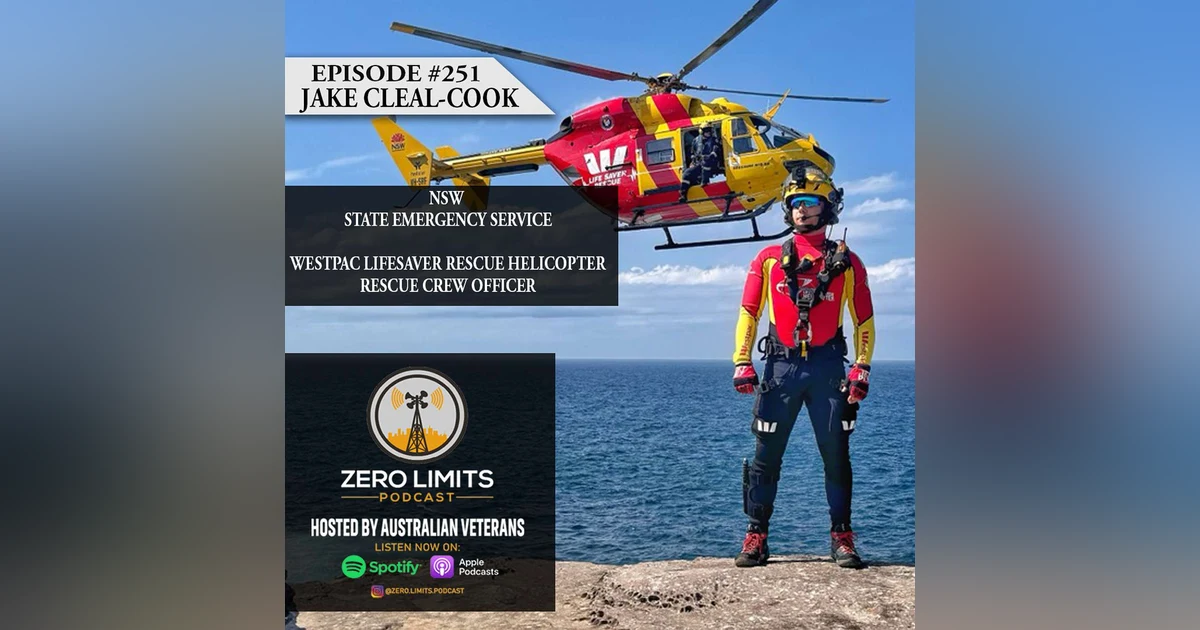
Ep. 251 Jake Cleal-Cook NSW State Emergency Service - WestPac Lifesaver Rescue Helicopter Rescue Crew Officer @rescuemanjake

 Apple Podcasts
 Spotify
 On this Zero Limits Podcast Matty Morris chats with Jake Cleal-Cook NSW State Emergency Service and WestPac Lifesaver Rescue Helicopter Rescue Crew Officer
Jake Cleal-Cook is a Rescue Crew Officer with the Westpac Life Saver Rescue Helicopter Service in Sydney, where he specialises in helicopter winch operations. He has responded to major flood disasters across New South Wales, conducting winch rescues in conditions that are complex, rapidly changing, and where access, information and time are rarely on your side.
Away from aviation, Jake is a senior flood rescue operator with the NSW State Emergency Service, and chairs the Service's Capability Development Group — a role through which he actively shapes how modern flood rescue capability is built and refined across the state.
He is driven by a straightforward goal: better outcomes for people in their worst moments. That drive carries through everything he does — from operations, to capability development, to the conversations he hosts on his podcast, Rescue Ready, where he brings those learnings to a wider audience.
Website - www.zerolimitspodcast.com
Instagram - https://www.instagram.com/zero.limits.podcast/?hl=en
Host - Matty Morris
www.instagram.com/matty.m.morris
For the new Zero Limits Pre workout and creatine supplements head to link below
Zero Limits Supplements - www.zerolimitssupplements.com
Sponsors
Instagram - @gatorzaustralia
www.gatorzaustralia.com
15% Discount Code - ZERO15
(former/current military & first responders 20% discount to order please email orders@gatorzaustralia.com.au
Instagram - @3zeroscoffee
3 Zeros Coffee - www.3zeroscoffee.com.au
10% Discount Code - 3ZLimits
Instagram - @getsome_au
GetSome Jocko Fuel - www.getsome.com.au
10% Discount Code - ZEROLIMITS
It's time for the Zero Limits Podcast, hosted by an Australian veteran. Chatting with high-charging humans with hectic stories from around the world. We'll give you the motivation to take on whatever life throws at you in the game to complete any goal you set your money to. Let's go.
SPEAKER_03Zero Limits listeners. On today's Zero Limits podcast joined in the studio with a bloke that I've been uh chasing on uh social media. He's uh starting to make a bit of a a profile of what he does current job as part of the Westpac uh lifesaver rescue helicopter. And now I think I guess we've all seen the helicopters cruising around, especially if you're up in Newcastle, see the one that flies out of Broadmeadow up here, and obviously down in Sydney as well. They've got one that every day you'll see it flying around and you're far out, someone's got themselves into some mischief. Um and there's always going to be, you know, probably three blokes in that helicopter and one that dangles off from the end of it. And I've got him here in the studio today. He's been in the job for a couple of years now. Before that, he did spend time with the SDS as well, which I'm definitely keen to talk about. I I think it's really interesting what the SES does. Like I've said offline to Jake, I'll introduce him in a sec. You see the SES on TV and you just think they're just throwing tarps over roofs. Yeah, yeah, they do do that, but there is uh definitely other parts, including the rescue side. Quite young, he's only 26 and started his uh surf life-saving career in 2012 as a young, young fella. So, Jake, mate, how are you?
SPEAKER_01Thanks, mate. I'm good. Thanks for bringing us on. I think I've got to be one of the youngest on the podcast. A bit intimidating, but uh thanks again for having us here.
SPEAKER_03No, appreciate it, mate. Uh sorry, it's uh Jake Cleal Cook.
SPEAKER_01Yep.
SPEAKER_03That's the one too that's mate. Again, appreciate you coming on the podcast. I was harassing you for a good, I reckon, a good couple months now. And uh I guess for yourself you would have been like just looking at the the list that I've had on the podcast, and you've got all these, you know, mad dog SSR operators and commandos and just you know, high high level achievers. And you I think we were just speaking offline then. You feel, you know, when I was questioning you about the life at this Westpac Chopper and you know, the stuff you guys do, as I said, you see it flying around and people, you know, uh uh are an operator dangling from the helicopter rescuing people, and you're just like, oh, you know, it's just uh you know, we do it once a week prop type thing, just like it's like it's nothing but for us civvies, mate, we see it and we're like, holy shit, that's pretty that's pretty good stuff what you do. So mate, again, appreciate you coming in.
SPEAKER_01No, thank you. And I think it's the same with any emergency service job when you're in it, you don't realise how it looks from the outside.
SPEAKER_03Well, when you're dangling for an helicopter, mate, bloody hell. You know, it's pretty wild.
SPEAKER_01You know, I'll tell you a little secret, you don't you don't realise the height when you're in it because you've got nothing to gauge it off. And you know, as we'll get into, I'm sure I'm pretty used to heights, and so when I came into it, I wasn't that uh freaked out by it.
SPEAKER_03Yeah, and you were just showing me a video, you've seen some videos uh before that I think your first ever rescue dangling from a helicopter, it's on channel nine as well. So you had a bit of pressure.
SPEAKER_01Yeah, 100%, you know, and that's part of what we do at Westpac Lifesaver, is you know, we need the funds to keep going and we need donations, so it we are always on the news. And generally when a helicopter goes to something, we are the last resort, you know, the top tier of the rescue. So it's likely to be in the media.
SPEAKER_03And just on that, let's let's talk about. I think we spoke about this a little bit offline. We know that Westpac uh currently funds these helicopters predominantly, but uh does the government give a bit of money? And obviously, there's obviously a lot of uh uh what do you call it, fundraising as well.
SPEAKER_01Yeah, so I'm part of the Westpac Lifesaver Helicopter, so we've got two machines, one based out of Sydney and one down at Maruya. Um you also have Westpac Northern Region, which is the ones you've got up your way, Tamworth and Lismore. Um they work on a little bit of a different funding model. But for us, three-quarters of our funding comes from the Westpac Bank. So we're heavily funded by the Westpac Bank, and then the other bit is split up between the government and all the donations um we receive from the general public and Surf Life Saving. So that's why we're just always out there in the media, you know, and sprooking what we do to some degree, because we rely so heavily on the funds that come in from the community and the bank itself.
SPEAKER_03Have you got a split of the what those funds look like?
SPEAKER_01Yeah, I think it's about two-thirds are from the Westpac Bank.
SPEAKER_03How much like how much are we talking? Of milk.
SPEAKER_01Oh, I couldn't tell you, but squillions. Yeah. A fair bit of money, a few million because it cost us um five thousand dollars an hour to fly.
SPEAKER_03Five grand an hour.
SPEAKER_01Yep. Jesus.
SPEAKER_03And like it w when you say five thousand dollars an hour, like how typically long is a flight? And if you're doing like you know, maybe the longest job?
SPEAKER_01The longest we can fly is for an hour and a half. You know, on one tank of fuel we'll go for an hour and a half. Um, a lot of our jobs are around that half an hour to 45 minutes, but it really depends on what we're doing, you know.
SPEAKER_03So, really, every time it takes off, it's about five grand.
SPEAKER_01Yeah. Minimum. Yeah.
SPEAKER_03That's a lot of money. That's a lot a lot of gas. That's a lot of gas. Mate, it's uh it's pretty wild. Uh as you said, a lot of it does come from crowdfunding as well. And again, we've seen it on the news nine, etc., channel seven, channel ten. And again, we always see the fundraising efforts, but we don't really know to the extent of where that money goes and how it works and who contributes what. And it's uh it's interesting to hear, but we'll definitely talk about that more down the track. But before we do, mate, before we move on to the SES, and uh because in the SES you did the rescue stuff as well, and obviously this is how you got that that itch to do more rescue, and obviously now you're dangle from a helicopter. Let's talk about the younger days, mate, because again, you're only 26, and you said uh you start your life-saving career in 2012. What's the math there? What's 2012, 13, 14 years ago, 2000 far out. You're only just a young nipper.
SPEAKER_01Yeah, mate, a little pub.
SPEAKER_03Yeah, mate. So this is obviously where you start, you're obviously living on the beach. That's I'm sure that's part of or in the region.
SPEAKER_01Yeah, so I grew up on a little town called Jambru down on the south coast, and uh when I was five got involved with the local surf club, and you know, that was probably the best thing for me. That's where I got a love for the beach and worked through all the way through the Nipper program up into around that time I do your surf rescue certificate um when you're about twelve, and that's where you can get on the beach and start patrolling. And um just loved it from there, just doing as many courses as I could do, working through the bronze, then you do your or your boating certificates into your jet ski until you're running a patrol yourself. I think I was one of the youngest um patrol captains at the club at about 18, running, you know, a group of five guys and making sure no one drowns on the ocean. Yeah. What what beach was that, sorry? Come on down.
SPEAKER_03Yep. Yeah, gotcha. And it's it's pretty wild to hear, you know, you you're at that age in control of you know, a surf living life saving team potentially out there to save adults. Which there's a lot of dumb adults out there.
SPEAKER_01Yeah, looking back now, you go, who trusts me then?
SPEAKER_03Yeah, yeah, but obviously w when it comes to the training, like what are you doing for surf life saving?
SPEAKER_01Um, you know, well, you start your surf rescue certificates. When you you know you are uh about 12, you can do that. You just learn about the surf, learn how to do basic things like board rescues, um, surf rescues, doing CPR, things like that. And then when you get a bit older, you can do your bronze sedallion, that's your entry into surf life savings, so yeah, where you're a full qualified patrol member, and you do a bit more of a fitness testing, um, you go through everything a little bit more in depth and consolidate all your training, and then you can be a real part of that patrol, and then from there you can specialise in all sorts of areas. So you go into your like crew for the rubber boat, um, the IRB, and then your drivers for that. Um, and then things like um patrol captain, one of the best courses I did um was our silver medallion aquatic search and rescue, which is you know, jumping off the rocks, swimming and uh looking for people on the bottom. Um, one of the definitely one of the best courses in there, and that all leads into work in the future, and that's was I also did lifeguarding for about eight years now, you know, on the beach, and that's a lot of fun.
SPEAKER_03During this time, obviously, you're quite a young kid schooling. Now you gotta school, you gotta go to school as well. And what are you doing this on the weekends doing this after school? But how did you go at school?
SPEAKER_01I went terrible because I never went to school.
SPEAKER_03You're just on the beach, yeah.
SPEAKER_01No, no, I was homeschooled all my life, so I've never done a day of school in my life, so yeah, from one all the way through to year ten, never did the day of school.
SPEAKER_03Wow, that's pretty interesting.
SPEAKER_01So all all the surf club, you know, was on the weekends and then afternoons taken up by a lot of sport. You know, that's where I got a lot of my mates from is sport. Just did max sport nearly every afternoon. I think the parents probably got sick of driving us to all the footy fields. But um, yeah, homeschooled all my brothers and sisters, one younger sister, yeah.
SPEAKER_03And used both homeschooled by by your mum? Yep. Fire. But and obviously I guess the the difference with that is the discipline probably would have been a little bit stricter.
SPEAKER_01Yeah, to some degree. I think you know, you let learn how to do things yourself, and not I'm always didn't hated doing book work, or much preferred being down in the garage building something or built, you know, buying a book. Yeah, making a new potato gun or something like that.
SPEAKER_03Yeah, mate, yeah, for sure. That was that's interesting. So, in in regards to your family history, you know, you move into this this rescue side. Any family history within defence, cops, or fieries?
SPEAKER_01Not really. Got one cousin who's in the cops up in Queensland, but nothing um that I really know about, you know. I th step-grandad did a bit in the military back in the day, but I don't really know too much about that, to be honest.
SPEAKER_03So where does this nipper stuff come into it? Like, how do you honestly?
SPEAKER_01I think it came from the neighbours, you know. It was brilliant. Like the neighbours had their kids in it and they said, you know, bring them on, check out the water, and um it started from there. And you know, our family is really into the outdoors, so it just played into it.
SPEAKER_03Yeah, yeah, right. And your sister, was she doing this as well? Yep. Yeah. Oh, yeah, so it's a whole family affair.
SPEAKER_01Yeah, 100%. So grew up, grew up in the wild, you know. Um, parents worked in outdoor education, so school camps and things like that. And that's one of the reasons we did homeschooling, because it worked around their schedule. In winter, there's not so much work. And so we'd go away for two, three months up north or overseas to see the family for a couple months at a time, and that really worked in with our lifestyle and made it um yeah, an awesome way to grow up.
SPEAKER_03Man, I think there'd be a lot of kids out there that love to homeschool. I know my kids would love it far or out. They hate going to school, but they're just like me. I absolutely hate it. It that's if I went to school. Actually, I I did do a bit of homeschooling by myself when I skipped it. Uh uh, so you do that uh surf life saving for a couple years, 2016, do a bit of outdoor education, and then obviously this is where the SES stuff comes in, and you're how old are you now? You're 18?
SPEAKER_01Yeah, Beth, I think I started with them 17. So I got to, you know, as most kids do, you know, got to finish year 10, and a parent oh, I think a parent said, you know, they worked in the outdoor edge, said come down, we need a water safety for a day on the beach. Um they were doing some snorkeling with a school group. And I went down, did a day of work, and that was the end of that. That was the end of schooling. Yeah. So wait, I can earn it, you know, what my mates earned in a week in one day, and just fell in love with outdoor edge, started working in outdoor education. So school camps, mountain biking, white water rafting, all that kind of stuff. Absolutely.
SPEAKER_03So like an instructive, one of those camps that the summer camp type style.
SPEAKER_01Yeah. And grow up I'd grown up around that, you know, because the parents had worked in that for so long. And you know, I can remember at about eight I got in massive trouble because I went ab sailing off the balcony on a figure eight. Mum came out, you know, with a I think a nerf gun over the shoulder or something and got in so much trouble. So, you know, moving into that, it was just a part of life and just absolutely loved it. And then doing the water stuff and that um sort of that was sort of aligned with the SES. And one of the trips I'd gone overseas um over to England, and we'd was staying in a place called Beer, um, which is down in Cornwall, and we'd seen a caravan had come down the hill through a flint wall and blown this flint wall out over over a crowd of people, and there were seven people, it was a mashed casually incident, everyone was fragged up from it. And I was just watching the situation, it was the first time I got the feeling of um helplessness, not being able to help. And I think that sort of came back later on going, how how can I do something about that in the future? You know, what can I learn to help people? And that's yeah, when I sort of seen the SES, I looked at a few different things, and um that's where I started on. And I was lucky enough that our local unit at Climber is a rescue unit, so you know, we do vertical rescue, road crash rescue, all that, as well as um putting tarps on roofs, as you say.
SPEAKER_03So you start at 17 uh within the SES. You know, again, run me through the process of joining the SES and moving into courses and stuff. Obviously, you can't just join and get an orange suit, and there's obviously got to be some training involved.
SPEAKER_01Yeah, so usually your first year is all your basic fundamentals. So you join up and then you're just learning, you know, half of it's about sucking eggs and how to use a drill so you don't put it through your hand, how use a circular saw, you know, just in case you're a city folk and you've never touched um tooling before. And then you'll the second half of the year you'll sort of start into your basics of the rescue work, how to how to load someone into a stretcher, how to lash them into a stretcher, you know, how to transport people over uneven terrain, basic bits and pieces like that. And then once you've completed that um basic level, what we call pyro participate in a rescue operation, then you can start specializing into areas that you want to go into. And for me, coming from Outdoor Ed and being in the water, it was flood rescue. So I don't know if anyone knows, but the New South Wales SES is the biggest flood rescue agency in the Southern Hemisphere. We've got the most amount of operators, and it's a core part of what we do, one of our job descriptions. So, you know, that's where I wanted to go. I wanted to get into it, and that's where I started moving into that flood rescue side of it straight away.
SPEAKER_03Which is all too relevant, especially here in New South Wales, like far out. There's non-stop actually from the bottom of New South Wales to the top of Queensland, far out. There's just it seems like there's a flood every year somewhere.
SPEAKER_01Yes, and they're only gonna get worse, you know, with the way the climate's changing and the more and more people and the way we're building um in different places, you know. I think we've got to make communities more resilient, and at the moment, that's not quite there. We're starting to move into that sector, but until we design better and build in better places, we're only gonna need more and more volunteers and paid people to help people out in these big disasters.
SPEAKER_03Just recently I had uh Jason Hiscox on from uh Coff's Harbour, and he spoke about you know, he was in the SES for 12 years, predominantly with that flood rescue and obviously the vertical rescue stuff. You obviously move into that vertical rescue stuff, and that's all part of the whole package as well, isn't it?
SPEAKER_01Yeah, it is. So vertical rest is you know that specialty side of it, and only certain units will do that because it is a highly um you need a lot of skill to do it, you know, and a lot of training. Yep, it takes a fair bit of time, and once you train, you're just safe, you know, and then you've got to gain your competence by actually going out and doing jobs. So for me, I went through a lot of other courses first, um, road crash rescue and things like that, and then I got onto the roping side, and it was a little bit easier because I'd already done a lot of ab sailing and rock climbing um with that outdoor edwork. But yeah, it it's one of those skills, it's you don't use it very often, but you need to keep up on it.
SPEAKER_03Just quickly back to the surf life saving as a young fella, mate.
SPEAKER_01Any any rescues? Well, pretty lucky in the beach that we were, you know, quite coastal town um that you don't get too much going on, you know, you'll get a call here and there or pull a few people out. My claim to fame is I did, you know, four years of lifeguarding before I did a natural rescue. So I said I did my job correct, no one got in trouble in the first place. But you know, we did a few on the beach where you have like um a family washed out in rip or something. Can you get on the board and go pick them all up, you know? But a lot of that work is preventing that from happening in the first place, and we're lucky that we don't have all the Sydney folk coming down to our area, it's too much that can't swim.
SPEAKER_03So yeah, yeah. Well, like you said, a lot of it's just education, isn't it? Swim between the flags. It's quick, it's because you guys put those, you know, I'm I'm I'm just guesstimating here, but you put the flags out here because you understand where the where the rip's happening and blah blah blah, and yeah. Yeah, I'm sure that's how it works. Yeah, yeah.
SPEAKER_01And that's why you go through that Nipper program, it's the best thing to get um comfortable in the surf and understand how it works. Um just work with the rips, because they can be your friend, you know, on the beach, and as a surfer at a bodyboarder, you know, they are the best thing on the beach, but you've got to know how they work and how to use them.
SPEAKER_03So at that young age you didn't really experience anything traumatic or anything, you know, it was drowning or a I don't know, a shark attack or whatever.
SPEAKER_01Stingrays. Not really on the beach. Shout out to Steve Irwin. No, not not off the top of my head. Um, it wasn't really till we moved into the the SES that um really got exposed to that more trauma side of um working as in that rescue space.
SPEAKER_03Yep, so as I said, you start that uh SES side of things, you do all the courses, get fully qualified. Mate, run me through again, like uh speaking to Jason, mate. It would it was just an eye-opener for me because I didn't understand exactly what the SES did. Like I said earlier, you'd see the SES on the news putting bloody blue NRMA tarps over their roofs, free marketing for NRMA. But we didn't know to the extent where Jason was talking about you know being part of the rescue squad, they were sometimes first on the scene to a you know to a to an incident or they're doing vertical rescue and you know, retrieving people.
SPEAKER_01Yeah, so obviously, you know, our reminiscence and tsunamis. So you got on the meter what we do, go out, kick, cut trees off people's roofs, you know, tarp the roofs. Then you have the flood side of it, which is the rescue side of most SES, um, where you go in the water, pull people out of the cars, you know, houses, um big floods like up at Tari recently, we actually went with the helicopter, I'm sure we'll come to later. And um then you have some specialty units that do do the rescue, like you said up there at Coffs Harbour, Chymer, I think we've put one here, just here at Port Macquarie. And they're guys that are volunteers, but they're highly trained, um just as much, if not better, than the paid guys, and go out of their way uh the drop of a hat.
SPEAKER_03Well it's gonna hurt some fieries.
SPEAKER_01There's a lot of guys, a lot of guys in our unit that are also fiery, so and you know that's part of it. Like I've got a handful of great mates that I met through through the unit, and now they're police, fieries, rail fieries, you know, all of my mates that I joined with are now all work in emergency services. In the system, yeah. Yeah. And it's a great starting block.
SPEAKER_03Of course, yeah, 100%. Now, when do you get your first, you know, your first text message and you know, I don't know, whatever. There's an MVA or a kid stuck over a cliff. I don't know.
SPEAKER_01I think it was only about I think six months in. I think my first job was a very good thing.
SPEAKER_03Did you have that young too?
SPEAKER_01Like 18. Yeah, once you once you start your basic rescue courses, you're 17, you can roll out, as long as it's not like a body recovery or such, you can roll to the job. Um, I think it was a just a person stuck up on a cliff, they'd just try to climb up one of the local um out of the beaches on the cliff and was just stuck halfway up. It's pretty simple, just put a ladder up and tell them to get down, you know, stop being silly. But pretty simple one for a start off, but they obviously increase from there, but it was a good one just to get the taste, and you know, when you're that junior, you've got no idea, you're running around like a chook with his head chopped off, you know.
SPEAKER_03Yeah, and what about the first time I guess you experienced that that trauma or something pretty serious?
SPEAKER_01Um, first time for me was we're doing a search um on the local coastal area. We'd been called for just a concern for welfare. A lady's car had been found. Um and so we're tasked with a few other SES units, uh, pretty common to go do a land search in the area, see what we can find, see who's there. You know, so we're walking um we're our job was a patrol along coastal area. So walking along coastal area per a team of four, and as we came around the point, walking around the rocks, all I see is just two feet sticking in the air. So obviously old love had some tied something to her chest, jumped in the water. And then that's the way she's decided to the end her life. With and I just always remember that one because all you could see was two trainers sticking in the air, and you go, That's that's just not how the people float in the water.
SPEAKER_03Jeez, and how old are you? 18? Yeah, as a volunteer. It's pretty I don't know, like it's pretty wild. Yeah, it's pretty wild because again, it's just a volunteer job. And and being so young.
SPEAKER_01Yep. But you know, there's if you're going into the emergency sphere and that's where the way you're going, then you see you volunteer for it. Yeah, you put up your hand and you know when you're going to that kind of jobs. And the senior guys and like myself now we're really good. You get you go there, it's not a rush, it's gonna be a search, you know there's a high likelihood of having that outcome, and so you have that choice, you know. You go, we're likely to be going to a deceased person on this job, you know. You don't have to come because ultimately that's what we may find, you know, and it's all about limiting that exposure. Like you've talked to so many people that it's the beauty of being a volunteer, you can say no, you know, we don't pay, we're not you don't have to do it, so you can choose, you know. And when we've done others in the future, like you just limit your team when we've done other body recoveries, you limit who goes into that scenario because obviously you've only got so much you can fill your cup up by. And so just by limiting who goes into that scene, then you limit each cup getting filled up.
SPEAKER_03And what's the scenario for that? Uh you you you come up to this this uh person, they obviously committed suicide, and do you obviously get in contact with the police from there and then they deal with the rest of it?
SPEAKER_01Yeah. Police rescue, uh, who've really got a great working relationship with, it's their job now, so they came in. I think the water is ended up coming in their little rib and picking her out of the water, and that was our job done, so we didn't have to do anything um on that one.
SPEAKER_03And how often are you getting called out uh in your area?
SPEAKER_01I'd say we average about two jobs a week. We're not the yeah, we're not the busiest unit, you know. Some units uh would do a job a day, if not more. So Hawkesbury at the base of the Blue Mountains, they're a rescue unit and they're one of the busiest in the state. So probably Hawkesbury, Port Macquarie, and Coffs are one of the b are the busiest rescue units for OCS.
SPEAKER_03And when we talk about what jobs you get in Court Alf or what are the types? What are we talking? MVAs, rescue, like vertical rescue. Is there anything anything wild? You're just like, what the hell is this? What's going on here? Who's how how's that bloke done that?
SPEAKER_01We're pretty lucky in our area. They've improved the roads so much that we don't get a lot. It's really hard. Like, I haven't put a tool on a car in anger, and I've been qualified for six years. I just haven't been available when we've had jobs. A lot of the work now is assist Ambos, so going to the Ambos, helping carry people out of houses and things like that, or you know, out of the bush. That's just a lot of the work or gain entries, you know, where old loves falling on the ground and ambos can't get in because you know, old people lock up their houses like Fort Knox, so you've got to go in, bust the door just to help the ambos get in, and then we'll ex-fill that patient. Um, that's a lot of the work, and then you get the high acuity stuff like the vertical rescues. Um, been doing a few of those on the cliffs recently and things like that. And then in our areas, we've also got the mountains, so we do a lot of bushwalkers and that of the gone into the mountains and gone missing, and so you have to go in and hike in over a period of time um to locate them and then bring them back out.
SPEAKER_03Sorry, you're still in the SES? Yeah. Oh, sweet. So when you're not flying around in an helicopter, you're on call for the SES as well. Yeah. Yep. Yeah, cool. Can't get enough of it. You can't get enough. Uh yeah, right, and uh just looking here, 2021, you did a job in Jerengong. Jong?
SPEAKER_01Yeah, you got the Jerengong Falls. So, yeah, that's one of those mountainous areas we got up up the back of um Jambru there. You know, you got the uh mountains, and it's a really beautiful waterfall that comes down, probably, you know, uh I think it's about an 80-90 metre waterfall that runs down, and it takes about 40 minutes to uh hike into um to the location. Pretty decent hike in. So we got a call for a patient that had taken a fall um down the base of Durangong Falls. And so we responded up there. I think there was a team of about three or four of us. Um and then we stage at a location, we wait for the paramedics to turn up, um, as long as as well as police rescue, because it's the key thing in those areas you've got to go into a team.
SPEAKER_03That says rescue paramedics, isn't it? Those SOT is a SOT. Yeah. SOT, yep.
SPEAKER_01Yeah, great dudes, awesome to work with, um, and we get along with them really well, and it you have to have them on those missions, and it was key to on this job here today on that job on the day. So we got all teamed up and then walked in. Um, there's like a chimney, you've got a shiver down a chimney, a bit of an ab sale to start off with, you ab sale in, and then it's a real bush-bashing track uh to make it to the casualty. Probably took us 45 minutes. Um, young kid, he was walking back, slid on the track, and then enrolled and had fallen off a 25 meter cliff.
SPEAKER_0325 metres and survived.
SPEAKER_01Yeah. Yes smokes. He wasn't in a good way, um, obviously. So it took another bit of time. We had to work out another way of getting down to him. Uh we use a bit of a roping system, go down a smaller, another smaller section until we could make it in. And then paramedics started doing their thing, working on them. Uh the toll guys from New South Wales Ambulance winched in the doctor and paramedic, they turned up. And then us as the rescue team, we've got to work out how we're gonna get the patient out of there. So he's in a spot hard up against the base of the cliff, and then we've got another 300 metres over undulating terrain and another five metre cliff drop to get to where the helicopter could pick him up because obviously you've got all the canopy cover. So that was another, you know, 40 minutes of working out how we're gonna do that, setting up roping systems, and we loaded him in the stretcher known as Stokes, and then slowly bee laid him out. Um Ambo's probably working on him for a good 40 minutes or longer. And then we put him in the stretcher, slowly X-filled him, had to absail him down the 10 metre or 5 metre, sorry, little cliff, and then carry him out to a spot where the machine could winch him up. Did he survive? I believe he got to the hospital. I don't know. You don't often hear the outcomes of these things. Separate from Yeah, you know. That's that's probably one of the hardest things, you know. If you if you know some of the outcomes, it can be a good thing, but it also, you know, can swing the other way.
SPEAKER_03Now, I guess this is one of the times where you see the toll helicopter winching down, you know, a knighting shining shining armour. It was was it did you look at it and just go, mate, that's me.
SPEAKER_01Well, the first thing I thought was, you know, go away because it'll give me a headache because it makes so much noise and there's tree branches coming down everywhere. These bugs. But yeah, looking at that going, that'd be mad. And I think and everyone that sees the helicopters, even in surf club, for me, it was on the we have a surf club book, and at the top tier of the book was a helicopter. You know, you've got all the qualifications, jet ski, then you go helicopter. And then seeing that, um, just yeah, well, you want to go, how do I get there? How how can I possibly get and do that? That's mad.
SPEAKER_03Which you obviously get into that what in 2000 this year. This year? You can do the oh sorry, three years. You've done it for three years now. Yeah. Uh yeah, so yeah, three years, definitely junior. So 2023 you start with that. But before we do, obviously you've got a couple more jobs with the SES, because that's and what what are you doing for uh for crust?
SPEAKER_01I think when that one, I was still working outdoor ed up until about 20, I don't know, 21 or something. And then with that outdoor ed, we used to do um we'd go out and set up Piewes activities. So we were one of the only companies in the state would go climb up the trees and set up all your activities, your big swing and everything. So we did a lot of work up at um Singleton on the back of the range there with army cadets, little kids out of the school, and then we'd go to Lisco, um, one of the other bases, and we'd climb up the trees, you'd put wires across and build activities in the trees. And from there, got the love of climbing. And so that led me into doing arbiculture, you know, cutting trees. So that's what I was doing at that time, you know. So that was your your day job. Yeah, and still what I do now. Oh, is it? Yeah, right.
SPEAKER_03Yeah, so you're still doing that as well. So you you're just a jack of all trades.
SPEAKER_01Yeah, workaholic.
SPEAKER_03All right, mate. Well, I suppose you're young, young fit, and not dying like the rest of us uh with injuries, but you will one day. Uh yeah, right, mate, and just a couple more jobs to you with the SES. You know, uh as you said, there's the whole I'm I'm sure you've done a uh a few hundred jobs over over your time with the SES. Uh more notably, a guy trapped under a boulder. Is it this is like that movie where he chops his arm off? He didn't do that though, did he? Nah, nah.
SPEAKER_01It was close though. So another one, this is one where we, you know, we talked about we work really closely with other agencies, and you've got to have a great working relationship in rescue. So we got called to support police rescue um in a local canyon. Uh a guy had gone bushwalking up a canyon, um, Cory Pass Canyon. It's a nice bushwalk, and then it pushed on high up into the top of the canyon where there was a couple of boulder runs. As he was climbing up through the boulder runs, he's grabbed a boulder to step up to the next level, and it's just been a little bit unweighted and fallen back down, he's fallen backwards, and that's boulder's then come down on his leg and pinned his leg in place.
SPEAKER_03Fucking hell.
SPEAKER_01Yeah, and he there's a few lucky things. One was his bag fell in reach, his phone was in his bag. Oh, and because he was in that runner canyon, he had a direct line of sight down so he could call for help. Five metres either side of him, there was no phone reception.
SPEAKER_03So he's away and that far out.
SPEAKER_01Yeah, so we'd got called um as a vertical rescue support unit to go and help the police. And there wasn't much information known at the time. You know, we thought he was pinned, but we didn't know exactly how, so we were second team in. The police had already got in. Um they arrived with the ambos probably ten minutes before we did and our team. Uh it was about a 40-minute walk in to where he was, up into the canyon. You know, that kind of terrain takes a bit of time to traverse, and then getting up to him and it's working out how the hell are you going to get this person out. So simple, you know, if it's on the side of the road, you've got a whole rescue truck full of tools, full of options from A to B. How do you get this person out? But now you've got to carry your gear 40 minutes in, it brings another whole ball game.
SPEAKER_03On the edge of a cliff.
SPEAKER_01Yeah, it wasn't it was more of a boulder run, steep hill, not quite on the edge of a cliff, but still, it's not the easiest place in the world to work. So decision was made that there's no way we can carry the tools in because we've got a few different options, and all of them aren't light. You know, your your rescue cutters or spreaders, they weigh the good part of you know, 40 kilos, 30, 40 kilos, depending on what ones you're using. So the decision was made to actually helicopter the gear in. So the winch inserted the doctor and paramedic again. They started treating the patient along with uh paramedics that are on scene, and then the helicopter went back down to the base, and then we started winching in all of our rescue equipment. How big is this boulder? We estimated to be about 500 kilos.
unknownYeah.
SPEAKER_01So it was a big standstone boulder that had just come down. Luckily enough, his his leg wasn't fully pinned, it was just trapped by um what we call confinement or compression, so it wasn't actually pressing down as such on his leg. He just physically could not get it out of there.
SPEAKER_03I should say he was pretty lucky in a way. There was no crush.
SPEAKER_01No.
SPEAKER_03Oh shit. That's pretty lucky. And what's the process here? What are you doing using jacks or something?
SPEAKER_01You know, yeah, so you've got a options, the multiple different options. You've got an airbag system, which is, you know, just like a very powerful balloon we inflate. Um, or you've got obviously your sp your hydraulic spreaders, which aren't ideal in that rock situation, but that's what it ended up becoming because we couldn't use airbags in that position. And then you've got to stabilize that rock as you're coming up, and you know, if it's not the easiest thing to do, so we had to build roping systems and wedges to stop that rock falling if um the lifting technique failed. So that all took time, and we're in there for a a couple of hours actually lifting this boulder. He only needed to move it, you know, probably 10 centimetres to get off his leg and get his fruit. And then finally that all happened, and we're able to remove his leg, and then uh ambos are doing their thing, and then it's the how do we get him out, and that became the next pit, and that's where we had to move up and up into the canyon another hundred metres to get to the winch site, and it was all had to be really smooth and efficient, but fast because we had the storm coming in, we got lights, it was like the perfect scenario. Yeah, you got the last light coming in, you got it. There was a thunderstorm, storm coming as well. Yeah, just uh added to the mix, and it was a single winch out, very fast, um, but safe on the air part, and then the rest of it. Was that toll again?
SPEAKER_03Was it?
SPEAKER_01Yeah, yeah. So local guys.
SPEAKER_03So again, you saw the night in shining armor coming down, like, man, I want that job. Was that another one? He was like, Yeah, another time. That's me.
SPEAKER_01Yeah, that's me. Another time being on the ground, it gives you an appreciation of how much mess a helicopter can make of trees and everything. If you're standing under it, you know, we were 200 metres away when they're picking the patient up from the location, but you've still got tree branches and everything just shredding around you, and those aircraft weigh about seven tons, so you've got seven tonnes of air coming down shredding trees.
SPEAKER_03Yeah.
SPEAKER_01And they're not meant to have air blown down from the top, so they just fall apart.
SPEAKER_03Yeah, mate. They are I've uh spent a bit of time under helicopters, especially in operation in theaters, uh Timor in Afghanistan, mate, far out. Just the draft that comes down and the dust and the rocks that go flying, and just people's kit goes flying everywhere, and absolute manic. And obviously, you're trying to work at the same time and try and keep people alive under under it all happening. Make crazy. Uh so you get this guy out and he's he's good.
SPEAKER_01Yep, he was he was pretty lucky in the end, you know, probably only had minor injuries. Uh again, one of those jobs you don't really hear the end of. But um, yeah, he was pretty good in the end, winched out, taken a hospital, and then just left us with all the tools that have been helicoptered in to then.
SPEAKER_03Oh, you've got to walk out.
SPEAKER_01Yeah, he got stooged up on that job.
SPEAKER_03And and you volunteered.
SPEAKER_01Yeah, but it's you know, it was a good one, great outcome, great what work, you know, top tier of what you have to do, thinking outside of the box, and that's what makes it brilliant. Yeah, mate, straight to the pub.
SPEAKER_03From there, again, like I said, couple more jobs uh with the SES. You're look you're loving this SES stuff, and where does the thought of I guess the the Westpac helicopter come into it?
SPEAKER_01I think it was always there. Um, always wanting to get on. I applied, I'd seen a few helicopter jobs than that pop up on seek and applied for a few, never really got anywhere. Um and so I was just always on the lookout, and then as you do when you're in SES, you meet people, and that's one of the brilliant things about it, about being in the service, and what I tell a lot of young guys not only you get all the skills and qualifications, but you meet people that are in services, and so that was a part of it. I met someone who worked at the Lifesaver helicopter um as a crew and has worked there for 35 years, and so had a lot of knowledge about the place and just started chatting to him, and then um as part of the SS our unit, we go away and we have uh road crash rescue competitions where we compete um cutting cars up and things like that, and he's our our team leader for that, so got to know him quite well. And uh I think one day we're just down on the beach and one of the mates showed us a screenshot of a of a job opening at the helicopter, you know, and it was one of those things, you know, it's a screenshot from a screenshot. Yeah. And so I sent him a text and go, Wait, what's this opening? You know, is there a job coming up? He goes, How do you know about that? It was a closed meeting yesterday. Like he said, I'll talk to you later. And then that's that's where it started.
SPEAKER_03Yeah, yeah, right. And just before we crack on with the Westpac stuff, one more job with the SES here. Uh some some silly bugger jumps out of pub window. Oh what's going on here? What yeah what's good? Which is, you know, to be expected and happens a fair bit, I suppose. But what's going on here?
SPEAKER_01Yeah, that that was an interesting one, actually.
SPEAKER_03Um because it's it would be an interesting job to get caught out to on your on your text message. Uh man jumps out pub window.
SPEAKER_01Yeah, well, you know, interesting enough, so that time it was it was pissing down with rain, and we were preparing for flood rescues, so we had all our cars um kitted up. Uh, I think I was on the on-call team for the flood team that night, so I had the car at home ready to go because we were expecting a few jobs, and then we got this job come in, and oh on the text message, you never get all the information, eh? Like, there's never all there, you never know what you're going to, and it almost sounded like there was someone had hung themselves off a pole. It's like, oh shit, you know. So we all flew there. Um I went in our flood car and the guys turned up in the rescue truck. It obviously didn't turn out to be that, and uh far from it. Yeah, well, not too far. So the guy is staying in a pub, uh one of the local pubs, and he's up in the room three stories up, and I think it'd been on, you know, he uh either had a few drinks or a few other things, and it thought someone was attacking him, and so it'd fully just jump through the pane of window the window pane, and then was clinging onto the ledge. There was probably uh five, ten centimetre ledge he's standing on, and just clinging onto the windowsill between two windows on the outside, and the publican and uh one of the other patrons has got like this balustrade rope wrapped around him from one window to the other, holding him there, he's and there's probably you know, three stories up looking down, he's pissing down with rain, he's all cut up. Okay, mate, that was not a good choice.
SPEAKER_03And you had to do the rescue for it, yeah.
SPEAKER_01So bit of a complicated one because you you know you've got fairly high up and there was a balcony below, um, or you know, like a roof for the shops below. So you go up and um got to build a a roping system to keep him in place, one, and then to get him down. And being, you know, a hotel room, there's not much to anchor off, so you've got to build anchors and think about door frames, and we built an anchor off the door frame um using a tool across it, and then over a period of time managed to get enough ladders up to to get to the base of him, get a rope on him, and then slowly lower him back down this um ladder over a period of time.
SPEAKER_03But it's just getting made like one slip and you're gonna it's again, this is interesting because this is the SES doing a rescue like that that you know generally is fire rescue, maybe police rescue. It's uh it's it's interesting. Again, like I didn't I didn't realise to the extent of what the SES did. Now I do you know, now I got somewhat of an understanding.
SPEAKER_01Yeah. And you know, they're just a fraction of obviously the things, and there's so many more people out there that obviously have a lot more experience than me, and have just done a lot more hectic jobs, and there's especially when we go into the road crush um side of it, you know, that that just is another next level.
SPEAKER_03Yeah, well yeah, Jason spoke about a a fair bit where they'd be the first on the scene, you know, with with the ambos and get the jaws of life out and cut these cars open and get the patient out. It's pretty pretty well. Again, I didn't didn't know the SES did that.
SPEAKER_01Yeah, and and as any emergency service, you can be the first on the scene of things. Like I think the f the first time I did CPR was with the SES and we'd a pretty um typical job, and uh elderly lady had uh passed away or had a heart attack on the toilet and had fallen against the toilet door, so we'd got called to come in and gain entry. And when we arrived, uh there was no paramedics there. We arrived at basically the same time as the police. Um not to say anything bad about the police, but I don't they had no idea how to open a door when someone was leaning against it, so it must have been pretty new. Couldn't kick it in. What do you do? Yeah, yeah.
SPEAKER_03That's your that's your job, isn't it?
SPEAKER_01Yeah, so he busted the door off and pulled her off and then started the whole process of CPR. And the thing that reminded me from that job is uh we were going and the ambos turned up and they walked over the top of us and disappeared into the living room. And he went, mate, you're gonna help us here? What's going on? But um, yeah, it turned out she had terminal illness and the family had didn't want to resuscitate her. So the Ambo's at to check this out and then tell us to stop. But you know, that's just another one of those jobs that happens and you just move forward.
SPEAKER_03Yeah. Far out. The pub job. That's yeah. That's a reminder for kids, don't do drugs. That's a hefty reminder. No one's chasing you. Don't jump out windows. Now, like we spoke about before, this is where, you know, over your SES time doing this rescue stuff, you're exposed to the toll helicopter more specifically. Uh I've had one of the guys on, James Cohen. Uh he's he was he is a pilot for uh toll helicopter. And again, you've seen this helicopter, you've seen the winching, you're like, yep, that's me, that's me. You finally get the you know, a text message of a screenshot of a screenshot of a screenshot, and you're like, Yep, right oh. And you get introduced to I guess the Westpac uh scenario here. Like run me through the process here. Like what what does it take to from start, you know, from from applying to being winched off Bondi?
SPEAKER_01My journey was a little bit different to the typical journey, um, just the fact that the way the company works and that. So, what a lot of people don't know is obviously we work for Surf Life Saving at Westback, we have the branding everywhere, but technically we are a contractor and we work for a contracting company. So for me, it was putting in that CV uh through the person I knew, and that will friend, and then it was a slow application process of that getting reviewed, and then going for an interview like you normally do, having a sit-down uh chat, and then it was another few months before getting the good news, and it was a closed process, it wasn't advertised externally, um, and so therefore there was only three applicants when I went for the position, and I was lucky enough to get across the line, and it was pretty much because I had that previous experience with the SES in flood rescue, vertical, but more so um that trauma-related stuff, dealing with deceased peoples, doing body recoveries, things like that, which you do do in the SES, and it's part of what we do in the helicopter. So it costs a lot of money to invest and train someone up, but mainly in the flight hours. So you don't want to invest in someone for them to then go out on the first job and go, This is not for me. So you want someone with a good, decent bit of life experience and skill set that they can bring to the service.
SPEAKER_03You did you mention the man out the window job? They're like, Yep, he's done that job. Tick that one. He's got the job. Uh so you apply for the process, you obviously get accepted um out of you and uh the other couple of guys. What's again, what's the training from here?
SPEAKER_01So we start um it's we do the way we do training is a very intense week. So we got one week of extremely intense training, and then you're online on the aircraft. And that's because to get a job there, you've got to have the background experience later, just don't hire a lot of people. So you've already got the foundations, yeah. Yeah, you've got the foundations for what you've done in surf. You've got to have like the top tier in surf, which is your gold medallion where you do the max physical assessments, um, plus all the background stuff. And so we do a week of training. Your first few days is just ground school. So you're sitting on the ground talking through all the safety things, how does the aircraft doors work? What's the emergency exits? How does the radio system work? Everything's new, you know. Obviously, you would know, but you can't talk in an aircraft, you're gonna yell at each other's ears, so you're on COM system. How does that work? How how do you transmit on the radio? It's slightly different just to a normal radio. Um, and then once you've got your basics, and then you start on our winch sim. So we've got 10-meter platform and you start learning going up on down that, learning your different stroks, how do they connect up? Um, all your rescue gear, your signals, your emergency signals for water rescue. So there's a few different sides to it. So you've got to we learn um water rescue. We've got three strops you've got to learn. Uh your hypo strop, which is one goes over your shoulders, up underneath your arms, and it's got one that comes underneath your legs, and so it brings it up person up and nice cradle. Really uh comfortable for the patient and really good if they've been in the water for a long time. Pretty important to use that one. Then we have our snatch and grab strop, which is we use it for fast water rescues. It's uh unique to our uh service, we've got it made up, so it's a two-part strop. You've got a carabiner in one hand and then a row of loops in the other hand, and you bear hug the patient and clip it at the back. So it's slightly different to the normal helicopter strop where you put it over the person's head.
SPEAKER_03Yep.
SPEAKER_01Um designed in that way, because in the surf, you know, everything's moving around or in floodwater, you just want to grab the person, and once you grab them, like in a bear hug, you want to make sure you've got them in the strop. So that's sort of the way it's designed. So if you're if the patient's moving around, all you've got to do is bear hug them and you've got them in the strop, and it makes it really fast to get them up, and then on top of that, you learn our floating line. So we've got uh 20 metre floating rope. The idea of that is how we get onto vessels and do snorkeling or onto rocks, so we're still attached to the winch. So you'll go down, you'll disconnect part of it from the winch hook, but you're still attached by this 20 metres of floating rope. So the air crew can pull these cable out of the water and we can swim around, and then there's no risk of the winch line getting tangled on a reef or on the vessel. Um allows us to do a few more things, and then we'll learn how to do harnesses. You've got to if you're doing a person on land, package them into a harness and then get them up. So there's a lot of intense training to go through while you're there. So that was all in the first week, and I think it was the second day of training. I was there and the bells went and the boys went, You're on the aircraft, you're sitting front left, and that was part of it, you know, is in your training. If you get a if the boys get a job, you're going out on it. And um that was the first time I flew in a helicopter.
SPEAKER_03Was it? Yeah, right.
SPEAKER_01So never been in a helicopter before. I was a little bit nerve-wracking going into that job. Didn't really tell anyone until afterwards. Uh, and we got called up to uh Central Coast for a plane, the suspected plane that had gone into a lake, and so boys were flying around there for a day, but we couldn't find anything, head back uh and back into training.
SPEAKER_03How long, like how many times you got to do that? You know, I guess just observe how many times you're doing that before you actually become part of the crew.
SPEAKER_01Probably we probably say there were three jobs I observed on in my training period. There was that one, I can't remember the other one, and then we had a drowning uh down at Cronulla we went to, uh, where the the the Ambo helicopter winched in and pulled that person out. Um so we did those, and then you then at the end of that week you last thing you do is your helicopter underwater escape training.
SPEAKER_03Oh Hewitt training.
SPEAKER_01Yeah.
SPEAKER_03I hate that.
SPEAKER_01Mate, it's alright when you've been when you're a clubby and you've been in the surf and you've gone over the falls a few times in the waves, it's yeah, it's the same feeling. It sucks.
SPEAKER_03I did it a million times.
SPEAKER_01Yeah, I I help out at now. We run it the course ourselves, and uh with a one of the rescue divers on the side of the doors, and you see the dudes that just are so uncomfortable. Yeah.
SPEAKER_03All the army guys, mate. That that was us. Yeah, right. So you do you do that week of training, then you do your observing, and then that's it, mate. You're signed. Obviously, you've got to pass all the criteria to be qualified, and then mate, once they tick you off in that final tick, then you're part of a a rotational crew, I'm guessing.
SPEAKER_01Yeah, that's it. So you finish off that week, then you'll swap out, you'll get um the head trainer comes on, you'll go through every single one of your rescues, including um the stretcher winching up into the aircraft, that's all ticked off, and then yeah, you're online with the crew.
SPEAKER_03And you when you say uh you do all that stretcher stuff, you are you doing actual stuff as well, like flying out of the helicopter and doing it for not for real, but as in training to get signed off on? Is that right? Or is it just the mock-up scenarios? Just mock-up.
SPEAKER_01Yep, yep, yep. Just make it, you know, practice scenarios, everything. We um we can't winch stretchers in of live patients. That's the ambulance job. We're not an ambulance helicopter. We're purely SAR, um, search and rescue. So we just train our stretchers for helping the police because part of that role is doing body recoveries with the police. So we train that closely with Polaris Rescue in Sydney to winch in bodies off the rocks and things like that.
SPEAKER_03Yep. And what's the crew? So you've got a pilot, you've got your crew chief, or what do they call him? Sorry.
SPEAKER_01Yeah, so you've got your pilot, air crew, and the air crew does all the navigating, uh what radio work, and then operates the winch. And then you have your rescue crew who's the person who goes up and down the wire, picks up the person, and so on.
SPEAKER_03So generally there's only three people. I'll put four fingers up there. Uh yeah, there's only three people in the helicopter at any what w which time, really.
SPEAKER_01100%. Yeah, right. Yeah. And it works perfectly because we fly the small helicopter at BK 117, so it's only got uh two patient seats in the back, five seats all up. So it works. You can't really have any more people in it uh than that.
SPEAKER_03So it's big enough for one person and then obviously a uh a stretcher. Yeah, pretty much.
SPEAKER_01We yeah, yeah. We don't put stretchers inside generally, uh just because of the way our seating setups are made. And generally, if you're doing a body recovery with a stretcher, you're not going uh you're only going a short distance, so they just go across cab. But that style of helicopter is perfect for what we do, you know. We're based out on the Sydney cliffs, we can throw a stone into the ocean from where we are, and because we're attached to surf life saving, that is our bread and butter. So we're bread and butter is between Palm Beach in the north and down to really narrow in the south, um, where we meet with our other machine, and just everything water-related. That's what we train for. What we're highly skilled at is just water rescues, you know, predominantly along that cliff line. And the Sydney cliff line is the most dangerous section of cliffs in Australia, it's got the highest drowning record, and that's why originally the helicopter was started there in 1973 off the eastern beaches, was because of that higher drownings.
SPEAKER_03Now you speak about you know getting qualified. You've sent me, you know, a text message with a couple of videos in there. Your first rescue is on channel nine. Mate, run me through this first time being the crew, you know, being the rescue guy dangling from a helicopter, like surely your your sphincter's moving at 100 mile an hour. Yeah.
SPEAKER_01So that was that was you know, it's got interesting. It's a lot of the memories of the first few jobs are just from the photos and things like that, because your adrenaline's so it's gone from your memory. But I know the first few winches were underwhelming because I had done all that arborist work and ab sailing all my life. And when you're going out of a helicopter, you don't have um the perspective of how high you are, and you're just getting lowered. That's what our first one out was it's just like I'm getting lowered down the cliff, there's nothing going on to you. But yeah, that first job that was a good one. Um it was late in the afternoon. It was one of those jobs where it was a bit of a Swiss cheese, it could have gone wrong, but it went it went really well for us anyway as a as a crew. We got the call from our com centre uh late in the afternoon that there was uh mass rescue at uh North Kerl Kell, and there was a reported multiple persons uh in the water in distress. There wasn't too much more information, so we started to get going. Uh it was an interesting crew set up, so we had a pilot we hadn't flown with before. He was new, he'd come up from one of our southern bases, and then myself, obviously brand new, and so we took a bit of you know extra time to get going. It was pushing the last lights, so our aircraft we can't fly at night time, we've got to land back there. So we'd done the sums and we knew it we wouldn't have that much time on target. As we're flying there, it was a reasonable surf day, probably about a metre swell rolling in, so a bit of bit of wave movement. As we're getting closer, we're getting more information uh from SurfCom telling us, yep, there's reported six to eight people in the water. We've got four out, there's you know, four still outstanding that slowly started reducing, and then as we were approaching scene, it was like one still missing. Probably only took us about ten minutes to get there, not long at all. It's only a short flight up the road. And we got there, we came, we were first aircraft on scene. We brought the door back, and as soon as I looked out the door, there was a guy floating face down in the water just out my left door. So called it to the air crew, you know, target side of the left nine o'clock, 200 metres. And the air crew comes over, we identify him. He tries to call. There's a obviously a lot of IRBs and water assets moving in and around that area. So try to call them up to pick them up. No one's picking up their radio, can't hear it. So, yeah, you're in, mate. So you're in.
SPEAKER_03Yeah, you're on. Like what do you do here? You obviously got that uh winch out the side there, mate, where you clip it on. Run me through this, mate. I've got no idea. Because you know, you you'd want to make sure you clip on before you step out.
SPEAKER_01That's that's a pretty key point, I think.
SPEAKER_03It's a key point, but I'm sure there's someone in the world that's sputtered in.
SPEAKER_01So that's set up there. We um once we identify the target, like we've got him there, the pilot backs up, he'll hold it 200 feet. Uh, I would have already had en route, I put my flippers, rescue strops, everything on apart from my water helmet so that we're ready to go. We're we want to get in and out of the water as fast as possible. You know, that's what saves people, you know. The the sooner the sooner we can get them into the aircraft and start CPR, the better.
SPEAKER_03And you're running tight on time as well, as you said, because it's uh coming on dusk.
SPEAKER_01Yeah, yeah. So once you identify the target, air crew moves over, he takes over, um, and then starts, he finishes off his checklist and starts getting the winch ready. I move back inside the cabin, take off flight helmet, and then we put our water helmet on, it's got our snorkel and everything attached. A few seconds later, the winch hook will come in through the door, that gets clipped up to me. I come off my um aircraft lead, and then you're moving to the door, and then the way the aircraft works, it flies down towards the patient. And when we pass about 120 feet, uh I get then put out the door onto the skid. And we sign uh movement so as the aircraft moves forward, um I get lowered down, and then it it helps the pilot get me on target really smoothly. So the air crew and pilot work together then. So you're approaching the patient and you're flying in, usually you'll bloody spin backwards because of the wind. So you're looking over your shoulder, you've got the target there, and the guys are really good. You'll be put within two metres of the patient. So two metres of the patient, you get the shock of the cold water, it was winter time, it wasn't warm at all. Try not to gasp, and then three about three flipper kicks, swim up underneath him, got the snatch and grab, clip it up under his back, clear the cable and give the cat thumbs up, and then the air crew's bringing me up into the machine, and then from there you've got to get him into the aircraft and just start CPR. It was like pretty clear, he'd been in the water for a long time, you know, rescue rolling him, getting a lot of fluid out of his lungs and things like that. And then it probably was only five minutes, but you know, when you're doing compressions, it feels like five hours. Uh we land at a local park. Um, beauty of our machine, we can open, we've got rear doors, we can open the doors, so doors get open, we grab the guy, drag him out, drag him to the front of the aircraft, um, clear him to the aircraft where we can start working on him, and the guys bring the D fib in, we start doing that. The toll guys can land next to us. Uh, because they'd also they'd turned up just as we started our winch, and you know, that's pretty common in Sydney. Is we'll have our aircraft, we'll have the ambulance aircraft, you'll have the police helicopter, and like that day, you'll also have the media helicopter above filming everything. Of course, yeah.
SPEAKER_02Yeah, yeah.
SPEAKER_01So we started that, we handed over the paramedics, and then at that point, um paramedics have control of the patient, and we bug out because we've got to get home and then and then yeah, fly back and then.
SPEAKER_03Quickly back to the rescue, mate, just so I can get a bit of an idea here and you know for the listener. You're winched in, you're still connected. When you talk about those strops, so you're you just get this guy in a bear hug, and that's it. And then you give the thumbs up and straight up. Yep. And you've got to drag him into the helicopter and then start start your process.
SPEAKER_01Yeah, so as you come up, you clip it at the back, and then you're pinning their arms down. That's the only risk with the strop, is their arms coming up. So you just pin their arms by the body, wrap your legs around their legs, um, and you come up in a nice streamlined form. And then, yeah, as you get to the haircraft, they'll be their back to the aircraft, and usually you and your aircrew will work together and you bring them up, sit their bum down on the edge of the airframe, and then from there you can slide them all the way down into the aircraft.
SPEAKER_03Yeah, right. And with that air crew guy, does he get out of that front seat and help in the back, or he just stays in the front seat? Our guys are all in the back.
SPEAKER_01Oh, gotcha. Yeah, gotcha. And the way our uh aircraft set up, you can't move from the front left to the back of the aircraft. So the aircrew and myself are always in the back.
SPEAKER_03Okay. Yeah, cool. So he kind of helps you uh manipulate and get this the patient into the into the aircraft.
SPEAKER_01Yep, yep. So real teamwork, small cabin. Uh he was lucky he was a smallish guy. But when you've got big people, you really got to work together to get them in.
SPEAKER_03You call me fat.
unknownI know.
SPEAKER_01I've I've pulled someone your size into the aircraft. Yeah, and it's it's a bit of work, but luckily they're they were conscious and could work with me. It's the people that aren't uh dead weight, isn't it? Yeah, they're their hard work.
SPEAKER_03Especially, yeah, someone like me, 126 kilos, mate, six almost six five. Tell you what.
SPEAKER_01It's an advantage to to being short, being in the aircraft.
SPEAKER_03Yeah, yeah, for sure, for sure. Now uh you spoke about the toll aircraft, is there? Uh just quickly, is there any ever competition between you know branches here? Come on.
SPEAKER_01Uh, there is, but we you know, we work really closely together. We try and avoid it. For the for the common goal, but yeah, you know first in best dress for any water jobs.
SPEAKER_03Company on company.
SPEAKER_01If it's medical, you know, they have a doctor and paramedic in their aircraft, you know. So if they're first there and it's medical or even if they're coming, we'll move out the way and let them in. You know, we we aren't paramedics, we've got a high degree of m um medical competency, you'd might say. But in reality, we're advanced first aiders. Yeah. You know, we'll try and go in first to any job, and if say it's a patient on the rocks that's slightly injured, we'll go if we get there first, we'll just insert and look after the patient and then wait for them to come.
SPEAKER_03Yeah, yeah, yeah.
SPEAKER_01Yeah. Yeah, nice.
SPEAKER_03Yeah, because they they do obviously do a lot of the hospital stuff, don't they, land on hospitals and yeah, yeah. Uh have there been times where you've had to, you know, you've picked up a patient and then offloaded and passed them into the toll helicopter to go to a hospital?
SPEAKER_01Yeah, I think that guy actually flew out uh in the toll aircraft.
SPEAKER_03I did see drop them off.
SPEAKER_01Yep. Pretty common. Yeah, it happens a fair bit, you know. That's our remit. Once we pick up a patient, we're looking for the closest oval or whatever to land, and then to meet the ambulance, or often they'll be landing next to us because they're coming to the same job.
SPEAKER_03Yep. Yep. Now this how long was what was that in the first that's this is your first three months, I think. First three months on your job. This is your first rescue. That all happens, you get back to get back, you know, knock off time. Is it is it knockoff time or is it?
SPEAKER_01Yeah, it was. Knock off. That I think that was my last day of my swing, so just head home.
SPEAKER_03So the when you said the helicopter doesn't operate at night, so that's what there's a hard cutoff as soon as nightfall and no more no more flights at night.
SPEAKER_01Yeah, ten minutes to last flight. So around this time of year, it's about five o'clock, ten past five. That's you've got to be back.
SPEAKER_03Who does the rescue from there? Police rescue.
SPEAKER_01Yeah. Police the police helicopter, polaire or um yeah, toll. Toll, yep.
SPEAKER_03Yeah, right. Well, why is that?
SPEAKER_01Is it just um a couple of reasons, but the main thing is funding. When you go fly at night, it's not double, it's three times the cost. Thermal and training. And for us and our star work, it's it's not there to justify it. It'd be awesome, absolutely awesome to fly at night, but ultimately you've got to use the money that you have in the best way possible. It's cost. Yeah. Cost, yeah.
SPEAKER_03Make the government do it. Uh yeah, right. And so this is the first three months of your job. Run me through a shift now. What are you doing? So you five days on, five days off. You rock up at what time in the morning? Sun sunrise, sunset, is it? Is that what it is?
SPEAKER_01No, thankfully not that early. No, uh at the moment, like we rock up about, you know, accord to eight with shots, shift at eight, so you'll get in, you'll set up all your gear, set up for myself, get the wetsuit out, harness, helmets, make sure I'm very pedantic about my gear, make sure it's all set up correctly so I can't forget anything. Go through, do your checks on the aircraft, so I'll go through, check all the medical pack, make sure everything's in order, and there all the rescue strops are set up on the machine the way I like it. Um all the radios are configured correctly so you're ready to roll on the mission, and then from there you go through a brief. Pilot talks about the weather, what's going on, where can we go, where can't we go, what are we expecting during the day. We'll also look at uh what the waves are doing, are we expecting big swell? Because that indicates we can high chance of a job. Generally, a lot of our job customers are rock fishermen, so of course, yeah. Yeah, that that's gonna lead to that. What are the currents doing in case someone goes in the water? What are they gonna do? Are they gonna go out to sea? They're gonna go north, south. Um and then once we've gone through that, then the day's ours. You've got a square pad, you stay on base, yeah, we don't move from there until the end of the shift because we ha our KPIs is six minutes. We've got to be in the air from the phone ringing to lifting off the pad is six minutes. So when the call comes in, yeah. You can get in a wetsuit pretty fast now.
SPEAKER_03Yeah, yeah. Just a bit of lube, mate. Slide straight in.
SPEAKER_01Yeah, actually, yeah. The old plastic bag treatment. Yeah, so if you put a plastic bag, it's great in summer when you're especially after if you've done a job or two and the wetsuit's pretty sweaty. Yeah, it helps.
SPEAKER_03Yeah. Um and what are you doing during the day when there's no job? You just are you doing a bit of training, watching a bit of Baldwin Beautiful and you know, 10am?
SPEAKER_01Everyone's got their little everyone's got their bit of a different thing, yeah. Some guys some guys just sit there and watch TV. I can't do that. I you know, find something to do, whether it's the working on my truck, fixing something up, building, or go to train at the moment, it's just studying. Like you're you're there for eight hours a day. You've got to be productive with it. And you know, if you especially if you're in a job like that and you're just sitting around, you've got to use your time and make it valuable. Yeah, of course.
SPEAKER_03And you talk about the six minutes, six-minute turnaround. So all three of you guys, literally six minutes, you've got to be out. Is that yeah, that's that's yeah.
SPEAKER_01So the phone rings, pilot grabs the phone. Um ring we use teams, so now I've got PTSD from uh not P I think every time I hear the um uh teams ring toned, I go, shit, jobs on news.
unknownOh yeah.
SPEAKER_01So yeah, that that blares out over the sound system all over the base. Pilot um uh picks up picks up the phone, we'll be hovering right next to his ear trying to find out whether it's a water job or a land job. As soon as I know that, then I'll either staying in the flight suit or going into the wetsuit. 90% of the time we're going into the wetsuit. Air crew gets in the tractor, pushes the aircraft outside, uh and then the file once the pilot's finished taking the details down, he walks out, starts starting the aircraft. Usually I'll have the blades just started turning as I've come out in all my kit, and then close the door, get in the aircraft, start setting up where we're going on the iPad, you know, get the mission details in, the routes, our ETAs, and that once the start's finished, air crew will hop in the aircraft. I'll give him a lowdown on where we're going, our ETAs, and then um we lift off and he runs the show from there.
SPEAKER_03Yep. So just break down those positions. Pilot's obviously dealing with the helicopter, getting it started, doing all the just turning the switch like in a car type thing, press the button, turns it on. Yeah, mate. Uh navigation is more for obviously pilot and the air crew guy, and then obviously the air crew guy's got to work out all the other stuff for you to do your rescue.
SPEAKER_01Yeah, it's a really you know, with that small crew, it's we all work together in all facets, you know. Like to say, the pilot's just an Uber driver, really, and useless without fuel as well.
SPEAKER_03Yeah. Are you listening pilots? That's all you are, Uber drivers.
SPEAKER_01No, that um yeah, so the pilot's he he'll have his nav up. Usually I'll send it to him if he hasn't got it already. Uh then once the air crew gets in, he's he's uh looking at that tactical aspect. So the pilot will take us to the site, and then our air crew's thinking, what's our search pattern from here? So from the start of the day, what's our swell and currents doing? What type of search pattern is gonna happen here? Has the person just gone off the rocks or are we doing a boat? So we he'll then relay to the pilot, we're gonna fly this search pattern, these legs, we're gonna do a square or you know, a radiating search pattern from the last known position. He'll be on the radios talking to the cops, so we can we can talk direct to the police radio room, we can talk then we also talk direct to our surf and ground air to the police as well. So we'll get all that information in, try and get as much in as possible, because that helps us so much because it's so key to find out you know, w where was that person or where was that vessel last seen, so we can build our search patterns from there.
SPEAKER_03And it uh how often you get spun up for a job, take off, fly, and then it gets turned off? Oh half the jobs. Do you just go for a cruise sometimes? Just fly around the helicopter and uh it'd be nice.
SPEAKER_01Sometimes we do uh in summer we do coastal patrols, so on you know, public holidays, weekends, not really shark patrols, it cost too much to go looking for sharks, and especially with all the drones that the surf club's got out now through the DPI contract. Um they do really good work shark spotting, and we don't see a lot of sharks because they don't like the sound of the helicopter. Yeah, they'll move, you'll see 'em. We uh recently there was the whaler washed up uh down the Royal National Park at the era, and uh we flew down and had a look at that on the back of a after finishing a job, and there was a lot of sharks, and as soon as you fly over them, they just shoot off, shoot off in the deep.
SPEAKER_03Yeah, yeah, right. And what's what's the area of operations for this this helicopter?
SPEAKER_01So our area of operations where we say you know we can save a life and be really effective is from Palm Beach up in uh central coast or the end of the northern beaches, down to about now where we meet with our other helicopter. But saying that, we'll go anywhere in New South Wales the police ask us to. So we often get called task up up this way uh for up into the central coast for people missing and things like that. And that's a lot of our work, honestly, is the police working with the police um to go searching for people over multiple days that have gone missing uh out in the water environment. So the fur the boys went uh sorry, yeah, the aircraft went all the way up here to Coff's Harbour the other day to go searching out in the bush for a person that was missing out in the bush up there because the police weren't available and they asked us to go, and you know, that's that's what we do. We go help them out where we can.
SPEAKER_03Yeah, right. And how many helicopters does Westpac have?
SPEAKER_01So uh no, our service, we've got two, one in uh one in Maria and one in Sydney, and then you've also got uh Westpac Northern Region, which is the ambulance helicopters, which are separate to us, but uh up here at Newcastle, Lismore, and Tamworth, I believe. And then you've also got uh the other surf life-saving Westpac helicopters, so there's uh Victoria, Queensland, South Australia, Perth, and they all do slightly different roles.
SPEAKER_03And just on that, you know, we talk about there's pretty limited helicopters out there doing this. How often are you spun up? Like let's you're doing your five-day a week shift. How many times are you getting spun up and it turning out to be an actual job?
SPEAKER_01On average, we get one call a day. But saying that, like my last block we had one call and we got halfway and then we got stood down. So in the summer we can get five, six calls in a day, of course. Especially, you know, on a public holiday and big swell, you'll get a lot of jobs come in. And then from that you'll get stood down to about half of them. Uh IBs or lifeguards will get to the job before us, and then the other ones you'll be doing a lot of search work, and then realistically, you probably only do ten winches a year if you're lucky. Yeah, yeah, right. Which is, you know, that's a good thing, because ultimately if we're going in to pick someone out, you know, we're the last line of defence and and the person's probably not going to be in a good way.
SPEAKER_03Yeah, yeah. And for yourself, how many you've only been in the job three years now, quite junior, as you said, and how many jobs do you reckon you've done to date?
SPEAKER_01I've I've done about 17 or 19 winters, yeah, for rescue people, but over over like 80 or lot, we have to redo our training every three months. We have to do four winches every three months. Oh do you? Yeah. So two land winches, two water winches, um, to stay current. So, but yeah, I've done an I've been relatively lucky being so junior, but have done a lot of work just in the space that we are. Like I've been talking through social media, you know, to a lot of other people that have been the job uh a little bit longer than me and have only done one or two jobs.
SPEAKER_03Oh yeah, right. Yeah. And with with those, you know, seven or so inches that you've done, like what are we talking? You know, you've you've spoken about one already. What what are the other ones? Are they are they serious? Are they have you had some wild ones? Like, holy shit, that's pretty messed up.
SPEAKER_01Yeah, we've definitely had some full-on ones over the time. You know, it really varies. You've got just this simple, mundane pick someone off the rocks, uh up to your full full blown ones where you're the only option. So we had one uh a few years ago called to a vessel in distress, 40 nautical miles off of uh Coal Cliff. Didn't have much information, they just told us there was a game fishing tournament going on and a vessel they got a triple zero call saying they were forty nautical miles offshore and uh their boat was sinking, and that's all we had. So crewed up, got in the aircraft, and when you don't have a Latin long like that, we just draw a line on our map, work out what forty nautical miles looks like, takes about 20 minutes, and you're just flying out to sea. You get probably at surface level, you wouldn't see the lander that far out. It'd be uh but up high you could see you could see a fair bit. So heading out there, as we approach the 40 nautical mile mark, we're getting ready, uh just in the cabin, talking to the pilots. Alright, well when we get there, we'll get the doors back, thinking about our search patterns, probably starting a radial pattern from there because we don't know where this vessel is. As we come to that 40 nautical mile mark, the pilot just goes, Yep, got them. It's just absolute. Yeah. Just luck. Open the doors, and the first thing you can see is a bright orange garbage bag. So the guys had a fairly decent boat. I can't probably would have been about like 10 metre boat. Yeah, right. Nice boat. And it was a nice boat. Yeah. Yeah. It was a nice boat. They were out in the game fishing tournament. There was three guys on the two guys and um their mate's son on the boat, and uh two of them had been sleeping. The guy got up just to put a forward and move move the boat forwards. As he's done that, they haven't realised, but over a period of time this water's been coming into the boat. Uh as he moves, full water moves to the back of the boat, wave comes over the back and it sinks in a matter of seconds. So when we got there, it was nose in the air, there was that um air pocket at the front of the nose, keeping it afloat, and all there sitting outside. The guy who was a skipper on the boat, absolute legend, he'd swum up under the boat and pulled his mate and his mate's son out from that air pocket who were trapped in the boat because it just sank that fast. Shit. He'd had his mobile phone in a life-proof case, which saved him. And he got up and was somehow managed to get signal. So he called for help, and that's how we came to find him. And then it had the brilliant idea of getting the garbage bag out, which was bright orange and filling it up with air, and so that's what the pilots all instantly, you know, st stood out, and that's just so key. You know, there's so many you look at you know, shape, shine, reflection, all that when you're looking for people, but it's really the colour that stands out. Yeah, it's a panel marker. Yeah. So on station, then located them, uh, quick discussion about what we're gonna do. We've got three people, we're gonna bring them all into the aircraft. At that point, there was no boats around, everything was pushed out onto the horizon a fair way away. Uh so I got put out the door, winched down. We had to go for a pretty high winch because it was uh no wind that day, and when there's no wind, it's a lot harder for the pilot to hold position, especially when you're out at sea and there's nothing to hold a hover reference on. So I went down, check in. First thing I'd do is just make sure if there's anyone injured, anyone missing. Um the guy's confirmed that, and then uh grabbed the young guy first, put the strap on him, uh, bring him up into the aircraft and place him in. And then we had another quick discussion, letting the air crew know what's going on with everyone down there, and then we get put out the door to go get the second guy. It was just amazing. You hit the water and you look down, it was just crystal clear. You could see the back of the boat, you could see the fishing rods still in the holders, and everything was so clear. Um got the second guy, hooked him up, and then gave the signal and brought him back up into the aircraft. Getting ready, we're looking down to get the third guy then, and then he decided he swam over to a boat and got up onto the boat. And we later found out he didn't like heights and didn't want to come on with a helicopter. And then um that was when I was chatting to the guys, you know, what how are you going? What were you out here for? And they said, Oh yeah, we're shark fishing. We had the chum at the back of the I'd seen the chum bucket as I was swimming over, and so they'd been out there looking looking to catch a few sharks, and I said, Oh, geez. I'm glad you've told me that now and not while I was down in the water.
SPEAKER_03While it's all chummed up.
SPEAKER_01Jesus. So yeah, just mm confirmed everyone's good there and uh flew on back to base and warmed them up and then hand them over.
SPEAKER_03Yeah, and um has there been any scenarios like that where you've had a boat that's been flipped over have you got the ability to you know if if there's a you know a boat that's only say one nautical nautical mile away, you can call that boat in to pick them up or rather than using the helicopter, is it has it ever been a scenario where you've done that?
SPEAKER_01Yeah, that that's honestly pretty common. Oh, is it yeah? Yeah, and like we uh it's safer as well. Of course it is, yeah. Saves the yeah. If the person's unconscious or have injuries, then it's far better to come into the aircraft because you're gonna get them back to further medical care sooner. But if they're not and it's close in, then we quite often work really closely with water police and direct them onto scene or marine rescue and say, look, here's the boat, here's the guys, they're in the water, come pick them up.
SPEAKER_03Just a quick question. Has there been any scenarios where you've, you know, on this list that you've sent me, there's obviously a few rescues that you're done where there's multiple uh casualties, and we've seen it with ambos, you know, when they rock up to a job and there's multiple scenarios and they've got a triage, obviously pick who they need to, you know, work on first, at least. Has there been times where this has happened?
SPEAKER_01Yeah, there has. Um probably one of the most full-on jobs I went to. We had to do that. Um and it's I think it's the same with everything. You you just question the job throughout. So we've been searching during the day just off our base, doing one of our most common tasks, which is searching for a person that'd been missing. Um person had gone off the rocks for about been missing for three days. So we're just flying lines looking for them in the water. You know, it's a very important part of what we do is searching for people um after they've gone missing. And we'd been flying for 40 minutes, 50 minutes, and we got a call from uh SurfCom requesting us to go down off to what, the Royal National Park, as there was reports of rock fishermen uh in the water. As we started heading down, we got sort of more reports coming in that suggested there was uh three people in the water, and we knew we're gonna probably be the first asset on scene, uh being such an isolated area and us already being in the air.
SPEAKER_03Uh as I did see this on the news. Yeah. I'm starting to click over now. I do remember seeing it, yeah.
unknownYeah.
SPEAKER_01Which is wild because you're part of it.
SPEAKER_03Yeah, yeah. You're it. You're you're the guy that was dangling.
SPEAKER_01There's very few jobs that we do that aren't on the news.
SPEAKER_03Yeah, of course, yeah.
SPEAKER_01Yeah. So as we uh approached down, um we were coming along, and I remembered as we opened up the doors, I was almost started looking out the air crew side thinking, because we were fair way offshore at that point, and then I thought, nah, better go back on my side. As I came back on my side, probably only a hundred metres down, target sighted, could see a little kid uh treading water in probably uh 200 metres off the rocks, which is unexpected. Like normally people are pretty close in. He was pretty close. So at that point, um held up, held the uh point, then moved into the back of the cabin, started putting on all my water helmet and gear, and uh crew started deciding how we're gonna do this job. As I came to the door on the windshield, we spotted a second person in the water, um, which turned out to be the father. So son and father had gone off the rocks rock fishing. The father was face down in the water, and the son was swimming, and then this is where it comes to like who do we get first? It's a split-second decision that uh we've gone over a thousand times, you know. But only you just got a back decision you made on the day.
SPEAKER_03Who who makes it's obviously three people in the helicopter, who makes you guys come to an unanimous decision type thing?
SPEAKER_01Yeah, basically it's just myself and the air crew who are right next to each other at this point on the door looking, and there's no comms, so it's just pointing. And we sort of came to the decision that the kid's there, he was freely swimming, treading water, and we've got this person face down in the water. That person, we might be able to help him, we can grab him now fast, we'll bring him in the aircraft, then we can grab the person that's swimming, and we might be able to save both. So we got put in the water, um, winched down, it was a pretty quick winch in, uh, especially when someone's face down in the water like that. As I hit the water, I look down and he's got paracord wrapped around his hands and just disappearing down into the abyss. So had to cut that free because obviously it creates a massive hazard bringing rope up from the aircraft. If it goes in the tail rotor, you know, something like really bad can happen.
SPEAKER_03And what's that from? Someone's probably try to throw a rescue rope in from the edge.
SPEAKER_01Probably the only thing I can think of, yeah. Just try to throw a rope to him and it hasn't worked.
SPEAKER_03So you carry a knife on you?
SPEAKER_01Yeah, carry two knives, one up on the shoulder and one down the leg. Um from experience of older guys getting wrapped in fishing lines, you've got to be able to grab one, whether your arms get pinned by your side or up in the air. So we carry two knives for that reason. So just grab the leg dive knife, cut all the rope free, and once that was clear, I could uh grab him. With the snatch and grab strop, gave the air crew a thumbs up, and then we were lifted back up into the aircraft. Pretty hard getting him in in the aircraft being unconscious, but we made that move inside the aircraft, uh, secured him into the floor, and then moved back to the door for that second winch. There was a bit of a communication between us and the police helicopter who was arriving on scene. Um, and the air crew made the decision that we're set up, we're over top of the target, we're not going to waste three minutes waiting for them to get the second person. We'll just go for it. So that was the decision made. Um I was put in, landed probably three metres away from the kid at the point in time, swam over to him and then grabbed him. As I grabbed him, you could just see the the um I think it's called like survivor syndrome, just everything life drained from him, and then I was physically finning to keep him up out of the water. So he just um stopped stopped the fight, and so I was finning, made the connection, and then I just kept finning to hold him up until we got uh taken up by the winch. That was the next bit. We're coming up into the aircraft, and as we're getting, I can just see him going into shock more and more. Um he'd obviously been in the water for a long time. Water was um the wooden been warm, so would have been suffering a bit of hypothermia.
SPEAKER_03And exhaustion.
SPEAKER_01Yeah, been a long time. So Lady and then had to lay him down on top of uh his father in the aircraft.
SPEAKER_03Just no space.
SPEAKER_01Yeah, there's just and his father's definitely. Yeah, at this point, you know, if we could have, the idea was get him in the aircraft and then I could start seating. But um by the time I got this kid into the aircraft, he his um condition had deteriorated, his respirations had gone through the floor, he was barely conscious. Um their crew turned to me and like looked and goes, uh Is he dead? And uh sort of said, nah, I can see his his stomach breathing. The boy. Yeah, the boy. Yeah, it was you know, pretty clear the father is not in a good way, you know. When you've dealt with a few of those people and bring them out of the water, you know what that looks like.
SPEAKER_03And he's been phased down in the water for probably quite some time.
SPEAKER_01Yeah, yeah. So we I start working on the kid, get the oxygen out, we put him on oxygen straight away, um, start assisted breathing for him. And then the pilot and air crew, it's up to them. They've got to find a landing spot and in the national park there. If you go, we could land right on, but it's a 40-minute drive for the ambulance, or we could fly five minutes, and uh the ambulance can be right there, if you know what I mean.
SPEAKER_03Yeah. So uh so the crew or is it the pilot that's working with the ambos on the ground to try and coordinate a a meeting point?
SPEAKER_01Yeah, the crew is working coordinating, um, and it's a pretty hectic time because they're talking. We've got the medical helicopter arriving now, talking to us. We've got the police helicopter talking to us, and also got ground teams. So they're getting information coming in from all sides, and why like police are telling us one thing, ambulances telling us another thing, and ultimately uh the police told us go to a spot and the the pilot just cuts in and goes, no, we're going now. We need to start work on this second patient, we can't do that until we've landed. So the call was made to put down in this oval up uh closer to the main road. So we put down, and at this point there's no other surfaces on scene. Um we shut down the aircraft. The pilot and air crew they grabbed the father out and pull him out and out one side of the aircraft. And then I they start CPR, I put the defield on him and start working on him and trying to get airways and things like that in. I pull the kid out and luckily he was small. I could just physically pick him up and move him to the other side of the aircraft and then started working on him, and then we sort of had to work out what resources we're gonna use, because you know, we've only got one kit in the truck. Sorry, one kit in the aircraft, and you've got to split your resources. And at that point, that was one of those times where I just didn't know what to do. I got to the end of my knowledge, and just I felt helpless. Like I I was maintaining his airway, um, his breathing, but like I didn't know what to do. And ultimately there's nothing really I could do. But uh, you know, it's nice to know you've read you know, you can't do anything else for that person.
SPEAKER_03And then um But you also motivated you to, like you said, do more training. Do you paramedical science or something and get more training under your belt?
SPEAKER_01Yeah, and it it comes back to you've got to be fit for your job. Like if you're like as you say, if you're a sack of shit pet and we I couldn't have picked that kid up and put him out of the aircraft, you know. It's all about being fit and comfortable for your job. So we were on the ground for probably five, ten minutes, and then the medical helicopter landed opposite us, and then the medical teams came over. Paramedics and the doctor had a look at the guy, made a quick assessment and then decided that um he wasn't sable. And then all resources were on the kid. Yeah. So they took over medical care, started we started warming it, uh we had a blanket on him by that point, warming it up, and then he started c coming around and get a bit more conscious and uh yeah, get on a lot better.
SPEAKER_03Has it ever been a scenario where like like you said, you you're more of a obviously search, um search and rescue, where you pick up a patient like that, you just go straight to a hospital. Is it is is that never a scenario? Like can that be done or not for our aircraft, no.
SPEAKER_01Yeah, we're not like the hospitals aren't really set up to receive patients from us because if we bring them patient that's really um well, they're gonna be wet, they don't have lines in, they don't have all the stuff they're expecting. Uh so that's not the best thing. Yeah.
SPEAKER_03The best thing for that patient is for us to land, to hand over to the South World paramedics, and they just find a a spot to land anywhere possible. Yep. How like and how does that work? Is there generally the Ambos on the ground ready to receive, and obviously therefore cording off an area for a helicopter to land, so you haven't got young Jimmy running out and kicking a football.
SPEAKER_01Generally, we'll talk direct to the police radio room. And they'll do the same, yeah. So we'll go, we're gonna have a patient, or if we know we're going somewhere, it's high likelihood we're gonna winch, we'll call up our surf duty officers and go, find us a pre-plan, let's start planning ahead, find us an area to land. So we'll go, if we do that through the police, they'll go, okay, we'll get back to you, they'll come back to you under XY park. We've got a highway patrol there securing the area, and that's generally what happens. One of the GDs or highway patrol will be there, secure the area for us, and that's um that's awesome. In that case, because we were so fast, that didn't happen. Um, but it was a pretty isolated park. I do remember though we landed and um we're pulling these two p very unwell patients out of the back of the aircraft and look over on the edge of the um edge of the little oval we're in. There's two bushwalkers and they just stood there in stunned silence the whole time until the police came 15 minutes later and moved them on.
SPEAKER_03Just go, like surely you would come over and see if we want at hand, but you know you can see why some people just they just don't know what to do. You know, it's intriguing as well. You you see something happening, you're like, Oh fuck, what's going on over there? Can I help? I'm I'm the type of person I'm like, can I help? What can I do? Tell me what to do. But there's gonna be a lot of people where there's like you know, they just freak out and they're like, oh shit. Yeah, what I don't I don't know if I should stand here or not, or I don't know. Yeah, you know what I mean? There is people out there, and you've seen them, you see them all the time. Just absolute stun mile.
SPEAKER_01And it never hurts to come and ask, because especially in when you're doing CPR, something, yeah.
SPEAKER_03Just hold this panel marker for the police helicopter so they can see where we are, type thing. You know what I mean? Whatever, whatever. There's just something you can do.
SPEAKER_01Yeah, that's it. And ultimately, yeah, we take directions from the police where we can and the medical people, but yeah, I think for the kid that had a good outcome, and that's when you know you go, Yeah, I made a difference that day. Yeah.
SPEAKER_03Yeah, mate's uh what uh I'm sure you know you've done this type of rescue, you've done those rescues, I'm sure there's more. What what what else you got? What else you got?
SPEAKER_01I tell you an interesting one actually. Um you would have seen on the media for various reasons, but it was quite an interesting day. So we got called to a jet ski up on the rocks.
SPEAKER_03Uh I'm oh yeah, I know I can always I can see this one on the news already. I know the one you're talking about.
SPEAKER_01So there's jet ski on the rocks, so we got caught up there. We come, we can locate the jet ski. There's a few IBs already on scene. Uh yep. And as we're about to go for the winch, we the comm centre calls us and goes, just be careful. What are they telling us to be careful for? What the hell? We know our job anyway. Go on. I go down and meet these two dudes who are pretty shaken up. They've been on smashed their skeeds in on the rocks and there on the shore. And they look like interesting fellas, let's just say that. They look a bit sus to sort of start with. Um and they got these brand new life jackets on, and you know when you pull a tag off and you've got that plastic loop still left on it. Yeah, they got that on the life jackets, go, these look brand new life jackets. Maybe these guys have just um bought this ski and it's their first day out and they've crashed it, poor blokes. You know, that's a lot of money to lose. Pretty much. Yeah. What happened? Just a lot more money to lose. Yeah. So anyway, we we winched them both up into the aircraft and pulled them in. They're very thankful. Like they've obviously shaken up. Anyone who gets smashed up onto the rocks is shaken up, and then we fly to the local park and the police helicopter's following us. Anyway, we land and they call us up on the radio, goes, Oh, can you just keep turning? We're gonna send a police officer, don't let them get out until the police officer comes over. Okay, sure, sure, mate, no worries. So the old constable comes over from the aircraft and then just tills with us, and then they uh then we shut down the aircraft, and if they both hop out with him and they go over to uh the two detectives that have turned up in suits, and then we go to the one of the pilots and go, mate, what's going on here? He said, Oh well, that 44 gallon drum that was on the shore, uh, he suspect that was full of cocaine and they were there to pick it up.
SPEAKER_03Yeah, right.
SPEAKER_01It's like that explains why SurfCom told us in the first place to be careful with these two guys.
SPEAKER_03Pick up but just the logics here, they're gonna pick up a 44-gallon drum on a jet ski.
SPEAKER_01Well, it's also at the time, if you remember the time when all those cocaine packages were watching the show. Yeah, yeah. So I think you know, all alleged, uh who knows? They could have been very upstanding citizens, for all we know, and just got caught up at the wrong place at the wrong time. But it uh made the job quite interesting.
SPEAKER_03Yeah, right. That's that is interesting, mate. Uh no, I appreciate that. During this time, you're also, again, still working with the SES. Yep. So you're doing your five days on at uh the chopper, five days off, doing a bit of tree cutting, and obviously the SES stuff that's still just popping along. And are you still doing plenty of SES stuff?
SPEAKER_01Yeah, still pretty involved, you know. That's it keeps your skills up. And I really um passionate about that flood rescue space, and I do a lot um in the capability and development side of flood rescue now for the SES. So looking at training, uh how we can improve equipment, what equipment's new on the market, how we can improve that. And um I've gone on done a lot of things with that, and I was lucky enough even to get sent over to the US to the International Technical Rescue Conference in New York State. Um shit. Yeah, SES sends you over. Yeah, right. And you know, that's I say that too. Look, there's so many awesome opportunities you can get by joining a volunteer service, and that that was probably a top tier. I don't think I'll ever get better than that. There's a fully funded trip to the US. So I went over there and they have a uh uh full simulated flood rescue centre, it's awesome. So they have a whole town they can flood and they go, the guys go in there and practice, and so we had a look at all the new emerging technologies and the way they train and the way they do things. Um so it's quite different to some of the techniques we do here, and they're they're quite gung-ho and jumping in.
SPEAKER_02Like they're America.
SPEAKER_01Like they're if you you know what's quite known to everyone sees online is the US Coast Guard swimmers jumping out of the aircraft, swimming over the people. They're pretty epic, though, those Coast Guards. They got machine guns and like you said, gung-ho. Yeah, well we don't do that, you know? But we don't. We'd never um never disconnect from the winch cape.
SPEAKER_03Yeah, yeah, because I yeah, speaking of that, I have had a couple of uh I have had a search and rescue guy on from the US and that's what they do. They literally lower the helicopter ride down and they just jump in the water and swim to the boat or whatever and do the rescue and then they get winched down. Like that's pretty risky.
SPEAKER_01Yeah, but it's the way they do things and they're you know, really they they train that all the time, and that's their cup of tea, and they do really good at it. Um where we have just the way we do it in Australia is the way we think is the best, you know. And we go down on the cable, stay on the cable, and we're in the water for a very, very minimal amount of time, you know. We very rarely do what we call skid jumps where you jump out of the aircraft because it's high risk.
SPEAKER_03But you you've done training for that?
SPEAKER_01Yeah, I've done it a couple of times, but it's just so high risk.
SPEAKER_03On the job, you've done it a couple of times.
SPEAKER_01No, in training. In training. In training. Because you've got you don't know how deep it is. And if something goes wrong, if you hit the water wrong, go unconscious, whatever. There's a rescue guy gone. Yeah, and you're gone. That's that's pretty risky. And the boys can't the guys in the aircraft can't come and retrieve you, you know. So you stay on the cable, you know, and we've got so many you've got a that shark risk here, you want to stay on the cable so they can get you out of the water as soon as possible. Uh so that's why we really try and avoid coming off the cable at any time. Or if we do, we'll get lowered into the water first, come off the cable, and then it'll be working with like a jet ski or a boat that's nearby.
SPEAKER_03Have you done any shark attack rescues or anything?
SPEAKER_01Not yet, thankfully.
SPEAKER_03No. Or lowered down, and you're like, no, fuck boys, up, up, up.
SPEAKER_01I haven't, uh, but the guys did one a few months ago. Yeah, yeah. And uh they were doing training um over one of the local reefs, and they went in, picked up our training mannequin, came back in. He was going down and then they reversed the cable and brought him back in, and he was going, What's going on here? And the guy said, Oh no, there was there's a shark below you, mate. So we'll bring you back.
SPEAKER_03Oh, it'd be like a teabag. Just just bowing up and down, trying to feed a crocodile type thing. You know, when they jump out of the water. Oh, Jesus, fuck that. Yeah, right, mate. So again, like you're still doing the SES stuff, and um we talk about those Tari floods because then you send me uh you know another clip from Facebook. And but this is when you're with the helicopter. So you're back on the job. You could have been either either way, called from the SES or helicopter. So you've uh on the job for the helicopter, now you're doing a rescue on this side of things. Like it's uh that's pretty cool. And the video, like it's pretty cool. You get lowered in and is this you you unclip? Yeah, on that one we did. So we got so this is again, this is where it's different because this is an urban environment. Trees, you got this, you got that, so you have to to make it safe.
SPEAKER_01Yeah, it's a real different atmosphere, and it was a very big learning experience for myself. So, you know, I've operated on the ground as an in-water flood tech with the SES and done a lot. I was done a few things by that point in the helicopter, but then combining the two was quite different. Um, so we got called up to Tyree to support New South Wales SES for the major flunt response uh on the Wednesday morning. I think the Tuesday night it had rained really heavy, the river had broken its banks and had come well above what they expected to happen. They had about hundred to a hundred and fifty outstanding rescue jobs on the system. Uh the police helicopters had been up there along with another RFS helicopter. And by the time we got up there about lunchtime, they'd had they'd done over 30 winches pulling people off of roofs and everything just because a lot of people had stayed in their houses, you know. Typical thing, it's never got this high before. And then of course it gets inundated, and you would have seen that all there's quite a few videos on news of the police guys pulling people out of top story windows and things like that. So we arrived on scene, and as we got there, we went to the first thing you know, get to the airport, no fuel at the airport, the fuel had been depleted already, half the runway's underwater. Uh so we managed to find another spot where they had a fuel truck, fuel up, and then got our first tasking uh to that house. Arrived on scene. We'd been informed by uh the lady's um son that he thought his mum was still in this house, and so we did a couple of circles over the top, couldn't see anything. The house was fully surrounded by water, probably only 50 metres from the where the riverbank would have originally been. Uh it was halfway up the side of the house. So the decision was made. We can't clear this house unless we physically go have a look inside. So we worked worked together, chose a point on the side of the house where there was a bit of an eddy. So obviously, when you got water flowing, uh at some points of the house, the water's gonna be uh flowing in the back, and that's where the best spots to go in. So we went in there.
SPEAKER_03In in reality, too, like when you watch the video, which I'll put up for the listener, it's only what, say about you know, three feet deep.
SPEAKER_01Yeah, you know that, yeah. And you know, because I'm sure it comes still comes up in my waist. Lucky I wasn't floating away.
SPEAKER_03Yeah, so yeah, for the listener, I'll put that video up, but like you said, you've got to drop you down because in the video you can see all the trees as well.
SPEAKER_01Yeah, so we come down through through a little bit of a canopy and then uh I had to go, decided I was gonna have to go around the front of the house, so we'd have to disconnect from the winch hook. So I did that, handed it back to the aircraft, uh, and then moved in around checking all the doors, all the doors were locked. So I made my way around to the front of the house, and then that's when I heard the lady yell out, come round to the front of the property and and as she walks out the sliding door like it's a summer's day, yet she's um, you know, thigh deep in floodwater. Just go, wow.
SPEAKER_03And from there, the obviously this is the winch comes because you again you've said this is all on everything's on video because you've got to record everything that gets done. Uh the winch comes back down and you you stop her in and take off again.
SPEAKER_01Yeah, so that you know the heartbreaking thing, and boy, I think went viral on the news that night was she comes out with two garbage bags of clothes, and I'm just there in a wetsuit, I've got no bags with me, nothing. All I can do is take her medication and phone, you know. That's just the most heartbreaking thing when you said, like, I'm sorry, you gotta leave it. I can't take anything, put it up high, leave your door open so the water flows out and makes couldn't find a cat. The cat was in the house somewhere, but couldn't find it, so you stayed there.
SPEAKER_02Yeah.
SPEAKER_01And then yeah, put her in the rescue strop, call the aircraft uh back in, and then we had to move out, uh clear the front of the port and then uh lifted her up from there. Put her in there, and then it was about two minute flight back to where we're dropping her off and then handing it back over to the Ambos to then go off on to the next job.
SPEAKER_03Did you see the SES cruising around on the T doing their thing?
SPEAKER_01Yeah, they were working pretty hard that day out um up and down. There was a few spots there we could get their boats, but honestly, it was a lot of aircraft work because the river was flowing that fast, there was only set areas the uh boats could get to, and there's a lot of um downstream areas where there was kilometres of water, you know. And so the next few days there was just so much aircraft work because there was so far to drive on a boat to get there. And then even a couple of days later, they started um flying boats in, so they strung them below some of the heavy lift helicopters that were there. They had a few companies that brought in their blackhawks and they underslung the rescue boats, flew them in, and then dropped the guys in via helicopter to then go search places.
SPEAKER_03What's the scenario for you guys in the helicopters? They use uh making a a temporary uh helipad somewhere and obviously rear fuel station, etc.
SPEAKER_01Yeah, so they had a uh an old masters building on the on the um south side of Taru there, and they had sort of commandeered that as the makeshift headquarters for all the emergency services, and then the car park was cleared of all the cars, and that became makeshift teleport. So I think in the end there was something like five or six aircraft helicopters there working in and out, and it was a little bit technical because we had light poles in and around the car park, so but so we had to work in around them and just a giant fuel truck there refueling us all. But it was perfect because you bring back a casualty and then you have all everything right there, you know, which is what they need. And you feel sorry for people like that because you've brought them out, they're soaking wet, and they have nothing. I've lost everything as well, yeah.
SPEAKER_03How how like how long was that job for?
SPEAKER_01So we were on stat we're on up there for six days or up.
SPEAKER_03And how like how many jobs are you doing?
SPEAKER_01Oh, we we did a few more witches winches a few days later, but that day we just did that one, and then we got tasked with critical transfers. So there was a few people that like required dialysis or could need to go to the hospital. So we got then tasked to go pick up those people and ferry them between the towns and places. No, not while not a rescue, still critical work.
SPEAKER_03Of course, yeah, yeah.
SPEAKER_01Yeah, and then the few days later, then we got pushed north, up um north of Tari, and then we started working up there in the in a couple of places, and then we did the next day we did winch three people out of caravans, so there was I got a call for one guy called up on the phone, he'd been there for a few days, and you know, his caravan was full of water. That was pretty technical one because we had to go down through the canopy on top of the caravan and then lifted him up off the top of the caravan, and then got him in. He goes, I you know, you gotta go get my two neighbours. And he goes, Oh, what do you mean? And he said, Oh, the the two caravans over there, there's two more neighbours. So we flew back and dropped him off and then um flew back in and winched in there, and there's another two caravans and two broth two brothers uh in their late 70s. They're just living out there in their caravans and living their best life. And I walked over to the the first guy and I said, Do you say, what's going on? He's uh getting a bit damp. Getting a bit damp. Well, meanwhile, he's you know, the water's halfway up through his caravan. So and then went over to his brother and his um brother could barely speak, he had a stroke uh and so it was c hard communicating with him and worked he was wanted a boat, but we worked out in the end he just didn't want to get wet and he thought he'd have to get wet for us to pull him up. Uh so we worked out a way we could lift him off The caravan in a spot where he wouldn't get wet and that was good and then went back uh winched him up and then went back down and got his brother and brought him up into the aircraft and got him on the door and pushed him in. Actually I got him on the door and I remember this, I was trying to get him inside going, I can't get this dude inside. Like he was about your size, but you know, able and he was but I couldn't work out why. And then half and then I looked down and he's got his gum boots on, and because we had winched out of water, his gum boots were full of water and weighed an extra five kilos. Tipped them out and then got him into the aircraft. But you know, it's just people like that just that are so thankful, and you know that's why you do the job.
SPEAKER_03Yeah, 100%, mate, 100%. Now we know flying in helicopters can be quite uh daunting and unexpected things can happen as we've seen in the past. Far out, I've lost a couple of mates in the helicopter incidents in Afghanistan. But is there any time like in the helicopter I don't know, just he's like, oh shit, that was Well the pilot's like, oh brace boys, this could get wild with the dodgy weather or something.
SPEAKER_01Yeah, look, we've been pretty lucky with our engineers are amazing, and so very rarely do we get anything that limits us in the air. Uh and generally, if it's gonna something, whether it be mechanical, we'll find it just before we're about to go on a mission and a light will come up and then we won't go. But we've had a couple of scenarios just coming back. When we get the westerly winds that roll off the mountains, they're the worst because you the wind works the same way waves does. When a wave rolls over a rock, it creates swirls, and that's what the wind does. And so we're coming back from a job and the westerly's blowing, and it's the only time I've ever felt sick in the aircraft because we're going up and down by you know, about we're flying in, I think about 300 feet, and suddenly we're at a hundred feet, and then we're back up at 300 feet because you're going through that turbulence and you just it was horrible. Just go, nah, nah. Yeah, another spinter moment. Yeah, and our our aircraft, the way the BK works, it's got a uh what we call a solid road ahead. So it basically it's like a um what do you call it? Um it's not a suspension bike, you know. You've got a hardtail bike, that's our aircraft. Yeah, yeah. And then your suspension bike, that's all your nicer newer aircraft like some of the police fly. So you feel every bump.
SPEAKER_03Every yeah, right, mate. For yourself, like are you gonna this is what you're currently doing now, you're still doing that, uh still doing the SES. You might even get a text message now, what be a job do you got to go to? Who knows? And we've had a fair bit of rain actually in the lately, and I think there's been to be more rain coming uh in the next month or two. Have you thought about uh moving into that uh into any any other stream like flying a helicopter piloting or like is there do you move on to the air crew? Is is that a is that a stepping stone or is that just another job role you can apply for?
SPEAKER_01Honestly, the rescue crew is the best role. Yeah, I think. You know, you get to do all the cool stuff. When you go outside of the aircraft, you're your own boss. You know, you don't you have comms back, limited comms back to the aircraft, but you're running your own job, you've got to make your own decisions. But ultimately, yeah, the air crew position is the next line in the career path, and hopefully in the next couple of years, get move into that space, and then that opens up a whole uh another opportunity with other people. The older blokes go, wouldn't it? Yeah, start getting it.
SPEAKER_03Although, mate, look give me tired for the winch. Like, oh tell you I want my knees a bit sore today.
SPEAKER_01I work with some of the most amazing guys that uh I was yesterday, you know, I was working with one of the guys, he clocked over his 40 first year in the service and he's still a rescue. Is he still on a winch? Yeah, mad dog. Yeah, awesome bike. He's been at he's been working at the Life Say Helica base his whole lot of career. And so he's done some rescues. Yes, yeah, yeah. And that's it's amazing to learn from those guys. Like the I think the next most junior bike has got 25 years under his belt.
SPEAKER_03Yeah, right. So yeah.
SPEAKER_01They're just looking at you going, absolute kid. He's a kid. Yeah, I think the common. Which is good though. When Jake grows up, he'll make a good rescue career one day.
SPEAKER_03Yeah, well, yeah, like you said, like these guys have got a lot of experience. They've probably done every rescue under the book, anything you can think of, they've done it, which is uh a great way to learn because you're not only gonna learn your own path, but you've got these people above you to learn everything from them and grab every bit of experience you can learn to make you a better operator on that winch, mate. It's uh it's pretty cool.
SPEAKER_01Yeah, yeah, definitely.
SPEAKER_03Yeah, mate. Uh it's really interesting. Like it is really interesting. Again, even with the SES stuff, mate. I didn't know that too much. And with the helicopter, again, you see the helicopter flying all the time, you don't really know too much on how it operates, who operates it, and how you do your things, and it's pretty cool. It's pretty cool stuff. Yeah, right, mate. Uh well, I guess we've come up to that final part of the podcast, mate. It's been absolutely a uh you know a pleasure to have you on the podcast. You know, I said I've reached out for the last couple of months and you're um and Ring, but you're starting to build a bit of uh online presence and push this rescue man Jake thing, and I I think it's really good because again, it's it's allowing people to see exactly what you guys do for a job. And like you said, all of it's on video as well. That's that's pretty cool because you can historically record that for the rest of your life and go, fuck, remember that time I'd you know winched down there and save that person, and it's pretty cool.
SPEAKER_01Yeah, and when you're in the job, you get all your mates and everyone asking you, How did you get into a job? How did you start? Like, well, how do I get into it? Get me a job. And that's I was off for a bit of time with a bit of injury, and that sort of let me thinking, you know, why don't why isn't there anyone here? All you see when you look a stuff up is the US guys jumping out of the machines, and that's not what we do here. And I was just lucky that I knew someone, and that's how I got into my role. But how do other people do that? And there's a really big industry in out here, especially up in Queensland, um, the way their health contract works, they actually have rescue crew on all their aircraft up there. So there's quite a lot of jobs there, but people just don't know about them. And I thought, why not use my experience and I'm in the unique position that my employer and the company I work for are amazing and allow me to do this and then share what we do and educate people and help them get into the industry.
SPEAKER_03Yeah, exactly right. Not to mention it only again gives awareness to people that uh want to donate to the to the cause as well. You know, as you said, there's a lot of uh donations that help. And now people go, oh yeah, now I see where my money's going. And you know, unless you've been saved by the helicopter, which generally I've I've spoken to a couple of people that have been saved or picked up by the helicopter, and they're like, mate, if it wasn't for that helicopter, I'd be dead. Yeah. It's plain and that simple.
SPEAKER_01And you know, we don't charge for we don't charge the people we rescue, and that's because of the Westpac Bank. They give us all this funding, and that allows us not to charge people for the rescues we do. And the all the searches and all the other work that we provide the community is because of the funding that we get from the Westpac Bank and all the donations.
SPEAKER_03No, exactly right. Uh for the listener out there, like where can they jump on to donate?
SPEAKER_01So you can go on to the Westpac Lifesaver Rescue Helicopter website, and then you can donate straight to the service on there. And that way all the funds come directly to the service, and then we can um use them for everything, you know. Sorry, use them for directly for the helicopter purposes. Like as we'd spoken about, it costs us five grand an hour to fly, you know. That's all our costs, that's fuel, that's the maintenance of the aircraft, you know, the wages of the crew. Um, and especially in these times, the fuel prices have gone through the roof. And um aviation fuel is actually still going up, so still costing us more. And the less money we get, then the less time we can spend out of helping the community.
SPEAKER_03Yeah, for sure. I think yeah, if you're listening, you got a couple of spare bucks, five bucks, ten bucks, whatever. Just you know, you just never know. This hel helicopter could be your lifeline one day. Who knows? It's in yeah, it's definitely uh it it's really appreciated what you do uh as a rescue guy, rescue man Jake. Uh your air crew, the air crew guys, and obviously the pilots and just the organization itself that doing what you guys do, especially the SES mates, same thing. Like it's really appreciated from someone that's doesn't not part of that world, and I'd never would be. I'll just not a rescue type of person. I like to play with guns instead.
SPEAKER_01Everyone's got their thing they're good at, and it and that's you know, exactly.
SPEAKER_03Um, but yeah, it's really appreciated, and you know, I guess on behalf of me and all the listeners and everyone out there, yeah, we really thank you for what you do, and mate, uh yeah, keep on saving some lives and yeah, keep going. Moving on to that final part, couple of final questions, mate. First one, now, what advice can you give to people? Just keep on keeping on complete any goal they set their mind to and crush it in life.
SPEAKER_01The key thing I think, and what I tell all the guys that I work with is that that volunteer piece, you know. Um, if you want if you want to make it somewhere, you know, like a lot of you guys come on here have said, just set a goal and work at it, chunk it down, set it into small chunks. You can't eat an elephant in one go. You've got to chunk it down and set little goals and work through it. But that volunteer piece, whether it be the real fire service, surf life saving, SS, something, because if you're looking, especially if you're looking to get into emergency services, it's gonna give you a little bit of a leg up. And even in any industry, honestly, I did my cert three and arbiculture and things like that, but what got me the most amount of work is having a truck licence, and I got that through the doing it at the SES. Yeah, right. Yeah, so just little things like that will help you so much. And as we saw, that's the only way I really got my job was doing that volunteer work coming from that background.
SPEAKER_03And uh for people thinking about joining the SES, you definitely recommend it.
SPEAKER_01Yeah, I say SES is amazing, but you've got to choose what you're gonna stick with. If you want to go join a volunteer agency, 100%, but do what you're gonna be passionate with, go where your mates are, if you've got friends or people you know, because ultimately that's what sticks you there. You know, you people join for the glory of doing things and doing rescues and that, but they ultimately stay for the the friendships and the mates you make and the connections you have in that surface. So if you're gonna do something, do something that you're gonna stick with. But yeah, 100% SES is the best one.
SPEAKER_03Yeah, yeah, no, awesome, awesome. Uh second question, what's what are you most scared of in life? What what are you most fearful of?
SPEAKER_01Honestly, I I think comes back to what I said before is just not knowing what to do. I've had it a few times on jobs where I've been treating a patient and just not known what to do next. Just had no idea. And that's sort of led me down. I'm doing medical studies now and uh trying to further my education into the medical sphere because I've done a fair bit of rescue stuff. I know some things now um that get me by, but I just hate getting to a point and not knowing what to do, not knowing how to help someone. Yeah, yeah.
SPEAKER_03No, that's that's fair, mate. That's fair. Uh third question tell us something about you that people don't know. What's your guilty obsession?
SPEAKER_01Well, gee, that's a good one.
SPEAKER_03Um you sit in your bathtub and pretend to be a pilot with cockles on.
SPEAKER_01No comments. No, that's probably one that I was thinking about this, and one that not a lot of people would know about me that even know me recently. My guilty obsession is steak.
SPEAKER_03Oh.
SPEAKER_01Because I was a vegetarian for 25 years.
SPEAKER_03Wow, what was wrong with you?
SPEAKER_01I know.
SPEAKER_03And then you try to stake and like, holy shit.
SPEAKER_01Yeah, I think I started concentrating on training and improving, and uh yeah, we crossed the line and never went back.
SPEAKER_03What happened there?
SPEAKER_01Fell to the dark side, apparently. Parents yeah, yeah, grew up vegetarian or your parents were both veggies as well.
SPEAKER_03Yeah, so it was just a natural thing for you guys, yeah. But then you try to cheeseburger like, oh wave. This is something different. I'm not going back. Yeah, got to hit up the KBC afterwards. Oh tell you what, that's where I'm going. Um steak, right? Well, let's quickly have a little chat about steaks. What what what cut are we talking about?
SPEAKER_01I'm not that I haven't got that far into it there yet. Well, I'm pretty new to it, I'm not gonna lie. Yeah, like you don't mind a bit of a ribeye or a sirloin. Oh yeah, you can't can't go past that.
SPEAKER_03Yeah. Ribye or a Scotch fillet. Oh, tell you what. Next time, uh mate, next time I'm down to Sydney, we're going, we're gonna get some steak. I've got a couple of good places down there too. Bit pricey, but you know, it is what it is. But man, like I had I've had some, I've had some really good steaks. I've travelled the world multiple times now uh through work. Generally, I'll have a steak in most places I go to, and mate, I've had some good steaks. I think most expensive was about a grand for a steak.
SPEAKER_01I uh went to the rock pool the other night.
SPEAKER_03How good's that, mate? I used to go there years ago. Yeah, mate, far out. Yeah, they oh geez, steak man. Like, fuck a yeah. Even like vegans, who are they're weird. Like just try a cheeseburger like you've done, and it just changed it to the dark side.
SPEAKER_01Yeah, but it is too like. I tell you what, even though beat you know, being a veggio for that long, it doesn't matter what you say to them, nothing, nothing goes for you. You've got to do it yourself.
SPEAKER_03That's what I mean. You that they'll never they stay strong. Mates, um TV show movie. What are you uh what are you watching? What's a what's is there any search and rescue movies?
SPEAKER_01Honestly, I I I don't watch a lot of TV. I I'm a YouTube person. I love watching going for YouTube and watching all the stuff that that Heavy D sparks, the guy from the over in the US loves his stuff and all the helicopters and that. If anything, uh be the rookie. Uh yeah, because it's about the only TV show the cop shows. Uh uh, I can't take the piss out of anything, rescue or helicopters. I just you just I just see sit there and take the piss out.
SPEAKER_03I don't know, it's like a military mission. Mrs.
SPEAKER_01cracks it at me, she can't handle it. I just start to go, you can't pop a door that way. That doesn't work. That doesn't work.
SPEAKER_03Yeah, right. Uh obviously into the helicopter stuff now, are you? That's you like it. Yeah, it's a new guilty obsession.
SPEAKER_01Yeah, it is. I some of the aircrafts he's got and the way he does up those black hawks up in the US is next to it.
SPEAKER_03That's pretty wild, isn't it? Yeah.
SPEAKER_01Pretty wild you can just buy a black hawk though in the US. Yeah, well, yeah, you can here, but you then you can't put anyone on it. It's just different rules.
SPEAKER_03And too expensive.
SPEAKER_01Yeah, well, it's the the outright cost of them isn't that much. It's the maintenance and then ongoing with everything, you know. I think it's something like I know for our aircraft, for every hour we fly, it's like three to five hours of maintenance.
SPEAKER_03Is it? Yeah. What are you doing? Changing the wall or something?
SPEAKER_01I don't know. They're the mechan the engineers that they work on it, they do a fantastic job. I'm not gonna say anything. How many bad about them? Yeah, how many those dudes? So we got one on base that works all the time.
SPEAKER_03He's their uh He's your Monday to Friday guy. Yep. Yeah. So he just maintains it you you take the just before you fly out, he checks over it. Does he check over it and then not generally?
SPEAKER_01Um they have a they have a maintenance schedule. Obviously, you've got timed parts that work on hours and then stuff that works on calendar life. Most stuff works on hours how how much you fly. Uh so the they'll every year, at least every uh 30 hours, the uh the engineer goes, does a really good look at it. But every morning the pilot's job is to go over and do a pre-flight check and ensure that everything's where it should be and there's no major oil leaks or things like that.
SPEAKER_03Yeah, right. Yeah, and so yeah, like every time it flies out, comes back, engineer checks over, is it?
SPEAKER_01Not every time, but uh fairly often.
SPEAKER_03Yeah. Because the pilot does his checks too, doesn't he? Yeah, yeah.
SPEAKER_01Yeah, yeah, you've got to make sure the flying blender stays in one piece.
SPEAKER_03Oh yeah. Well, you're putting all your trust in one dude, pretty much. Yeah. Make sure you change the oil. Yeah, mate, yeah, I did it last week. I did I went uh I went uh hunting last year in New Zealand and with this pilot. Engine light comes on or something, and he's like, ah, you'll be right, it'll be right. He's probably he's he's like, Oh, it might be just a bit of metal in the wall or something. I was like, mate, like it's still beeping. Like put us down on the ground. He said, Nah, it should be right. They ended up fixing it eventually and almost lost us as well. It was awesome, awesome time.
SPEAKER_01That's yeah, chip lights aren't good.
SPEAKER_03Yeah, yeah. I don't know. What yeah, I don't know. He he said it was fine. Like he's he's one of those uh those pilots are like they're pilot pilots, like they know their aircraft. It's like flying an old Dadson, it'll just fly forever, just limp to wherever it needs to go. Yeah, mate. Crazy pilots, too, those small helicopter pilots. Dude was just wearing gum boots too.
SPEAKER_01Yeah, one of the one of the pilots we've got at the moment, he is amazing. Ex-mustering pilot, so the way you can move that is what I mean, yeah. Yeah, way you can move that aircraft around is amazing. And he's been flying for over 50 years. Has he? 71 hours and he he's still you'd think he's 50. He's an amazing pilot.
SPEAKER_03Yeah, right.
SPEAKER_01Yep.
SPEAKER_03They ever do ride-alongs or anything. They should. Yeah, yeah. They should. If you're listening with it.
SPEAKER_01Just get down on a coastal patrol well.
SPEAKER_03Yeah, or I'll just go drown on Bondi.
SPEAKER_01Yeah. A bit further out though, lifeguards are coming.
SPEAKER_03Can you uh send Jake, please and pick me up? Um, mate's uh next question music. What are you listening? He's listening to music in the helicopter. Is that is that a thing?
SPEAKER_01No, he can't. You've got too many radios going on uh uh when you're flying, so you've got to be clued into what's going on. Can't have your airpods in. Nah, none of that, none of that. Um, when you're part of the crew, everyone's a part of keeping that aircraft safe. Look at that. Always looking outside, making sure no one's nothing can run into you or not gonna run into anyone else, you know, especially in the day and age of drones out there, like they are a real risk. And we've had a few close calls with moving the beaches. Um, so you've really got to be looking outside for everything. Um fortune or the sun, I love you know. Oh, of course, yeah. Oh, yeah, that's that you just but uh honestly I can't, you know, that the Spotify X or whatever it's cool, that's usually what gets hit in the car. Don't like it listening to the same thing on repeat.
SPEAKER_03Fortunate someone that chopper's picking off.
SPEAKER_01Yeah, yeah, yeah.
SPEAKER_03Into the sunset. A couple of nerf guns on the side, mate.
SPEAKER_01Yeah, it'd be good. Maybe you know, it's something a bit more powerful to get rid of the drones that we see.
SPEAKER_03Yeah, actually, just on that. So you've obviously had a couple of scenarios where drones are getting too close. Look, what happens there? Do you see them? Does a pilot see them on the radar or something? Or it's just you just see them, you're like, holy shit.
SPEAKER_01Yeah, honestly, you will see them at the last minute, they're that small. We're doing a search um on the or just off the coast. We're really low when we're we're down, you know, power pole height off the water, doing a search just above where we're gonna make wash on the water, and we look down as you're looking down for the person that's possibly under the water, you see there's just a DHI little drone flying underneath you, and you go, mate, like you have to know the helicopter. There's no way you don't know the helicopter is above it. Yeah, and it's flying underneath us multiple times. The pilot tries to put a bit of wash on it, and you watch the thing, it nearly falls, it falls a bit and then restabilizes and keeps flying. Yeah, because it's pretty. So we just bugged out, called the uh GDs on scene, and that luckily enough that time they actually found it was flying. But that's rarely happens. You'll just be flying and you'll just see it zip past the door, and that's that's the worst thing because those batteries in them are so dense, it's may way more dense than a bird. If it comes if it goes through the front windscreen, you know, we'll lose a pile of numbers. Lose a tail rotor, we're we're in the drink. Dunski's, yeah. Jeez.
SPEAKER_03I didn't even think about that. That's um that's pretty wild. Maybe they should use an anti-drone stuff. You know, the cut the I don't know. I think in maybe some laser systems. Yeah, yeah. Electro optic systems, if you're out there listening, I invest in you guys. Put some laser systems on these helicopters so they can shoot these drones out of the sky. Fry the battery.
SPEAKER_01Yeah, I definitely think in the future it's something where we've got to go, we've got to be able to get the um one, the maturity to work in the airspace with drones, um, and to also just have that understanding of ways to eliminate that. But uh it's probably pretty hard in the respect that they're getting that small now.
SPEAKER_03Yeah, yeah. Obviously, that maturity with working with drones is more for the commercial drone operators because they understand they're all part of CASA. I've done my drone course, so I've been through it all. And uh, but it yeah, it's the hobbyists flying those little drones and they just don't give a shit and they just fly them thousand feet in the sky. Yeah.
SPEAKER_01Yeah, and you know, our aircraft and all the rescue aircraft when we're working, we fly really low, well in the envelope of where you can fly normal drones. So it's just yeah, if you're flying one and you hear a machine, just please put it on the ground.
SPEAKER_03Yeah, 100%. 100%. Mates, uh, for whatever reason people want to reach out to you, they can obviously find you on Instagram, rescue manjake.
SPEAKER_01Yep, that's it. The Instagram handle. Uh pretty simple, straightforward.
SPEAKER_03Yeah. And what what are you doing on the Instagram? Just like you said before, just giving a bit of a an outview on what what what you do for a living type thing.
SPEAKER_01Yeah, a bit of an education of what we do, um, different tips to people that are looking to come in into the industry. I've started working with a few people, helping them find courses that they can do, um, working on career paths, they can improve themselves to land jobs, and there's a few people now that have got jobs, and it's amazing to see those young guys and girls landing positions in the helicopters. It's so cool. And hopefully in the future, start sharing some of these jobs we've talked about here on there so people can see what we exactly do. Because yeah, we're in the position that we do film everything for promotional purposes because ultimately, yeah, we need to see people need to see what we do to donate to us.
SPEAKER_03Of course, yeah. No, exactly right, mate. Uh no, I appreciate you again coming up to Newcastle, jumping on the potty and sharing your story, mate, and uh yeah, I'll be uh keen to catch up for a steak, mate. Yeah, come down, come look at the machine, mate. Yeah, 100%, mate. That'd be sick. Even just come and check it out and take it for a fly. Well, I won't do that. We'll see if you go to the ground. Can't be too hard flying helicopters. You know, I've done it on Call of Duty. I think about it every time. Like, imagine if a zombie apocalypse comes in. There's like a helicopter, they're like, fuck, do you reckon I could I could watch, I think I've watched enough YouTube to I I probably can't even tell I couldn't turn it on. That's probably the hardest part. Maybe flying, I reckon. I don't know. If the Taliban can do it, I could probably I know I'm just I'm talking out of my ass here.
SPEAKER_01I thought I was like, I always just give a shit. Yeah, just a glorified Uber driver, and then I had to go in one of the navy helicopter simulator things and crushed after 30 seconds. I thought, okay, better shut up now.
SPEAKER_03Yeah, yeah. Like the Taliban, you see when they first got those black orcs and they're they had some dude like on a on a winch, yeah, just flying along, and apparently it crashed and they all died. Good, good to see. But uh yeah, anyway. Mate, yeah, appreciate it. Yeah, we'll get we'll catch up soon. Yeah, cheers, mate. Thanks, mate.