
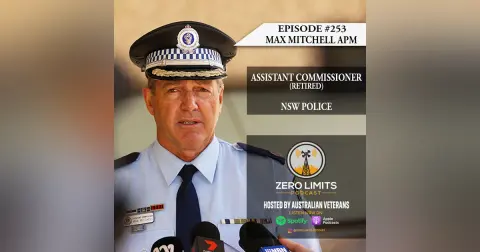
Ep. 253 Max Mitchell Assistant Commissioner (Retired) NSW Police Force

 Apple Podcasts
 Spotify
 On this Zero Limits Podcast Matty Morris chats with Max Mitchell Assistant Commissioner (Retired) NSW Police Force.
Max Mitchell spent over four decades in the NSW Police Force, rising from a young constable in Newcastle in 1981 to Assistant Commissioner. Along the way he worked as a detective, police negotiator, and undercover supervisor, and commanded some of the state's busiest regions. He led the NSW police response to the 2011 Christchurch earthquake, stood up the state's Police Transport Command from scratch, and drove major reforms that cut alcohol-related violence in Newcastle's nightlife precincts. A recipient of the Australian Police Medal and holder of degrees in investigation and terrorism studies, Max retired in 2022 as Northern Region Commander after a career defined by frontline policing, crisis leadership, and reform.
Website - www.zerolimitspodcast.com
Instagram - https://www.instagram.com/zero.limits.podcast/?hl=en
Host - Matty Morris
www.instagram.com/matty.m.morris
For the new Zero Limits Pre workout and creatine supplements head to link below
Zero Limits Supplements - www.zerolimitssupplements.com
Sponsors
Instagram - @gatorzaustralia
www.gatorzaustralia.com
15% Discount Code - ZERO15
(former/current military & first responders 20% discount to order please email orders@gatorzaustralia.com.au
Instagram - @3zeroscoffee
3 Zeros Coffee - www.3zeroscoffee.com.au
10% Discount Code - 3ZLimits
Instagram - @getsome_au
GetSome Jocko Fuel - www.getsome.com.au
10% Discount Code - ZEROLIMITS
It's time for the Zero Limits Podcast, hosted by an Australian veteran. Chatting with high-charging humans with hectic stories from around the world. We'll give you the motivation to take on whatever life throws at you in the game to complete any goal you set your money to. Let's go.
SPEAKER_05Zero Limits listeners on today's Zero Limits podcast. Joined in the Newcastle studio by a 40-year veteran of the New South Wales Police Force, 12th of January 1981, the 20 at the 22nd of July 2022. He reached the heights, the dizzy heights of assistant commissioner. Spend a lot of his time uh down in Sydney, however, a large portion up here in Newcastle as well, as the commander up here. So we'll definitely talk about that. But uh just quickly, Max Max Mitchell. How are you doing, mate?
SPEAKER_02Yeah, good, thanks, man.
SPEAKER_05Mate, appreciate you coming in and uh wanting to share your story. I think you reached out and I was like, mate, 100%. I think last time I was speaking, we spoke about this offline, having Nick Caldus on. And people at that level, it's it becomes less policing, more political. So that's the reason I wanted to get you on, so we can talk about obviously your policing career, but that top end that no one gets to see where all the the corridor creepers are, they say.
SPEAKER_03Hopefully I wasn't one of those.
SPEAKER_05And it's funny because when you did reach out, obviously I I get my character references out there, reach out to a few people. Mitch Ashworth is one, Kane ICOP and he said, Thank you for helping him one time.
SPEAKER_02Yeah, good man.
SPEAKER_05Yep, exactly. So and I reached out to a few other guys and they said, Yep, he's one of the good bosses, you know, that's it, which is rare, which which shouldn't be rare.
SPEAKER_03Well, that's lovely to hear, but I guess, Matt, along the way, there's always one or two that you've upset. And uh there is, yeah. That's right. It comes with the territory. Yeah, yeah.
SPEAKER_05Well, that's it. Being the being the big dog, mate. Yeah, can't keep everyone happy. And you've seen it with with the news and the media and the government. This country's going crazy. It's absolutely crazy. We'll talk about what I want to do with your podcast, like we do with all the other ones, is you know, you talk about your policing career, but also move into that political aspect. And obviously, we spoke about this offline. You had to stand up in front of the media a whole bunch of times as well and deal with them. And like we like you said, there's a different between the media groups, you know, you've got your your Sydney-based Chai Latte drinkers, and then you've got your you know, your Newcastle, Novicastrian type media guys that were actually really good and wanted to present real news.
SPEAKER_03Yeah, yeah. Look, Sydney's ruthless, there's no two ways about it. We're we're regional, particularly NBN up here. That were fantastic to work with. And also, you know, the local radio stations that wanted to get the uh the word out to the the general community.
SPEAKER_05Yeah, yeah, that's it, mate. Shout out to 2HD. I listen to them every day. Show my age, mate. It's funny, like when I I realised I was getting my old old, I switched from FM radio from you know Nova to 2HD AM.
SPEAKER_03I I listen to a lot of Spotify these days.
SPEAKER_05Mate, uh like I said, let's get back to the younger days. You know, you joined 1981, so you know, I wasn't even born.
SPEAKER_03Oh, thanks, mate.
SPEAKER_05Yeah, two three years later I was. Mate, run me through. Like what where'd you grow up and yeah?
SPEAKER_03Well, I I I was a Newcastle boy born and bred. Um my father was a police officer. Mum in her earlier days was a uh a buyer for for the um the clothing side of business. Um but with dad, it it got to a stage where you know, about 16 I was looking at leaving leaving school and there was just no apprentices um anywhere. And I always wanted to be a carpenter, of all things. But anyway, went back to year 11 and 12 at Gateshead High, which was a pretty rough, rough uh knock around school back then.
SPEAKER_05Still is.
SPEAKER_03Yeah, it is. But dad dad pulled me aside one day and he said, Look, what are you gonna do with yourself? And I said, Oh, I don't know, I haven't really thought about it. And he said, Well, it's one of two things. You're either gonna go and join the police or you're gonna go into the military. And I went, Yeah, police sounds pretty good to me. And that's like I didn't want to go and change the world, you know, be the be the you know, the the super cop or anything like that. It was just simply I had great respect for my father. So uh yeah.
SPEAKER_05And this this is uh obviously in the 70s.
SPEAKER_03Yeah, yeah, yeah. So 1981, I joined as what was then uh junior trainee. So we used to have police cadets because of my age. I was I was 18 at the time, so uh you couldn't attest um until you were 19. Um so I did a little bit of time as a junior trainee down at Chatswood and I worked for what was then the education and training branch, and Jack Avery was the the boss back then. And if you know Jack Avery, he used to be one of our police commissioners and and a fantastic individual. But anyway, I um I worked there until I went into the academy at Redfern uh and uh and did my time. I attested two days after turning 19, and I s I was uh I was allocated to Hornsby Command back then, lived up on the Central Coast and and worked at Hornsby. You know, and a funny story was my first day at Hornsby because I'd never I'd never sighted Hornsby Police Station. Caught the train down from uh the Central Coast down to Hornsby, got off. I thought, which way do I go here to the police station? And I thought there's an old lady over there, she'll she'll point me in the right direction. Anyway, he said, excuse me. I said, It's my first day, and I said, I'm just looking for the police station. And the old bugger just laughed at me. I thought, oh thanks very much. But uh anyway, I found the police station and and that was my uh my first my first station.
SPEAKER_05Growing up, how were you uh with the discipline? And obviously your dad being a police officer was also I'm sure he gave you a clip here or there when you needed it.
SPEAKER_03Yeah, look, you know, mum and dad were were were good parents. Um my sister, who was a bit older than me, she was, I always say, she was the brains of the family. Um she had a master's in different things in the education side of teaching. But for me, I uh I had no real interest in school other than playing sport. So I was never academic. Um I really enjoyed my my time playing sport, but I did a lot of surfing. Most most most sports I played, you know. I played soccer, played cricket, um, I played rugby union for for Warata back then. Um but uh yeah I found like I I wasn't one to to stray too much from doing the right thing, I guess. I was never a goody two shoes, but at the same time I I really enjoyed my surfing, surfed a lot of Dudley um in those days and uh and enjoyed that. And as as I said, you know, it was really dad that pulled me aside and said, Well, it's time to knuckle down. And I just had you know huge respect for my father. Yeah. So it was just a case of you know what, dad says, go and do this, that's what I do.
SPEAKER_04Yeah.
SPEAKER_05How long was he in the job for?
SPEAKER_03He was I think probably about 36, 38 years. He retired as a chief inspector down on the central coast, which probably now would be the equivalent of our superintendents.
SPEAKER_05So he spent a lot of his time up here in Newcastle, though.
SPEAKER_03Yeah, yeah. He was a he was a well-known detective for many years um around Newcastle, um, well known.
SPEAKER_05But um How did they go for you at school, you know, with the other kids? They didn't know. They didn't know. They didn't know.
SPEAKER_03Where where my girls, I've got I've got two girls, God love them. But the poor buggers, because I was on the media so much. Everyone knew. Everyone knew. And I did a lot of work, which is probably a good thing. Yeah. I I I I don't know whether that's the case or not, but anyway, um, I always remember at one stage when I was the boss of Newcastle and did a lot of work with the uh with the alcohol regulations and the lockouts and different things. And so I did a lot of media, and uh, I always remember the the youngest sort of saying, Dad, do you have to do so much media? Everyone at school's giving me such a hard time. So, you know, that's that's just a change, I guess, of of the uh the social side of of growing up, you know, from where you know, in my days no one knew who my father was because he was never on the media. Yeah. Where where through my career I was I did a lot of media, so yeah, the poor old girls really were really copter pizzling at times.
SPEAKER_05Oh, I mean that you know, he'd be up there going, Oh yeah, answer this question. You're like, if anyone's out there trying to date my daughters, I'll send I'll send the TAU to your door.
SPEAKER_03Yeah, I I did ro I I always remember rolling up at at home there one afternoon, you know, I'm in in full uniform and walking in and and one of my daughters was talking to one of the one of the boys on on her bed, and I just stopped and said, uh get out here, go down on the lounge where I can see you, and you don't touch my daughter.
SPEAKER_05Yeah, right, mate. Uh now back to you know, getting to the academy. Again, you spoke about you, you know, your plea your dad uh being a police officer, so that discipline's within your family. Uh as you said, you're more into that sports, you're trying to find purpose. Obviously, everything else is not gonna fit, so you thought I'm gonna join the police. You join the police, get to the academy. How did you go down there? And again, this is this is a long time ago. This is before political correctness, there was there was only two genders. It was quite back hands, yeah. That's right.
SPEAKER_03Yeah, you know, walking through the uh the gates there at Redfern Academy, you know, I can I can still picture it quite vividly. Um and the instructors back then, you know, as soon as you walk through, the screaming started, get it get your backside over here.
SPEAKER_05Very paramilitary.
SPEAKER_03Oh, it was. Yeah. It was.
SPEAKER_05And that time too, that's you know, this is the Vietnam era. Yeah.
SPEAKER_03Post. Yep. And of course, for for me being a a surfer, you know, I'd had the the tan skin and the blonde locks. Get yeah, get your backside across the road to the barber, go to that barber and get a haircut. That was within five minutes, and then report back to me with a haircut. Okay. But but back then, of course, everything was, you know, it was manual, you know, every everything we read was was in a book, it was paper. Um but the instructors back then were, you know, as an 18-year-old, I learnt so much from them, you know, the discipline side of things, still had the respect for them. And yeah, if you got a kick in the back side, you you knew you deserved it. And you just got on with things and you learnt from the mistake and and moved forward.
SPEAKER_05You didn't contact the HR department?
SPEAKER_03No.
SPEAKER_05There was none.
SPEAKER_03There was none. There was none. So uh yeah.
SPEAKER_05How long was the academy?
SPEAKER_03Twelve weeks.
SPEAKER_05And again, this is in Redfern, not your current day Goblin.
SPEAKER_03Yeah, and that that's that's right. Twelve weeks at at Redfern. Yep. Um and I I you know, I think one of the the greatest things that came out of the time at Redfern was signing a one-page document that that um created the pre-88 scheme for me.
SPEAKER_04Oh, yeah, yeah.
SPEAKER_03Yeah. So thank God to those instructors for giving me the paper and saying, Don't ask questions, son. Sign this. Yeah, I remember the the guy at the front of the class said, I'm gonna give you a paper, don't anyone question it, just sign your name to it. And of course, you know, the rest is is is history with a predefined scheme that I'm I'm now one as a retired member of the police force.
SPEAKER_05Yep, yep. Um, just quickly, in regards, you know, you spent 40 years in the police, you've seen the the changes of obviously Red Fern moving to the Golden and turning more into a university subject. Now, a lot less things happening at the academy. You know, again, you're probably exposed to morgues and dead bodies and everything back then. You would have seen, again, seen the changes over the years. What type of differences are we talking back in the 80s there?
SPEAKER_03Oh, look, huge change from from when I started to to what the men and women go through now. Um you know, I was mentioning to you my first day when I went to Hornsby Police Station, my first shift, I was pulled aside by you know a constable, a senior constable, and uh he said, Alright, son, let's go. We're we're going down to the morgue. I've got a postmortem to to witness. And I'd never seen a dead body at that stage. So my first day, I was introduced to a dead body and sat through or stood through a post-mortem. A couple of times they said, You're right, you know, you you're feeling okay. I stuck it out. Um but it was uh it was in it was interesting. But you know, nowadays it it never happens. Um, you know, even police, you know, with some suspicious deaths don't even have to go to the the mortuary anymore to to witness a post-mortem. So it's it's changed dramatically, you know. Even like I said, the discipline that was, you know, at Redfern, you know, the yelling, you know, you're you're a dickhead, um, you know, wake up to yourself and they they'll apply it, and they'll fuck you, you know, clip over the ear or whatever the case may be, those days have gone. Now, whether that's good or bad, um, you could you could sit through a whole host of of people and listen to their stories. Um I do think that the psychological side of our men and women these days, um we haven't got that right. I I think there's a lot of people that are introduced to policing that go, Whoa is this for me? Um I think they they believe that a lot of policing is is very much or very similar to what they see on on television. So they're not prepared for it. But at the same time, if you're not prepared for it, that's okay. It's okay if you had to go to a post mortem and you felt sick or you're you're gonna pass out. You'll you'll get through it, you know. Someone will give you you can go outside and take a deep breath or throw up or whatever. Yeah. Um but the the the most important thing is you'll you'll get through it. It's not gonna kill you. Yeah.
SPEAKER_05Yeah, I I think you know when you talk about the the psychological aspect of people, you know, the cops these days, there's obviously a ton of good cops out there, men, women out there, absolutely killing, and I know a lot, and absolute badasses too, getting out there hunting, doing their job, you know. The what the what us as a civilian, what I want them to do is get out there and and bust the criminals, but it sucks with all this social media because the stuff you see on the New South Police social media, they're just selling a false product. There's they're showing this happy you know, pride flags and their patterned horses here. And what about the door kicking? I don't know. The the the the you know the times where there's cops getting bashed. That's the stuff we want to see because that's going to present what an actual police officer goes through. And then, you know, we go through these issues of you know that cop that got charged because you know the kid crashed into his car and the cop a couple of weeks ago down Penrith pushing people. Yeah. You know, we we're not seeing we're only seeing this, everyone's now blaming the police because they're not seeing what police go through. Yeah, yeah. The criminal side.
SPEAKER_03Yeah, look, there there's so much we could we could discuss and thrash out. Which we will, Matt. We'll get down there. But one of the things that the men and women have to put up with today, the hypervigilance that's caused by you know, every time they step out of the truck, you know, someone's got a camera on them. And you go, really? Like, why are you why are you doing that? These these people, these men and women are only doing the job to protect you and look after, you know, the the victims of crime. But but the hypervigilance that's caused by our social media side and the media is just incredible these.
SPEAKER_05I think that hypervigilance also is carried on by the lack of do you know the the brass that are not backing their cops, you know. For example, you know, the that cop that pushed that guy a couple of weeks ago, it was only the the association that came out and said, Whoa, whoa, whoa, like how about we just slow this down for a second, let's get the full picture before we start pointing fingers.
SPEAKER_02Yep.
SPEAKER_05Well, you know, where was the the the brass then? They should have come out and did the same thing.
SPEAKER_03Yeah, yeah. And again, I think that goes more to, and I'd like to think it goes more to um the Sydney metropolitan media than regional media. Yeah. I think regional media uh like I've I've always found, and I don't want to harp on it, but I always found them so supportive of the local police. Yeah. And they'd listen, you know, if you said, look, there's more to this story, they'd go, yep, understand. Where Sydney, no, it's it's all about the clickbait. Yep.
SPEAKER_05Yep. Yeah, they don't care. No. They don't care at all. Mate, uh, we deviated off track. There, we'll we'll talk about all that political stuff down the track because I I find it interesting, and I think there's a lot of young cops out there on the street right now listening to this podcast, going, you know what? That's what I feel right now. Like, why aren't the pol why aren't the bosses backing me up? Anyway, we'll get there. Uh back to your academy, you've done 12 weeks down there. Uh, what are you getting exposed to? And this is back to the old s six shooter and oh yeah, the old Smith and Weston. Yeah, yeah, yeah.
SPEAKER_03Yeah, yeah. So uh, you know, you learnt your your basics like you still do with your firearms, your hand, you know, your handcuffs and all that that basic stuff that you you need to know uh as an officer when you're on the street, uh your powers of arrest and and so forth. Like back then we used to know our powers of arrest, you know, off off hand, you know. It wasn't on an iPad. That wasn't on an iPad. You couldn't you couldn't just check it up on your T, yeah. You couldn't ask Chat BT BT what's our powers of arrest. Um so you you had to learn a lot in regards to you know that basic legisl legislation, regulations, uh how to operate on the street. And and look, I I enjoyed my time. You know, I enjoyed for someone who was an academic at school, I actually went, you know what, I'm I'm interested in this. This all makes sense to me. And I wanted I probably wanted to be the best police officer I could be because I was proud of my father. So I I worked worked pretty hard when I went through the academy.
SPEAKER_05Yeah. You spoke about you finished at the academy, you get to Hornsby, your first day, you check you going into the morgue. What's happening in that uh actually we'll go back, you know, this is 40 years. Let's let's see if it let's test your memory. Oh god. How was that first couple of weeks on the job and you know, is is there any arrests involved? Did you uh go to any traumatic scenarios, you know, a dead person or whatever?
SPEAKER_03Yeah, look, I I think you you know, we we well I was introduced to uh a fair bit uh at Hornsby. It wasn't the busiest of of locations, but it was a good it was a good police station to to learn the basics, I guess, and and and uh and introduce you into the world of policing. Um yeah, look, I was involved. One of the things I loved about working in Sydney was whoever you worked with, like even your senior operators, the ones who were responsible for training you, were only uh probably a constable first class. So they'd only been out on the street for you know five minutes themselves. Yeah. But the thing that I always loved about that was everyone was motivated. You know, if if there was a you know an arm.
SPEAKER_05No, no.
SPEAKER_03Yeah. If there was an arm rock, everyone wanted to work and lock up crooks, you know. The old basics of, you know, why why why did we join the the cops? Because we won't wanted to chase crooks. It was like that. The amount of pursuits, I always remember being in the pursuit in the old Ford 100 truck, you know, they'd turn the airfield upside down, so it had a more throatier sound to it. But you always everyone got excited when up at Mount Penang, the juveniles would break out and they'd steal a car, and guess where they came? Down the old F3, as it was known back then, the F3 freeway, and would just sit on the side of the the freeway there somewhere and get into pursuites, and it was just on for men and women. Well, I always remember going through the old toll gates and and um the senior officer was driving it on on this occasion. And Ded said, I reckon he must have sucked the old operator out of the little box. He was going that fast. But we used to, you know, have great pursuits, you know, they'd have the uh the poly air up in the in the sky, um, the news cameras were up in in their helicopters. It was on on for men and women. Yeah. It was it was great, it was exciting. Yeah, yeah. But I loved working at at Hornsby um with you know other young cops because I was so motivated.
SPEAKER_05Yep. Just just for the young folk out there, we back in the day we used to have uh toll operators, so they'd sit in the little boom gate, and the boom gate you pay your money and the boom gate would open. These days you've got your little tag things, and you don't ever see a a person sitting on the side of the road uh collecting toll money. But uh yeah, anyway. Your first week on the job, you did you get oh, you know, first couple weeks on the job, you're getting exposed pretty quickly to policing. And like you said, you know, you're all pretty young. So your your field training officer was quite young as well. And like you said, everyone is almost a blank canvas, and everyone's keen, everyone's motivated. And I think uh you know, more politically now, there's a couple of field training officers out there that I've heard that have been quite quite lazy, and and this can breed, you know, that that same mentality. Whereas you guys were just everyone was young and fighting, and it was not just want to get out and hunt.
SPEAKER_03Yeah, I look, there was nothing nothing more when you when you used to come to work and you'd look at the first thing you used to do was pick up the the roster and see which truck you were on and who you were working with. And you you're dead said you you would be excited if you were working with a a motor another motorbike on top. Yeah, it was great because you knew you You were gonna have fun on the on the shift. And uh you'd get involved in anything and whatever came along. Yeah. Um, you know, when you when you worked with the operator that was, you know, dragging, dragging their feet around, didn't want to, you know, answer answer calls to the radio and different things, it was a bore nothing worse than a boring shift, but man, I I I used to get the shits with with working with lazy cops. Yeah.
SPEAKER_05Like we said uh earlier, you know, I fit the fitness pays a big part in a lot of this. And these days, I guess there's a lot of cops that are quite unfit and I guess very unmotivated. And I've heard the stories, you know, every time I do a podcast like this, I'll get messages flooding in the inbox, and like, oh yeah, I know this guy that just doesn't do anything and doesn't answer calls, doesn't care. He's only here just because he's getting paid.
SPEAKER_03Yeah, look, hopefully we'll come back and discuss a fair bit, Matt. But I'd always say to those men and women, if you know, if you're not physically fit, you've really got to have a good look at yourself in the mirror. Um, because fitness plays such a key role, not only with doing your job, but also maintaining, you know, as best you possibly can, good mental health.
SPEAKER_05Yeah, mate. Said it time and time again. And if you're out there, just head to zero limitsupplements.com. Grab yourself some pre-workout. Mate, uh, yeah, right. So the first couple weeks on the job, you're down in Hornsby. How long did you spend down at Hornsby?
SPEAKER_03Uh I spent, I think it was roughly about sort of 15 months thereabouts at Hornsby.
SPEAKER_05Um exposed to a lot of policing, of the full spectrum of policing?
SPEAKER_03Yeah, look, at Hornsby back then, um used to like motor vehicle accidents were significant, um, bad accidents. You know, you'd you'd cringe like you'd get a call because a car's hit the the wall on the um on what was then the F3. Used nowadays it's the M1 for people.
SPEAKER_05Um but if the car seatbelts were optional.
SPEAKER_03That's right. And some of the some of the trauma that you would see. I always remember one of the most traumatic uh scenes that I went to was um down Bob and Head. And if you've ever driven down to Bob and Head, it's a really windy, steep bit of roadway, quite narrow in places. And what had happened on this occasion, there was a a young male and and female, and they were with family members down at Bob and Head, they'd spent the day down there, and for whatever reason she got on the the uh the back of the motorbike and off they went up to leave Bob and Head, so they're heading up the hill at speed. And he's taken a corner too sharp, hit another car, he was thrown into the the brick wall, um, and and obviously died through you know with with his injuries and she was decapitated. But what was worse, so we've got on scene, but what was worse was the family found out, you know, the message got down to them that there was a bad accident. And of course, you know, her head was just covered in a tea towel. That's the best we could do. Um, and removing those bodies from, you know, the the the bodies themselves were you know quite traumatically uh um injured. Um but dealing with the family and trying to keep keep them at a distance and looking after their welfare and different things, like for for young cops that was difficult. Um and that's something that always stayed with me throughout my career, you know, seeing that scene.
SPEAKER_05Again, like I've had a whole plethora of cops on the podcast, and they've they've said that, you know, that always the hardest part is dealing with the aftermath more, you know, the delivering the death message or dealing with the family on scene. That's just gotta be a rough, rough scenario. Yeah, I look and when you're not only doing it once, you're doing it twice, three, four, five, six, seven, ten how many times have you done it in 40 years?
SPEAKER_03Yeah, I know. I know. Well, look, there was nothing worse than a cot death. Yeah. They were always so difficult to deal with, you know. Having a a mother and father with the the new bub. Um, they're just so traumatic. And you know, I probably thank goodness there seems to be, I I don't know personally on on the the facts and figures of this, but it it would appear that there's far fewer a lot less these days for sure. Which is great. Technology Yeah, that's right.
SPEAKER_05Yeah, yeah. It's I'm sure you did the same when you um when you had your first kids. I did the same when my first child, like I used to wake up every night. This is 2000, 2007, she was born, and I'd wake up like midnight, just walk up to a cot just to just check, like, is she breathing? Yeah, like it was and I did it for months on end, just because it was such a I think I guess a prominent thing, us growing up in the 80s, 90s, etc. It was just a like you said, it was it was always on the news too, like oh cot death, cot death, cot death.
SPEAKER_03There was look one of the one of the you know, one of the guys I went through um policing with Mick Corboy, Mick did a lot of um um work in regards to Red Nose, which was you know, all in respect to to cot deaths, you know, some some fabulous work by that's one of the things I always admired about so many police. Like policing was hard enough, but to then get themselves involved in in some of these sort of social movements and for the betterment of of society, I always take my hat off to them.
SPEAKER_05Yeah. So you spend that first year and a half down, Hornsby made you get the full exposure to policing, chases, uh, deaths, everything, arrests, suicides, arrests.
SPEAKER_03Yeah, yeah. Look, it wasn't, you know, it wasn't in terms of major crime, it was more volume crime, you know, accidents, deaths, uh basic drugs. But back then it was nowhere near the the scale now. The scale that we have today. But a lot of juvenile, you know, youth, youth offending and and different things. So it was a good place to to learn the basics of of policing.
SPEAKER_05Yeah, and where did you go from there?
SPEAKER_03Up here into Newcastle.
SPEAKER_05That's it, back home, mate.
SPEAKER_03Yeah.
SPEAKER_05Where did you grow up in Newcastle?
SPEAKER_03Out of Charlestown.
SPEAKER_05Oh, yep, gotcha, gotcha. So where'd you get posted up here?
SPEAKER_03Uh started off at Newcastle. Yep. Um, and what a difference. I always remember um like walking into Newcastle police station and just the difference, the age difference. So in Sydney I worked with everyone was young. And came to Newcastle was like retirement village. This was like dad's army.
SPEAKER_05Yeah.
SPEAKER_03And I and I'm you know, I was the only young single guy. Everyone who I'd worked who I worked with was married, and uh and look, you know, their motivation, I guess, for arrests and and getting out on the street was you know, it was waning in in comparison to what I had I'd come from down at Hornsby. It was chalk and cheese, I guess. I always remember driving down uh Hunter Street Um with a sergeant, and these guys, these two guys started to have a scuffle. Anyway, one one guy picked up the other guy and threw him through the plate glass window. I think it was like the old store or something like that, down on Hunter Street, and I've hit the brakes to to get involved, and he put his hand across to the the steering wheel and said, No son, keep driving. Just they'll they'll sort it out.
SPEAKER_02It's Newcastle. Yeah.
SPEAKER_03And I went, uh, okay. So um yeah, I spent a little bit of time at Newcastle before they they sent me here to Mayfield. Yep. And Mayfield was a really good uh police station to work at.
SPEAKER_05I was gonna check the population of Newcastle back then. What are we talking about? Oh, about 1982, 83. Let's check the population. You know, you've you've been here a long time. Yeah. Uh Newcastle population. 1982, Jesus Christ. Uh Wow. Only 297,000.
SPEAKER_03Yeah. Only back well back then you had uh BHP. Yep. That was in full operation. Com steel, full operation. And I remember many a night at Mayfield Police Station, particularly in summertime, where you had those really hot humid nights, and like two, three o'clock in the morning, you'd be outside on the front steps of the police station trying to cool down because there was no such thing as air conditioning and and different things. And you just had that polluted smell sort of drifting through the steel mill. Yeah. Yeah. I I can I can still picture myself sitting out the front steps with, you know, a couple of the other boys, just, you know, you'd be chatting and trying to cool down. And just that that yeah, like a um rotten egg gas. Yeah, yeah, yeah. It had that sort of smell through the through the subway.
SPEAKER_05How busy was the Newcastle station at that at that stage? Yeah, this is only 300,000 people, so it couldn't be too.
SPEAKER_03It wasn't too bad Newcastle. Newcastle was I don't know, it was just it wasn't a great station back then. Um it was pretty boring. Like you used to do a lot of prison runs. Um so you'd take the prisoners from the court and you'd run them up to Maitland jail. And it was a bit of a funny experience. Uh my first prison run. I've got up to uh to Maitland jail and opened up the back of the the F 100 truck, and all of a sudden this guy goes, G'day Max, how you going? Well, someone I'd been to school with. So we were having a bit of a chat before he uh he was taken off by the the corrective services and off he went into the into the jail system.
SPEAKER_05G'day Max.
SPEAKER_03Yeah, yeah, yeah.
SPEAKER_05So but what did he do? Dunno.
SPEAKER_03Oh, I can't remember. I think he was an arson actually.
SPEAKER_05Oh, was it?
SPEAKER_03Yeah, oh yeah, it was a bit of a bit of a character, bit of a lear.
SPEAKER_05Isn't it crazy he'd like how you know you meet up years later, but your life's taken a total different direction. Yeah. And like I'd like to know what where where do people how does it deviate for people? Yeah, and I'm sure you being a police officer, you'd see it, you know, dealing with youth offenders, and I'm sure it stems from their parents being shitbags too, and it just it's a flow on effect.
SPEAKER_03Yeah, look, it's you know, I think there's there's that aspect. Uh, you know, the the parenting comes into question. You know, whether dad, whether mum, whether both were were drug addicts or, you know, they're addicted to alcohol, um, lower socio-economic, you know, they get caught in that that vicious cycle. Um But you know, some of the the some of the youth that uh over the over those years that you'd want to kick in the backside or give them a clip around the ear, they were the sons in I won't the girls were pretty good back then, but the sons of lawyers and doctors who would want to say, Do you know who I am? Overentitled. Overentitled. Yeah. And he'd go, oh my God. You know, do you understand how privileged you are? And there's kids that, you know, they're they're lucky to have shoes on their feet back then. Um that's you know, that was just something I I you know I picked up from from youth back then. But but but for me, I I found um I was pretty I was always pretty sort of easygoing with with people. So it was never a case of, you know, if you and I went to school together and you were a bit of a rough head, that that wouldn't cause me to say, Oh, I'm not dealing with you, or I'm not speaking to you if I saw you on the street or if we were out in the surf. You know, you're you were someone I went to school with and I'd say, G'day Maddie, you know, how you been, mate? Haven't seen you for a while. I was always friendly, it didn't matter whether I knew you were a crook or not. Um, there was a, you know, obviously uh being a police officer, yeah, you know, we weren't going to be best of mates and and hang around, but certainly I still had respect.
SPEAKER_05Yeah, everyone takes their own routes, don't they? Yeah, that's right. Yeah, yep. Yeah, it's funny say that because you know I've got a really you know, a lot of good friends that are within uh outlaw motorcycle groups, and they you know, a couple of them are really good friends I served with. And it is what it is. They they do what they do, and that's right. I'm still mates with them. I'm still friends with them because they're good people. Yep. What do they do on their side hustle? That's that's their own business. Yeah. If you get caught by the police, then that's it again, that's your fault.
SPEAKER_02Yeah, that's it. That's it.
SPEAKER_05Mates, uh, like you said, from there, Newcastle, come out to Mayfield, probably a little bit busier, uh a bit of a it's been a rough area for a very long time.
SPEAKER_03Yeah, we had the blue-collar worker and so um it was always rougher. You know, there was no like domestic violence was something back then, but it was nowhere near um the the the policing requirements that it is today. So, you know, you'd you'd rock up to a house if you know the the father had been, you know, knocking the the mother around, you you you'd still throw the father in for assault and and different things, but it was very hands-on back then.
SPEAKER_05As you need to rough them up as well. Well give them a you'd allegedly give them a left-right good night.
SPEAKER_03You'd never give them a rough up. But no, no, no. Amazing.
SPEAKER_05See the twinkle in your eye.
SPEAKER_03It was it was on, it was on. I I you know, there was a there was a guy, um, I'll just refer to him as Alex, and and Dead said, he had hands three sizes bigger than than most males. Like he was a big boy. And this is a police officer. And I always remember he was working with one of the sergeants on night work, and the sergeant was out the back having a bit of a kip, and Alex took a phone call and off he went by himself to a domestic um dispute. And I said to him, I said, Do you want me to come with him? Because I was doing the station back then. I said, Do you want me to come with you? And he said, No, no, no, it's all good, it's all good. Anyway, probably about 45 minutes later, in he comes the back door, and he's got uh it was one of the Pacific Islander boys, the the father, and he's dragging him in with a couple of wallops with the old batten you used to put in your pants back then. But it was on. He he had fought with this Polynesian guy for you know a good half an hour to get him into the truck, and that's what it was like back then. Yeah, it's it's changed so much in regards to you know the the physicality, I guess, of the job. Like now, even with you know, dealing with you so so many young people, yeah, you gotta be really vigilant that they're not carrying a knife. Well, so every second one they all do now, isn't it? They carry knives and that and they'll stick you with a knife as soon as look at you. Yeah. So it's where where back then it was almost like uh, all right, if if it's if you want to arrest me, we're gonna have a a fisty cuff. But that's as bad as it got. You know, you'd you'd finish shifts and you'd have blood over your shirt, your shirts would were torn and different things. But it was good, it was good fun.
SPEAKER_05Um what about the youth crime back then? Because again, like we speak about now, it's out of control now, absolutely out of control. Only because the kids now they just know we're just gonna get away with it. Yep. Carrying a knife, who cares? Cop's gonna take it, I'll go to court, and they're just like, Oh, he's he's too young anyway, we don't care. Dolin Kapax, he doesn't know what he's talking about. Yeah, his brain's not developed yet.
SPEAKER_03Yes. Well, we still had those sort of issues to a a lesser level, yeah. Um back in the eighties and and the nineties. Um but but certainly now, uh like but well, sorry, let's take a step back. So with youth back then, you know, if if someone was arrested, you know, quite often they'd get a foot in the backside, you'd take them home, and then the father would give them the rounds of the the yard. Yeah, like it it was just uh the way we we operated back then, and that's what society expected. Yeah. Today, um, don't touch my son or my daughter. Yeah, and and look, now females I I think have become worse to deal with than young males. Like some of the scenes that you used to see, or you'd listen to the constables and what they were putting up with, you go, Oh my god, what what is happening with our our young people? Yeah, mate. But but having said that, there's still some tremendous young people out there. Oh, 100%, 100%.
SPEAKER_05But like you said, mate, there's uh no repercussions these days. Like you said, mate, also, you know, for me, I remember back in the it would have been late 80s, 90s, so I would have been like six or seven years old, ride my pushy, maybe a little bit older, eight or nine or something, I can't remember. Wasn't wearing my hat, had my helmet on. It was me and my brother, had my helmet, my brother had his helmet on, had my my helmet on the side of just hanging off cop pulls over. So mate, put your helmet on. I said, well no, I don't have to listen to you. Yeah, he gave me a clip, put me in the back of the police car. My brother rode to I only lived like a block away from my my dad, mum uh separated. He took me to dad's house and then dad flogged me.
SPEAKER_02Yeah.
SPEAKER_05I'll I I'll tell you what, I wore a helmet for the rest of my life. I still wear one now.
SPEAKER_03Yeah, yeah. I I reckon as a kid, I was too I was too frightened to step out of line. Well, because there was no greater fear for me than getting picked up by the cops and then going, I'm taking you home to your father. Back to your father, yeah. Oh no.
SPEAKER_05Yeah, right, mate. So obviously Mayfield, a bit busier. How long you spend Mayfield?
SPEAKER_03Uh I spent about 18 months at Mayfield. One of the things I did in my younger career.
SPEAKER_05Sorry, where is the police station in Mayfield? It's not there anymore, is it?
SPEAKER_03No, I used to, I think it became the post office. Sort of. It did, yeah. Yep, yep.
SPEAKER_05Yeah, it was it was um because this is all under command of Waratar, isn't it, now?
SPEAKER_03Yes. Yeah. Yep. Yeah. So back back then it used to be the old post office. Yep. Um, and it was a really busy location. Um, you know, some of the industrial deaths, oh that you know, they they weren't pleasant to to go and a BH steal. Yeah. Um but it had pretty well everything, Mayfield, you know, from murders, um, you know, armed robberies, uh, you know, si really serious assaults. Uh it was it was a busy place to work.
SPEAKER_05Back when people used to rob banks, the good old days. Yeah, that's it. That's it.
SPEAKER_03And and a good crook was was always respectful to the cops. Yeah. They that you know, quite often if you got a good crook, they'd say, no, fair cop. It's a cat and mouse game. It was a cat and mouse game. If they were good enough to get away, so be it. But when you caught them, none of the bullshit you have in today's world. Yeah, um, they they basically they would.
SPEAKER_05I'll be out in five years and I'll try again. Yep, yep. Yeah.
SPEAKER_03Absolutely. That's what they were like. So it was, you know, you you'd treat them fairly as well. So uh so it's so different, isn't it, to today's world.
SPEAKER_05Yeah, yeah. Probably because again, back then they knew the they'll uh again, a couple of left rights in the back of the back of the truck.
SPEAKER_03Yeah, yeah.
SPEAKER_05Well resisting arrest.
SPEAKER_03I I when I worked out at Chelsea many years ago, I um I worked with a guy, and we'll just call him Pinger, but he had a bit of a shake in his in his right hand, but when the shake stopped, that's when you're ducked. We learned that pretty quick.
SPEAKER_05Yeah, right, yeah, right. The pinger. Pinger. Was he on the pingers?
SPEAKER_03Not back then.
SPEAKER_05Yeah, I suppose, yeah, probably the heroin. Um, yeah, right, mate. So so how long have you spent at Mayfield?
SPEAKER_03Uh, about 18 months, I think.
SPEAKER_05And what what's your what's your thoughts here on the rest of your policing career? Are you loving air to you? No, I loved it. This is your career now. You're like, yep, visible life. It you know, again, this is one thing about the social media these days. I think a lot of people see a paycheck, they don't realise that policing is a lifestyle. Like it becomes your life.
SPEAKER_03Yeah, I look, it it does, and the police become your family. There's no two ways about it for the majority of us. And you know what? Throughout my career, um, I can't tell you the amount of times I looked at a paycheck. I was really not that interested. As long as I saw something going into my account.
SPEAKER_05Not much either, back then.
SPEAKER_03Not not much, probably still isn't enough these days for the for the boys and girls. Yeah, um, but I I never did think I I I never cared about the money. I just loved the the lifestyle. Um, you know, the whole thing about policing was was terrific. Don't get me wrong, like there was there was times when I had, you know, some shit stuff going on and uh dealing with some some pretty uh ordinary people. But putting that aside, I'd I when I retired, I always said if I had my chance again, I'd I'd do it all again.
SPEAKER_05Yeah. Uh from there, what were your ideas? What avenue were gonna take down the police? What were you thinking? Because obviously there's so many these days, there's a lot more. Oh, yeah.
SPEAKER_03Look, especially look, I always wanted to be a detective. Yeah. Um, dad was a detective, so that was my driving force to become a detective. And look, back then, um, you know, my whole aspect was if I became a detective sergeant, I I'd be pretty damn happy about that. So so back in the early days, I always remember getting pulled aside by one of the one of the senior guys because I'd I went general duties. Um back then I applied for the A list and to be to start the training as a detective. And the detective inspector back then for the for the district, I think they were called back then, if I remember, pulled me aside and he said, Look, son, he said, you're too young. He said, if you want to go back to Sydney, they'll take you tomorrow to to go into uh detective training. But up here, we want to see you do at least about probably five years of of good policing, good street policing. I said, Look, yep, understand. So so with that, um, there was a group of guys on the highway patrol of all things that were probably doing More search warrants in the drug unit. And it just caught my eye because, you know, again, you didn't have to work in the station. You're out on the on the in the cars and doing pretty well what you wanted to. You'd get in the car at the commencement of your shift, and you'd, you know, you could drive, you could drive up to the bay, you could drive out to Musselbrook, you could drive, you know, down to the Central Coast. You could do whatever you wanted to do. So I I went into the highway patrol and with a couple of other guys, we we got tied up with doing a lot of drug work and I loved it. And then we did that much drug work at one stage, the traffic inspector back then pulled us aside and said, listen to you three, if you don't stop it, because you know we weren't giving out tickets. Yeah, yeah. Just busting drugs. If if I stopped a car, I was more interested in just saying, look, just do the right thing and and on your way. Thanks very much. Have a good day. Um, I had no interest in traffic work, but uh yeah, I love the drug side of of things. But I was only in the highway patrol for probably about 12 months. Um, and the traffic inspector pulled me aside and said, Look, son, you're not suited. I went, not suited. And he said, No, you're not suited to traffic work. Because you did none of it. No. And I and he said, What do you want to do? And I said, I want to be uh be a detective. He said, Well, I'm gonna release you from because it used to have to do three years minimum. I said, I'm gonna do a release and off you go, back to uniform work and good luck with going into detectives in the future. So I went in in I finally got a start at in the detectives out at Charlestown and uh, you know, ran around then for probably I'm just trying to think how long it was. Probably about eight years or something like that. I I worked uh Charlestown Belmont. They were sort of the uh the Southern Lakes area. I worked as a detective there. I worked as I came into Mayfield.
SPEAKER_05This is late 80s?
SPEAKER_03Uh this is late 80s into the 90s. Yep. Uh worked at Mayfield as as a detective, which was terrific. Worked with some great, great people there at Mayfield again. Um and then there was a forced transfer system that came into place and I was moved down onto the Central Coast, and I worked in a group called the Special Operations Group and worked worked with some great people. I worked with uh Mick Gallagher, who was who later became the police minister uh for the Liberal Party. I worked with Mick. Um my best mate, it was funny, uh my my best mate who we joined together and we worked at Hornsby, he worked at Pennant Hills. And when the first day I started at the special operations group, I was walking in one door and he was walking in the opposite door, and we were both starting, and I didn't know and he didn't know. We were both starting in the special ops group on the on the same day. And we we spent we spent about the next 12 months or or whatever um you know working the Central Coast, serious crime, you know, a lot of murders back then, um, armed robberies.
SPEAKER_05What sorry, what is the again, yeah, special operations group?
SPEAKER_03It was a bit of a funky sort of squad. Um there was a group of detectives, so I think we had about a dozen or you know, perhaps 16, and and it was 50-50, so it was detectives training young up-and-coming A-listers. So uh so you had a a training partner, um, and we were really involved in in whatever came along. Whatever the the the district bosses back then wanted done, we would we'd get involved and and support whatever crime was was being investigated.
SPEAKER_05So it could be anything like drugs or guns or whatever.
SPEAKER_03Anything, anything. Anything, anything.
SPEAKER_05Because I think I know at this time Nick Coutas was part of the DEA. Yeah, again, a lot of young cops out there being like, DEA, isn't it American? No, there was actually one here in Sydney.
SPEAKER_03Yeah, so uh so yeah, we we really had a a fantastic time as as a funky squad, yeah, racing around, roaring around as young blokes on the central coast, um you know, digging into whatever we wanted to investigate. Um always that on the Central Coast, uh a bloke did an armed robbery at I think it was the NAB down in uh Man Street at Gosford and off he shot in a stolen car. And we we my partner and I pulled it up on Terrogall Drive, heading out towards heading out towards the beach, arrested him. Um he was later interviewed, charged and different things. Um it was one of the best armed robbers in New South Wales at the time. Oh, yeah. Don't ask me his name. Robin Banks. Yeah, Robin Banks. He was he was well known. And and I got down to district court when it was going to trial, and it was it was thrown out, it was dismissed because back then it was the start of the Royal Commission. And found out that you know one of the one of the detectives who was involved connected. There was some connection there. Um and at it just yeah. Yeah, investigators for the Royal Commission sort of came forward, gave evidence to to the judge at the at the time. And of course, as a as a young detective, I thought, holy shit, like I'm gonna get dragged into some Royal Commission, which I had no idea what the hell had gone on. And uh as it turned out, I I was never spoken spoken to.
SPEAKER_06Yeah.
SPEAKER_03Well, so you know, I think I had a reputation where uh you know, don't bother, you're squeaky clean. Yeah, yeah. Thank God. Yeah, thank god.
SPEAKER_05All right. I'd like to um probably read more up on that Royal Commission back in the day because it was a tarna corruption, tarn of corruption again, like again, different times. Yeah, that's technology, yeah, bank robberies, yeah. Good movies. So you get into this detective side of things, any crazy murders that you had to anything wild.
SPEAKER_03Anything wild, geez, I'd there's a few. Yeah. Look, probably I I always remember this investigation which which really tore at my heart and my partner's heart, and it came back to Mayfield actually. My mate and I uh we were working an afternoon shift this day, and and in any event, a young six-year-old girl had been abducted from a house at Mayfield, and she was a little Polynesian girl. And as it turned out, she was abducted and sexually assaulted by this grub who thankfully we were able to to catch. And uh and I always remember having him in the interview room, and you know, i it just felt like tearing him apart for what he'd done to this little girl. And my mate and I had a had a bit of a chat, and we stuck to the script because what we wanted to do was was put this bloke in in prison. And that that job always stuck with me because of the the the young girl's age, uh, what he'd done to her, and then dealing with the parents, and they were wonderful Polynesian family, um, just the heartbreak that they were going through, and they had a number of of children, of course, but um that was always an investigation that that that caused me some grief over over the years. But look, I I used to always love um drug work, used to always love drug work and uh you know getting drugs off the street and different things, and I th to me it was always a bit more exciting. Drug work and armed robbery. That that were the two probably favourite things that that I enjoyed investigating. I did a stint with major crime, uh, the armed robbery unit, um, back back in the days. So what they used to do is bring some of the young detectives from like the patrols back then into the the major crime. Um and you you play hard you played hard and you worked hard. And we did a lot of work up on on the Mid North Coast with uh with Aboriginals who were you know doing uh robberies a around the location at the time. So we spent a lot of time up on the Mid North Coast.
SPEAKER_05How do you um you know, in reference back to that six-year-old guy, like how do you refrain yourself from you know you're sitting across from this piece of shit? How do you do like it's one of the most difficult things you And it's not the first time too, like there's multiple occasions when you're like I want to just pummel this prick.
SPEAKER_03Yeah, that's right. Or or throw them out the window. Yeah, push it with you know a couple of couple of stories up. Um but I guess that the bottom line was it was always a case of you know what, I don't want to lose this case because we've we've lost control over of our own emotions. Yeah. So it was more important to to get a good brief around the individual and and get them into the into the court system.
SPEAKER_05Yeah. Yeah, I that's probably why I'm not a police officer. But uh I had uh I had Chief uh Chief Hall Grimson on, an American cop. He went through this, but he ended up bashing this guy. So got a call one day, he's a chief of this uh this county or this police station, gets a call, there's a uh a girl that's been thrown into a an in drowning in a lake. They get there freezing lake to this is uh winter time in the US, gets there, turns out the father uh launches kid into the like to kill it crazy. Uh he gets the baby out, resuscitates, keeps it alive, back to the ambos. They arrest the father. The father's taken back to the police station, chief's just warming up, getting dressed, getting his clothes, kit back on, heads back to the police station, sees him sitting in the in the lobby. That's it. Just all red and just bashed him on the front. They charged him, got kicked out of the police and everything, and everyone backed him at the end of the day. Good job. Yeah, should give him a medal.
SPEAKER_03Yeah. It's just yeah, look, it it it it's so difficult, but uh it's so important to to keep your emotions in check as a police officer.
SPEAKER_05Of course.
SPEAKER_03You know, as much as that's what you would you would like to do, and you know what, it probably would stand the pub test in in many cases. Um you probably get his time in prison too. Well, that's right. It's it's I'm not quite sure what the prison system's like these days, but back then I think if you were if you were a pedophile or you know that the guy we threw in for the the sexual assault, the raping of of the young Polynesian girl, he he would have got his just dues in inside. Surely. Surely the good crooks would yeah, sort of.
SPEAKER_05Yeah, I just saw one in the US a couple of weeks ago. Again, the US of of all places, they lured the the pedo into the into his cell and they killed him. Well they you know, if I was a judge, I'd be like, Yep, uh, your sentence has been quashed, you can you're allowed to go.
SPEAKER_03Yep.
SPEAKER_05Thanks for serving your time.
SPEAKER_03Yeah, that's it. That's it. But no, with investigations, you know, I I did a lot of drug work, um robberies, yeah. Uh um as a detective sergeant, I worked on uh outlaw motorcycle gangs uh for a period of time. Um what they were involved in and different things.
SPEAKER_05Um have you seen them change over the years? Again, they've they're more Nike bikes now, and some don't even ride motorbikes. Yeah. Back then, you know, this was reeling off that Vietnam era. A lot of them were Vietnam veterans. Yep. Yep, obviously, you know, drugs and guns.
SPEAKER_03Uh drugs, guns, you know, the money laundering side of things. Yeah. Um, they were heavily involved, but you know, they they you know, I think with New South Wales police and like bringing in Raptor.
SPEAKER_04Yep.
SPEAKER_03Um Raptor's done a lot to they did well. Yeah, they did really curb.
SPEAKER_05Especially here in Newcastle. Yeah, done well.
SPEAKER_03Really done some uh some great work. Um Deb Wallace. Yeah, Deb. Yeah, she's a character. Yeah, I love Deb. Yeah, but uh hell of a nice lady. But yeah, when she was running things, um yeah, they they did some fantastic work on the bikes.
SPEAKER_05She's been on the podcast and uh she'd rock up in her pink frock and give it to the the rebel's boss or whatever bosses out there, and yeah. I think one one one of them said she had a big bum or something, and she ended up taking down and got his house taken away from him and his motorbikes and apparently come grovelling.
SPEAKER_03Yeah, right. Yeah, no, no, no. Deb's yeah, Deb was you know, she was a a fantastic police officer, great, great detective, and then just a wonderful person. Yeah. Wonderful kind person.
SPEAKER_05She I think she's a really good example of you know not being you know, uh of a physical presence towards uh policing. Obviously, she's not gonna be one out there getting scuffles, but uh strategically uh that's what you need. You know, you need those people that are just strategically smart and use your police on the ground, your strong cops like Andrew Murphy, send them in to do the job. That's that's what your police are there to do.
SPEAKER_03Yeah, 100%. Deb, you know, as you sort of rightly said, she was always well dressed, she was very feminine, and but when she spoke, she spoke with uh a a strong or you know, strong authority and to get the message across. Basically, you know, you want to commit this crime, we will chase you and game on. Yeah.
SPEAKER_05Type of commissioner that I think New South Wales police needed, you know, like Nick Caldus or yourself, mate, you know, people with yeah, what with strategic and balls to say things and get things done, yeah. Unlike some previous commissioners who don't even know what your calibre of your pistol is.
SPEAKER_02Yeah, I know.
SPEAKER_05What's going on?
SPEAKER_02Yes.
SPEAKER_05We'll talk about uh that that top level soon, mate. Um, so you're in this detective stuff. You you know, this is your uh you start working at the special operations group 1995, and you're spending a lot of time in the Central Coast, working your way up here, Raymond Terrace, Lower Hunter, etc. Yeah, 15 something years in the job, you're still just cracking along, loving it. And now are you starting to see the rank structure now?
SPEAKER_03Is that is that yeah, well, Peter Ryan and love him or hate him is the the British pommy who came out as our police commission commissioner. He probably did more for New South Wales police than any other commissioner in my working time. Um, you know, obviously through forensics, uh, but the whole restructure, the restructure of commands, um, bringing in, you know, the structure of you know, a crime manager, duty officers with the superintendent in charge of a local area command. He he did so much in regards to improving policing, crime management units, the the structure that was created. So so back in the mid-90s, I had applied for a detective sergeant's position down at Woi Woi, and I won won that position. And shortly after they they flipped myself and the guy who won Raymond Terrace at the time. We were both promoted at the same time. He came from the Central Coast, I came from Newcastle, so they flipped us across. Um, needless to say, his father was a ex-assistant commissioner and said, I'll do whatever you want. Yeah, but but it means me getting closer to home, that's great. So I I probably then spent uh some of the best years of my policing with a team of guys, um, you know, Wayne Humphrey, Pete Jenner, Graham Parker, um fantastic, fantastic detectives, um, great people, and to this day we're probably you know solid as good mates. And of course Raymond Terrace was you know, it was a busy location because we did up to the bay. But right about then, uh as a detective sergeant running around, um, things started to change with, as I said, with Peter Ryan, with the change of the organizational structure. And so, you know, a lot of the older rank and file, uh, left left police, you know, whether they were pissed off, passed over, whatever the case may be, they left. And so all of a sudden it sort of opened up to uh people like myself, um, albeit I was probably still quite young at the time, but I had the opportunity to apply for positions. And I applied for what back back then uh was the crime manager down at Tugra Lakes. I applied for a number of crime manager positions, so a crime manager was in charge of detectives in the crime management unit as a detective, and I won the position down on the central coast at Tugra Lakes, and working with the men and women down there on the central coast, I say I was a detective chief inspector, and that was probably one of the highlights of my career. I've never worked with greater people, it was the busiest location that I've ever worked at. Um, from murders, you know, you'd have almost a murder of you know, a fortnight. Like there was because it was what we used to call it was Mount Drew It by the Ocean. Yeah. You know, that top end of Wyong, all the W suburbs that were Daubers, um, etc. Um, it was just fraught with low socioeconomic domestic violence was out of control, um, yeah, your drugs, your re your robberies, your murders, um, it was just an incredible place to work. But, you know, I always say that the men and women down there never had the opportunity to sit around the meal room and and sort of probably, you know, shitload on onto the cops, you know, how how stuffed the job is and different things. They were too busy. And I always think it was really healthy for them because everyone really worked closely, they looked after each other, um, did some terrific work. One of the things I'm really proud of down there was I created a um what we eventually called DART, was a domestic assault response team. And what we did, we worked with back then was Dox or Family Community Services. And when we sat down and looked at our repeat offenders, our repeat offenders as police married up with the repeat offenders they were doing work on. And so we we engaged and and created a team, a joint team between the pair. And really, that was all about my my whole driving philosophy with that was about trying to reduce for the men and women on the trucks the amount of domestic violence incidents they were going to. And it worked. Within 12 months, they so in the first three months, um, you know, the the intelligence side of the house would would run some data and they would identify, you know, top 10 repeat offenders within five minutes. And that was, you know, you'd only have to really go through a few weeks of of data. By the end of 12 months, they were going through six months, eight months, nearly 12 months of data to try and find repeat offending. So what what what was the crux of that was police really focused on um case managing individual repeat offenders. And we asked docs to really focus on managing the family, re-managing the victims and the family. You know, did they need financial support, whatever the case may be? At the same time, and I was always big on this, um, and and I I'd get yelled down by some of the left wingers with domestic violence. The argument my argument was, you know what, if you're a repeat offender or you were involved in domestic violence, what is driving you in that direction? Was it drugs, was it alcohol, was it uh financial pressures? Get them into some sort of management course to try and break the cycle. But of course, there was people, you know, the left wingers, who would want to argue, what are you doing with they they should just simply go to jail. Well, that's not gonna break the cycle. So there was a lot of work done on the Central Coast, which uh at the time was was groundbreaking, but it was only financed probably, I think, for a few years by government. And this is part of the problem with government. They will trial things and they'll give you some financial backing, but it's only there for a period of time. Whether that's 12 months, two years, generally it's around about that that sort of time frame. And then the money's taken away. And if you want to continue with like Dart, for instance, if you wanted to continue with that, you'd have to find the finances from within policing or you know, with with docs at the time. So it made things quite quite tight, of course, because you didn't have budgets for for that sort of uh managing. So, but that was that was some terrific work done by the by the men and women. And then the other the other side of this, this is how successful they were. So at Wyong Court, where domestic violence uh matters would take up, you know, two, three days of of the court sitting, within that 12, 18 months time frame, they were they they had finished all the domestic violence uh in s matters by morning tea. So it was it was fantastic. The the work that was done back then by by the by the men and women who were involved in in, you know, from the policing side and with the aside from Department of Community Services, they did some fabulous work.
SPEAKER_05What are they doing these days with domestic it's just back to that Put them in prison and they're back out and they do the exact same thing. And you know, we we've seen it you know in the in the past more recently, you know. I think uh just saw something the other day, you know, there's kids getting killed by these m you know people like, oh men get domestic yeah, men killing women and kids like 99% of the time.
SPEAKER_03Yeah, but this was one uh it's a crime type that I was always really passionate about, not so much in regards to you know the the victims and the perpetrators, but for the police, the impact on the men and women who like nowadays all they do on a truck is they'll go from domestic to domestic to domestic. I've heard that, yep. And the poor buggers, like the amount of, you know, like that, if that can't impact on your mental health, I don't know what does. Because when they walk into a you know, they go to a house and they start to investigate, you don't know to start with what you're walking into. Is someone armed? Has someone got a knife? Yeah, you know, all those sorts of things. Then, you know, you're dealing with the perpetrator, you're dealing with the victim, you get them, you know, the perpetrator out, you charge them, the victim, you you you support, you get them to court, or if you're lucky, you get them to court, because so many victims will flip at the last moment because they're back in love, and it's just that cycle of domestic violence. But but the men and women on you know who go around in the in the battle trucks, I take my hat off to them and I always admire them for the work they do with course, yeah.
SPEAKER_05It's just I think the thresholds change with domestic violence, do now? Oh, it is. You've got to take action. Well, yeah, you have to. You've got to take action. You just don't know how far it's gonna go. And we're again in the in the past we've just seen it.
SPEAKER_03Many getting killed. Yeah. But in the past also, Matt, I've seen some police work harder to piss the matter off and hide it, then actually, you know, it would have been a lot quicker to just made make make the arrest and get that person to court. Yep. And of course, what they'd have to always keep in the back of their mind, if they don't follow the the process, the procedures, the legislation, and something does happen to the victim, guess what?
SPEAKER_05Which has happened on numerous occasions.
SPEAKER_03We we see it all not all the time, but we do see it from time to time through the media. And those those police officers who were involved in in that initial investigation are then under investigation by you know internal internal police, um, or even you know, an oversight from from Leck, the Law Enforcement Crime uh Commission. Yeah.
SPEAKER_05Yeah, mate's uh for the listener out there, I know some of you are gonna go, oh, men get beat up by women all the time, too. You're an arsehole. Anyway, I'm just pointing out the obvious, it's generally the male that's uh causing a lot of the issue out there. Let's let's all be real about things. Um but anyway, my words, my words. Come at me, not Max. He's not a cop anymore. Mates, uh yeah, right. And where are we at? Uh you're still detective chief. How many guys have you got under you? Like how many staff?
SPEAKER_03Uh back then I had a I think a uh detective's office, roughly around 30 thereabouts. Yep. Um, crime management unit of probably about a dozen people and crime management units like intelligence, domestic violence, liaison officer, youth liaison officer, um crime crime um management. Um I'm just trying to think of a couple of the other positions that that would flitter in and out of the out of the team. But you also, you know, you were across the intelligence, the data side of crime in general. You know, what's happening with breaking inn is what's happening with all your volume areas of of assaults and domestics and you know, thefts and and so forth, stolen motor vehicles. So you did a lot of strategic sort of planning and and uh and looking at various crime methods to to try and impact on it on a crime trend.
SPEAKER_05But that unit, like you said, is just busy. Job to job to job. You're falling behind because you're on another job and blah blah blah. Tugra Lakes was continues on.
SPEAKER_03Yeah, Tugra Lakes was extremely busy. Like the detectives there, the amount of murders that they were dealing with, and some pretty horrific ones. Um plus I always rem you know one of the worst ones was uh a family of young kids who were burnt to death. And you know, we were doing the the forensic basically a a forensic debrief. Um, you know, and was it domestic, was it? No, no, it's no forensic.
SPEAKER_05No, sorry, with the the kids burnt to death, what what was this what was the scenario?
SPEAKER_03I don't think it was a domestic, I think it was just it was just a house fire. But seeing the photographs of of you know the the bodies of the young children and stuff and and sitting there through the debrief from the forensic side, like the forensic side, if you've never been involved in forensics, like it's so it's so interesting. But what I was also looking at was the impact it was having on my offices. Of course. And also forensics. I I don't know how the men and women do the forensic side of you know it it should be a short-term, you know, skill to, you know, do 10 years, I guess, because you know, they do so much study and and different things in forensics, but how they do that for a career on is beyond me. I take my hat off to to to their diligence and and what they put themselves through. They're fantastic people, but and they do some incredible work.
SPEAKER_05Yeah, mate. It's just like the you know, we're talking about the child abuse coin that I've got here from Detective John Bretter back in the day. Same thing for them, mate. Like how did the how do they deal with that?
SPEAKER_03You talk about PTSD, yeah, those men and women who work in crime, uh, the child mistreatment units and and investigate that sort of crime. One of my best mates did that, and yeah, he's he's been long gone out of out of the cops, but there was never a a side of policing that I was I wanted to get involved in.
SPEAKER_05So I have the highest respect for those men and women who've but valuable what they do, uh very you know, just an integral part, especially these days, mate. Like it just seems like again it's just getting worse. Now, again, you spend what two years at this Tugra Lakes, and now you get you get promoted again, mate. To superintendent. Next level next level up, more people under you.
SPEAKER_03Yeah, yeah. So, you know, how uh it's it's interesting how that sort of um came about because I would you know I I was quite young as as a commission officer, and I'd never relieved as a as a boss, never relieved as a superintendent. And my boss, who was a a fantastic uh operator, a great leader of of men and women, Alan Clark, he was my boss on the central coast at Tugwell Lakes, and he was moving on to Brisbane Water, so Gosford. And so Tugwood Lakes was becoming vacant, it would go into the promotion pool, and he spoke to me about throwing my hat in the ring. He said, Look, you're a dark horse because you've never relieved and and so forth. But he said I'd encourage you to have a go at it. And I went home and and spoke to my then wife, who who well, that's my first wife, and she was very supportive. But she said to me, and I'll always remember her words, if you don't have a girl and some other dickhead gets the job, you're gonna be coming home complaining non-stop. And I looked at it and I went, you know what, you're right. So I'll have a girl and just see what happens. And the rest is history. I I won the position. I I think I was perhaps back then the youngest superintendent in the state.
SPEAKER_05How old are you? Back then? Yeah, we're gonna be able to do that. I think I did now.
SPEAKER_03I think I was 36. Yep. Something like that, or 36. Yeah. Yeah, and to be our commands back then were level ones through to level three. So a level three, for example, may be muscle brought, and it was based upon, you know, less less people to lead and manage. Um, crime was a lot less than other locations. Tugra Lakes was a level one. Busy. It was busy. And so I'm I've got no skill at at leading men and women at at that level. Um, and I win Tugra Lakes. And I I was you know, I was just so proud to be the boss of the men and women who were were down at Tugra Lakes. They were fantastic people. Um, I did my best.
SPEAKER_05How many cops under you at that stage? Oh jeez.
SPEAKER_03I think I think roughly around 200. Wow. Yeah, I I could be wrong. It's it's so long, but but it was a busy it was a busy location.
SPEAKER_05Do you feel the change of attitude towards you from cops? Again, I've now you're the big big dog.
SPEAKER_03Yeah, I I think I I personally I didn't. Yeah. Um becomes a boss.
SPEAKER_05Because I make it look like you're working.
SPEAKER_03Well, so I always had this philosophy, and I mentioned to you off air about this. When I used to come to work, one of the things I was a great believer in is I'd walk the floor. I'd want to see the night shift or the morning shift and just see how the the boys and girls were, you know, what were they up to, what what the shift had been like, um, just have you know five minutes chat. Um a lot of times, you know, if someone was struggling, um, you know, I'd take that back and then try and work out with my senior staff what we could do for that individual and and look after them. But it was what you know, walking the floor was always something that I was a great believer in. And I never stopped from when I became, you know, from the crime manager to then becoming the commander. What made it difficult was at that stage, um, in in the initial days, we were up at Turkley. So the the place was fragmented. We had a a little station at Turkley, we had a little station at at uh Wyong, and then the entrance. Um until such time as then we got a demotable, you know. Lucky us, we got a two-story demotable at the entrance, which at least gave me the opportunity to see more of my staff on a more regular basis. Um but yeah, so Tug uh Tugra Lakes was and it always has been one of my favourite times in in policing.
SPEAKER_05Is this when your media career starts as well? Uh yeah, yeah, yep, yep. How'd you go with that? You know, get in front of the camera, speaking to the people, yeah, look, getting grilled by channel nine.
SPEAKER_03Yeah. You know, I I think back then, um, because it was more regional media, it was more covered by NBN, uh, they were they were pretty friendly. So, you know, you'd have a bit of a a chat about off-air before, you know, what what what sort of story are they after, you know, what were the what were they seeking? So um it was pretty, you know, pretty good to work with NBN reporters. Um but I'll get into the reporting when I came to Sydney and and and the media in Sydney there they were just assholes.
SPEAKER_05Being at that top level, did you ever rip out to jobs? So if you heard a you know a big job going on, you'd jump in your car and zip out there?
SPEAKER_03Yep, all the time.
SPEAKER_05Pistol on.
SPEAKER_03Yeah. Well, I was I was a former negotiator, so um we never carried pistols back then, and you know, the the Glock, we wouldn't carry a Glock if we were negotiating. Or even as a detective, I'd you know, half the time I'd you'd roar out to jobs and you didn't have a gun on you. Um because you'd you'd you'd wear an ankle holster or or something. Like the men the the boys and girls now, you know, quite often you'll see them, or they always do, they have their their guns on their belt because that's the change of time as well. You know, it it it they've got to be so vigilant, like you there's so many guns out there, that's it, and so many people dealing with mental health and and so forth, you don't know who's gonna try and shoot you or stab you at any given time. Where I was lucky, you know, really, um you could still roar around with confidence that no one was gonna try and shoot you or stab you.
SPEAKER_05A little pea shooter on your ankle, yeah.
SPEAKER_03But look, in in terms of, you know, if there was a serious job on, um particularly where there was, you know, a child killed or whatever, yep, get out to the to the jobs. When I was at Gosford, because I they moved me from Tugra Lakes to Brisbane Water, Gosford. Um, and this was one of the toughest things I'd ever done in my career. I had one of my officers, Peter Gordon, uh, who was killed up on the F3. He was a highway patrol officer working from Gosford. And him and his his offsider were working uh radar up on the F3 northbound. And they were doing the the radar work and they they tried to stop a car speeding anyway, pure accident, but one car was driving too fast itself and hit a hit another car, then veered off and collected Gordy. And uh, you know, they they rang me um straight away, of course, and and I flew down to the uh to the central coast as quick as I could to the scene. He'd been taken to hospital at that stage. Um but dealing with his offsider uh who was just distraught, um, then getting down to to the hospital and you know, seeing seeing a police officer with you know tubes and and different things still in his uniform um and passing, he he passed away unfortunately, um was mu one of the most difficult things I'd I'd dealt with as a police officer, and then looking after the staff, you know, the the the staff were were so important because he was you know we're all close. Um so Gordy, uh a a tragic situation, and I'd you know I'd I'd only moved him at at one stage there from highway patrol into general duty just for a rotation. That's what he wanted. Um and he was just a very polite, respectful, professional police officer to lose your life, you know, working radar, you know, who who would come to work thinking that's that's where it's all going to end. Yeah.
SPEAKER_05But yeah, that was Do you do you feel partly not responsible, but because you're the commander, you you there's one of your troops under your do you change processes or policies and procedures down the track? Is is that something you look into?
SPEAKER_03Uh look, there was a huge work cover uh investigation. Um and I must say that the investigation like it was one of the the most difficult things that I that I'd I'd sat through and answered questions. Um really sort of turned my guts the way work cover back then operated the inspector who was current conducting himself with the investigation. Um But it was a it was an accident. You know, the the officers could they have you know undertaken radar duties differently? Benefit of hindsight, you could probably say, look, they they could have, but the bottom line was it was an accident. And the boys were trying to do, you know, a professional job and and and save the lives of other people on the freeway, you know, the amount of speed and and different things that occurred on the M1. And you know, probably what I turned my mind to for weeks after was just looking after the rank and file. Because they'd already lost another officer before my time at Gosford. Um again, highway patrol officer who lost control of his vehicle in a I think it might have been a pursuit, but yeah, lost control and hit a telegraph pole. So yeah, there's there's danger at every uh at every bend.
SPEAKER_05Of course. And did you have any officers under your command that got injured during the you know, maybe maybe stabbed or shot or uh anything of the likes? I'm sure a lot of cops had bumps and bruises.
SPEAKER_03Oh look, there was plenty of plenty of bumps and bruises. No two ways about it. I don't think I had anyone shot. I'm just trying to think. Because it would it'd stick with me if if I did. But no, no, thank goodness. Um a lot of officers that that that you know, thank goodness there was a fine line between uh total disaster and and walking away, you know, being able to go home, you know, safely and and to their loved ones. Um so thank thank God, you know, there wasn't too many of those those incidents.
SPEAKER_05Uh just quickly, any any time over your career you had to pull out your pistol and bad boys, uh bad boys for life.
SPEAKER_03Thankfully only a a couple of times. As a negotiator, you know, one of the one of the incidents we went to was a um it was a domestic. It was uh a female who held a male at knife point, she had a huge carving knife, probably like a 20 centimetre blade carving knife. And so we were negotiating with her. Old mate was on the lounge and he was pissed as a as a newt. Um the best you'd get out of him was you know a half a mumble. Um so he was inebriated quite quite heavily. She was also, you know, alcohol affected and trying to negotiate with her by my mate, he was the primary negotiator, I was the the secondary. Um she was very difficult. She'd, you know, highs and lows from being quite severely agitated to sort of being quite calm. And you know, it was it was going backwards, the negotiations. And I always remember turning around to one of the detectives who was there and I said, Can someone just lend me their gun? Because I think this is gonna turn bad. Anyway, this uh this detective he was ex-Vietnam, he said, No, Max, he said, if you need someone shot, just let me know and I'll I'll do it. Not his first time. Not his first time. Anyway, old mate, you know, he's laying possum on the lounge. Old mate jumps up and he goes, Well, if you're gonna fucking stab me, have a go. And of course she does. So she rips the carving knife right up his his middle, and with that Vince races in and and shoots the female. And I thought she was dead. The bullet wound, it was a clear shot right into her side around her breast, and she was flung back into the kitchen of the unit. Paramedics flew up, um, everything was dealt with. Old mate, he uh he his heart was nicked by the carving knife, the the plunge of the knife into him. He lived to tell tell uh a story a different day, and she lived. So the bullet, because it was a Smith and Weston, had hit the rib cage and tracked around the breastbone to the you know the cleavage in between her breasts, and that's where they removed it, and she she lived to tell the story. Yeah, right. Unbelievable. Wow, cock raachers, mate.
SPEAKER_05Yeah, that's it, mate. That's it's wild, isn't it? It's wild. Um the old Vietnam veteran.
SPEAKER_03He's a god, mate.
SPEAKER_05Uh guy loving this a few times.
SPEAKER_03Yeah, he's he's passed on now. Has he? Yeah, rest in peace, mate. Rest his soul.
SPEAKER_05Yeah, right. So now you're all the big dog. Walk around the station. It's really good again hearing that you go around and check in with you guys. And obviously, you've had this incident with uh the highway guy losing his life. What is the go from here? This is now you're coming up to 20 years, you are 20 years in the job. Yeah, it's a long stint already. Surely, uh what are you thinking? What's happening now? You're going, you know, I've I've hit that next level up. Now I'm the boss of this this area. What's next?
SPEAKER_03Yeah, I I probably got to the crossroads a little bit. Well, you know, I was um you know, I was going through a a separation with my first wife. Um, so things were were pretty difficult. Um, but it was still amicable. I was very fortunate with my my first wife. She was, you know, we just grew apart. It's as simple as that. Two kids. Yeah, two two daughters. She was a good mother, still is a great mother to them. So, you know, she was a good she she is a good woman. Um but I personally I was sort of you know on my own, sort of, you know, which way am I going here? And uh there was an advertisement for assistant commissioner, professional standards of all places, and I thought, you know what, I'm gonna have a go at this. And so I threw my hat in the ring, I was interviewed. Um, and that's that's a funny story about about the interview, and I'll I'll come back to that. But anyway, I was interviewed, I missed out on the job. Um, and the deputy commissioner at the time was Blake called Dave Owens, and he rang me and he said, Look, um, we don't really know much about you because I'd been up, you know, around Newcastle on Central Coast at that stage for most of my career. We we don't know too much about you. We want to bring you to Sydney and to do a restructure of the Commissioners, what was then called the Commissioners Inspectorate, or or um it I'm just trying to think of the the new name it was given, planning, planning something planning performance branch.
SPEAKER_05Performance improvement and planning command.
SPEAKER_03Yeah. And I went, okay, I've never been in the corporate side of I've always been an operational coach. But I'll I'll just go back to The interview for the professional standards. So on the day I'm living with my mate at Lambton, and my mate in Sydney rings me and he said, You've got your interview today, haven't you? This is my best mate. And uh I said, Yes, yeah, yeah, why? He said, There's been a really bad truck accident on the M1, it's closed because the trucks are on fire, blah, blah, blah. I went, Yeah. What am I gonna do? And he was in charge of the water police. So he said, Can you get to Wai Woi, down your minor? And he said, I'll pick you, I'll have a launch there for you to pick you up, and we'll get the launch, the small launch, to shoot you out to the ocean, and we'll I'll come up in one of the big launches and pick you up from there. I'm going, Can you do this? And he went, Yeah, yeah. It's it's all cool. So here I go down to Waiway. So I drive down there, I'm in a suit, and I've got my briefcase, and anyway, these young kids are jumping off the jetty, and they go, check out this blake.
SPEAKER_06He looks like a drug dealer.
SPEAKER_03He looks like he's James Bond or something. And I and so I've I've got the chuckles going, you know, having a bit of a laugh, and and uh with the with the kids jumping off this jetty. Anyway, this small police launch picks me up and off we go out out to the ocean seas. And thank thank God it was pretty calm. Wasn't uh wasn't a big swell. And we start zipping down that the coastline towards Sydney, and my mate comes up in the in the big launch, so I jump out in the middle of the ocean, I jump from from the small launch to the large launch, and then they they turn about and head for uh for Sydney Harbour at full speed. And so that's how I got down to the interview. And when when I got Dave Owens and one of the other ladies sitting on the panel, they said, How did you get down here by chance? So I told them the story, and they said, Oh god, we should give you the job just because for your innovation.
SPEAKER_05Yeah.
SPEAKER_03Yeah, it was a funny one that.
SPEAKER_05It's not what you know, it's how you know.
SPEAKER_03Yeah, that's right. So thank good to thank goodness to my mate. But anyway, um, yeah, because they, you know, they said, Look, we were impressed, but we didn't know you. Um, we want you to come down to Sydney to the performance improvement planning branch. Um, you've got eight months to do um a whole rebuild of what was it used to be called um what was it? Uh uh Operational Crime Review, OCR, I think it was it was called. So Peter Ryan brought this in where they'd drill the commanders. And you've probably seen it on on cop shows like in New York, New York was Bill Bratton was the the godfather of of creating um, I think, um, the OCR system. So they'd hold um their commanders accountable for crime and so forth, what what was occurring in their local areas and what are you doing about it. And if their performance wasn't up to speed, back then, like my commander who I remember going down to one of those OCRs, and he was sweating. He was just a lather of sweat, the poor bugger. He was just a nervous wreck because Peter Ryan would get about them and and really sort of you know threaten them with, well, you know, either performance improves or your time in the cops are you know coming to a to an end. So it was it was pretty rugged stuff back then. So I was brought to Sydney to do a restructure of of that system, um, at the same time restructure like performance and accountability within the the New South Wales police. So I set about with the team there, and it was like I said, it was funny because I'd never worked in corporate before. Um I thought, you know what, I'm an operational cop, but I I totally understand and get where where the executive were coming from by putting me there, because at the time the New South Wales government had created this New South Wales state plan and some of the facts and figures and data requirements, and this squad at the well, I wouldn't call them a squad, they were a unit. The work that they were doing was going to require just breams of time and paper by local commands, you know, doing nothing but reporting back to Sydney for politics in regards to crime trends and what was occurring and so forth. It was just out of control. You talk about bureaucracy. Yeah. It was it potentially was out of control. And so at that time, we worked, my mate and I worked heavily on really minimizing the impact on the operational cops as best we possibly could. Um, by at the same time providing to the commissioner's uh executive the requirements of government. So so we did a lot of work in in regards to restructuring, and um that was that was all completed. Um that still stands to this day in some way, shape, or or form. Um and then from there I was sent back to Newcastle by the commissioner's team to do a restructure of Newcastle and Warata Local Airy Commands in a combination and become a basically a super command. And and so I was given that responsibility of being the first one in the state, creating that, and uh and seeing how everything went, which was terrific, you know.
SPEAKER_05So you come back up to Newcastle and pretty much change the structure, yeah, the way the policing was done up here.
SPEAKER_03Yeah, yep. Yep. And it was, you know, it was it was look, it it was it was tough work.
SPEAKER_05What type sorry, what type of changes were made?
SPEAKER_03Well, you know, if you had you had back then you had Newcastle and Waratah being two separate commands. So what occurred was we had to restructure, have one command structure, and it would be Newcastle City. So it it it basically took in Waratah policing and it became Newcastle City command. Um with with that restructure, there was also a number of human uh position savings, and so they were sent up to Port Port Stevens at the time, and so we cre the later on there was a a new command created up at Port Stevens. So it's just simplifying it was simplifying, but at the same time, one one of the toughest things you'll ever do in policing is change a structure that has been ingrained in our police for years. Of course, you know, it it's so difficult. I I don't know whether you find that in the military. Of course, yeah, mate.
SPEAKER_05People people get stuck in their ways. They do, especially the older, yeah.
SPEAKER_03So um so there was a lot of work undertaken to to try and create a command structure that supported uh the rank and file, that gave them good leadership and and good management. Um and look, uh by the time I had sort of finished uh not not much so much finished the work, but I was there for uh a good couple of years, so I was able to to put the the a lot in place, um, which was which was good to see. Um there was a lot of positives, there was still some negativity. Um you know, like you know you'd find police didn't want to work at Newcastle or they didn't want to work at Warrata. It's funny, like geographically, what what is it, about 10 minutes drive?
SPEAKER_05Easily, yeah, 10-15 minutes.
SPEAKER_03But but yes, police again, they they they love their teams. You know, if you get you know, you you you've you if you are working on a good team, the last thing they want to do is give up that team. And I I don't blame them, you know, I I get that. But at the same time, we we needed to sort of change the environment a little bit, you know, freshen people up by giving them an experience, whether it was Newcastle or Warata. Um, so that was that was work in progress. Um but what happened from there, I was and this is probably one of the the finest hours which I was really proud of was the um the work I was uh um seconded to with a with a number of staff to go over to New Zealand and respond to the Christchurch earthquake. So I'd been heavily sort of um involved in in emergency management, uh, you know, whether it was on the Central Coast, you know, fires, flooding, different things. Um back in my early days, I was running around as a detective um when we had the Newcastle earthquake. So I'd sort of lived through a little bit of that. But going over to Christchurch was with part of my team, I I could select a number of my senior officers was one of the best things that that I ever had the opportunity of undertaking. And and the work that was undertaken in in Christchurch was just fantastic. So it was roughly around 130 police. One of the the most um proudest moments was when when we arrived at Christchurch earthquake. So we're going through the arrival gates, and we've worked walked through the arrival gates, and there's cameras everywhere, and there's hundreds of people. And as soon as we walk through the gates, and we're all in uniform, the cheering, the applause that went up, and we were sort of looking, looking around, going, Who who's the rock star? Like, you know, is there someone here we haven't seen? It was for us, you know, responding uh to that to their you know emergency. And one of the greatest things by New South Wales Police was they were able to put us on the ground at Christchurch within 48 hours, which is unheard of. That's fantastic. So 130 police and forensic experts we took over. We well we also took over some paramedics with us.
SPEAKER_05Is it rescue cops as well? Or is it they were already there? A bit of everything. Bit of everything. Yep. Um and w so what what is the what's what's the goal here?
SPEAKER_03Well the goal was to support uh policing, you know, security.
SPEAKER_05Because obviously they're extended at that point.
SPEAKER_03Oh they were they were busted. Yeah. They were busted. No, no. I was met at the um uh at the airport by Howard Broad, who was the news the New Zealand police offic uh police commissioner at the time, and he asked me, he said, Max, he said, are you able to put your staff on the ground tonight? And most of us had been up since 4 a.m. in the morning by the time we got to Christchurch. Um, then we had to be inducted, we all became New Zealand police officers, so we had to follow you know some basic legislation. Um to get like sworn in. Yeah, and get sworn in. And so he asked me about that, I said, Look, can you just give me five minutes and I'll have an answer for you? And I turned around, went with my senior officers and and and spoke to a number of the the constables on the ground and said, Look, we've been asked to do this, and there wasn't a wasn't any pushback at all. They just said, boss, we'll we'll do what's needed. And so we had police, New South Wales police on the ground uh that night doing night work. Like yeah, like that, that's just huge. And I I n I have never worked with a greater bunch of of police than the ones that went to Christchurch with me. Um part of you know, the the aspects that I was so proud and what the men and women did, and this gives you a really good um idea of of how they were thinking, it was like when the military goes into a location and it's about hearts and minds, and that's what we did. The men and women went out into the suburbs, you know, places where like it was like a war zone, Christchurch. Um, the amount of damage, um, houses that had sunk into the ground, liquefaction that had come up and was still remnants of it. Ah, it was it was it was incredible. Um, and of course, at that stage, when we're on the ground, the rescue's still under underway. So they're still clearing uh the Canterbury television building that had collapsed. So the the boys and girls went out into the suburbs, um, connected with community, um, you know, supplied some of the kids, you know, a little like even just police wristbands and and different things, whatever they could dig up.
SPEAKER_05Boost morale.
SPEAKER_03They were boosting morale. Um, even a couple of families where the kids were doing it tough, and you know what, the the police put their hands in their pocket and bought them pushbikes, brand new pushbikes, and gave to this family. I'll I'll never forget that. But that's what the police, you know, what they were like over in in Christchurch. And I think that's the epitome of of how in general the majority of New South Wales police operate in their local communities. If people would only open their eyes and understand that the men and women are there to help them, not hurt harm them, they're trying to do their best. And that's to me, that example over in Christchurch was just the epitome of what policing was all about.
SPEAKER_05How long did you guys spend there?
SPEAKER_03Uh uh a month.
SPEAKER_05A month.
SPEAKER_03Yeah.
SPEAKER_05Wow.
SPEAKER_03Yeah, a month.
SPEAKER_05And obviously you're in control of your 130 officers working with the New Zealand.
SPEAKER_03Yeah, funny. I I almost came like the pseudo-Australian police commissioner, uh police commander. And and what happened there was on a daily basis, like myself and my equivalent, so at the at the time the AFP were they they followed us, they were on the ground, VicPole were on the ground, and I think it was Queensland back then, were on the ground, or might have been South Australia. So that they followed us. But on a daily basis, I would go into Christchurch Police Station, which was uh which was a probably about a 12 or 13-story police building, which was on a lean. And on the fourth floor, I think it was the fourth floor, we had it set up as a command centre. And you'd be sitting there, and I was I was sat next to a military, one of their military guys, um, and you'd the bottles of water that were sat on the table, as soon as they started to the water started to move, you went, oh shit, here comes another tremor. And the place would shake. It'd shake. Like just trying to hold your nerve was was unbelievable. On a building that's already leaning, it was already leaning, and the top part of it had collapsed. And like the I remember the the the military um commander, he looked at me and he said, I can't fucking believe what what we're doing in this building. And he was right, but that's what it was like. But we we generally did we did a lot of strategic planning for New Zealand. Um it was a really good learning experience from from my aspect too. Um and the learning experience that I got from that and I shared with the other senior police that were with me was the fact that I I think as New South Wales police were very action-oriented. You know, here's a problem, let's go, let's do, you know, let's plan our way through it and get it done, ASAP. New Zealand police were more sort of casual, laid back. And so, you know, I could have made the huge error of being bombastic with New Zealand police. And and I identified really early, hey, this is not how they operate. So I just took a step back and and supported, you know, their planning and operational activities and and different things with with our police. So we we did a lot of strategic planning with with military, like a 10-day, 10-month, 10-year plan. Um, at least because they had no plans when we hit the ground. It was just it was a mess. And they were uh, you know, to their credit, they they were busted because they had been up, you know, pretty well 48 hours, non, you know, without any sleep. Um some of the police had lost their houses, of course, um, and and family members. I think all in all, there was about 180 plus deceased out of that earthquake. Yep. So it was it was significant. There wasn't it wasn't a small earthquake, it was significant.
SPEAKER_05Yeah, and I guess for yourself, you know, coming from the New South Wales police, you would have dealt with a lot of state emergency stuff here in in Australia, especially New New South Wales, floods, fires. Yeah, so you got you've got that emergency um management background.
SPEAKER_03Yeah, yeah. But we operated the difference was as New South Wales police, we become the primary where over there it's their local government that's the primary, and the police are only a cell within that structure. Yep. Which I found at times was a bit frustrating because you were trying to push through plans or or get sign off through the government. And you're going, why are we answering to government dicks when politicians that got no idea? No, that's right. So it was it w uh uh without doubt, it was one of the best things I I did in my career.
SPEAKER_05Yep. So you spent a month there and you get back. Um again, how are you going? Like this is now you're at the top, you've you've been exposed to a life of policing. Now this trip to New Zealand, surely, you know, a breakup in marriage. And are you travelling okay at the top there?
SPEAKER_03Or yeah, look, I I I don't know whether I ever sort of gave myself time to to sort of sit back and and absorb all of that. It was like, all right, New Zealand's done. Um I'm back to uh to Newcastle. And I was just about to take up the Newcastle command again when Nick Caldus rang me. And he said, Where are you? I said, Well, matter of fact, I'm in Woolworths. Yeah. And he said, mate, he said, Don't worry about Newcastle. He said, I'm bringing you to Sydney.
SPEAKER_05And what what uh rank was Nick at that stage?
SPEAKER_03He was the deputy commissioner. He was the deputy commissioner, yeah. And he said, Look, I'm bringing you to Sydney, I need you to do some work for us. Um, it's been a government proposal that we design a new police transport command. And he said, I need you to come to Sydney and put this all together for us. It's a bit of a uh dog's breakfast at the moment. Um, blah, blah, blah. And I said, Yeah, fine. So I guess as being single, I I could just operate and pick up stumps and and off I went. So uh I I did that work. Um that took me, oh, what was it, about six months, eight months of of work. Um before the the position was advertised, and that's where they promoted me to assistant commissioner. So I was, you know, I was fortunate. You know, I always say to young cops and and people that I'm sort of mentoring, you have to understand with policing, it's about sliding door moments. You know, you can you can think, you know what, I've missed out on whatever it may be. Um, but just hang in there because somewhere the door will slide open and it's time, but you've got to make the decision to walk through the door. And so, you know, I was very fortunate. Um, I worked for Nick, I worked for Kath Byrne for a number of years. Um, look, Nick's Nick, you know, he's he is he should have been a police commissioner. There, there's no said that. Everyone has said that. Yeah, like he is polished, he's intelligent, um he's one of the best individuals that you'll you'll meet in in policing, um, and of course now out of the job, but he's also very support supported to the rank and file. He's very in tune with the rank and file. Um so it was it was an absolute pleasure working with Nick.
SPEAKER_05Can't have that as commissioner.
SPEAKER_03Um and I worked for Kath Byrne, and of course, you know, the history shows there was some rub between between them both. Um I tried to stay out of that as as best I could. God. But and but both had their their own abilities, you know what I mean?
unknownYeah.
SPEAKER_03Like Kath Byrne herself was was highly intelligent, uh a good person. Um she just didn't have the support of the rank and file like Nick did. But um, and of course the the politics within policing, between you know the the hierarchy at that time.
SPEAKER_05Yeah, and for yourself, you you're missing the the frontline policing, getting out, chasing the grubs, and yeah, yeah.
SPEAKER_03I I my mate tells a funny story. So this goes back when I was the commander of Tugra Lakes, and my mate, my best mate, was my crime manager. And I he comes into the office, and at that stage we'd had a spade of armed robberies. And I'm going, mate, what are my detectives doing? And we're like this, what are my detectives doing in regards to these armed robberies? They should have someone in the dock by now. And he goes, Well, you just relax. That's my job. You don't worry about it. And I go, No, I want I want results. I want results. And he said, Oh my God, you are so frustrated sitting behind this desk and not not out on the street yourself. And that's what that's what it was like. He lean across the table and kissed me on the forehead and said, relax, and he walked out of the office. So uh yeah, so that gives you a little bit of an insight. I was always sort of quite frustrated in terms of not getting out on the out on the street. But I also loved, you know, as a commander, I'd always work New Year's Eve. I'd always go out on the street with the men and women. Um I remember going to Gosford when I first arrived at Gosford. I got a phone call. There was a a stack of people that had gone off sick. So I said, It's okay, I'll come to work. And I went out and worked on the truck.
SPEAKER_05Oh, did ya?
SPEAKER_04Yeah. Yeah.
SPEAKER_02Yeah.
SPEAKER_03Because I just wanted to show them. I wasn't scared of that. And if I And you want a bit of action.
SPEAKER_05Yeah. Yeah. Yeah.
SPEAKER_03Look, you know, I I'm not trying to do the wrong thing by you people, but we need to support each other.
SPEAKER_05And when you say you're back on the truck, are you next to a just a young young constable? Yeah. Obviously the young constable's going, fuck, who put me with the boss? I've been stitched up here.
SPEAKER_03Well, I said, get your notebook out, constable. Yeah. I don't have a notebook these days. So um, yeah, I always remember that when I was when I was at Gosford. Yeah. But it was very much about showing that my my men and women had my full support. Yeah. And look, you know, did did some of them, you know, do a fur for you? Most likely. But hey, you know, you know, stuff happens and you just got to deal with it and move forward.
SPEAKER_05Now, as we speak about now, you're starting to sit at that top rank. It's very political. There's I know it's the ivory tower, there's leather-bound books. Yeah, it's very prim and proper, silver spoons. What's happening up there, mate? Run me through this, because again, there are you know, a lot of younger officers are out there on the trucks listening, going, what do they do up there? Yeah, all they do is fuck us over.
SPEAKER_03Yep, yep. Look, I there there's there's a number of things that that I could sort of chat about. So to start with, you know, when when I first went there and I had Nick as is a deputy um Catholic, they were very, very astute strategic thinkers. Um Andrew Scipioni is the he was the commissioner of the at the time. Um you didn't see a great deal of of Andrew. Um but you know, when you look at the role of police commissioner, I think he did a fantastic job in regards to standing up in front of the media when he was in the media a lot. He was in the media a lot, the way it should be. Yeah, and I think he ensured that there was a lot of confidence in policing at the time because he he dealt with the media and he dealt with he was seen when he should have been seen. Um that's my personal view. Um, and of course, Nick and Kath both, you know, handled the media, and Nick was just uh a jet at handling handling media. He probably had a lot number of them in his in his back pocket because he's married to one, yeah. But um, so you know, I was in a fast track of learning because as an assistant, you you you jump from an operational police commander to an executive member of the New South Wales police, and it's not like someone sort of uh goes, you know what, um let's drive around with you for the next six months and show you what is expected, um, etc. etc. No. Straight into the seat. They just throw you the keys and go, there you go. It's your car now, off you go. So I was dealing with not only the politics of policing, um, but I was dealing with the transport, um, state government transport side of the house. And back then, um, Gladys Barrow Checklian was the transport minister and Mike Gallagher was the police minister. And so I had to create the police transport command, which had all been signed off on by police and government in regards to what the structure was going to look at, but I had to deliver in regards to bodies on the ground, and that's where it became really difficult. So I had to get people released from local area commands uh into you know, for the purpose of policing the transport system. And of course, you know, there's always been difficulties in police numbers. So you'd get a lot of pushback from other assistant commissioners going, well, that's all well and good, but we can't release our people because we're already short-staffed. So there was a lot of that going on. Um, and at times I sort of felt like um, you know, the commissioner probably should have stepped in and gone, you know what? This isn't Max's problem, it's our problem. And we need to uh deliver this because it's a government pledge to the to our community of New South Wales. So um it would have been nice for him to have stepped in and and sort of probably undertaken his position and and told a few people what what was to take place. He didn't, um, and that's fine. So I had the the uh the great great job of of trying to negotiate um with other ACs for release of staff, which look we we got there in the end. Um but I was also reporting to Gladys and and Mike through Kath Byrne at the time. Um But you know, you talk about politics, and I think the best politician I ever came across was Gladys. Very intelligent woman, but what I what impressed me was she was so respectful of police and senior police, but police in general. She wanted to do the the best she possibly could. Um and she was astute. So the things that you would discuss, she'd she'd pick up pretty easily and and you know throw her her uh thoughts uh to you and and negotiate through different uh different periods of time. But we finally got the police uh transport command up and up and operating. And I my vision was that I really wanted to see see it being like a flying squad, that young cops again would attract young police, um, give them the opportunity of not being tied down to a specific location, but being able to uh be sent uh into areas of crime problem and solve it. You guys, there you go. Get in there, you're well equipped, you're well trained. We did a lot of training in regards to counterterrorism, because as you know, um, you know, the the likelihood and what we saw in overseas incidents, they will attack the transport system, whether it's trains, buses, etc. So we we we did a lot of education of our police in regards to emergency management, crisis management, you know, for for counterterrorism incidents.
SPEAKER_05What year are we talking here?
SPEAKER_03We're talking about 2012. So Lynn, yeah, the Linton. So the siege pre, yeah, pre-L. Yeah, so pre-Lynn. Um so we we lead into Lint. Um but and I also create had created for the command our own OSG because we're also the um basically the the overseers of people going to large events, um, whether it was out at Sydney Olympic Park, um in in Sydney itself, um, but whether it's soccer, football, um, other music events and and different things, yeah. You've got thousands upon thousands. Yep, New Year's Eve, thousands of people who use the particularly the rail network to get from point A to point B. And so, you know, bringing in OSG and having our own personnel trained as OSG operatives was was a huge benefit so they could deal with crowd management in particular, you know, make sure there's no crowd crush going through, you know, some narrow areas where you've got thousands of people either either trying to enter a uh an event or leaving. So so the whole vision of the police transport command was to work hand in glove also with the transport um uh transport, what what what do we call them? The Ministry of Transport anyway, let's just state that. Um, but we'd share share intelligence. Um we would look at doing a lot of joint work, particularly in identifying problems, whether it's pedophiles using the network, um, whether it was they were really big on graffiti. Graffiti is one of the things I I really hate seeing graffiti. I just it's beyond me to to understand why people graffiti tag things. But anyway, that's a whole separate issue. But yeah, we did a lot of work, really good work, I think, um, in creating the police transport command. But I wanted to see one of the the driving factors, I wanted it to be an exciting place, as exciting as I possibly could make it for the men and women. So every day was slightly different. You know, that's you can't do it exactly that way, but I always found that that cops are motivated when you're not doing the same thing day in, day out, week in, week out. Yeah, yep. That they get the opportunity to to do different things, yeah. Yep. Be developed, be educated in different areas, um, and just have you know different experiences and and raise their whole experience and skill level.
SPEAKER_05Just quickly, uh, in regards to the rank structure, so you've got the commissioner, you've got the deputy commissioners, the assistant commissioners, how many in total are we, you know, how many in total are sitting around this, you know, the the knights around table? How many are there?
SPEAKER_03Uh all up about twelve I think there's about there was about sixteen or seventeen assistant commissioners.
SPEAKER_05Yep. And they all have their own separate Yes. Like obviously you're part of transport, there's the own, yeah.
SPEAKER_03Yeah, you've got regional commanders, you know, state crime, um, highway patrol, blah, blah, blah. So all up, you know, people who are in charge of HR.
SPEAKER_05Is it very in top is it top heavy? Do you feel it's top heavy?
SPEAKER_03I I think there was a couple of positions that were created. Yeah, which I I think did we really need it?
SPEAKER_05Sounds like the military, mate. Like we've got generals on generals. Generals for generals. Yeah. Like it's just madness.
SPEAKER_03Yeah. Um so I I think that they they could have stripped it back a little bit. Um it it ebbs and flows a little bit because uh, you know, now you have an an assistant commissioner in charge of HR and education. Probably two of the biggest corporate you know, commands back then, because corporately there's a lot of political pressure over recruitment and retention and so forth. So to have one assistant commissioner in charge of those two areas, that's I don't know, that to me, that's that's a hell of a a workload for for one assistant commissioner. Um back when I was running around, you had two assistant commissioners. So it ebbs and flows a little bit. Yeah. Um but yeah, so and and look, um, if you worked in in field or specialist, so Nick would have a number of assistant commissioners under him, Kath would have a number under her. Um and so I would meet on a regular basis with Kath and her team, and we'd we'd discuss, you know, various aspects of of policing, strategic issues, a lot of politics. Yep.
SPEAKER_05Um how how often would you would all the assistant commissioners, deputy commissioner, and the commissioner all be in one room and you get a dressing down from the commissioner?
SPEAKER_03Probably once or twice a year. Yeah.
SPEAKER_05Were they good dressing downs or always bad ones?
SPEAKER_03No, well look at look Andrew was he he was pretty sort of relaxed. He was he was a very strategic thinker. Um he would leave a lot of that to like Nick and and Dave Hudson and Kath. Um and you wouldn't like a shit rolls downhill. Yeah, that's right. But you'd only come together as a full executive, you know, a couple of times a year, and would would head out to uh head out to Western Sydney.
SPEAKER_05And where does the you know, I think one thing we spoke about offline, the police minister? You know, we've got a police minister now. She's dreadful. Like she she does nothing but get her face on the TV and make it feel like she's the king of shit. Yeah, yeah. What what was the police minister doing back then and how involved was the police minister? Because really all they should be doing is just signing paperwork and taking direction off the commissioner and deputies.
SPEAKER_03Yeah, there's a few things there in my own personal view. Um so Mick Gallagher was our police minister, I think, when I when I first became an assistant commissioner. And and Mike, you you wouldn't see him, you'd only see him when there was a requirement on government to outline there was some restructuring going on or or something of that nature. But in terms of, and this is what frustrates me with today's police minister, I think Yasmin Catley far too often has too much to say on operational issues. Like we see her all the time on NBN News, and you go, oh my god, here she is again, talking about an operational issue that should be being delivered by a senior police officer. I I and I hate when I see a multi-agency um matter go down, and we've got a an ambulance, senior ambulance officer or a senior fiery talking about a policing issue, and you go, Oh my god, can we get a senior police officer to stand up, please?
SPEAKER_01There's plenty of them.
SPEAKER_03That's right. If you're not there, like hand in your positions and and we'll have more constables, thanks very much, on the on the ground. But but Yasmin, I think, in in terms of she oversteps significantly into the field of operational policing, and she has no right to do that, in my personal view.
SPEAKER_05Wait, or she has absolutely no right. And if you had a light l a late library book, fair call. Yeah. But that's as far as you should go. No. You know what I mean? But like you said, it should be some assistant committee. There's you've got 17 of them, or 18, whatever. One of them should be standing up and going, you know what I'll take this. Yeah, this is my role here.
SPEAKER_03And look, I I I feel for Mal Daniel, our current police minister, uh current police minister, commissioner. Mal's I I know Mal well, and he's a a fantastic individual, um, intelligent, you know, driven for you know getting the best results for the for the rank and file. But we don't see enough of Mal on the news speaking about, you know, operational issues. And I'm not quite sure whether some what happens is generally they can get hamstrung by the politicians. Of course. The premier, the police minister.
SPEAKER_05Oh, she'd be like, oh no, I've got this. That's right. I've got this.
SPEAKER_03That's right. Where I'm sure the majority of the generic general public would rather see Mel Lanyon stand up and one cop telling me about cop issues. And well, the cops on the ground would want to see their commissioner.
SPEAKER_05Their boss talk about it. Yeah, exactly right. He's a champion bloke. Yeah. No, we yeah, I've I've heard, yeah.
SPEAKER_03If I was if I was a constable on the ground, I want to see Mel. I don't want to see her. Not at all. If she's going to give us extra police or make some announcement about more police or whatever, that's when you want to see the police minister. It's your box. Or there's a restructure going on that that government's undertaking. That's your box. Otherwise, stay in your own way.
SPEAKER_05Seems like she's taken that role as the boss. You know what I mean? To literally.
SPEAKER_03But um, yeah, and look, you know, I I I can be sort of, you know, going around my own issues now, you know, being retired. But the amount of people that still want to talk about, oh Max, you know, what's what's the new police commissioner like? And I'll say he's he's very, very good. His heart and soul is for the rank and file. He's got a big he's got a big cruise ship to try and turn around because it was heading in the wrong direction from the previous police commissioner, in my personal view. So he he's got a big boat to to try and turn. Um whether he'll be able to to do a great deal in in his time frame, I guess only time will will tell. Um, but he is he's the right person for for the job at the moment, 100%. And he's well he's well liked. Like the rank and filed. Of course, yeah, they yeah. The rank and filed meet Mal will always speak highly of him. Loves a drink. I don't know about that.
SPEAKER_05But yeah, no, he I think if I'm sure he's gonna be listening, mate. Time to get on the news, tell that Yasmin to sit back down. Just sit in the back row, love.
SPEAKER_03Well, well, the bottom line is Mal, that the what he needs to hear is that the general community, not Max Mitchell, yeah, not Matty Morris. Yeah, the general community, they want to see their police commissioner.
SPEAKER_05100%. 100%.
SPEAKER_03Or or if it's a local issue, an operational issue, they want to see their local police superintendent or a local police inspector speak up, and this is what's occurring. Yep.
SPEAKER_05Especially yes, especially now these days, you know. We had those those kids riding the electric bikes a few weeks ago up here in Newcastle, went crazy. No one spoke about it. I think Yasmine did. Of course she did.
SPEAKER_01Yeah, of course she did.
SPEAKER_05But no one else did. I want I want to see the boss of Newcastle come and go, listen here, you little bastards. I swear to God, if my cops come across you and you're riding those bikes, we're just gonna destroy them. We're gonna take them off you, we're gonna throw them straight into the into the fire pit.
SPEAKER_03Yeah, you talk about local issues, Maddie. Um, one of the guys that I I think does a terrific job with media, locally, that is, is Wayne Humphrey Bear. I'd know whether you come across the name. Yep, yep. But you see him on the news quite often. Uh Chad Gillies down at Tugwell Lakes. You know, you you've got a superintendent there who stands up, I think recently with with a murder investigation or there was some serious crime that had occurred, and he he stands up quite regularly, which is which is great to see. But I would encourage local superintendents to to really stand up because it's the one way of creating confidence. That's the big thing.
SPEAKER_05That's the big thing, isn't it?
SPEAKER_03With with policing and your community, that's the way to build confidence.
SPEAKER_05And it gives confidence for your police officers as well.
SPEAKER_03Oh, 100%.
SPEAKER_05And I think like just you know, we'll get to this this, I guess the political side now, you know. Again, we spoke about it earlier. There's police officers going through issues where that kid's hit that, you know, that parked police car, he's been charged, been kicked out of the cops, and basically thrown to the pits, thrown to the wolves, I should say. And then, you know, there's multiple other scenarios where not a single single, you know, officer at the top has come out and defended, not even defended, but just throwing, hang on, guys, let's just get the full picture here before we start pointing fingers and letting the media do what the media do best. Oh no, blaming the police officer was his fault that that kid was killed. How about the kid riding around on a stolen motorbike?
SPEAKER_03Yeah, that that's right. I look I don't know a great deal about that incident, um, but but certainly uh, you know, the judicial system has let down a police officer significantly. Um like it's just dreadful, you know, to to be questioned about oh, you should have foresaw what you know the consequences could have been. Like the the the the officer, from my understanding, was at least trying to get this young person to stop. That's his job, isn't it? That's his job.
SPEAKER_05This kid has broken the law. Well how committed an offence. Yeah, well, just let them go.
SPEAKER_03This is where police are on a lose-loose um predicament at times. So you let that pursuit continue on, and that kid goes around the corner and he runs down a mother pushing a pram with a young baby. Which has happened, which has happened, and he kills the you know, one of whether it's the mother or or the child or both, and then people are up in arms going, why didn't the police stop that? Exactly right. I you you've gotta feel for the men and women who are out there today.
SPEAKER_05For sure, for sure.
SPEAKER_03You know, you you just cannot win. It's it's almost like a lose-lose situation. Yeah. But you know what? You know, my message to them is keep going. Do not let this, you know, win. Back yourself. I'm I'm hoping that that the best outcome occurs for for the officer that has been charged and and you know that the situation that he's going through, but he'll be broken. He'll be broken now for the rest of his life going through this. The poor poor individual. So, you know, he's not the only one.
SPEAKER_05It's not the first and it's not the last time, it's still happening.
SPEAKER_03Yeah. I I look, I you know, one of a couple of the things like I had probably in my latter years as an assistant commissioner for this region, say northern region, so we covered from you know the bridge, the Hawkesbury Bridge up to the border with with Cool and Gatta. The amount of critical incidents where, you know, I had to authorize whether it was special weapons um, you know, or tactics uh or both. Um and we had a number of incidents where people were shot and killed. Um you know, and you've got to stand up for your your rank and file.
SPEAKER_05100%.
SPEAKER_03The men and women are out there to do the best they possibly can. Do they make mistakes at some stage? Yeah. They're human. They're human. But you've got to look after them. And you've got to s have the the courage to be able to stand up and go, you know what? I'll take the the heat from the press or or whatever the case may be, and let them know, you know what, you're doing your job. You're doing what you're asked to do. This is what you're sent out to to undertake. Do they come to work big and thinking, oh, you know what, I can't wait to shoot someone today? No, they don't. They want to go home safely and they want everyone else to go there. Their own ways safely. But at times, violence, because of mental health or drugs or whatever the case might be, stand in the way. And and you've got to act with a with an element of of you know stronger enforcement.
SPEAKER_05Yeah, mate, it's uh yeah, and like you said, especially this day and age, it's just getting worse. Like you said with the youth now, yeah. Every single kid out there, they did just did an operation, they picked up 120 something knives off every and you know, a lot of my security guards work the doors every week with our fail, there's a knife story. Ah. We found a knife, we got a knife, there was a machete, there's this, there's that. I'm like, Jesus Christ.
SPEAKER_03Yep. You know what? We're we're we've slagged off a little bit in regards to politics. But at least that's one area of where they've made the right move, and that's to support police, to give them the wands to be able then it should be across the state. Not on certain areas, across the state, they have a wand to be able to, you know, run over an individual to make sure they're not carrying a knife.
SPEAKER_05For sure, yeah. No, I'm I'm down for it. I'm down for it, especially in you know who's carrying a knife. You can see them. You see these kids rolling around 16, 17 in their north face jackets, mate. You've got a knife on it, just know it.
SPEAKER_01Yep. Yep.
SPEAKER_05Yeah. And if you are a criminal out there and you pull a knife on a cop, you deserve to get shot. My words. But that's that's the way to deal with things. And if you are a cop out there, don't be shy. Someone does pull a knife on you. Honestly, like forced escalation. Don't bring you know a bat into a knife fight. Bring your gun to a knife fight. It's it's because you're gonna get killed. And we've seen it multiple scenarios where police have I guess second guessed their their forced escalation and gone to a scenario and not had their you know, pistol, they've had a taser out that's been malfunctioning, they've been stabbed.
SPEAKER_03You know what?
SPEAKER_05You've got to be really switched on with your training. And like if the organization doesn't give you this training, head out. Yeah, go to Next Peak, these other sorts of organizations outside of your organization get this training.
SPEAKER_03Look, the the the police uh and and look from day one uh of my policing career to the end, one one of the things they did very well was was train and educate. Um at times could they have done better? Yeah, of course they could, but in particular in regards to uh the handling of your weapons um or your tactics and different things, they're they do a pretty damn good job. And most men and women are uh very skilled with their with their weapons, which is which is great. And of course now they're bringing in the um the new squad down in Sydney where there'll be a lot more long arms, which we've been waiting to see, or not me personally, but the general public has been waiting to see. 100% because it makes it feel a lot safer.
SPEAKER_05It's presence, isn't it? It's a force force continuum. First step is presence. Yep, yep. So you make you make yourself look like a hard target, you're gonna be a hard target.
SPEAKER_03Yeah, yeah. I think what what um what stagnates a little bit in in the minds of the men and women is the fact that you know what, if I if I draw my weapon, and I'm only talking about drawing it, not using it, who's watching, who's filming, well that's it, yeah. Um, what oversight body is then gonna jump? Um, will my own organisation support me? These are all the things that if you speak to the men and women on the ground, it concerns them, and rightly so.
SPEAKER_05Oh no, for sure, for sure. But this is where, Mal, if you're listening, back your troops. Back your troops until proven otherwise, isn't that the whole process?
SPEAKER_02Yep, yep.
SPEAKER_05Uh yeah, right, mate. Uh oh, there you go. Bit of a bit of politics, mate. At the top, at the top. This is coming from the top. As you spoke about now, you this is pre-December 15th, 2014. 15th, 15th, 16th, 2014, Lint Cafe. Yep. You know, this is where it changes, I guess. Changes a lot of things. I read through, you know, I've had uh Ben Bazan on the podcast, he was the first through the door, put a couple of um drain plug, drain holes in uh old mate Man Monis, which again, the justice system let us down there again. Moving forward, Bondi last year, the whole system let us down for that one, which we'll talk about. I think I'll love to get your thoughts on it. But Lint Cafe, mate, what happens? You know, you're at the assistant commissioner level now. Link Cafe kicks off. What's you know, is there a text message that goes around? Or what how does it how do you get alerted to something like this? And what's the process here for someone at your level?
SPEAKER_03Yeah, look, I'm I'm just trying to think back how I was actually alerted outside of it being a news event.
SPEAKER_05Just a phone call. Yeah. Yeah.
SPEAKER_03Um But look, that what swung into action very quickly is our counter-terrorism cadre of police pioneer commanders, uh, which I'm one of, which I was one of. Um so we were skilled in taking command of terrorism incidents. Um and and so that that process was undertaken, you know, quite quite um quite rapidly, which was which was pleasing to see. For me personally, um, because we run the transport system, um, what was occurring? Is it a was it a a single one-off incident with an individual or was it was it going to be a complex, yeah. Yeah, a complex.
SPEAKER_05So your focus goes straight onto the public welfare or the public system transport. Yep because you're thinking London, London style, where they started bombing buses and blah, blah, blah, train stations.
SPEAKER_03So straight away I had uh my senior staff with our officers deployed to those locations that that individuals within the city, um, you know, that there'd be people wanting to leave the city, get out of the city and and return home, um, they'd see police officers at their train stations. So they'd there would be a level of of comfort that they were secure. Um, let's get that in place immediately. And and which we did. Um, what followed from there was uh the police executive, the police commissioner's executive, then undertook what I think they referred to it as Operation Hammerhead, which was all about making sure that our level of visibility in New South Wales police was heightened. Um, again, making sure that you know our society was was calm, that this was a one-off, we've dealt with it. Um look at our, you know, whether it's transport, look at our road systems, you know, look at the way we operate. Um, we've got everything in place that you can go about your daily business safely. So we played a fairly significant role in that operation Hammerhead, making sure there was a lot of police visibility on the police transport network, you know, hoping that that we were getting the message across we're there for the the safety and support of our community. Um the whole issue in regards to the decision making of of Lint, um I had nothing to do with. Um difficult situation, you know. Um again, hindsight's a wonderful thing. Um, but um uh it's just uh another tragic tragic incident in in New South Wales policing history, I I believe, with uh with the outcome of of Lint. Um the uh the men the men from the tactical operations unit, God bless them, they they did a fantastic job job under the most trying of of circumstances. Um, you know, I've met some of those boys um and and they're fan fantastic fellas. Um do a such a professional job, highly skilled, um, highly experienced. You know, you'd it it's just you know, it was tragic the fact that you know there was loss of life outside of Man Morris.
SPEAKER_05Well, you know, obviously a lot come out of it. Uh I read through the inquiry and a lot did come out of it eventually. Um it was a failure command to be expected. Now obviously when something like that does happen, now it's the cop on the ground that makes the decision, not someone laying in bed. Which yeah. But uh yeah, so obviously that changed a few things within uh New South Wales, specifically more for yourself. Uh, like you said, it turned into a more of a higher presence on the public system because that was obviously played through ASEAN that was you know part of the park uh targeting packages that they thought terrorists were gonna eventually target, which they did in other parts of the world. That's you know, the um in Spain and Madrid, etc. And obviously London. For your self mate, how long do you spend in that uh so your assistant commissioner from 2012 through to basically retiring?
SPEAKER_03Yeah, yeah. So I spent, I think it was about roughly might have been just on six years, police transport command, because that was you know significant work in getting that structure up and running and delivering what what the government required. Um and also like it did, it took years to get the the the policing, the staffing of of that command uh to a level which was um agreeable with with government. So, you know, I look back on on that, which was which was difficult years, but at the same time, you know, creating a new police command. Um I I had the opportunity of working with some great people there, um, good people who are still best friends uh as of today. Um so that was a great experience and and part of my history. Um and then uh Mick Fuller became the police commissioner and Mick called me in to his office and said, mate, um, I want to move you. I want to, you know, what's your thoughts on going to Northern Region? And of course, being a Newcastle boy, born and bred, I went, you don't have to ask me twice. Um I was very, very proud to uh to finish my career in Northern Region as as the uh assistant commissioner. The the men and women who work in in this region, uh you know, they they work under the most trying of circumstances. Most of the crime rates are the highest in the state. When you look at, you know, what do our offices do in our local communities, they're going from domestic to domestic to domestic. They're dealing with mental health, mental health, mental health. They're dealing with deceased. You know, the what and look at times I've got frustrated at at some offices because, you know, it's all about providing to the community a good and fair level of service. And the amount of people that will complain to me going, Max, you know, I I've you know, a member of my family was assaulted or there's some incident, and you know what? I haven't heard from the local officer. Or when I when I have rang, oh he's off or she's off. Um what I would always encourage young men and women to do their utmost to pick up the phone and just update a victim of crime. Just let them know what's happening. If you if you're going to wait going away on holidays, let them know that. At least communicate with them where you're up to with the investigation, what's happening. Um, and that's all the general public, I think, uh are really crying out for. If they were informed, kept informed, and you know, it they are, they're a they're a victim of crime. Like treat that person, but at the same time, I can understand why some men and women, you know, they're so busy dealing with the incidents that that are occurring on a shift-by-shift basis. They don't get five minutes to go and you know, pick up a phone and ring ring some of their victims. It's a real catch-22. Um, and across Northern Region, you know, the the the crime that occurs is significant. Um do Northern Region uh commands require extra police, they they could deal with another few hundred extra police, and that would be only scratching the surface. But retention and retainment and recruitment in New South Wales police is at such a point where most local area commands now, they're lucky to be able to, you know, operate at 70% of their operational strength. You know, 30%, they're off on on sick leave or whatever the case may be. It's been a very, very difficult time. I know from what I hear that that Mal and his team are trying their utmost to turn that around, but it's not a five-minute fix. Um, and then what happens, and what I saw over the years, that you and I, for instance, if we're on a on a team and we're working the truck and you know a a couple of our team members go off on long-term sick, guess what? We're gonna carry that that burden of the workload, and eventually we're gonna we're gonna burn out. So it's a real catch 22. It is really difficult. Um why why are we having such difficulty in recruiting good people um to in today's world? I'm I'm not quite sure. But a lot of agencies are like that. I think, you know, if you look at health, look at fire, it's a change society.
SPEAKER_05Yeah. It's a change in behaviour of people, but it also stems from the current governments, the weakness of our current governments, Liberal and Labour, both very left leaning, they have been very left-leaning for the last probably since John Howard. Very commissioners, obviously. Karen Webb, bloody hell. Enough said, very left, very weak.
unknownUh uh.
SPEAKER_05You know, and that's what you're gonna recruit. If you have a weak leader, you're gonna recruit weak people. You lower the standards, you're gonna recruit again, weaker people, they're gonna go off. Like you said, they're not exposing these kids to scenarios at the academy anymore. You know, there was a time during COVID where I knew I knew of officers that never placed handcuffs on people during training because it was COVID, which you know turned out to be just absolute ludicrous. And then they, you know, the first time putting handcuffs on someone was on the street, you know, there's stuff like this that just complete left-leaning politics that have it has destroyed policing. Yeah, yeah. Especially when I well, not destroyed policing, but more obviously the recruitment and retention of officers.
SPEAKER_03And I I think Matt, you know, throw in what we've been sort of discussing at at times during this uh podcast, you know, the the external bodies, the oversight bodies, and w and even within our own agency, within policing itself, you know, I used to get annoyed with commanders. I used to say to them, do not manage your staff through the complaint management system. It used to piss me off no end. But but they would. You know, they'd target an individual and you know, the complaint the complaint sort of process gave them the opportunity to to get them moving on out of their command or out of the police. I used to sit on the commissioner's uh panel for 181Ds and um What's that? So a loss of confidence in a police officer. Yep. So there was a number of us, a number of assistant commissioners, um, along with legal, would sit and look at a case-by-case situation on individuals that would come before that panel that should be considered for demotions or you know, um a uh uh a managerial transfer or to the highest degree um put up to the commissioner for loss of police con the police commissioner's confidence. And time and time again I would see a commander come in and speak about that officer who was before the panel and say, all right, you know, they did A, B, and C, which um accounts to, you know, this level of of managerial action or or um dismissal from New South Wales police. First thing I'd always ask them is where was your sergeant or where was your inspector supporting that constable to make sure that one they were doing the right thing, but two, if that constable had made an error in judgment.
SPEAKER_05Where was it rectified?
SPEAKER_03When retraining. Yeah. When was it when could it have been rectified? Rather than allow it to get to a stage where we're we're considering uh a constable's um employment with New South Wales police. Uh it used to bug the hell out of me.
SPEAKER_05Was that ever the was it was there ever the opposite example? Karen Webb was a vote of no confidence there. Surely that came across the table a few times, and like, Jesus Christ, like you've got someone that doesn't even know what type of pistol we carry or use.
SPEAKER_03Yeah, look, I I like Karen, obviously I was I I retired when Karen took up the um the helm of of being our police police commissioner. Did you know her? Yeah, yeah, I I know Karen quite.
SPEAKER_05Did you see her or was she just cold or creeping?
SPEAKER_03I Yeah, I could tell you playing the political game. Yeah, yeah.
SPEAKER_05Look didn't they call her Casper?
SPEAKER_03I've heard that, but anyway. Um you know, unfortunately for for Karen, I I I guess, from a political point of view, um, you know, I I blame the politicians. You know, was she the right person to become the police commissioner? I think you know, her actions and history all say, well, probably not. Um who would have been a better commissioner at the time, you know, Nick Caldus or Dave Hudson, for instance, um, you know, they had the runs on the board. Um, but I guess it was about a government that was trying to uh promote a female into an executive position within government.
SPEAKER_05Um that could be manipulated and told what to do.
SPEAKER_03Possibly, yeah.
SPEAKER_05I'd I think we've seen it.
SPEAKER_03Yeah. But but Perite at the time, uh he was the one who was the uh liberal leader. Um did he make a sound sound decision? I I I guess we've we've you know, there's a lot of people that would say no he didn't.
SPEAKER_05Was he a sound politician? A lot of people, a lot of people say he wasn't.
SPEAKER_03Yeah, I I I don't know the man, I never came across him. But um, but certainly for for Karen's sake, you know, she you know, I I just think she was probably promoted above where she wanted to be. Um, you know, having the the the keys to the organization handed to you and saying we want you to be the police commissioner, you you've got to be proud of that. But unfortunately, um, you know, there was incidents, you know, that the tragic bus crash.
SPEAKER_05Yeah, up here.
SPEAKER_03You know, we we never saw her for a number of days until basically she was pushed in front of the cameras for the media, which is a real shame.
SPEAKER_05Um it's the same thing when that uh that constable tased that 90-year-old I know.
SPEAKER_03And that that's that's the thing. So she's now going to be remembered.
SPEAKER_05That's what she's mem remembered for. For those going missing and just saying stupid things. Yep. I haven't seen the body cam footage, and I don't want to. You're the boss. Yeah. Well you should be making decisions on this stuff.
SPEAKER_03Yeah. So back then, the politicians made the wrong decision, in my my view, and I think that's been proven by time. Um, and it's a shame for Karen, because the the the woman is a uh is a lovely person. Um but she's been thrust into a position that probably beyond her.
SPEAKER_05This about uh the you know, current prime minister, previous prime ministers, yeah, they're lovely people. Julie Gillard, she's a lovely person. I'm sure she was a lovely person, but a shit prime minister. Call it Agent World, mate. Just like um our guy right now. Yeah, absolutely woeful. Um but I've again I've heard he's a lovely guy.
SPEAKER_03Yeah, I yeah. He's never worked in his life, has he?
SPEAKER_05No, he yeah, he's been a politician his whole life. That's right. Fancy that, fancy that. But yeah, mate, no, you're exactly right. It's uh probably a lovely person, but again, political porn put there for a reason. Yeah, manipulation of government, who knows?
SPEAKER_03Yeah. But it's a shame. It's the house of cards. Yeah, it's a shame because you know a Dave Hudson, for instance, could have done the job quite percent, or Nick Cowtis. Yeah, oh yeah, bring Nick back.
SPEAKER_05Bring yeah, I've told him, eh. See, he needs to come back. He's he's in the UAE now, and oh, he's always somewhere, is he? Yeah, yeah, should be back here running the country.
SPEAKER_03No, good good man, but yeah, he he would have made a fantastic police commissioner. You know, look, like I said, Peter Ryan, I think was was a police commissioner the organisation needed to have, and he he delivered the all the change. Ken Moroney was by far the best commissioner in my my personal view and and such an approachable individual. Um, and I and look, I I I um apologise for for forgetting some of the police commissioners, but but um you know Andrew Scipione, uh Andrew was was a great uh spokesperson and and stature for the organisation. Uh Mick Fuller, I think Mick did a terrific job. Like he had COVID and geez, poor old Mick, he was he was always in front of the cameras, cameras during COVID, but he he did his utmost. Um and then of course, unfortunately, um, you know, there was Karen and of course now with they've turned the uh turned the cycle back to to a good person in in Mail, who's uh I I I I wish him all the best the pushback a bit. I just wish him all the best.
SPEAKER_05Yeah, no for sure. If he's listening, mate, just push back. Tell her to get back very very difficult. Get back in the politician. Drive him from the back seat and lead the way, mate. Lead the way. Because yeah, again, I've heard of he's a he's a pretty good cop, and everyone uh backs him. Mate's for yourself now. You you get out in 2022, but what what's what's leading to this? This obviously you're 40 years on the job, you're at that political level now. I'm sure you're getting frustrated with a few things. You're missing the the the run and gunning on the on the ground. I'm sure that's that's well gone. Yeah.
SPEAKER_03But you're at the top now, political games, this is where I guess Yeah, it was it was, you know, there was a there was a number of things that sort of uh crossed my mind in terms of the thought of exit. Um, you know, I knew Mick was just about to to uh finish up as the police commissioner. His time was you know coming to a close. Um and look, I I had relieved quite quite often as a deputy commissioner for for regional New South Wales, which that was a position created by Mick, and it was a great one because it gave more of a voice to regional policing, having a deputy commissioner, where in the past you only had a field deputy commissioner, and they were generally I say generally, I'm just trying to think, but they always came from Metropolitan Sydney and they'd never done time um out in regional locations. So it was good to have a deputy commissioner for regional policing and having that that voice around the table. So that was a great, uh I think a great introduction to New South Wales Police by Mick Fuller. Um yeah, and then you know, funny because at that stage I was told that um no more relieving for me and and others, it was you know, they they wanted to promote a female and Karen Webb was going to to get the the inside running. And I just went, you know what? I I'm I'm over it. I I've always been a great believer in How does that sorry, how does that come down?
SPEAKER_05Like does that come from the boss, the commissioner?
SPEAKER_03No, not the commissioner, just his deputy. Yeah. Just his deputy to say, look, you know, this is this is what's occurring.
SPEAKER_05This is what the the current government wants.
SPEAKER_03Yeah. And and and again, it's not about so much the police commissioner, it's always about government. Government's uh Yeah, that's what I mean, yeah. Yeah.
SPEAKER_05Yeah, so as in the uh premier.
SPEAKER_03Yeah. Yeah. So that's or the police minister, it could have come from the police minister for all I know. But but wanting to um I guess promote more more females within within the organisation. And you know, look, I get that. I've worked with some wonderful policewomen. Um and and they're you know, I put them up against a male any time. Tons of fantastic. Deb Wallace, absolutely gangster. Deb's a great example.
SPEAKER_05She's a gangster in a frock. Yeah. Yeah. Yeah, beautiful.
SPEAKER_03I don't want to fuck with her. Beautiful person, smart operator. Yeah. Um, God love her. But um, yeah, some some wonderful police women in our in our organization. 100%. But the bottom line to me is, and it's always been the same, don't promote someone or give them the inside running unless they're they're they can actually prove through their own performance and accountability. Exactly.
SPEAKER_05Doesn't matter what you're doing.
SPEAKER_03Yeah, it don't belong to a barbecue squad or or whatever.
SPEAKER_05You'll be a cross-dresser on the weekend, I don't care. As long as you're the top cop.
SPEAKER_03Yep. Yep, because nine out of ten times the top cop, the best one on merit, will be the person who understands the the rank and file, who will get the job done for for them. And anyhow, I I I said to you, you know, way back when we first met, part of my philosophy with leadership, yeah, particularly within policing, is the staff don't work for me. I never asked the staff to work for me, I work for them. So, and what I always meant by that is what do they need? You know, how should they be supported? Um and you work hard to try and and provide that level of support and and leadership through through trouble, particularly troubled times. Um and look at at times, did I get it, did I always get it right? I'd say no. Um there's some people out there that would say, yeah, you're an arsehole and and different things, and and I get that. But for the for the majority of the rank and file, I always tried to do my absolute utmost for them to make to make policing interesting, enjoyable, um, supportive. Um, why did they join the cops to make a difference?
SPEAKER_05Sounds logical, mate. Sounds logical, but like you said, mate, it's it's the government of the day that dictates this. And you know, why would you want to put a top cop like Nick Cowdis up there where he you know for a fact he's gonna be pushing against police ministers and state premiers, and I I reckon he'd be pushing pretty hard against the two right now, that's for sure.
SPEAKER_03I think you might be right.
SPEAKER_05Uh yeah, right, mate. So so you finally come up to the decision of that's it. 40 years, obviously the pre-88 stuff.
SPEAKER_03Yep, it was it. You know, the bucket, in the bucket in many regards, was full. Um, you know, you you know, I I can talk about PTSD where you know you have trouble sleeping. Um you know, you act out in your and act out in your sleep. Even today, I I still dream and talk in my sleep about policing. My wife will say, Oh my god, you you didn't shut up last night. Oh yeah. What were you dreaming? And I go, Oh, I was you know just resting someone. I was just talking to the to the rank and file. Yeah. You know, it's it's a strange thing, you know. Like one of my best mates, um, Roger Peters, and Roger was a psychologist in at Newcastle, God love him, and rest in peace, Roger, but but you know, I was blessed with Roger because if I saw an officer that I knew was struggling, I could ring Roger up and say, Roger, can I get this officer um to see you ASAP? Go, mate, not a problem. He would move heaven and earth to to look after local police. And he did the same for emergency services, the Ambos, he did a lot of work with with local ambulance and military, because he was ex-military himself. Magnificent man. But um, you know, probably one of the one of the things I learned from Roger was I had a lot of officers at one stage off on long-term sick. And I said, What are you doing, Rog? Like, because he was signing them off, going that they're they're done, they're burnt out, PTSD, um, they're they're getting out of the job. I said, What are you doing to me, mate? You're killing me. Like, I've got hardly any staff left, blah, blah, blah. And he'd he he said to me, he said, mate, it's as simple as this. I used to ask the officer when they walked through the door, what do you want to do? If they said they wanted to go, he said, I'd exit them as soon as I possibly could for you. Not me personally, but for the police. I said, why? He said, because they he said you have to understand PTSD will you know, develop in police at a very early stage of their career. It'll only get worse with some. That's how you manage yourself. Um, but he said importantly, he said, they are broken. And he said, what you're not in what you're not considering is you you have a lot of people, a lot of police walking around broken who are carrying a gun. He said, which isn't a great scenario. And I went, I thought, thought about it, I went, you know what, you're right. If they're if they're busted, we should be letting them go as as soon as we possibly can and and get on with their lives and in particular get on with treatment and hopefully turn their turn their lives around. Um so yeah, PTSD is is is alive and well 100%. And you know, that's never going to change. No. One one of the things I would encourage young men and women to to look at is understand that that this is highly likely to develop in your policing career, but it's how you manage it in terms of your own health, your fitness, um, you know, going to the gym, being physically fit, whether it's like it's simple as swimming laps or walking or or whatever the case may be, but be active. Um having breaks. I used to always say to officers, when's the last time you had your annual leave? Some officers wouldn't, you know, they'd they'd accumulate their annual leave over 12 months, um, some over two years. And you'd go, you need to have a regular break. You've got to have a time off. And two weeks generally, I found wasn't enough. You needed probably around that three weeks because two weeks you're coming down, and before you know it, you your body's starting to tune back up to go back to work. Where at least three weeks you tune down, you've you you level out to a degree to relax and and you know re uh recalibrate before you then tune back up to come back to work.
SPEAKER_05I I know this is all well and good, but I've heard of many, many stories from many current cops. Again, I speak to a lot of police officers, see a lot of police officers, get a lot of messages. I know for a fact there's cops out there that have applied for leave, been rejected, and had to crack on. I've heard of times, you know, uh multiple scenarios uh cops have been sick and they've had to crack on. Like, where does this change? And cops doing 70, 80 hours a week. It's not legal, but we still make we push our police officers. We we are pushing, or the government, the the structure is pushing police officers to the edge rather than managing this PTSD.
SPEAKER_03Yeah. Look, I I I think there needs to be a look, there'd be an argument that over the last 10, 15 years, there's been a lot of um change with the New South Wales police to support their officers and support the management of injured officers. And look, I I know one of my daughters, she's a paramedic. And so the difference between how a paramedic has been managed off on an injury to how police I'm very proud of how the police officer gets managed. And one's a health system, they should know better than what we do. But I think where I'm where I'm working towards with this is there needs to be a significant rethink about the way we police, the pressures that we put our police officers under on a daily basis. You know, saying to a police officer you can't have your leave because we're short staffed, I could imagine has has occurred and is occurring because of not having enough operational police on the ground at their command. Um but that's only going to end up in in more more desa more of a disaster because they'll burn out because they're not getting their leave. Um but I think this also goes back to a significant issue that New South Wales police are facing, and that is we are being asked to undertake far more than what core policing is about because we're the only 24-hour service outside of the paramedics and the firies. Everyone else goes home. Yeah. They knock off. And so when a member of the public requires um some assistance, who can I ring? Oh, oh, the police will look after this. And it might have nothing to do with policing. Yeah. Like noise complaints, for instance. Well, they should be done by council. If you know, get a council ranger to to work night shift and do the noise complaints. Don't ask the police. You know, there's enough on police now without giving them extra requirements. Like the one thing I've noticed, and and it's such a huge issue, it's you know, it it seems to be out of control, is the tobacco industry with all the um the blacklisted tobacco coming into the country, it's worth you know, who who would put a finger on it? But guess what? Health has asked the police to go along.
SPEAKER_05Shut all these yeah, what's not a yeah and you go, you know, really?
SPEAKER_03Um I I get it if the police weren't busy, you could ask them to to pick up a a bit of the workload, but they're flat out now without asking them and giving them more duties to undertake.
SPEAKER_05Yeah. I think it's one of the maybe you know, re restructuring down the track, but you know, you're looking at the US model where they've got an ATF, they've got organizations that just look after alcohol, tobacco, and firearms, rather than having the feds do it or the FBI or yeah, state police, or they've actually got units. I don't maybe Australia starts looking at models like this to expand our organizations.
SPEAKER_03Look, it's worthwhile taking taking into consideration, without a doubt. And that's what I mean about you know, the whole environment in today's world. How do we police, um, how do we use technology better? How do we use AI? Um, they're all issues that need to come into the fold, but they need to be addressed far more immediately and as a priority than oh, we'll we'll look at it when we get to it. And it just bumbles along the road, and in two years' time you'll hear the same issues being raised because I know that there's there's certain issues that that are raised in today's policing that were the same 20 years ago. Never changed. Yeah. But I think it's it's time for a significant rethink in in the way we we operate.
SPEAKER_05I think the judicial system needs an uppercut or two as well.
SPEAKER_03Ah, they do. Look, they let police down significantly. But you know what? What I I don't want to be negative on our police. I hope I'm not coming across as being negative in saying this. But our New South Wales police, one thing that they could do exceptionally well is they accept and they move on and they deal with it. You know, the politicians will ask, like we were just talking about the tobacco. Guess what? What do we see? Police out there in today's world, you know, enforcing tobacco laws and and shutting down, you know, places that have got legal supply going on and so forth. They just accept and they get on with it. But it's unfair. It's unfair that they're being asked to do that when they have so many other issues. And this is, sorry to to um put back here, yeah. But this is where it comes into play, where the general community, like like I said, as a victim, they just want to be informed, kept up to date. Well, this is the issue. The the young men and women don't get the chance a lot of the time to be able to pick, have have a bit of downtime to go, you know what, I've got this, you know, I've got ten cases. I want to update each of my victims. They don't get that opportunity.
SPEAKER_04It's a backlog. Yeah.
SPEAKER_03Because someone's coming down the the steps from the you know, the hierarchy. Someone's coming down the steps going, what are you doing? Get out on the road. You've got a domestic or or you've got, you know, a mental health to to deal with. That's that's the reality of of policing in today's world.
SPEAKER_05Yeah, that's yeah, definitely a m a manning issue. You know, for me, I've always I've always advocated, I don't know, again, moving into that uh US style of policing where they bring in a part-time force. You know, imagine if you were, you know, you've retired from full-time, but you're still actively like an active reserve, like in the army. They call you up. Hey Max, mate, we've got two weeks. One of the assistant commissioners going off of he's taking a month off, he's going to the Greek islands. Hey Max, can you come in and just run this for a month? Yeah, sweet, mate. Yeah, I'm I'm retired, I'm free. Yeah. May as well.
SPEAKER_03I it's funny you mentioned that. I I saw that on a program just recently, and I went, what a good idea. That's that's a really good idea.
SPEAKER_05It's a simple, simple fix, isn't it? Yeah.
SPEAKER_03But but here's this is where, from a policing aspect, and it follows on with from what you're saying there. When I was about to finish up, I remember I was over at Manley at the um Australian Institute of Police Management with Mick Fuller and all that the other executive members. Anyway, we're out walking, and Mick and I were just sort of, you know, chewing the fat about, you know, finishing up and different things. And I said to him, I said, Mick, why is it that I finish up on a on a certain date? I've got all these years of experience and skills and different things, and I'm not asked to actually mentor uh another young assistant commissioner who's just been given the keys to the car.
SPEAKER_04It just dies there.
SPEAKER_03Or a superintendent. It just dies. And he said, Oh mate, we we don't have the budget. I said, No, no, no, don't get me wrong, I'm not asking for money. I'm I'll I'll be fine with with what I get. But what I'm saying is, I would volunteer my time to assist even young officers to understand um what's in front of them with policing. And you go, like, why isn't that occurring? That might be a great support uh aspect that that could really help a lot of police. For sure.
SPEAKER_05Should be paid though. And and I I think that's a big old cop out. I don't have the budget, but I understand the police don't have the budget, but this is for Yasmin, if you're listening, love. This is where you find that budget. Yeah, rather than the federal government spending fifty million dollars on you know the OSI to throw soldiers under the bus. How about you use part of that fifty million? We'll pass it out to the states so they could run a system like this.
SPEAKER_03Yeah, yeah. I um I look whether it's paid or not paid, like my view is I I'm I I was happy to volunteer my time. Sure. Just uh, you know, it might be a a day here and there, sort of every month. Um, but to to do my best and to and to help help the the the police that are coming through because I found it such a good career and a love for the organisation, and they are my my my blue family to help them. But yeah, they just cut us off and you go, My God, you're just all this wealth of experience that that a a number of us have and we just walk off.
SPEAKER_05Even at the you know the senior constable rank where someone's done 20 years and they get out, that just again it just dies there. That's it. Yeah, imagine if they stayed on as a part-time officer. I know again, but hey hey John, can you come in for two weeks? Uh yeah, oh mate's taking some time off. I need you down in gossiping. Yeah, done, mate. Sweet.
SPEAKER_03But you know what, Maddie, you hit on something which I totally 100% agree with. And that is take the budget off OSI. They're not needed because they shouldn't be doing what they're doing.
SPEAKER_05100%.
SPEAKER_03Mate, and and I I said this to you before. I said any of the men and women who fight, unless you've actually picked up a rifle and fought alongside them, you've got no right to criticize.
SPEAKER_05Exactly right.
SPEAKER_03Simple.
SPEAKER_05Yep, mate, exactly right. And hey, coming from a police officer, let's for example, yeah, you've got uh someone's been charged with war crimes, Ben R Smith. No body, no ballistics, yep, no blood, no blood splatter.
SPEAKER_02Right.
SPEAKER_05How does that work for in the court of law for you? Yeah. Charging someone, does that work? No, I know. If you took that to a court, would that just laugh you go, mate.
SPEAKER_02Yeah, I know.
SPEAKER_05What's what's the name of the the guy that he's killed? Oh, we don't know. Yeah, we can't couldn't find him.
SPEAKER_03Well, you wouldn't even get to to get it through the local the local court. Yeah. You know, with well, we've got a case here or not.
SPEAKER_05Um but example this 350 million, the federal government could have gone, you know what, here's 50 million for each state and territory. Yep. Use that for your police service.
SPEAKER_03Yeah, absolutely. Wouldn't that be better money spent for the for the community?
SPEAKER_05And that's that's just one scenario. There's multiple things the government spent money on. You're like, what are you doing? Yeah, what are you doing? Yeah. Could be using that for hospitals and schools, education, police, ambos. Yep. Let's pay our cops more. Let's pay, let's get more cops.
SPEAKER_03Yeah. Don't get me started on on any of that.
SPEAKER_05Yeah. Well, now we're getting cops from India and I think Queensland have trolled it as well. Oh, have they? Oh, they're bringing in yeah, the Five Eyes. So if you're Oh my god. Uh yeah, they I think they've there's been some successful ones I've seen and heard of. Uh they brought some cops from uh Canada, they'd help you transition from Canada. Fair.
SPEAKER_03But you know, if you got I know um South Australia at one stage, they had a lot of ex-Pommies.
SPEAKER_05Yeah, of course. I think I think it fits.
SPEAKER_03I think WA was the same. Um, probably New South Wales. One of the things that I was always proud of that, you know, we re pretty well recruited from within New South Wales.
SPEAKER_05Yeah.
SPEAKER_03Yeah. Uh which I think's great for our community.
SPEAKER_05Yeah, yeah, mate. Then it's funny because I I I do get a ton of messages, especially from young kids leaving school, and they're like, Oh, should I join the military or join the cops? I told them now, join the cops. I don't want to join them. Why would you want to join the military now? It's boring. There's no wars going on. I joined because I wanted to go to war. I wanted to go deploy, do my job, shoot a gun, do this, fight, do you know, do the infantry thing. Yeah, you can't do that no more. Join the cops. You get to do that, you know, you don't you're not getting into gunfights, or you might. Yeah, yeah. But at least you're getting out in the street, get to do a job, and guess what? You get to go to sleep in your bed every night.
SPEAKER_02Yeah. Yeah.
SPEAKER_03And it's good money.
SPEAKER_05It's like it's not bad money. Some of these cops are in really good money.
SPEAKER_03Yeah. I look, you know, the the way structure of policing's, you know, pretty good. Um, you know, there's always a a a call for it to be improved and I and I get that. Um but overall I I think it's a it's a pretty, pretty Well paid occupation.
SPEAKER_05Get a couple of those user pay spots as well. A bit of overtime, mate. That's it. Go walk around the shopping centre for six hours and eat McDonald's. That's good money though. Well, they shouldn't be eating McDonald's if I've seen them. They deserve it, mate. They deserve it. And it's 50% for them.
SPEAKER_03What I'm talking about is looking after their health.
SPEAKER_05Mate, exactly right, mate. If you're out there, don't eat McDonald's. I do. But you know, you're right. You've stayed fit. Just let's quickly talk about that. You've stayed fit throughout your career. You know, before coming here this morning, you know, you're so what how old are you? Is this rude to ask? 60 something? 60 something, yeah. So you you know, but you're actively staying fit, and I love it. I love going to the gym, seeing an old like I'm getting old now. I'm 40, 42 this year, not old, old, but not your old. Thanks. But mate, I love getting to a gym and seeing, you know, a 50, 60-year-old and man just lifting weights, staying fit on the treaddy, just it it it it inspires me. Like I said, I'm like, fuck man, I want to be like that guy in 20 years' time. And uh for cops, you know, for you being uh an assisted commissioner and people seeing you at the gym and smashing in protein shakes, and people like fuck, that's that's the type of commissioner, you know, assistant commissioner I want to be.
SPEAKER_03Yeah, well, I I you know, it was one of the reasons why another reason why I I pulled the pin in the end, because I wanted to, I guess, live a life that was was full of experiences. You know, so now in in retirement, you know, like you said, I I go to the gym a few times a week. Um, I'm playing golf two or three times a week, um, I surf two or three times a week, and then you throw in travel. So we're not too far off going over to Spain and Portugal and Croatia for a trip. So we're really looking forward to that. That was put off um when we when we went through COVID. So so life in general is is pretty good, but for me, I find it very, very hard to um I get my wife will say you're not relaxing. And I'll go, Well, there's plenty of time to relax when I'm dead.
SPEAKER_04Yeah.
SPEAKER_03You know what I mean? Like I I just want to squeeze, and my my cousin always says, I've never come across a a bloke that wants to squeeze every ounce of juice out of the leg. You gotta. And but that's what I'm like.
SPEAKER_05You only get one shot at it.
SPEAKER_03Yeah, yeah, and hopefully it it's a long life, but but um you know, you never know, but but hopefully, you know, I I can live a fulfilled life.
SPEAKER_05And just quickly, what was it like at the ivory tower? Was it quite quite heavy up there? A lot of cake eaters?
SPEAKER_03Uh there was a there was a few. There was there was a few.
SPEAKER_05But um look for me, I when I see someone in that level, especially in the military, you know, we at our level, commander level, even within Aberdeen, everyone was fighting fit. Everyone wanted to be the best versions of themselves because when we had to go overseas and do the job, we knew the next person beside you was going to be fit and ready to roll and drag you out of the the gunfight if need be. That's how it should be for officers here in New South Wales, statewide, Australia-wide, nationwide. Yeah, I look worldwide.
SPEAKER_03I agree. There's probably some people that wouldn't agree with this. Yeah.
SPEAKER_05Um the big ones.
SPEAKER_03The big fish. But I'm saying uh saying that out of the the the best of my and and genuineness of my heart, that I want to see them live a healthy life. Exactly. I don't want to see them fall over with PTSD and and be sucking their thumb crying in the corner in their in their room and their life's destroyed because they didn't look after the health. They didn't look, they didn't manage their life. And and you know, whatever you say about and whatever the rank and file will think about this, but they can't put the blame on the bosses all the time. They need to take the responsibility for themselves. You know, if they don't do it for themselves, no other bastard will. That's the reality of it. So I'd encourage them to always take a take a step back, have a look at your lifestyle now. Where can you make improvements? Um, and it's all about living a healthy, healthy life, um, you know, full of enjoyment. And while you're at work, you know, you're you're enjoying your energy at work, you're motivated, and you're doing your best, and and you're, you know, you can share some stories and laughs with with your offsider in the in the truck or in the detective vehicle or what whatever it may be.
SPEAKER_05That's it. That's it. And like you said, fitness with PTSD, it's it comes twofold. It's so good for the endorphins and releasing just pressure and it is an escape from the real world sometimes, getting to the gym, putting your headphones on, listening to a bit of music and just lifting weights, get moving. And for a police officer, you especially a GD, your first role is to obviously arrest people and you know get into scuffles, and you've got to be fit and strong to deal with that type of stuff and run down these criminals.
SPEAKER_03Yeah, yeah. The amount of back injuries you know that occurred. Of course, yeah, because you're grabbing hold of people in you know poor positions and different things, or you're chasing someone and you can twist your ankle, knee, whatever, quite easily, or or or do a shoulder. Like it's it's a it's a man on man or person on person, you know, engagement. Of course. Quite often. Of course.
SPEAKER_05And that's and it can turn sour. Yeah. So you've got to be ready, gotta be ready, especially especially if you're living down in Melbourne with African gangs kicking down your doors. Oh, Jesus Christ. They've lost it. What's going on down there, mate? They've lost it. That's yeah, they've got to sort that out. Like again, you're you've you've sat in that ivory tower. How does it go when you you know there's all the assistant commissioners sitting around a desk with the deputy going, Oh, you know what? I think uh machete bins, they're a really good idea. Everyone put their hands up, and everyone puts their hands up. Like surely there's someone there going, What are you fucking idiots thinking? Like, who which one of you dickheads has come up with this?
SPEAKER_03Yeah, look, I'd thankfully, you know, I I can say this with hand on heart, that there was always some some good discussions. There wasn't you know, if the police commissioner, whoever that may have been at the time, said we're going to do A, if everyone, if if people disagreed, they'd say, you know, excuse me, can can we just discuss this a bit further? Yeah. You know, I'm concerned about you know, A, B, and C. Um did it ever get rowdy like No, no, there was all there was always great respect. There's always always great respect there whenever I was in the in the 50 cuffs. No. No, no, I'm sure Nick and Kath wanted to to pull each other's head off at times, but but they were always very professional. Yeah, that's to be honest. That's great. They were good people. Yeah.
SPEAKER_05Mate, all right. Well I guess, mate, we've hit the you know, there's only so much you can fit into a couple hour podcast, 40 years of policing, mate, and you're at the end of it, you know, you've been out five, six years now. How are you going with it? It's it's a long time to be institutionalized. Like you said, now your wife says, just take a take a breather, but you're not.
SPEAKER_03No, I know. I know. I wish I could, and that's probably uh, you know, whether it's uh an aftermath of PTSD, I'm not I'm not quite sure, but um I I've got to admit I don't watch a great deal of news because it frustrates the hell out of me at times. Um, you know, the the way the way Sydney media in particular report. Um you know, I like I said, I've got a a firm dislike of politicians that want to stand up and talk about policing uh in regards to operational issues. I I think get it get out of the lane and get in your own lane where you should stay. Um but you know, knowing that, you know, I I I guess I'm very still very, very proud to, you know, to be, you know, referring to New South Wales Police. It was a great organization, still is a great organization. Um the men and women uh do a fantastic job. They still do a fantastic job. I feel for them because you know, social media, everyone's got a camera these days. Um you know, it's it's uh there's always some oversight body that wants to jump on you. Um I which just brings my memory to a a green a green politician up the North Coast, I think, that wanted to heavily criticize local police over an issue just recently.
SPEAKER_05I just David Shoebridge?
SPEAKER_03No, it wasn't Shoebridge, it was a female He's a dickhead. Uh but totally, totally. But uh this female um min uh she wasn't a minister, she was a green politician. Yeah. And she was criticizing, you know, the police. I might have been the the guy who chest hit him with the chest push and should be investigated, and you know what? Just worry about the the local issues, about you know, our cost of living and everything else, and and stay out of policing.
SPEAKER_05Yeah.
SPEAKER_03It'll sort itself out.
SPEAKER_05Well, that's the whole point. It's don't don't don't comment on something you've only just seen on social media after it's like a 20-second clip. Yeah. Meanwhile, you've missed I I heard the next day I mate got pinched for breaching an AVO.
SPEAKER_03Yeah, that's right.
SPEAKER_05And that that wasn't reported, was it, by anyone?
SPEAKER_03No.
SPEAKER_05No, that's only that, and then obviously where he'd come from, there was multiple adversaries, he's been charged multiple times with multiple offences. Like he's not an outstanding citizen. No. They didn't go around pushing anyone.
SPEAKER_03Yeah, that's that's exactly right. And that's what the general public don't don't hear enough of. Well, you know what? This is why it occurred.
SPEAKER_05Let let let the let the police investigate it and do their thing, and yeah, they should come out and go, you know what, fuck you're all.
SPEAKER_03Yeah. But you know, the last thing I'd I'd I'd I'd say, Matt, is like if there's any police officer out there that that needed assistance um in terms of their own career, in terms of their own health and well-being, that that wanted to get in touch, um, I'd encourage them. You know, I'd I'd always be there for them. It's easy to pick up a phone or you know, deal with email or or go and have a coffee.
SPEAKER_05Yeah, yeah, mate.
SPEAKER_03Uh I'd make myself available.
SPEAKER_05If anyone's out there, reach out to me and then I'll I'll I can pass that on to uh Max maybe. But before we go, obviously a couple of final questions here. Uh mate, as I said, 40 years in the cops, mate, it's it's just crazy. It's a long time to be in such a a role where you said like the police uh, you know, at at any time when something happens, everyone just goes, let's just call the police. It could be a house fire, they go, call the police. And it's one of those crazy professions where the GDs, you know, you look at the GD, they roll past a house fire, they deal with it. They roll past a person having a heart attack, they deal with it. Unlike Dambos and Fieries, they stick to their professions, whereas the cops become this universal for everything. Like you said, noise complaint, call the police. Yep. Let's go, yeah, everything. So, mate's um crazy 40-year job, uh 40-year career in the New South Wales police. But a couple of final questions before we end here. Mate, first question: what advice can you give to people just to keep on keeping on, complete any goal they set their mind to and to crush it in life? Oh, geez. Maybe aim this at some of those younger cops too. Give them a bit of words of advice of a seasoned veteran.
SPEAKER_03Well, to to start with, and I think we've we've touched on it, um, looking after your own health is is probably the number one priority. Um it's so important to remain physically fit, um, which will benefit your own body, but also benefit more importantly, your own mind and how you handle the stresses of policing. Um that um as young police, uh, the general community um have you know have great admiration for the for the role that they do on a day-to-day basis. They don't hear it. They don't hear it because um people can't sort of you know share their their views. But certainly as I go around and people you know bump into me and and have a chat about different things, they always have speak highly of their police, uh, great admiration, great courage shown by police, etc. You're going to, as young police, uh, come across times when you know things will be tough. Um, whether that's a work-related issue, whether it's uh an issue um of conflict within the workplace with with others. Um that if you're true and honest to yourself, uh you will get through it. Um have the courage and the fortitude to work through it. Don't just throw the towel in and and take the easy option. It is it is tough. Sometimes you've got to make tough decisions. Um it occurred to it's occurred to me in in my career, I've had to deal with some some horrible situations.
SPEAKER_05Um but made many mistakes?
SPEAKER_03Made a few. You know, made a f made a few. Um there's no two ways about it. But hopefully the majority of my decisions were were good, honest decisions. Um operate with integrity, um, stick to your values. You know, you you've probably been brought up by your mum and dad with really good values. Don't ever hand those to anyone else to do the wrong thing. Um, you know, carry yourself with with great pride and admiration because you know that's what the general community deserve. They deserve good, honest, toiling cops. Um, so never never change that path.
SPEAKER_05Exactly right, mate. So I think uh integrity is a big one. Like I said, with the mistakes, you know, you make a mistake, take it on the chin. Yep, move forward, figure out what went wrong, move forward, be better next time. It's it's that simple. But if you make a mistake, put your hand up. I fucked up. Yeah, one of the biggest things in the military. If we fucked up, yeah, I fucked up multiple scenarios, got charged multiple times. Yeah, but I went every time I'm like, yeah, boss, that was me. Yeah, yeah, I did. I let the fire stinning your software and destroyed that TV. That wasn't me. Yeah, yes, I was heavily intoxicated in Melbourne and banned from Melbourne for a little while.
SPEAKER_03Oh dear. But I I think there's there's one other point, Matt, I just wanted to offer to um those men and women that are coming up to senior commission officer ranks, and that is to look after your men and women. And I mean genuinely look after them, not pay them lip service, because a lot of young police all they see is this sort of fighting by s by the the rank and file to try and get promoted. They do things to try and get promoted. Promotion will come if you're a good, honest toiling cop and you work hard and you're doing your best. But don't ever, you know, basically uh cut off your your men and women and and forget about um what they provide because you're more interested in getting promoted.
SPEAKER_05It will come. It will get yeah, exactly. If you deserve it, it will come. That's it. Don't forget where you come from. Yeah, that's right. Started on the truck.
SPEAKER_03Yeah. It was always a great, you know, uh view of mine. I used to always reflect, you know, even as a boss, if when sometimes if I made a decision, I'd think, if I was back as a constable, what would I want to see from my boss? And I used to always reflect on on you know what I would want as a as a young constable. Was man back in the earlier days I worked with some shockers. Yeah. And and back then you never saw your bosses. That was another thing. You never saw an inspector or a or a superintendent. They were off on the golf course or you know, wherever they were. You never saw them. Yeah. Where you know your sergeants are so important. Um, and now of course your your inspectors are so important. But give give due to your rank and file and look after them.
SPEAKER_05That's it. And stand up, stand up for 'em when it when it's required. Grow some balls, stand up for 'em. Mate uh seg question. What scares you most in life? What are you most afraid of?
SPEAKER_03Dying? Yeah. Um, I guess you know that just comes into into play as you get older, but I guess um what what um what am I most scared of? I I'm thinking to to lack purpose in life.
SPEAKER_05I can see that. Yeah. Well, you're just moving still, becoming your wife.
SPEAKER_03Yeah.
SPEAKER_05Just relax, mate. Just have a sit on the catch. I haven't got time to sit on the couch.
SPEAKER_03Yeah. Having purpose is so important.
SPEAKER_05100% it is. Find purpose in whatever. Yeah. Outside of you, especially, I guess this rolls on to the you know, young cops out there. Just just because you're a cop doesn't mean you can't get into collecting Pokemon cards or whatever, just to get your mind actually, I'm speaking of Pokemon cards, Mitch Ashworth. Yeah, he's a Pokemon collector.
SPEAKER_03Don't don't tell me that about Mitch.
SPEAKER_05But you know what I mean? Like it's just an an offshoot. Go play golf, get get stuck into something else because it just gives you purpose and gives you an outlet as well.
SPEAKER_03Yeah, that's right. There there's other interests, you know. That's actually it's a really good point, Matt, that um making sure that you maintain other interests outside of policing. Because again, that that just helps you manage your mental health in particular.
SPEAKER_05Hunting, fishing, whatever you're into.
SPEAKER_03And stay social.
SPEAKER_05That's it. Yep. Yeah, exactly right. Stay social, hang around your friends, yeah, be there for your friends. Reach out to your friends too, especially if you're your own cop out there and you know there's another cop. Like you said, maybe there'd be times where you've dealt with a domestic and then you've gone to a deliver a death message. Yeah, if you're uh a cop back at the station, just check in. Check in with that person that's just gone, that's done something. Like the bus crash, you know, like there's multiple. They're finally, I think I saw a couple of weeks ago, they've all been they were all issued medals and a bit of recognition because it's I heard, you know, and I know a couple of those officers that responded and emergency uh response that responded to it, and it was traumatic. Like it's just it's it's gut-wrenching to see something like that happen.
SPEAKER_03Yeah, and then uh it's even worse under the under the circumstances, you know. A wedding. It should have been everyone's happiest day. Joy, yeah. It's just just dreadful, isn't it? That's the part of life you just you just wonder at times, like how how do you draw the card?
SPEAKER_05Yeah, yeah, that's it. That's it. Uh mate, third question tell us something about you that people don't know. Guilty obsession. Is it food? You know, I know you're a fitness freak like me, but I love a zinger burger. Tell you what. Tell you what. Um if I was gonna rob anything, it'd be a KFC. That's a that's a yeah. I'm sure your wife would be going, Oh, this is what he does. It's disgusting. He picks his nose and eats it.
SPEAKER_03I know, I I look, I'd I I'd I'm a fanatic, you know, surfer and golfer. Oh yeah. Yeah, I just love it.
SPEAKER_05Watch it on TV. Yeah, yeah.
SPEAKER_03Yeah, yeah. My wife will complain because you know, I just watched the Scottish Open, the British Open's this week. So not only do I play it, I practice it. At home. I watch it. I just yeah, it's it's just fabulous. And I I've met some some terrific people who uh you know form part of the the club that I'm at. Um and none of them are police. You know, they they come from all walks walks of life, you know, whether it's you know, the mining industry, financial institutions, um, transport, whatever it may be, you know. It's uh it's really nice to to play golf and and and chat with people. Yeah, yeah.
SPEAKER_05It's not Muri. They come out there, mate. Or Merryweather. That's where the crims play out there, Muri.
SPEAKER_03Yeah, Newcastle. Yeah. Yeah, no, it's it's fantastic.
SPEAKER_05Yeah, yeah, nice, mate. Yeah, so it's uh yeah, watching plenty how many golf clubs you got now? You got a few sets?
SPEAKER_03No, I've only got the one set. What do you got? Uh what am I off in at the moment? Uh seven.
SPEAKER_05Oh, tell you all right.
SPEAKER_03So yeah, blown out a bit actually. Yeah. Well, Newcastle's going under major renovations. It'll be a magnificent club in the next couple of years. Yep. Um, you know, people want to play there from from everywhere.
SPEAKER_05Yeah. Are you walking or you got golf cart?
SPEAKER_03No, no, I always walk. Do you? You're kidding me?
SPEAKER_05Yeah, no, I don't walk.
SPEAKER_03No, no, no. Uh you've got to walk, but I carry beers. No, no, no. So you and I can't play you and I can't play because I do not drink on the course. Yeah, yeah. I've got to have one or two. Yeah, no. No.
SPEAKER_05I play better.
SPEAKER_03I'll I'll have a sports drink.
SPEAKER_05Yeah. No, I I do walk sometimes. It just depends.
SPEAKER_03No, I that's I enjoy walking.
SPEAKER_05Yeah. Mate, I've got uh Kokoda coming up next year.
SPEAKER_03Oh, let me tell you about Kokoda. So I did Kokoda back in 2015. It was the hundred year of the Anzac celebration, and also it was 10 years of police legacy. Um, I went on the trek under a company. Aidan Grimes was the the trek master. Um oh god, I I I sorry Aiden for forgetting your company, but it was one of the most magnificent things that that I that I've ever done. Um and going with other police and police legatees, so it was all about police legatees, um, making sure that they were looked after. And we did it from Kokoda back to Owers Corner um in April, so it coincided. So when we finished the next morning, we were at the Anzac ceremony at Bo Bomana Cemetery. Um so at that time of the year up at uh up PNG, she's wet. Yeah. We were just from day one, we were wet. We were never dry. But you know, and we carried our own packs.
SPEAKER_05Oh, did you?
SPEAKER_03Oh yeah. Well, to me it was about the admiration of the diggers. Oh yeah. And Aiden provides um Meanwhile fighting the Japs at the same time.
SPEAKER_05I know.
SPEAKER_03The the the overview that he is able to provide, because he's done it, I think he's up to about 130 crossings. Yep.
SPEAKER_01Wow.
SPEAKER_03But if anyone's listening, actually for for young police or police in general, if you haven't done it, um, do it. Because and again, it's so stimulating for your mental health.
SPEAKER_05Ground you as well.
SPEAKER_03It grounds you. Um, understanding our diggers, what they fought for. Um, fantastic experience. That's it. And you know what? You lose a lot of weight.
SPEAKER_05Yeah, that's yeah.
SPEAKER_03I lost nine kilo when I did. Yeah.
SPEAKER_05Wow, that's what I'm not looking forward to. If KFC's listening, can you chop her in some zingers? Yeah, yeah, yeah. But Kakoda, you'll you'll love it. I'm gonna I'm gonna really enjoy it. Uh, I'm gonna yeah. My um my great uncle uh died there a couple of years after the the main effort, but uh he did die there. Um but yeah, I'm definitely looking forward to it. I know there's a couple of current cops that are coming on since we put it out on social media. There's been a few reach out, but if you're out there listening, you want to come on it, reach out uh to Kakoda Crossing and Pillars of Pilgrims.
SPEAKER_03They'll um get involved because it's yeah, it's a fantastic opportunity.
SPEAKER_05I'm in training now, actually, on the stepper. I was on the stepper yesterday. Tell you what, I wanted to spew the stepper. Yeah.
SPEAKER_03Feeding them how embarrassing it is actually thinking about it now, it is quite embarrassing. You know where I trained? Well, because I was living at Cremorne at the time, and um we trained down at what's the near Mossman, it's the Balmoral Burn, I think. Like the hill at the steep hill that that that runs down to the ocean. We we walked up and down that hill so many times, and so what we did was with our backpacks we we put dog kibble. Yeah. But you know, bags of dog kibble, so we were up to about 15 or 20 kilograms of weight and and threw that in the backpack just to walk up and down, up.
SPEAKER_05Yeah, it's a good 100 K's, isn't it?
SPEAKER_03Unless there's nothing flat. That's it. It's all up and down.
SPEAKER_05That's it, yeah. Fire, mate. I've last time I did about a hundred K's. I was in the army and I I was young, fit, and handsome back then. Yeah, I've just I'm full of cheeseburgers and oh god, zinger burgers, mate. Uh fourth question, favorite movie TV show? When you got in, mate, 1980s are talking Police Academy.
SPEAKER_03There's no no no. Two favourite movies, and I watch generally I watch um them both once a year is Gladiator. Oh yeah, the first Gladiator.
SPEAKER_05Yeah, the second one's terrible.
SPEAKER_03Yeah, yeah, with uh with Russell Crowe. Yeah, he's just such a powerful realm. And of course, you know, Sam Neal and Run Hunt for Red October, yeah, God rest your soul. Yeah, just like that was away. Yeah, that was just a shock. And that he was he was a favourite actor, yeah, mate.
SPEAKER_05Yeah, odd. Yeah, Jurassic Park, yeah, classics were all there, yeah.
SPEAKER_03So yeah, they're my two favourite movies. Is it? Yeah, right.
SPEAKER_05What about um like a cop one?
SPEAKER_03I don't watch cop cop ones to be to be honest. No, no, sorry. What I love is the bad boys series, yeah. They are classic.
SPEAKER_05Yeah, they all three were really good movies. Uh even the last one like that was yeah 20 years after the fact, and yeah, they still did really good. Bit chubby, but but older, heart attacks.
SPEAKER_03They still got away with it, yeah. But yeah, the bad boys series. I'd I love what's the type of cop I'd be.
SPEAKER_05Yeah that's probably that's the reason why I've never been a cop and never will be a cop. Bad boys for life. Uh yeah, right, mates. Uh music, what do you listen to? What's your what's your go-to? Nicki Webster, Spice Girls.
SPEAKER_03Yeah, yeah. Now um love I've always been a Midnight Oil fan. Oh, yeah, yeah, right. Yeah, Midnight Oil. Um, I listened to a lot of like Jack Johnson. Um he went off the grid and he's gone off the grid, ain't he?
SPEAKER_05He was big back in the early 2000s, big on Jack Johnson.
SPEAKER_03And yeah, he's he's he's he seems to have disappeared and he's just starting to come back.
SPEAKER_05Yeah, I met him two years ago. Did you? In Singapore, yeah. Yeah. Come to a show that of that and I escorted him around and had a little chat, mate.
SPEAKER_03Yeah, but I love a lot of Australian rock bands, you know, Powderfinger and Huda Gurus, you know, all that. Metal as anything. I used to love Metal as anything. Oh yeah? Yeah. So um, but yeah, Midnight Oil's always been my my go-to. And you know, I saw one of their last concerts up here in the the wineries, oh yeah, which was fantastic.
SPEAKER_05How did his political career go?
SPEAKER_03Where it should have. Nowhere, it was terrible.
SPEAKER_05Stick to stick to music, mate.
SPEAKER_03Yeah, yeah. Yeah, so what you're good at. Yeah, midnight oil.
SPEAKER_05Yeah, yeah, right, mate. Um, for whatever reason people want to reach out to you, just reach out to me and I'll I can pass on. Uh yeah, it's gotta be genuine, it's not some rebel bikey that wants to kill you.
SPEAKER_03Or or to tell me I was an arsehole.
SPEAKER_05That's it, yeah. No, please. That pick that pull me over for doing four kilometers over the speed limit. What an arsehole.
SPEAKER_03That's it.
SPEAKER_01That's it.
SPEAKER_05Mate, how many just quickly, how many arrests do you reckon you've made over your career? Oh god. Surely there's a tally somewhere. Yeah, no. Like a on the side of a bomber where they tick off.
SPEAKER_03Yeah, no, no, but but when uh when I worked with uh another guy out at um Charlestown, like if we didn't make an arrest a day, yeah, we were bored. Like the first thing we'd do is we wouldn't, as young, young up-and-coming detectives, we weren't interested in in sort of you know drinking coffee and different things. We'd who can we lock up today? Let's go and search for this. Yeah, let's go and search for this. And there's plenty of them. Well, Window was always it was a happy hunting ground. Window. God love there's some good people that come out of Windale.
SPEAKER_05Not many, not many. Yeah, right. Um mate, again, really appreciate you coming on the podcast and wanting to share your story. Again, mate, reaching those dizzy heights of assistant commissioner slash politician. You know, it's uh it's good, good to get you on and share your side of the story and share where you come from. Because again, young cops out there looking up and going, who's that pricking? Who's that? You know, I don't even know who the assistance commissioners are these days. Yeah, um, but they'll be looking up going, he's not doing nothing. But some are, some are trying to make change, yeah, but some get pushed out, like Nick, like yourself.
SPEAKER_03Yeah, yeah, that's that's it. It's um it's you know, one of the things I'd really encourage young people to to bear in mind is don't be too harsh on on the bosses of today because hopefully one day you'll become a boss. So learn from the errors that if they're making errors now, you learn from them and don't don't continue with the same errors when you're a boss. So it's generational.
SPEAKER_05I think if we can make the change now, like I think we've done with the military. A lot of the younger guys that went through, you know, post G Watt, we started losing because there was no wars going on and it got very left, very political with Wackeye in control and obviously all the war crime stuff. But then the attitudes changed now. A lot of people are those younger diggers now are coming through the rank structure and starting to change the attitude and bring us back to being war fighters in a way. So same thing for the cops, you know, we've got senior constables now that have starting to change the attitudes of and hopefully we've got a new government in the next couple of years, and yeah, that may assist with uh changing attitudes and maybe who knows, restructuring, bringing in a part-time force or whatever.
SPEAKER_03Yeah, well, you know, one of the things is don't become a meal room orator. You know, if you're a if you're a constable or a senior constable, whatever the case is, and you're not happy with things, you know, work hard to to you know, climb the ranks and change, make the change that's needed. Yeah.
SPEAKER_05Mate, just quickly before we go, I just want to get your opinion on you know, again, sitting in that ivory tower up the top with all the the head shed. We spoke about Link Cafe and the few changes that happened after that. Obviously, in the last you know, a few months, last end of last year, we had the biggest single-handed terrorist attack that happened here in Australia, especially you know, in in Bondi. What's your thoughts on that? Because uh, you know, a few things have come out of this now where it's it's failings of New South Wales Police, federal police, ASIO, and obviously government. And obviously, me being a shooter, they've just put all the blame on on the law, law-abiding citizen that's got a few guns.
SPEAKER_03Yeah, yeah. Um I think clearly there's been a a failing with the intelligence sectors somewhere. Now, whether that's Commonwealth or whether it's state, um, you know, I'd have to be given further information. But but I think from from New South Wales perspective, generally they're they're they were well across things. So to to have a failing there, it may be the case, I'm not quite sure, but I think perhaps ASIO at this point in time, um, and the Commonwealth Intelligence side of the house. I think this is where homeland needs to take responsibility and build up to what it should deliver for state governments and state police forces. Um, you know, who's out there, who's active, or you know, who's who's doing what, um, what communications are are flowing. So I think there's there's got to be a lot more uh work done in in terms of um professional intelligence gathering and then the sharing of that information with the the correct bodies. So that's that's one aspect. You know, what I really um feel for uh were the men and women who were on the ground.
SPEAKER_04Of course, yeah.
SPEAKER_03Um you know, that that's from a policing perspective, you know. God, I feel I feel sorry for the this the fact that you know people lost their lives and and good people uh you know witnessed their family members being slain with with with these two lunatics. And the police officer that had the courage and took him out with his with his Glock. Like, what a fantastic shot. Like there's not not too many police that that under those circumstances could could take the individual out with a with a glock. So um courageous effort from from him. But in terms of where we're to from here, I think that the what we've got to do is learn that uh intelligence is is highly sought after. There's got to be a huge improvement in in that area. Um again, where where do the funds come from from a Commonwealth level? That's where the funds should be going to keep our communities safe. Uh, like for instance, the ISIS brides. It's beyond me to understand why they come back here, the amount of money it's costing the general taxpayer in in looking after those individuals. But I'm not quite sure whether you know or not, but the the the indication is that for the children that come back of the ISIS brides, the money that they require to educate, uh try and re-establish them back into Australian society is astronomical.
SPEAKER_04Yeah, of course it is.
SPEAKER_03It's astronomical. Um and the politicians need to be held accountable uh by the community uh to answer what is going on there. Um what is it costing? Was this the right decision to be made? But you know, Bondi uh will it occur again? Um you know, we we hope not, but I I I would think that we will see more of these sort of uh uh incidents occur over over the years to come, particularly with what's occurring over in the Middle East now. Um and again it it comes back to we need to ramp up dramatically how we how we know gather intelligence, uh how we investigate, um even having appropriate staffing numbers to be able to surveil and and monitor individuals uh on a twenty-four hour basis. Like that that capacity is not there. And but it's required.
SPEAKER_05Um Yeah, I think uh the reason why I wanted to ask you is because you're you were part of that, you know, the command structure for the for the uh public transport, so no doubt you would have been getting briefings from counterterrorism side m from ASEO from AFP in somewhat aspect.
SPEAKER_03Yeah, well I I was part of the the card race, so I had top top um security clearance. So yeah, you'd be briefed occasionally by by ASIO and and certain members. Um but I I don't think we were briefed sufficiently.
SPEAKER_05Um which I think has come to fruition w through the prelim inquiry. Yeah, yeah. You know, they're pretty much now ASIO, especially I think within the latest legislation changes that come in, you know, the start of the year, I think a lot of it angles that's the breakdown of communication between organizations, especially ASIO not passing on again. This is what I've read and this is what's open source.
SPEAKER_03Yeah, yeah. Look, I I haven't sort of looked into it a great deal. Um but certainly in in in today's world, you know, y you can see the writing on the wall. If you don't ramp these things up, the intelligence gathering, uh, the investigative capacity and capability, uh, the good and solid sharing of of information on a timely basis, you know, it'll lead to another and lead it'll lead to another incident. Um you know, New South Wales police, as as we touched on, I think, earlier on, you know, the long arm long arms rollout of a of a new command, I think that's essential. But they can't be everywhere. And that's and I'm not quite sure that that's what worries me in regards to.
SPEAKER_05I think there should be one in every boot. Ah, obviously. I think every officer, again, US model, every officer should be there should be a shotgun, there should be a a long arm in the back of each of those vehicles.
SPEAKER_03Yeah. Well, that was something that was sort of uh, you know, when I was in um following Linton and different things, that was something that Mick Fuller was keen to to follow up on and and look at the rollout of of a high-powered firearm in in each police vehicle. Um it it never sort of gathered the momentum and and sigh enough that it should have.
SPEAKER_05Still should. Um like you said, you know, is it gonna happen in the future? It's probable. It's definitely probable. And are they gonna use firearms? Probably, probably, probably not. We don't know. Yeah, but we know for a fact, history has shown they use cars, they use knives. I've spent time in these countries, Iraq, Afghanistan. I've seen what they've used. There's been times where they used zero firearms. You know, it kind of pissed me off that the government and the police come out straight away and just blamed the everyday citizen as well. Hang on, you you're the pricks that gave him the firearms license, then the you approved it through your little system, you New South Wales Firearms Registry. You guys approved it, and not me. That's your fault. Why are you blaming us?
SPEAKER_03Yeah, yeah. I always question, like, you know, you look at their their firearms, like, why did they need all of those long arms that they that they maintained, the the the father and son? Like that, you know, from a firearms perspective, I I was never a great believer in in uh, you know, everyone they a lot of people don't need long arms. Some people do, of course, because of their occupation and and what they what they're involved in and different things, but but I think there was a rollout of some new legislation just recently uh through firearms registry.
SPEAKER_05Which is embarrassing and disgusting. Yeah, is it? Yeah, it is, it is. It's it's mate, I like I I do disagree with you know why do people need long arms? You know, it's it's it's I hate it when when police or you know the government says it's it's a privilege, not a right. Hang on, hang on. No, it is a right for me to be an Australian citizen to do what I want, you know, kind of when I want, with well within the law. And one of those reasons is to have firearms. I want firearms because I enjoy it. It's been part of my life history for the last I've carried AK 47s, you know, I've I've used these applications in the real world. But I also use it now to help farmers eradicate pests, and and the reason why I have so many rifles because I'm not gonna shoot a pig with a 50 cow. I'm gonna use a appropriate uh round, 308, 6'5, etc. I'm not gonna use a 308 to shoot a rabbit, it's not cost effective and it's just pointless. I'll use a 22. This is the reason why I need so many firearms. So the new legislation that's come out is absolutely ridiculous. Again, Chris Miz cris come out and said we're gonna ban belt-fed shotguns. Mate, what? What is a belt-fed shotgun? And the government backed this, it went through legislation. Like, who's feeding you this information? What is a belt-fed shotgun? Yeah, I d I don't know. No one knows.
SPEAKER_03Yeah, I've never heard of it.
SPEAKER_05No one no one knows, no one knows. And it's in legislation, it's written in legislation. Yeah, right. No one can still figure it out. Everyone's like, we don't we don't know what this is. But anyway, like it's I think again it is political because it is very government oriented and you know that they are very left. Yeah, yeah. And they're obviously their first reaction is let's just take away the guns from everyone. Because if we cancel the guns, there's going to be a no-more gun crime. Guess what? There's buddy AK-47s and SKS now out in the street, and they're shooting up the streets now, and then dump then the wild part is that they're just leaving the S SKS on the side of the road. What does that indicate? It indicates there's a shit ton more. We don't need that one because we've got 50 more.
SPEAKER_03Oh, yeah, look.
SPEAKER_05How about we focus on the real crime rather than and actually how about we don't give a firearms license to a fucking someone that's been on the ASIO watch list? Yeah, that's a good startup.
SPEAKER_03Yeah, well, it would be, wouldn't it? That's a good start. But but but I get you know, I I can see, you know, you're very passionate.
SPEAKER_05100%, 100%.
SPEAKER_03But um, yeah, getting back to Bondi, look, you know, we go, will it happen again? Well, it wasn't that long ago when you had the lone wolf at Bondi Junction. So what's next? Yeah. So, you know, people and this is probably the greater fear of lone wolves um, you know, escalating over time. Because whether it's you know what they're reading on online, um, you know, whether it's their mental health, uh, you know, that gets to a point where the right people haven't, you know, pushed the the uh the the alarm bell. Yeah, yeah. Going, you know what, this person's you know, uh of a danger to him or herself plus others. Um there's a lot of work to be done. There's no two ways about it. Yeah. A lot of work.
SPEAKER_05Yeah. Yeah, hopefully, uh hopefully the Royal Commission gets completed and some good stuff comes into this inquiry, and a lot of it comes out, and hopefully, again, amalgamates what the ASIA's doing with the federal police and with obviously the guys on the ground, New South Wales police. Yeah, and because again, there was a New Sail West police that had to respond to this. Two cops were shot. I actually caught up with one of them uh a couple of weeks ago, had lunch with him. All right, and uh he's doing well now, and he's trying to get back on the on the on the truck, you know, like the guy was shot twice, yeah. Shot through the chest, like mate, and he still wants to get back out in the truck, which is you know, yeah, all power to him. But uh yeah, again, mate, just for the you know, the poor cop out there, and again, I guess this comes back to fitness and just being the best you can be because you just how many of those Bondi cops realise they're gonna be in the biggest gunfire of their lives? Yeah, I know. Not a single one of them.
SPEAKER_03Yeah, but again, you know, it's it's um you know, the media reaction.
SPEAKER_05Oh yeah. You know, it was a poor reaction by the the Prime Minister too.
SPEAKER_03Unbelievable.
SPEAKER_05Yeah. Yeah, and and again, this is I think that comes back to that word integrity. This is where the Prime Minister should have come out the next day and said, We fucked up. My government fucked up, the police fucked up, AZO fucked up, we all fucked up. We're gonna get to the bottom of this, we're gonna figure this out. Yeah, let's make this happen.
SPEAKER_03Yeah, yeah. Well, that's you know, it'll be interesting anyway to see what comes out of the Royal Commission. It really will be. Yeah. But to to actually see significant change occur, I guess time will tell.
SPEAKER_05Maybe they might give you a call, mate. Might be time for some restructure. Hey Max, mate, uh they can have that. Fancy coming back.
SPEAKER_03I don't have I don't have time for that. I'd rather go and play golf or surf.
SPEAKER_05Yeah, mate, as I said, I just wanted to ask you the question, just only because you're within that that that public transport, and I'm sure you would have got briefings from you know, in your your secret round table meetings about obviously counter-terrorism, which isn't, you know, it's a it's a it's a threat around the world right now. And it again with the war in Ira uh in Iran and the the anti-semitism, the the word of uh 2025 slash 2026 coming around.
SPEAKER_03Yeah, well I think you just have to look at what's occurring in America. Yeah. And and what's being shared with us through social media or the news and different things. Like if that doesn't set some people off as a lone wolf, I I'm not quite sure what will.
SPEAKER_05No, exactly right, mate. Yeah, and I think I think the government needs to be wary of the right side of lone wolves coming out as well, like Christchurch, you know, for example. Yeah, I th you know it's it's such a massive imbalance between both now where it's very unstable. Yeah. Uh which again, the poor old GD is going to be the one that's gonna have to suffer, uh, as well as obviously the public, but the GD is gonna be the one that's gonna have to be the first on the ground and respond.
SPEAKER_03So Yeah, and and look, some of the training that they've done in regards to, you know, running towards the the the danger. Um, you know, you you you take your hat off to them.
SPEAKER_05100%. They run towards danger.
SPEAKER_03That's right. They don't run away from it.
SPEAKER_05Everyone's everyone else is running in the opposite direction, they're running towards it, getting getting into the thick of it.
SPEAKER_03Yeah, so anyway.
SPEAKER_05Anyway, mate, uh I thought I'd just uh quickly question you on that, but again, I think you were the person that asked about it.
SPEAKER_03I'm not quite sure about that, but but hopefully, um hopefully with there's there's a number of learnings I would think will come from it, but it's all about the action at the end of it. Yeah, getting on with things, which hopefully is is occurring behind behind the scenes. Yeah. We shouldn't have to wait for a royal commission to hand down the recommendations.
SPEAKER_05Like I said, there should be a shotgun and long arm in every single vehicle, every single cop should be trained in those firearms. There, if needed, it's better to have it than not have it when it's needed. Absolutely. It's one of those bigger scenarios, isn't it?
SPEAKER_03Yep, absolutely tough.
SPEAKER_05Yeah, mate. Uh yeah, right. No, appreciate you coming in and uh we'll have to go for a go for a hit, mate. Come out with Mu Ree. You might get stabbed. But uh mate, I love Muri because it's such a coarse you can you can you can shank it completely. I was just about to say you won't lose a ball. Yeah, you'll still end up on a green. Maybe three greens over, but you'll end up on a green.
SPEAKER_03No, no, no. Matt, it's been uh terrific, mate. Thanks for the invite. It's um it's been great to to share some of the stories. Hopefully, hopefully uh what I've had to say and share with you is resonates with some some young police. Um if it doesn't, I I apologize. Um, but hopefully it it it's resonated to to a number out there, um, as well as other emergency service personnel. For sure. Um but um yeah, thanks thanks for having me and and uh and I appreciate your time.
SPEAKER_05Thanks, mate. And shout out to all the young GDs out there. I know you're listening, you're out there in your truck drinking your lattes and resting.
SPEAKER_03They don't have talent for lattes, mate. They're on the roll.
SPEAKER_05I see them all the time dropping at the coffee shops. So they should. They need the coffee. They need the coffee, but get out there and get get hunting.
SPEAKER_03That's it.
SPEAKER_05Get the crimson. Thanks, mate. Appreciate it.
SPEAKER_03Cheers.