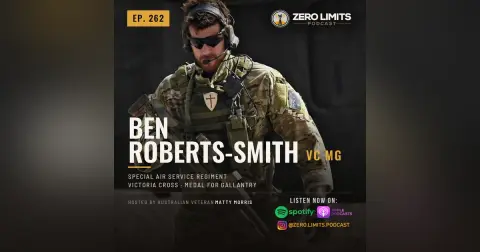
Ep. 262 Ben Roberts-Smith VC MG Special Air Service Regiment

 Apple Podcasts

 Spotify
On this episode of the Zero Limits Podcast, Matty Morris sits down with Ben Roberts-Smith VC MG, a former Australian Special Air Service Regiment soldier and recipient of the Victoria Cross for Australia and Medal for Gallantry.
Ben enlisted in the Australian Army in 1996 and began his career with the 3rd Battalion, Royal Australian Regiment. During his time with 3RAR, he completed two operational tours of East Timor, including the Australian-led INTERFET mission in 1999, as well as two deployments to Malaysia with Rifle Company Butterworth.
After completing SASR selection in 2003 and the regiment’s reinforcement training, Ben joined 3 Squadron. His service included counterterrorism duties with Tactical Assault Group West, operations off Fiji in 2004, and Iraq throughout 2005 and 2006.
Ben went on to complete six deployments to Afghanistan, serving in roles including patrol scout, sniper, patrol second-in-command and patrol commander. He was awarded the Medal for Gallantry for his actions in Afghanistan in 2006 and the Victoria Cross in 2011 for his actions during the battle of Tizak in June 2010, when he assaulted enemy machine-gun positions while members of his troop were pinned down under fire.
Website - www.zerolimitspodcast.com
Instagram - https://www.instagram.com/zero.limits.podcast/?hl=en
Host - Matty Morris
www.instagram.com/matty.m.morris
For the new Zero Limits Pre workout and creatine supplements head to link below
Instagram - https://www.instagram.com/zero.limits.supplements/
Zero Limits Supplements - www.zerolimitssupplements.com
Sponsors
Instagram - https://www.instagram.com/vetcomp_claims/
Vet Comp - https://www.vetcomp.com.au/
DVA claims experts, dedicated to helping veterans navigate the claims process with guidance and support.
Instagram - @3zeroscoffee
3 Zeros Coffee - www.3zeroscoffee.com.au
10% Discount Code - 3ZLimits
Instagram - @getsome_au
GetSome Jocko Fuel - www.getsome.com.au
10% Discount ...
It's time for the Zero Limits Podcast, hosted by Australian veterans. Chatting with high-charging humans with hectic stories from around the world, we'll give you the motivation to take on whatever life throws at you in the kick to complete any goal you set your mind to.
SPEAKER_10Let's go.com.au. If you haven't seen it, this is Ben Roberts Smith, VCMG, his clothing line, his own brand. This was his call sign for the actions that earned him the Victoria Cross. So jump on. Grab a hat, grab a shirt, grab a hoodie, grab what's on there, support the man on his journey moving forward. Now, stay comfortable in the chaos. Back yourself when no one else will. Find a way forward, find a way to win. Epic one-two is for the underdog who refuses to stay down. Anyway, let's get to this massive podcast. You won't be disappointed. Let's go. Zero Limits listeners on today's Azonas Podcast. Now it doesn't get any bigger than this. Here in Brisbane with uh I guess someone that has been uh polarized within uh you know the the media scene and across Australia, not even across Australia, probably around the world. However, he spent uh a pretty distinguished career within the Australian Defence Force. Along with that, uh a Victoria Cross, uh Medal for Gallantry, Distinguished Service. The list goes on. Uh started off in the finest baton, the third battalion, as a paratrooper, just like myself. And then moved into the Special Air Services uh regiment, uh spending 10 years plus in there and obviously accumulating all these awards. Um, you know, and it's just a for them, it's not uh they don't seek to do this for awards. They seek to do this for their country and for their brothers, and uh, you know, along the way they lost a lot, which we'll definitely talk about. His name is Ben Robert Smith, aka B O S. Yeah, mate, how are you?
SPEAKER_08Good, buddy.
SPEAKER_10Yeah, good mate. I was just about to say there's a couple of other names, the Wookiee. Yeah, the Malt teaser thief.
SPEAKER_01You've been talking to the wrong boys. Yeah.
SPEAKER_10Mate, really appreciate you uh, you know, wanting to come on and share your story. Zero Limits is you know, I've had multiple um, you know, colleagues of yours in the past that have been on the podcast, Hamish McLaughlin, for example, shared his story. For example, he was there in T Zak and did his thing on the on the flank, and then you've you've you you with your team did what you had to do. So we've had so so many different aspects of what's happened uh throughout Afghanistan and other parts of you know your defense force career. But yeah, mate, really appreciate you wanting to come on and just share your story in the full aspect as well.
SPEAKER_01Yeah, hey Matty, I I appreciate the opportunity, mate. But it's one of those things, you know, everyone focuses on a particular thing, as you point out, and you're right, you know, I'm this polarizing figure for for many reasons. But the reality is I had a you know near-on 20-year career, and um people tend to focus on one or two days of that whole career. And I've seen, you know, some amazing human beings in my service, and some very, very brave men do very brave things. Um, and so I feel privileged to be able to share that today with you guys.
SPEAKER_10Yeah, mate, like I said, we'll go back right to the start as well. You know, the three hour hour career, you know, you did two trips of T-Mor there, you know, early days of uh SASR, Iraq, a lot of things that's again, people don't really have that full picture, but now they're gonna get that full picture of you know your full life and career within the defense force. But mate, before we do, let's crack off right back to the start, mate. Western Australia, that's where you're born.
SPEAKER_01WO boy, yeah. Mate um really enjoyed growing up in WO. Just uh, you know, it's a beach city in Perth, so spent all my time on the beach, you know, had um mum and dad and my brother, you know, we're just the four of us in our family. My grandparents lived over there at the time, and um uncle and aunties had moved there. I mean, they were all originally from South Australia, but had migrated to WA with a little break in the middle because they all ended up in Papua New Guinea. So my mum and my uncle were actually born in New Guinea. Not many people know that, but when they were born there, it was an Australian territory, so they're still Australian citizens. My grandfather had got work over there as a policeman um in the 40s and became uh the commissioner of police in New Guinea. So that's how he met my dad, who was over there working as a lawyer, and then the rest was history. He met mum, and then that that was that. And they moved to WA where I was born and did all my schooling there. You know, ended up uh all public schooling until high school and then went across to a private school for high school, which didn't help me. But uh, but good times, you know. Like I really uh I look back on that now. I think most people do, you know, you look back on your school years and think I was actually having a good time. Yeah, it was easy, you know. There's no responsibility. Yeah, exactly. Um, but mum and dad, um, you know, we were one of the I'd say sort of middle income family, uh always looked after, never wanted for anything, you know, two loving parents, uh, who I really respect for various reasons. Um, you know, like my dad, I don't think I've ever met anyone in my life that I would consider to have the levels of integrity that my dad has. Um, and obviously that served him well. And he ended up in his career being a judge after being a lawyer. Um, but I really respect him for that because he's just staunch, you know, that's what he believes. Uh he sticks to, and there's just there's no wavering on that. Um, and he's a fair man, you know, like he uh he did a lot for um the indigenous in WA with legal aid and things like that, and did a lot of pro bono stuff. And I always respected that, you know, because people talk a big game with things like that, but they don't actually follow through and do it. Yeah. And he did. So I I thought that was very impressive and something I aspired to. Uh and mum, in her own right, mate, you know, mum, mum's power is her loyalty, you know, she's just like ferociously loyal and will fight anyone's fight. If she's just if they're a friend, she's she's in, you know. Um, and she's certainly been a good asset for me in the last few years. But uh, but yeah, I mean those two coupled together really, I think, set me up in terms of making me understand what what the right way to live is and you know how I would represent myself and my values. Uh, and I'm very uh I'm very comfortable with that, mate, um, with everything going on. I mean, I know who I am and I know what I stand for, and I took that from my family, and I have respect for people and always have. Um I'm a big believer in, you know, I respect everybody until they disrespect me.
SPEAKER_05Yeah.
SPEAKER_01You know, I don't have any um preconceived notions about any individual until I get to know them.
SPEAKER_10Yep, yep. Now, just going back to your family side of things, you know, growing up, family, you got siblings?
SPEAKER_01Yeah, one. So just my brother, he's a younger brother. Yep. Uh seven years younger.
SPEAKER_04That's quite a large gap.
SPEAKER_01Yeah, I always tell him it was an accident, but he's um no, look, man, and again, mum, an entrepreneur, dad, you know, progressed to uh great heights in the legal profession and is well respected. My brother ended up being uh quite a renowned opera singer.
SPEAKER_04No way.
SPEAKER_01So he was actually uh in the ten tenors for a while. People would have heard of that. Yeah, yeah, yeah, yeah. But um, he studied at WAPA, so West Australian Academy Performing Arts, then went overseas, was um in sings in five languages, worked in Germany, sang with the Opera House, had a contract with Opera Australia, and he's my height, and he was quite slender then, you know, but he sounds like a short, fat Italian guy, you know, amazing voice. Uh so in his own right, you know, like I was a black sheep of the family, man. Yeah, yeah. They're all they're all high achievers in their own right. But um, but I'd always just wanted to join the army, you know. So that was it. I just I'd never ever wanted to do anything else.
SPEAKER_10And just, you know, just back to you know, your your younger life growing up, schooling, you know. I know most of us have been on the podcast, most of guests I've had on the podcast have all had guess what, you know, you're always on the report card was you could try harder and you don't apply yourself, etc. And all those type of things. Were you one of those type of children?
SPEAKER_01Yeah, it's a really interesting comment because that's exactly what I got. It was and I got a lot of um, you know, as an example, dad was always keen for me to go and be an officer, you know, and um you know, realistically, if I wanted to, I probably could have done that anyway. But I uh I just had my mind set on being a soldier in the army, um, particularly because of the books I'd read and the people that I'd interacted with who were you know mentors to me at that a when I was in that at that age, but I always got that on my report cut. Yeah, it's like you know, could if he applied himself, could be getting A's and all that kind of stuff. And it's I guess it always comes down to when you're at that age. You know, there's a bit of all of us that just you know, you're focused on what you want to do, you don't want to learn things you're not interested in. And you know, sometimes that's to your detriment. You know, I'm not saying I'm not suggesting it's the way to go, but it it it's probably quite common with people that have a passion for something because they truly excel at that because once they get into it, that's the driving force, right? They're doing what they want to do, and then you realize that that individual can fully focus and demonstrate the um I guess the commitment to getting it done then.
SPEAKER_10And you got the like you said, there's that seven-year gap between you and your brother. So you're pretty much living it's almost a different generation as well. So you're off finding your own friends, he's off finding his own friends, and yeah, one of those scenarios.
SPEAKER_01Oh, totally. So my brother and I, you know, I mean, I left home um effectively just before I turned 18. So my brother was 11, you know, like totally different age brackets. Yeah, we're much closer now, but you know, when we're younger, that's just how it is, you know. Exactly. I I often think of it like that, like you know, we don't we didn't really grow up together, but he's a good bloke, you know. Like I like hanging out with him, he's got a great sense of humor. He's funny, funny man. Um, and he's always had my back. So, you know, we're we're good, man. You know, it's it's interesting, but you're right, yeah, it was a big gap when we're younger.
SPEAKER_10Yeah, yeah, I totally get it, mate. Same same with my family. There's always that one older brother that was just off doing his own thing. But uh family history within defense, how like this I know this goes this goes back.
SPEAKER_01Yeah, yeah, it goes back a bit. So we had three, three uh direct descendants land at Gallipoli, which was fascinating for me. I actually didn't know much of the history until after um the awarding of the VC because people, you know, did some research and came back and explained some things to me about our family tree. But yeah, one uh my great-grandfather, my great-uncle, uh, and a great cousin were all in the 10th battalion, which is a South Australian battalion, and they landed together at Gallipoli. And uh my great cousin was only 16. So he actually was there for like something like two months, but got dysentery or it was some type of illness like that, um, and had to be medevaced out. If you call getting on a rowboat medevact, but uh the other two stayed in, and my grandfather who joined uh great grandfather, sorry, he had joined just as a digger, like his um like my uncle, and they uh he rose to become a lieutenant in something like six months just because of the casualties, you know, um, and went on to fight in the Western Front.
SPEAKER_10Isn't it wild how you know, like you talk about your your family members there, one being 16 and entering into a war zone, you know, like I think obviously moving forward to our era, you know, eight you had to be 18, you know, a lot of good people could join at 17, but you had to wait till you're 18 to deploy overseas. You know, now these days the kids are pretending to get into pubs at 16. Back then, they wanted to get to these war zones and assist their country.
SPEAKER_01And it was just society, right? Like you they were just harder people. You know, the the men that fought in World War I were living in a land that was hard to live in. Like Australia was a tough place to live. Yeah, you know, the expectation was you'd be working at 16 on farms or bu in building building stuff in the cities. Like it's it was a uh a real mark, I think, of the Australian soldier uh when they're overseas, apart from being Larkins. Yes, it they they were hard, they were hard men. Yeah, yeah.
SPEAKER_10And you know, you've uh got this uh, you know, I guess aspirations of joining the defense force. Like, where does this come in? Like you're watching movies, you know, because you know, at this stage, this is what the 80s, 90s, you know, the the movies coming out, Charlie Sheen, Navy SEAL, yeah, all the Delta Force, Chuck Norris.
SPEAKER_01Yeah, all the really accurate wars, yeah, Predator. Yeah, yeah, exactly. No, yeah, I mean, look, I I loved all that stuff as a kid anyway, but I think the um the driving force for me was actually the fact that there was so much talk about Anzac Day, there was so much talk about Remembrance Day, because I mean every male in my family, in some capacity, except my brother, had served. And I mean, you I'd argue now my brother's served, but I I think at the time that we're talking about, that's everyone was talking about what they'd done and who'd been where, and and the other side of that is uh in the 90s, particularly before I joined, I think what solidified it to me was the SAS Blackhawk crash. And I've got a really unique story about that because when that happened the inquiry that was set up to look into the Blackhawk crash was trying to pin it on the SAS planners saying that they did the wrong thing, and it was for their for that reason that those helicopters crashed that night. Um, and just an absolute tragedy, man. I mean to lose that many guys in in any sense. Um I can't imagine what that was like having seen you know a small amount of of death in my career. But my dad was the legal officer assigned to defend the SAS in the inquiry.
SPEAKER_05Oh, you're right.
SPEAKER_01And uh, and you know, to his credit, he did a bloody good job, and they were effectively um exonerated of any wrongdoing, and they all received their awards, you know, bravery awards, um, many of them for what they their actions that night. And in that process, I got to meet these guys who'd come around to the house to talk to dad about witness testimony and stuff like that, and they took me down to the barracks.
SPEAKER_04Oh, did they?
SPEAKER_01You know, I went to an armory, you know, when I was like 15 years old or whatever it was. And um yeah, that just that was for me was like the because those guys, I had them on such a pedestal, man, you know, like they were the epitome of soldiering. Uh as everyone does, I think, when you're in the military. They're the the top tier guys, and you you aspire to that. But they really that that made me really want to join the military, but I wouldn't say join the SAS. I don't I actually don't think I had the confidence at that point. I really felt like, oh, that's probably because I had them on such a pedestal, I always thought then on the I just want to be in the army, you know. I just just wanted to to join and be a soldier.
SPEAKER_10And just quickly on that, like you would have seen this, you know, in the later years of your career within the SAS where you've got these younger, you know, you go to Holesworthy Barracks or you know, anywhere, and you see these younger soldiers that they you know, they look at cats and you go, wow, like I want to be that guy. Or two commando, same thing. So probably not so much two commando.
SPEAKER_01But I'm not even going anywhere near it. Not even going anywhere near it. I mean, uh a lot of uh we'll get into that in 06, but a lot of those boys are awesome, awesome operators, man. Plenty on the podcast and have done some yeah, pretty awesome stuff, uh, which I've witnessed. So I'll leave that alone for now, mate. But I I think, yeah, everyone looks up to the that sort of SF side because you've got to, they know the people that are there have done something a little bit different in terms of they've gone through a process, they've put themselves in a position to be, you know, hurt, you know, punished, whatever it is to get where they need to go, and they've they've made the decision that um they'd rather be disciplined to get there than just not attempt it. Exactly. And I'm not saying it's for everyone, it's certainly not one of those things where you know you have to go to SF. It's not it's not what it's about. It's just about the people that do decide to do it. Yeah, they're just making a commitment, and the ones that get through, you know, prove to themselves that they could do it. But I I really I like the um I like seeing those guys when I was a in the regular army, you know, because it's like you said, uh I was the same. I remember getting relieved or relieving them in Timor when we flew into the enclave. They were getting on the helicopters, you know, they've been there by themselves, just six-man patrol getting on, and you're like they got beers, lower. I've just rocked up with a company of infantry and you've just been hanging out here with six dudes. Yeah, yeah. And you just think to yourself, yeah, man, that's cool. That's what you want to do.
SPEAKER_10I was gonna bring that up because that's what I've read, you know, through your bio, that's where you kind of had your first interaction with the SASR was in Timor.
SPEAKER_01Yeah, 100%. Yeah, and uh funnily enough, it was in my first trip to Timor. Um, but we had we were in APCs at the time. We were the old buckets driving down a creek line, and there'd been a bit of a skirmish on the on the um on the border, and we radioed it in, and they basically, you know, to get a mouse trap to go into the and they just said no, you you're not going in that grid square. They took it off us, said hold your position. And while we're sitting there waiting to go, and like everyone's like, let's go, let's go. Because we've heard this gunfire kicking off. Black horse just fly over the top, land, more gunfire, black hawks fly back over, and they're like, Yeah, you can have the grid square back. And I was just like, mate, I don't know what I'm doing, but I want to be doing that. Yeah, that's what I want to be doing. Yeah, and that was my first like look at them in operations, and I'm not saying that I, you know, I saw what they were actually doing. It was just the notion that we've been denied, and these guys just flew in there, kicked out, and went back home, you know, yeah. For beers and pies.
SPEAKER_10It's it's like an add-in of off the movies as well, because you see that coolness in the movies and you you see it real, you know, in real life, and you're like, yeah, but most of the guys, again, that I've had on the podcast, have had that same interaction, they've had that one or you know, two interactions with an SF operator, and it it inspires them to do that that same role.
SPEAKER_01Yeah, I think it's a it's a good point, man. And the reality is if you if you're fortunate enough to meet someone who's prepared to give you their time, um that's the bit that changes your philosophy because you're talking to someone who's actually done it. But everyone who doesn't pass has got advice there. You know? Yeah. The guys that are in there, you don't really see them that much. But when you do and they talk to you and they tell you that you can do it, yeah, it means a lot. Yeah. To a young digger who's been told, hey man, you can do it. Yeah. You just need to just give it everything you've got. Yeah. So don't be afraid. That's it. Just apply. And and it's it's good advice, man, because it's true. Yeah. Achieve anything you want as long as you're prepared to sacrifice to get it. Yeah.
SPEAKER_10Yeah, there's a lot to it as well, which we'll get on to. Maid to obviously let's get back to that. You know, you're just leaving school. What's the process here? 13, 1901. The cool lads are on TV. It was a lot different back then.
SPEAKER_01Buckets and it was a bit like that. Yeah. I mean, we were turning up, we were not using mobile phones, man. That's how I like now I sound old. That's um, I am old. That's uh going into recruiting, like you're walking in the door and literally saying, Hey, I'd like to join the army. Like it's that that setup.
SPEAKER_04That's in Perth, yeah.
SPEAKER_01Yeah, yep. And I look, man, I was not the the the type of discipline I have now towards training and things like that. You know, when I was 17, I was playing football, I was a heavy kid, always struggled with my weight because I'm like a big guy, and the recruiter in there is like, oh, you know, back then they used to use that BMI scale. Yeah. And he's like, Yeah, you're six foot six and you're this, but that means you're obese, you know, because you're on that scale. Yeah, which is rough. The whole thing is rough because you could be all muscle. Yeah. I wasn't. And the problem was uh he's like, Yeah, I mean, I I just think you're big boned. So I'm just gonna write down, yeah, you're good to go. Because I didn't actually pass it, but he passed me anyway, um, to get in. So I was okay, cool. I'm gonna be joining up in three months, and then I went and played in a game of Rugby. One last game to the grand final of a Colts game. Injury. Yeah, and I'm dislocating my shoulder, full dislocation, and uh out like in the end, I think it took about um maybe four four months of just intense rehab, and that held me back um until I was 18. So I literally, just after my 18th birthday, um they enlisted me and I went and arrived uh well I enlisted on the 11th of November, which is quite poignant.
SPEAKER_05Yeah.
SPEAKER_01Um easy day to remember. Yeah, that's it, remembrance day, yeah. Yeah, and just ended up in um in Kapuka.
SPEAKER_10And what was your thoughts initially joining obviously infantry?
SPEAKER_01Was that the the You know, it's funny, I actually initially, because I didn't really know enough. You know, you think you know, but when you get there, you know, you you find out you don't. Um I I did I did want to actually go to infantry, I just didn't know that precisely. Yeah. And I had that thing where it's like, hey man, who who wants to be a door gunner on a black hawk? And so there's like all half the people in the hallway like put their hand up, you know, that's cool, yeah. I want to do that. Like, yeah, good, you're all going to infantry. Yeah, okay, good. You know, like um, that's how it used to work back then. Yeah. Uh, but but you know, like Kapuka was just different too. Uh I I'm not sure how I can imagine what it's probably like. Um, and for good reason. But there's also, I think, some of the things like we're coming back from the mess, and you're watching your mattresses get thrown out of the windows from the third floor, and you know, and you get up there like cyclone just went through, you need to repack all your stuff because we've got an inspection in 30 minutes, that kind of stuff. Yeah. And whether they do it or not. But it's all about a sense of urgency. It's about you know attention to detail, all those things um used to be trained through mechanisms like that. Yeah. And I look back and laugh now because it is funny, but it's also a totally different generation.
SPEAKER_10So again, the political correctness was not that not existent. Exactly right. So let's let's talk about this, you know, the first few weeks in the defense force. How did you go with that, you know, with the discipline? I'm sure, like you said, your dad would and your family are quite disciplined in a way. So how did you transform that into and obviously soldiering itself? Did you grasp that concept pretty quickly?
SPEAKER_01Yeah, I think I would say that I I actually struggled at Kapuka. I think Kapuka, I didn't really, I didn't enjoy, and I think it's because you're doing that really uh it's where they're breaking you down to be a soldier, right? That's they want you to stop being a civilian think like a soldier. It's a it was a good process because it worked. Um I actually think I was just too immature to be able to deal with it. I actually found it quite difficult. Um and then when we went to Singleton, it was like a whole different world. Like I loved I love being at Singleton. Yeah. You know, like because we're doing infantry stuff and uh being taught, you know, how to be an infantry soldier, which means you're out there doing section attacks and then platoon attacks and you're learning the things that you thought it was going to be like. Uh, you know, there's no drill at Singleton, that that stuff, you know. But uh yeah, I struggled a bit, I think. You know, in all just in all aspects. Fairness. In in uh in Kapuka, I did, yeah.
SPEAKER_05Yeah.
SPEAKER_01Just I it was interesting because I went there with this sort of vision of it, and then first time away from home, just turned 18, didn't, yeah, didn't find it easy. And that's just the the fact of the matter.
SPEAKER_08Yeah.
SPEAKER_01But I but it it did what it was supposed to do because by the end of Kapuka, yeah, I was like it was good, like I sort of it broke me out of whatever you know, whatever sort of phase I was in at that point. So that when I started singing, I was like, yeah, okay. Yeah, now I know what this is about. I get it.
SPEAKER_10Do you remember any of the staff that you had back then?
SPEAKER_01I actually don't. I wouldn't I wouldn't remember their names, but it's funny because you always remember their faces. The stories in that, yeah. Yeah. I mean I had a Bombardier as my I think everyone did.
SPEAKER_09Yeah, probably. And then you'd end up calling them Corporal.
SPEAKER_01Yeah, that's right. Yeah, getting boosted to saying corporal instead of Bombardier. Yeah. Yeah. But no, I learned the hard way with with all of that stuff. Yeah. But uh, but yeah, I mean, I loved it. At the end of the day, that six months of training, I look back on it now and I was like, I understood why the process was done the way it was done and what it left me with at the end of that, which was enough to be able to go to a battalion. Yeah. Just go there. Not saying you know anything. It's enough though that you can you can go and if you have to do something, you're good, you're good enough to do that. Yeah. And then then you start learning when you get to the battalion. Yep, yep.
SPEAKER_10Like you said, from Capuca, did your uh family come down to Kapuka for your march?
SPEAKER_01Yeah, yep. Yeah, my you know, it's interesting because my grandfather was a pretty hard man because he'd been, as I said, been a policeman most of his life. Um and always respected him too. You know, he was six foot six, but for his generation, that would have been massive. Yeah, you know, but uh I always it's one of those things, you know, when you're young. So because I was, you know, this young punk teenager, he was always dismissive of me, you know. And uh and that's fair enough, because he was probably right. But the day I marched out of Capuca, I distinctly remember his words. I actually don't remember anyone else saying anything to me, but I remember him like welling up, like with a tear in his eye, and saying, mate, I'm really proud of you. You know, and I I don't I mean I understand why I remember that, but it just meant a lot to to see him recognize it, but it also explained to me the power of service, you know, because his brothers had fought, one of his brothers died, you know, he you know one of them was in the navy, got sunk, lost a lung, you know. The he was too young to go, and he was you know, always, I think in his life had to deal with that, watching his brothers go away. Yeah, um, which is why it was a copper. Yeah. But yeah, that that was a really uh important moment for me. I think just uh transitioning into manhood. You know, to hear that from my grandfather.
SPEAKER_10Yeah, yeah, and you know, that's the reason why, you know, I'm so glad to have you on the podcast is to uh you know put your story out there from those back days where people only see the VC or the MG and they think that you know you just made your way up there and you got it, you know what I mean? Whereas there is a full complete backstory. So from there, obviously you go to Capuco, you finish Capuco, march out, head to singleton, mate, like-minded individuals, yeah, all wrap bags, yeah, all ADHD, autism, all put into one, all the one box.
SPEAKER_01Yeah, 100%. And it is like that, isn't it? Yeah, that's a funny thing. Yeah, I mean, we joke about it, but it's like you've got you're a certain certain type of uh individual who wants to get in the in the weeds and be grunt. But yeah, man, I I love just being around like-minded people, and uh I really started to develop my passion, I think, even more so. Like I I didn't know enough yet, but I was definitely doing what I wanted to do at that point, yeah, you know, finishing up and made some awesome mates. There's guys singo. Yeah, like one of my very best friends, you know, who lives here in Brisbane. We went through Capuca together, went through Singo together, went to Three Area together, you know, and uh he didn't go west, but um still one of my very best friends, yeah, you know, still speak to him. You know, there's that little moment when I'm away with you know with the unit that we probably didn't speak to each other as much. But then, you know, I get out and one of the first people I call. In fact, he was the guy I when I was told I was getting a VC, he was a guy that I was allowed to tell one person and told him, and they flew him down. Oh, did they? Yeah, and he because he wasn't in the unit, he was different because we couldn't be someone in the unit. And I was like, yeah, okay. But uh yeah, man, solid guy, good dude. He taught me to box too.
SPEAKER_10Oh, did he?
SPEAKER_01Yeah, yeah, yeah.
SPEAKER_10You gotta learn a box when you get the three hour out too.
SPEAKER_01It didn't help me, but I lost my first fight. Yeah, mate.
SPEAKER_10So, yeah, so you've done singleton uh just in regards to singleton, you know, the firearms aspect and hey g week and all their stuff. You loved all that stuff. And did you grasp that concept of you know firearms as well?
SPEAKER_01Yeah, yeah, I certainly did. That was I mean, I I mean, yeah, because I was so young, I hadn't done much of it. I'd done a little bit of shooting or you know, hunting, but nothing significant. Um, I didn't have the experience of many of the lads, you know. Some of the country boys, brilliant, you know, you talk about Hamish. Oh mate, he's a nine goat. Yeah, I mean he grew up with that stuff, you know. So I definitely started behind the eight ball. I wasn't the guy that walked in having those skills. And in some ways that's a benefit, you know, because you you can be moulded and shaped as long as you've got the right instruction. Um, but I did, yeah. I went through all of those aspects of single and came out thinking that, you know, yeah, this is for me, this is a job I want to do. Yeah, yeah, yeah. And loved and was like, yeah, let's go to the battalion. I was on.
SPEAKER_10Yeah, I think like you said, Singleton economy establishes the drive to become an infantry soldier and move to your battalion, but it also, like you said, turned you in from a boy to a man. Because at the end of it, you're independent, you should be able to do everything. But again, like with like-minded guys, and from there, you get your uh selections to go to a battalion. What's is there anything on offer, or you you guys just tend to three?
SPEAKER_01We split between uh two RER and three RR, my platoon at Singleton. So they did ask who wanted to do it, and um I stupidly I said, Yeah, I want to be a paratrooper. Sounds good, you know, because I thought I I didn't understand the concept of rownies at that point and being doing over 100 kilos. Yeah, I'll get it. Um drop like a rock, yeah, yeah. But uh, but no, I was keen. I I thought that sounded yeah, I was like paratrooper. Who doesn't want to do that stuff when you're 18?
SPEAKER_10Yeah, we guys went to Townsell anyway.
SPEAKER_01Yeah, that's true. Uh yes, I did. I actually picked it and then was lucky enough to be allowed to go. But we, you know, as you do, you go to the batan and you march in, and you're um in those days they were called lids because you literally turned up, everyone was in you know, double cherry or morone berets, signifying that they were paratroopers and we're wearing our slouch hats, you know, which is gonna be called a lid. Yeah. And then when you get there, they're like, no, no, you can wear berets, but you had to wear the green beret, infantry berro. So you you're walking around and and you're it's just so they could identify you as a new guy. You know, we get marched past support company lines and they're just throwing beer bottles at you and abusing you, and you know, and you that's that was the life then. That's what used to happen. And you know, people, you know, the the senior leadership of the military don't like people saying things like that, no, because that's poor behavior. It wouldn't happen. Well, it did happen. It did happen, and it happened probably way worse than that in the generations before me. Um and I'm not suggesting that it's right or I'm condoning it. I'm just simply saying that's that's the battalion I moved went into, you know, and that's that's how it was. Yeah. Um, and I don't hold any grudges for it. I mean, it it was part of the uh it was actually part of the ADF culture, which has evolved, right? So good, but it also helped us become the soldiers that we were because we learnt from that that there was this uh you know a chain of respect. And um, and you had if you wanted to call yourself a paratrooper, then you had done it. Yeah, and you had to go and do the paratrour and you know, do the required uh courses and tests and fitness tests that they had to to be part of that alumni. Um and later on, you know, you can go to SF and you can do other things. But at that point, that was the only thing that I had in front of me at 18 years old, and I was like, yeah, okay, I get it. So I need to get I need to get do this course. And because you know, people do the course and they just say, no, it's not for me. And fair enough, like some people don't want to jump over a plane. Get it, totally get it. Um, but uh, but it's just another thing, right? Because when you haven't experienced it before, it's always that's the fear, and everyone knows that. You know, everyone's fighting to the unknown. Yeah, and until you actually go and just throw your hat in the ring, you never know that's it, what you're what you're made of.
SPEAKER_10Yeah, yeah. You know, I I I'm not sure what other batanes are like, but obviously I come for three hours as well, and I understand, you know, arriving to the chat and arriving above the chat and staying up there, and then we're obviously walking past support company to get to uh, you know, whatever company you always in Alpha Company, so you obviously walk past all the company to get to Alpha Company. And like you said, it's one of those things because, you know, in subsequent years moving down the track, you know, you move into that war fighting space, but that guy next to you becomes your lifeline. The other guy next to you becomes your life, the guy in front is your lifeline in the back. And that's how it was in the batane, you know. Yeah, you get into this that lid mentality, and you know, they pick on you, but then your mates stand up for you, and then they show, and then you you know what I mean, it just grows that team. I feel like stepped it into the tribe. Exactly right.
SPEAKER_01You know, you really do, and that's what it is.
SPEAKER_10And being paratroopers too, like you know, we thought we were the the bee's knees and best soldiers, best infantry guys out there.
SPEAKER_01But and I love that mindset, right? And it it it's got nothing to do with reality, no, it's got to do with your belief in in yourselves and your passion for it, exactly, and the standard. Yeah. What's the standard? That's the standard, yeah. The standard is I want to be in the best section, yeah, best platoon, best company, yeah, in the best battalion. Yep. And and so what that drives then is a uh you know, a love of the unit whereby you want to actually contribute to make the place as good as it can be.
SPEAKER_05Yeah.
SPEAKER_01And look, I'm sure it's not that's not, you know, every individual's feeling on it, but in the main, I would say it is, man, because you you believe in the boys and your mates, and that's how we that's how we did it. Yeah, yeah.
SPEAKER_10But it wasn't, it was also cultivated at the command structure as well, because they were breeding this behavior and you know, behavior, it's more to say attitude in becoming an Australian soldier, because again, ultimately the goal is to go to war and get into, you know, possibly lose your life, which does happen down the track.
SPEAKER_01And I think that's the interesting part. Uh we talk about all the things that you the courses you do, the you know, the aspirations that you have at the end of the day, what you are training for is to be able to fight. You are training for the eventuality of a war. So having our military named the Defense Force is a great concept that someone changed and probably got a medal for changing it.
SPEAKER_05Yeah.
SPEAKER_01But the reality is that you are a soldier, and your first job, no matter what your ECN is, is to fight and defend the country. Yeah. And wherever they send you, that's not your decision, it's not political. That's not not our bag, man. We don't do that. We do what we're told, and where they send you is where you go. And that that is what you do when you sign the dotted line to serve your nation.
SPEAKER_10And they teach that at Kapuka. Yeah. And I've said this multiple times. It's like one of the only professions where they teach you to kill another human being. Your first role is, especially in the inventory, yeah, is to kill another human being. Kapuka, you're bayonet in out on guard.
SPEAKER_01Yeah, I love that example, man, because that that is the biggest fallacy that you know, that's not what it's about anymore. Mate, go and run through a bayonet assault course. You know, you want to see how training actually works. Yeah. But they people forget that. They're like, oh no, that well, don't teach people how to fight with bayonets if you don't think it's about war fighting. Exactly. Because that's about as personal as it gets. Yeah. You know, and the way that training is conducted, as you say, yeah. In out on guard. You're talking about stabbing another human being with your bayonet. Yeah. Um, because that is what Australian soldiers had to do in World War I. Exactly. World War II in Korea, you know, in Vietnam, even. You know, you look at coral, you know, they get overrun. You're talking about people fighting in, you know, gun trenches. It's just like it's not pretty, it's not perfect, and it's also not necessarily what anyone wants to experience, but it is a reality.
SPEAKER_10Of the training, the mindset, the chain life, everything.
SPEAKER_01Yeah.
SPEAKER_10So from there, you obviously you march in, you're you're you know, you're walking around through your green beret for a bit. When do you get on your on your para course?
SPEAKER_01It wasn't long. I was it was before the end of that year. So we went down, I'm I'm pretty sure from recollection, it was uh Was this 96, 96? 97 I was there. So it must have been, yeah, somewhere in the middle of 97. We would have done it. I'm sure there's an old PDS photo out there with my shaved head. Yeah. Um, yeah, did the course. And you know what that's when you learn what roundies are about. And I when I say roundies, I'm just talking the round parachutes are um a little bit unforgiving. They have a maximum sort of descent rate and a minimum. And the heavier you are, the more weight you're carrying, obviously, yeah, you're at the upper end of that scale. So when you've got your equipment on plus, you know, body weight, typically always at the upper end of that scale. And that first um, I think year or so, I actually did a couple of stooging trips, which means that you just go down to help out people learning to be instructors. You're stooge. Yeah, stooge, really are just getting thrown out of the plane for them. And so I got quite a few like land jumps up uh in the end, which was not um it's probably why my body doesn't work as well as it should now. But good experiences, and at that age, great, you know. Um probably probably looking back on it, would have liked to have probably not done as many jumps. Yeah, yeah. Um, but uh, but good fun. Water jumps, good, you know. No, mate, I did two jobs. Love the water jumps.
SPEAKER_10I did two water jumps before I did my para course.
SPEAKER_01Oh, yeah.
SPEAKER_10Yeah, it was weird because I had no idea what I was doing. They just said just don't jettison too early.
SPEAKER_01Yeah, that's right. Yeah. Mate, well that's yeah, just saved your body. Yeah, yeah.
SPEAKER_10I think for the listener out there, you know, for anyone out there listening and for the paratroop of life, they they say it's equivalent when you hit the ground, especially for us bigger guys, landing off or jumping off a two-story building.
SPEAKER_08Yeah.
SPEAKER_10Because every time you hit, you can you can just hear people go, oh, oh. It's just like a big taking a big hit on a rugby field. That's what it feels like. Guaranteed someone's broken. There was always someone broken.
SPEAKER_01I mean, I was actually fortunate early on. We did a um an exercise, which I'm fairly sure was 97, maybe 98, but it was the the only battalion drop that I took part in while I was there. So you get a whole company in the sky, and then the next the plane's coming in behind that's you know, throwing out the next company. So you got a lot of people in the air, man. And um that was that was cool. Yeah, because that's you know, like that's the kind of stuff you watched on the movies, you know, when the guys are doing it for real, and the charts going off on the air too.
SPEAKER_09People screaming at each other, yeah, let's go.
SPEAKER_01You're so close, and there's all these collisions, and it's just yeah. But that, you know, good experience. Good to be able to do it. But yeah, I took part in that.
SPEAKER_10Yeah, what what company did you go to?
SPEAKER_01I was in Charlie Company, Charlie. So Seven Patoon Charlie Company, yeah. My first company. Uh, and I stayed in Charlie Company for my deployment to East Timor in 99.
SPEAKER_0999.
SPEAKER_01Came back, and then um then I went down to support company. So just before I went to Timor, I got a DFSW course, so direct by support weapons, so basically machine gun platoon. Heavy weapons, yeah.
SPEAKER_09There's a word in between. Yeah, keep that out.
SPEAKER_01Yeah. Um, so when we came back, I was able to go there, but I went over, I deployed as a as a rifleman, uh just a digger in a Timor. And that was another one of those things, mate. That came in '99. We were told you koala bears, you're never leaving Australia because you're paratroopers. You're there designed to jump in up north and defend the country. So one and two are our we're always going to go. And uh, yeah, they drew our number. And I remember that being just, you know, 19 years old and just pumped. Yeah. Being like, it's happening, you know? You don't know any better. You just you're seeing it on the TV, and Dilly was on fire, and they they push us up to Darwin, and everyone's just doing build-up training, waiting for it. Uh, and then they greenlit it, and it's classic, classic Australian army. It's like two RER with the amphibious force, and we're the paratroopers. So we went to Timor on a boat and they sent them into the C-130s. So they flew in and we went on the boat. We turned up on the Jarvis Bay, which is like a catamaran, man. It's like getting the ferry to rot nest right across. Um, and we're all you know, everyone's getting off the thing like off the off the boat, like you know, we're landing at the at the beaches in Normandy, you know, and it's just not like that. It was nothing like that. But it was it was a good infantry operation, yeah, you know, for a young bloke. All the skills you've been taught, living on hard rats for three months straight before we got resupplied, because there's no American uh logistics. So it was because it was all Australian logistics when we were there. I mean, you're just sleeping in burnt-out buildings, um getting resupplied when you could, didn't change uniforms for three months, same socks, same shirt, you know, whatever you had in your pack. Um back then I used to load you, like love loading you up. So you'd have these ridiculous packs, and you're patrolling in them when you're trying to clear buildings with packs on, you know. And clear building, when I say that, I'm talking like this is in the 90s, man. This is when people, we'd never been taught CQB. We our urban training was minimal. Like I'd done a heap of jungle training, I'd done kanunga, I've done Tully, been to Malaysia twice, just hadn't um had no urban experience, and that was the first thing we had to do, it was sort Dilli out. Um and look, it wasn't. I'm not suggesting for a second it was crazy, but they had a scorched earth policy, which was an actual document that the Indonesian government had produced, and they wanted Dili burnt to the ground so there was nothing left when they when they left. So the pro-Indonesian militia were actually being marshaled and organized by the Kapasas, who are Indonesian special forces and they knew our rules of engagement and they knew them very well. So you'd never see them with their weapons, you know. I mean, we were taking machetes off people and stuff like that, and it just wasn't necessary, but it was that you know, that was it was because we didn't know. Um but they just kept burning everything down. And the Timor was interesting to me because at the end of the day I I really didn't I came home from Timor and just didn't like the fact that they wouldn't fight us. Um because there were some atrocities there, you know. So people talk about I think the the bodies in the well at Balabo or something like that. Yeah, yeah. That definitely had nothing to do with that. But that's something that you hear a lot of people talk about. But what I don't hear people talk a lot about is um at the early stages in Dili, there was daily getting young women and uh and kids coming in looking for medical aid, and uh you know, they'd been raped for um cigarette burns. Oh shit. Like tortured. Wow. And it didn't really I didn't get it at the time, you know, it's just like you gotta get them to the medic, you know that that's fine. But um that was weird because it's not what I pictured. I pictured getting off the boat and being in these big, you know, fighting the enemy. Yeah, yeah, yeah, yeah. And it just it wasn't it's like humanitarian stuff, yeah, you know, and it was uh not confronting at the time, but confronting later to realise what had happened to those people uh and why they wanted their freedom, obviously. So going through that whole process, we finished in Dilli and then we did a company op Somaliana, and that was uh again this is the Australian army finally doing a unified operation since Vietnam, you know what I mean? Like Somalia or Wanda, those guys did a great job, but it wasn't using all of the assets and all of the uh the arms of the military. So we're like a whole company in Blackhawks, you know, taking off together, flying down the coast, and you're just sitting in the side, you know, and this different, no seats, sitting out there like just thinking. That you're king of the world. Yeah. Um feeling SF.
SPEAKER_08Yeah.
SPEAKER_01A little bit. Yeah. And then you land in Maliana and you're like, here we go. It's a ready to get out. Another one waiting for the gunfight. It's going to be big. And you get out, and there's like an S Ace Patrol on the DZ who just marked, who marked the landing zone for us. So we're all like ready to go, and they're just not chilling on the sitting on the side of the on the landing zone. You're like, okay. All right. And then we did the same thing, cleared Maliana. I hung out there for a bit.
SPEAKER_10Yeah, you just spoke about before how, you know, this is the first time the Defense Force, you know, you know, I guess enacted the Defense Force as a complete since Vietnam. So when we talk about that, you know, all the stuff that we were taught, you know, back in those early days, the all the PAM, all the training, everything was pretty much replicated from Vietnam. That's all we knew. Obviously, subsequently, again, moving down the track, G Watt era, yeah, all that evolved. And you know, we'll speak about two commando and obviously SASR and even the infantry now. Like, you know, that we look at the infantry now, their bottom standard now is pretty, pretty, pretty wild because of the the evolution of training and couldn't agree more.
SPEAKER_01Yeah. I mean, I look at these guys now and just I mean their equipment, yeah, you know, firstly, and then you see how they um how they train, and you're like, I wish I had that training. I mean, I think I mentioned, you know, like we when we were in Darwin before we went to Timor, they I'm talking three days before we got on the Jarvis Bay. Yeah, right. They gave us a nod and a head mount. So not a single tube night. And I'd never seen none of us have seen them. Yeah. And they get sold just five, you know. This is how you clean them, this is how you do that, you know, you're going awesome. And they were terrible. And then you put this thing on and you're like, no depth perception. It's the most counter waves. Not big for photos, yeah. Um, so that was, you know, we're that that's the kind of stuff that we were doing on operations. Yeah. You know, whereas nowadays it's, you know, it's like the training's good, the gear's good, and these young people that are joining, man, are studs. You know, like they're coming out of high school, built, they're training hard, they're athletes. You know, we we all joined up, and you know, there was a drinking culture and things like that. That that was, you know, you could walk a hundred kilometers, but then you just sort of fix beers and you know, and that was it. Yeah. Whereas the skill level of these kids, man, is just unbelievable. That's it. And impressive. And I'm I mean, all power to the to the way that the trainings evolve. Yeah. Because it should be, should be like that.
SPEAKER_10And it's all about presence. They they look like soldiers now. Back then, like you said, we looked like baggy shit with monoculars and H harness on and just baggy, you know, the baggy clothes and baggy boots and nothing of a fit, and but we could stomp.
SPEAKER_01Yeah, could walk, could have a pack, man. Yeah. That's the just every Friday we'd we'd be doing that, Charlie Company. Every Friday you'd walk ring road. Yeah, ring road, and then it would just be building up to that 40-clicker. Yeah, you know, just but on bitumen, so that it just ruined everyone's feet. Yeah. And then you finish with your that LF9 or whatever that shoe is. But mate, hey, you know, it's uh in every sense of the word, it is character building. Yeah, you know, like not a throwaway line, but it actually is character building, you know, makes you understand that you know you've got to put that pain out of your mind and just get get the job done. Because if you are a paratrooper, you're supposed to get dropped, you know, far away from where the fight is, and then you walk in, stomp in, do your job. So it was cool. It was cool to do that. But yeah, I mean, we're so when we went from Maliana, same thing, cleared all the Malayana, and that was a lot quieter. I had my 21st birthday there.
SPEAKER_04Oh, did you?
SPEAKER_01Yeah, yeah. So um that was cool. My mum had sent over this picture, man. I looked back on it now, I'm like, what were we thinking? Sent over these like party masks, you know, the old ones with plastic on them. And um, and they all put them on, man. Like the section put them on and had this phone. There's this photo of us sitting there, because you know, there's no grog or anything. Um, and then I went back to my two-hour picket because you know, that's what we were doing back then. You know, it was long pickets at Timor, yeah, like proper stag, which, but you know, that that's what it was about. That's what being a grunt when you're out there like that, you have to be on picket. So that was cool. Um, and then we moved, we were supposed to be going to the Enclave, but before we did, we had an air mobile op to uh to a place on the border, and I've forgotten the name at this point, but just just away from Maliana, just outside of Maliana, and we did a company op there, and we bounced in, and as we're coming in, uh the Helos took fire. So they actually put us down on the wrong LZ, and we hadn't known it at this point. And this is back before it was integrated comms, so like the true the platoon commander didn't have comms with the heel, like it was just disjointed, and this is why we learned so many lessons from T-Mor, uh, luckily. Uh, but that they put us down. We're sort of like uh we're in the wrong spot, we needed to walk up the hill, but we didn't realise I think how close we were to the border, and as I said, I mean I was a baggy ass digger back then, yeah. So I'm just you know humping the the 203 or something, like a one-back gun. And we're walking up uh up the hill, and my section commander sort of just crested the hill and then bursts of fire, but from a distance, like it wasn't heavy, it was just from recollection, I'd say it was probably probably a PKM, but um put in a few bursts of fire into the the side, and I was on the reverse side, so I was much safer than the scout, the the section commander at the time. But that was the first sort of like oh getting shot at first rounds, yeah. And you know, you don't you don't even thinking about it because it wasn't it's not like it never is, it's never like you think it's gonna be. And in this instance, it wasn't heavy, it wasn't, but at the time I didn't I didn't know I didn't know what a heavy gun fight was, I'd never leave anyone. So we're just sitting there being like, okay, what you know, and everyone's sort of on edge and was manoeuvring around and being told your heart's racing because you're like, are we gonna get into a bigger fight? What's going on? And then the end they caught up a couple of snipers from uh from company headquarters to try and engage this gun because it was like 800 metres away, and none of the weapons that we had in the section were really effective. And they did that, and that night we decided to put in uh a company ambush, which was cool. So we did a fake the helicopters came in and did a fake pickup at night. They all came in, all left, and then we went out and put in this um big company ambush on all the uh on all the walking tracks and stuff around that particular location, and we didn't we didn't uh we didn't hit anyone, but I just remembered doing that and that that that sort of day, if you like, from my experience in Tim War was was the bit of there's been some gunfire, we know the enemy's here.
SPEAKER_08This is what I signed up for, yeah.
SPEAKER_01This is what we're here for, and then we're out and we're on ambush, you know, and this is what we trained for. This one while we were staying up in singleton for eight hours, you know, just lying there waiting for someone to walk down the trail, you know, and they don't, yeah, and they didn't, but um, but it was just a it was a good experience because it was light on, you know. I'm thankful for that in many ways. Yeah, because it's like okay, cherries popped now, you know, like that that bit's happened. So now it's just a little bit progresses, right? And I I always look back on T-Mor for me as a really good base for what would happen later in my career. Uh I was fortunate, you know, and I you know, I've got a lot of respect for some of the boys that you know, their first tick, they join the SAS, their first tick is then when they're in the SAS, and it's heavy, or someone gets hit, you know, and that's what you're dealing with. That's your experience as your first sort of engagement with the enemy. Um that would be much more difficult to deal with.
SPEAKER_04100%.
SPEAKER_01You know, and I so I respect those guys, um, particularly if they were that age, you know, 19. And you know, as we just said, there's guys in World War One and two, like 15, 16, 14, you know, and I'm talking about being 19, being hard work. Um, but yeah, I I really appreciated that um that experience. And that was us in Maliana. We went to uh punched up into the enclave and spent the last sort of two months up there. And how was the rest of that two months just heavy patrolling routine, but we you know it was nothing significant. There's a couple of um, you know, like sightings. So basically the militia would sit on one side of the border and we'd be on the other side and just looking at each other, you know. Because again, they knew you they knew you were um TTPs. The Kiwis had it worse, man. The Kiwis uh when they lost one of their guys, and I'm pretty sure Hamish was involved in that we spoke about it.
SPEAKER_09Pretty brutal too.
SPEAKER_01Yeah, it was. I mean, they disfigured him and uh and dismembered him, uh, which was very sad. But uh but the boys went back in and got got him back, which was good that they were able to bring him home. But we didn't we didn't experience anything to that level, um, which I'm grateful for, man. You know, I think it that I had got enough out of Timor to understand what the infantry sort of op was like, but um I didn't have anything that was you know tr too overwhelmingly traumatic that I didn't like it or you know. So I was a good base to start at. And um as I said, the only thing that really dawned on me later was just how the people of East Timor were treated. That if any if I was to say that anything uh stuck with me or affected me from that trip, it was that just that stuff, man. The uh just the kids and the women, uh just seeing their scars and the wounds and stuff. You just it's not what I expected. I really thought it it pissed me off that they did that to them and they wouldn't fight us. Yeah. That that's why.
SPEAKER_10Yeah, which you know, again, you see further on in Afghanistan. It's that that you know what I mean. Like it then that was 10 times.
SPEAKER_0110 times, yeah. Which we'll talk about, yeah.
SPEAKER_10We'll definitely talk about so that you spend that last couple of months in Timor. Get back to Australia, mate, get back to Holesworthy. Everyone's uh everyone's a war dog now.
SPEAKER_01Oh yeah, we're all war heroes, mate. 21 years old, just being on operations, strutting, yeah. Thought it was cool as straight back to the guard room, yeah, yeah, yeah. Straight back on guards in the floor, do oh I was washing Dixies, yeah. No, we um we came back and straight back into courses and stuff. I had a bit of time off, which is cool. Um, but I actually got straight back up onto a another Butterworth rotation. Oh, yeah. So yeah, that was cool. So but 21. So when we came back in uh in 20, there was just courses, and I think I did maybe a couple of subject courses or at least one.
SPEAKER_10That's the year 2000. Yeah, 2000.
SPEAKER_01And um but I ended up going to try out for army rugby in 2001, yeah. And mate, that was probably one of the most the best experiences I had you know in the regular army, which is bizarre because it took me away from doing the job that I actually love doing. But it was just surreal to be. I mean, you play in the the tournament, the tri-service tournament, play against army, you know, Navy and Air Force, and that's cool in itself. And then they picked the Azaru team, which is your Australian services team, a combination of all three sides. And then we basically just followed the British Lions tour and played all of their openers around Australia, you know, like at um Sydney Football Stadium, you know, Bruce Stadium in Canberra. Yep, yeah. Just everywhere they went, we played their openers and play against all these different teams. And some of them, you know, I look back on and just man, we got absolutely puzzled. You know, there's like Australian universities who are con all half of them were contracted super rugby players, you know, and we're all just meathead, you know, soldiers. But great experience, good fun, man. Just doing doing something different. No, it was bizarre. It's like you just disappear for three months and then come back to work, and it's yeah, no problem, fine. He's getting paid to be a soldier and playing footy, it was good. So I enjoyed that. But then yeah, when I got back, it was Malaysia. So back over to Butterworth, but this time I was in uh support company, but and I went with Alpha Company, so I went as a support company detachment.
SPEAKER_10Yeah, just quickly run the listener through what uh RCB was, the Rifle Company Butterworth.
SPEAKER_01Yeah, so Rifle Company Butterworth is uh an Australian um deployment that it's actually a RAF base that sits in just outside of Penang in Malaysia, and it's been going since the 70s. Uh originally helped to effectively they deploy a company of infantry soldiers there to defend the airbase against communist threats at the time. But uh obviously by the time we're talking, um, there was no threat, it was more a deployment for training. So we'd work with the Malaysian military in um large-scale joint um training exercises and also get time down in Singapore with the Singapore Army and Thailand as with their military. So when you're in your capacity as uh as Rifle Company Butterworth, your sole purpose is literally just to train with those other Southeast Asian uh militaries, but you're based out of Malaysia, so it's it's great drunk jungle training because you're literally right there in it. Um and it's a great party trip because you're just next to Thailand. Yeah. So every weekend everyone's driving up there, you know. I mean, and when you're a young bloke, what a great experience to be able to travel around and go to Singapore and KL. And you know, we're doing this 21 years old, free rain. It was uh great experience.
SPEAKER_10Obviously, yeah, and you get extra pay, and obviously you just come out from Timor, so you got somewhat a little bit of cash there.
SPEAKER_01Yeah, yeah. No, we had a great uh great number of experiences in Butterworth. One that would actually become a problem for me later in uh after selection, but um the OC on my first trip uh had what they call a skippy special, which is uh like a chat special. It's just every white spirit and uh and coke put on top of it in a big mug. But he'd had this drink and it obviously went to his head and he just started getting a bit excited, a bit punchy. And the RS of the RSM, the SSM, or CSM I should say, at the time, company sergeant major got myself and another another guy, a corporal, and said, You guys need to put him on his ass and then get him down into the cells because he was going nuts and he was a big boy, the OC. Uh, and so we did, and uh great man, like took took the tackle the OC, dragged him down the stairs, put him in the in the cells. And this is when Cosgrave was chief of army, and it became a bit of an incident because yeah, stickers taking down an officer, general, no, no, uh incident for the OC, yeah. That's what I mean, yeah. So they were they're like, Yeah, man, you were just doing nothing nothing for me. I was totally under orders because we were trying to protect other soldiers because the guy had sort of lost his mind, but yeah, Cosgrove in the end uh basically rang up and said, You're coming home and sent him home. Shit. And it's a bit jumping ahead slightly, yeah. But the reality was the day I finished selection, and they said, Yeah, wait to find out if you're in, because you don't know if you're in yet, you just finish selection. And then um at the time it was Porky Hibbert, who was the uh the wing SM, said, mate, you need to come and see us. And I'm thinking, oh, here we go. I'm I didn't make it. And he says, You need to go to Sydney, you're a witness in this case with the OC, because apparently they did him for you know assaulting a subordinate or something. That that bit I had nothing to do with. And I said, I don't even like I wouldn't have a clue. Anyway, so I'm literally just finished selection, man. I'll withdraw and I got covered in tick bites, and um, they sent me over there, and I get to this uh military court martial at uh base right in the middle of the city in Sydney. Uh the one they're trying to sell. Ranwick. Ranwick, yeah. No, no, in uh what's it called? Vic Barracks. Vic Barracks. That's the one the one they're trying to sell. Yeah, Vic Barracks. That one. Yeah, so I was sitting in the court martial and they're like, so uh judge comes in, uh Robert Smith, how did you go? I said I uh finished the course series. Oh well done that all I clapping. Yeah, all these people in the court like, yeah, cheers. And they you know gave this evidence, which was I don't know, I wasn't I didn't see what happened, I was just told by the CSM to do this. And they said, okay, thanks, you can go home. And then I literally the same day and had to fly back to Perth. You know, that that scenario happened and it just still had a still dealing with it later.
SPEAKER_10Yeah, well, it's not often you see an OC or an officer go that way, it's normally a digger.
SPEAKER_01Yeah, that's the point, right? Like it was bizarre. Um, and in the end, I'm I'm pretty sure that he was totally cleared because he wasn't aware of what was in the drink. Yeah. Um, so fair enough, fair play. I'll use that next time.
SPEAKER_10Yeah, I'll use it on the how many times you junk out of a you know, the boot, the old boot back in the batana, the chat.
SPEAKER_01Oh, yeah. And you don't know what's in it. Yeah, the chat's special, man. They were dangerous, very dangerous. That's true. The end of many men.
SPEAKER_10Yeah, and it was always straight after an exercise, too. Be start off someone's just filthy boot.
SPEAKER_01Yeah, no tough out. You had to do it. Yeah.
SPEAKER_10Different times, mate. Uh, so how how long in total was that first T-more gig, sorry? Six months. That was six months. So you get back to the battalion, you do uh RCB, and how long's RCB for?
SPEAKER_01Uh the second one, I think it was about four months actually. It was a little bit over three. Yeah. The norm, I think they're normally three, but we had a four-month trip from memory with an A company. Yeah.
SPEAKER_10Yep, yep. And at that stage, T More's still going on, isn't it? There's obviously other battalions there.
SPEAKER_01Yeah, so they'd rotate it in. So we didn't know at that point that we were going to get another run. Yeah. And I think that goes back to what I was saying before. You know, I'd seen the SA guys in action and said that's what I wanted to do. But I had been given really good advice by a section commander quite a while back that was never knock back a gig as in an operation. And when we found I was planning on, you know, putting my hand up to have a go at selection, and then Timor 2 came up. And I just remembered his advice ringing in my ears, and I was like, I'm gonna do that first, and then I'm gonna, you know, and I did, but uh man, that second, that second trip to Timor was like being in prison. And having some recent experience in that, I can say it really was like being in prison. It was terrible. We just sat sat on pickets, you know. Like that was 2002, yeah. Yeah, but I reckon we ran maybe four patrols the whole time we were there, and that was it. And the rest of the time was literally just writing picket lists, yeah. But but in all the what they had then pseudo-fobs. Yeah, yep, yep. You know, so but we had a couple of uh section positions outside of the the company fobs. So that would have been the best part of the experience, you know, when we were operating in an isolated position, it was just a section, still doing pickets, but you had a little bit more freedom to run some patrols and at least get something out of it for the younger guys. Yeah. But it was definitely, you know, at that point we're under the UN United Nations peacekeeping mission then, as opposed to Interfed 99, which was peacemaking. Of course. Uh so nothing. But you know, it was it settled down by then. Yeah, before it blew up again in 2006. That's right. Yeah. Yeah, it was really it was very quiet. Yeah, yeah, yeah. It was just going through it.
SPEAKER_10Just before that, you know, before I'll we'll talk a little bit more about that Timor trip, but 2001, September 11, you know, this is where the absolute game changer happens, you know. And again, subsequently, look down your career, all our careers. Most guys served in Afghanistan or Iraq, and run me through this day. I'm I'm sure you remember it. We all remember that day, where you were, what you're doing, and yeah, everyone walks in, see the TV, and you think it's a movie.
SPEAKER_01Yeah, mate, and you know, you just steal the words out of my mouth. Literally, I I do, I do know where exactly where I was and who I was with, and what and I felt exactly the same way. I was at the singleton army base. I was on my Officer NCA DFSW course, and I'd been out all night with the guys on the course, and we just come back, walked into a group of people sitting there, and it was after the first plane had hit the tower, and we're watching it, thinking they're watching a movie and watched the second plane going, and was just like what and then no one could comprehend the reality of that situation and gravity as well, and then when it when it did, it was just like okay, because at that point, you know, the whole Australian defence force basically got put on standby as well, and I'm sure every um every country did, just for any new numerous reasons around internal threats as well as being prepared. But I um yeah, we all we thought we were gonna get called back to the units, but um, but we didn't. So Australia doing what it does was just holding off at that point. Yeah. Um the digger nets obviously going off. Yeah, that's it.
SPEAKER_04Oh yeah, boys, we're we're on. This is happening. We're going.
SPEAKER_01And it was, and but you know, so we and I ended up finishing that course. We did it so another week or so, and then we went back, and uh and that was the problem, right? Because then we went to Timor. Yeah. So that had happened, and we've gone to Timor, and we're just sitting there on pickets, and I I distinctly remember thinking, How I'm sitting here in East Timor, where there's nothing happening, it's all it's all done, and this is kicking off. Yeah, and yeah, we were aware of like the Yanks had gone into um Afghan and there was things happening.
SPEAKER_04SASR too.
SPEAKER_01Yeah, yeah. And so I was very much aware of that. And that was the part where I was like, you know, that's what I signed up for. Man, I thought we were gonna get to deploy. Um because I don't think there's a person on the earth if you're from um well, the free world. I think you uh it it's a day that was an assault on all of us. Yeah. It doesn't really matter what where you're from, what your religion is, what your personal preferences are. what's the colour of your skin. It was there was innocent people in that building of all denominations. You know, and they were killed for no other reason than hate. And you just go for the Yeah. Yeah. And I you really that that certainly played a part in me or solidifying my decision to go west. It was like, yeah, I I don't I want to be part of this fight.
SPEAKER_10Yeah, so obviously that's where you know that desire or that burn starts. And you know within the batains of these infantry battalions, there's always the factions of boys are like starting to train for SF, you know, two commando or uh W SSR. Were you getting that with other blokes as well? Like you're having those chats within those you with in DFSW obviously.
SPEAKER_01Yeah, there was there was a number of guys. It's funny actually because there's more guys that I knew in the unit that were from DFSW platoon than there was from Recon. Oh yeah right and you know the old adage is you know the recon guys would go to this want to go to say well yeah through our DFSW had I think there was four or five of us from DFSW that at different times like not the same year but um that had gone across which is quite funny. But I certainly after September 11th that was that was it you know we we'd had our T More trip and I started training there. Yep.
SPEAKER_10That's right Oh you did start training in T More?
SPEAKER_01Yeah because I was okay but I mate I I followed the training program to the letter so I say 12 that 12 the old one 12 13 week one which is I had no I wasn't trying to pull in any crazy stuff or you know or do my own thing. I always had the mentality that if that's what they say you need to do to be ready I'll do that. But I was to the point where I'd do the workout go home and I'd physically highlight it off the list so that psychologically I was like yep tick done that you know and if I wasn't training I'm reading up on stuff or and when I say that on like geopolitics or you know the what was going on in Southeast Asia around some of our you know with in regards to DFAT or anything that I thought could help me understand better what the unit would likely be engaged with. People don't necessarily understand that they think it's you know it's all brawn and you know you you want to be this big super soldier that's just wants to go and gunfight and it's not it isn't just that right like you're a strategic asset if you're in that unit. The impact that you can have on um our geopolitical space is quite important. So you the best example I can give of that is I told you you know fighting capaces effectively and militias they were running in 99. In 2012 before I went back to my last tour of Afghan I was in Indonesia training capuses because that was the agreement between Australia and Indonesia and it was and that's we'll we'll send over some guys to train you and then they're gonna create some you know or reduce some tariffs on a particular trade. Yeah yeah like it's that kind of stuff that that's why it's important but understanding that that's why it's important is the bit that matters because I was working with guys that would say yeah man I was in East Timor as in the Kapasa guys and there wasn't that this is 2012 right like the team I took over there I was the only guy that had been at Timor and I looking at this guy who was like their patrol commander and we're teaching them diving and uh he's like yeah I was I was in Timor I was like yeah same and it's like that uneasy like that's what we do. Yeah nothing personal kind of thing but you know you're training the guys you were fighting. That's wild. Which is a weird experience and that's what I'm that's the point I'm trying to make though about why I was so interested in the the study aspect as well as the physical aspect because it just puts you in the mindset where you're all in. Yeah because if you're gonna do it you want to be all in because I think if you give yourself any opportunity to to get out of it then you'll take it when it when it starts to hurt. And so that training I yeah like I said I did all the training to the letter up and down the gorges out the back of uh Holesworthy there area E. Yeah yeah just pack on just navigating and walking man because that's that's what it is selection is just a tool so you train for it and half the stuff on there you'll never do again. And that'll just crack me up people who give up on selection because it'll be like oh I don't want to be in a unit that's going around pushing trailers with one wheel dude you're never going to do that again. It's obviously just to you know annoy you. Yeah you know but some people just didn't grasp the the the pointlessness was for a reason.
SPEAKER_10Yeah yeah but even some of that points pointlessness you know I think I've had a couple of Kamano guys on that you know had to carry out you know Lance couple marks out of a you know 10 kilometers on a stretcher. So those stretcher carries you did you know on high range or wherever there was a reason for it. Which again you are you I'm sure you understand that. 100% and but also there is a lot of pointless pushing one wheel trucks and stuff you're like this is stupid.
SPEAKER_01I mean that is that look I I often say to people I don't I think I've done harder things on operations than I did on selection. Of course and but selection is exactly that man it teaches you that you can endure and it does and it's not it's not about anything else other than just embrace the suck. Like it's not going to be pretty it's not going to be fun it's gonna hurt but you've still got to do it because you've got to do it for the guy standing next to you and you've got to do it because you've been given a mission and if you want to be in that unit then an admission first. Right? So you look after your mates and you get the mission done. Doesn't matter if you're hurting doesn't matter if you know it's not going your way because as we all know like once you're in a gunfight man things don't go your way you know and I my you know we'll talk about it shortly I'm sure but that my first Afghan contact was very much like that.
SPEAKER_10Yeah you know nothing nothing was going right and I was that was one of those moments when you're thinking hey man when we train we always win what's going on this is not how it's supposed to be you know you're having those thoughts in your mind in the middle of a firefight because you're like what why why are we not winning this yeah because if you want to win man you could have put it out there yeah that's it mate for the listeners out there this tip for as that sound the army tip for young players yeah tip for tip for tip for young players mate so as you said uh you've uh started your process training process for the selection in team or you get back to Holesworthy mate 2003 this is when you do your selection yeah do you feel like you're prepared ready role for it yep for other guys doing it with you yeah there was there's a couple of guys um that did it with us um my notably I a friend of mine uh Rob Maylor who you know writing a book essay sniper he um he did it with me and he Rob was significantly older than us at the time which I laugh about now because he was like in his 30s or stuff um but uh and he he's you know he's another guy who's got a a pretty amazing background you know British Royal Marines policeman in New Zealand done a ton of stuff but uh Rob and I probably out of everybody either were talking about it the most or or trained a little bit together but I really I trained alone and I really thought that was the way to go and I still mate it's a funny thing because I like I don't even I like not training with people at the gym.
SPEAKER_01Yeah like I I always train alone and it's just it's my way of just concentrating. Yeah concentrating and also just that's where I get my um my energy back. Yeah you know I I just process stuff and yeah it's interesting but I've always been like that and um and it paid off because on selection it was it's the stuff that when you're alone typically tends to break more people than you know the Hell Week style punishments. Like so when you're on the hills or in the dunes or whatever it might be when people are alone navigating or whatever they have to do at a particular time they've got no feedback got no one talking to you and that's when guys would you got yourself used to it yeah and I and I but I quite enjoy it. So it's like they put yeah I was like what do you know you know you're not gonna be doing push-ups yeah you know you're not gonna be you know getting beasted just got to walk that's all you gotta do just walk just navigate and walk so I loved it um and I ended up doing my selection in uh Lancelyn so Bind Dune and Lanslan which is in Western Australia but Lanslan is uh the beach so it's just sand dunes and a lot of other guys did it in the Sterling range which is what we call the hills and uh it's notorious you know you've got to get over five peaks that's the the kind of scenario that you're facing and it's quite steep country hard walking that's what everyone fears you know getting the the miles up over that terrain so I thought oh we're gonna this is great just go on Lanceland's flat on the beach and in the end mate it's like when you got to walk like whatever it was I think something something in the vicinity of 120 clicks was the maximum I think but it's in sand dunes like soft sand and it doesn't really like you don't grasp it until you start doing it and you're like yeah okay and you just you your calves are blowing out and you you everything that you're surrounded by is uh is fire hardened so all the shrubs and the bushes it's all low it's not not high there's no shade just in this melting sun February and WA and you're walking and everyone's clothes are just getting shredded you know your cams are everywhere you're scratched up there's ticks man just ticks everywhere and you're covered in them when you finish uh and I just I thought to myself yeah okay I see why they do it it makes sense now whereas I thought it was going to be easier uh and I don't know which one's easier or harder but I'm just mean it was it certainly it it had the desired effect on people.
SPEAKER_10How many bikes did you start with on that selection?
SPEAKER_01At that point they were running two selections a year. So they capped it from memory at 70 and we had two selections of about roughly 70. And then I think we finished with around 18 but selected was 11. That's wild. And then the 11 went on to Rio and joined then with the other crew so we ended up and they would have had roughly the same so say say call it 20 guys over the course of the year that went on to reinforcement cycle. Yeah and you know within that you know that that selection three weeks doing all that stuff was there any point where you just like I don't know about this this is I think it's gotta definitely yeah I think definitely on the at the end of the first week so the first week which is effectively punishment is up all night up and down doing you know menial tasks but also getting physically smashed so it's just hard PT sessions and it's like okay everyone can go to bed now you'd be asleep for now it's like get back up you're back downstairs do another PT session or you know just events that are designed to fatigue you and get you before you start the rest of the phases I think at one of those runs we did um like in full kit just running around in bindune and I just felt like I probably got really dehydrated. It's just hot man that's hot. You're talking 42 degree days and that dry heat you know which is good like I I actually quite like the heat spent most of my career in it but that when you're under that kind of pressure I think I probably got that was probably the most at the end of that run I was just like I don't know if I'm good enough. I don't it's not that I wanted to pull like withdraw I just thought I don't know if I've got it and it probably took to get out of the truck so we're in the back of a mog and when the MOG pulled up back at uh the camp this is to continue selection so I mean the camp at Bindon I got out the back and it or it just gone man just washed over me. But I but I do remember sitting in the back when I was exhausted thinking yeah I don't know I'm probably not gonna get through this course but then I you know I got some shade and some water in the back of that mog and I got out the back and I was like oh cool and that was the last thing we did in a week one and then it started all the solo stuff like war and I was just like yeah I'm back in my element. Yeah but but it's interesting you know because that's that's how you that's the point of training your body physically as well as mentally yeah because even if you're exhausted you know it's that it's that moment that your mind will win. Yeah yep and uh I had a psychologist tell me before I did selection is like you know if you want to steal your mind for the course just look in the mirror and say every morning say it three times yourself look yourself in the eyes and just say I will finish selection can't say pass because that's up to them. If they want to select you or not you who knows but you can finish that's up to you um and I was like mate that's I'm not doing that. I look in the mirror talking to myself and uh and I was that that focused on doing it as well as the study as well as the physical training I just started doing it and and I did it every in that during that training program I say every morning. Yeah and the funny part about it was it's just like it well I don't know if that's what works but when I when you are exhausted it's just that bit in your head that's going you're not gonna give up yeah you're just gonna keep just it doesn't matter pass out pass out you know yeah and what about you know when you're on those selections you you know within that you know the 70 group you see those studs you know you go fuck he's a stud like he's just just just looks like a stud. Does everything fit everything but then you see them drop out yeah you know how does that affect your mind with with stuff like that it's funny right so I there was a particular guy in our call Semtero who was from Recon Snipers quite a tall guy but weapon as you say fit everyone knew him and was like oh he's a shoeing he's a going and I was I was the opposite because I was you know as I said I was a bigger guy and had more weight on when I was in the unit and used to embrace the drinking culture until I got to the point where I was like no line in sand I want to do this um so everyone sort of had their money on him and man he was bizarre he got to Lucky Dip which is the last three days I think it was on the second day like we're talking 24 hours left and they even told him like they wanted him that badly they're like hey he he came up one day goes this isn't for me and we're all we're all it's on Lucky Dippids as a team so we're just sitting there going man what are you doing? Don't just keep going because everyone knows if you get to that stage it's only a couple days to go maybe they add a day maybe they take one off you don't know but he uh he just said it wasn't for him and they said to him hey man you finish this course tomorrow he's like yeah not for me put his form put his withdrawing own request and he got on the MOG and disappeared man never saw him again and I used to think of him as like super soldier yeah who's gonna do it yeah and it blew my mind but that was one of the moments that I always look back on about mental strength. Yeah and that's why no one in the unit looks the same and that's why we're not all six foot six and you know built like brick shit houses because it's not relevant. It's totally to do with your mindset. Yeah that that is the only thing that matters man because every size has its own advantages you know smaller guys great for confined spaces and you know I was a diver I'm trying to lock out in a conning tower you know and I can hardly reach my equipment because of my size disadvantage right but had to make it work but then when it's something else you know humping a pack that's 60 kilos you got you know Hamish humping his body weight. Yeah it's it yeah and I'm like yeah no worries because only half my body weight yeah so yeah everything has its advantages but but the one the one common denominator is resolve it's just that will will to keep going and and and it does matter because you see it in battle you really see it in battle and it doesn't matter how good you are in training.
SPEAKER_10Yeah and you start to forge those relationships with some of the boys on that on that selection and you know they they start you bond a bit more yeah yeah I think you do and that like your Rio cycle is important because you're all learning at the same time about how to be an operator and you know you come in there from selection and I I didn't really appreciate the Rio cycle and the importance well I I knew the importance of it I just didn't the intensity is probably the word.
SPEAKER_01Yep yep you know like selection yeah mate just you're gonna get you knew put through the ring and there's you're not gonna learn anything the idea is to find out whether you've got the metal to be trained. Do you have what it takes to be trained to be an operator and then when you start Rio you okay then it starts basic stuff like SF weapons and you're learning some different weaponry and things like that. And it's your capacity to assimilate information quickly and apply it. That that's what matters to your trainability coupled with your resolve are the two um probably the most important attributes initially certainly what we're looking for. And those courses are just back to back for 18 months man. So when you're in that pipeline you just go from one minute you're doing weapons next minute you're doing live animal labs learning how to give chest tubes and cricothyroidotomies or whatever your um whatever your lessons are on that day to become a medic and then you finish that then you're doing uh physics and mathematics because you've got to get the uh explosive mixture correct so that you can build charges you know like but it's all happening back to back so you do one thing you get assessed on it and then you get your final assessment you pass that and you're like oh thank god then you start the next one yeah and you're just doing that man you're in that pipeline for 18 months and you're learning so much so much stuff and it's all cool it's all awesome stuff um but the liability is that you know trying to retain the information you know because it's it's high end stuff like it's important yeah lives depend on it um and I so yeah I really think Rio was quite that was a good experience itself in understanding resolve but from a different perspective so not the physical side so much but more that mental resilience and yeah your ability to learn because like you said back in school yeah that's right you just didn't apply yourself but now you're I guess you found your purpose so you apply yourself and it is probably retain the information a bit better.
SPEAKER_10And I guess the way the the defense force teaches things sometimes it can be if you get a really good instructor yeah it just especially for people like us it just you just absorb it which is wild because you go again go back to school. Yeah I don't want to listen to that none of that shit.
SPEAKER_01And the thing is like you're doing these courses that you've always wanted to do anyway whether it's breaching whether it's your medical course whether it's um you know like we're doing escape and evasion training you know and we spent a week just working with uh guys teaching us how to pick locks, hot wire cars, you know they just stuff random stuff like that just to have the skills um and knowing that at any point in that process everyone knows at some point you're gonna get bagged to go through interrogation training.
SPEAKER_05Yeah.
SPEAKER_01And so you never really know when it's gonna happen but um but even that experience you know like it's not pleasant but it's uh it's an experience and it's always gonna be if it was real I mean you can't train for real. No. But you can you've been put through it. I mean we spent three days just sitting on a bar like a hard plastic bath mat naked with no sensory awareness at all like blacked out goggles the headphones just got called a prayer in the background 24 hours a day and not being fed in unless you're being interrogated um like that in itself was just a bizarre experience but um but always in the back of your mind you know it's training it's not real. Yeah you know and the real thing mate you've you know you're getting your head cut off you know that's that's what's happening. Yeah.
SPEAKER_10Which you would have read about Bravo 20. Yeah everyone read those books and Chris Fryan and it's kind of what they experienced when they you know when they had to escape and evade. And obviously you know during this time you're talking 2003 the early 2003 March February March at the Iraq war kicks off.
SPEAKER_01Yes so this again another game changer another you know a carrot in front of a donkey everyone sees that one squadron just uh deployed for the so one squadron was in there in the invasion um and that's some good stuff man I think you know I know there's a guy got a uh an MG for a massive tick they had and uh put a a javelin into a a technical full of you know hierarchy soldiers that were trying to attack them and it just there was some cool cool stories from that um from that deployment but you know once they'd done that and the war that the Australian government said that's enough now and so that squadron came back and no one else replaced them. Yeah so again it was everyone's sort of like you know when are we going to commit to this fight? You know like everyone else is there. Why isn't Australia doing its bit and then eventually obviously we would but that was so I was on my Rio when those guys came back. So there you know again to get the stories. Yes but we're on the Rio so we're still looking at the guys who are in the unit like yeah we've done selection but what you learn as soon as you get there is that everyone's done selection man. You're not special no cares. You know you're sitting there going now you now you've got to learn what else they know and they're good at it and you've got to catch up. And uh so it just becomes about skill sets. You know like how good do you want to be at what like what's your thing and um obviously Obviously, everyone wants to be, you've got to have your CQBs got to be squared away. Like there's standards, you have to meet the standards, and there's also particular aspects to each course, whether it be with counter-terrorism that you might be dealing with breaching or fast driving, sniping, like where what lane do you want to go down and specialise in? So whilst it was difficult doing the Rio, it was still awesome. But at the end of Rio, um the last couple of courses, you do your insurgent skills. And in Australia, we have um sort of like a there's an air, uh, land and water troop in each squadron. So each one of the troops fulfills a separate insurgent skill, but at the end of the day, everyone in that squadron has the same base level skills. So we we did the same job. One of it, you know, some of us are divers, some of us are high altitude parachutists, uh, some of us are experts in all manner of vehicles and motorbikes and so forth. So it just depended where you went. And I was sent to Waterwing, so I did the dive course and uh made us that's like doing selection again, that course, because you just um you you're on the ocean and you're doing boats and uh diving and the dive course, you know, it's three dives a day, up in the morning, PT, you're getting smashed all day. You make a mistake, you don't put your set together correctly, goes up on the board, you finish your last night dive, and it's like 10 o'clock, you've reserviced everything, then you come out and do all the punishments for all the mistakes you made that day to remind you that if you make that mistake and it didn't get found, then you'd be dead because your set wasn't put together correctly, or something like that. And also another part of the punishments is that they're trying to build up your upper body for declining. So when you're in water ops, there's a lot of uh high climbs that you would do on caving ladders. So part of that is either assaulting ships or oil rigs, and you're talking about you know, 90-foot climbs after you've just done a dive and you've tied off and trying to uh make sure that guys had the capability to be fatigued and still make those big climbs with all their gear and and being wet and so forth. But that like awesome experience. Yeah, that's that that was the that's the SF stuff when you're doing that kind of stuff, diving out of subs and you know, firing plummet guns up onto oil rig deck stuff. Charlie Cheen. Charlie Chene, yeah, yeah, he nailed it.
SPEAKER_10And you know, just for yourself, you know, you're you're six foot six, you obviously lost a bit of weight at that stage, you're getting fighting fit. Do you find anything you struggle with, you know, being your size? Like you said before, you know, when it comes to diving, you're in tight confined spaces, yeah. Makes things a little bit harder when those little guys like Hamish.
SPEAKER_01Yeah, it was definitely like it was definitely that stuff, like um that all of the confined space stuff. It just be it's just more difficult, right? Like you but even I get it, yeah. Yeah, exactly. But just when we're doing domestic CT before we changed over to overseas recovery work, when you're in those roles, you're talking like 16 to 18 guys in the back of a black hawk, fully kitted up, you know. And I'm sitting in the middle of a black hawk with all these other guys about a fast rope, training exercise, WA, and you're just like, man, I'm too you you can't hardly can't turn around as it is, let alone then you're trying to get out onto the rope. And there's just you know, being a big dude is not always advantageous. And particularly, you know, you can't get a partner saw on your back buzzing away. So you've got a this partner saw going, everyone's uh dead-ed up charges, and you're like, yeah, this could go bad real quick. But that's that's the job, right? So you just you you find a way to make it work. Yeah. Um, because there's plenty of advantages that come with being saw in other instances, you know. So yeah, you just find a way to make it work.
SPEAKER_10And developing your skills, uh, you know, we spoke about the firearms, you know, everything's pretty primitive when you, you know, the the regular army back then, obviously, like we spoke about, totally changed now. But moving into that SF element, like you said, CQB and advanced uh quarter battle and all that type of stuff, and you know, or you move into that CT role as well. That shooting aspect is one of the, you know, I've had a lot of SF operators on the podcast where they found that quite a and it's a pass fail. You stuff up two times and that's it, you're off.
SPEAKER_01Yeah, it's interesting actually because the shooting itself is pass fail, but I this is where it comes down to the way you train, right? Like because you're coming in there fresh from the regular army and don't have a background in it. I remember my first week of CQB was dry firing for a week. But every drill was dry. Just to get the muscle memory down, and it's man, it's reps, man. You just need reps, you know, and then it was every day you're punching out a thousand rounds minimum of handgun, and then you know, at that point it was CT training, so we were using MP5s or submachine guns, and yeah, it's just reps, and eventually, you know, once that comes in, then you can it becomes about the finite detail and you know, you you be the precision because uh speed and accuracy are different, right? Like you need them both. So when you get that bit, then you can start doing CQB. So that's all we did. I think the first three weeks is just shooting, but one week of dry, two weeks of just shoot every day and just punching out rounds, uh, until the point where you'd be validating and you know doing 20 and 10s, like everyone talks about, yeah. You know, um, that's just transition drills from your long gun to your pistol um over and over again, and then you can go on to the kill house and do CQB, and again, you get you start dry, and then when you start doing it, um that's room combat training. Because you can shoot and you have the ability to be accurate, uh, it changes. And when you talk about the regular army, like we all know that the 600 mil rule, if you're doing live firing and training, you you know, you can't put your weapon, can't be within 600 mils of someone else, which is a big quite a big distance. In CQB, it's 200 mil, which is two fingers. So you can put around right next to someone else's head as long as it's 200 mils and as long as it's safe, and that can happen, right? And that's that's how the training is supposed to develop, so that you can do it and you can do it uh competently uh and consistently. So when you get to that point at the end of the course where you that's what you're doing, and you're just doing run throughs, and then it becomes about the tactics and um broadening out your skill set as a CQB operator. You you finish pretty pretty comfortably confident, I would say. Yeah, I'm not gonna say everyone ends up you don't finish as you know, you're not a guru, but you're good and you're ready. And what happens from that is you get better, and you should all and that's the point, right? You're always trying to get better anyway, but the the the techniques in that instance change. So the style of shooting changes. But you know, the the you the unit is um beholden to uh uh resourcing, however, they're also it it's in their best interest to bring people in to teach you the best way to shoot. And if there's a new way that's evolving, we want to get ahead of that curve and make sure that we've got that too and understand it. And you know, I think uh Iraq certainly did, and Afghan to a big extent, it changed the way we fight. But there all the things that we were taught, I would say at least 50% of them that didn't work, they just weren't right for real life. Yeah, and that's no one's fault because there was no experience, yeah. We hadn't done it. Like I said, it was Vietnam. And a lot of it derived from then. And I the last time I saw had Vietnam guys training me was literally when I first got to the battalion up in Kanungra or Tully.
SPEAKER_05Yeah, yeah.
SPEAKER_01And there were only a few of them left, you know. So after that, then it's like, well, who who have you got that can give you real world experience? And so you we just everyone did the best they could. And I think it's fair to say that from the moment we went into Iraq and Afghanistan, our rate of change for our TTPs would have been at like six months. Yeah. Every six months, it's like, yeah, we don't do that anymore, we do this. So there's never a place where you can go, oh, I was taught to do this, that's how no. Because if you do that, you get killed. You know, and something as simple as getting intelligence that uh the enemy or the insurgents are putting pressure plates offset to a door because they know we like to stack on a door. So you walk up to the door and you know, and you take a knee on the corner, and there's a you know, little plastic toe popper or a pressure plate on the corner because I know how we do our drills, you know, or they put it in the doorway because I know you want to step in there. So they we started doing you know what they call the giant leap. So when you make an entry, you're still doing the CQB, still using the same angles and so forth, but you would deliberately step, take a giant step over the threshold to avoid if there was a pressure plate there. Yeah, and then they wouldn't do that, they'd do something else, you know, and it just kept evolving, and you just had to be up to date with it. And as you came back, you'd be teaching the next crew, going, hey man, this is what we just weren't, this is what we're getting from the US, this is what we're getting from the Brits. Um, and you had to be on your game because it just evolved so fast.
SPEAKER_10Yeah, we'll we'll definitely talk about that. So then obviously moving into that Afghan world, and you know, look at the world that we're going now with all the drone warfare that's happening, and mate, that's just gonna change the ballgame again. Absolutely.
SPEAKER_01What's going on in the Ukraine is nuts, mate.
SPEAKER_10It's it's it's madness, isn't it? That's you know, it's blokes getting killed from 60 kilometers away by a little drone, so yeah, that's a chance.
SPEAKER_01I don't envy them, mate. It's a hard war to fight. I mean, trench warfare uh coupled with you know the high-end of technology now, and you're doing it all. It's madness. How do you survive that?
SPEAKER_10Yeah, exactly. You do the reinforcement cycle, mate, finish the reinforcement cycle, get your beret. How's that feeling?
SPEAKER_01Yeah, it was I I do say it's probably the proud one of the proudest achievements, one of the proudest achievements of my life. I was pretty I was pretty uh I'd put I'd put so much into it, you know, like I I gave up everything else in life to train and prepare for it because I wanted it that barely. And you know, if you when you when you do that and you succeed, I mean the feeling's amazing. Because you don't always succeed, you know, like we've all there's tons of ex examples in my life where I haven't succeeded and then you know you just you have to suck it up and keep going. But in that instance I had succeeded and I knew I'd put the work in. And it it was a bit of a defining moment in my life, actually, because I think at the time I was 24, maybe 25. And it actually made me realize at that point, you know what, man, you can do whatever you want. Not because I thought I was the best, or not because I thought I was any different, but I just knew that if I really wanted to put the work in, I'd do it. Like if I want to go and be a doctor, sure. Go back to university, study. If you really want it, you can do it. I just wanted to be in the unit and uh and I got there, but it just changed my mindset a little bit. Yeah, you know, it made me understand myself a lot better.
SPEAKER_04Yeah.
SPEAKER_10Were you standing there in the mirror?
SPEAKER_01No, when I got my barrow, it was from uh the Governor General who was Jeffries at the time, and I was standing next to Horse. A lot of people will probably will know who Horse is.
SPEAKER_04Yeah, he was just on TV. Yeah, he'd been on TV a bit. Yeah, um I've had him on the podcast as well.
SPEAKER_01He was on my rear, right? And mate, for me, he was the best guy to have on selection too, because every time do a stretcher carry, he'd be me and horse because he's the same height as me. So we we could share the load, it was good. But when we were getting our berets, I remember I had mine. He's like, Where are you from, son? And I said, Oh, I'm three hour uh server, you know. He's oh paratroopers, you know, great. See you guys coming through here, and horse is next, gets a berry, gives it the horse. And where are you from? So he's like, Oh, I was on the dull. There's a chicken working as a bouncer at Melbourne. I just went the whole place just erupts in laughter. And he's like, and the governor general's like, Well, well, you've come a long way, congratulations, you know, just moves on to the next person. And I'll never forget that because he literally said it to his face. Yeah, that's that's some whore stuff in one uh in one story.
SPEAKER_10Yeah, I had him on the podcast, mate, and just uh what a career, and then obviously post-career with his mental health issues, and but now he's you know back on the mend and you know, out there advocating for not only for the SDSR but for veterans in total.
SPEAKER_01100%, man. Yeah, and you know, just another one of those guys that's giving back, which is necessary, and particularly in our days, which is a whole nother topic. Yeah, but it's good, it's good that he's out there doing that work for other veterans.
SPEAKER_10Yep. So you get your uh Barrel, what's uh squadron you go to?
SPEAKER_01I went to three squadron uh initially, so uh posted to three squadron and iTroop, which is a water troop, uh, but wasn't there long. So just marched into the three squadron basically, and uh an operation had spun up that was already in the works, and I was uh I did the medical course as part of my reinforcement cycle, so I was a qualified patrol medic, and they needed a medic, so it wasn't for any reason other than I just happened to be like right place, right time, had the quals they needed to fill the team, and they said you are going with that crew, and it wasn't a water patrol, it was just a sort of a composite mix of guys, uh, and from um not all from three squadron, some from other areas of the the unit had no idea about it, and then we got pulled in for the briefings and it was a deployment to Fiji in 2004. 2004, yeah. So nothing going on, uh, as people would be aware in Fiji in 2004. Yeah, but uh for all intents and purposes, mate, uh it was a compartmentalized operation, and that for the punters just simply means it was an undeclared operation, and we had to sign um into a compartment so under the Secrets Act that we were not allowed to talk about it for 10 years. Um it's uh yeah, no, we're clear, we're well clear now. But that was my first experience with any of that kind of stuff, and I um, you know, so I was just sitting, I mean, yeah, how cool is this? Like my first gig out of uniform, gonna go black ops. Yeah, yeah, but it was and and it and it certainly wasn't wasn't black ops, but you know, the intent was we were actually going to train um Fijian military in PSD. That was the cover story, and the majority of the time we were there were actually out marking helicopter landing zones or um anywhere we believe we could get fixed-wing aircraft into on the basis that the intelligence agencies had identified that there was a potential coup coming, which there was. Yeah, yeah, yeah. So we were training those guys, uh the Fijian military, and also mapping out the escape routes for the embassy, and also doing some other things around the uh the local telecommunications networks, just trying to map those, um, which goes into a whole nother conversation. But the point of it was we're doing that you know, sort of off time and out of uniform, and then doing this PSD training. Um, but we'd taken over a container full of um, I think at the time there wasn't any long guns in it. It was all uh MP5s, like MP5 SDs, MP5K, like they were all MP5 9mm chambered weapons and pistols, but it's a full shipping container, and we took that over there to train them, use that so they could use it to train, and they they uh they kept those weapons and in about a year I'd be over in Iraq doing a different mission, and I bummed into half of those guys half of those guys were on the private security circuit and they had those Australian guns, man. They weren't in Fiji. Interesting, yeah, real interesting thing that one slipped through to the keeper.
SPEAKER_10Yeah, that's a taxpayer, yeah, mate.
SPEAKER_01But uh yeah, I mean that was all a prelude to what would then happen in yeah 2004, uh sorry, 2005, with um one squadron getting on the canimbla and uh going over there to actually extract the embassy just prior to the coup and then obviously the black hawk incident on Josh Porter and Josh Porter getting killed, which was you know, like Josh, he was actually my neighbour, so is he in the patch, he and his wife, yeah. Um good guy, and really unfortunate scenario, obviously, but just um just nailed it home to everyone that you know it's the train train for real and that that's that's how it happens. Um and we've lost more people in training than we have on operations, and it wouldn't be the last guys we'd lose in training in that in my time there, but um, but yeah, uh that was a loss. And I I was actually overseas at the time, but I mean to your point, yes, that was my thing in Fiji. And you know, we did that, came home, and I was allowed, you know, just bounced back into the troop, started doing domestic CT training, and we were just we're on team, basically, they call it, which is we were holding the counter-terrorist capability for the country, and that was full black rolls, the gas mask, all the stuff you see on TV, and just you know, that was cool. We're getting all the venues, had all the assets. Um, and normally you do that for 12 months, and all that means is for 12 months, you're on four hours' notice to move for the whole 12 months, and that was fine. I it's actually one of the reasons. I was never a real big drinker in the unit, I didn't drink much at all. I would with the troop or you know, with the guys every now and again, but I would train more to be honest, and I always just did I wanted to be ready to go. Like I'm I mean, I was that I was pretty focused, and that's probably part of the reason, you know, I'm in the position I'm in. Uh, you know, you talk about it being polarizing. I was sort of a one-way or not kind of guy.
SPEAKER_05Yeah.
SPEAKER_01Like I was all in, man. Like I just loved it. I believed in the job, I believed in what we're doing. I love my country. I'm gonna do what I can to be the best I can possibly be. And you know, that to a large degree rubs some people the wrong way. And and I'm certainly not saying I was I was you know the nicest guy to be around all the time, but um, but it always with good intentions. Um, but yeah, so we did that for 12 months on team, and then instead of rotating off, which you do because you've been on this four hours notice to move, they actually got three squadrons to do another year. And so we're all a bit gutted because we don't want to be on team because you're waiting for some incident to possibly happen. Whereas there's other things going on in the world the other squadrons are dealing with, and uh Afghan was kicking off, and we got stuck on team for a second year, but the difference was they wanted us to take it from Black CT to focus solely on overseas recovery of Australian nationals, so it was a totally an offshore, you know, blue water and and away, and uh that was because at that point um I think it was maybe still four area or or about to be two commando or was two commando at that point.
SPEAKER_10Four area 2009 they turned it to the city. Yeah, okay.
SPEAKER_01So it was four area, and they'd take so their tag East had taken it was fully up and going, and they took care and because they had that capability, it enabled us to focus on doing something different. And so the recovery thing was like really apt because we started doing that, you know, that's force projection basically, enabling us to be able to bounce out and go where we need to go and utilize different um countries' networks around the the globe to assist in that. But one squadron, no two squadron, two squadron deployed to Afghan, and so we were all a bit gutted and they because they were the first ones to go, and everyone was like, What's this gonna be like? Because we hadn't been there since 2001 when those guys went, and I wasn't in the unit, you know, we'd only ever heard about that. But they went, uh, and they, from all accounts, had a pretty good trip. You know, they were operating mainly up north around the Cod Valley, and they had uh a pretty big battle um in Bag Koshak. Um, pretty sure a couple MGs awarded. You know, I remember one one of the guys had um a round put through his peltors, you know, and rounds into the headdress of the cars, RPG in the radiator that didn't detonate. Like we got all these things that are in the museum now, you know. At the time everyone's going, okay. So I was good, it was up there. Yeah, good first hit out. But they were doing that, and we were back in Australia, and um, so we're all sitting there, you know, kicking rocks, like, oh man, we should be over there, you know. Yeah, yeah. Um, but I got a call up one night and had to go back to work. And uh, as I said, we have four hours' notice to move, so you get back as quick as you can within the hour. And when I got there, they told us to give up all our technical devices, watches, all that stuff, disappear, and then we got put in isolation. And the reason that they do that is so that you can be briefed on the mission and deploy without, and and everyone safely knows that there's no way someone can intercept what's going on, andor you inadvertently pass on that information. From that point, we got told that Australian hostage had been taken in Iraq. And uh his name was Douglas Woods, who's a businessman. And they activated two teams under what's known as Australian Operational Concept Slate, and the AOCs all have um different parameters, but uh AOC slate pertains to the recovery of Australian nationals. And because they greenlit that, that meant that we were gonna forward deploy to Q8. Because this is before we had anything going at our Midhad or there's nothing in Dubai. It was just Q8, leveraging off American logistics. So we bounced to Q eight, got the rest of the brief, worked out a uh a course of action for how we're gonna sort of try and uh nut this out because we didn't have any, you've got to remember that Australia hadn't committed to Iraq, so we didn't have any uh Fort operating bases, we didn't have any. People on the ground that could assist us, other than like an LO or a couple of guys doing random jobs. So we connected with some special missions units from the US and the Brits, and then we split the team in half. And what happened was one went with Task Force Green and one went with Task Force Black, which would later become Task Force Knight. I was with Black, and our function there was solely to go and assist them with any operations that was going to derive intelligence to find Douglas Woods or to go and recover him. So we weren't going out on every mission with them. They were still running their full gambit of missions, the Americans and the Brits. But on any downtime, basically we were just training with them. And uh I mean it was cool, you know, like we're 160th just touring around Baghdad getting little birds and just doing night stalkers. Yeah, hanging out with the 160th who are awesome pilots. I mean, I've always got huge praise for the Americans I've worked with. Yeah, they're absolutely amazing, especially after watching Black Hawk down. Yeah, yeah, yeah, yeah. Very intense. Um, and later on, you know, what I saw them do under fire, very brave men. But that was cool, and I would get uh a bit of training down here for Lucia doing some breaching training uh a couple of days, which was where I really learnt or understood what the current sort of landscape was for wall breaching or heavy breaching to a degree, uh really sparked my interest, and I got a bit of a um, I'd say sort of wanted it to be my thing, my specialty. Yeah. So I learned as much as I could from those guys who were doing it live, you know, most nights, um, and took back as much as I could to Australia to try and help develop that capability for us. But out of that, the most interesting part of that deployment, unfortunately, we weren't uh we didn't recover woods. He was found by indic forces, and so we went and picked him up off them, and then he was flown out to uh from memory, I think we took him to Bahrain. But uh in attempts to try and locate him, we were engaging uh predominantly through MI6, which is British Intelligence Service, and uh they were tasking us to go and meet sources. So we're driving from the green zone, which is central Iraq, into the red zone, which is insurgent-held territory basically. We gave it the 14th of July bridge. Anyone who's ever been to Iraq knows that bridge, um, checkpoints on both sides of it. And the scope of our mission was to identify the sources, meet them, uh make sure that they were safe, bring them back for uh meetings with these MI6 agents to get the intelligence that's required. So it was basically working mainly off Humint in the day, and then at night it was all SIGINS stuff or signals intelligence, and then they try and fuse all of that to find Old Mate. But uh the reason that I'm bringing this part of the story up is because out of all of it, this is the only time we really put it getting into anywhere that was dangerous. And when you cross that bridge and you're in the red zone, that's that's it, yeah. Yeah, you don't know, like it could be anything because back then that was IED central, man, like snipers and IEDs, like anywhere you go. And the problem with meeting these sources was we never knew if it was a come on. So we would have to go, and I remember one particular day, um, my two IC, Michael McAvoy, um he would be killed later in a training accident. But he and I had to go and meet this source, and you're walking down the road just outside a checkpoint, we had two up, two different vehicles, one pulled out in sort of a fire support position, but guys aren't getting out of the vehicles except him and me. And because in that culture, it's quite common for men to hug each other, so I have to walk up and hug the guy, and the purpose of that was to frisk him and make sure he wasn't wearing uh suicide vest, right? Because the worst thing you could do is obviously you go just grab him, get him in the car, and then he detonates and kills everybody in the car. But at the time, it's like, yeah, yeah, I'll take the hit. Mike's like, yeah, look, R S you and I will go and do this part of my I'm looking at him thinking, dude. What if he's had what if he does have a vest on? That's it, yeah. And so we're like feeling this guy patting his back down and everything, and you're just thinking to yourself, man, I hope it doesn't clack off. But uh because it's uh it was that loose, man, because we needed these sources, and that that again, like that's the sacrifice in the service, right? Like just about the same. That's what you get paid for, you know, and so suck it up. But I you know, I laugh about it with um with Macca, but that was it. We one of us had to do it, so we just that's what we did, and then you get them in the car and we'd do that, you know, four or five times to bring sources back, and then then we'd go to the British Embassy through past the Gurkhas doing security and put them in with the the MI6 lads. Um but yeah, that was an interesting deployment because it was like we got a lot of stuff out of it. Um, but it wasn't, you know, we we didn't, I wasn't in a position where we were doing you know mad nighttime raids and everything like that. It was really based solely on finding him, and we were under such heavy restrictions from uh from the government because Australia hadn't committed, so they were really conscious of us doing anything that would indicate that we had we were committing, we'd done anything outside of looking for woods. But it was a cool lot because you're just exposed to all of it, man. All of the all of the assets, all of the capabilities, yeah. Um and given that that freedom to be, you know, dealing with sources and working with the the OJs, and it was it was cool. I I took a lot away from that mate. Yeah, a little bit, a little bit. But yeah, it was cool. That was good fun.
SPEAKER_10It's a wild concept though, mate, for you to now for the listener out there hearing that, you know, you're you know, you I understand the Iraq we we've seen, I've spent plenty of time in Iraq and that culture where the you know the bloke's holding hands and they cuddle, they kiss each other on the cheek, etc. But you're you know, you were doing it to obviously to please them in in that way because it it's their culture, but also, like you said, to basically frisk him to see if he uh had anything under those jackets. And if he did, you will there was d detonation, I'll tell you that for a fact.
SPEAKER_08Potentially, yeah.
SPEAKER_10It's uh it's it's a wild concept, and that's a sacrifice like you spoke about.
SPEAKER_01Yeah, because it's uh my job was to try and bring uh that person home, that Australian home. Right? Everyone in my team, that was our job. And everyone was the same. Everyone was like, well, that's if it's my day to do that, then I'll do it. But you know, you look back on it and and you know, as an older man and just go, well, you know. It's your job to hug the dudes. Yeah. Yes, yeah, my job to hug the dudes. Yes, mate.
SPEAKER_10Uh yeah, so how how long are you in Iraq for? And is this where you said you'd seen those firearms from from Fiji?
SPEAKER_08That was it. Yeah, so it was on that trip.
SPEAKER_10What what's that like to see that? And you're just like, Jesus, like, am I a gun runner?
SPEAKER_01Am I a war dog? Yeah, it was a bit, it was a bit like that. Yeah, it was very bizarre. But it's also, you know, I just yeah, again, mate. I'm not there to for politics, not there for it, you know, that's that's the job.
SPEAKER_10Has that been told anywhere else?
SPEAKER_01Or I don't think so, mate. Oh, Jesus. But no one said anything about it for a long time. But I I'm I absolutely adamant it was only a 10-year compartment.
SPEAKER_05Yeah, yeah.
SPEAKER_01But it is what it is, and as I said, there's nothing that's reality, nothing untoward, and that that's what happened. Those guns were given to the Fijians and they ended up on the private security circuit in a row.
SPEAKER_10Yeah. Wow. So there's only uh so you do your time in Iraq, you're back to Australia. I mean, how are you like how are you traveling in you know, individually, mentally? You're just charging. This is yeah, and like you said, Afghan's already kicked off. So that's it.
SPEAKER_01So now we know we know where where next, we're going Afghan. So you come back from Iraq, and it's like, yep, that was a great trip to be on. Happy to do that. Made some good mates, good contacts in the some foreign militaries, um, good experience. Got home and started focusing on that breaching I was talking about, developing our wall charge capability. Um, really enjoyed that. And then it was like Afghan three squadron went, and we were last. I sorry, one squadron went, and then we we were last on that first rotation. So I went two squadron with the first ones in in 2004 or five, and then uh one squadron went, and they were there when we started build-up, obviously. And it was just like, yeah, we'd heard about Bad Kosh at we're getting feedback about what's going on in theatre. We knew the stouches one squadron was having, and it was okay. So it was just a lot of vehicle-mounted training and build-up back at Lansland, using the heavy guns, making sure everyone's squared away with the 50s and the Mark 19s, and just vehicle-mounted operations in general, because that's what our primary role was initially, because no one had been into URI's gun. So it was about mapping the ground, getting a layer of the land, understanding the the sort of dynamics of that particular province before we sent we got main force elements in like the traditional SAS, you know, long-range weak on patrol. Yeah, yeah, 100%. So that's what we prepared for, and uh it had slowly built up. So when they first went, I'm pretty sure one squadron uh two squadron went with just the squadron, light, so not even a full squadron, and then there was only a platoon of um commandos that went with them from four, because the Australian government again was like not prepared fully commit, I think. And so they went the platoon from four RL went as a QRF squadron, went out to try and um path find effectively for the main uh battalions when they eventually got there, but it slightly increased. So then one squadron went, and I believe it was probably a platoon heavy, if not a company of commandos went as well. And then by the time we went, I'm sure it was a company were there, but it just different. Like I mean, this is how risk-adverse the government was. Like, you got you got this a company of pipe hitters, commandos, sitting there, heavy gunned up. Like, that's what they do, man. Yeah, like that's not what we do, that's what they do, right? Ready to fuck tear it down, and they can't leave the base. Like they weren't allowed to leave the base, man. Yeah, and we're going out being like, Well, you know, could really use some some other dudes out here, that'd be good. Um, and we had mortars, so they attached mortar platoon, uh, sorry, a mortar section to us, to K-Troop. And the SA, just go back a step, the SA's squadron had been broken into two different troops, right? So we had an L troop and K-Troop. I was in K-Troop, L troop got pushed up north, and we're operating around the Cod Valley, which is where they had those other blues, and we were a bit gutted about that. So K-Troop sitting there, you know, we're stuck here, we've got to stay around TK. This is rubbish. You know, it's gonna be boring while those guys are up there getting amongst it. And then, as I said, we got the mortar section attached to us, who are all, mate, good guys, and would later prove their worth 10 times over, you know, like in in contact, like good operators and typical mortarmen men, like not body beautiful at all. You could look at them and go, uh, these guys love being mortar. But mate, they were so good at their job, man. Like crash actions in contact, getting the tubes up. Mate, awesome. Yeah, and they got to do it, man, like proper. Like you talk about that training you're doing support company, mate. They did it for real, under fire. Very impressive. But we get out with them and we're just touring around the TK bowl, you know, like it's nothing, and then it just kicked off like everywhere we went. I I think the longest period of time that we had between ticks was seven days, and then most times it was day after day or day between. And because the patrols for us were about seven, eight days. Whereas the guys went up to COD, they were out there for six weeks. We're going out for a week, coming back resupply. But we were going out and coming back to resupply after three days because we went Winchester on our ammo, so we got nothing left in the cars. I'm talking about 50 cal, Mark 19. It was the busiest trip I think I'd done. Um well, up there, one of top two, definitely. And it was, but it was all out of the cars, you know, like we weren't doing much in the green, it was all just gun, long-range gunfights. When I say that, anywhere from a kilometre to you know a hundred metres from the green, but it was always us getting hit because of the way we'd chosen to operate. And we had Dutch commandos with us as well for a while, but um, this all led into us going to uh the Chora Valley, which people had been to before, but hadn't really occupied. So I think one squadron had gone in there, done a little bit of a testing, they drove into the Chora Pass and you know, probed it and got hit. And Chora was the Badlands then at that point. Like it was just there was no fobs up there, there's nothing there, right? Except Taliban. So our job was to establish a fort operating base in Chora. That was K-Troop's job, and and we we had planned a mission to do that. Um, but we were gonna use a patrol to go on Overwatch, which was my patrol. So we left our vehicles behind and jumped on the back of the RPVs. The rest of the troop drove out there. Our role was to walk up to the top of um, I believe it was referred to as the Kuranga, which is a mountain range, to the sort of southeastern side of Chora or southern side, and provide an overwatch position with a JTAC and some sniper weapons while the troop would push into the pass and try and uh identify a compound of to adopt a defensive position. And that was our first for me, my first foot patrol in Afghan, and probably one of the last ones that would ever well of that duration would take place because it was a there was no need to do reconnaissance patrols like that or put Overwatch in like that. And the reason that everyone has seen the movie Lone Survivor, that they got isolated and you know couldn't couldn't get out of that unfortunate position. So we effectively put ourselves in a similar position, but a big yama. So we did a hot drop, the cars drove down, and the idea was at night, we just jumped off the back in the dark, and they the cars kept going in towards the Chora Pass so that if anyone was listening or watching or whatever, they'd identify that. And then we're on foot. Uh the seven of us went up, sorry, six of us went up to the top of those mountains. That was a mate heart. Like we're gone up there. I'm pretty sure the whole plan was to stay there from for seven to ten days. So we had a lot of gear. You know, we're talking radios, batteries, machine gun rounds, optics, long-range cameras, lenses, um, signals equipment, but transferring imagery, laptops, like all kinds of stuff. Plus, it's summer in Afghan, and we're running like 20 litres of water for that amount of time, and that's giving you you know like a litre a day to drink. Yeah, yep, yep. And that's you know, 20 litres of water is 20 kilos.
SPEAKER_05Yeah.
SPEAKER_01So most of the packs were up there. Like we're talking pushing 60 kgs, and then you've got webbing and weapons on top of that. So it was a hard walk and steep. I was a lead scout that night, and so it got it got so arduous that the patrol would sit and then I'd bounce forward while they'd cover me. And then once I got to a position and I could glass it, I'd sit there and then the rest of the boys move up. So we're just like caterpillar up the hill.
SPEAKER_10How far are you punching forward?
SPEAKER_01Oh, not a great deal. It's just in elephant because it was steep, so elevation. So I'm talking like, I don't know, 20 meters, maybe slow up a visual distance, you know, so you could get up there, but it was just slow, and there was a point, one point towards the end of it where you just passing packs up because you're climbing, because it's so uh so rocky and steep, and there's nowhere to hide on top of those mountains, man. So we found a little saddle, which tactically is not ideal, but you're trying to find somewhere to hide and remain clandestine. And the saddle gave us the ability to put some cam nets over rocks and really sort of wedge ourselves away. But if you're in a saddle, obviously you've got high ground on either side of you, which is less than ideal. But what do you do? You've got to stay clandestine. So we got in the position as the sun was coming up, didn't even have time to set the OP up. So we just pushed two guys forward, went static, obviously, because it was daylight, and defended that position. And then the cars started to drive into the Chora Pass. And I would say, from the moment that first car rounded the bend, sort of into the Chora Pass, so it's this wide open space of a kilometre between two mountain ranges, which is which leads into a green belt of Chora with all the compounds and where the civilians would also live. But when that car drove in there, man, it just opened up like it's the most surreal experience for us on the hill because it was like watching a movie because you you're so high that you're looking over, you can see the whole valley, yeah. The green belt and the cars, you can see what they can't, and you can see all of the like mortars, the RPGs coming in on the cars and the machine guns and the cars wheeling and dealing, you're seeing it kick up and explosions going off, but it's it's you're far removed from it, yeah. Right, and you're just sitting there and like we I remember sitting there with Matt just going, mate, why why are we missing out on this? We're sitting up here, these guys. Who was down there? K troop. So was the rest of the troop. So the boys are pushed in there, the rest of the troop. And um, so our JTAC was straight away working his magic. We had American with a weapon, weapon awesome operator, man, and we're just straight on the radio and started bringing in A10s, whatever he could get. And that was the day uh one of the cars got hit, RPG airburst, um commander got hit in the face, he fell out of the car, and one of the other boys, Maury, gets out of the car under fire, runs round. He's a driver, runs around to the side that's getting shot up, grabs his crew commander, lifts him back into the car. All this is why they're taking fire. And the gunner, sorry, had been knocked out because he because of the um explosion. So he's lying in the bottom, got no fire going back. He drags his commander back in the car and then runs back, gets in the driver's seat, you know, does a 180 and tries tries to break contact while the other cars had come up. Um you can't you watching this whole thing. And we're watching it, man. You know, like he's just he's driving the car holding on to Bill because Bill's falling out of the car because he's just took RPG fraggle through his face. And um Maury would get a commendation from Gallantry for that. Um but man, like his th three men in the car, he's the only one that's still awake. One guy's bleeding out, and he has to make a decision, just a trooper, go and grab his guy and get out of there. So awesome job. And he got his uh he got a he got rightly a commendation for that. But yeah, so the that fight for us one, we were like, hey man, we're not able to help them because we're too far away from where they actually were on the ground, and two, other than the JTAC obviously supporting it, and two, we were like, we're just missing it. So we went with the guys. So they actually broke contact and pushed back out of the valley to go and get Bill Medivacht. And actually, one thing I'll say about that is when that went down, and those cars were getting absolutely pistoled, man. Like the amount of fire on those cars was nuts. And and I can say that totally hand on heart because I'm you you're watching it like a TV screen sitting above it. But the thing I I did and what I was mentioning before about the four area mortar team, mate, they're they they were the last car, right? So they just drive up into the fight. I've heard this, yeah. Yeah, man. And they went straight into crash action, got all their tubes set up under fire, like rounds are just landing right where they're setting up their base plates. Danger close. And they just start, yeah, just started punching mortar rounds into the green, like danger close. It was awesome. And I was just sitting there going, yeah, I just paid for themselves. Yeah, yeah, yeah. But so yeah, I mean, you know, credit where credit's due. And uh that that would happen a couple of times with K Troop to that that mortar team. And you know what the worst thing is, man, I can't remember the dudes' names. You know, I remember all their faces, I don't remember their names, but the two commander to the rescue. Yeah, again, two commander to the rescue. No, they were good, man. I I really um I just think it it's really worth they're the little things, you know, that over time you forget, but they they mattered on the day, you know, if it made a difference in that fight. It does it didn't. Those cars wouldn't, I honestly I don't reckon they would have been able to get it the way they did.
SPEAKER_04Um without what those guys did as well, you know.
SPEAKER_01And obviously all the other boys in their cars were fighting and pushing forward, and it's not to take away from anything, it's just identifying that you know it was a day that we had them as an asset and they did their job, man, and they did it well. Yeah, that's all you can ask for.
SPEAKER_10Yeah, and that's everyone doing their part.
SPEAKER_01Yeah, definitely doing their part.
SPEAKER_10Just quickly, mate, just back to your first ever gunfight in Afghanistan. You know, again, you've come from team or yeah, yeah, or yeah. Or was it was that it?
SPEAKER_01So that's happened. Oh shit. And my my first gun fight. Yeah, right. Mate, should we want to do a toilet break first? Yeah, mate, yeah, yeah.
SPEAKER_10Break, break, let's break.
SPEAKER_09Uh all right, back from a quick little break, couple of Mars bars, a couple of cookies, some sushi, some sushi, mate. Um doing it hard here in Bridget. Doing it hard on a Dolce Gabbana.
SPEAKER_10Wow. Well, anyway. Uh where we got to was you uh Speaking about that, you know, that first engagement in the Chora Valley there. And uh, you know, this subsequently leads on to, you know, w where you get your first, you know, honors and awards with Matt Locke. And uh let's let's move on to this.
SPEAKER_01I mean, mate, there was my uh that operation happened pretty early on because we were trying to break into Chora from the beginning of our tour. So um that this next battle uh effectively was my first what I would deem as my first real gunfight. Um but we had been up there in that observation post for that 24 hours now. The cars, as I already explained, had got hit, they'd pulled out. We were um maintaining our observation post routine. So we had two people at the front watching the valley with uh cameras, um, optics and reporting on that. And we're seeing a lot of activity. Satora was quite heavily built up with Taliban presence. There was a number of times we'd watched um SUVs drive-in, convoy, you know, people who get out what what you would consider to be obviously some form of leadership giving sermons or briefs or whatever you want to call it, um, to the rest of the Taliban on the on the on the ground there. But certainly big enemy presence. And so we, for the first time in my career, doing an observation post that was like legit getting the information necessary to feed back, you know, and we were looking at doing kinetic strikes, um, targeting those leadership that were entering and leaving the valley. And I think it probably took two days, so not that next day after the cars had been hit, but the day after, and us maintaining this routine that uh it became clear from some of the traffic we were getting from the valley that they were concerned that there was people on the hills. I wouldn't say they knew where we were, I just feel that uh they were aware there was people watching the cars or helping the cars because of the air support that was involved. Because they know the tactics, you know, they've been they've been doing it for a while, you know, since 2001 they've been fighting with the Americans and the same kind of style of operations. So they had started putting spotters out around the hills looking for anybody. And on this particular afternoon, um a spotter had walked up to the front of the observation post, and there were two other individuals, sorry, two other uh operators who were on the observation post at that point, myself, Matt, the patrol commander, and so forth were in the um the admin area, which is behind which was behind and tucked away in the rocks. But we could see the observation post and see past them, and that individual sort of walked up and then took a sharp turn to their left. And it's like at that moment, you know, the feeling in the observation post, certainly for us and for the patrol commander was that he had seen us and he was just like, oh shit, you know, and done a hard turn, started walking sideways across the hill. Um so he had to make a decision at that point. So we we're in the position where we've got a soft compromise. The position has now been seen by this person. Don't know what the intent is quite yet. And um, you know, I clearly remember this individual with chess webby on. Right. Or I've always believed that, and there's never been a change in how I felt about that. Um at that point had said, let you guys go. That's literally all he said. And Matt was a sergeant at the time as well. But um the patrol commander was a British SBS guy who had been around and done some stuff, you know, solid operator and made the right decision because Matt and I got out of the observation post, started traversing the side of the hill down into some dead ground in what was effectively a re-entrant that we had to drop into. And as we came out of the re-entrant, saw the individual, uh, and Matt started engaging because we all had suppressed weapons, and he dropped the guy. I'd dropped down onto my uh stomach because I had an SR25, which is a effectively a semi-automatic sniper rifle, which was also suppressed and put it onto the bipod and put more rounds into him. And um whether it was Matt or me, one of the rounds ignited something on this guy's body. Um, and so it started to flare up, you know, like a flare, it looked like a flare, something something was flaring. So I don't know, we hit some kind of grenade, whatever it was, in his in his webbing. And that obviously is a problem because this guy's there, but he's in this, he was sort of in this fold again, like a re-entrant. So he wasn't fully exposed to the the base of the hill, but he was still enough that we were like, okay, that's not good. We went back to the IP and said, explain what had happened to and we had to sort of make a decision then it's like, okay, do we break now? Do we get out of here, go down, or do we maintain the position? Part of the problem was for us at this point that after our cars had got hit, the coalition had put together a task force that was going to do a sweep and hit the valley, and they were coming in, it was it was Americans actually, and uh, they were gonna land, and I'm talking big muscle movement, it was like 10th mounted or something like that. But they were coming in as an air mobile lot, and they're like, we need you to stay in location to provide, you know, uh real-time intelligence to these guys so that they can land safely. That was that was all it was, but it's a big deal to just then turn around and say, yeah, nah, sorry, we're out of here because we'd only had a soft compromise. We all made the decision to stay, which was the right decision anyway, to support the Americans going in. And um funnily enough, we just went back into OP routine and a couple hours went by and nothing happened. So we're thinking, okay, maybe we got away with this one. This is all right, hold the position. And we're all we're thinking, instead of staying the whole duration, which you know, as I said, was going to be seven or long, seven days or longer, we'll wait for the Americans to come in as soon as we've done that job, we're just gonna pull out at night and move move back down, you know, cut the OP short because it was just too many things had happened. Uh but while we're in uh I was on OP, as in on the observation post with Matt. We get on the radio, we're all wearing earpieces, and you get on the radio that there's voices in the back of the OP. So back behind where our administration area was. If you can imagine, you're on a hill, obviously. So there's a front side and a backside of the hill, and we're sort of right on top of it in the rocks. And we're so the the downside of the hill is the hill that we walked up, and then you've got the front side which goes down to the valley, which is where the bad guys are. But the voices were coming from the side we'd walked up, so from behind us. And as soon as we heard that, Matt and I moved on the OP position on the enemy side, and we went back through the rocks to support the administration area. And then as we got there, these two I saw two anyway, on one side of uh the rocks sort of appeared, and Matt and I started to engage them, and then one of them started to put fire back sort of across our position onto the guys in the administrative area who were uh returning fire themselves. Well um the patrol commander was, but um one of the weapons wasn't functioning at the back. So we had a effectively a weapon go down, um, which we'd find out why later, but at the time it wasn't really relevant other than it wasn't working. We continued to fight with these guys, and I believe Matt dropped one of them, of the ones I could see. So I don't I don't remember seeing three guys, but I definitely saw two on one side, and there was apparently another one. But at that moment, because we were as I told you earlier in the saddle, those guys had moved around our flank, so they sort of dropped back and started coming around on the high side, which would have been to the east of our position, and they got above us. And the problem would have been if if they had got to the edge of that and were able to shoot directly down into the OP, mate, we were done. Like you that you ain't getting out of that, that's tight. Because it was decent, it would have been like a four-meter climb. So, or maybe even more, four to five. So, noting that we're all sitting there going, shit, it's gone loud. Because now loud because I've been firing AKs, right? So the gunfire's gone off, even though we're suppressed. Uh, it's a hard compromise. They've started to manoeuvre. We're trying to get target indications of where they've moved to. Yeah, the JTAC has got on the um horn and started asking for air. And Matt slings his rifle in the middle of this, not knowing, like you don't know, when you don't know what's going on totally, and starts climbing this side of the saddle. Right. When I say saddle, it's a cliff, man. Like he climbed a cliff, and he's climbing it with no way of defending himself, right? And then he gets to the top, and as he crests the top, he obviously sees the bad guys, and um you could just hear him start opening up because obviously suppressed fire is very different to late fire. And Matt starts a running gunfight with these two guys on top of the hill by himself because we can't support him from where we are. But you know, you're just watching him climb up there with his weapons slung, right? So you got hands on the rock face, so you're fully exposed. And I'm just thinking, man, what are you doing, bro? You know, like just stay here, like we can manage it, you know. But he did, and that's what Matt, that's what Matt always did. He got to the top, he ran that fight. At that moment, I moved to push out. I was actually trying funny thing is, I was trying to get a better angle to see up and help Matt. But when I pushed out to the front back towards the observation post on the the front side of the hill, um we saw 16 dudes, Taliban moving up the hill to have 16. Yeah. And I just went back into a a prone position, sort of I don't know, meters in front of where the observation post had been, and started to engage them. To slow their roll, because I was like, as soon as they get into that position on the hill where we can't see them, they're gonna be like right on top of us. So the further away I could keep them, the better. So you're engaging down? So I'd got to a position a few metres past where the original observation post was facing down the the hill towards the Chora Valley, the green belt. And at that moment I'd seen 16 insurgents coming up the hill to have a go. So I was in the prone position, bipod down, trying to use the maximum range of the weapon to sort of slow their roll because if they had got you know close to us where there was dead ground, they would be able to maneuver straight up that and be right on top of us without us being able to do anything about it. So started to engage them, and um while I was doing that, we or I took fire from behind me from the top of the hill because I'd pushed out too far. I sort of exposed myself, not intentionally, you know, I just had to get to a position where I could see the guys underneath, but started to get engaged from the guys up the top that Matt was having a was holding off. Um and this went on for quite a while because I remember that everyone was just trying to defend the position, you know, and eventually the uh the fire up top had stopped, which mate, you know, I'm pretty confident Matt had dealt with that. And um then I got reinforced by another guy and came down, he had an SR25 as well, came down next to me and started well, tried to engage, he pulled the trigger and his weapon failed as well. Uh so he had to go back, try to do his stoppage drill, didn't work. Went back to the centre of the observation post where the administration area was and had to strip his weapon because as it turned out, he hadn't um he hadn't assembled correctly. The the bolt firing pin was loose in the bolt, which is a common problem for SR25s. You really got the test after assembly is very important. Crucial.
SPEAKER_08Yeah.
SPEAKER_01Which he hadn't done, obviously. So that just left us out there again, isolated for a bit. And eventually he rectified that, came down, and then we both engaged these guys till uh as long as we could. But at that moment, once we gave the indications to saying, hey man, we've got 16 guys coming up. And I mean, I can't honestly say I think because we never got to see the bodies or clear it, I think it was probably two, maybe three guys that were able to to hit in that in that moment or that period. Because we were both uh on glass spotting it, watching, going, yeah, hey, that guy, there's someone down there, there's someone, you know, we're good with that. But unless you actually, you know, turn it over, you don't know. Yeah. Nonetheless, they did get into that area where it was a bit of dead ground. And turns around and says, Hey, I can't get any air. Like, what are you talking about? And he's like, they the Canadians were in tick up north and the air assets were being utilized. And we said, Well, you better get something here quick, man, or we're in trouble. And uh, these guys kept coming up uh up the hill. And it was the I'd never never expected them to have like the the kind of tactics they had, like it was old school sort of tallips, but they're in it, like arrowhead with RPGs in the centre, like a tail on the arrowhead, so guys carrying RPG launches, but they were positioned they were moving in a in a military formation, you know, which I did I I remember that because I didn't expect it. Uh, and what I thought was with their commander, the guy I thought was on a a handset or radio, was the one that we were trying to target, so we just kept going at him to try and um stop any command or control he had of what was going on. Eventually made the decision that we had to stay. So we couldn't and this is based again on what happened to uh the SEAL. If you break down the hill and they got on top of us and they got to the top, and you're fighting trying to break downhill while they're fighting downhill, the death ends. So said we're gonna stay. But we needed to collate everything, so we brought all the sorry, co-locate everything. We brought all the packs into the middle and we rigged them up to blow because we we in the position we thought we were gonna go on to E and A and separate if it went to Tiss. And then got on the radio and gave there was a call sign back in the day that you used to have, and if you use that code word, it signified that you were a foot mount foot-mounted special forces patrol about to be overrun. And I think it it was derived from the fact that what happened with the SEALs, and he gave that call sign or that code word, and mate, fucking air came from everywhere, it was awesome. Fuck, just stacked A-10s um and fast air jets above them, and he started calling it in, and it was um intense, like the A-10s, you know, the 30 millimeter chain gun at the front with explosive tip rounds, and he's like, get your head down, man, it's danger close. And they were rolling that shit 50 meters in front of the OP. You know, you're lying there, and it's just like the whole world just blows up. I mean, it's fucking cool, you know. But it it's like, yeah, like you're sitting there thinking, okay, and that goes back to what I was saying before, you know, like that whole fight. I wasn't sitting there thinking I was hard as nails, man. I was thinking, how do we get in this position? Like we don't lose, man. We that's not how this works. And obviously it was all ringing in our ears what had happened to the guys, you know, not that long ago, like only a year ago or so. And um in Lone Survivor. 2005, I think it was, yeah. So it was fresh on us, so we're all sitting there going, like we learned that we learned that lesson, but not well enough, obviously. So it just like went sort of from bad to worse, and then the psychology behind being told to ditch your packs, you know, even though we in the end we didn't do it being prepared to do it, you're sitting there thinking, man, we're not winning this, this isn't good, you know. But the but those A10s came in, man, and that was it. That's that's what broke their back. As soon as the A10s rolled in, we finally got that air. And I'm talking, it was a good sort of two and a half hours before we got air.
SPEAKER_10Oh, was it?
SPEAKER_01That's how long this thing had gone for.
SPEAKER_10And that was a constant gunfight as well.
SPEAKER_01Yeah, well, I'm when you say constant, I mean but there there was lulls in it for sure, but there were some intense parts to it, but definitely, definitely lulls. So it wasn't just like full fighting the whole time, but it was enough that because when you weren't fighting, it was like how we're gonna we're trying to decide how to get out of it, you know, and not having air, being told you're not getting air, you know, you can't leave the position, you know you're outnumbered, and yeah, it was a concern for sure. But uh, but yeah, as I said, the ATs sort of came in at that just at that moment and just before dark, too. And that broke their back, and they broke they broke off, and we just went into a defensive position. That was when the main element of the Americans were coming in that night. As soon as the sun went down, we were AC 130 overhead, and that just spot lit us, you know, that big IR going, hey, is that you guys? And we're like, Yes, yes, you know, strobes on. Uh, and so we had them protecting us in the night, and we're just sitting there just going, Yeah, okay.
SPEAKER_10Felt good when they're above us.
SPEAKER_01Ah, mate. Yeah, so good. And uh, and obviously then the Chinooks came in, dropped off the Americans, they started their clearance, and we were like, Okay, let's let's get out of here. Packed up our stuff, man, and we humped down the hill. We got to the bottom early morning, sun just coming up, cars, the rest of the guys that had Xfield Bill drove up to the base of the hill. You know, we got in, we drove out in the middle of the desert nowhere, and then we all just collapsed, so get some sleep because we hadn't slept in like two, three days. And um, yeah, it was pretty for for my that's why I say when it was like your first, that was your first real fight because there's so many aspects to that that all happened in the space of 48 hours. Um that was a a learning experience, two made me realize the seriousness of the reality of the situation that we are in when we choose to go on operations. And yeah, I I just thought that if that if that's what this is gonna be like for the rest of this tour, because that was like the first one, then after that, man, just every everywhere it went, it just kicked off. You know, we didn't do anything else on foot like that. Um but we did. I mean, we got in went on foot in the green belt and stuff a couple times, and there was ticks for sure. But that one just felt like it was 50-50 kind of deal, you know, when you're just going, uh man, we should be all over this, but it just the coordination wasn't there, not having the air, people's weapons not functioning, just you know. Just the recipe. Yeah, but mate, like I said, you you I'll put my hand on my heart and say, still to this day, one one of one of the bravest and coolest things I've seen, man, was Matt just without even thinking hesitation, just started climbing that cliff. And I'm just like, dude, you know.
SPEAKER_10So really without with without him doing what he did, that could have turned a lot worse with those just two Taliban fighters.
SPEAKER_01Yeah, yeah, 100%. Yeah. Because you're talking you're talking about like fish in a barrel. Like you we we had nowhere to go, right? If they were over the top, we would have just been surviving at that point. Because what can unless you can I mean they could have we don't know if they had grenades, it could have started dropping grenades on us. Like you don't want to not have that high ground. Um and we'll never know what it was.
SPEAKER_10And that was just a sporadic thing to think of him to do. Like, because when you've seen it, you're just like, holy shit, what's he doing? Yeah, that's right. But it was already in his head and you knew exactly where what what he needed to do.
SPEAKER_01Yeah. Uh and he what that's yeah, man, that's Matt. There was a few he there was a few examples of stuff like that that Matt would do. Um, but yeah, he was awarded the Melody Arnish for that, and rightly so. It was ballsy, man. Very ballsy. Yep.
SPEAKER_10And then obviously you're down on the The lower part there, dealing with the 16 that are advancing.
SPEAKER_08Yeah.
SPEAKER_10And what's what's the distance on that on that engagement? And what's the distance for the engagement for Matt up the top there?
SPEAKER_01Oh, mate, I reckon Matt's is like well, like I don't know what happened on the top of the on top with Matt, right? All I know is that I I remember what the layer of the land was, so I could say I could suggest that it would be about it must have been 10 metres kind of deal, maybe somewhere between 10, 20 metres because of where it was, like there wasn't any there wasn't any more cliff to go. Yeah, yeah, yeah, yeah. It was either in that that bit of ground. Um and from where they were to me, you know, so when they were able to see me would have been 60? Yeah. 50, 60, pretty close, but high. Yeah. And that's like I was saying, because of the the deepness of the terrain, it's more the the vertical elevation that was the issue to deal with rather than light distances. But when you talk about the first 16 guys, that absolutely was long-range engagement to start with. So when I first engaged those guys, they would have been no closer than 800 metres. But that's the maximum range of an SR25. So I was like, great, you know, use it to its maximum effect, try and hold them off. And I was just trying to stop them getting closer, and obviously they did. Yeah. And when the other guy was with me, it was the same. We're trying to do our best, but even together, you know, they they sort of you couldn't see them. And one as soon as you couldn't see them, that was a problem because they were under they were in dead ground. And it was either you go forward so you can see them and expose yourself further, or you consolidate together and make a day, and that was how that went down. But the um without the without the A10 support, of course, yeah.
SPEAKER_10Yeah, that would have been a story. Yeah, yeah, mate. It's it's crazy too, because you know, Matt could have done it two minutes later and two two minutes too late. Yep. It's just a ball got killed up there. Well, he's exactly right, yeah.
SPEAKER_01So that's what because I kept calling out to him and I wouldn't and he wouldn't answer back. Because that's all I kept thinking was what happened like because you always do, you don't want to be online, like you always give me twos up, you know. Of course, yeah. Like CQB, ideally. You don't want to be doing one-man re-entries. Ideally. But yeah, that's what I mean. That's why it was brave, man. Like he put himself on the line to to make sure that that flank was secure to save the patrol. That simple, man. Put his life on the line for the rest of us.
SPEAKER_10So did you get back to the dash and now you get a bit of shut eye? And is there any time to sit back and just you know, recollect, or just go, fuck, boys, that was uh that was interesting.
SPEAKER_01Yeah, well that that basically got us into the position where we were like, okay, we need to go and clear Chora. And that's what generated the um the mission planning for Op Perth, which was a large-scale clearance with um SASR and the Americans.
SPEAKER_06Yep.
SPEAKER_01At that time. Yeah, because we we we've been through Troy a few times with different crews, but yeah, that that first one was with the Americans, uh, and they they lost they lost guys when we did op Perth, which was uh sad. But our position at that point was we went in there heavy to take a house that became known as the White House, which would eventually become known as Fob Loch.
SPEAKER_06Yeah, yeah, yeah.
SPEAKER_01And that was our base, and this is before we pushed any further forward of Fobloch. And then that op Perth night, and this is I'm talking weeks later, this took place. We pushed through the valley. That first night again meant unreal. So we walk out single file. We've got Dutch commandos with us on this mission as well, and they had a different ROE, so they couldn't engage unless they were engaged. So they liked working with us because we had different ROE. So if we got into a fight, they could then help, but they couldn't start it, if that makes sense, just because of whatever their ROE was. And we're walking in single file, and my team was from memory, somewhere in the middle, like we weren't even leading. And the idea was that we were gonna go to this first compound that we'd identified and had some SIGINT for that had a Taliban commander staying at that night. So we moved towards that on the basis that we were gonna hit that, hold that, and in the morning the commandos would sweep through and clear the whole lot, and then we'd all consolidate together and sort of pepper pot down the valley over the course of days. And we did the same kind of thing with the vehicle. So we drove in there and then we all jumped out of vehicles, and the vehicles turned around and came and went back. As it turned out, the Taliban has set an ambush for all the vehicles further down the road. So when we got out and started moving through the um orchards, these guys had realized the cars had turned around and we'd all stopped in single file, right? All these guys that have set the ambush, the Taliban, started moving back through the trees, like with their weapons slung over the shoulder, thinking that we'd all driven back. Ah, we don't get to ambush them, they're not here. And we were like in perfect ambush position for them, and they walked into us and they got like, I'm talking, we're all on nods. So all the lasers are on, and they come down, probably four of them, and mate, I'm talking about three metres away, and they're covered in covered in lasers, just right, and they get to like three meters away, and we'll my patrol commander's next to me and because I was scouting and he was lazy, and I was waiting for him to shoot, and he didn't shoot, and then I was just like, okay, that's close enough. So I've just engaged him, and then every like if you can imagine everyone who had a laser lines, yeah, yeah. I mean it's all suppressed, but same you still get flat, yeah. And their battle barred up AKs, oh yeah, PKMs, their PKMs, yep, they had the whole lot on, like fully ready to ambush the cars. So we hit them and then started taking fire from behind them. So other guys obviously that we didn't see that were still sitting up on the road or something, and the the guys behind us started to engage that crew, but we're searching all these guys, man. And this op Perth was gonna go for I don't know, like a week. So I've gone out to search, we all's covering, I'm searching the guys doing what we do, taking their phones and the chest webbing off and stuff like that. And at this point, like it wasn't an SSC, all right. It was just a battlefield clearance, like because they were killed outside, and we we weren't uh as far ahead in our procedures as we were would become later. So I'm just taking all the all the mission-sensitive stuff, the weapons and ammunition we're storing, all that, and things that are of relevance. And I was kneeling beside this guy searching him. Um, and I just felt like my legs were wet from being in the orchard. Because you know, the it's irrigated and just muddy, and I'm kneeling down thinking that's all good. We get up and we keep moving forward. And as we move forward, the lead patrol, it's like, hey man, I can see guys in the creek line. So I think the people that were engaging from further back had moved around and didn't realise how long this conga line of SF guys was in single file, and they've come down a creek line in front of the other team, and so the other teams lit them up, got a bit of return fired back, but then we got contacted from the compound we were heading towards, where there was obviously other guys because uh Toro man was just it's hard to explain, but it was just packed full of bad dudes. Fuck, no one had been in there, and if you had been in there, you were in a gunfight. But this time we were trying to clean it out. So we had AC-130 back on station, another one of our guys um called Pez, awesome operator, awesome JTAC, man, and he brings in AC 130, and we're that was for me like as close as you're ever gonna get to being under artillery fire and stuff like that, man. You know, like because it's just pumping in, you know, that 105 is just hooking in. And in the morning, after all these 105 rounds and Bofus was going in front of the troop when we went to do the battlefield clearance, you know, it was like 22 dudes that has cleaned up, you know, like the guys in like parts of people in trees and stuff, like it was this horrific scene out of World War I because it was it's literally artillery. I mean, that's what it is, firing artillery. Yeah. And we're just sitting there like watching the light show because we're at the back and it's just hitting, you know, like 100 to 150 metres in front, again, danger close, and you just go on, it's like it's intense, like it's cool, right? You're just like this is what it's about because you're not seeing the the effect, we're gonna see the effect to it later. Um, but just uh that was when you know Pez was calling that in, he was up the front. There's only a couple of guys up there just doing it and called it in danger close and basically wiped out their enemy force. Like it was awesome. But we continued on that night, got to the compound, went firm in the compound, and in the morning, so we'd married up with uh four, and their job was to push on in the daytime, and they actually, those guys get into a tick, and I think that's where their CSM and guys got wounded. It was an RPG fight at their command team, you know, like they had it, they had a pretty decent stash in the morning. But when I woke up, you know, because we had the A protecting our building, I was like, my legs, my pants are like rock hard. Like, what's going on? You know, I said last the night because what had happened is I'd just been kneeling down and this dude had just bled out all over the ground, and my it was all his blood all through my knees and on my legs. But we were out there for that week, right? So from that first night, I'm walking, these are like rock hard like cardboard, just with this guy's blood all over my pants. And I'm like awesome, you know, I've got to wear this shit now for the next week. Um, so you know, you're just like, yeah, great. That's just how it is. Added to it, yeah. Yeah. And the funny thing is that morning RNA did the uh the classic A thing, and we're all sitting inside this compound, and as you guys know, there's walls and then sort of big open areas, and next minute, machine like AK-47 over the wall just unloads into the compound where we are. So everyone scatters and we're running around trying to work out what's going on. And this was just before the 4A guys got hit. Um you know, like you're just going, where's our security? And they just disappeared. So they're you know, they're doing deals with the Talibs, and we're like, that was cool. Thanks, thanks, boys, appreciate that. Um we'll push out into the cornfields trying to work out what's going on, start taking like machine gun fires through the corn because they used to love that one. As everyone who's been Afghan knows that they don't, it's just they just spray through the corn. You can't see anything, but you can feel all the rounds coming through. And I had a mate with me uh who had a a minimum uh coops. It was like that scene out of Black Hall down. I'm like, I'm sitting there, I'll sort of sit up like this out of a money drain, a lot a shallow money drain. I'm trying to look through the corn, and he just gets up and puts this big burst of you know, minimi fire straight back at the in the corn, back at the fire, but right next to my head. And I'm just like, dude, and he's just pissing himself, he thinks it's hilarious, you know, and I'm just like uh because it's that's the yeah, that's the thing, right? The dark humour about of course what's going on, you know. But um that basically for us in Ot Perth, that was pretty much it. There was a couple of small skirmishes, but after the four-hour contact, and they got in, you know, had those guys wounded and had a few other fights. The Americans on the other side took an RPG, one of the guys got killed and one barely wounded. But for us, we just we did it for a few more nights, kept bouncing forward. But basically what happened was the towels just bomb burst out. So because there was no effectively, you know, they think cutting off the end of the valley stops them, but all they do is just squirt down into the mountains. And so there wasn't much fighting after that. But the first two nights between everyone in the task force that was doing that, it was um it was good, like it was an interesting fight just because of the use of AC 130, you know, and the that the damage that it did. It's like, yeah, okay. That's uh that's enough to make them think again about coming back to Chora, which was the intent because we needed it cleared out.
SPEAKER_10Did that happen?
SPEAKER_01Or you know, not well, I think we we did go back there a couple times. They came back initially in 2007, and then after 2007, we start, you know, we had the FOB build at Bellucci, we had Mirrorways, we had the one build at um then the regular army started. And we had the regular army holding ground, yeah, you know, which is what we needed from the start. Yeah. Because all we were doing was having a fight, clearing it out, leave, they'd come back, and then we'd go back, have another fight, clear it out. You know, we lost a lot of guys in Chora, man. Like Chora was uh a bad place for strains. You know, I whether it was IEDs, you know, Matt, Sean, uh the time, you know. I look at that all the time, and I just it's a f it was a flawed campaign strategy to start with because we didn't put people there to hold the ground. And that just comes from a lack of political will, basically. Yeah, yeah. It happened too late. But I think we all know that there was no campaign strategy. That became evident when we pulled out.
SPEAKER_10100%. And you can look at it too with the US, they were doing that. They had FOBs in places and they just had regular military and holding ground as as you should be. Isn't that how you fight a war? You know, you take ground, boots on the ground. Yeah, boots on the ground, take ground, hold it, defend it, move forward again, do the same thing again. It's the same as the Ukraine war. That's what they're doing. It's back and forth. Yeah, take ground, hold ground. But uh yeah, no, I get it, I get it, mate. Totally get it. How long was that uh first rotation for?
SPEAKER_01Uh it was like a week shy of six months. So it was actually quite a long one for Athens. Yeah. As in for the for us. Yeah. Those SATGs typically went out for four months, maybe because of the tempo. But the first one, my first and second trip were were basically six months, maybe a week less. Yep. They uh, as I said, that at the end of that tour in 06, we went back to Australia and the government pulled us out. So not many people realize that, but we did three rotations and the government said we're not doing it anymore, and we went back and didn't we didn't have anyone there for six months, so we sort of let it go again for six months until I think America put pressure on us and they reinserted us back there, but with a much better force element. You know, I think we had the commando company, um, we had engineer support. That's it, yeah. You know, more logistics, and the Americans also provided, you know, that base logistics that we needed, and and Heshko up all the they ringed up Tarrancout and the ODA came in, so we had Green Brays on the base.
SPEAKER_10It was just moving into that 2007 period.
SPEAKER_01Yeah, moving into that yeah. Actually, I'm pretty sure the ODA were there at the same time earlier anyway, but just I mean, that's what they do, right? But they um it definitely got bigger by the end of 2007. But yeah, just living in the I mean Tarrancout, I was talking to you guys about was my uh first experience with proper war fighting, and we were still when we had didn't have lit American logistical support. I mean, we put sandbags up around TK because there was no base, it was just a couple of burnout buildings with sandbags, and we just occupy inside it, we had run gun pickets, like we were in Seymour, and you know, one, if you're lucky you get a fresh meal a day because we had cooks that come in, but we just depended on resupply, so we're eating still hard rations. And at that time, if you think about it, like the way that other militaries are operating, like we were just stone age, man, like just scraping it together. But that's what we do, like we wanted to be there, wanted to contribute. So that's what it had to be.
SPEAKER_10Yeah. So just talking about that, you know, that uh, you know, finishing that first rotation, going back to uh Australia, mate, back to the West Coast, how do you go transitioning back from operating at that level, nearly losing your life once or twice, getting back to Australia and and you know, assimilating back into just everyday life? Like, you know, uh majority of people here in Australia had no clue outside of their own little worlds that there was an actual war going on and guys like yourself were over there fighting.
SPEAKER_01Yeah. Well, I mean that's a good question. It's uh I think at that point, that's where I fall back on my time in Timor and the battalion, and think that because I had had some experiences, um, albeit just being deployed full stop and understanding that cycle, that probably helped, you know, just having a base understanding of yep, gonna go home and go through this particular process of getting to know your family again, seeing your mates, you know, having and the funny thing was for me at that point it didn't happen. So I got home and uh it was like four weeks. We planned a holiday actually to go away to the States or something like that. I can't even remember where. But we booked it. I remember booking it because um I got a phone call four weeks in saying, Hey, get back up to work. And I was like, I'm on leave. So yeah, whatever. So you get back up to work, and they they said, You've been um deployed. And I was like, okay, where? Like, we need a PSD for um for Iraq, and same deal. So we went back to Q8, and this time they sent, and Matt Matt was on that as well. So Matt was the team leader, and so was Michael McAvoy, guy I talked about earlier, that was you know in Iraq with previously, uh, and a heap of other dudes, and it was a good trip, like good solid operators, and everyone on that trip um were good blokes. So we get to Q8 and they're like, yeah, it's uh gonna bounce around a bit. So it wasn't just Iraq, we did Iraq, Afghan, um some other places, Kuwait, Saudi. It was because we were looking after the head of Australia's uh uh national security directorate. Uh so basically just the head of intelligence and that was to take him around, just be his be his personal security detachment, basically, while he was having his meetings with counterparts and so forth. But again, good trip. But you know, anyone who's done that kind of work knows that the idea of that is that you you're not supposed to be, you're trying to avoid a fight. That's it. So it's not it's not gunfighting, it's actually can be very mundane and boring, and it's all in the planning. That's it. So we just tried to try to do that, get that right, which we did, and it was good to do it. But also probably the best part of that was I mean, I forward deployed to Afghan by myself just to as an advanced party and set everything up for the guys when they came in. So that was a good couple of weeks at that point. One squadron, I think, were in country doing their stuff. Um but then we got recalled, so Matt and I got sent home just before Christmas. And we went back home, and they're like, and we're going, you're like, what's going on? They're like, you're both getting the Medal of Gallantry. And I was like, yeah, okay. So we went to the ceremony and then we got it, and then a week later they sent us back to Iraq. And just like, why can you just wait till we come home, man?
SPEAKER_10How Ed like just talk talk me through that, I suppose. And obviously the listener and viewers, the the you know, you don't do this for awards and honors, and but now you're getting issued these these medals for what happened on that, you know, then that contact in Chora Valley. Yeah, and it's gotta be, I'm sure, old Sue and Lennar over the moon.
SPEAKER_01Oh look, man, that's the whole point. Look, everyone, everyone loves um their family getting that recognition or understanding that that. But um yeah, I mean even then, you know, great, great honour. You know, I'm not I would never detract from anyone, anyone's um awards, particularly gallantry awards, unless you're paying when you know everyone goes through their own fight, you know, and you you never you never know exactly what someone's had to go through or endure. But the the focus for me was just on the fight still. Like I really, really just wanted to get back to it. And I know Matt was the same because it it's it's like everything that we trained for was was happening and it was up there and all we had to do was just keep putting your hand up and they would keep sending you. Um maybe to our detriment. Well certainly to Matt's detriment. But that was that was the focus. So it was like, yep, great for that week, great for mum and dad, you know, great for Lee and Keegan to see see that and have that moment, you know, with their with their husband and with their father, and be proud of him in that way. But at the end of the day, mate, we were both like that. I just want to get back on the go back with the rest of the team. Yeah. And and we did. So we get back over there, and then it's like, you know, when this finishes, there's another gig coming out. We're all talking about the next Afghan, which was 2007, because we'd heard we were going back in. So that was the first rotation since they'd pulled us out after that 2006 deployment. And when they said they were redeploying, we were still overseas. When we came back, Matt got posted to OSS because he was a sergeant, he had to go and do time. I think he went to Waterwing from memory, so helped running the dive courses and providing that instruction to the reinforcement cycle because of his seniority.
unknownBut
SPEAKER_01I was still relatively new. So I came back and they're like, yeah, you can double up. And so I came back from that PSD trip. We started our build-up training again in 2007. So I'd done that week at home before Christmas. Went back for January, came home in February, did a month or two of training, I think. And then yeah, about mid-year, deployed back to Afghan straight ago.
SPEAKER_102007.
SPEAKER_01So backed up. Yeah, 2007. Yep. Um, that's and my two IC in that patrol was Blaine Didems.
SPEAKER_04I wasn't. Wow.
SPEAKER_01So I did it was my corporal punishment on selection, which was cool. Uh that's when I first met Did when I did selection. But yeah, he was my in my patrol. So we uh we were good mates and used to play chess a lot, which he was very good at, I might I might add. But so that tour in 2007 was it was pre-light on, like it wasn't uh it just wasn't like 2006, you know. So I I went over there thinking, okay, it's gonna be like it was like every couple days, like you know, like you're pretty ramped up for it, and they just changed their tactics, man. You know, in six months that we had not been there, they had learnt that if you poke the bear, they're gonna destroy you. So they didn't, and it's when all of that technology with regards to IEDs had flown in from Iraq into Afghan. Um, and it was just like that that trip was just trying not to get blown up, you know, like we got IED'd all the time, and uh and had a couple of very close calls, and then some we just yeah, had uh guys got hit. There's a particular job we did driving up, it's actually uh Anaconda was the fob I was thinking of, uh, which is in Kazaruzgan, and it's a known route, but at that point guys had been up there before, but they wanted us to prove the route again for some reason. So we're in LRPVs, so these aren't armored vehicles. We drove from TK to Anaconda. This would take days, but you go through a certain section of that through a mountain range and a pass, and there's no like there's no other way to go. Like you're driving on a single lane, dirt road in the middle of Afghan, through the mountains, and we drove up one way, had to come back the same way. So as soon as we'd finished operating with the at that time, it was an ODA team, so Green Brays that were at Fob Anaconda. Once we'd finished with them, done some jobs with them, we came back, and on the way back, we hit this pass, and we were I remember being the lead car, so we've driven up and stopped before the crest, and they changed leads. So the team behind us was taken over because we'd been driving in the front for whatever long. So it was a good bit of dead ground. They drove round us. I think I said before I'd been um with Rob Maylor training to selection. Yep. And I'm sure it was his car. They went past us and we're giving a shit, and I remember he was giving us a bird because they were taken over, and then we were like, yeah, you know, whatever. And they probably drove about 50 metres and then went straight over an anti-tank mine and fucking detonated, man, like loud, you know, and this car just it's hard to explain how they look like when that happens. But um all three of those guys were wounded, but no one died, thankfully. So we went to start to treat them and then get a helicopter in to evacuate them, and we tried to get a chinook, and we did get a chinook to come in and pick up the carcass of the car and get rid of it, but the rest of us had to keep going. Um so we kept driving, and all of the ICOM was going on about you know, the bearded devils are still coming, make sure the bombs are ready, because they obviously armed all their IEDs along this particular passage. So we get over there, we're very conscious of the fact that there's IDs, so we dismount and we push up onto the high ground, keep some guys in the cars, and we, you know, patrols up on either side of this high ground to protect us. And I was in one of the patrols that went up on the high ground, and the guys down the bottom using the mine labs, right? Slow, tedious stuff, just waiting to hit these IEDs. You know, and they did it for hours, man. And then eventually we just there's no batteries. Like we ran out of batteries for the mine labs, it took that long. So the engineers uh now can't, they're in the back of the car. Mine labs don't work. So we've got a bomb dog, so now you've got the bomb bomb dog was Raz, and spins was his handler. So Raz and spins are out the front, and he's just sending the dog out, sending it back. Okay, we all move forward a little bit, sending the dog out. You know, and this is you know, we're going from the morning now into close to late afternoon, and kept doing it. Dog would go out, and we had moved to the edge of nearly at the end. We'd move to the edge of these ridgelines, and the cars were sort of getting there, you know, we'd probably get there before dark. That was the aim. We'd post it up on top of the ridge lines, just focused down to make sure there was no talibs that were going to ambush the guys. And Spins sends Raz out, and Raz sits, and that's like that that's an indication for for he's found explosives. But Spins calls him back, sends him out again, and for some reason, he sent him out again. Instead of sitting, he started to dig the ground. We never understood why. Like, I think it was just because of the way training works with the dogs. It's like because you'd send him out again a second time, maybe. I don't know. I don't know. I don't I don't know why, and it doesn't matter why, but he started to dig and then he hit two stacked anti-tank mines, this dog, and man, it was like when you we're sitting there again, it's similar to when I was in the OP, you're looking down, not as high, just looking down over it, and then these mines go off and the dog just disappears. And there was parts of this dog landing up on the bridge line, man, like it was that big an explosion, and spins just gets folded in half. So, you know, it's like one of those movies when you see someone get blown backwards, you know, and their feet uh touch their hands, uh, and you know, perforated eardrums just full smashed him. So he gets blown backwards. Now we've got dogs gone, we're still not quite out of the valley, we've got no mine labs, and our engineer dog handler is wounded effectively, and he's and his dog's been KIA, which is a big deal, you know, for a dog handler, obviously, it's their partner. So the boss is like, hey, we need volunteers, and guys volunteered um to go out the front and fucking prod, you know, like as if you're in Vietnam or if you're in World War II, and they had to go out there and prod the road, man, because it was so it's like soft sandy dirt. It's a little mine prods. Man, I was using whatever.
SPEAKER_06Whatever, knife, whatever.
SPEAKER_01I mean, we didn't have proper git. Yeah, so they're just they're just you know the old back of the hand bullshit, and you just go, man, like have we come, are we that are we that up against it that we're now prodding the road hoping that he doesn't hit a a mine, you know. They did that for it wasn't a long section, granted, but it was enough to be like, you know, because you just after you're watching the dog just get vaporized, you're like just hoping it doesn't happen to one of the lads. And they do that, and eventually it starts to get dark when we get out on dark, so it's black now, but we're outside of that, and we push the cars forward, everyone comes down off the hill, we consolidate, we go into a harbour and uh wait for the helicopter to come in and take the dog handler out because he was busted up in the morning, and that was just an example of like just a day of just waiting to get blown up, you know, and watching this dog razz that effectively saved someone's life. Yeah, you know, man, as so many of those dogs did, whether they whether they were the attack dogs, whether they were the bomb dogs, such an invaluable asset, you know. Um so everyone was a bit gutted, you know, because they're part of the team. Yeah, exactly. So that was disappointing, and we probably had to keep going. So and we kept we had to drive back, we actually got ambushed on the way home. Just driving around the green belt. Um, yeah. We were marrying up with two Kuma uh four for our hour at the time, and um yeah, we drove in around a bend closer to TK and just got hit again and then started like in vehicles, and those guys came in and we had dealt with it, but it was just wasn't the same kind of trip, you know. Psychologically, it was and I feel changed. Yeah, it had changed and it was TTPs off.
SPEAKER_06Like you said, the Taliban learned the they did.
SPEAKER_01So it was a different one. We needed we needed to change. Yeah. Um, so we started operating more on foot in that 2007 period.
SPEAKER_06Yep.
SPEAKER_01Um so we dropped the cars off walking in the green at night, and we did, you know, probably the only other, the really only other notable, I think, sort of contact that we had in that 09 period was similar kind of thing around Mirambad.
SPEAKER_10So what'd you say 09? 07.
SPEAKER_01Yeah, 07. Because we went into the green belt and uh we were working with the indige force, so there was quite a lot of them. I can't remember why we were doing that in Mirambad, but it was just like a sort of a large-scale clearance, and we were just going along as sort of our patrol plus support to them, and the rest of the guys are in the cars while they cleared Murimbed or a part of Mirimbed. But our team ended up walking down into a creek, and you know the creek lines over there can be quite wide, and there's also quite high creek walls that can be pretty straight up and down, like you can't climb out of them, you've got to find an access point. Uh and there are there's like little roads so people can cross them. But I was scouting again, and I remember walking down this creek line, and gunfire erupts from the right-hand side on top of the creek, but it's the ANA shooting, and they're look- I thought they were shooting at us, and he wasn't, he was shooting across us at someone's who was a um a talib who was sitting up on top of the other side of the creek. And we're you know, we're just like, what's going on? What's going on? And what had happened, we've gone around, gone up, found this guy. What he was doing was trying to put together a spider device, which is the receiver obviously connecting that to the to an IED. Yep. And when we followed the IED line back, it went down into the creek line that we'd just walked past. And what they'd done is they had 82 millimeter mortars, five of them daisy chained into the creek wall, daisy chained with deck cord and then covered in the mud, obviously, and then the cable going back up. And old mate was trying to connect, they've obviously just done like done it and they're trying to trying to connect the thing so they could detonate it, which was us walking down there, you know, and you're talking about 581 82 millimeter mortars, and you've got six guys in a straight line.
SPEAKER_05Wow.
SPEAKER_01And it was like, okay, you know, like say we turned up five minutes later, it would have been that's it, it's over. And you just look at that and it was just that kind of stuff. That's what that trip was like for us.
SPEAKER_10So it wasn't crazy gunfights, it wasn't just a different aspect of warfare because as I said, the TTPs change on both sides. Yeah, and now you obviously they've changed their TTPs, you go back to Australia, then you change yours again to get ready for the next trip. Um, I think you obviously spoke about spin's Craig Turnbull, he's been on the podcast and spoke about that incident with phrase. Yeah, mate. Like you said, mate, the the those dogs, mate, absolutely invaluable. You know, those working dogs, mate, just the lot the lives they saved, yeah, you just can't count.
SPEAKER_01Yeah. It's such a good capability, you know, and the the blokes that are involved with it puts so many hours into getting those animals ready to do that job. It's impressive, man. And that's why their bond's so close, which is why you know to lose one hurts.
SPEAKER_10Yeah, yeah, exactly right. So you finished that deployment, mate. Again, back to Australia. Back to Australia again, mate. How you uh how you feeling?
SPEAKER_01But I'm on the way out, and then on that deployment, I had um the next squadron came in to replace us, uh, and Matt Matty was with them. So we took him out on a nursery patrol, which is just when you're doing handover, so we take him out, sort of show them roughly around TK and just some TTPs that have changed and things to consider over the period of a day or two. And then we came back and you know, cigars in the guard tower, shooting the shit, talking about how good we were. And then uh I had to go home. So my crew, my squadron left, and as we're rotating out, um, you know, Matt's took over, and it was just handshakes, and you know, I remember saying that to him, don't do anything I wouldn't do, just as a piss take, because he's uh because he's a wild man. Yeah, and um that's the last time, yeah. That was the last time I saw him. So I got home eventually, it was like a week later, and I remember getting to the airport, and uh that's my partner's mother at the time was picking me up, and I just remember her saying someone's been hit in Afghan. So just as you get back to Australia, yeah, and I don't I just remember that sinking feeling when you don't know who it is. And it's the most selfish thing in the world because all you're thinking in your head is it one of our guys because you don't know, but you've and that's what happened. I actually didn't find out it was Matt for about ten or fifteen minutes, and I'm driving home from the airport in Perth, and they released his name on the radio while I was in the car.
SPEAKER_03So twenty years later.
SPEAKER_10You know, it's um I just get shit as talking about any of this stuff because you know I think most of us have been on this this side of the fence where you know you're back in Australia and you just don't know and then you hear it. But then you know I know Keegan and I've spoken to Keegan about you know the scenario he had dealing with this and how defense dealt with that side as well.
SPEAKER_01I was like, Jesus Christ, like just to add to it all, you know, like yeah, it's it's one of the reasons that I take so seriously uh our debt to them because of the lack of care, you know? So I don't think because after Andy Russell, Matt was the first of the SOTU rotations, and they just didn't know how to deal with that. You know, and every politician's oh what a great soldier and a fantastic Australian, and you know, they'll want to turn up to the funeral and get their photos taken and it means nothing, mate. It's so hollow because I saw how the families were treated and other families later. But that, you know, that's a much bigger discussion. Um but I yeah, I mean I went, I literally drove when I found out on the radio, I just drove straight to to Matt's house and saw Lee, who was obviously beside herself. Um and Keegan, who was just a little kid, man. He was only 12. Yeah. I remember him, you know, just a little kid. But he went on to do great things, man. You know, followed in his dad's footsteps. He served, represented his country, and now he's got his own family, which is awesome. That's what happened. Next generation.
SPEAKER_10Just quickly talk me through, you know, I've you know, I've heard some stories about when obviously Matt's coming back to Australia. You know, you know, and this this is a process that a lot of people don't get to see. And uh unless you're within that world, yeah, you don't understand. And I guess also you you know, your thoughts on the emotional side of doing that as well. You you're escorting with one of your mates home, essentially.
SPEAKER_01Yeah, well I mean I've I was back home, yeah, so I didn't I didn't deploy to recover Matt. But typically the the process is they're flown into Kabul first from TK. And um well, sorry, they're packed in ice, and then they're flown to Kabul, and then they typically go to Ramstein and come out of Ramstein back home. Or later on, I think it would probably have been um mid-had when we had the infrastructure established in Dubai, but all our wounded, seriously wounded, would end up in Ramstein initially anyway. And by the time he gets home, it's you know, the first thing is they need to clean them up, make them presentable for the family. And that's what happens. You go to the you go to the funeral home and lean. And you went. Yeah, yeah. Yep. Yeah, there was there was a few of us that went down. You know, Matt had friends he'd known longer than longer than he'd known me. There was tons of boys that were worked very close with Matt. You know, my it's my one story, mine, it's just one story. But those good friends of Matt turned up there and uh because Matt was senior to me, so those guys were most of those guys were my instructors actually, and as Matt had been. And we s we sort of had time just to go in and say goodbye by ourselves, and Lee and Keegan um got to go in after us. But one of the boys, Matt used to always drink bourbon and coke. This is this is his drink. One of the boys took one in and left it there. So when uh cigar, and when uh Lee and Keegan went in, Keegan's like 12, and he still remembers that he went in there. He's like, There's a can of bourbon in a cigar in the room. But Lee understood, she understood why. It was good, it was good that they had time to um to say goodbye like that. Yeah, that's the thing, mate. You know, when you're doing what you believe is the right thing and you love your country and you fight and you accept that that's a possibility. And you're proud of your mates who've made the ultimate sacrifice. But the the reality of being in that position and then holding your mate's hand like that just to say goodbye when it's cold. Yeah, that tests that tests your metal what you really believe in. But to be honest, it just made me angry.
SPEAKER_10Yeah, I was uh you know, I was about to ask that, you know, what how does that with your psyche and your you know your desire to get back on the job, does that give you that drive to, you know what, uh we need to make a change, we can't let this happen again. Because again, like the uh you know, post Matt Locke, that was the almost the catalyst, and then just seemed like every couple of months it was just someone and then someone you like we'd be back here in Australia just waiting.
SPEAKER_01Matt was the first, but um yeah, we sure it sure did feel like that. And then I uh I think for me, I just you know, because I'd just been there. I didn't I always felt bad about not being there, if you know what I mean. Yeah because I'd like I'd just been there, and it was like and everyone does, you know, made everyone thinks that they can make a difference, and it's it is what it is. But um I would have liked to have been there. But the boys that were with him did an amazing job and fought bloody hard, and so did the Gurkhas that were with him. They were doing a joint op that day that night. Um very impressive story out of three squadron and how that all transpired that fight. Not my story to tell. But the uh but I certainly certainly wanted to get back in the fight after that. So I went back to the OC of two squadron at the time. Sorry, one squadron, and I said to him, Hey, I'm happy to go back. I know you look you need dudes, because at this point we're just trying to fill spots everywhere because it was just so the tempo was so high. And he initially actually said yes, you can get like we'll just give you a spot in one of the patrols, like not a senior spot, just as an operator. And I was really keen on that, but then I think within about 24 hours, I see the RSM and he goes, mate, you're out, you're gonna have a break. Like, what are you talking about? Because I I mean, at the time, honestly, I felt fine, like I'm no issue. He's like, You have to have a year in OSS, we need someone to go to school. Skills Troop, you've been on this run of ops for over two years. You go and do that. And I was pissed off because I wanna I did want to go back. Um and I felt fine. But I ended up in Skills Troop for 2008. And that was probably one of one of my most satisfying years I spent in the SAS out of that. It's not it's not being in the fight, but it it meant a lot to me to be able to train the guys pass on the skill. Yeah. But the experiences. And I don't mean that from an arrogance standpoint or or that you're I knew more. It's like I was just there, this is what happens, this is how it's gonna be. I wasn't teaching him about like when I got taught, I got taught stuff that was relevant 20 years ago.
SPEAKER_06Yeah.
SPEAKER_01It's like, man, this this is and when you get to the squadron, it's gonna change again, but it's for real. And because Matt had just died, they were they were acutely aware of the fact or the need to understand exactly how to do their job and be good at it if they wanted to survive and keep their mates alive. And even more than that, in 2008 is when Mark Donaldson was awarded the Victoria Cross for his bravery. But we had eight guys wounded that day, and it was a big firefight, you know, in Kazaruz Garden. And that happened literally. I was on the range with the Rios, and that information started to come through. So from a from my perspective as a instructor, it could not have been I mean, not that we had people injured, that obviously is not ideal, but that as a tool to drum in the reality of the situation to guys that are about to hit hit it for real, I mean it couldn't have been better timing. And you know, I just I really I loved putting in the effort to making the training as realistic as I could. It was something that I you know I prided myself on. I like doing that stuff, putting the extra yards in, whether it was getting guys up early and running to the range so their heart rates up, and then doing the obstacle course while we're doing live fire, and then pretending that everything's good, we're just gonna walk home, and then as we're walking home, have one of the Dems guys set off some slabs and pick guys out to be wounded and make the rest of them carry them back just just to do it when no one's ready for it in the middle of the day that's not supposed to be doing that, just so you can say, because this is how it's gonna feel, and you all got to be ready for it. And I'm not and I you know, I wasn't trying to be stupid about it or you know, but every now and again it's just being able to introduce that kind of training to remind them that when we're teaching you the fine the the skills that are perishable, don't let them be don't let them perish. Yeah, yeah. You know, keep keep sharp, stay sharp, keep training. It's gonna keep you alive, keep getting better, yeah. It's gonna keep you alive and the person next to you alive because it after that it kept going, you know. After that, I think that's when they lost Sean. That's it, yeah. You know, like they just the names kept coming in, and um yeah, and I think they I think the guys on that cycle got a got a fair bit out of it, I would hope.
SPEAKER_10Yeah, mate. I was actually I was in Bellucci Valley when heard the explosion when Sean was killed, and that was kind of one of my first interactions with the SSR when they come to the base, mate. Just when you see you guys not defeated, but just that look, and you're just like, fuck, man, like if they're feeling that, Jesus Christ. Yeah. But then they get stuck back into it, they get straight back out there on the horse. Like we say always say the job goes on regardless.
SPEAKER_01Yeah, I hated that when they um when they would stop the battalion boys have a cease ops period because someone got it. I just that blew my mind, man. Like that there's a totally the opposite thing of what is necessary. Yeah.
SPEAKER_10Time to go out and look for these IED facilitators or you've got to keep people on on the horse, as you say.
SPEAKER_01You know, because what no, it's better to put people in a fob where they're constrained that A, they're not doing their job to start with. B, they're not out there looking for the people that have hurt their friends, and C, you're in a place where you're stewing in your own, you know, anger and self-pity or whatever the feeling is, it's not a positive one. When you should be out there doing being, you know, being professional, doing your job. And all those boys, man, would have done that in a heartbeat. They want everyone was the same, every soldier's the same. I don't care. SF regul it's irrelevant.
SPEAKER_05Yeah.
SPEAKER_01You know, that's not a that's not a tearing thing. That is just soldiers being a soldier, and they should have let everyone back out to do their job. Yep. And that doesn't mean that's nothing other than do your job professionally. That's all that means. Yeah. Yeah.
SPEAKER_10Yeah. And I guess you know, just quickly we move forward a little bit and we'll come back. But you move forward, obviously the heck metal thing happens, you know, and this is a result of keeping guys inside the base working with these other forces when we knew this was going to happen eventually because you were restricting us within areas and keeping us inside the base, which it did happen. And then obviously you spend a month looking for the bloke, but we'll get onto that because that's uh you know, that's a that's a crazy story because you know, those those poor lads that passed away from that incident, you know, like it's just it shouldn't happen inside a bloody base.
SPEAKER_01No, but that's another example of how they kept changing their T T first. Exactly. Couldn't beat us the other way, infiltrate, yeah. Yeah. Classic insurgency, mate. Yeah.
SPEAKER_10Mate, so so so you're on your third trip now to Afghanistan. Again, it's uh this is post that one year of training.
SPEAKER_08Yeah.
SPEAKER_10Uh third trip of Afghanistan, that's 2010. 2009. 2009, your third trip.
SPEAKER_07Yep.
SPEAKER_10And again, TTP's a change. It's been a year since you've been there. It's moved, I think this is where it moves for you guys to more, you know, three, four-day insertions in and out, helicopter away from the I because again, the ID price, the threat it picked up in that in that valley, like it was just a hotbed.
SPEAKER_01Yeah, exactly. What happened? So for us, it was all about trying to generate the required assets to do that type of targeting mission. So we had transitioned effectively in 2009 to targeting, but we didn't have the resources in nine to be able to do it effectively. So we had the intelligence structure and some ISR. So that's your you for those who don't know, the drones, the information surveillance, reconnaissance assets to identify where the leadership of the Taliban are. Uh, but we didn't, we just didn't have the rotary ring because we had not, there was no Australian assets. So we were still trying to do it using vehicles, but we basically transitioned because of the IED threat, we transitioned away from LRPVs and we were now using Bushmasters. So we were doing a lot of offsets. So instead of, you know, like a helicopter would land on the Y and you'd walk in, it's the same thing, same principle. You'd drive into the desert, set out a deception in terms of your route, and then stage somewhere off the target so that you could try and do a silent infill, which is actually a good methodology for Afghan because the spotted network is solid. So landing on the X does certainly work, um, but comes with one, a lot more risk, and two um the potential to allow them to squirt if you don't have enough resources to hem them in or follow or track them with an ISR. So nine was much more vehicles, but still targeting. So I would call it like a low-level attempt at targeting, and then a bit of few Hodge Podge jobs mixed in there as well, a bit of reconnaissance, but a few other things. So it was just that transition period before we went proper um air mobile, had our own dedicated air and assets and target.
SPEAKER_10Any stage where the Australian, you know, I guess the ESF element, you know, yourself two commando, turn into two commando at that stage.
SPEAKER_08Yeah.
SPEAKER_10Uh are they questioning why we're not using Australian?
SPEAKER_08Every day.
SPEAKER_10Oh no, we look at you know, Opt Nile, that happened just before Opt Perth, and that was the first time they used two Australian Chinooks for JTF to, you know, do their targeting. But that was a wild concept, like which is not a wild concept because this is what we've got all these assets back here in Australia, black orcs, shinooks.
SPEAKER_01It was such a waste. And we couldn't but it was a waste of experience. Yeah. You know, like we we earlier we could have deployed armor, we could have deployed artillery, we could have deployed our aviation assets. Party would have been massive. Then the point I'm trying to make about that is it wasn't a conventional war, right? So we're not we weren't fighting like they did in wars before us. It wasn't China, it wasn't Russia. They were an insurgency, right? So it's as we know, man, it it's still a deadly environment. Yeah, it's very dangerous. But the experience that we would have generated as a military from for all arms, combined efforts there, yeah. And and basically, I and I say it on the basis that I feel like we lost, we lost that opportunity to do so to build that knowledge base and help every part of the military, whether it be the Air Force, Navy, Army, like everyone could have benefited from deploying and certainly having our own resources, but you know what? It would have it would have made our job a lot safer, a lot easier, you know, but we're you know, we're leveraging off our friendships with the US. Yeah, and the Brits. I mean, I I did two jobs in all of my tours of Afghanistan, two jobs with Australian Chinels. That's it.
SPEAKER_05Yeah, that's not true.
SPEAKER_01And you know what they were doing while we were over there? So what when we were there in 2009, they were doing the rubbish runs. The transport, yeah. From TK back to Cabor or Canar or wherever it was. But I the point I'm trying to make is like imagine if they were dedicated to you. You know what you what we could have achieved with that.
SPEAKER_10Yeah. Pick up that model, you know, especially what the UK were doing in Hellmann province. Yeah. They had artillery, they had their own gunships, they had their own armour, they had everything. And that's what we should have done. Unless you picked up her army, dropped it off in TK. We got imagine artillery in in in how you mate.
SPEAKER_01You saw the bottom.
SPEAKER_10So we had that uh um the Dutch had that big uh Heimar's that big that big gun on that tank thing. I don't know what the hell it was, but it really got used. But yeah, mate, I I totally get it. Totally get it.
SPEAKER_01But yeah, I just think it was a missed opportunity to be frank. Now I in my opinion, I actually think it would have made Australians safer. Yeah, oh we put more people, it's more dangerous. It's like actually, yeah, doesn't necessarily work that way. Yeah. But nine was that. So we had uh quite a few different types of experiences, but a relatively quiet trip. I'd say you know, I say set the seven trip, oh seven trip was quiet, but it w you know it's just y'ed all the time, right? It's a different type of trip. But I think if I was gonna say one of my trips was more quiet than the other, I'd definitely say 09.
SPEAKER_05Was it? Yeah.
SPEAKER_01Yeah, we did a lot of um a lot of dry holes, a lot of you know, I mean, I think there was one target that we were on that we took something like 56 pucks, you know, and had to had to process them. It's just that kind of stuff, mate. Just feel like uh but uh yeah, it was funny.
SPEAKER_10And so just enlighten the listener on the on the pucks, obviously. Yeah, we know, yeah.
SPEAKER_01Personality confinement. So basically anyone that you had found on a target or in a during an operation that you had effectively detained, or for lack of a better word, arrested on uh suspicion of them being a member of the Taliban. Sometimes you would have you just have to make a call on the at the day whether you need to do that. Um, but they'd eventually be processed, sometimes let go that day, like on the spot, you just go, well, no, the interpreters talk to them, they're fine, you know, sorry. But it's about force protection. You know, if you're doing those kind of that kind of work, you prioritize force protection above all else. You know.
SPEAKER_10Uh how often would you see those pucks back out in the field back behind a gun?
SPEAKER_01Well, mate, there's plenty, plenty that would the catch and that's always a joke, right? It's catch and release program.
SPEAKER_05Yeah.
SPEAKER_01Yeah, when when Karzai's rules really started kicking in and they had detention centres, and we were trying to they were trying to develop the judicial system in Afghanistan. The idea was to bring them in, and here's the swab of their explosive tests that we did on them that shows they've got, you know, whatever ammonium nitrate on their hands. This is what he was doing at the time. Like it right at the end, I'm talking, it was much more like a police action. Um, and we were trying to let the that was partner force led, so our ratios were a lot worse. Whereas in 09, we were still pretty much just operating with the five or six um highway patrol guys that would just be attached because it wasn't that bad, and that's why we had yeah, it a lot of it can't I think had to do with just the timing of everything and how we were doing business, but it wasn't um it was nowhere near as heavy as the other two of us. But still kinetic? Yeah, yeah, still kinetic, yeah. But it just depended on whatever sort of function we were trying to meet. And when I say that, it's because there was teams being sent to do individual things, like working out at an ODA fob to help them with reconnaissance. There was us moving as a troop packet, going to do trying to do direct action style, you know, offset assaults, um, through to working with local indige forces and rallying them to go and clear things, you know, as I said, what we sort of did that in 07 a little bit. So it was a bit of a hodgepodge deployment of a lot of different different ops.
SPEAKER_10Yeah, changing, like you said, uh, because even you know, further on down in the years, uh, you know, they take away the nighttime operations and it turns into day operations and which we'll again we'll talk about because that changes the you know that changes the battle space for you guys and subsequently turn into more KIM, I'm not KIM, more yeah, more injuries, um, what do they call it? Um wounded actions.
SPEAKER_08Yeah.
SPEAKER_10So yeah, we'll talk about that soon. So get back from that third rotation, this is your third rotation to Afghanistan, back to Australia again, mate. How are you coping just in general? You're just just just soldiering, mate. Just living the life as a soldier.
SPEAKER_01Yeah. Yeah. I think you know a lot of people talk about or say, you know, are you to veterans, you know, you had to go through these things, and it's true. There is there's certainly an element of that. But you know, I was I was living the dream, mate. Like I I joined the army to be a soldier, and for whatever reason, the timing, you know, that I I feel sorry for guys that, you know, sort of came in after Vietnam, did 30 years, and weren't were never afforded an opportunity to deploy. And the one thing I'll say about those type of guys, or people that joined the military and didn't get a chance to deploy before it all sort of happened more recently, is they still kept the reputation of the Australian military going. They're the ones that you can we all came into and had to work with and learn from and understand the culture from. And we talked about it in three area. You know, like you had espree de corps because those people maintained it. You know, they they were no different. Same, same guys, totally up for it. It just it's just timing. That's it, isn't it? Yeah. And I, you know, I got in there at 97 and it kicked things started in 99 and it just didn't stop till I left. Yeah. And I it I just it's like I think it's lucky because it's no different to someone training for seven to ten years to be a surgeon. You know, a doctor does his surgical courses, learns all that, and he's told you're never allowed to operate, but you can watch everyone else operate. You know, I mean, I'm sure they feel the same way about it. Yeah, you know, I get it, I get it. So it's not about the war or battle itself, it's just about being in a position to say I did everything I could to prepare myself to do my job, and when I was asked to do it, I did. Not better, not worse, I did it. And I and I'm comfortable in myself that I did the best job that I could do, and I and I've got no problem with that. So that that's what I what I took away from 20 years of doing that stuff, and I think I said it to you, like I'd never actually thought about the months away, you know. And then when I was preparing for this and had my you know, record of service from going through, I'm like, yeah, it's like, and that doesn't even count some of the stuff that's not on there. Yeah, it's like 38 months on operations, and I'm like, okay. And it just makes you, you know, at the time it doesn't feel like that. Like you say it's your fourth trip or your fifth trip, you know, you just it's just the next trip. And you just think, yeah, so I've got to do this again next year, and it was just rinse and repeat. And I'm sure it does. Well, it has. It has certainly taken a toll. It takes a toll on everybody. You cannot, you cannot be deploying in or on warlike operations and not have it change you. You know, that it's it's it that would be inhuman, like it's not possible. As a human being, it will change you somehow, you know, in a particular way. And everyone's different. Some people better, some people worse. Um, but it changes you for sure.
SPEAKER_10Especially at the tempo that you're operating at as well. You're not, you know, you're not the regular forces where we do get a lot of downtime. Yeah, you're at the top end where you, like you said, if the job pops up on that whiteboard, you're on, and there's gonna be another job and another job and another job.
SPEAKER_01Yeah. And I think that's, you know, to go back to what I was saying about 2006, being busy like that, that's then what happened in 2010. So we went from nine into ten, but when we got there in ten, we had uh dedicated air assets, and that's when I was like, okay, now now it's now we can do all the things we knew we could do on 09, but we didn't have the assets, and now we can. And we had our own blackhawk package, and you know, there was uh I'm fairly sure from recollection we actually had Kiowa uh gunships in support too. So, you know, the little Kywas and the rockets and they're cool. And those guys, those Kiwa pilots, man. Like we were getting in ticks with those guys, and they're literally using their M4 out of the window while while they're flying, you know. Uh awesome. So yeah, it was uh it was a different tour, 09, but then we came home, and I know you talk about like really a couple months. Don't I think the problem was that the way that we'd all dealt with it was that you came home and knew, yeah, I can relax for a couple of weeks, but I'm going back next year. So as soon as I'm allowed, I'm gonna get back into training to go back. You know what I mean? So psychologically, it's like you go, Oh, you went home and you're like, but you don't really go home. You you go you go training back to getting ready to go again. Yeah, yeah, yeah. You know, yeah, yeah. So everyone's like, Oh, yeah, I had to leave. Well, it's not really, because when you're there, you're either doing courses or you you job builder and then you're away again. And it was very much like that.
SPEAKER_10Yeah, and obviously during this time, you know, the Australian KIAs are starting to build up 2009 period, and obviously now you m we move into that 2010 onto your next trip.
SPEAKER_08Yeah.
SPEAKER_10See, this is the game game changer trip. Yeah, you know, so for yourself, you know, within Australian modern history or history in general. So let's let's you know, I I know I know on that note I'm gonna have to go to the bathroom.
SPEAKER_01There you go, yeah.
SPEAKER_10I do I do too. Uh mate, just before we um uh jump onto that 2010 trip, I was just looking at the bio. Obviously, we just had a quick break again. Um we're getting older so we need to tall it a little bit more. Mate, uh Operation, what was it? OP, sorry, OPEP depth charger.
SPEAKER_01Yeah.
SPEAKER_10What is this one? I've heard a bit about it, obviously spoken to a few other guys.
SPEAKER_01And well, Operation, uh the operation itself was after objective depth charger. So he was a JPL target, um, which is joint prioritise effects list. Everyone, you know, has been talking about this on podcasts in the last two years, so nothing new there, but basically it's the targeting list, all the people that have been sanctioned uh under the rules of engagement to go out and either kill or capture. So this particular individual, the the patrol commander was working up the target pack on this objective, and they got a really good pattern of life on him, so they had solid human intelligence from the village, and we had really good ISR coverage over a course of a couple of weeks that identified that he would always on uh on Tuesdays and Thursdays, if something like that, be driving down, get his bodyguards, get on two bikes, they'd drive down the road past a particular village and then go and have chai or tea and a meeting with other members of the Taliban. But the particular objective himself was just you know dedicated to his routine. And that's always a bad thing for them. So that gives us an option. So the way that they'd considered the operation to unfold would be that we'd do a a pseudo at a uniform up. So we wore Afghan clothes, we did a vehicle drop off offset. The patrol commander that planned the mission uh would adopt an overwatch. Position because he had the majority of the snipers in his patrol, and also it gave him a better overall perspective to be able to manage the mission that he had identified and planned. So it was my team and one other team that were assault teams, and we had agreed to meet with a humant source, so Afghan local national. By night, we went in dressed as Afghans, uh, met with a source. He brought us into a compound that paralleled the road that we knew this insurgent commander used. Once we got into the building from there, it was basically a matter of waiting. In the build-up to that, though, we had trialed a number of different things in relation to how we identify the individual through his phone, and we had the capability to monitor and watch where he was moving via his handset. But additionally, to make sure that we uh captured all of the information that was required and also provide us with some uh additional observation fields, we had actually put cameras into paper machet and turned like covered them in uh dirt and rocks and made them look like rocks and put them on top of the compound walls in the court, like not right on the corners, but because the walls were a bit uneven. Um, just so they'd blend in, and that way we could be in the compound and watch, you know, long ways down both ways down the road and get good footage of it, uh, capture it for intelligence purposes, but also for our early warning, so we'd know if they were coming or when they were coming. As it turned out, he normally came, you know, like clockwork at something like nine in the morning. I can't remember the exact time, but let's say it was nine. So we're in there now in daylight, but we're all like in this guy's compound, hidden in a room. There's a a doorway that leads into an alleyway that had a big metal gate, double metal gate. And the plan was that as soon as we identify the guys coming, we'd be able to get into the alleyway, get two guys, would pull the gates open, and we'd flood out onto the road and engage or ambush this Taliban commander and his protection party. Nine o'clock turns up, nothing happens, and we're all sitting there like really like every time for two weeks, this guy'd come and then uh he didn't come. Uh and we're thinking about pulling the mission about 15 minutes later because he had been so accurate or um always there. Like he's just always there. The pattern. Yeah, he had set a pattern for sure. And when just as we were about to try and withdraw out of this compound, the signals operator that was with us is like, no, no, I've got something. And he was saying it's weak, but it's out like 500 metres or something. I can't remember the range of the the the equipment, but he had picked up this guy's handset and it was moving. And then we get word from the sniper teams on there. Uh they radioed in saying, yeah, we got two motorbikes coming down. Uh, and that was still a green selector for for that handset, which meant that we had the guy positively ID'd using that phone, and Sabron was good to go. And it was uh it was a very cool moment because we're all you have to identify yourself as an Australian soldier, you know. We can't do uh covert operations, but we can do clandestine, so even though we're dressed as uh Afghans, we still had to, you know, you put on the caps with the Australian flag on them or demonstrate that you're wearing your uniform somehow. Which we did get in the alleyway and get the the bear on the on the um computer being like, yeah, 150 metres, 100 metres, 50 metres, and then when we can hear them by now, right? And that's like 20 metres, 10 metres, boys pull the gates, first guys flood out, and just on, just basically into this immediate ambush, and we peeled out both sides of the road and just hit these two bikes, man, and it was yeah, it was carnage. But um that was the end of objective depth charger. Um was a great piece of work by the patrol commander working up the target to understand how to do that, and it was just uh you know, classic SF op, you know, getting into position, being able to remain clandestine, holding the position, you know, that decision point. Uh yeah, and so that happened in daylight, cleaned it all up, got it back, and went back to went back to TK. But that was Objective Depth Charger. But interestingly enough, we'd gone back to TK and there'd been other things happening in between. But another one of the objectives was known as Objective Stiletto. Now, this guy, this guy was we've been after him for years, like since the beginning, because he was well known as an IED facilitator and and fighting commander, but supplying IED components that were killing Australians, right? So he actually was responsible directly for killing Australians in Uriz Gun. And we just couldn't get this dude, we couldn't find him. Um, he was pretty savvy, and we're literally sitting in the top one day, and this is another guy, Steve, his name is he comes running down to the top, goes, get your shit on. Stiletto just drove past the front gate, and we're going, What? And he was not only did they get Stiletto using his handset, but him talking on it, got positive voice identification that it was him in a on a bike driving past the front gate. And because no one, like we haven't prepared for it, so it became a time-sensitive sort of job. And all that we did was grab three teams, jumped out, three bushmasters, so Steve's team, Steam Leader, his target, and got out on the road, and it was just like hell bats out of hell, man. Just got on the road and just chased until we got, and we had the ISR above him watching him, going, 'Yep, you get in there, you get in there.' He pushed out into the desert near some coochie tents, and eventually he realized, ran out of space basically, dropped his bike and ran to one of the tents, and the three bushmasters peeled out of different directions just to sort of cover it. And Steve's team being the lead team, the guys jumped out, and from recollection, I'm pretty sure it was Hamish, has just got out with an with an 84. So Karl Gustav 84 and just put a H E round straight into the tent that the guy was running into, um, which took him out because the whole thing caught on fire and it was uh yeah, it was a pretty, it wasn't a pretty scene, but the point of that was it's really from our perspective, it was like what that guy had been doing to Australians is effectively the way that he ended up dying. So it was a bit of poetic justice, if you like. Um, and the rest of us effectively, you know, covered that, and then we went and had to do the the grim task of searching through it all and confirming it. But we took that bike that he was on, and that bike is actually now in the SAS Museum.
SPEAKER_10Is that the one that's been uh turned into a bit of a little chopper?
SPEAKER_01Yeah, a little bit, but it's back there because he was uh because Objective Stiletto was something that was a bit close to our hearts because it was one of those ones where, as we always did, man, we took we took what the Taliban were doing to the regular army guys to heart, you know, like it when something went wrong or when something happened, it was very much a case of hey, you know, if you're gonna do that to our guys, then you better be prepared for the wrath. You know, and and our philosophy on that was if you attack our patrol bases, if you IED our guys, then we will come for you. And then the next guy won't want to be so forward-leany in trying to attack Australians. So that was a good win, Stiletto, because he'd done a lot of damage. And so we were we were proud of the depth charger and stiletto. What taking them off the table was was good.
SPEAKER_10Shout out to Hamish. Yeah, again, mate. Uh yeah, so obviously from there, they said we get back, you get back to Perth. However, now you drum back up for another deployment to Afghanistan 2010, mate. Again, this is uh I guess the call sign changes a little bit too. The name. Yeah, well, what's going on anyway, mate? Because you're dressed up here in uh we all are Epic 1 2, mate.
SPEAKER_01What's yeah, let's quick touch quickly touch on this. Well, mate, the 2009, because it was the deployment that was based on the uh freefall troop, so we were um supplementing them and their G-Troop, right? So that's why it was a Gothic troop, and we weren't the lead call sign because we were water troops, we were attached to them. In uh 2010, it was e-Troop was deployed, which was the water troop, which meant that our patrol was the first patrol. Uh, and the call sign was Epic for E-Troop, so Epic Troop. And I was in the first patrol, I was a two IC of the first patrol, so um the E's for Epic, first patrol, and two because I was a two IC of my team. So Epic 12 was my call sign throughout 2010. Uh, and the purpose of that is that it or what it stands for is that it's a great way to sort of unify people's understanding of you know my situation and their support for me, and we can put it into uh a brand effectively rather than have to have my ugly melon on everyone's shirts all the time. Um E12 stands for that, man. It's about the underdog and it's about um you know what all of those guys on that first day, you know, in T Zac when the VC or the VC battle took place, it's how outmatched, outnumbered, outgunned we were, but still came through the other side. And unfortunately, the brand also represents that I've you know, I've been up against it since then. Sort of, yeah, says it all, man. It's on the shirt. So hoping that uh hoping that Australians that are supported me already can see that it's just a good way for me to give something to them for their support rather than you know it's all well and good for people to say they're gonna donate and things like that. And I'm extremely grateful for that. But I really like the fact that I'm you know I can create something that hopefully they'll they'll want to use or wear, and we'll try and do that as much as we can and get it all behind the big one too, so it means something and it's the movement. Yeah, yeah.
SPEAKER_10For listeners, jump on to Instagram, it's on there. Uh you can and I'll tag it all in. We'll tag it all in the links, get your shirts because they're sick, hats, shirts, hoodies, grab it all, grab it all because it's not only supporting you, it's supporting the boys.
SPEAKER_08Yeah, that's right.
SPEAKER_10Yeah, but uh mate, as I said, we move into that 2010 period uh period. This is where it all completely changes historically.
SPEAKER_01Yeah, man, it was a busy trip. So I said before that 2006 was the sort of top two, and this is the other one. So the between these two, but um yeah, we were busy. We had, as I said, we had the assets, so we were running a pretty solid routine, getting out most nights and full reverse cycle until we couldn't. So car's eyes rules change, and so when I say reverse cycle, just people don't understand that, it means you know you're typically waking up about three o'clock in the afternoon, you go and have your first meal of the day, which is everyone else's dinner, so your breakfast, and then you go um maybe to the gym or whatever you like to do in that morning period for an hour before you start getting briefed on what targets are available, what's you know who's who's up um to be targeted and what likely mission sets you might be looking at for that evening. And then basically those targets are worked until someone goes green and you get a green light to launch a mission, and then you'll roll out that night, do that mission, and then come back, and that's the cycle. You do that every night you're going out, and daytime you sleep. Sometimes you do a couple of jobs a night, if uh depending on the intelligence, but it didn't actually last that long because there was quite an uproar about uh from the Afghan, the new Afghan government being Kazai, that they didn't want the nighttime raids to continue, and the coalition for in their wisdom decided that that was appropriate uh and that made life very difficult. But we Some of the coalition. Some of the coalition, yeah, yeah, some of the coalition, that's right. But it was just being in a position where you lost your main advantage by being forced to do assaults by daylight. I mean, there was units that just said we're not doing it, like some of the American and the British units because they just said it's just too much of a risk to force on the way that they did business, um, which is which is totally understandable. But being Australians, we just tried to work, like what can we do to work around it, you know, and we came to the conclusion that okay, so what what is explain to us what the rule is, you know, and if the rule is that you can't the period of darkness is between 0530 and 7 o'clock at night, then we would typically utilize a period of darkness to move into a position silently, according a position, and at 0531, light it up, you know, do the knock Afghans call-outs if you need necessary, you know, let them go in first, like what for sure, go for it. That was all the part of the new rules. But we found that actually worked, it was quite successful for a while doing that. But the problem was when you had something time sensitive and you had to roll out in the daylight, um you know that I mean the risk was just immense. And it happened to us a few times, and effectively that's what would happen in TZAC later in the tour. But one of the biggest ones was Gizab. We had a human source inside Gizab who had used us utilized a satellite phone to call um our other government agency that was working at uh Tarant, who informed us that there was a local militia in Gizab, which is directly north of TK, straight up. And they had taken on the Taliban and had a big fight up there, and basically the Taliban had pulled out and they're like, listen, we can hold it, but they're coming back with their guys, and if you don't come up here, they're gonna kill us all. So if you want, because we couldn't, no one had been no one had held Gizab, there was no fob up there. Uh, and the ODA wanted to go there, but they didn't have the resourcing. Um, and those guys at the time, the ODA crew, then um awesome bunch of dudes, like we just had we had a really good relationship with them. So we said, let's just do it, and it had probably, I think, around 40 minutes notice, and it was basically land, secure some compounds, and try and work it out. My team was for on the rare occasion that we were put into an overwatch team, um, was supposed to land offset probably about 500 metres away from the buildings on a slight rise towards the mountains. So for that reason, we took our sniper weapons. I actually took a barret. So uh it was small day sacks barrts, tons of ammo and water, and then the assault teams did their normal thing, you know, and they were landing on the X straight in the compounds. But as we flew in there, Gizab's quite elevated, and the pilots need to adjust for that because they're landing at altitude, but um we had a hard landing, as they call it, because um the flare was just a bit too late, and so we bounced, and the guy on my side and myself had already undone the strop because we were had to get out, and because I had the barret, which is you know, as you guys know, it's like 18 kilos weapon alone, and uh just just peeled out, so as it bounced up, we both fell out, and then the hilo came back down, so it fell from like two metres high and just straight with all the shit, um, which is actually where I hurt my back first on. But at the time we were under fire, so we started taking fire. The other teams, the assault teams are taking fire, and we've just gone straight into a a crash action drill, just hit the ground, try to find some cover, which was effectively quite small, uh dry aqueducts that were maybe at the most a meter deep. And we got in them and just started putting rounds down. Um, so I was just looking for guys to be targeting the cations and I was punching barrot rounds down, just putting holes in buildings, which is because the poories were up against it, and they hit the first compound and they got to a position where they couldn't move forward because I'd taken too much fire from the second compound they took, and the compounds were running along the side of the green belt, so there was greenery and so forth in there, but there was also Afghans everywhere, and then there's Afghans everywhere with with guns, right? So we didn't know who was who because there was guys there that were on our side that had called us to come up there that had been fighting the Taliban. So you've got both there just rolling around looking exactly the same. And I well, we could only focus on the people that were shooting at our guys, so you'd identify someone shooting at you guys, you you could engage them, right? Yep, yep, yep. Outside of that, you couldn't just engage someone who had a weapon because they could have been our guys. So I was a bit tense, you know, trying to work that out. And uh the lead team at that point was Steve's team, and he they went to throw smoke, like old school stuff, right? Like, I'm gonna mark our edge of Ford troops, and then we were and they were trying to identify the building in front of them on the corner. There was a guy with a PKM hitting there, throws the smoke, and as we always taught, like smoke should smoke is a double-edged weapon. So this red plume of smoke starts coming up on the out on the outside of the building that they're in, and like I reckon within about three seconds of that smoke starting to plume out, RPGs, man, just bang straight into the comments. Like a target marker, yeah, yeah, yeah. And it was like, yep, okay, no more smoke, it's all good. But uh it did identify what we were what we needed to see, so we start um focusing on that area and trying to suppress that for the guys. Uh and I think effectively, because of the amount of fire we're able to put on that, the the Talibs had broken back, and the pro-Aussie fighters that were there, the you know, call them a local militia, um, had started a fight back in the green too. So the Talibs sort of broke off for a minute, and then we're in this position of okay, we need to consolidate on these compounds. We all get down there, and we're we we've got the Afghans that obviously want to talk to us, they're coming out, holding their guns up, just saying, hey, we're indicating that they're on our team. They they're just want to make contact. So we have a big sit-down in the in the compound with these people, and we didn't know how else to mark them, right? Because we had to keep going through this valley. So we had market, you know, we all carry market panels.
SPEAKER_05Yeah.
SPEAKER_01So we're cutting our market panels and um like pinning them bright orange squares to these guys so that we could identify that they weren't Taliban when they were moving through the green and so forth. But obviously it marked them to everybody, yeah. But it was the only way to do it, you know, and they became known as the Gizab good guys. So we called them triple G. That was their call sign. It's like the triple G down there, it's like okay, we know where they are. And we went through this day just bouncing through like that. And the Taliban commander had been picked up on COM saying he was gonna reinforce and come back with some rockets and so forth at a particular time. So once it got dark, we pushed out and didn't uh a linear L sh or an L-shaped ambush uh along the creek line that we had identified as where he said he was gonna meet these people, mate. Sure enough, you know, like I think it was probably about two hours later, they come walking down through the creek line, dig this thing up, pull out all these RPG rockets, and it wasn't our team, it was uh team. Um, and they walk right into it. Bang, like classic infantry ambush, you know, awesome. Just and that was and he turned out to be the local commander of the region as well, which was just coincidental. But that was the first day in Gizab, and then we stayed there for days, man. We had an Ansac Day up there, and then the um the Green Brays came up, we got them established, we brought up some A, they set a fob up there, and that was the start of actually being able to hold T Zak as a Ford operating base and area that was coalition friendly. Um, and it all came out of that phone call from the locals that just decided to jack up themselves one day and start the fight. So quite random, but um, yeah, pretty intense sort of first couple of hours, and then it was yeah, just just holding it.
SPEAKER_10Yeah, yeah. Yeah, all right. Well, shout out to the Gizab good guys if they're listening.
SPEAKER_01If they're listening.
SPEAKER_10It's crazy because you look at, you know, the again, we referenced the Ukrainian war. They were in, you know, the colours, just to that's how that's the the that's the fog of war, isn't it?
SPEAKER_01Yeah, it is.
SPEAKER_10And they're in uniforms, that's right.
SPEAKER_01That's the crazy part. Yeah, man, it's in it's intense that kind of stuff. And anyone who's been there or done that kind of stuff understands that you find an enemy that doesn't wear a uniform, yeah, they're they're more than happy to conceal their weapons or conceal the fact that they're a combatant, correct, uh, or hide them for a period of time and then go and you know get them again. That's that's the stuff we had to deal with that. I think the civilian population struggles to understand well, how did you fight that war then? Um, but it also that what comes back in that regard is that's what they used to call tuning in in the jungle. When you talk to Vietnam guys, they're like, Yeah, you take that first day or first few hours, you've got to tune in, you've got to get in with your surroundings. Well, with us, because we kept deploying there, it's like you you know, man, you you feel the atmospherics, you understand how the pattern of life of locals varies from that of the Taliban. You can see when someone's doing something dodgy. It's like I mean, the police, no doubt, in Australia would be the same. When they're in certain areas, they work, they know who's who, they understand when atmospherics change or when people are behaving a certain way and looks dodgy. It's very much like that for us. And once you're tuned into it, you can very quickly start to discern between the people that are doing the wrong thing and and someone who's just a local national.
SPEAKER_10Yeah, or you can just add panel markers to them.
SPEAKER_01Yeah, or you still if you're in a gunfight, give them a panel marker. Yeah.
SPEAKER_10Mate, obviously, this then leads into T Zach.
SPEAKER_01Yeah, so plenty of jobs in between, but T Zak was uh a task force operation. So two commando had been sent down there uh to the south of Tarankou into North Kandahar province. Uh they went a bit further south than TK. I think it's uh Shinatu, something like that, around that region. And they went down as a full company in this big disrupt op uh to take platoon houses and And hold the ground and basically stir up the hornet's nest, so to speak, which they did. And I had a couple of good mates who were in their snipers, like uh Gary Robinson, who'd end up being in the the crash that lose his leg. Um, but they pretty much just flew down and same thing because it when you hit it and have to go in the daytime and you're dealing with that kind of stuff, you're gonna get hit if you're just sitting around in the day, and they did. Uh and they had a variety of different fights from all accounts. But by doing that, it enabled us to sit back and then target the chatter. So because they were there, the commanders we were looking for started to talk to each other about how they were going to reinforce against them and where they were how they're gonna fight them, which gives us the opportunity, right? So we were looking for a guy called Objective Slayer, who was the commander of that region, and he came up and everyone said, Yep, good to go, got the intelligence packet, said he's got five or six bodyguards max. Like, cool, this is good, but daytime, you know, and the risk versus reward was he's there, the commandos are in place, you know. We've got mutually supporting uh force elements that can QRF for each other. Let's let's run it. So we worked up the mission profile, which is just gonna be four black hawks, two Apache assault force, straight from TK, straight down there, uh low and fast below the mountains, and then just roll into T Zac and drop the assault force. For that packet, we were the lead helicopter, which was token one, and token one uh had us and the troop Bravo on it, so our troop sergeant, and uh I think that means he also had the medic with him. One of the other helicopters went to high ground to drop off an overwatch team. The overwatch team also had the alpha, which is the platoon, uh the troop commander, and our JTAC. And the reason for that is so they could see the valley and coordinate fires and coordinate movements and so forth if it was required. With them was another patrol that had heavy guns, so mag 58s, 84s, and their role was obviously exactly that fire support. If it went heavy, then they would have put rounds in. So we fly into the valley, sorry, and the other two Black Hawks with the assault force, obviously. So three more teams who were going to land, push forward and assault the building. So we were in the front helicopter, which was um what they call the RAT, which is a reserve assault team and aerial fire support. So our role was to prepare the aircraft to provide fire support from an air mobile sniper platform, effectively. So we took those type of weapons. I was actually on that day, I had an M14 EBR, so enhanced battle rifle, which is a 762 rifle. Uh our actual team sniper, because I was a 2IC, the team sniper was using an SR25, which is similar to what I had in 2006, 762 weapon. And then the other guys, uh, one had another EBR, so M14 EBR, which is 762, and then the rest were just M4s. And the purpose of taking the 762 rifles was simply because you gave you a bit more bang for your buck from attitude from the HILO in support of the guys, but also then if you got on the ground, it wasn't too big or cumbersome to still be able to assault if we needed it, because we were the reserve assault team as well. Fly into the valley as soon as we get over the top of the green belt, start taking fire. So we're in the HELO, we start engaging, door gunners start firing because the the first HELO takes fire. But our job is to uh circle the target initially while the boys are landing, and we did that, continued to engage targets on the ground who were engaging our lead helicopter. While that happened, the two assault helicopters landed in the desert, probably a hundred or so metres away from any cover or the greenbelt, because that's where they needed to land so the boys could get out, but it was completely open. And when they landed, like the whole place just both sides of the hills, so the mountains had machine gun teams on them that no one was aware of. The greenbelt erupted, so they're getting hit from the front as they land, and they're getting hit from both sides, some effectively three sides, uh, and it's a lot of fire. And they're trying to get off there and straight away. I mean, off the bat, basically, there's two guys wounded immediately. Um, A guy shot through the chest, or one of our boys shot through the arm shoulder from recollection. So they've got casualties straight on the ground now, trying to deal with that. We got pushed out of the way so they could get air support. In the meantime, the overwatch helicopter lands and they land under fire as well. These guys are getting out, and that's actually where there's footage. So they had a helmet cam going, I think, but there's that real footage of them getting off that helo under fire and then having a hook in straight away. And they're on, you know, the hills are like there, it's just a bald hill. So they're down, and the boss is up with them. So basically, everybody's under fire in a different position, and it's and you're trying to work out what the hell is going on and what we're gonna do. J-Tac, who was a weapon, um, is up on the top of the hill, American Navy SEAL, good dude, solid, you've been around forever, you know, Somalia, you know, the whole lot. He starts trying to bring in the Apaches uh to target these machine gun teams. What we didn't know is that the one Taliban commander that we had gone after was having a meeting with like four or five other Taliban commanders in this compound, and each of them had brought like five to ten dudes with them, you know, plus the local Taliban that were there because they'd come down to reinforce them. So the estimates at that point were upwards of like a hundred dudes. And you know, everyone might talk numbers and you know, bullshit and this and that. The reality was it it was a hundred dudes, if not more. And at the end of this fight, there's you know, we were able to demonstrate that it clearly it was but that or get to that bit, but we were pushed to the north in our hilo to get out of the way so the Apaches could start doing gun runs to support the guys pinned down on the desert floor. They had, I understand, moved to one side of the valley where there was a dry creek bed just to try and get some cover, but it wasn't providing much cover because the elevated fire coming from the mountains. And as we started to see flying north and at altitude around the tops of the mountains now, was that the guys down on the ground had also they'd put them up on sort of peak positions up and down the ridgelines, and it was sort of one RPG guy, one other fighter, and a PKM, and they were all the way along the ridgeline, but at different sort of high points. We came to learn that because as we got to the end of the valley, we're we're on the radios being like, hey, we need to get back, we need to get inserted, the guy, you know, thinking that that was what where we should be focusing, and then we are literally rounding mountains at about a 50 to 100 meter distance off the top. So you know you're looking straight ahead, 100 metres, you can see the rocks in the mountain. And we got to one of them as we started around it and just started this mad burst of peak aim fire straight into the bottom of the cockpit and across the front, and we can see the guy. So we myself, the sniper on that side, start engaging him, and then as we're doing that, RPG come gets fired, and you can just hear on the radio everyone yelling RPG, and the um the pilot has had to do this evasive maneuver that's like tips the quite a violent shaking of the aircraft to tip it. And I, you know, it's always perception, man. But it felt like it felt like it came just under our because our feet are hanging out the heeler here, like that's pretty close, you know, and it just goes flying out underneath the bird, comes out the other side, and the guy sitting on the other side watched it fly off and then impact across the valley. So we keep shooting at these guys, but the pilot's gone into evasive flying, and rather than putting us in a position to snipe, which means you need to slide the aircraft because if you're flying around, you get that centrifugal force that throws your rounds off, and you're not it's impossible to shoot accurately like that. So he was doing that, which made it very hard for us to shoot, and then we got him to sort of stop and flip the aircraft so the other side, the guy sitting on us who hadn't been firing, and gave us a chance to reload, and they got to engage. Um, and fairly confident that them plus the door gunner took out the machine gunner and uh at least one of the fighters, and we kept flying around that hill. Eventually found the last guy who was sort of hiding in the rocks, and he we were back on our side and he was dispatched, and then it was uh okay, we need to clear that. Let's just find out like what's going on. So the pilot, who is a wet absolute weapon, comes and lands one wheel down on this point of a cliff, right? A cliff, a mountain. And as he puts the wheel down, it's like we're jumping off onto the side to go and clear these bodies, get all their gear. We do get it back on chest rigs and their PKM RPG, give it to the troop sergeant, sort of sit on so we can get back in the in the fight. Helo takes off. We're now back on com's what's going on on the valley floor, because we're not part of that, right? And we're hearing it and hearing them talking and yelling on the on the valley floor about what is happening, and we start flying down south around them. So we're now hovering around them, but we keep getting hit from every one of these peaks. So we decide to try and land on the northern peak to give them fire support on the landing zone. We come in to land, same thing, like 50 metres in front. This guy just stitches up the black hawk with a PKM of the pilot's man again through his foot pedal, you know, while he's flying, and they're you know, they just like drop drop into the valley, you know, like a roller coaster to get out of it. And where everyone's just sitting on there, like, man, how we like how the fuck are we gonna get in there? Like, we can't, everywhere we go, they're everywhere. So at that point, I think it was like we're we're gonna we're gonna land on the right behind where the boys are because they had the casualties they're stuck because they've been flying around, like we could see them, they're getting pistoled, man. Like they're just absolutely getting wailed with enemy fire because it kept coming. And even when we landed, it was probably the the first break that they got from being you know under such a heavy weight of fire because the black hawk attracted the heat, you know, and the dust came up. And uh, and I just I remember getting out of the black hawk in that brownout, you know, that dust cloud, yeah. And you're just seeing it, man, like in the dust cloud, just round strike everywhere. And we all we did was run behind some rocks, and everyone was just lying down behind a rock trying to get into a position where uh because could take over the he was a JTAC, take over controlling the aircraft for some danger close stuff. So it was pretty heavy getting in there, but once the helicopter took off, the focus went back on those guys and what was happening, and it was still still kicking off pretty well. But it was you know that having those wounded guys and flying around, you got guys that were trying to just move off HLZ, which is what you're supposed to do and get any cover. There's guys that helped the wounded, and then um then there's guys like that ran from the Kree climate where there was minimal cover but where everyone was, and positioned himself on a knee in the middle of the open where the helicopters had landed, and just engaged wherever he could see fire coming from to draw fire. Because while they were focused on him, they could focus they could our team could look after the casualties and get them somewhere safe. Extremely brave thing to do, you know, and uh he did that and then he ran back, and the casualties well one of the casualties had got in, and then he went back and did it a second time. And I'm I'm talking like this isn't just like I'm just kneeling out there shooting at stuff. He's sitting out there and the rounds are impacting around the guy, and you're watching him hit behind where he's looking, so he's looking forward, and that's because they're going past him and just missing him, right? So two times, and then runs back again with the rest of them. And that was the first sort of demonstration of his bravery that day. But the fire starts to sort of wane, like there's a what we call a lull in the battle. And I think it's because the Apaches came in initially, but then they pushed the Apaches away. They said we don't want any more Apache, like the gun gun runs because we just weren't confident about the civilians in the valley. So for that reason, we didn't want to use the Apaches in case there was, you know, collateral damage or civilian casualties. So when that lull happened, my team that was had landed where we landed, pushed up and met up with everybody else. So now we had the reserve assault team was with the rest of the troop. We're in this creek line and we just and the patrol commanders decided to just use that creek line to get close enough to the green belt. We had better cover, deeper creek line, and m you know, make a decision. Go firm, get defensive, and then decide what we're gonna do. Which we did. And when we got to that position, the boss basically gave command over to not command, but tactical control over to um one of the guys, one of the patrol commanders. Um he was the one that decided that we were gonna fight. So he's he's like, yeah, okay, we're good. Like, if we need to bring the Medevac helicopter in, it's gonna get shot up. But the Medevac helicopter was like, Yeah, I'll do it. So they flew right back in where it was all going on, right back to where we all got shot up, and the helios got smashed, and they landed that Medevac helicopter, and we got the two guys in and took off again. Like, again, man, like talk about courage. So you know, you know, if you bring that helicopter in here, it's gonna get hit. And it did, but it survived it.
SPEAKER_04That's those dust-off crews, is it?
SPEAKER_01Yeah, yeah, yeah, man. Out of Kandahar, crazy US Gutsy. So they took the two lads out, and that's when the decision was made. No, no, we're gonna assault. Um, Overwatch was on comms again, they were surviving where they were, even though they took a massive weight of fire up there. They were putting in good fires across the valley, sort of suppressing the machine gun teams on the ridge line, and then it became okay, let's let's push into the green belt. So we're in single file um three, sorry, four teams moving single file. Lead patrol commander, the one that had been given tactical control, was leading the push, which was his number one scout. Push forward, and we get to a creek junction. And so we start doing, you know, effectively an obstacle crossing draw, but as and the number the other scout is starting to cross, they get hit by PK and fire straight down the creek line. Get lit up, and they're stuck in this creek line. It's pretty wide though, it's like, you know, I'm talking 15 metres, 20 metres wide sort of creek line with that soft, uh, shaley stuff in it. And they've had to go straight to ground in there because the fire was coming in pretty pretty fast. Starts firing back, right? At the machine gun. But by doing so, like drawing attention to himself. But then he also starts calling out a target indication, so stops firing, starts yelling out what he could see, which is absolutely critical for the rest of us to understand, because we can't see it because it's down the creek line, right? And while he's doing that, he is legitimately making himself a target for enemy fire to give us that information because he knows we need it for the rest of us, and we're in a covered position. He's trapped in the creek line, still because he's the only one that can see he's yelling out doing it. Do you want say doing the job? But mate, how you act under fire is is different for everybody, and he was legitimately under fire. So that's the third time that day that he had exposed himself effectively to fire to give us that information. And I've said it before, I've you know, I people always say that, talk about the awards and honours and all this stuff, and there isn't a single person, you know, you talk to the VCGC Association in London, all those boys are all the same. We're all the same kind of guys, and there's not a single person that sits there and says, Oh yeah, I deserve a Victoria Cross. Who thinks like that? Like I no one I I know or that I rate thinks like that. But at the end of the day, man, it's like you you do your job the best you can do it, and if your actions on a day are recognized by a particular body for a certain type of award, so be it. But there's tons of people that don't. They don't get recognition and they don't do stuff. And I always make that point about because quite frankly, out of my whole time there, if I'm talking about the actions of everybody or the people that I've seen, and I've seen some brave stuff, you've got a guy that's just exposed himself three times, which is effectively the same as Dan Kieran's VC citation. Yeah, yeah, it is. Right? So there's a guy that didn't even get an award, nothing, who, in my opinion, could quite easily have received the Victoria Cross for what he did. And that's the way it plays out. And he doesn't whinge about it, he doesn't complain about it, and he's one of my good friends. But that's because no one gets a VC alone.
SPEAKER_07You know what I mean?
SPEAKER_01Like you don't fly into battle alone, you're never there alone. It's about the team, like without all of the parts coming together. Yeah, sure, someone, some people are making decisions that are different and acting a certain way, but that's fine. But to get to that opportunity, you've got to have had everyone to get you there. So that was the first thing I would say about T Zak in terms of that part. What I saw, the pilots flying, mate, just awesome American pilots. Um Task Force No Mercy. That's that was their name. Like so good. Yeah. Task force, sorry, task force no mercy. And they um they were prepared to to put it in for us. Like they were never left us, kept coming back, whatever we needed, and they would land under fire all the time. And then what did and at that point when you giving us that information? It was, well, how do we deal with that? Now we know there's three machine guns at the end of that creek line. Well, we didn't know there were three, but we knew there was a machine gun position there. And uh it was holding our whole troop down, basically, so no one could move because there was fire coming through across the top of the creek line. I mean we were in cover, but it was sort of pinning us down effectively. And the guy that was leading the show is like, hey, you know, pushed another team up, sort of tried to get them up on some high ground to put some fire on the machine gun, and that didn't really work. And then at one another point, my my team commander just says, Um, hey man, we need to just do a front of assault of that machine gun position to me, right? Because he's he's a boss, the sergeant. And I'm like, Yeah, man, what could possibly go wrong? You know, and he goes up to the other team commanders and says, Yeah, we're gonna we're gonna go and do this, we're gonna take this machine gun out. So stay here and we're gonna go and shake out, give us some covering fire when we give you the word. So before we jump out of the creek line, like everyone jumps up, they put some fire in, we jump out and shake out in a straight extended line, angle roughly towards where the position is, and start approaching it like you do, like creeping through what was a fig orchard, actually. So not much cover, but very lots of shadows and hard to see, and we're slightly going uphill, and the ground was sloping on the right side down, so you had a bit of dead ground on the right end, and as we were moving along, that dead ground caused the other one side of our patrol to sort of be slightly disjointed, like a dog's leg. So they were coming around on a different angle to us, so we sort of ended up in this kind of position, but the machine gun position was in front of the left side, which we found out when we got to a certain point because we're creeping forward and we weren't being hit. It's kind of you know, it's an eerie feeling, man, when you like the machine gun fire stopped, so then you you could hear them before and you roughly know where they are, then because it stops you're creeping forward, sort of looking left and right, make sure you're aligned with the other guys, just know roughly where the other side of the patrol is, and because there's so many shadows and it's dark, and you're looking up, you can't see totally where you're headed because of the foilage of that height, and then you do and then you get hit, and then it's like fucking the world opens up and it's just getting shredded, you know. Like we get hit, and I just remember everyone went to ground, join the drill, you know. I say it all the time, man. There's nothing special for us about a gunfight. Like when you're out in the open like that, it's you know, I I was thinking about what I was doing at Singleton and then Charlie Company, three hour hour, you know, like all of those things that you get taught when you're a young guy, as because that's all that mattered, and it was like pushing your face in the dirt kind of stuff. Uh, and I'll look across on my left side, another good operator. He had or was. pushing his face he was pushing his face into the dirt because he couldn't move and uh the trees were just exploding around him because big trees are only like 30 centimeters thick at the most so when you're lying there I rolled over onto my back at one point just because I was closer to the ground I was wearing chest swimming and my back was clear and I rolled over my back just to get closer to the ground and I remember looking up and it's like the uh the leaves just being shredded and just falling on top of the these the guys and you know I looked over at the guy on my left side at that point because I'd rolled over my right side but my left as I was lying then and uh it was the same he was actually firing his weapon uh at the time but I could just remember the the rounds man impacting in the dirt so we keep moving and when I saw him I saw there was like a a low sort of rocky outcrop next to the side of an outhouse old part of a compound. So I yell out to the guy on my right and I'm like man I'm gonna go I'm gonna bound so he he started putting some firing jumps up covers me I ran around from him across behind him to where the rocks were and I could link up at that point see uh the rest of the team down in that dead ground and these two guys are still into it and I start firing because I start firing there and I'd moved I obviously drew some attention so this little rock pile I mean we're talking like I don't know bit under a meter of just sort of shitty rock they start targeting that and hooking into that for a bit um and then it comes up and is like hey man I I'm gonna throw a grenade I'm like good plan uh and actually before that I was gonna throw a grenade I took out a I'd gone back at base and got US grenades you know big no no in the Australian army but the F1s just didn't work so I was using American grenades. Problem was I'd just gone but we only just got them and they have two safety bars. Pull the pin flick the safety bale right pull the pin flick the bale throw the grenade as an I did it lands right where it's supposed to land. Nothing happened then says I'll throw a grenade he throws the grenade boom goes off one of those guns stopped because what we had at that point I could tell we could see it they weren't that far in front of us with three PKM machine guns uh elevated to us by about two and a half metres um behind a mud brick thick mud brick wall in front of a courtyard and I think because they'd been firing what had happened is the mud brick had cut out so there was not firing ports but it's like it created a firing port if you know what I mean. Yeah because it's worn away the rock so their heads were effectively below the line of the wall it just made it really hard to get rounds on them from where we were shooting up and once that grenade went off definitely remember one of the machine guns stopped right at that point I look across and see the two guys who are now on my left as I'm there on this pile of rubble and the other two machine guns were still going but it was the same scene right they're getting pistoled and the guy again on the left the far left he's probably taken the worst of it and he's just literally pushing his face into the dirt right which does it does definitely help you but it obviously psychology man makes you feel better and then at that point um I just just saw an opportunity because they were taking the heat and um because that gun went down the first one got up and just ran towards the wall and got to a position at the wall where there was a like a pedestrian access little gap in the wall pedestrian access to make it sound like it's all nicely concreted and the first machine gunner was pretty much just off that so by the time I got there I just engaged him um fairly close and then moved down the wall to the second gunner who was still firing he had a big oak tree behind him oak I want to say I think it was oak and uh when I engaged him I just remember his head going all over that tree but that was the that was the two machine guns and then at that point the guys had got up and come up beside me and then we had a choice because the rest of the team was still down in the low ground and uh I thought we needed to push the advantage so I just said hey man we're gonna roll this building the three of us because I was you know effectively the two I see of that little group so we jumped the wall went to clear the building stacked up on the door and I was uh the first guy in and because we've been going through this fight it was uh you know a case of quartering from outside the room like we weren't going to rush the room there's no need to rush it so starts quartering from one side to the other and as he does that he sees a target inside and starts to engage and has a stoppage and so his weapon goes up and because he's done that I just break the threshold of the door make entry and continue to shoot get one round off and then my guy stoppage so I'm doing the drill man I'm running down the long axis of the room and the third guy comes in and you know everyone sort of did the drill the way it's supposed to happen and effectively the third guy comes in and and takes the guy out which effectively saved my life um because you know when you're moving down the wall you're the rabbit right you're right the idea is you've got to keep moving one so it's hard to target and two that um it takes everyone's focus off the door and hopefully makes the next guy's job a bit easier and that's how it went down and so we got there was two guys two more guys in there but at the end of it um that machine gun position itself if you like they had the three PKMs we got one RPG out of there and uh from recollection there is a photo of it so it can be confirmed so I'm gonna say eight but I think it was nine um nine bad guys and then that's what we consolidated and the next thing was the rest of the troop was then free to move up because the creek line became open across that came up and mate that started what would then be another um from that point nine hours it had been going for four from there we nine hours of fighting down the valley and um I remember when we had to consolidate do the SSE you know we had to do it as we went because there were so many um EKI and at the end of it you know I don't even remember the number but I remember filling up the slide and it was you know we're talking in excess of sort of 45-50 dudes that we had that we had to take photos of and biometrics and you know that took time to get all that stuff done and a ton of weapons you know like 10 PKMs and it was all this gear man everywhere because they were so ready to go down and hit the commandos but the guy that had gone wood got wounded his team ended up at the very front um position of Teasak which was the end of the green belt and we'd gone down and had a couple of different skirmishes we um had done some SSC on there. I mean we walked out of that mosque which it was a mosque that we hit on the outside of that mosque we'd gone firm waiting for the rest of the troop to come up we sat there for I reckon 15 to 20 minutes and then as we stood up to walk in single file to start our patrol on that side of the valley while the rest of the troop was clearing that side I reckon we went about five metres man and there was like a big it's like a mulberry bush really thick bush and they'd cut the back out of it and there was two guys had put a PKM and an AK and they were sitting in there and it was only like right in front of where we would and I was at the back because I'm the two I see so I'd pick up I'm the last guy turn around and I just see this massive burst of fire and the whole front position just turned into dust and I instantly I'm just like fuck they're dead and all made are dead and I'm saying old mate because I don't want to use your name but um you know like it just was like that all day and even in that instance and I'm at the back the guy in front of me and myself break out to the right trying to do the drill like counterambush sort of style push down the creek line start firing at these you got two guys who are running down the creek line and we must have clipped one of them because it was a blood trail and we would catch up with them later but you know it was that we just we were advancing to contact in every sense of the word for that whole fight it was just going from that bit to that bit and on both sides the other guys on their side were doing the same thing they had same kind of blues some in compound some outside and just went on uh all day but right at the end I mean that's the photo that they've got in the war memorial um is the only photo of me well the only photo of me by myself that day because I took the guy's spot that was wounded so I wasn't with my patrol right at the end I volunteered to go with them. He's like I need another guy and I said yeah and let me go so I went and they were just going to clear up to the corner around the the bend into the next pass so we weren't going to go in the next valley but we needed to clear up into there. So I took over as their scout uh their patrol commander behind me and we we headed off and it was quite steep on either side quite a narrow little pass and I went through the pass feeling alright I turned around to look back at the patrol commander just as normal patrolling sort of tactics and as I turned back to look at the front there's burst of fire from behind me and there's a guy who had been like laying doggo on the rocks put a burst straight between me and another guy who was further down and just effectively missed and the patrol commander behind me has turned around and shot that individual and when we did the SC of that because I was at the front we I mean we cleared the rest of the way came back to see this guy on the way through which just means to search him and take his stuff um they were taking that photo of him and I'm in the background of it so when you see the photo there's a photo of the guy that had shot at us from behind and then they they've just captured me. That's why it's so pixel ad because it wasn't a photo of me I was just happened to be standing there with his rifle the guy on the ground we'd picked it up and I slung it so it's sticking us what's sticking up off my back but that was a photo that they ended up putting in the memorial from that bit and it was basically like you know man if it was a better shot I'd be dead so another just another one of them but went back that was us going through man we went through cleared all those bodies and uh got all the gear together and had to wait till nightfall to get the helos back in pick everyone up and there's tons of stories of course yeah you know like the other I wasn't with the other side of the thing I mean I've heard the stories about the guys what and guys on that side you know commendation for gallantry British uh SAS guy that was with us got a commendation for gallantry uh for his actions in uh in their firefight and if you think about the context of how many people we're talking about like the break in or the machine gun position at the start is just was just the start you know it's one one part of it but I always thought it was gutsy that my patrol commander decided to make that decision on the day but when I became a patrol commander and had to make similar decisions in my career later it just becomes really apparent man like that's it's a big call mate they're balls of steel man because no one else made it you know there was no question in his eyes like that's what we're gonna do when everyone else was looking for an answer he stood up and did it and mate you know if anything had gone wrong one of us got killed it's on him but who dares wins mate that's the whole point and he trusted in our skills and he trusted in his ability as a leader and mate you know what I've I'm back into the cows come on you know what I mean like that's that is leadership if you want to talk about the pointy end if you want to talk about these DSMs and DSCs that I see everyone wearing yeah mate that that's leadership yeah yeah it's it's like like you spoke about a four he's just said mate we're we're gonna go straight towards those guns yeah and you're just like yeah sweet let's let's do it I mean who says that in today's warfare we're gonna do a frontal aside it's mad they're showing up but and then you know you know next year I'm sure there's a little bit of end of that uh deployment but following year this is when it all gets recognized etc on on you know on your side of things just I know multiple things happen that day especially for a and all those you know all those guys but you know at that point when you're you've already been told you're gonna go forward take these guns you're laying there at what point do you go fuck it I'm going I'm I'm making this decision now I'm going I'm going straight for them I'm gonna take this out I'm gonna make it happen I think it was just seeing the weight of fire coming in on the lat like you're I don't think of it like I made a conscious decision that oh I'm gonna I'm gonna go and attack this machine gun I mean how could I go home and justify to their families if they got killed if I was to say well you know I thought I had an opportunity but I didn't want to take it I would much rather man that it was me that got killed than to have to go home and face their families Yeah no 100% right mate you just said it before who dare's wins yeah it is and uh sometimes you're lucky and I you know my true belief after seeing you know a bit of battle a little bit the um it doesn't matter how good you are it never does you know you can do every everything you can to mitigate risk you can train as hard um as possible you can have all the best gear you have the best assets on the day you just step the wrong way just has a particular angle look at Matt man Matt was lying in the prone position when he got hit got hit in the shoulder went straight through his heart you know his body armor and that was a thing you know on that day I had my body armor clipped into the heel because I couldn't get my chin down on my rifle to get a good enough sight picture to support the guys right so I was just like I'll just crap I I can take it or grab it if I have to get off the heeler and I because we were under fire I just like totally forgot and um yeah so we just just ran the day with a chest rig. And at you know at the end of the day what diff like does it what difference it was it gonna make yeah you know yeah I would have preferred to have it on but I didn't you know it's just just how that's how it unfolds man think life is in and war particularly is imperfect.
SPEAKER_10Yeah and you just run it yeah mate buddy how how long did you have left for that deployment?
SPEAKER_01I think about a month I think a month and something like that something like a month three weeks and you know I'll tell you the thing I'm most proud of that rotation was that battle happened we came home and you know everyone was the officers and everything back at base were talking about it and asking us questions and it was a we knew it had been a decent fight just simply because of the number of EKA you know like you don't come across that kind of scale that often and I guess the um the thought could have been yeah we've sort of that was our big thing and you know I mean we we reconstituted I mean we got off the the Helos back at the main base and went to the ready room and filled my water back up changed the batteries in my GPS started bombing up magazines made sure my armor was ready to go sitting in my box in the you know the ready room because you know you get you ready to fight before all else. Yeah and within a couple days we're back out again back out again and it's just like yeah so it didn't really sink in with everyone until maybe like we got back to uh our Minhat in Jabai or the UAE once we got there and everyone had a chance to sort of decompress for a few days and it's like yeah that was a good trip man we we were lucky there's a lot of lot of a lot of big hit outs that trip and a lot of guys were lucky to to make make it through that one but yeah I was I was proud of the way we just kept cracking on actually yeah so just on the end of that uh that trip you get back to Australia again and you know 2011 this is where it all changes for you because now all this about TZAC comes to a light and you know there's yeah it's it the the good part and the bad part the bad part is like they say there's quotas for these for these awards and there's a lot of guys that should have been awarded like like you said but apparently these quotas come into play but so your actions warranted you know the the the highest award that an Australian soldier can receive and uh you know previously obviously Mark Donaldson uh Dan Kurt was that postal after after after you and um you know the second one since Vietnam yeah mate how does this how does this come about I'm sure there's a there's a phone call and you're just like mate who's taking the piss yeah man it's a it's a weird yeah uh scenario because obviously you're back and we went rotated straight on the team so I was back on uh overseas recovery so then out four hours notice to move kind of stuff so we did our leave and came back to that uh and yeah I think we're at the back one day of uh of the recovery squadron and we'd been shooting so we were just cleaning guns in the diesel you know doing what operators do mate cleaning guns and got told to go and see the SSM which I did and he said hey man you've been nominated to go to a a meeting for defence housing with all the reps in Western Australia because I had been compla I had been complaining about my house and I was like yeah because that made sense right yeah so I was like yeah okay I'm happy I'm like I'll fired up I'm gonna go and sh tell them a thing or two about it and uh so they tell me when it is they tell me it's at the it was like the Hyatt or the Hilton or something in Perth and I'm thinking it's gonna be a conference room and but you've got to take your partner so we both went and turn up like this is a bit weird sort of standing there where's like the rest of the dudes thinking we're in the wrong spot then this guy in a suit comes out he's oh Mr. Robert Smith it's like yeah he's oh we're upstairs I'm thinking okay so we start going up getting the lift go upstairs and then we're walking through where all the rooms are I'm like this doesn't this isn't like at that point I'm a bit okay something else going on door opens chief of army's there's like mate come in and obviously at that point I realise there's something going on but I'm not quite sure and he sits down and he's with his guy on the suit and the guy in the suit is the um secretary for the governor general which I didn't know at the time and they give me a letter didn't say anything gave me this letter and I open the letter and it's a letter from the Queen saying that been awarded the Victoria Cross for Australia and for your actions doesn't have the citation on it that was separate just a letter from her saying that you know saying how proud she is of the Commonwealth and what we're doing in Afghan and that was and that was it and then you know you gotta remember man I'm I was a corporal in the army sitting on a couch with the chief of army doesn't matter whether in what unit you're in still the chief of army and I'm still not I'm not Ben Robert Smith VC I'm just Ben Robert Smith corporal being what does that mean? You know and interestingly enough mate my biggest concern as soon as I saw that I just said do you have to give it to me now can I go back because I knew what had happened to Mark and I and they said if you take it because you don't have to take it you Have to take it now. But you can go back. And then I said, What about the other bikes? Because at this point no other no other awards. And then they gave me a list of what had been proposed. And it was like eleven. It was eleven gallantry awards. Or awards. Service and gallantry awards. I was like, okay, so that was that. You know, sort of level of comfort's okay with that. Um but I wanted to know that I could go back. And they said you can, but you're gonna be you're gonna lose your protected identity, but you can go to Afghan. So in other words, I was gonna lose the ability to do other jobs. And I sat on it for a bit, to be honest. I was I was actually really conflicted about it because everything that we'd done, I was so into the job. And when you're in that mindset, it's really hard to see that you know I understand what a Victoria Cross is, and I I have looked up to those men my entire life. You know, so it's a bit so A, it's surreal, and B, it's like when they say you don't have to take it, you go, what does that mean? Like, explain that to me. Like, well, you're just not allowed to talk about it. We'll give you this document, you can sign this, and it'll just go back and it won't happen. I was like, okay. Um so I'm talking to them, and you know, we had this conversation, they let me um they let me speak to some of the guys. And that was that was basically it. So I said, yeah, okay. If I can go back, alright. If that's you know, if you're saying what's in that citation is worthy of a VC, sure. But you know, like it was a big day with a lot of dudes that did a lot of brave things.
SPEAKER_04100%, yeah.
SPEAKER_01Yeah, I get it, yeah. You know, a lot of people came close to dying that day, yeah, including the helicopter pilots, including the Medevac, you know, including the guys in Overwatch. And I've said that from day one, man. There's never been any ambiguity in my position. Yeah. From the first time I've ever been asked about it till today, because it's true. It's always been the way it was.
SPEAKER_06Yeah.
SPEAKER_01But yeah, so I accepted it, and then that was mate, that was weird. Because then it was like they put you in isolation, took me out, put me into some Airbnb in Perth, and it's like you wait now until it happens. It's like okay. So you know that guy I told you about I did Kapuka with, and I've known him my whole life. He was the one I rang him because I couldn't, you weren't allowed to pick someone from the unit. They said you can call one person to come over. So I rang Jed and I'm like, mate, guess what? And he's like, You're kidding, I went nut. I said, You need to you need to get down to Canberra because I'm I'm allowed to have one one mate there. And he's like, mate, I'll be there. So he turned up and he stayed at the GG's house with us. We just taught about three hour hour. Good old days. No, man. Good bloke, always been there for me.
SPEAKER_10Yeah, yeah. So mate, again, like your life changes from there because now you're uh you become a public figure, obviously, once it's all awarded, but you know, it's got to be pretty you know, it it's history, it's absolute history, and you know, obviously the Battle of T Zach, all that's all in history, but again, you've lost that PID. Now you're going back to, you know, let's say 2011 you get awarded. Now you're Ben Robert Smith, VCMG. It's a big fucking deal because again, uh at the end of the day, you know, especially coming from Arsen, the the civilian listener out there, you know, it is a it is a pretty big deal, and you're locked into history for the rest of Australia's history for as long as we live. Um it's uh but yeah, yeah, I under yeah, I know what you mean.
SPEAKER_01No, I was just gonna say it's definitely I'm extremely proud of being awarded the VC.
SPEAKER_05Yeah.
SPEAKER_01I mean, how can you not be? You know, I spent my life looking up to those men, I read all their stories, they're part of the inspiration for me wanting to join the military. I aspired to to hopefully have an ounce of what they had. It's still to this day surreal to me that that's how people would look at me because I man, I was a soldier. I did I just loved too much old. Yeah, yeah, it really is, man. Yeah, I just loved the job, man. Yeah, but I literally spent 20 years living the dream, man. Yeah. I was a little child dreaming of being a soldier, and I got to be a soldier in the in every possible way that you can imagine, and it satisfied me as a human being to the point where when I had left, I was totally comfortable with everything. You know, life was fine. I did I had no aspirations to try and you know take over the world after that because I'd done it, man. I'd lived my dream. I did. That was me taking over the world, being an SAS corporal just for that period of time, and I was just happy to get on with life and live. And uh yeah, man, I mean the rest is history now, unfortunately, and it's still unfolding. Yeah and it's been a long 13 years because it hasn't stopped. Yeah, and that's the that's the part of the the cross you bear, as they say. Correct. But I had a really good interaction with a very brave man, he was Bill Speakman, Victoria Cross recipient from Korea. He was the second Victoria Cross awarded for Korea. He was the first one that was ever awarded by Queen Elizabeth. He actually got it in Korea to start with, so they gave it to him in Korea, and then when he got home, he went, yeah. And as a side note, he would go on after Korea, he was with the Black Watch or something like that. Yeah, yeah, yeah. But he'd go on after winning the Victoria Cross or being awarded it to doing selection and joining the British SAS after that. Wow. Yeah, and so when I went to meet this, all these guys in the association, yeah, you know, I'm seeing this guy, and I'd read all his, I knew his story way before. And he's a tall man, he's probably my height, yeah. Um, but obviously he'd been around a while. So he was in a wheelchair when I met him, and I just had such a rapport with him, you know. Like I met this and he was totally different generations, but we just got on, man, like a house on fire. I used to just sink beers, you know, and he loved to drink, and uh he I just had such an admiration for him, and I always remember him telling me the story of his VC because of what happened after, and it never really struck me at the time because he passed away before this stuff happened to me. But they used to talk about his being the beer bottle VC, and that's because his citation was I can't remember the name of the hill, it might have been 257. It was actually Marianne Sang around then, you know, where three are was bad bonus. And the Chinese had overrun the position and he had run back to a defensive line behind his point on top of the hill and grabbed a box of grenades and he ran back up the hill under fire and threw grenades and broke up all these Chinese assaults to the top of the hill. And he did it a couple of times, and like on the third time that he ran up and down to do to hold this off by himself, you know, he sort of encouraged by his actions, he encouraged six other guys to follow him up there, and they they held off these waves of Chinese attacks. You know, it's like millions of them. Um and they ran out of grenades at one point and they were throwing rocks and ammunition tins. They held them off. He gets his citation. The urban lit legend is that they ran out of their stuff, they had nothing left to throw, but there was empty beer bottles around, and they were throwing empty beer bottles at the Chinese who were attacking them. And that was like, it's just an urban lit, and it's like sort of pseudo-funny, and everyone's like, Yeah, you know, good, that's a good laugh. Yeah, and he had a real issue with it. I never got that. And he because he was like, they they called it the beer bottle VC because we ran out of everything. But he goes, you know why they said that? It didn't start until I got back to England. I was like, I don't understand, mate. So they started saying that because there were people that did weren't happy with me and were trying to insinuate that I was drinking on duty when it happened, and that's why I was throwing beer bottles. And sort of because of my drinking on duty led to the position being in the position it was. And I I understood what he meant and why that why that annoyed him and why people would be that negative, because that's just toxicity and how how things people some people respond. But it didn't really sit with me until I started going through this process. Yeah. And I always remember that because it was like another generation, another time, totally different, nothing to do with each other, other than we'd met at the reunion, and he just saw it, it was just so poignant to me, man. Because I was like, it doesn't matter, it's the cross you bear. Yeah, yeah. You know, there's good and bad, it comes with everything, and all you can do is try and do more good. Yeah, you know, and I and to be completely frank, I I was doing a lot of good before they turned this shimozzle loose, yeah, because I had the opportunity to raise money for charity, to go and speak to kids at schools, to do all those things, which they took away, you know, and uh it's just disappointing, man. It is, it is, and particularly because of you know, without I don't I can't go into any of it. We know Sean, that's not what this is about. You know, it's just disappointing when you know uh that it's not true, yeah. It's that shit. And you're like, well, hey man, just gotta keep rolling, keep moving forward. That's all we do.
SPEAKER_10That's it, mate. And outside of all that, you're still inspiring people, regardless of all the everything that's out there. I know we're just getting a little bit political now. We'll probably cut that out there, but uh, you're still inspiring people, uh like myself, like the kids out there, you know, there's still Australian people and public out there looking up to you going, mate, you go to the Walmart, we went the other week, you know, you see your photo there, like, mate, that's that's a fucking soldier right there. You know what I mean? That's and it it does, it's inspiring because now people get to go through that Walmart and still see you know your stuff, your stuff in display and part of that hall of valor, and understand that's the type of people we want here in this country, protecting it, you know, regardless if they keep changing your bloody plaque or not. It's like a Facebook post.
SPEAKER_01I was gonna say, I was gonna say, mate, it's about three pages long now, goes down onto the floor. But yeah, mate, you you're still thinking the only thing I I say about or would say about it now is everyone's got an opinion. I just fought as hard as I could fight every time I was in the frame end. That was it. And I I fought with guys that were braver than me, I fought with guys that were less brave than me. And it doesn't mean anything because all of us served, and we all decided to step across that threshold and put ourselves in jeopardy for Australia. That is the bit that matters to me. Yeah, yeah, and I that's the bit I'm proud about. You know, people think it's about the VC for me, and it's just not, man. It's not because I've told you before, and I say it to the day I die, man, I live my dream. And I would fight for this country any day of the week. Now, today, even with everything going on, man. If you put me in that position right now and ask me what what would you do if you had your time again? Not a goddamn thing different. I would run it exactly the same way.
SPEAKER_10Yeah, mate. It's we need people like this. We're we're in such an unstable part of the world now. It's only getting more unstable. It's good to have people like yourself still willing to fight for this country.
SPEAKER_01And man, there's another generation of them. I've seen them. And that's all we need, man. You're inspiring them. Good young people, mate.
SPEAKER_10Uh move on to 2012 quickly.
SPEAKER_01I think we're wrapping up, mate. That was all done.
SPEAKER_10No, yeah, almost almost done. Just quickly, uh, 2012, and then we'll move on to the final part of the podcast. Just quickly on 2012, there's a couple of little things there we can talk about. I don't want to get hit in the back of the head by the solicitor. Let's uh just, you know, there's a couple of little things in there. Uh the Hec Metula thing, was that that was 2012?
SPEAKER_08Yeah.
SPEAKER_10Yeah. So let's just on that, because I did have someone else on the podcast and I remember when that incident happened, you know, you guys all turn up, you spent a month looking for Hec Metula, but I remember one of these guys telling me like they they were speaking to you boys just going, Boys, fuck man, like they've just killed our boys. Go find him, go fucking find him. Yeah, like it's gives me a chance now just thinking about it because you know, it's the boys pleading with the special forces operators that you were out there sent to do and find this guy.
SPEAKER_01Yeah, it was a rough night for those lads. And um again, you know, a difficult experience. And you I talked about each team or you know, I wasn't war fighting like this, but it had there were certain moments of it that you um that you remember for obvious reasons. But in that instance, we were the patrol on standby that night to react, and obviously Hek Matoula, an Afghan soldier, had uh gunned down three Australians that he was supposed to be working alongside of, and the story is well known, and those three men were killed in action while they were relaxing, playing a game of cards, I believe, and um it was a the most extremely extreme act of cowardice I think you could possibly show. But once that took place, my actually there was a Ford LO, a single LO was pushed out there first, particular individual who got out there and not quite sure what he did when he got there, but it was a schemozzle when we turned up. So my helicopter landed with my team, and um the Medivac helicopter had just lifted off with all the bodies aboard, so they were taken out. We landed, we went into the fob. I went to talk to their platoon commander, he was dealing with this LO I'd mentioned before, but they were basically hunkered down in the corner of the fob. They just backed in the bushmasters and gone into this sort of pseudo-defensive position, and the Afghans were still out, and there's quite a number of them. You know, I think it was up around the 80, 80 soldier mark. But we walked in and all the you could just see it, you know, obviously where these guys had been and the the incident site, if you like, and the carnage. But I went to see the platoon commander and he was um visibly distraught. Which I understand. Young, he's a kid. And my initial concern was you know, if this if this is an insider intact, what how many more are there? What what's to come? Are the rest of them going to turn on us? And they had carte blanche in the fob, so they're just walking around with their weapons and so forth. So my team's waiting for me to give some kind of instruction. I'm talking to the platoon sergeant now who's like, oh, you know, we can't take weapons off the Afghans and we've got to talk to their commander. I said, and I'm like, mate, I'm not in the mentoring task force. That's not what I do, that's not my gig. I said, we're taking their weapons. And he's like, I, you know, we can't do that. I said, can I you just give me your terp? And are you happy to stay with your boss? And he's like, Oh, okay, fine. So he done it, and then the terp comes, and this corporal came over to me, um, who I'd later meet playing Army Rugby League. He used to play on the rugby league team. But he came over, three hour uh lad, and he got and he called me RS straight away. And I was like, hey man. So straight up because I thought I might have known him, and I hadn't met him before. And he says, What do you need? And I said, mate, I need you, you and your section to get those three Mag 58s and get up on that berm and point them at the A. And if anything happens with me down there, light them up. And he's like, can do. And he has the guns and he gets his section, and I was like, mate, this is awesome. That this guy still had, you know, so that again, man, another another demonstration of leadership from someone in a position like that. Just another corporal, but in the heat of that and that traumatic situation and everything going on and not understanding what's happening, just totally happy to do his job, but take control of his part of the situation, which I I love that bit. And he gets the guns up there, and I talk to my crew. We roll down to talk to the commander of the Afghans, and he's, you know, doing the typical because he's the boss kind of thing. And he was a colonel or something, and we asked him, listen, politely, you know, given the circumstances, I'd really appreciate it if you would get your men to line up in ranks and place your weapons on the ground, just so we can until we sort out what's going on. And he's sort of, you know, procrastinating and being a bit of a dick. And the turp turns to me and he's like, Oh, look, he doesn't really want to, he says he doesn't, they're not supposed to have to give up their guns and they run their own show, he's not under command of the Australians. And I'm looking at the terp, and I just point back at the three Mag 58s that are about 100 metres away, just up the boom. And I'm like, tell him I want them to line out in ranks, and I want to put their guns down in front of them, and then point at those guns to the terp. This is me talking to the turp. And the terp turns around and tells him, and they're just like so. He gets his guys, turns around, tells them they'll come running up, and they're in rows of 10, sit down, and we just classic CT stuff. So we put them in rows of 10, filed out, about a metre between each person, which is what we do with hostages in a CT environment. They lay their guns out, we take all their guns. So we got the guys to walk down each lane, take all the guns, took them up out of their control, told the corporal up on the hill. I'm like, mate, they don't move. This is them, and told the turp, he told them, said don't move, they stayed there. We started searching all the their barracks blocks. They had two barracks blocks down the bottom, but the rest of the fob was just open ground. Sort of um, it's the next one up from Bellucci, that fob up there. But it's elevated, so that's what those the corporal was with the machine guns. It's like a tiered sort of fob on uh on the side of Hill. And we search all this, all these, all their personal property, all this stuff, and we find a few things, but in the long story short, we got a MP3 stick or card from a camera. Turns out we get back to exploit it back at home. It is the only photo of Hekhma Tula that we've got because he wasn't biometrically enrolled, and everyone in the Afghan army was supposed to be biometrically enrolled for obvious reasons, but he'd slipped through somehow. So it was nothing except on this camera, this one photo of him. And it was like, okay, and that was the starting point. And then sent the photo down. The guys at the incel did their work and he was JPL'd within about 24 hours and became objective jungle effect. And it's like that's the guy. Now we knew who we were going after, at least anyway, and we had an image, which is un that's unusual anyway. You don't normally have that uh luxury, and that was it, man. After that, we um, you know, sort of stumped up the lads a bit and got back in the hilo and flew back because for us it was like we need to get on this now because it was time sensitive. So we flew back and started planning up and spun up, and I believe went out, if not that night, pretty close to it, like that day or the next night. Um, and that just kept going for a month, and we were not allowed to do any other missions other than target like mature, and they just pushed the assets to it, so we had all the assets in the world, and it was just trying to find this guy, so it was uh it was a big deal for a month, but you know, I watched something the other day, and you know, because I you know you don't see things from your point of view, right? And um there was a guy talking who said he was in the guard tower that night and watched us land, and then to your point, mate, you know, like the impact, he he said that you know I saw them land and I saw RS and I was like, okay, we're gonna be alright, you know. And I'm thinking about I hear him say that and I laugh about it, you know, when I'm watching it, but to your point, um saying it's that inspiration. No, but for me it had come full circle, right? Because that's how I felt about the SA scores, you know. Yeah, we yeah, I'm seeing every team all going, oh man, it's cool. The SAs are here. That was it, yeah. And then you got this this poor bastard who just watched his mates get shot um feeling the same way. And as I said, I only found it out a couple weeks ago. I met him on a podcast or something, but yeah, it was just interesting to me. Um, and that that's what drums home, you know, the effect it can have and how important that is. Exactly right. But we spent that month going hard trying to find him, and obviously, in the end. End, he actually escaped into Pakistan and he would get captured. But um yeah, in the end, the Australian government didn't want him to suffer the consequences of the uh Afghani or Pakistani justice system, yeah, Afghan justice system it was. Because he was sentenced to death and D Fat intervened, and because Australia doesn't condone the death penalty, and he was not sentenced to death and then subsequently released and is now living like a king as a uh bona fide Taliban hero. Mmm. Yeah, it doesn't uh it doesn't sit well.
SPEAKER_04No, it doesn't mean no, it doesn't.
SPEAKER_10There's a lot of money out there that's been used for something else, and yeah, it could be used for some clandestine work.
SPEAKER_01Yeah, exactly.
SPEAKER_10But like I was alluding to before, that you know, that inspiration because that young digs, you know, that young corporal saw RS because your PID has been now been you know what I mean? Like it's just that whole inspirational piece, but like you said, it's like you being a young dig as well, seeing through the SAS come like, fuck yeah, the boys are here to save us. Yeah, they'll they'll get the job done.
SPEAKER_01And you know, there's an element of that that before we even knew about that, you know, I mentioned it earlier. That that is how we felt, man. Like we were very protective of the rest of the task force.
SPEAKER_07You know, yeah, yeah.
SPEAKER_01You know, like when something went wrong, it was like we focused on that area, you know. It's like we're going out there just to put them back in their box so they stop messing with the the boys, you know. It was we took it personally, that's all it was. And and I think that's how you have to take it. Um, because if we could do that, if we could do a mission out there and hit an objective or you know, take someone off the the chessboard, and that made them think about next time they want to go and dig up a bombs or put a bomb in the road next to where your patrol base is. There's a consequence, yeah, exactly right. Yeah.
SPEAKER_10Yeah, you're like the Kandahar giant. There's a consequence, is the Kandahar giant's coming. And actually, just quickly on that, uh, before we move into that last part, you know, uh again, I've got to steer clear of this uh, you know, just sk skim over this 2012 trip. But um the size of you, mate, you know, running at these there's a lot to hold, you know, there's a there's a big target.
SPEAKER_01Yeah. It's um I think it goes back to what I said before, man, to be honest. Just arc. You don't feel like I don't, you don't, you know yourself, you don't feel any bigger than anyone else when you when something's happening. Obviously, it can be a disadvantage potentially.
SPEAKER_10You're a big figure 11. Yeah, full full size.
SPEAKER_01Yeah, not anymore, mate. I'm half as wide now, lost my shoulders. Um, yeah, look, it does you just none of that stuff comes in your mind. We're all just everyone you're just doing the job and you you rely on the fact that you know how to move, you know, move, shoot, communicate, three things that keep you alive and fire fight, man. Yep, and if you focus on doing those things well, um that's that's the best you can do. Because as we said before, at the end of the day, man, you'd just be unlucky. Yeah.
SPEAKER_10Mates uh one final job on 2012.
SPEAKER_01Yeah, bitter one guy we're after the whole trip. He was on my target deck, his objective crack and husk. We're looking for this guy, he was run Shahidias, which was sort of uh northwestern side of Uruzgar, a bit further north. But it was for that 2012 trip, that area was like the bad lands for us, you know. So we were up there a lot, and it sort of happened like that on every tour. There was different areas that would flare up and um you'd focus on. But Shahidi Assass was a big one for us in 2012. You know, we multiple times we landed under fire or extracted under fire there. They used to love doing that in 2012. There's a lot of rather than trying to target the force, they target the heelos, um, but deliberately so, like have come-ons where they'd want you to come in on a dodgy job, you know, to try and take out a whole helicopter. My we did a double hit one day up there and engaged on the way out, but we'd got good int off the first target, which led us to a different position, and then got a SIG int hit in the same location, so we bounced from one job to the next. Um on Insertion, and after a short period of time, engaged the PKM and the troop commander was the one that actually got hit. He got shot in the ankle. Yeah, long story short, but just it was that type of area, you know. And like we had um the boss obviously had to go home after that, and we had a new boss, but that area was pretty hot for 12. So I'd been looking for this particular commander who was the area commander up there for that trip, and everyone, every bit of intelligence we were getting was suggesting that he'd gone back to Pakistan, and no one wanted to hear it. Everyone's like, it's not here, it's not here. We still were getting some good human coming back, which was unusual for that area. Um, and with a there was a bit of fusion work done from other people that made me believe that he was still in location. So I planned a a pseudo-reconnaissance mission up there designed to identify that he was in location, and if he was and we could get uh an identification of him via his handset or some other means, then that would trigger the rest of the squadron to come in on an assault. So if we could get up there and identify him, then that would be bring the boys in helicopters to hit him. Ideally, that was like the perfect scenario, but um because it was so far away, it was uh six SA guys we took. I took a signals intelligence operator and a uh turp interpreter. So eight of us on the ground, but we went up to Fob Cobra, talked to the ODA guys, they became our QRF, launched the mission, and made we had massive air flucks. We had AC-130 stacked with arm pred and two Apaches on standby later in the night that would see us off into the morning, and then AC-130, um, which was available in daylight, which was an unusual um unusual thing to get for us asset. So it had a lot of cover, but we went in infilled by foot out of Bob Cobra, get into the valley, start doing the walk around. It's um this is all reconnaissance gear, you know, chess rigs and and full NVG set up, no nothing outrageous. Um and we had identified a particular mosque that they'd all been sleeping in by night, and we knew that they'd it had previously been used by the Taliban. So in any view, we thought that if we could get or identify a group of fighting age males in that mosque and you know, corral them, get their handsets and check them out, see if they had any links to the Taliban or were Taliban, then that would be worth doing. So that was the first portal. When we get to the mosque, we silently secured the outside of it, and then myself and my number one scout um dropped some gear outside and then snuck into the mosque, and it was a one-door way building. There's no windows, no other doorways, just you know, about the size of this room, so you know, I don't know, four metres by eight metres, and there was a series of men asleep and a couple of little kids actually. So we went through there and we were sneaking around on NVGs, which aren't that great without the um ambient light. So we had uh, you know, the IR torches just to give ourselves some um or better viz and started lifting their phones from their clothes. So they had you know, they take their vests off and they lay it next to them when they're sleeping and stuff. And so we picked as many phones as we could, and then we get back outside and we give them to the signals intelligence guy and he does his thing. And uh, sure enough, nah, not a single one of them had any connection to anyone, and so we're like, well, that was that that sucks. Um so we continued on the patrol basically. I thought that might have been like that. We might have got a jackpot right up, yeah, yeah. You know, of course not. So we continued the patrol, and the second part of the patrol was always gonna be moved to um some ruins that we previously identified with ISAR. So we finished off through the village, got to these ruins, half or the back of the ruins was on a cornfield and aqueducts, had good escape routes, and I was happy with that in case we did get contacted. But the the point was if we didn't get any hits at the mosque, we were gonna do like the old days with a reconnaissance by fire. There was a tactic we used earlier in Afghan that was if you could put a slab out um and detonate that slab on a timer, because it has the same effect in terms of sound as an IED, it generates a lot of chatter. So the Taliban start talking to each other saying, Well, what was that? Was that one of the IEDs or whatever? And by doing that and them talking, we can start listening and identifying who's around and what's happening. So we got firm in the position, and probably about 200 meters away from us, we'd already set it up on a timer, this this slab, you know, you know, middle of an open field, basically, pretty much near an aqueduct. And we had eyes on it the whole time, so we could monitor it. And we let it crack off. No one around it went off, and the chat started. So we started listening, and sure enough, the guy we're looking for comes up on the radio and a subjective cracking hust. And the guy with us, who was brought with us to identify his voice, gave us a positive voice identification, and then the signals intelligence operator we're with is like, Yeah, man, I've got to fix it up there. And just as that's happening, so I'm in the middle of talking that the boys are defending the position and trying to stay low. Um, we get hit, get hit by PKM fire, come straight across effectively the the open ground of that field I was talking about, the open field, straight at the ruins we're in. And uh RPG gets fired. I get onto our JTAC and I'm like, mate, get that AC-130 to start putting in some fire, uh, which he does. So it starts putting in both his rounds, which is 40 millimeter rounds, explosive like grenade grenades, and uh it was firing that out of the AC-130 around those positions, just trying to suppress them a bit. The fire it picked up a little bit. So we started to get multiple directions of fire. Uh and then I moved to the front to try and get ascertained where they were to try and better direct the JTAC. And when I did that on the radio, two of the lads at the back who were defending the cornfield section um had two towers walking the back of the OP. So they'd try to come through the cornfield, and those two guys had dispatched them and said, Yeah, we got two EKA back of the position. I'm like, Yeah, okay. And then we start getting feedback from the signals um operators saying, Hey men, they're all they're talking about trying to corral us here or keep us in location because they want to target the blackhawks or helicopters. And um the problem with that for me was I just got PID of Kraken Husk, and we could launch the assault force and get them on there, but they've just made the point that the whole purpose of what they're doing is to try and hit a black hawk or a helicopter coming in, and you know, after everything else, they're a QRF with lone survivor extortion. You know, the last thing I wanted to do was be responsible for calling them in, knowing that I'd heard that, and then having one of the Helos get hit when we could come back for him. Like we now he was proven that he was in location, you know, we could we could do that later because the other part of my problem was they were reinforcing, and there was a whole dudes on the other side of the river trying to get around to us, which the bear was saying, hey man, they've sent they've asked for reinforcements and the bikes are coming down, uh, and the pred had picked them up and was tracking them coming down towards our position. And I'm like, okay, you know, I called the QRF, that's the boys coming helicopters, they get smashed, too risky. We're breaking contact, call the ODA, they can move down in vehicles, we'll marry up with them somewhere else. So we started to break contact, we go into the um creek line, money drain, whatever you want to call it, irrigation ditch that was behind the position, which I had previously thought would work in terms of escape route to get to a compound where we could go hard inside a building. Um, and we did that. We bounced out, went down, cleared two compounds, um, went firm in there, so I could actually formulate our best route and course of action to get to a marry-up point with the ODA. We selected the position, everyone's still listening, you know, waiting. We're hearing all the Talibs saying that they're gonna, they're still coming around and we're gonna keep them here. You know, we're listening to how they think they're gonna attack us. And the bear, or sorry, the signals guy turns around and says to me, hey man, all I can hear is DTMF tones, right? Which is like a mobile phone sort of tone, that beeping you hear when someone presses a button on a phone. But what that means is that's them arming IEDs, so they're remote IEDs. So there's a belt that they had laid of IEDs through Shahidi SAS, knowing that we were trying to move that way, hoping that we'd hit one of these IEDs. But we all wear uh what's called a sparron, which basically blocks that RF signal so it can't, if it's near you, it can't go off. The problem with that is if you turn them on and you're using them, you can't then hear what we were hearing, which is what they were doing. And so the decision is do I want to know what they're saying about us or do I want to put the get everyone's spiral on, keep it on so that when we're moving, we're protected from the IEDs. And you know, it's that's a big call.
SPEAKER_10This is decision time, yeah.
SPEAKER_01It is, man. Decision time, and it's it's the you're dealing with this is the boys' lives, you know. That rolls back to that T Zak moment, and that's it, and that's that's this is the experience that made me fully appreciate, you know, what those guys, the guy that was given tactical control, you know, the patrol commander there, and then the decisions made. I mean, these these are big decisions with people's lives on the line, and they made those decisions, and it isn't easy. And I was getting an appreciation for that in this moment. And in the end, I decided that we'd turn the sparns off so we wouldn't have the RC protection because I needed to know what they were how they were manoeuvring and by which means, and the way to mitigate the IEDs from my perspective was rather than do what they thought we were going to do, which is walk through the fields or through the green belt, was to get into the aqueducts. So we're up to like our chest, man, in the water. And the only way to you know protect you, because obviously it's in an aqueduct, so you've got no visibility, so you have to push two guys on each side that would protect the guys in, and we just caterpillared, just kept bouncing. Two guys get up, rest go through, two guys get up, and by staying in the water, because there's no IEDs in the water, you know, you're not gonna trip an IED going down them in an aqueduct, and we did that you know, for like a K and a bit just trying to get into a position where we could break out and then move to meet up with the the ODA, but it was just um it was just that experience of having to make those kind of decisions because you're sitting there and like my that was my job on the day. Like the boys were fighting the fight, they were they were gunfighting, and I was sitting there with my map, you know, going, okay, man, we need to do this, we need to go here. Should we or should we not turn our sparruns off? Um it just made me really appreciate uh the difficulties of true leadership because and have much more respect for the leaders that I had had, is the point I'm making. Because it when it's someone else's life in your hands, man, it's it's twice as hard to make that decision. Exactly. So when we obviously we survived that day, and the beauty of that was you know, regardless of the outcome of that day, I'm actually proud of that mission because we get back, it was our last mission. Three squadron roll in. I give a full brief. Three squadron, their first hit, they go out and smack Kraken Husk and take him off the board, and I was just like awesome. But you know, and would I have loved to have done it? Yeah, 100%. Did I want to get the squadron in there to be like, yeah, we got two squadron, did it? But uh shit, we lose one of those heelos. That's it. A whole nother story, man. And that's that is the game. Like you make those decisions, and yeah, I'd rather be called an arsehole for not getting everyone else involved than being called the guy that got half the squadron killed, you know. So that is what it is. That's it. But uh, but yeah, so that was my that was actually I think my last real like proper engagement in Afghanistan.
SPEAKER_04Yeah, right. Yeah, yeah.
SPEAKER_01We went after a couple more jobs and other things happened, but that was probably the last decent one.
SPEAKER_102012 done there. Yeah, yeah. All over Red Rover. That's yeah. That's solicitors like, yeah, thank God for that. 2012, nice and quick, easy.
SPEAKER_08No, great, mate.
SPEAKER_10Uh obviously, you know, we we could talk forever and you probably got a book that probably go for.
SPEAKER_08Probably have.
SPEAKER_10Moving on back to Australia, 2013, you leave the defence force, you know, your life now turns into, you know, uh, you know, before it moves into the current day, the 2000, you know, you this is where the VC takes control and you become, you know, a bit of a spokesperson of Defence Force, and like I said, going out to schools and uh, you know, VC parties overseas and uh yeah, everything like that. So, mate, that's um you know, I'll leave that. And everyone knows these these stories now of you post defense force, and but just quickly, did you want to leave the defense force?
SPEAKER_01Because now you you know your PID's gone and you kinda I feel like uh You know it's difficult for me because of the way that it's panned out, to be honest. But uh the big part of me which is a state because I I honestly believe that if I had a state, I probably wouldn't be in the position I'm in, yeah. To be frank. That's hindsight. I um I really felt at the time that I'd done everything I wanted to do, and there was one thing that mattered more to me than me living my dream, than doing what I thought I was born to do and serving my country, and that was being there for my daughters when they were growing up.
SPEAKER_06Yeah, yeah.
SPEAKER_01And that 2012 trip, they're only one year old, you know, they don't know anything about my military service, so they weren't they didn't suffer through any of it. You know, they don't remember that having to be away all the time, like so many families have had to go through. You know, I was very lucky in that way, and that's what enabled me to stay as long as I did and do you know the trips and other things. You know, I didn't have that burden that a lot of guys had to deal with. And I've got great admiration for that being a father now myself. But that was my decision at that point. It was like that's you know, I've done I've done what I needed to do. I was comfortable in myself that I'd given service to the country and I just wanted to be there with my kids, man. I wanted my kids to grow up with their dad. Yeah. Um so I was, you know, the first time when I went back in 2012, that was because they'd just been born and I had a real thing about not going back and being the guy that was like, well, my my family's more important than your family, so now I've got kids, I'm just not gonna go. And I'm not saying that's right or wrong, I'm just talking about this is how I was thinking about life. I was just thinking, well, why should I sit here and say I'm not gonna go anymore because I've got kids when all these other guys are over there, you know, and their their wives are pregnant, have got kids, and they're still fighting, they're still putting it in. So I didn't want that to be the excuse. But I think after I went back in 2012, it was okay, I did that, but now I owe them to be around. And um and I'm glad I did, mate, in that regard. So I've got a great relationship with my girls, you know, they're they are the love of my life and my greatest achievement. So I'll always miss not being with the boys and doing the job, but I don't miss being in the army. Yeah, yeah. You know what I mean? Of course, you know, I get it, and everyone gets it. Veterans get that, you know.
SPEAKER_10I get it, yeah, I get it. Yeah, you know, and also twofold, the Afghan war finishes. Yeah, you know, yeah, and it wasn't line after that. Combat operations finish. Yeah, and then eventually we leech just leave and pick up and leave. So that's right. It's a it's a totally different podcast. Yeah, that's all right. But uh, yeah, mate, so uh again, mate, I think uh we'll we'll just move on to that final part of the podcast, mate. Just a couple of little quick final questions, mate, and we can go in a merry way because it's been a good five and a half hours, mate, of just of stories, mate. Yeah, but you know, again, absolutely really appreciate you coming in and sharing your story, mate, because again, this is going to inspire people. Now people get to see another aspect of Ben Robert Smith, not just VCMG, but Ben Robert Smith himself. You know, the the the beginnings, the humble beginnings.
SPEAKER_01Yeah, they were. Yeah, they were.
SPEAKER_10Yeah, and you know, a big 140 kilo rig back then, too.
SPEAKER_08Yeah, golf for parachute.
SPEAKER_10Yeah, because obviously when you got the you know, yeah, when you started the PID left and mate, you're a jacked unit back then.
SPEAKER_01Yeah, great.
SPEAKER_10Just a jack gin it. It was wild. But it was like it was like a a a poster boy.
unknownYeah.
SPEAKER_01It was uh that's what they that's what they tried to make it, yeah.
SPEAKER_10Yeah, and fuck, they were quick to take it away too.
SPEAKER_01Yeah, that's a whole nother story.
SPEAKER_10That's a whole nother story. I'm staying out of that one. I'm staying out of that one. Couple final questions. What advice can you give to people just to keep on keeping on completing any goal they set their mind to and just to crush it in life? You know that that they gave you that uh, you know, you stand in the mirror and say those things three times. What can you give people?
SPEAKER_01Yeah. Man, it's like I said before, I think the biggest reason for failure in any individual's life is because they don't attempt anything to begin with. So if you truly have a love of something or a passion or a desire to achieve a particular thing, whether it's in employment, whether it's family, whether it's business. My honest take on it is you you have to believe in yourself. And if you don't believe in yourself, then create it. Create the belief by doing what is necessary to enable yourself to succeed. And I go back to that point I made about selection. You know, like if you want it, you'll do it. If you don't really want it, you put in a bit of effort for a while, then you'll give up. But if you want it, you don't give up. You keep going and you'll you'll get to that point. But the important part of that is you've got to start the process because too many people avoid the things they want to do in life through fear, right? And it's like, well, it's the unknown and it's effort and it's discipline. I'm not even going to bother doing it. Everything starts somewhere. You know, every journey starts with one step, every success has been a long road. And you know, you see it all the time. People say, you know, everyone sees a success. And like people talk about me and being a VC, you know, and as I said, I it doesn't sit well with me because I look up to those guys, and it doesn't sit well with me because, you know, the chubby little fat kid at high school who's playing rugby who goes to um join the army and you know ends up in the drinking culture and is having a great time and it's all fun and didn't quite reach my potential until I decided to make a difference in my life by by going after it. But I think that's that's the point. My my advice is don't die wondering. Don't don't sit there and don't procrastinate any longer. Just start it.
SPEAKER_10Yeah fight to the end, mate. That's what you're doing now. Fight to the end.
SPEAKER_01That's the whole point, man. I say this quite regularly now, but the reality of it is um life's not fair and no one is coming to save you. So cowboy the fuck up. Yeah. Get it done. Yeah.
SPEAKER_10That's it's uh second question. What scares you most in life? There's only five questions. Nice and quick. Well, my mum.
SPEAKER_01No, we'll edit that out, mum. I'm sorry. No, uh, what scares you most in life? It's probably at the moment. It's funny because that stuff changes, right? But in reality, what scares me most in life is not being there for my family. You know, and I've had plenty of time to think about that in the last few years.
SPEAKER_06Yeah.
SPEAKER_01And uh I think that would just be a travesty because they that's that's my mission now. You know, is to see those girls out of high school into whatever further education they want, if that's what they choose, into whatever sport they want to do, into whatever job or occupation or relationship, and see them blossom into women and live great lives like that. Yeah, just that man. I'll just that's all I've I wanted because as we've talked about relentlessly, I live my dream and I want to help them live theirs.
SPEAKER_10Yeah, that's awesome. Well, mate, you know, just on that, you know, for on behalf of the the Australian people out there, they should be proud. I'll appreciate um mate. Third question tell us something about shit that people don't know. Again, everyone knows the VC, everyone knows the MG, everyone knows Ben Robert Smith on TV, everyone knows this. There's surely there's something that people just don't know. About mate. Guilty obsession, mate. I don't know. Do you eat Kit Kats in your underwear and not?
SPEAKER_01You wear dew strings? Do you hug men? Yeah, yeah, well, we know that. That's happened. Um, it's a that's a tough one. Everyone knows everything about me. How about that much month thrown? I mean, there's not many that nothing left behind.
SPEAKER_10I suppose the AP the AP do know everything.
SPEAKER_01No, I'll tell you what. I um I drink coconut rum. Damn. Yeah.
SPEAKER_04Oh, yeah.
SPEAKER_01I don't I don't like saying that to many people, so hopefully they'll forgive me in Queensland for that. Mate, I'll never hear the end of this now, but that's true.
SPEAKER_09Coconut rum.
SPEAKER_01Yeah, it's good too. I'd give a shout out, but I don't know about the sponsors, so I won't.
SPEAKER_10Mate, that fourth question movie TV show. What's your go to? What are you kicking back on the lounge, mate?
SPEAKER_01You know what I'm really enjoying at the moment is Linus.
unknownYeah.
SPEAKER_01If you haven't seen it, they did a big piece on uh the Ukraine war. I mean, it's dramatic, obviously. But you want to see if you ever for people who don't understand what's happening in the Ukrainian conflict at the moment and you want to understand drone warfare, just watch this later season, the first episode, because they've done it really well and it's terrifying, mate. Yeah, terrifying. That's what we were talking about before. Totally different type of warfare. But that is a that's a great show, very well resourced on Paramount. Yeah, shout out to Maddie sponsors, yeah, mate.
SPEAKER_10Um fifth question, music. You I know you're a gym junkie.
SPEAKER_01Yeah, mate. I've a really eclectic music taste. Like I like everything from uh classical music all the way through to heavy metal, but um without fail, mate. My go-to is just rock, rock and roll. I love ACDC, yeah, guns and roses, and yeah, yeah. I've always loved that kind of stuff. Yeah, yeah. But man, I'll listen to anything. I uh depends what kind of mood I'm in. The only thing I don't really like is that thrash, the thrash metal. I can't deal with that. I can't deal with that hardcore techno stuff. Yeah, yeah. I don't mind dance music. That's alright too.
SPEAKER_10Yeah sometimes. Yeah, especially with young daughters too. You I find it with myself, like my Spotify playlist at the end of the year, you know, when you get that rates like Taylor Swift.
SPEAKER_01Yeah, you know, uh my daughters pulled theirs out the other day. It's like your Spotify age is 32, and my other one was yours is 36, and then dad did his. RS, your Spotify age is 19. Ozzy younger said, everyone. Very hip.
SPEAKER_10Yeah, right. Mate, uh, again, really appreciate you coming to the potty and um epic one, two, mate. Jump on, support. Get on board, get on board. There's more stuff coming. Get some gear for the underdog. Yeah, get yeah, that's it. The underdog, it's the underdog story. Like dodgeball. Mate, uh, again, appreciate you and uh we'll you know we'll stay in contact, have some beer down the track and steak and whatever, mate. That's uh yeah.
SPEAKER_01Appreciate you having me on, man. It's been uh it's been nice to to talk about other things in my career. Yeah, mate. So I appreciate the opportunity, man. Thank you.
SPEAKER_10Uh awesome, mate. All right. Well, that's it, is it? Thank you.
SPEAKER_03Awesome. Let's do it.