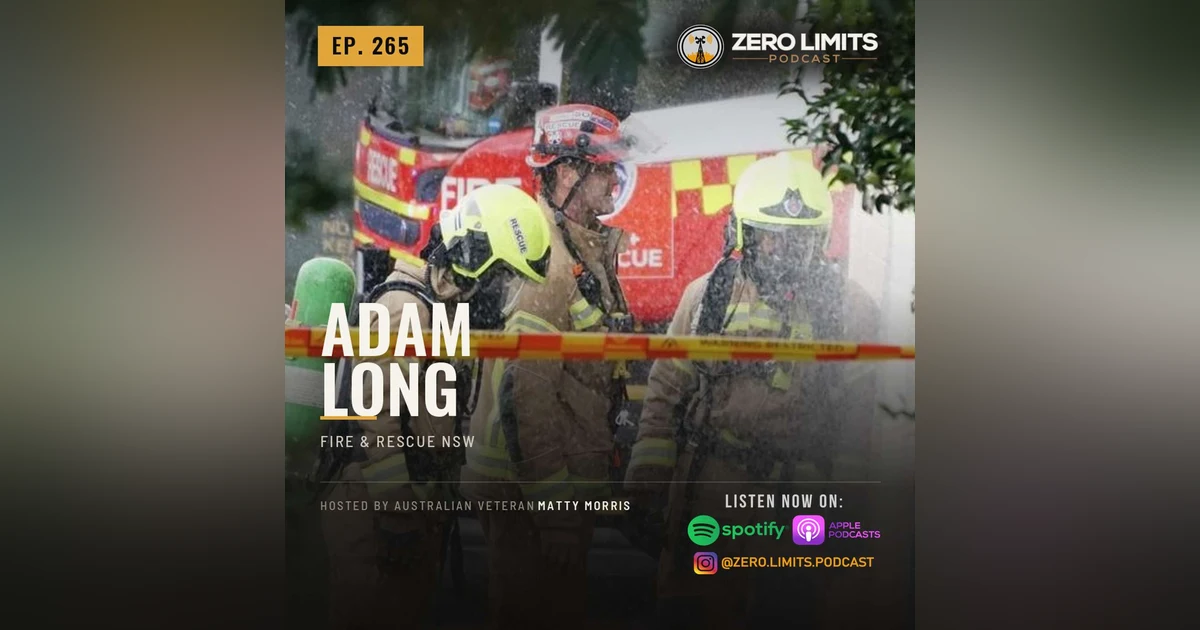
Ep. 265 Adam Long Fire and Rescue NSW


 Apple Podcasts

 Spotify
On today’s Zero Limits Podcast Matty Morris chats with Adam Long, a Station Officer with Fire and Rescue NSW.
In this episode Adam and Matt talk about his career in Fire and Rescue NSW, Urban Search and Rescue, major incidents, leadership, training, working under pressure and some of the experiences that have shaped more than two decades in emergency services.
Website - www.zerolimitspodcast.com
Instagram - https://www.instagram.com/zero.limits.podcast/?hl=en
Host - Matty Morris
www.instagram.com/matty.m.morris
For the new Zero Limits Pre workout and creatine supplements head to link below
Instagram - https://www.instagram.com/zero.limits.supplements/
Zero Limits Supplements - www.zerolimitssupplements.com
Sponsors
Instagram - https://www.instagram.com/vetcomp_claims/
Vet Comp - https://www.vetcomp.com.au/
DVA claims experts, dedicated to helping veterans navigate the claims process with guidance and support.
Instagram - @3zeroscoffee
3 Zeros Coffee - www.3zeroscoffee.com.au
10% Discount Code - 3ZLimits
Instagram - @getsome_au
GetSome Jocko Fuel - www.getsome.com.au
10% Discount ...
517.571.
SPEAKER_01It's time for the Zero Limits Podcast, hosted by an Australian veteran. Chatting with high-charging humans with hectic stories from around the world. We'll give you the motivation to take on whatever life throws at you in the kick to complete any goal you set your mind to. Let's go.
SPEAKER_00Three Bravo nice reactor, River. Uh Bush Ranger seven one trying to contact you, Raven. Uh to you uh Bush Ranger uh
SPEAKER_02Zero Lemons listeners on today's Zero Limits Podcasts joined in the studio, Newcastle, with a 23-year current serving uh New South Wales fire fire fireman. Fireman. Absolute crazy uh story. He spent about 12 years in the Australian Defence Force as well, and uh as uh reservist during this time, which we'll definitely talk about multiple different jobs we've already spoken about offline, just to get a bit of a a brief history of his life and career. And most recently, probably about a month ago, I think we'll we'll team up the podcast. We've been chatting for about two or three months now. And he ended up on the news part of a rescue, and we'll get into it because it's just it it just shows that the job never stops. You're out fishing with your boy and you you know you you're ferrying our GDs out to a you know a floating body in the river. And mate, it's just sounds sounds like a movie. Absolutely sounds like a movie. Not to mention multiple commendations for for bravery fires, uh typical, you know, like it's Ladal 49 running into houses and I watch a lot of Chicago fire. And mate, that's my that's about my experience with um with firefighting. Otherwise, you you know, you see them cruising around and I know the police pretty much say you guys just kick back in your uh lounge chairs and put the feet up. But uh Adam Longmate, welcome and thanks for coming on. Yeah,
SPEAKER_03thanks, buddy. Yeah, thank it's uh it's good to be on the on the podcast. Uh you know, a legend like yourself, uh, you know, it's uh it's a good platform, I think. Uh you know, getting uh a whole range of as you you know uh you know sim similar minded people on to uh to tell their story and and you know what lessons can we learn from each other and you know it's that constant never-ending improvement kind of uh mindset.
SPEAKER_02For sure, for sure. I think you're gonna be the first I want to say actual firefighter, but the actual firefighter that had on that that has been your main career, you know. Ma majority of the guys that have had on the podcast previously they've all either come from defense or fire uh from the police, or you know, I mean they've always been amalgamated histories with with them. So now I've finally got someone on that's got the full story, not to mention now, you're you're the station officer for Sydney City. So, you know, you've got a ton of officers under you, with the fire firemen under you. Mate, like could you ever imagine being where you are now, you know, 30 years ago?
SPEAKER_03Yeah, it's it's it's a weird concept, isn't it? Um you're always uh you know, resetting your standard on where you are and everything just becomes normal again. But yeah, sometimes it's as like it's important to kind of think back to that, you know, that 10-year-old, that uh 20-year-old self, you know, to you know, when you're when you're there, kind of looking ahead at your career and wondering what you're gonna do, you know, like we all uh we all end up being this age, but what we choose between then and now, I mean that that makes who we are, you know, it makes our life, makes our story. So uh, you know, I I think uh, you know, I I'm very big on psychology and I think you know, but the the new generation of uh or young generation of people, it's important that we do mentor them because uh they are our future. And uh, you know, I think people like you and I, you know, I think we've got a lot to give now that we're a little bit more older and a little bit more experienced to that younger generation. And hopefully things like these podcasts can help someone that might be, you know, wondering what they're gonna do with their career and and and realizing that you don't have to get have it all figured out at the start. You figure it out on the way, but but you've got to start, like you've got to do something.
SPEAKER_02Yeah, exactly right, mate. And I'm sure it's the same for the fire. He's been I've had a whole bunch of police officers on and they have those field training officers that you know teach them within their first you know promotionary year. And uh it's so critical to have such a good trainer to teach you uh not only old things but new things. And uh rather than you know getting that big old fat training officer that just lazy because it's monkey see monkey do.
SPEAKER_03Yeah, yeah, yeah. You know,
SPEAKER_02like that's and that's where that's where that all comes into it. You know, we spoke about this offline in regards to that you know the psychology of of life in in general. And you've learnt it over the years, obviously now being a seasoned veteran uh within the the firefighting scene, you understand life now. You know, you understand whereas, you know, uh when we're back in 19, 20 years old, you've got no idea. Like you've just got no idea. And it's wild too because us defence force guys, we all join, you know, 1920 and you're in in an active war zone at 1920, and it's just it's crazy to see what you can what you know now.
SPEAKER_03Yeah, yeah, yeah. Yeah. And I you kind of wonder now with what you know, uh how like how that exposure would be to you today as opposed to what it was when you were 19, now that we're probably better equipped emotionally than what we were back then as well. You know, we'd see things through very different eyes. But you know, it's uh yeah, it'd be fascinating to see.
SPEAKER_02And just quickly, just on that, I this will probably lead into the first question that I normally ask right at the end of the podcast. But the first question, what would you tell your younger self right now? You know, that 16 to 70, because you know, between that 14 to 16, it's quite a I think it's a pivotal age, 14, 17-ish. Can dictate the rest of your life, I reckon, that that age period.
SPEAKER_03Well, I I guess I can answer that as a father because I have two young boys, uh, 10 and 12, Max and Harry. Uh, and I guess you know, that that message, that question you asked me now, I try to deliver to my boys. So I teach them about risk management. Um, because life is life is dangerous. Like we don't get out of this alive. Nobody does. Um, but uh, you know, if I can expose them to as many things as I can that others may see as dangerous, like whether it's motorbike riding, scuba diving, you know, operating boats, um, fishing, um, you know, like uh anything that, yeah, driving cars, even like I've teach I've taught my kids how to drive cars. Like as my my grandfather when I was eight taught me how to drive because we used to go out on on remote adventures when I was when I was eight. And uh my grandmother couldn't drive, so um he made sure that I could drive if there was a problem so we could get get to you know, get get to help. So I guess you know to reflect on that question, like what would I say to a 14-year-old these days? Get out and challenge yourself. You don't know the answers, you don't know what you want to do, but um the more competent you are, the more options you have. So, so chase challenge. Um be comfortable with being uncomfortable, and and that still applies as an adult too. I mean, how how many people don't go for a job because they don't think they're the that they're they're good enough for it? Well, you're probably not good enough for it right now, but you certainly won't be good enough if you never even try.
SPEAKER_02That's it.
SPEAKER_03So, you know, like I I kind of you know, I I like to just throw myself head first and work it out because I know I can work, you know, that that's the challenge, the fun part to me is working it out.
SPEAKER_02Exactly.
SPEAKER_03Um, and and being uncomfortable, but that feeling you get when you do work it out, and the feeling you get when it's like you reflect back and go, you know, I was well out of my depth, but I worked it out, you know. I've uh it's very satisfying. So I mean that's that's what I would tell the kid these days. Challenge yourself, be uncomfortable, get up, public speaking, get up and speak in front of people as much as you can. Like, probably one of the biggest um changes for me as an adult was um when I started to do um adult education. Um, because everyone's worst fear is is getting up in front of a group and and talking. I and I guess I guess the fear is is is is people seeing that you don't know something. But once you realize that we're all human and everyone has the same insecurity, like you, you know, you if you can get up in front of a group and talk um and and be okay with not knowing something, then it just opens up so many other doors. You know, it's uh
SPEAKER_02exactly and no doubt uh as a station officer you're on the news outlets every so often talking about a about a job. But you know, exactly right, mate. With with kids that age, uh obviously think about who you're hanging out with as well. That's one of the biggest things. Surround yourself with good people, like-minded people that'll take you in the right direction. You hang out with the shit kids, you can turn into a shit kid, hang out with the good kids. You know, yeah, so you don't know most of us. We always had the good in us, we just did some bad things,
SPEAKER_03yes, definitely.
SPEAKER_02Um yeah, there's so much and and like you said, put yourself out there for the younger people, just put yourself out there. You know, you could be going for a job, like you said, you probably think that you're not qualified for. Just do it. What's the worst that's gonna happen they just say you're not we're not looking for you? But I know for a fact there's gonna be people out there business owners who are like, you
unknownknow
SPEAKER_02what, I'm gonna take that kid. I like the way he's doing it. Maybe he hasn't got the qualifications, but we'll make that happen. But he's blank canvas, we can teach him, blah, blah, blah.
SPEAKER_03Well, there's that saying, I mean, you can't teach attitude, but you can you can teach skills. So, like uh if I'm looking for a new candidate at my station, um, the first thing I'd look for is attitude because I can train them, I can I can get their skills there, that's fine, that's trainable. But if they've got a bad attitude, you can't train attitude. I mean, you can influence attitude, but again, with that, you have to slowly boil boil them. You can't just get them to change straight away. You just have to slowly influence them over a period of time and eventually they change, but it takes a long time. So I think attitude is is everything, you know, skills can be trained.
SPEAKER_02Exactly. Yeah, I guess this rolls on to first part of your life because spoke about this offline. Your life wasn't so cushy right at the start there. This is where you had that, you know. I guess this is why we started with that part of the podcast because your younger life, you had the you had the opportunity to to take it to the the wrong way, which it almost did. So let's get back to these younger days, mate, growing up.
SPEAKER_03Yeah, so um uh Penrith boy, uh grew up in in Penrith. Uh so I was born in the Penne hospital, um, parents uh Brent and Judy. Uh I've got a sister, Natalie, who's uh in the police. Um but uh you know, just humble upbringings, um, you know, just standard Penrith life. Went to the local schools.
unknownUh
SPEAKER_03uh I think that the first high school I went to, um, you know, it was pretty rough. Um being being a policeman's son, like a a lot of the a lot of the kids there were like, oh, you know, don't tell Longy you'll tell his dad. So it kind of pushed me into a side where I was always proving that I wasn't the good guy. Um, heaps of fights. I got suspended five times. Um I was always I guess it's like when you walk into a prison, what do they say? The first thing is find the biggest, toughest guy, punch him in the face. Well, I guess it was kind of like that, you know. You just wanted to make sure that uh, you know, um I didn't want to be labelled like that, which you know it's wasn't a it's just how it just naturally happened. And uh at the time you kind of don't really recognise it's all in reflection now. Um, so I guess in those days I was probably heading down a path that uh, you know, I'm glad got changed and got altered. Um and and and what happened, I guess, for that was kind of moving into uh, you know, the City 2000 Olympics uh announced in 1993. Uh they they tried it, they they kind of went down like the East German approach, which is what they call the talent identification program. So they uh they selected people based on uh on genetics, height, weight, reach, um, parents' genetics, sporting backgrounds from your parents, and all that kind of stuff, uh, and selected people based on the sports they thought they'd be best suited at. And I was selected for rowing. Um, being a Penrith boy in a Pine River, you
unknownknow,
SPEAKER_03we've got the best uh training facility there. Uh so um yeah, they I think they selected around 400 kids to try out, and they selected 16 in total, so eight boys, eight girls. So I was in a training program there from the age of uh 13. Uh and I guess for me that that was pivotal because uh it gave me an identity um as an athlete and also kept me off the streets because I was training morning night, morning night, like you know, before school and after school. Um and uh you know, I guess you don't realise the lessons at the time, but it taught me discipline and uh it talked taught me grit. You know, it's probably one of the most important words that I kind of you know that I've recognised as an adult now is the word grit. You know, just get just doing those things you don't want to do, you just get it done. Um and uh yeah, so that that there um really changed my trajectory, I think. Um having that identity change is into an athlete. I mean, I always did sport, but but this now was at a pretty serious level.
SPEAKER_02Back, your dad, current cop back then, how long was he in the job for and what was he what was he doing?
SPEAKER_03Uh so dad was in the job for 40 years. 40 years. Yeah, 40 years. Uh and and just like me, he always chased, uh, he he didn't mind a bit of a scrap. So uh he worked at Mount Druid
unknownand
SPEAKER_03uh St. Mary's. So I
SPEAKER_02do, yeah. Straight to thinking.
SPEAKER_03Probably the more notorious police stations for uh, you know, if you want to find trouble, that's the place to find it. Uh you know, big tough, you know, old school police officer, six foot six, um, 120 kilos. Where
SPEAKER_02you get your hype from?
SPEAKER_03Yeah, yeah. Well, he's a little bit taller than me. He's uh he's a he was a weapon, pretty uh my first, you know, as first superhero, as they say. Um, but uh um yeah, so he he was uh highway patrol for for many years, loved the fast cars, loved the motorbikes. He rode the police motorbikes as well. Like he just chased adventure as well. Like he was uh he got into he's got bravery awards as well. Um, yeah, many, many stories. I mean, you could do a whole podcast on him. He's he's got some incredible stories. But um, but that that was my dad, like uh just uh, you know, he'd be on the news. Um he's in the police museum for you know, his shirts in there. He's got a big slash across it from a breakout that happened at Penrith Police Station in, I think it was 92 or so. Um ended up taking out a one of the prisoners, like smashed his jaw, broke his ribs, um, pinned him down. Another guy got out, but a TRU guy was TOU guy was off duty because the guy at the other police, the other criminal was so high profile, he recognized him straight away and codanged him off duty and took him down. Um these guys had actually smuggled um some knives into the into the jail up their backsides, and uh, you know, they ended up pulling him out and overwhelming a couple of police, and dad was the the uh the sergeant that day, and he's you know, said a you know, he these certain police had apparently been locked up by these criminals, and he'd gone in there, two guys, just him, big guy just swinging his fists around, and uh, you know, he uh he copped a couple of slashes, seven, seven slashes at the time, um, but kept fighting, um, which was interesting though, because you know, back apparently they had a few diseases and stuff. It was my first exposure to
SPEAKER_02come out of someone's bum.
SPEAKER_03Well, yeah, exactly. Just
SPEAKER_02add that to it.
SPEAKER_03Yeah, yeah, yeah. But I just remember I couldn't use my dad's shaver for three months because he'd just uh you know been exposed.
SPEAKER_02Yeah.
SPEAKER_03And and and AIDS was the death penalty back then in the early 90s. So it was uh I don't think they had AIDS or anything, but had you know hip alphabet and all that stuff. And dad was fine, he was clear, but that whole uncertainty period, um, you know, he's come home with broken legs, crashing bikes, and you know, like it's uh yeah, he's he's had a pretty crazy life. So dad
SPEAKER_02comes home, he's
SPEAKER_03like,
SPEAKER_02mate, what's going on now?
SPEAKER_03Yeah, he's on the crutches. Yeah,
SPEAKER_02what's what's next week? Was he ever uh you know, uh, you know, I guess giving you stories? Because you know you we spoke about this offline. You you know, you you update your kids just so they're aware of it it keeps kids these kids aware of what's ha actually happening in the world, you know, not in your little sheltered communities. There is a real world out there, yeah, real things happen.
SPEAKER_03Um he he he was a very quiet man, very humble man. He never really spoke much about it, but uh but there was other things I was exposed to. So he he used to lecture on um uh disaster victim identification. So back then there was all VCRs of these crashes. So I remember vividly when I was a little kid finding the VCR collection and putting it in, uh, and all of a sudden there was a crash in New Zealand, aircraft crash. And the whole video was on finding the pieces of the bodies and how to line them up on the on the blue tarps and go, oh, this part goes here and there. And I'm you know, like a 10-year-old looking at this video, going, Oh, this is this is cool. And uh and back then to the police journals. So that that would show, like, say, the bikey, um, the bikey shootout that um happened out at Reevesby, like all the dead bodies in there. So as a little kid, I'm open up the police journals. Oh yeah, look at that. And uh, you know, at the time you kind of don't really think about it, but I
unknownguess
SPEAKER_03it desensitized me a lot to um these things as well, which has helped me out in my later days as well. Um, my dad always said to me, Um, you know, if they're if the person's alive, um, they're a casualty, if they're dead, they're just a piece of meat, um, which might sound really hard and cold, but it's just a way of, you know, I guess filing it in your brain, really, as a coping mechanism. There's a lot of things that emergency services and and you know, war veterans do, I guess, um, as coping skills, whilst to the general public it might seem pretty sick, but you know, we we are dealing with unusual things. Um, so we we do have to you know have that dark humour uh and way of processing things as well.
SPEAKER_02And you said you've got a sister, she's currently in the police.
SPEAKER_03Uh she's just left the police, she's done 17 years in the police and you know
SPEAKER_02another podcast here. Oh yeah.
SPEAKER_03Oh yeah, well she she's uh yeah, she she's a overachiever as well. Um, silver medal at the at the uh under 23 World Championships with rowing, she was a rower as well. Uh she uh surfed burrito, she she's won one of the professional surfboat leagues, uh rowing out of Bateman's Bay, Amazon woman, six foot one, um, all the crews that height as well, pretty nuts. But uh again, yeah, just just a really good um hardworking human as well.
SPEAKER_02Like we spoke about offline, mate. This is your life. You're hanging around the wrong kids, and it was gonna take, you know, and one of these kids turned out to be, you know, pretty, I guess, synonymous criminal, yeah, gangster in Sydney.
SPEAKER_03Yeah,
SPEAKER_02you know. Okay, how does this come along? Is this during school and you just start drifting with those with that crowd?
SPEAKER_03I think I think because I was trying to portray myself as the the badass at school, um, or or you know, not necessarily the the straight shooter, uh I guess uh you kind of kind of naturally gravitate to to those that are willing to challenge the norm, um, which you know I guess is what a lot of a lot of those people that choose that side do. Um I guess there's an interesting philosophy that no one ever thinks they're the bad guy, or you know, if you you ever read the book, you know, How to Win Friends and Influence People, there's a lot of talk about that as well. Everyone justifies everything they do, they never think they're the bad guys. Um, but uh yeah, I I think that that's how that naturally gravitation occurred is just due to my attitude at the time. You know, you surround, I guess you become a magnet to to those that reflect your similar values to what you have at the time.
SPEAKER_02Yeah. With this gangster, man, how how gangster are we talking?
SPEAKER_03Um, yeah, it's yeah, he's
SPEAKER_02is he still a friend?
SPEAKER_03Yeah, yeah, yeah. Not not someone that I hang out with very often. We're friends on social media and I we we watch each other's lives unfold. Love loveliest guy too. Like you, you know, you you'd want to sit down and have a good conversation with him, but that's such a good guy. But you know, like it we so I I I guess sometimes we challenge the rules. Like, I guess the way that we justify it is you know, there's rules out there. Well, what rules can I bend? Um, to you know, like he it doesn't hurt people or not not as far as I know anyway. Um, but uh but you know, I guess challenges the rules, which is the law. Um, and maybe uh you know, I guess sometimes people bend them a little bit too far where they may cross over the other side of the law, but then you know it's it's finding that that uh balance, I guess, for those individuals. But um uh but still a good human, so
SPEAKER_02yeah, of course. Maybe I've got a lot of friends in that in that space. It looks lucrative, I'll tell you what. Fact, it looks lucrative, but you know, they all get caught or stabbed or shot or whatever one day or dead.
SPEAKER_03Well, that's all part of risk management, isn't it? Sometimes there's severe consequences. And I I have another friend uh that I went to school with as well that did some jail time uh for for you know for um yeah you know going down the world of drugs and selling drugs, and I guess you know that that lifestyle is very lucrative as well. Like if you can have this product that you can sell and get a good return for, I mean, you it's gonna be very tempting to do, and and then you get caught and then there's the consequences. So, you know, I think I think a lot of people like that grow from it as well. Like this individual I'm talking about um has flipped his life around and uh is has a very high um media presence now and uh obviously uses his lessons of the past like we all do um to help others. So, you know, from those you know times previous to helping others, you know, moving forward. So, you know, I guess you know, we we all we all take pars, and some of us realize the path we've taken and can help others through those lessons.
SPEAKER_02And like you spoke about, your path was heading down that route. Who knows? You might have a teardrop, you know. If we're looking if you continue on with that par, you'd have a teardrop tattoo on your on your face right now, and it'll be probably a totally different story. Yeah, might be in a jail cell. But like you said earlier. you moved into that uh obviously the Olympics were ramping up and uh they you know had a diff like you said the East Germany style where they're just pretty much on appearance six foot buddy five strong you're a rower you definitely look like a rower and obviously your assistant becomes a row as well so obviously there's you know there's uh somewhat that theory works uh that drags you into that pipeline so it almost steers you away from uh that had the pipeline that could have been worse
SPEAKER_03yeah yeah yeah
SPEAKER_02like changes your life but it what what made you make that decision to go you know what I'm gonna focus on becoming a rower
SPEAKER_03yeah so that's the interesting thing isn't it because I mean you can quit at any time like how many sports do we play and we're like you know I don't want to do this anymore and we'll go and find a a new one what I I guess what attracted me the most was um the feeling of accomplishment you know like where you kind of feel a bit worthless but then well maybe not worthless but you don't feel like you can achieve something but then through goal setting you end up getting something that you you never expected to achieve and and that whole you know reward process um became addictive. Where can I go next? And uh you know I guess with each each thing that we accomplished we we set a new benchmark. We set a new norm. We go well I've done that what's next so that the setting the next goal next goal and it gave me a really interesting exposure about the importance of goal setting and creating new norms by constantly lifting your standard you know through accomplishment
SPEAKER_02so you you obviously rowing in the Nippin River part of the the rowing club how do you go like you are you are you making progress here and thinking this is going to be I'm gonna make the Olympics is that
SPEAKER_03well again it comes down to the micro goals doesn't it so at when I first started like the whole thing's about the Olympics and you're like there's no way I could be an Olympian like that's just that's just too far away I mean that's the ultimate goal but you know you you you go from you know not being able to roll at all to being able to row okay to then winning a club championship and going oh yeah I can win a club championship you know I've just beat you know 12 guys um to then going on to you know like a a a state championship and winning your first state championship medal and uh going well I thought that was unattainable but but but here we are uh and then going on to win national championships so um I ended up winning four junior national championships uh uh over the years uh 1996 was my first one uh in a in a uh uh Cox four and then I went on to win um three more like uh was it the the Cox Coxless four uh a quad and then a double skull with Tom Lorich in in 1998 we we won the the junior double skull with the nationals then um but uh yeah just just just constantly resetting where you think what you think you're capable of um 99 I was in the Olympic training squad for the 2000 Olympics and uh here I am a 19 year old with big boys like uh you know like uh I think the next youngest was 26 so yeah you know I was I was the junior there um and uh a lot of hope you know I was rowing uh I was rowing with a uh uh a previous Olympian at the Nationals we came fourth at the Nationals in 99 in the open men's like I was rowing with the big boys then and uh we'd beaten a few Olympians in that uh there was a bit of an upset between one of the Olympians that we beat and he ended up going well you know I'm not gonna row um in pair in in sweepor anymore I'm gonna go back to skulls and there was a bit of a shake up uh I ended up rowing with a guy I just didn't really row very well with kind of the you know all the pieces fell apart a little bit and ended up missing out um on the Olympics and uh and at the time like it was a huge upset like I was so upset like that was my ultimate goal I felt I felt like I should have been there um and uh rowing fell apart at that point for me mentally I just I didn't have the drive to want to do it anymore um it's just what but what I did learn is the power of resetting goals you know in in reflection um there's that it took me many years like these aren't lessons I learned straight away like there was a lot of struggle there was a lot of uh depression and all that after after these uh events um and it wasn't until you know when you you actually go down the path of trying to what can I learn from this you know what what what was the lesson in that defeat um and that's yeah that that the the the resetting the goal resetting was was so critical you know okay I didn't I didn't make that all right but what's next what's next what's next I was always looking forward not always focusing back all right what did I learn from that okay but what what how did I how can I learn uh use that lesson in moving forward um so that that was you know whilst it was a defeat and you know at the time very negative um experience for me uh I'm definitely a stronger person for
SPEAKER_02especially because you were so close it seems like you were so close to be you know rowing in the Olympics and at that stage this is a Sydney 2000 Olympics so this is the biggest you know for Australi for Australia obviously Kathy Freeman and all the the four dudes in the the rowing for awesome foresome that's it and there was ads about them like they were kind of like the poster boys of the Olympics at one stage you know which they had
SPEAKER_03we were one of the better countries in the world for rowing like we we shined um
SPEAKER_02so it had to be a just a massive cut down for yourself to just you know again you've won all these medals and you made the Australian team and now selected and then it just comes crashing down. So it's got to be a big toll to take especially for a 19 year old and
SPEAKER_03yeah
SPEAKER_02that was your life I suppose it was that was your life.
SPEAKER_03Yeah yeah well it went to as far as so year eleven uh year 11 and 12 I did uh a thing called Pathways so I did part-time schooling because we're in training camps we're overseas a lot um like I was at that stage it was the New South Wales Institute of Sport the Australian Institute of Sport uh we're getting paid by the government to to to row yeah there's a lot of money thrown at us back then 2000 Olympics
SPEAKER_02um yeah
SPEAKER_03and uh it was it's just so much hype you know how often does Sydney get the Olympics and uh you know we we're just living breathing um you know I missed down on so much childhood as you can imagine just rowing for this um and then to miss out obviously was uh was a big hiccup or big uh setback.
SPEAKER_02So that's the 2000 Olympic actually just quickly that's you know different times where you're getting paid by the government to go to the Olympic now Gina Reinhart's got to fork it out of her own pockets. Yeah
SPEAKER_03yeah that's
SPEAKER_02crazy in it's
SPEAKER_03yeah yeah
SPEAKER_02just just on there like and they told they told the athletes that they couldn't say that Gina Reinhart was paying them you know bonuses for winning medals. And then obviously when they got back to Australia they're like yeah Gina Reinhart she's a legend what a mad dog.
SPEAKER_03But good on her 100% mate you need that you need those good Aussies promoting Australia um promoting athletes you know we live in such a good country that you know we we need those icons like Gina you know to that can step up if the government hasn't got the money for it we'll
SPEAKER_02the government does have the money though we know that we we know the government's got the money but anyway we'll stay away from that because you're still in the job
SPEAKER_03yeah
SPEAKER_02so the 2000 Olympics happened again you've had a really you've got a really strong uh family history within policing your dad your great uh your granddad as well and then obviously your sister how old do you say is she younger or older?
SPEAKER_03Younger younger two years younger
SPEAKER_02where does the thought of emergency servers come into your mind where where does that come in
SPEAKER_03yeah so
SPEAKER_02obviously it's always been there.
SPEAKER_03Well yeah I guess it was just second nature right I mean acts of service was always in my family um I I always wanted to be army like I always wanted to be an SAS soldier uh I was just obvious obsessed with army you know army cadet um you know I just always wanted that challenge uh and and you know sas soldier was where I was heading uh or to u police as they were my obsessions as a teenager. Uh and and you know I communicate this with dad and and uh I remember dad saying to me once that uh if I was ever police officer he'd break both my legs so um he he uh said the police had changed a lot since he got in in the 70s and uh and this was around the Royal Commission times there was a lot of backstabbing uh it wasn't a good time in the police force at the time there's a lot of uh you know uncertainty uh so he was a little bit anti uh police at the time um yeah so so I guess um but but interestingly he steered me into the fire service oh
SPEAKER_02did he
SPEAKER_03so he he's actually the one that encouraged me to to do that but uh uh yeah so I think you know I think I certainly got dad to thank for that because it really wasn't on my radar at the time the you know fire like I I wanted to do either army or police that's all I knew based on my family uh so um yeah I I I definitely think I made the right choice though like in reflection.
SPEAKER_02Yeah yeah and just just on that obviously you said that your dad wanted to break your legs if you joined the cops but then your sister joined the cops.
SPEAKER_03Yeah well so I guess interesting as well because it was very pro-women back then as well because it was a very male culture but they were really pushing to get women into the police in those in those times uh and uh and like anything if you've got if you've got the the knowledge about how the system works then you can you can work well within the system like understanding you know getting in promotions um how to fit in all that kind of stuff so um my my sister got in well after I was in the fire service so I think I think the the police had picked itself up a lot in that time between when I joined the fire service and when my sister got into the police force uh so I think that had come around a lot since then about the police you know that had that slump and then it picked up again uh so yeah so um he uh yes encouraged her to go police at the top
SPEAKER_02her being six one and can fight yes man a row as well she have a fucking mean uppercut I reckon
SPEAKER_03yeah yeah yeah I'm I'm the uh she she's the more masculine one in my family that she she's not she's very pretty but uh but she can fight yeah loves a fight like she'll get in like 'Tis this really tall pretty Amazon woman that will throw down yeah
SPEAKER_02uh
SPEAKER_03which I think shocks a lot of people you know you as a police officer turning up to a to a brawl at a pub and next thing you know like she's in there throwing haymakers and knocking guys out uh
SPEAKER_02we're gonna have to get her on the podcast like you spoke about the or you wanted to join the military in 2001 September 11 happens I'm sure that would have been uh another like shit maybe it's maybe I should join the army.
SPEAKER_03Yeah and and that was definitely an option like I was strongly looking down um options for military at that stage uh I remember I'm sure as everyone does I remember where I was at the time uh I was working for Rowing Australia at the time uh I was at uh I was at TAFE actually doing a business management uh diploma and I was I was at the TAFE at the time when when the news broke all right just I just remember exactly where I was when that happened and I was like okay all right this is interesting this this is this is new territory like what's next um and you know I'm like a lot of my mates who ended up going right well you know I want to correct this wrong um or how how can I help in this situation stepping into into the you know the armed forces at the time uh and uh where for me I guess you know I ended up going down the the civilian uh route there into the fire service but that certainly got my attention as well I mean already had my attention but yeah
SPEAKER_02for sure especially you would have uh watching 9-11 you know was very focused on on the uh fire department in yeah mate crazy stories I had uh Joe Torillo uh on the podcast he was there he was a firefighter mate you just couldn't imagine that that scale that scale you know they lost a hundred something firefighters and crazy so for yourself you know you joined uh Fire Rescue New South Wales uh November 23 uh 2003 at the age of 23 what's the process here like what's the process of joining reaching out
SPEAKER_03okay so I I actually got in in 99 um but that you're right in in those numbers I got in in 99 yeah but I I'd also got into rowing Australia at the time so I went through the process got selected but then I chose Rowing Australia so I knocked it back uh and then you know the I did the Rowing Australia thing for about three three years and then um I thought you know I I I need some adventure you know I want to I want to toughen up a bit and I want I want some challenge. So I went back and applied again for 2003 uh in well 2002 because it takes quite a while to get in uh and got in in November 2003
unknownuh
SPEAKER_03so the fire service is quite a competitive um job to get into there's a lot of people so when I applied there's 1000 people and there was 200 people selected so super competitive uh aptitude testing fitness testing um psychometrics um all you know all that kind of stuff so um yeah it's uh it'd be quite tough I guess as selectors to get the right people out of those 10,000 you know to to get in but but what you do get is you do get you get high performance out of that um which again becomes your normal like you you're working with that top two percent of people selected that applied for this job um which again you know raises your standards again you know at a to another level
SPEAKER_02yeah how is it how like how's the recruiting these days is it has it died off because I know I know for a fact that when I left defense 2009 at that stage there was like a million soldiers getting out of defense and everyone to try and join the firefighting every single year you'd apply and just nothing nothing nothing nothing.
SPEAKER_03So there was there was a there was a big uh period where we went recruiting uh so uh I on the I I do recruit instructing now um uh as uh uh you know going in and out from the fire stations um they're doing a massive drive at the moment so we're trying to get our numbers back up uh so uh they've just done 400 fires through in the last uh the last financial year uh so that there is a big drive it is a good time to apply uh I understand they may be doing another recruitment very shortly so uh a lot of people contact me now to ask about getting in and uh you know 23 years later I still love what I do so I'm I'm a big big advocate for the fire service uh you know we get to make people's worst days better there's no more rewarding feeling than you know being a help someone on their worst days uh so yeah I look I I encourage people to do any active service you know whether it's police fire ambulance uh you know military I mean all of these things are just building layers they're they're they're um you know they're they're their components that are that that are building a more resilient you really
SPEAKER_02yeah exactly um I was gonna say just just quickly if there is someone applying for New South Wales uh fires right now give them a quick tip what what's the what's the angle here to be better than the next applicant
SPEAKER_03so they they say you can't study for psychometric tests but you can study for anything the quicker you can comprehend a question the better you're gonna be at answering the question so uh like you you you can go online and you can study psychometric testing um you can understand personality traits um the other one is uh is emotional intelligence as well so they they do a lot on emotional intelligence so understanding um like yeah be interested in understanding body language like when people write raise their eyebrows or they you know what does a frown look like I mean a lot of these things do we instinctively know but to actually verbalize what does a frown look like or or disgust understand what does disgust look like these are some of the the questions were actually asked so when I went for my station officer promotional program that there was an actual test on emotional intelligence to see if you could actually identify different facial expressions so you know go down that path of psychology you know understanding the the emotional intelligence psychometric testing um uh you know yeah I'd I'd say that would probably be a big one also interviewing as well like uh so one of the processes you have to do an interview and uh you have to be able to sell yourself like it's all good being good and knowledgeable but how do you how do you sell that to someone else? And um it's not about big noting yourself it's just about expressing your knowledge and experience and how you would be of value to an organization. So I'd I'd I'd uh encourage people to practice interviews.
SPEAKER_02And fitness
SPEAKER_03yeah fitness fitness is a big one of course uh you know I I guess that's something I I take for granted not no actually that's that's incorrect I don't take for granted but I think it's a norm. I think everyone in my industry as a professional firefighter um it's uh fitness is a big one uh you know we've we've got gyms at work uh we encourage each other to be fit and healthy uh you know we're a lot of the mess room talks is about fitness psychology uh this there's a lot of good conversations down that path there's a lot of guys and girls that work in the fitness industry in in in the fire services so they bring all that knowledge into the fire stations and we have good cookups and you know it's uh all the modern all the science has been spoken about you know we we have these conversations so we're constantly teaching each other uh and sharing knowledge so it's
SPEAKER_02yeah yeah now back to back to November 2003 so you get accepted into the firefighting side of things you go to the academy where where's this at how long is it
SPEAKER_03so so this is at uh Alexandria so when I got in it was at Alexandria um so it's it's uh uh it's now out of Erskine Park we've got the um it's called the Emergency Services Academy out of out of Erskine Park um back then when I joined it was called the New South Wales Fire Brigades so they had a name change in 2012 um and uh so alexandria uh we did 16 weeks of training uh I think we actually did 18 weeks we did an extra two weeks because it was over Christmas period and there was a big bushfire period that happened around that time in 2003 uh so we had quite a a longer uh training process uh we had some good instructors back then um you know very hardened uh instructors um very military style back then as well you know it is you know a lot of uh a lot of yelling a lot of uh holding people to certain standards and yeah it's just conditioning people really you know it's uh so you know we we did a lot of uh a lot of firefighting a lot of rescue um you know it's a lot of hot soil training as well getting in there um being uncomfortable um we had a lot of different equipment back then you know we've we've advanced a lot since I've got better better clothing
SPEAKER_02technology
SPEAKER_03better technology better training as well today we we we we've learned a lot in the world of training you know worldwide you know worldwide and we're we're constant I mean every organization's learning and growing as such so today we're we're a lot more um a lot more scientific um I think our methods are a lot better um we've got to understand that a lot of a lot of fire is come from the military or other emergency services a lot of police and amboys come across to to the fire service as well so um it's it's adult education so it's not like you're going to Kapuka with an 18 year old and yeah we we want to we want to kind of make sure they're disciplined and you know we want to make sure that they um they follow all instructions yeah without thinking where I guess with the fire service we've got a lot of mature people with a lot of experience life experience coming in so um as a recruit instructor you know you want to treat them s with some respect but but they also need to understand that you're there to tr to to to train them so it's a bit of uh you know bit of tooing and froing about you know treating them as an adult but when they step out of line bringing them back into line to realise that you're a recruit and you're here to learn and uh I understand you've got a lot of experience and knowledge but whilst you're at the college you've got to follow instructions and uh you know and and our job is to to to bring those concepts and try to align them with real world experience uh so they can apply it when they leave to get out to the fire stations.
SPEAKER_02Now during this like I just want to break down this this training you know this 13 weeks of training mate I've got no idea. I did a intro to fire and hazmat back in I don't know 2009 or something and even that opened my eyes I think it was two days you know right going into a room and it's all dark and smoke and like holy shit this is crazy. But um for yourself mate you know 13 weeks run me through this you know first I'm sure there's a lot of educational side as well you know learning the you know the behaviors of fire and the chemicals and all that stuff.
SPEAKER_03Yep yeah so I guess to start with uh it's it's a learning learning about equipment um learning about what equipment we have the tools that we carry on the truck uh I always think of a fire truck as a toolbox on wheels you know we've got uh there's 2,000 litres of water in an urban truck and then the rest of the truck's tools uh so you you know you've got to select the right tools for the job so understanding what's on the truck and how do we use it concepts all those types of things uh they need to you know learn about uh you know the psychology of being exposed to traumatic events as well like some of these people may have never seen uh a dead person before or a severely injured person before so equipping them uh emotionally and mentally uh for what they might be exposed to as well um I think sometimes it's also about educating people what they're in for as well like I think some people naively come into the job thinking that you know it's all you know like what you might see on on uh you know Chicago Fire or something like that. But um which you know it it is but uh but actually I've got a funny theory about that. So all of those shows that we watch whether it's a a doctor show or the fire show it's all based around incompetence. Yeah.
SPEAKER_02So if you
SPEAKER_03when you Think about it, the drama is incompetence. So the reality of a fire service is it's not Chicago fire, it's it we're very professional and we're very calm. And and the thing that cracks me up the most is when people go and visit uh patients after the event. Uh that that brings on trauma to you personally. Like you've got to look at a job as a job, and once it's complete, you go to the next job. You know, it's uh you know, if you want longevity in what we do, you you've got to be a little bit more mechanically minded than emotionally minded when it comes to these jobs. Um so back to the college, uh so they're they're learning about road crash rescue. So uh so we changed our name from New South Wales Fire Brigades to Fire and Rescue New South Wales because our our our core role has has grown considerably over the years. And the public just thought, you know, New South Wales Fire Brigades, oh, they just put out fires. But putting out fires is actually quite a small part of what we do these days. Uh uh we assist Ambos quite a bit now with medical. Uh so for instance, you know, like your grandma collapses, ambulance arrives, they can't get through the door, you'll you'll generally get a you know, the the the local fire station, a rescue unit turn up to uh to gain entry. Um the person may need assistance as well, they might be on the second floor, so they need to be carried down from that second floor out to the ambulance. So we do a lot of uh ambulance assists there. Um uh so yeah, even just manual handling, like teaching them how to lift a patient and uh not just to protect yourself, but what about the patient as well? Like if you're dealing with an older person, you know, you grab them on the arm, you might tear their skin, or you pull on their shoulder, you might dislocate their shoulder. So using the appropriate equipment and the appropriate techniques to be able to move humans around without further injuring them. So that's another aspect that uh that we train. Uh we also move on, so so uh Fly and Rescue New South Wales are the combat agency for urban search and rescue. So for any building collapse, so we've got different layers of urban search and rescue. So a recruit gets taught level one, um, which is a first responder, urban search and rescue first responder. So a building collapses, the all the local emergency services turn up, uh, and uh and and they can generally save the most amount of lives because you'll have people on top of the rubble pile. So they can go in and extricate people from the rubble pile, from the top of the rubble pile, from the surface. Uh, but then you've got the more technical side, which is uh where people like myself step in, which is your urban search and rescue technician, where we can actually go in and and uh so we go into an unstable environment, a building collapse. We've got to make it safe, structurally safe. Like we, you know, we we don't take unnecessary risks uh and then access casualties that may be deeply entrapped within rubble. So that that's where we step in. But that's that's separate from their training college for recruits. Um you've got hazmat, as you're talking about before, so chemical spills. I
unknownmean,
SPEAKER_03we're the combat agency for hazmat in New South Wales, so so making um you know any type of industrial chemical spill safe. Um we work on the water as well with the Ports Authority for chemical spills. Uh so teaching all about hazmat. So they go out and do they've got hazmat trainers that teach about hazmat. Um, we've got driver trainers that teach them about driving how to safely drive a 16-ton truck on the road safely, because obviously we don't want to injure people or kill people on the way to a call. Um, and then we've also got specialists um uh in uh in in actual firefighting behavior. So um so I was a recruit instructor, which would kind of broadly um teach them the the overall overarching um skills, um, but then we've got the um uh firefighting operations um uh team as well that they'll they'll actually teach them about what you're talking about before, where you go into like a burning structure using thermal imaging cameras, um, how to use water and how it expands six and a hundred times its own size to displace oxygen. So it's not like the old days when you just put the wet stuff on the red stuff. You you actually can use steam in a compartment to expand and push the oxygen out of the fire. So you know think of a unit fire these days, you know, it's all it's all um, you know, you've got the windows and doors intact. Um we can actually push the oxygen out with steam uh as opposed to just putting water on the fire. So that's what we call the compartment fire behavior training that we do. Um and and we've got specialists that train the firefighters in that as well, and they just live and breathe that. Um so uh just
SPEAKER_02quickly, mate. Now I've seen this in the movies.
SPEAKER_03Well, Justin Hems had it had a stint at that as well. He came out to do one of the stints that you're talking about.
SPEAKER_02Oh, yeah, right. Yeah, yeah. Yeah, mate. It was it was funny when you talk about that thermal camera, because that's what they did for us. They showed this, you know, it's absolute pitch black, and they get the thermal camera like, holy shit, you can see you can see.
SPEAKER_03You can you can see the heat layers, you can see where the hotspots are, you can see bodies on the ground. Um, the thermal imaging camera, just I mean, in your in the in your military time, you would have seen the flurs on the tanks and stuff. And yeah, you know, like the the information it gives you at all different levels.
SPEAKER_02Game changer.
SPEAKER_03Yeah, just to be able to see in the
SPEAKER_02technology. Yeah, I've got I've got one for pig hunting. It's great. Put it up in the air and bang. But just back to the movies, mate. Chicago Fire, ladder 49. Yeah, a couple of my favourite tear jerker, lad of 49. Oh, yeah. Actually, right at the end of that movie, you know, they um you know, there there's a firefighter trapped and they talk about that steaming thing. I think there was an incident in the US I had a firefighter on Travis Howes. Something similar had they had nine firefighters killed, and a lot of them were steamed to death.
SPEAKER_03Yeah, yeah, yeah.
SPEAKER_02Because it collapsed and obviously to do the rescue, they gotta hose it down, but that's when the steam is made and it kills firefighters. Like that's
SPEAKER_03yeah, yeah, yeah. I mean, you you can get burns at 45 degrees if you're exposed for two hours. I mean, it's just all the burn is is taking your tissues outside of its survival range, whether it's through cold or heat, and uh, you know, that's a burn. So you can imagine, especially inhaling this uh you know, superheated gas, and uh, you know, as soon as you you burn your lungs and they swell up, I mean you lose your ability to breathe. So, I mean, that that's that's the the most common way that people would die in these type of environments is just the inability to uh to breathe and breathing superheated gas, burn your air away, all that kind of stuff. I mean, the other big ones carbon monoxide poisoning as well. Of course, yeah. You know, like just the off-gassing in a fire. I mean, especially in in modern firefighting now, we've got so many chemicals or so so many plastics and and and other products within these houses that when they burn, they off-gas a lot of carbon monoxide. Um, and I mean that sticks to hemoglobin, um, you know, uh excludes oxygen from being able to bond to hemoglobin as well. So it's it's it's a really difficult one. Uh if you get that that carbon monoxide poisoning, like how do you how do you save someone after they've got carbon monoxide poisoning because all their hemoglobin's taken up with that carbon monoxide and you can't get the oxygen on them. So um, yeah, that early intervention's critical for us. You know, we need to get people out of these environments before they get the the full saturation of carbon oxide.
SPEAKER_02Of course, mate. Yeah, we'll definitely talk about some of that stuff, especially the lithium stuff these days. I'm sure you've experienced, you know, well well versed on lithium fires now, Teslas and scooters and all that stuff, which I think those uh those electric scooters have contributed to a lot of house fires as well. Oh, for sure in recent times. But we'll get on to that, mate. So you do your 13 weeks at the academy, you're loving it. Is it is this you find your purpose, you're like, fuck yeah, this is me.
SPEAKER_03Yeah, oh it's the the the brotherhood and sisterhood you get in these organizations, um, you know, it's just just people with uh common values. Like for instance, so you if you think about a firefighter, um, we don't have much authority, really. Like when it's not we're not like a police officer or security guard or whatever it might be, you know. It's um we purely join to make a difference, I think. You know, if you if you really break it down, um we join for the challenge and we join to be able to help people. Uh it's quite a satisfying thing when you're driving down the street and you've got families waving at you. Like it's you you you you feel like royalty, like you everywhere you go, like there's little kids waving at you, and you know, like mums and dads pointing to the fire truck, and you know, it's uh yeah, it's it's very satisfying when you can actually, you know, you see the kids, you get them on the truck, the excitement that they get on the on there and photos and all that, you know, you don't realize how much um we don't know how much influence you might provide on that kid. You don't know what direction you're steering them on just through being that friendly uh you know uh official or emergency service, getting them on there, showing them the truck, um, you know, putting the lights and sirens on. Um yeah, it's a it's just a nice feeling to have that.
SPEAKER_02I think it's um it's one of those things, you know, fierys, ambos, cops. The other reason why you guys are responding because something's bad happened. So when you turn up, you know, people think, fuck thank God they're here. Yeah thank all the professionals are here to deal with what they need to deal with. Just quickly on your you know, back to the academy, you know, you speak about, you know, we spoke about this offline, you're doing CPR and all this medical stuff. What type of medical training are you doing? Is it because again, there's multiple scenarios where you're first on the scene.
SPEAKER_03So so we get trained in advanced resuscitation and basic life support. So we've got the uh we we we carry uh oxygen with us, so we can we can bag patients. Um we've got Gadella OP airways to be able to administer the patients to be able to keep their airway open. Um but but when you think about like a lot of people think that that first aid or medical intervention has to be complex, and it's not like I've got this saying, um stop the bleeding, keep them breathing. Like if you can do those two, if they're bleeding, stop it. If they're not breathing, start CPR. Like that, those two things are the fundamentals for any type of thing that you turn up to. So so for us, um that even getting there before the ambulance, if we can get there recognizing they're not breathing effectively and we start CPR, that that that's essentially going to save the life. Uh, the other thing, too, is just because we carry defibrillator as well. So every fire truck has a defibrillator on board. So uh so if their heart's in an arrhythmia, we can place, well, if they're not breathing effectively, we place the the pads on there. Um it actually, as you know, it assesses to see if there's a shockable rhythm present or not. And if there is, we can administer that shock before the ambulance arrive. Uh and and it and their chance of survival drastically goes up.
SPEAKER_02Yeah.
SPEAKER_03So for for every minute that goes by that that person, when that person's in cardiac arrest, for every minute that goes by, they've got a 10% less chance of survival. So that early access to defibrillation is is critical. And it doesn't matter who carries the defibrillator because anyone can, like my 10-year-old son could use a defibrillator and can use a defibrillator. But uh, you know, it's just a matter of just following the instructions and and people just need to have the confidence to use it. Uh, I also say, like at these events, like when people are in cardiac arrest, they're already dead, essentially. Like, you know, they're they're not breathing, they're they're technically dead. And I always say you can't make them deader, if that was a word, you know, you can't make it worse, right? Yeah. So any attempt is better than no attempt. Like just get in there and have a go.
SPEAKER_02Exactly. Exactly. Man, I just bought the new St. John's uh pocket D Fib. Two grand. Mate, it's tiny.
SPEAKER_03Yeah,
SPEAKER_02it's awesome. Yeah, yeah. It's awesome. But for two grand, what to save a life? Yeah, it that's that's a nothing cost.
SPEAKER_03Oh, for sure. And and if you're a business too, like I mean, to look at it from a selfish point of view, like you're a business and you save a customer's life. I mean, that's good business promotion. Yeah, correct. You
SPEAKER_02know,
SPEAKER_03I've got to look at you know what's in it for them type of thing. But you know, like gyms are now there carrying them. There's um like you know, you've got these uh good Sam apps now that actually highlight where the defibrillators are around the place if if the the shop or the the business has actually reported they've got a defibrillator. So just um just knowing there's defibrillators around that you can access and and save a life. There's been many lives saved through that early intervention phase of early CPR and early defibrillation.
SPEAKER_02You know who has cut the funding on D fibs though? The New South Wales police are you listening? God almighty. I don't know what's happened, I don't know why they've done that. I think they were carrying D Fibs in every car at one stage, now they don't have them in every car. I don't know, it's it's very weird. I know we're we'll stay away from it because it's again what's two grand to save someone's life.
SPEAKER_03Well, it's so many times the police are first arriving to the medical events.
SPEAKER_02That's it.
SPEAKER_03Yeah, so
SPEAKER_02they've got less training than you guys, obviously, when it comes to medical.
SPEAKER_03And no, it doesn't matter who carries them. They're so simple to use. And many times I've turned up. The police are already doing CPR.
SPEAKER_02That's it. Um and you can't mess it up. No,
SPEAKER_03you can't. A
SPEAKER_02machine, it tells you, and if you even if you put it on wrong, it'll say it'll say it's not detecting anything, change the pads.
SPEAKER_03There's uh they actually design it for a four-year-old to use. Yeah, big pretty pictures on there, you follow the pictures, and if you can't even speak the language that's written on there, you just look at the pictures and you just put it on there. Yeah, it detects the pads are there, it goes into analysis and it tells you if a shock's needed or not. And the fully automatic ones, you don't even have to push a button, it
SPEAKER_02just
SPEAKER_03says shock advised and clearly and shocks the patient without having to touch anything. So yeah, it's which
SPEAKER_02I'm sure you've used these a million times. We'll get onto mate, we'll definitely get onto it. So you finished the academy, mate. How's uh is your dad still in the cops?
SPEAKER_03No, he's he's been retired for seven years now.
SPEAKER_02How is he? Is he is he loving it that you joined the fieries and
SPEAKER_03oh yeah, he's he's he's now um he's left Penrith, he's down in Bateman's Bay on a on a property, living the dream, um working with Marine Rescue down there now. Um and yeah, just just as a casual volunteer.
SPEAKER_02Yeah. Uh
SPEAKER_03yeah, I guess that's and that's a big topic in itself when people retire is is having a sense of purpose.
SPEAKER_02They moved, yeah.
SPEAKER_03Yeah, especially people that have had a job where they were valued, where they were they had a really important presence, and then all of a sudden they retire and they like, well, what do I do now?
SPEAKER_02Yeah.
SPEAKER_03I mean, there's so many things that retirees can do, especially with all that knowledge and skill, experience they've got. What what could they offer society now? And uh I think dad's now found his feet, he's now you know working with like-minded people, yeah. Um being able to be useful. Yeah.
SPEAKER_02Like we spoke about you've just finished the Academy What's the process right at the end? Do you get like a you get your I don't know, do you get do they give you something?
SPEAKER_03So so you you're a recruit and you wear like a green patch, green epileps
unknownand
SPEAKER_03a green sticker on your helmet. We call it the green slime, you know, as a recruit. Uh, and then from there uh you you become a level one firefighter. So you're not qualified as yet. Uh you've still got a lot of training, uh a lot of uh training to do on the job. Uh and uh so so the modern way of doing it, you've got a level one and level two firefighter, and then um after two years you become a qualified firefighter, you get your first stripe. So for the firefighters with no stripes, they're still in that transition period to become a a qualified firefighter. Uh so you you you're running through a series of um, you know, like uh uh we used to be through TAFE, but now we do it in-house. We're a registered training organization, as in Fire and Rescue is. So we we run all the training. We have dedicated trainers and assessors that come out and they train you on things like you know public speaking. Um we we deliver a lot of programs to the elderly and to kids as well, like on fire safety. Uh so you have to be able to do that. Uh fire safety systems as well, sprinkler systems, detectors. So the firefighters need to know all about how to use sprinklers and booster systems, and there's a whole range of uh fire protection systems that that we need to be uh all over, and uh, because that's what our bread and butter is what we use at fires. So um that's part of the training. Um so yeah, so they'll run through that process. You'll become a qualified firefighter. Um, and from that point, you actually stay qualified for the rest of your career. Yeah, if you if you wanted to, you could do that. Um, the next step is senior firefighter. So once you've done uh I think it's seven years now, six or seven years, you can become a senior firefighter. It's two stripes again. You need to go and do some more leadership courses, some more leadership training to become a senior firefighter. Um after nine years, you can be you can apply to become a station officer. Uh like me personally, I wouldn't recommend rushing into these things. You probably want to get some experience first before you become a station officer. I think I did 18 years before I was a station officer.
SPEAKER_02Yeah.
SPEAKER_03Um I just love the job too much. I'd love being on the tool. Tulling
SPEAKER_02and grinding on the on the gap on the ground. Yeah.
SPEAKER_03Oh, yeah. Well, I just there's there's a so what I'd seen as a firefighter was sometimes people had rushed up the hierarchy too fast and they still wanted to be fiery. They'd become station officers, but they wanted to be on the tools, and that really frustrated me as a as a firefighter. So I really wanted to make sure that I'd had my time on the tools, and uh, you know, after 18 years, I was like, you know what, I actually get more reward out of mentoring people than I do being on the tools, and that's when I knew I was ready to go the next step to become a station officer.
SPEAKER_02As you get old, mate, the body uh doesn't um recuperate like it used to as well. Oh,
SPEAKER_03yeah. I'm sure like yourself, I've got a lot of battle scars, a fractured vertebrae, and you know, knees and back and discs and all that kind of stuff. I mean you you you manage it. I'm still you know super fit. I could still I I think I can still keep up the young flakes.
SPEAKER_02It just takes longer to recover. It
SPEAKER_03takes longer to recover. Young kids,
SPEAKER_02mate. They back up the next day, big nine on the booze, back up the next day. Not anymore, mate. It takes about a week, mate. Um like you spoke about, so you get to the station, you're still you've got two weeks, two years to become you know a uh a qualified firefighter. So run me through that first, you know. First, you leave the academy, where's your first station? Where are you going to?
SPEAKER_03So I was very lucky. So my first fire station was Smithfield. So Smithfield's in the um western parts of Sydney. Um when when I worked there, it was the biggest industrial area in the southern hemisphere. Uh so you you generally find like when you leave the college, all the all the uh other recruits that you're with, like we stay in contact, we email each other. I mean now it's you know WhatsApp and Facebook, but back then it was all email, 2003-4. Um, and uh, you know, you talk about your jobs and stuff, and I was going to factory fires, there's gonna cut like fatality, like car crash fatalities, and um there was a there's actually a a war happening at the time in the in the wreckers amongst the wreckers, so they'd set each other on fire, or not bike is like you know, just getting back at each other. So we're going to these massive wreckers. Um, people were rebirthing cars back then as well. There was a big cynic happening with rebirthing cars, so that the old car they'd go and burn out somewhere. So they'd go out to Weatherall Park and they just dump it. That was a dumping ground. Like, if we didn't get a car fire shift, it would you know it was something wrong. Like sometimes it was two or three car fires. Like, I haven't had anything since like that, but back in the day, like 2004, it was just going off. Uh, so like my fire, my experience was very, very rapid in terms of like I was always the I and I I had senior guys around me too. So I was a level one, but I had a two-striper and a three-striper, you know, uh a 15-year or more firefighter um with me. So I was always on the branch. I was always like, you know, getting into the fires. I had really good experienced senior firefighters as my mentors. Um
SPEAKER_02branch, so branch you're on the
SPEAKER_03the hot the branch is the hose. The hose, yeah. Yeah, yeah. So we refer to it as the branch, the front guy, the branch man or yeah, branch person. Um but uh is
SPEAKER_02that where you start when you first get to a station?
SPEAKER_03Yeah, yeah, yeah. And that that's how it should be. Um where I'm currently working at City of Sydney, there's a lot of a lot of juniors there. So unfortunately, there's uh when there is a fight, there's a lot of fight for who's going to be on the branch, uh, because there's a lot of juniors there. But when you're with a lot of senior guys, like, hey man, have the you have the branch, you jump in there, I'll I'll I'll kind of oversee you, you follow on through. Uh so yeah, it's it's I I think that's where station selection is important. If you can get out to where there's a lot of seniors, um, you get a lot more time to be that uh the one that is actually practically on the hose. Yeah,
SPEAKER_02mate. Let's break this down. Do this with the cops first for the cops to say first rest. Now, this for you, first fire on the branch, and then you know, I guess first time experiencing trauma. Mm-hmm. So, yeah, running me through a couple of these, mate, in the first couple of years.
SPEAKER_03Okay, so I guess yeah, I I I I remember yeah, a few car accidents that I went to, um, they were dead on arrival, um, high speed. Uh, it was interesting like that the whole injury is incompatible with life saying as uh as the ambulance calls it, uh, is where someone's that badly injured, they're obviously not alive because you know the the parts aren't in the right spot. Uh and and that's where I kind of reflected on my my dad's statement. You know, when when they're alive, they're a casualty, and when they're dead, they're just a piece of meat. So um, whilst it's cold, uh it's very uh it's yeah, it certainly helps you psychologically. Uh, because because sometimes we have to bag up these people as well. Like we'll have to put them into body bags, you've got the contractors coming. Uh generally it's the role of the police, but sometimes the police rescue can't get there, and they'll just ask the local fires or local rescue unit to uh to actually do the body recovery for the person. So uh yeah, it was fascinating. I think I think the first time anyone sees a dead body, it's quite confronting. Um, and then there's a lot of processing that takes place, like anything that's new. Um, I guess we're all we're all curious about death as humans, you know. Like what is death? What does it look like? What does it feel like? When are we gonna die? Um, I guess it opens up all these questions when you start dealing with actual deaths. Um, and I I generally find it's not the deceased that's the problem, it's the family members that actually cause the most amount of stress. So you've got crying, wailing people around you, um, processing that it's probably more traumatic than the actual person that's deceased because I guess you can empathize with those people feeling the pain. It brings that human factor um back in.
SPEAKER_02Yeah. Yeah. Um do you remember thereabouts the first time? Just going, oh shit, that's yeah.
SPEAKER_03I'm trying to
SPEAKER_02that's a that's a mess.
SPEAKER_03I'm trying to think of my first. Yeah, you'd think your first would be etched into your mind.
SPEAKER_02Some some people do, yeah.
SPEAKER_03Yeah, yeah. I I I mean, there's certainly ones that have stood out to me.
SPEAKER_02It'd be hard for fire is in airbows because that is your role. Yeah. You're getting called because there isn't there is a bad scenario happening. Someone's definitely injured or thereabouts. Yeah, yeah.
SPEAKER_03Yeah, how do we um so I I guess I'm just trying to think. I think the first the first one was a was a um a WRX back in the day. Like it crashed it crashed through a um uh you know, when you go to end of a road, you've got those uh black and black and white like arrows. He hit that sideways and the and the actual bars through them penetrated through his head and chest and killed him instantly. Uh that just impaled him and he was dead on arrival. There's a lot of out at Smithfield, there's a lot of WRXs and street races and you know, being an industrial air at nighttime, people are always out there racing. So we used to get some pretty full-on car accidents out there uh that would be you know first on scene for. Uh there's a lot of a lot of trauma, a lot of car accidents. Um and uh, you know, again, dealing like these guys are street racing or whatever they might be. And then you've got all of these people that might turn up. Like you might have 40 or 50 people turning up that might know the person. So it can get quite um it can get violent, can turn up into you can, you know, you can get punch-ups out of it. Uh sometimes they're very aggressive towards you as well. Like you're dealing with people that are that are dealing with uh with trauma. Uh and a lot of this might be their first fatality, and it's their friend that's dead, so they're just acting in a way that uh they wouldn't normally act. So what you learn very quickly is how to diffuse situations, um, you know, and uh and and different areas have different cultures as well. So, you know, working in Bankstown or Blacktown or Smithfield or or Burwood or the city, like each area has its own culture as well. So you've got to become very understanding of the different cultures and how they represent death as well. Um, so I I found that fascinating as well, just bouncing around, just seeing different cultures within Sydney. Um, and uh, you know, they are what they are, and uh you you just seeing how people process things,
SPEAKER_02but the aggressive aggressiveness towards firefighters, like what have you got to fucking do with anything that's happened, you
SPEAKER_03know
SPEAKER_02what I mean? I understand they're grieving and blah blah blah, but just
SPEAKER_03yeah,
SPEAKER_02take a deep breath for a second and just have a think because you're there to possibly help if possible.
SPEAKER_03Yeah, yeah. And I I don't take it personally though, because I understand they're not they're not it's not you personally, it's just that it's just their um they just don't know how to process what they're processing. They're overwhelmed, I get it, yeah. The fight or flight's kicked in, they're in the fight, and you're just in the way. Um and like how do you how do you diffuse the situation? That's that's the I actually enjoy that's the psychology part I enjoy is um you know, bringing the calm to the storm. That's the saying that I love is how do I bring the calm to the storm and uh and de-escalate things. And uh and and sometimes that may be through directness, like you know, just telling people what they must do and and uh you know um
SPEAKER_02of course uh
SPEAKER_03just just making people away. Um sometimes it's the art of distraction as well. You know, people are standing over their dead mate, like how do you get them away? You start asking them a series of questions, so you're just inadvertently directing them, distracting them from the situation temporarily whilst we can fix the problem. Uh so I mean there's there's many techniques I've learned over the years on how to diffuse these hostile situations. Um I mean, we don't carry guns, we don't carry handcuffs, so so our our thing is to try to direct things, yeah. We're there to direct more than control as well. But you know, um we have the police that arrive. Sometimes, you know, we have to refer to the police and say, look, can we get this person removed from the scene? Uh and there's a lot of laws that that uh because I work in rescue units, there is a lot of laws that uh empower us to have people removed from the scene. If they're if they're interfering with what we're doing, we can get them lawfully removed so we can get our job done.
SPEAKER_02Yeah. Um,
SPEAKER_03so
SPEAKER_02also I think little John probably shouldn't be doing 130k an hour around a corner.
SPEAKER_03Well
SPEAKER_02in a WRX.
SPEAKER_03Yeah, yeah. Just talking before, which we usually call pea plates tree magnets because they always find a tree somewhere, especially out west, um, which you know obviously for me as a father's kind of highlighted the possibility. And you know, I'm sure you know you and I were young and dumb once and stupid and we took unnecessary risks.
SPEAKER_02For sure.
SPEAKER_03So how how do you teach your kids to be prepared for this time when you get all this testosterone released? You've got your mates, you want to show off, you want to be someone. Um, how do you how do you make sure that they don't end up like that guy that ends up wrapped around that tree and killing his mates? How many stories do we hear whether you've killed your mates and you survive for sure? For
SPEAKER_02sure. Tons, isn't there? Like I think there was one not long ago last year, I think. The driver survived and three of the friends. Tell you what, that's that's a that's a it'd be a big total to live with, but I think a lot of it too, you know, it comes from your parents, what you learn from your parents about risk and mitigation, and obviously your kids now within that world, you know, they've lived pretty much lived your life.
SPEAKER_03Yeah, yeah. And
SPEAKER_02they understand risk, and you know, I guess for me it's monkey see, monkey do.
SPEAKER_03Yeah, kids don't do what you say, they do what you do. So, how can you become a good leader? And that's leadership 101 as well. You know, um, you can't tell someone to do something, but not do it yourself. Yeah, that's just yeah, it doesn't work.
SPEAKER_02Exactly, mate. Uh back to back to the first time, you know. Again, mate, I'm gonna reference Ladder 49 here. He's in there, Joachim Phoenix puts his first fire out, and they all come out, they're all cheering. John Tavolta's
unknownlike,
SPEAKER_02yeah, oh yeah, that's my team.
SPEAKER_03That's accurate.
SPEAKER_02Was it like that, mate?
SPEAKER_03That's accurate. So this is something that we've got to like we're we're there when someone's just had a house fire, they've just lost their house, they've just lost all their possessions. Uh, you know, it's it's like a soldier when they go to war. You know, they're they're actually doing what they're trained to do. So there's this element of excitement. We actually get to do what we're trained to do. Uh, I remember um one of my firefighters, his first his first fire, and he's standing in front of this um this burnout house and uh taking a photo of him, you know, it's like the first kill shot. And uh it's that moment of realizing that you know we've got to be very empathetic uh about the situation. Whilst you know, we're excited that we got to contribute and we've had this first fire for this guy, that this is someone's house, and and and you know, we've got to have that balance between you know being excited about it, but being a little bit empathetic, really showing some empathy towards the people that we're attending. Um whilst no one was hurt or injured, someone still lost what was important to them, which is their house and possessions.
SPEAKER_02Yeah, I guess again, a lot of four nine is come out and you just cheer them like that. We call that high five
SPEAKER_03fuck years.
SPEAKER_02Do that be when you get back to the station, mate. Um the first year of firefighting, mate, how was it like just busy and what what are we talking about? Is it four days on, four days off? What what's what's the schedule here for yourself?
SPEAKER_03So when I first got in the job, um we're doing uh what we call 1014. That that's what this roster was called. So uh we did two 10-hour day shifts and two 14-hour night shifts, uh, and then we had four days off. So um great lifestyle, really good. Um, you know, we'd uh you know we're doing back-to-back nights then, so you might have a busy night, you come home and sleep, then you do another busy night, depending on where you were. Uh so yeah, I I guess in the early days you're really being conditioned uh for what we do, like making a new norm. Um, you're going to all of these crazy events, um, which at the time is all new and exciting. Uh, and and then slowly over time it just became the new normal. You know, it's just okay, when you get there, um, you know, what can we do to make this situation better? Um, another thing my dad taught me, which was um which has always stayed with me, is uh, you know, I asked my dad, you know, he'd come back and you'd tell me stories of stuff that had happened. It's like, how do you do this, Dad? Like, how do you perform like through these crazy times? Like, you know, you could have been shot, you could have been killed, or whatever. He goes, I always fall back into process mode, you know. So I arrive, I look at the situation, I assess it, all right, what needs to be done? I'm gonna do this and then this and then this and then this and then this, and then it's over. And it's like, so you've removed the emotion from it completely. You've looked at the process and you've gone through and um and and you've executed all of these steps, and then you've done this thing that people are gonna ask you, how did you do that? Um, and I've always lived by that is that whole that process mode. Um and and obviously that that comes down to training, doesn't it? I mean, it's that famous uh military saying is that when times get tough, we don't step up to meet the challenge, we fall back on our training. Yeah, but that's why we train so hard. Yeah, because you fall back to your default. Um, and uh, you know, the the better that you train, the harder you train, the more effective that default will be when things are highly stressful.
SPEAKER_02And what's the standard day look like for you know more more specifically a junior firefighter? I'm sure as a station officer now you just rock up, bang on, you know, a bit of solitaire or blackjack on the on the computer. Probably not much for the for the junior officer, like what what is it you know you rock up and what what's the the process here for the day?
SPEAKER_03Okay, so I mean we work 24 hour shifts now. So the modern the modern day at work.
SPEAKER_0224 hours. Yeah,
SPEAKER_0324 hours. So we work 24 hours on, 24 hours off, and then uh 24 hours on and then five days off. So we're essentially we only work two days out of eight, but there that's 48 hours in three days. So um, okay, so let's look at the modern day. So the modern day is you'd arrive at 7 a.m. Um, you'd do uh in some stations at 6.30s. Where I work currently, 630 changeover in the city because there's so many, it's 26 warriors on one shift, so there's a lot to change over.
SPEAKER_0226 on one shift.
SPEAKER_0326 Farries on one shift. There's a lot of um, you know, um, you know, you've got aerial platforms, heavy rescues, rescue pumps, flyer runner, you know, all of these uh specialist appliances there. So let's say arrive 630 to 7. Um do your handover. Uh you generally you know hang around and chat warriors with the the crew that are were just on as well. Uh I always find the best lessons come from that conversation handover. Uh I generally find you don't you don't have to go to the job to learn. You can actually learn from those that went to the job. And a lot of like some of the stories that you might mention later have actually come, like the reason I actually did what I did is from a from a story someone told me. And I just put that in the back of my mind for, and you just never know when you might need it. So you do the handover at seven at 637, um, then you do your truck checks. So every day uh we check our truck thoroughly. Um we've got this thing called Sims uh invented by a Fire Chris Sikes to actually systematically go through the truck. So you imagine there's a lot of technical equipment on our truck that has to have um quite an in-depth uh inspection and test on it. So um there's certain days where we test certain things and that and different shifts will actually do those depending on what shifts on at the time. Um so for instance, on a on a Tuesday we'd do hydraulics. So all the hydraulic tools, all the rescue tools, jaws of life as people may call them, but uh all our hydraulics, we pull out, we do all the testing on them, uh, pressure testing, uh, chest test to make sure they haven't been damaged. Um, we'll run through all these processes, uh, then we tag them, then we put them back on the truck and we record that we've actually tested that equipment. Um, so we've got accountability. So accountability is quite big because you imagine if it wasn't tested, you pull it out at a job, it's not working. Well, who was meant to test it? Why is it broken? Why do we still have it on the truck if it's broken? So that's really important. So the first part of the day, it's all about checking the equipment, uh, making sure your equipment's good to go. You get all your firefighting gear on the truck as well, because you know, as soon as you turn up, you need to be expected that the bells could go off at any time. So you need to be ready to go. So all that gets on there. Um, and then you do station cleaning as well. We don't have cleaners in fire stations, so we actually do our own cleaning. So mop the floors, clean the toilets. Yeah, it's just all part of it. You know, we we've it's our home for 24 hours, so we make sure it's spotless, we clean it. Um you might even do some minor repairs on the place as well. I mean, we do have trades these trays that come out, but if we can fix a lot of forries,
unknownare
SPEAKER_03traddy. So um the station I've spent most of my time at, Burlwood, we're we're renowned for a very clean and proficient station. But a lot of people think that we just clean our station all day and fix stuff all day. But the truth is is that we just um we we just we do our basics and we always just do one thing extra. And it's the it's the power of that one thing extra, every shift by by every every platoon that's on makes for a very high performance um station. Um so
SPEAKER_02and cost effective for the government,
SPEAKER_03and very cost-effective for the government as well.
SPEAKER_02Which I think we I think we just went through this with the defence force about the changing of the light bulb, you know. We got a log a job, contractor comes out, changes like whereas a digger could just go to the carpet, grab a light bulb like you would in a fire station, grab a light bulb. Hey John, can you go down and pick up a fucking light bulb? Change it? Yeah, I don't know. So uh
SPEAKER_03essentially we we we had the same process um as that where we're supposed to call an electrician out. Um but at the same time, like I can go and buy a light globe and replace it, or I mean we're supposed to order it through our systems and um I mean actually we know we do have the we're yeah, the officially we can change light bulbs in our stations, um, but obviously not do
SPEAKER_02any
SPEAKER_03wiring or anything. No,
SPEAKER_02exactly, yeah. Even
SPEAKER_03though we may have quite a few electricians that are that are fireies, but uh um yeah, so so back to the the morning duty. So we'll do that. Um we generally like uh after we've done our uh all our station cleaning, all our truck checks, yeah, it's around 10 o'clock now in the morning. Uh we'll we'll go out. So for me, I like to ring another station, or being in the city, we've got a lot of lot of fireys there. We'll go out to a park somewhere and we'll we'll pick some training that we want to do. So for instance, last week we went through um through the EMT kit, which is our our all our uh first aid gear. Just always pick a nice spot. We went under the harbor bridge, uh directly under the harbor bridge. You know, you've got to get the harbour views. Yeah, yeah, yeah. Get a coffee, of course. You've got to have happy fires. So um, coffee, view, um, and gear out, and then we run training on that. So um, and obviously, like with training, I like to kind of keep it short and sharp. You know, what do we want to learn from this? Like, what value are we gonna add today? Like, I otherwise you just lose your audience, like you you lose people. So if we can get in there, get the training done. Everyone walks away with some extra knowledge. Um, we'll that we'll do that. Um now it's lunchtime, so we'll go and grab lunch. This is of course if there's been no jobs, but uh, City of Sydney, it's uh we get 5,000 jobs a year, it's a very busy place. But let's just say that you know, we've we've got choice of our day. Uh, we'll go and grab lunch, uh, we'll come back to the station. Um, afternoons, generally um like to give people personal time because a lot of people are studying. So I'll I'd say, look, I don't want to see you guys for a couple of hours. Calls pending, obviously. Um, go and do your study, go and do what you have to do, um, and and they'll go and do that. Uh they
SPEAKER_02can hit the gym and
SPEAKER_03hit well the gym usually comes in the afternoon. Yeah. Now every station is different, but um for from my experience, um, especially in the city, we've got a we've got a uh volleyball court in the city. Oh yeah. It's a three-story station. If you if you ever get a chance, drop in to Castle Ray Street. It's the biggest fire station in the Southern Hemisphere. Uh so we get all 26 of us, we get up to the basketball court and you know, top gun style, we get up there and bit of basketball. But yeah,
SPEAKER_02firefighters, all the girls with the binoculars and the
SPEAKER_03well stories, it'd have to be in the neighboring uh commercial buildings. But uh but we we have that's how we bond. Um yeah, there's no rank on the basketball court. I'm sorry, on the volleyball court. Everyone gets up there. Um I got smashed in the face last game by one of the juniors, um, which I'm sure he enjoyed. But uh, but we're we're just playing volleyball. Extras,
SPEAKER_02mate, you're getting extras.
SPEAKER_03Yeah, oh yeah, it's uh yeah, but uh yeah, so we'll do something bonding. Like it's I think that the key to our job is bonding, you know. We're uh I usually find crews that that uh you know we'll do sport together or anything like that perform better at jobs.
SPEAKER_02100%.
SPEAKER_03Yeah, and touch footy is a big one as well. So away from the city, we usually get the stations around and we'll go and play touch footy. Um and uh obviously in response form, like as soon as the bell, like we'll we'll we've got this mobile data terminal when that when that goes off, it's like an iPad, you know, we'll we'll respond straight away, like we're we're ready to go, we're always ready, ready to go. Um, but um but I usually find the touch footies important as well because you know, I'll I'll work with the neighboring station, I'll get to know them, we'll we'll a lot of banter, a lot of shit stirring. Um, but that's what makes us strong. Like when we get to a job is you know, hey, hey uh Jack, you know, let's go and do this, or you know, they'll they'll know my name and you know we'll we'll go get into it, you
unknownknow,
SPEAKER_03as far as and uh
SPEAKER_02this team building isn't sports. Obviously, again, same as the defense force, touch we play Dutch footy almost every bloody day.
SPEAKER_03Yeah, yeah.
SPEAKER_02But you just start to learn you get to know that person that you you're working with. Yeah,
SPEAKER_03you know, and you kind of
SPEAKER_02preempt their moves already, if you know what I mean. Especially out in the field, you go, fuck, I know what John's gonna do. He's gonna go there.
SPEAKER_03Yeah, yeah. You know he's dummy spirits. Yeah, exactly. Yeah, exactly right.
SPEAKER_02Yeah, to
SPEAKER_03push their buttons.
SPEAKER_02Yeah, 100%, mate.
SPEAKER_03Yeah, uh,
SPEAKER_02yeah. So that's that's uh and obviously like you said, throughout that day, throughout that 24 hours, the bell's gonna go off and you've got to get ready. You gotta you've got to swing it. Even if you're out doing this first aid training under the uh harbour bridge,
SPEAKER_03yeah.
SPEAKER_02Your truck is ready, your kit is ready. Always ready. It's which is almost a good thing too, because you're already out in the out in the field.
SPEAKER_03Yeah. Well, we don't get a break. There's no time that we get a break. We're always on call. We've got a guarantee of service that we'll get there um within 10 minutes, uh, which I think we're the only mercy service with that guarantee. Um we are quite lucky in Sydney because we've got you know 102 fire stations uh ready to respond, all professional fire stations full-time.
SPEAKER_02How many stations?
SPEAKER_03102. Yeah, so
SPEAKER_02most of them, you know, different numbers at these each station?
SPEAKER_03Yeah, so different stations will have different specialty, whether they're hazmat or or rescue or aerial platform. Um so they're so we're very strategic in how we place our stations and what they specialise in as well, because you know, we're you know, you you to be able to call for a resource, you need to have it within a certain proximity. So um we've got technical rescues, we've got heavy rescues, uh, we've got pump rescues, we've got aerial platforms, we've got hazmats, we've
unknowngot
SPEAKER_03heavy hazmats, we've got Urban Search and Rescue One, which is a big semi-trailer like Optimus Prime that rocks up with with six-wheeler motorbikes and uh all now ATV in the back, but uh you know, all these levels. So the the whole the whole thing about Sydney, especially, is that we have all these layers of of technical resources that we can call upon. And everyone has their specialty, uh, and we lean on each other. You can't know everything. So like I specialise in rescue, that's that's my baby, and urban search and rescue is my baby. Um hazmat, you
unknownknow,
SPEAKER_03that's the hazmat's baby. That's that's their thing. So when when it becomes hazmat, you
unknownknow,
SPEAKER_03I lean on their specialty. Uh they come out and they provide their specialist skills. The same with you know, aerial platforms. Um, yeah, it's uh yeah. I I think I think leadership isn't knowing everything, it's just knowing where to find that knowledge and and special and specialty. Um
SPEAKER_02I've got two questions. Uh now you've got so many fire stations in an area. Who, you know, is there a certain AO that you work within? Second question to add on to that, how does it break down? So you get a phone call, or you know, the someone's called 000, one fire, goes to the call operator. How does that disseminate down to you guys on exactly what that job is and what's needed? Because obviously, like you said, they might say we don't need search and rescue, but we need uh hazmat.
SPEAKER_03Okay. Um to answer your AO question or uh air operations question, so we we've got an area that we cover. So uh so a standard fire truck will have a standard fire district. So generally you'll go like you'll you'll probably notice that with most fire cores, you'll get two fire trucks. Um in the outside of Sydney, um, or outside of City Sydney, uh, you'll have like one fire truck mostly for each each fire station. So you'll generally have um, let's just say, you know, you've got Burwood and you've got Concord, um, you know, two separate fire stations. So you'll have two trucks responding to the same job, but from two separate fire truck uh fire stations. So um one truck will be their local area. So let's say that the the uh you know the jobs in Concord, so Concord will arrive first, the second truck will arrive from Burwood, um, if it's a minor incident with just two trucks, uh and uh and then look if we need a specialist, uh we'll build split lead rescue. But let's just say it's um you know like a high rise and we need aerial, so then all of a sudden we need to go, well, Parramatters, uh Bronto or Aerial Pliance might come, or City of Sydney's or or Glebe, they've all got their brontos that they might come and assist. So they're coming from a little bit further afield because there's less of them, um, but they will then come into that area to operate. So yeah, so the we've got fire districts, but then we also have rescue districts as well, which are a lot larger. So, like a rescue station might cover, say, you know, six or seven fire stations as such. Um, and you'll notice the the specialty fire is will
unknownhave
SPEAKER_03on their shoulder their specialty. So you'll have stripes and things, which will be their rank, but then you'll have say rescue on their shoulder or hazmat, or communications, or whatever it might be, their specialty or aviation um will be on their shoulder to identify what their specialty is. So that's um so
SPEAKER_02some of those smaller stations wouldn't have fire and rescue, they just have fire, you know, just dealing with just the fire truck.
SPEAKER_03Yeah, so so so every fire truck deals with rescue, basic rescue. Okay. Um they'll deal with basic road crash rescue.
SPEAKER_02Yeah, but not the specialized rescue. But
SPEAKER_03then you'll have specialized rescue that will come in with more equipment and more training. So the key is more or the training. Um as as you upskill, you're upskilling your training, which enables you to use more specialized equipment. Um, and uh yeah, so there's there's layer layers are very important in our organization, it's just because I said as I said before, you can't know everything, so you need to have specialists to come in to manage certain aspects. Um so yeah, so that was the area component. Um what was the second part?
SPEAKER_02I forgot it's not what was the second part? Listen out, they go, No, it was just there. So I'm like, oh shit, I can't rewind. Uh the second question. What was the second question? I just got lost there. I've got no idea. Terrible host. I I got it sucked into that your question, then the your answer then. Uh first question was area operations, the second question was I don't know. We'll move on, mate. Um I'll think of it. I'll think of it. I'll think of it. Um Where we at now? So Oh fuck now, you completely lost it.
SPEAKER_03So we've got in the afternoon, you've got, you know, like where we where we bond. So we go out in the afternoon, we bond, and then you get to say dinner time. So one one of the other big things in fire stations is um you know we bond over meals as well.
SPEAKER_02Yeah.
SPEAKER_03So a lot of fireys are really good cooks. Yeah. Um and uh you know we teach each other as well. Like we're very big on teaching each other like different recipes and how to cook. And uh so we'll we'll probably go out, we'll go and buy the ingredients, we'll come back, we'll cook it. Um one of the big things at the moment, slow cookers. So like we'll see we'll throw it in the morning, you know, nice big lamb or something like that, let it cook all day. Um because the problem is you just don't know what kind of day you're gonna have. So a slow cooker is quite useful because it's not gonna overcook your food, basically, like you get caught to a factory fire. Yeah, yeah. You know, it's uh the nicer the meal, the more likely you're gonna get caught to something big. Um, the amount of uh meals we've eaten at midnight, you know, after a big uh factory fire, house fire, you know, what whatever it might have been, like a big multi-car fatality or something like that. Um, yeah. So that's where you get back the slow cooker still working. You're like, oh yeah, how good's this?
SPEAKER_02Finish big fire and there's a lamb roast ready to roll. Silver side or whatever. Yeah.
SPEAKER_03Yeah, yeah.
SPEAKER_02Did do you take turns every every meal? Is it breakfast, lunch, didn't obviously, but do you take turns at uh cooking?
SPEAKER_03Every station's different. Like uh in the city, for instance, we we do a like a like a big cookup for Brecki. Uh so we'll we'll do you know egg, eggs on toast uh with avocado for brecchi, and every everyone gets involved in that. That's our that's our first bonding time as we eat for brecci. Um lunch, we generally kind of like we will break up into our trucks and we'll go get our own lunches and and whatever. Um, but then we come back for dinner, so you imagine 26, plus the inspector's there as well at where I work in the city, so he'll come and join us, or she will to come and uh have dinner with us as well. Um
SPEAKER_02Does everyone behave themselves when the when the boss comes in? No food fights,
SPEAKER_03yeah. No, no food fights. So as soon as the person inspector's gone, then um, yeah. Well, it's actually a very different world where I'm currently working because um so the firefighters have their own side of the station, the officers have the other side. So we have an officer mess and we have a firefighter mess. So um when we do cookups, the officers come across to the firefighters mess, which is quite large, uh, and we join them. So in some ways, we're guests in in their little side of things. And uh we we have senior firefighters that manage the firefighters. So because there's so many of them, we we like to kind of tier it like the military, I guess, where you've got your juniors and then you've got your seniors and you've got your officers. So uh yeah, it's that's very different to how a standard fire station will work. But when you're talking a big fire station like City of Sydney, um you know that's how it's always traditionally done.
SPEAKER_02But you've all come from that world, so you understand. Yeah, and they're doing something back there. You're like, we know what you're doing, we've been there, we've done it for years.
SPEAKER_03Oh, for sure, for sure. But you
unknowngotta
SPEAKER_03trust, you gotta trust your guys.
SPEAKER_02Exactly. Yeah, exactly.
SPEAKER_03Yeah, and we do like we're we've got really good people that we work with, and um, and it's important to give people a sense of importance as well, give them responsibility. Um, yeah, so we the the the senior guys run the shift, it's the firefighters that actually choose what the firefighter, what appliances they're gonna be on in the city. Um we don't we don't tell them what to do, we let them choose, we let the firefighters do that. Um and that just gives them that sense of responsibility, sense of ownership. Yeah.
SPEAKER_02Mate, I thought about that second question. I think I've I've got it back now. Basically, how do they disseminate the the information coming down from the call center to say what what you know what's needed?
SPEAKER_03Okay, so all right, let's say um your house is on fire, you call Triple Zero. Uh you'll go to Telstra, police fire ambulance, okay, and what state are you calling from? They'll then direct you through to the to the to the comm center of that emergency service, whether it's a police fire or ambulance. All right, so you said it's a house fire after fire, you'll go through to our operations center, which is at Alexandria, it's one in Newcastle as well. Uh they'll answer you a call. Um, and then just like when you call uh the paramedics, they're gonna ask you a series of questions. Um, you know, what's your address? What's your nearest cross street? Um, you know, what's actually on fire? Have you got everyone out of the building? Like there's a whole range of questions that that that they'll ask. Um that information is then typed into a to a database, central database, or to a program. Um that will then be then sent off to the fire station, the two closest fire stations. Um so that the our bells will go off, so you'll hear this um this whirring sound that will get our attention. Uh, we'll then go to what we call the watch room. The watch room has got a computer screen there, tells us what the type of call is, what the address is, and then the details. So the details will tell the story on what we're actually responding to. And that story comes from the person um who rang Triple Zero. And and that's why the questions are important, because that can that can um uh prepare us mentally for what we're about to attend. Um, because you know, on the way, you're actually uh mentally preparing for what you're about to uh attend and what things we can put in place to to manage that. So um, so yeah, so the bells will go off, we go to the watch room. Um, there's also a printer as well, so like a bit of paper will be printed out with all the details. So you've got the the the like the monitor that tells you what it is, you've got the paper that that also tells you what it is. You'll then go to the truck, you'll get your your gear on. Um, and in the truck there's a mobile data terminal, an MDT, so it's like a big iPad. And that that then has everything that you've already seen on there. But the difference is that things evolve when you're on the way. So we have these things called breakthrough messages that will come. So for instance, you know, like one of the jobs that that you're familiar with is uh you know, like a house fire with multiple persons trapped. All right, we get in the truck, it says house fire. All right, we then go down the street, it says uh reports of multiple persons trapped on hit acknowledge to say, right guys, we've got multiple persons reported in this building. Um, and then another one comes through to go, kids reported in the house. Um uh neighbors are trying to rescue um persons. It's just these these statements that come through, acknowledge, all right, I break that through to my crew. All right, we've got kids involved, um, we've got neighbors trying to assist, blah, blah, blah. Um, and then it might say, uh, address has changed. Um, it's the actual address is, and then because someone might have driven past the house and said, Oh, the house is on fire, this is the address, but it was the wrong address. So that new information has come through. So we call them breakaway uh or breakthrough messages, uh, and that updates us to information that's changed whilst we're going there. So we're constantly changing our thoughts or strategies or whatever it might be based on that information that comes through. Um, that same data term when we arrive, um, there's a there's a list of codes that we can do. So code one is is responding, so we're on our way. Code three is arrival, so we've actually arrived at scene. Um, code four is we've now finished and we're available to response. Um code five is we're unavailable. Oh sorry, we're back at station, back at station. Sorry, code seven is we're unavailable. Uh and code six is that we've entered into rural fire service area because we've got there's two fire services in New South Wales. You've got the New South Wales, uh you've got fire and rescue New South Wales and you've got the rural fire service. Um so there's certain fire, that's to answer your question further. There's actually fire districts as well. Um as you go outside of Sydney, um, you've also got rural fire services that have their own fire districts. Um, you know, for instance, uh uh out at uh you know Picton or uh Midicon, you've got a mix of fire and rescue and you've got a mix of rural fire services, and there's certain patches within there that the different agencies are responsible for.
SPEAKER_02Yeah. Because obviously that rural side of things, they become more obviously specialised in the bush, bush fire because it's a total different scenario, isn't it?
SPEAKER_03Yeah, yeah. And and also car accidents, like if you're down around some. You're getting trucks, um, colliding. There's some pretty serious accidents that happen down there around Golburn. Um, you've got a lot of uh, you know, dangerous goods coming through, house fires. I mean, you've you've still got you've still got all the similar emergencies, but just not high rise. You don't have the high rise. Um, you may not have the major hazard facilities as well. Like as you get into the the outer parts of Sydney, sometimes you'll have some pretty uh big complexes there which involve you know days of firefighting. Now, some of these big complexes, um, you know, uh the um uh what do you call it? The storage king. That was one of our last fires we had um out west. So any storage facility. Well, we don't we don't know what's inside.
SPEAKER_02Yeah. Uh yeah.
SPEAKER_03Multi-layer, um, not dangerous, it's too dangerous to enter. So we're doing external firefighting. It once it gets quite big, um, like I think the storage king fire was four or five days. Yeah. Just you know, we ended up having to demolish this fairly new building to to extinguish it.
SPEAKER_02Yeah, and and just on the dissemination of uh you know information, I'm sure there's times where you've rocked up and it's gone, what the hell is this? This is totally come from another state.
SPEAKER_03Yeah, yeah. Is
SPEAKER_02this wrong? Like, what's going on here?
SPEAKER_03Well, our information is only good as a triple O caller. So, I mean, some some of the information that I've received over the years just to, you know, like uh yeah motor vehicle accident oil on road turns into active shooter, you know. You've got to be prepared. We've got this slogan called prepare for anything. That's our you know our um organization slogan. And it and it is true, like you you you've got this mindset of oh, you know, motor vehicle accident, oil on road, or someone's might have had a medical episode and crashed, and you know, we we might have a medical job here, guys, but you get there and
SPEAKER_02there's an active shooter,
SPEAKER_03it's an active shooter there. Like you all of a sudden you've just you you you're stepping out of the truck, and within seconds you're changing your mindset to totally different scenarios. So, um, but that that's one example. Like, there's so many examples of when the information is there, um, and it's totally wrong um when you arrive. So you've got to be very fluent in in how you treat the information and and very much able to change your tactics and strategies on the run.
SPEAKER_02Um, yeah, yeah, definitely. And again, like you spoke about, there's times where you've rocked up to the wrong address, like is the house fire and like house fire.
SPEAKER_03We I mean we we've smashed indoors, that were the incorrect address. We're with the ambulance, and we're like, oh, we've got this person unresponsive, not breathing at this address. We break the door down, there's a very angry um homeowner on the other side. It was in the shower, it couldn't answer the door, and then we find out oh it's two doors down or whatever it might be. And you
unknownknow,
SPEAKER_03we we try we're only as good as the information we're given.
SPEAKER_02Exactly. Um,
SPEAKER_03and we've knocked on this door, no one's answered. Um, and you know, if we didn't force that door to get in, well, there could have been someone there that would have died as a result. So yeah, it's very rare, but at times, you know, we we do, you know, yeah, maybe smash someone's door that's not uh wasn't associated with the job, but
SPEAKER_02yeah,
SPEAKER_03super rare.
SPEAKER_02Yeah, mate, yeah. Well, as long as they pay for the fixed door.
SPEAKER_03That's another complex issue.
SPEAKER_02Moving forward now, you obviously become a uh you know a qualified uh firefighter at this time. Uh what's this about 2005 ish, you become a rec rescue technician. But during this time also, this is where you join the defense force as a reservist.
SPEAKER_03Yeah, yeah. Where
SPEAKER_02does that come along? Just uh
SPEAKER_03well, I I kind of I I see all these experiences as as ways of gaining knowledge and uh and experience. So uh so 200 2005, I do my um my my rescue training with fire and rescue down at Albion Park. Uh I joined uh uh Five C E R uh Five Common Engineer Regiment uh in 2005. Uh I didn't do my basic training in 2006 and I did my IETs in 2007 at the School of Military Engineering at Warbank, which is now gone. Um but uh yeah that was a busy few years of learning, um, which is what I wanted. I wanted to throw myself in the deep end and I just wanted to immerse myself in as many opportunities as I could, like doing rescue, doing um recruit training with the army, um doing combat engineer training, which was with the full-time soldiers as well. So there was, you know, like our troop was um you know, like two reservists and you know, 28 whatever it was, uh you know, reg soldiers, uh three months of that, you know, it's just that was the best course, yeah. Um so yeah, just deep end in learning, trying to swim. So
SPEAKER_02yeah, mate. No doubt, you know, at some stages we would have crossed paths if you spent a bit of time in Holsworthy barracks. Yes, that's for sure, mate. I was obviously there. And yeah, Jesse, you know, you served alongside a lot of boys that went to Iraq and Afghan, and obviously it was the the little bears that deployed out of Holesworthy to Afghanistan and a whole bunch of other engineers. So, yeah, mate. Yeah, a lot of
SPEAKER_03the command engineers that I that were in in my IETs that later went to Afghanistan and Iraq, and was that Ivan Um Paplovich was his surname, he ended up getting struck by an IED and uh had considerable injuries. Um there was a few guys injured. Uh, you know, back back in those days, Facebook had just come on. Oh,
SPEAKER_02yeah, 2007, mate.
SPEAKER_03Yeah, following each other. And uh, yeah, he all of a sudden, you know, they're they're posting that you know, that Ivan, especially, like he had a lot of damage to his face uh from shrapnel. Uh, you know, these guys were in the thick of things, and as you know, a lot of combat engineers had had lost their lives, you know, those years later. Um, luckily, none of them from my um, you know, the guys that I'd I'd come to to uh train with. But uh uh it was definitely a special time as you know you could attest to a lot more than I could.
SPEAKER_02Yeah, mate. So, you know, at this stage, like I said, you you're doing the the chocos on the side and still firefighting full time, obviously. You're just a busy, busy guy.
SPEAKER_03Yeah, yeah. But I mean, the amount of learning, like the um, like the the rescue is you know, they call it the science of alternatives. That's what we call rescue, like it's all problem solving. You have this problem, how do we fix it? And uh uh here's the equipment you've got, you've got to solve the problem. All right, so you're gonna do that. Um, you know, recruit training was was great as well because uh with the recruit training with the army that is um because you know, like it's it it it humbles you, you know, you've got to keep your mouth shut and get the job done. You got these guys yelling at you, and you've got to not take it personally. So, you know, it's a it's a whole new world, like it's a whole new concept. Uh, and I I guess you know, all of these experiences kind of taught me that you've got to play the game, and there's lots of games, you know, like what are the rules? What are the or what how do these guys operate? How do you fit in? Um, so and uh look, I I'd say, you know, I was you don't always get it right, um, and it's not always perfect. And sometimes you don't learn the lesson at the time. Sometimes that lesson comes years later, but you still had that exposure, and you can still learn that lesson 10 years later just from you know doing your basic training at Kapuka, or you know, like especially when you're out field. Like I seem to always time myself stuff in winter. So my you know, being at Kapuka in winter, like seeing grown men cry out the field like cold, raining, like everything's wet to the core. Um, with the you know, the combat engineers, winter again, um, doing our water machine training. All right, guys, all right, walk straight into this river here. I don't want to hear any complaints, and you're just walking in, and it's that cold that you feel your skin burning. Yeah, it's the first thing. It's like you know, this it's a test. So
SPEAKER_02did they uh did they compliment each other? Obviously, fire rescue and obviously combat engineering?
SPEAKER_03More more than I imagined. Um, so years later, so 2018, we're we're rewriting urban search and rescue as it stood. So we're looking at things. So I was um heavy lift and uh technical search of my the my babies that I was rewriting for our fire and rescue. So all these years later, um, I'm bringing in things that I'd learned in the combat engineers uh into our world of urban search and rescue on how to do heavy lift because you know, uh with combat engineers, we're lifting unimogs um using shear legs and telegraph poles. And um, you know, how do you lift these big things using levers? You know, because the like the um turf winch is capable of lifting five ton, and these these um uni mogs are a lot heavier than that. So, how can you lift these things with equipment that's underrated for that? But now we're looking at levers and things. So um, you know, well I was able to bring these shear legs into a smaller size to be able to um into our urban search and rescue. So, you know, they certainly complement each other. It's all problem solving.
SPEAKER_02What isn't it? Yeah, exactly. Especially with the combat engineers, mate. That's all they ever did was they're like, you need to build this, then they're just like, Oh, yeah, we'll figure this out, we'll make it happen.
SPEAKER_03Oh, yeah, yeah. And and sleep deprived, um, you know, as you know, the army owns you when you're there, so you know, you need to get this done and there's no knockoff. You know, you're exactly
SPEAKER_02right, yeah.
SPEAKER_03You're gonna work until this is done. Um, how do you manage that? The psychology of it, um, especially when there's no light at the end of the tunnel, you
unknownjust
SPEAKER_03got to get the job done, or you're sleep deprived, cold, hungry, you know. It's uh yeah, it's these moments which I'm sure you've had hundreds of that you kind of call upon later. Like when times are tough, there's always been a time that was tougher. You know, you look back at those times and go, Well, this isn't so bad. It's all about perspective, isn't it? Like it's
SPEAKER_02yeah, exactly right, mate. Um sure there's a lot of cops out there saying uh firefighters are not sleep deprived. It's the only job you get to sleep on.
SPEAKER_03Oh, yeah. Well, I mean, further to answer your question, like during the day we're we're proactive.
SPEAKER_02Yeah.
SPEAKER_03So we we might go out and go to a school and we'll do like a talk to a school, we'll go to a um a nursing home, we'll talk to like a nursing home or whatever it might be. We'll we'll look for um communities that uh, or even communities that that may not speak English or they've just come to the country and we'll talk about you know fire safety in Australia. Um, we might have um interpreters with us. Uh there's a whole range of initiatives, like this, a lot of depth, which I haven't covered that that we actually do within our service um as a preventative component. Um, building inspections, walkthrough, pre-incident plans, brigade exercise, all that stuff. We have to gain information from buildings as well. Um, because you can imagine, like you get a fire alarm in a high-rise building, you need to know like where the fire panel is, what fire systems are, how many floors it is, where's your electrical switch off, where's the gas shut off? All of these things are critical because these fire alarms can turn into a unit fire. Next thing you know, you know, you're you know you're trying to sort out all of these challenges. And uh the more information you have beforehand, the better.
SPEAKER_02So come nighttime, it's kind of hopefully do you do saying that? Do you ever get like some brand new recruit that's just come out of the fire station, he's just laying there at you know, eight, you know, you're having dinner at 7 p.m. He's like, mate, fuck, it's quiet.
SPEAKER_03Well, for me, I mean, I don't I don't I like to stir I call them the fire gods. I always uh I like to curse the fire gods. It's like you always say, I I haven't uh I haven't had a had a bus into a building for a while. And uh like we always joke at whatever you say it happens, or you know, not not that we wish ill on anyone, but we just want the challenge. Um you want people like us to be excited about making people's worst days better. Yeah. I mean we don't we don't cause these things, but we fix these things. So we we joke about, you know, like you know, whatever it might be. I always say it's uh
SPEAKER_02that's what keeps you guys alive. So you know, I was spoken about with cops and airbows, fires, um, sorry, military guys, black humour, mate. Like it's just it's that's part of the coping mechanisms for moving forward. Mm-hmm.
SPEAKER_03And and but you want people that enjoy what they're doing coming to help you. You know, imagine if your house is on fire and you're like, oh, I hate how house fires, and you know, uh you do a bet like if you're passionate about it and you enjoy it, you'll do a better job. Yeah. At actually minimizing the damage, minimising um any risk to life. Um, and uh, you know, it's uh you want people that are good and enjoy what they do to make sure they do a good job.
SPEAKER_02Yeah,
SPEAKER_03whatever it might be.
SPEAKER_02Yeah, I think it'd be um I I'd hate to be a firefighter. I'd be watching you know stay average or something in the you know the bell rings and we're like this. You
SPEAKER_03get used to this
SPEAKER_02timing.
SPEAKER_03Yeah, yeah.
SPEAKER_02Yeah,
SPEAKER_03lucky everything's recorded these days.
SPEAKER_02Yeah, right, mate. Uh so from here, 2005, like I said, you become a rescue technician, later on you become the urban search and rescue uh technician in 2012. Uh so from you know becoming a rec rescue technician, you're moving off that branch off the hose, moving more now into rescue.
SPEAKER_03Well, that's the thing. So uh when I left uh Smithfield, I went to uh I went to Blacktown. So Blacktown's got what we called a heavy rescue back then. So you had a like a pump rescue and a heavy rescue. So we still did firefighting. We did all the normal stuff that firefighters would do. Uh, unless you're attached to the heavy rescue, then you'll rescue only at for that sh for that time you're on the heavy rescue. Um whilst you're on the pump rescue, you're still responding at like a normal fire truck, but also doing rescue additionally, depending on how big the job was. So a lot of the time, like a lot of the big jobs, the heavy rescue and the pump rescue would roll together because you had more rescue techs turning up to the scene. Um, so they kind of complement each other. So we were still in the brand, like um Black Town's a busy area, we're still fighting fires, we're still doing all the normal stuff, but additionally, we're doing rescue on top of that. So you you've got another layer. Um, so it was never it was never quiet. There's no there's never the key word. I mean, yeah, we're always busy.
SPEAKER_02The key word. Uh
SPEAKER_03and and back then too, like this is like 2005, I think to 2008 or nine, I was I was there. Um, car technology, yeah.
SPEAKER_02Changed,
SPEAKER_03early technology. And and remember at Blacktown that they're not buying brand new cars, they're they're driving 1990 cars, um, you know, different areas with different socioeconomics. So the car accidents were full on. Uh, a lot of people drink driving with no seatbelts. So I learned what it looked like when a head penetrates through a window halfway and then pulls back. It actually removes the top of your skull. Um, it kind of like just crowns you. Um, what submarining was as well. So without seatbelts, like being like sliding under the dash at speed um and and breaking all your bones in the process, and then but still being alive and still having to extricate. Um, you know, it's just yeah, the cars have come a long way. Like, you know, you see you see people driving their Mercedes now, and uh, you know, someone's putting their lipstick on and they get distracted, they drive into two telegraph poles, and uh by the time we get there, they're out of the car, still putting their lipstick on, going
SPEAKER_02That's it, yeah.
SPEAKER_03Yeah, like it's the Car technology has really evolved.
SPEAKER_02Cars drive them tessers, mate.
SPEAKER_03Yeah.
SPEAKER_02They drive themselves now.
SPEAKER_03Yeah. And avoid collisions.
SPEAKER_02Yeah. That's that's where I'm at. That's
SPEAKER_03oh, it's crazy. It's crazy. But you know, it's good. It's we still get the car accidents, um, and we still get quite high-speed car accidents, but now people are surviving them. Now you've got crumple technology, you've got uh passenger cells as well. So the area around where the people are uh are a lot a lot stronger. Uh it is all it also meant that we've had to evolve with the technology. So I remember going to jobs in 2006 where like a the new Volkswagen GTI has just been T-boned, we've got to cut a person out, and our rescue shears at the time were not strong enough to cut through the high tensile steel that had been put into these cars. So our tools were stalling. So we had to look at ways to actually overcome this new technology because our tools hadn't kept up with the technology at the time. So that was an interesting time, and we we just we ended up having to do with what we could do with the tools, uh, until you know we're highlighting this problem to then go, well, the manufacturer, Hermatro, then had to step up to keep up with the car technology, where today we have like we have the most amazing gear. Um, you know, it's it's a very yeah, it's advanced a lot in the like in the in the 23 years that I've been in the job of
SPEAKER_02course
SPEAKER_03to see where we are today. Now
SPEAKER_02we spoke about that, you know, I guess that first firework, you know, the oh Joachim Phoenix uh feeling ladder 49. When's the first time you actually get to do a rescue? You run yeah again, like the movies, you run in, there's everything's burning down, there's you know backdraft. Yeah, yeah. And you're putting someone out.
SPEAKER_03So my my first memory was at Smithfield. Uh so someone had had a combustion stove in the lounge room, like a you
unknownknow,
SPEAKER_03like a heater with timber, and didn't lock the door on it properly. And then there was these two guys, younger guys that just come back, they'd been partying all night. It's like three, four in the morning. Um, they've put the fire on, but they hadn't locked the door properly. So this logs rolled out onto onto the onto the carpet, set the carpet on fire. There's all bars on all the windows. Um, and uh so the the lounge room catch was alight. I don't think they had a working smoke alarm at the time, you know, to alert them there was a fire there. Um and by the time that the triple zero was called, the house was well alight and they're trapped in the bedroom with bars on the window. So um back in those days, standard fire station, we didn't have all the fancy rescue gear that we had today. Um, getting in there, shielding the person, getting them out through the fire, and and and uh you know, we we ended up saving them, but uh, you know, potentially receiving burns in the process. But the other option was that you know they die because we didn't really have all of the tools back then to uh to to be able to get them out through the bar. So um yeah, so that that was one of my first exposures, you know, the adrenaline's pumping, we got persons reported in going inside, doing search and rescue, trying to locate where they are, as you know, no visibility. We didn't have a thermal imaging camera back then as well. So we had old school firefighting techniques, left-hand search, you'd search the left hand, you work your way around, you didn't know the layout of the building. It's quite intimidating. Um, and then like yelling out, you know, uh back then, um, fire brigades, can you hear me? You know, before it was fire and rescue, uh, and then locating them and then reporting it through on the radio, getting them out. Um, it was a good feeling, yeah. It's back to the you
unknownknow,
SPEAKER_03high-fives and fuckers at the end. Yeah, yeah, yeah. We saved we saved some life today, and uh um yeah, that that was probably my first actual rescue that that we did.
SPEAKER_02And what about the first scenario where you've got to a house fine, there's a deceased inside, and you've you're inside, and it's like you drag them out there, that's it.
SPEAKER_03Yeah, yeah. So um sometimes you don't actually see the deceased until later because you might have had roof collapse or something, and they might be buried under under rubble. So a lot of the jobs I think of where we've we've found like uh uh people deceased afterwards is just due to because the you can imagine like in in these buildings, like all the roof tiles are held up by you know all your trusses and stuff like that. The timber burns through and you get you've got the the tiles that are falling in, and then the gyp rock falls down on top. So so people can get easily buried in these things, and we don't find them until after we we go through and and do a like another search. So um, I mean, a lot of the time, like I found a number of deceased people in beds. Um, so there's uh there's an interesting fact that so the reason that smoke alarms are law is because your sense of smell actually shuts off when you're asleep. So the problem was, especially when I first started, we never really pushed the smoke alarms as much as that uh a fire would occur. Um, you don't wake up from the smell of fire, you wake up from the sound. And by the time fire's making the sound, the place is like well and truly light, and uh and that carbon dioxide um poisoning, burn airwaves, all these people get overcome by the fire. And and and we lost a lot of people in the early days, hence why we made it law to have every residential property um to have working smoke alarms, especially if it's about sleeping. That that's the thing. Make
SPEAKER_02the like 10 um 10 bucks a bunnings, 15 bucks a bunny.
SPEAKER_03Yeah, yeah, yeah. Um, and and people can contact their local fire station and well, we'll come out and we'll install a smoke alarm. We've got we've got um you know um uh uh initiatives where we do that as well. I do. We'll come out and uh we'll we'll do a home fire safety inspection, um, you know, check out the property, uh, and we can put up a free smoke alarm. Paid the the local council supply the smoke alarms, and it's just an initiative where the different government bodies can you
SPEAKER_02request uh shirt on, shirt off for the game masters up there and they're thinking, oh, you know what I might call it first place if they come change some fires.
SPEAKER_03Oh I don't want to turn them off their dinner.
SPEAKER_02Yeah, mate. Uh can you uh send Adam along? I'm gonna do it. Newcastle? Yeah, mate, yeah. I'll pay extra. Just on like just quickly on the the rescue side of things, it it's gotta be gutting to you know, uh respond to a fire, get inside, have a look around. It's got getting too overwhelming, you obviously gotta retreat back out, and then obviously find out there's you know a death involved. You just gotta be it's gotta cut, you know, like fuck mate, no, I'm here to save life, not yeah.
SPEAKER_03Yeah,
SPEAKER_02yeah.
SPEAKER_03And that and that's something you process, isn't it? Um I think the first time you do it, you know, it's pretty yeah, it's a bit of a kick in the gut. Um that uh you know we we couldn't save that life. Um but I guess the more you do it, the more you realize that you can't save everyone. Um there's this there's so many stories that I've got, uh, experiences that I've got where they didn't make it. And if we if we only got there, you know, 30 seconds earlier, we probably could have saved them, but we got there as quickly as we could. So, you know, I think that's where a debrief is really important, is you know, after these events, like you've got to debrief afterwards because uh you look at you know, what did you do well, what did you not do so well, and what could you do better next time. You know, there's those three factors. Um, and there's always something to learn from it as well. You know, that there's that saying that you can't be experienced without experiences. So for every experience you have, you build upon it, you learn upon it, uh, and you become um better equipped for the next one. Um, there's that there's another um saying that I like, which is uh post-traumatic growth. So for all these traumatic incidents, you know, if you debrief about it and you can learn from it, then you get growth from it. So you're better prepared. You
unknownknow,
SPEAKER_03it's like a surgeon that uh hasn't really had anything stressful. You don't want an inexperienced surgeon working on you. You want them to have had uh events where they might have made mistakes or they've had problems or whatever it might be, but they've learned from it and they won't make those mistakes again. They're better equipped, they're more experienced. So that post-traumatic growth, I think, is critical for people like us that you know get out there and um exposed to trauma, exposed to stressful situations, um, because in a lot of ways it numbs you as well. Um there's uh there's another thing called um um empathy fatigue as well that that we get uh where you know we we just it just become we just get so used to turning out to these events that we we lose that that empathy side of things. Like we can still fake it, but we become very numb to these jobs um because it's just a everyday occurrence.
SPEAKER_02So regular,
SPEAKER_03it's just another one. Um so you know we we don't we don't mean to be cold hearted or anything, but it's just a coping mechanism that we have and it's a condition as well. We just it's just you know it's it's your worst day of your life, but it's just another job to us. Um and I think the more you the more you're exposed to it and the more you do, the more it becomes just your everyday
SPEAKER_02yeah.
SPEAKER_03Um
SPEAKER_02But in saying that, you know, we I think we spoke about this offline, it does catch up, and you know, there are jobs where you're dealing with kids and
SPEAKER_03yeah, everyone has that trigger.
SPEAKER_02That I'm sure kids are always gonna be trigger
SPEAKER_03for
SPEAKER_02anyone. Yeah, police fire exambos,
SPEAKER_03yeah,
SPEAKER_02etc. Because majority of us all have our own kids at the same age, which we'll talk about soon because you do deal with a job that's very uh home hitting. Now, uh like I spoke about you move into that urban search and rescue, you get fully qualified 2012. Over that period with that training, are you is that is are you going to places to do training? And is that yep?
SPEAKER_03This is this is all full-time training, so you get removed from the fire station. So the rescue course is a one-month training course down at Albion Park. Um, urban search and rescue again is another one-month course.
unknownUh
SPEAKER_03yeah, so that's again very much like the combat engineers course, the urban search and rescue. You you're in there, it's very hands-on. Um, so urban search and rescue is the highest level of rescue that we have in our organization. Uh, it's it's very high risk. Um, as an urban search and rescue instructor, I do a lot of the safety talks or or did when I was doing it, um, which I say you've now reached expert level risk management because there's no one above us to call upon. So you you are the one that needs to come in and manage this. You're not calling anyone else. You need to fix these problems or or make exclusion zones. If you can't control the problem, then we need to make that an exclusion zone. Um, so you because you don't know what you don't know. So there might be other people around that aren't trained in the in the risks and hazards that that may not be aware that that brick wall might fall and collapse and kill them. So um, yeah, people need to be very aware of you know their their their role in managing that risk. Um
SPEAKER_022012 period. This is where we spoke about before, got you to write down a few jobs. The Roselle explosion. And we spoke you know, obviously you spoke about losing life, and this is this is one of those scenarios.
SPEAKER_03Yeah, so soon after I'd done my training, um, we ended up getting called to uh the Roselle explosion. So uh this was in uh Roselle near near Baumane in Sydney. Uh so a uh a shopkeeper there set fire to he's all been charged for, so I can say that. He set fire to his uh shop. Uh I think he may have been going bankrupt, you know, trying to claim insurance. He poured petrol all through his uh uh through his convenience store, which was below residential, uh, like an old an older style building. Uh he poured so much petrol in there, it made the ideal explosive mixture. So when he set fire to it, it actually exploded with him in the building still, and he was ended up being trapped in the rubble, uh, which the local uh fires there, Baal Main had turned up and uh actually removed him from the rubble. He was he was up to his waist, is what I was told in the rubble. Uh so they'd rescued him, but then there were three people still unaccounted for in this in this building collapse. So uh I was at Build at the time. Uh so myself and uh and Kevy O'Connor, who who's uh he's he was actually one of my USA instructors as well, um, but now my station officer and I was a fiery. Uh we ended up being sent as urban search and rescue technicians to um you know to deal with this incident. And uh we're actually tasked with the the what we call the alpha side or alpha sector there, um, where um the there were reports of a woman and child that had been buried there. And obviously you rock up, you're all excited to get in there and and help. Um, you know, we we start you know setting up, doing tech search across the top. Um, we're getting the police dogs on there, um, looking for any uh any survivors, uh, working out if there's any survivable voids. Um you know, I I guess it really quickly became apparent that we're this is actually a recovery, not a rescue. Uh it just all seemed very unsurvival with the fire and the other building collapse. So um, but we we stayed um on with it. So technically, we probably at that stage the police may have could have taken over, but keeping it an urban search and rescue um kind of scenario just meant it just freed up the fire is to be able to do what we do do best. So uh now in the rubble, we had a mother and trolled 80-month-old baby boy, and uh I never really thought much of it at the time. So excited. I'm trained in urban search and rescue, we're actually being used for it. Um we're getting in there doing the search. Uh, and it wasn't till like we're there for 18 hours or so, um, big day, uh exhausted, kind of coming home after that. It was back when we worked the 10-hour days, 40-hour nights. So we've done a lot of this, all this overtime and massive day on the pile. Um, I guess it's when you're alone you start thinking about it, you're debriefing your head and then kind of realizing that you know I had I had an 18-month-old baby boy at home and I'd just been searching for an 80-month baby boy. And I I'd actually seen the dad come and his distress at the incident because he'd he'd actually just left to go to work just before it happened and came back to discovery his wife and and child were now buried in the rubble. So to see his distress, and at the time you're still task-focused, he didn't even think about it. It's not till things go quiet that your brain starts to process all the information that's been thrown in your face and you start to you know break it down. So um, I remember ringing my dad um you know, uh after that kind of debriefing to him, and uh I just kind of started to to cry like my I wasn't even cutting up onions, you know. It was uh it was just this weird kind of emotion that kind of came over me, and I just kind of realized that you know, sometimes these jobs hit you uh unexpectedly. Uh, and uh like anything, I I approach everything with curiosity to then work out the science behind it and just the connection between obviously the the 80-month-old baby boy and me having an 80-month-old baby boy, there was a you know, um, a strong emotional connection to that job where where previously I'd been to jobs involving kids and they're horrible, but I never I'd never shed a tear over a job before until then. So um, and and I'm glad it happened to me because it I'd actually seen guys break down from jobs that I'm like, yeah, what's wrong with this guy? Like, why that wasn't that bad. Why are you having a problem about this? And then I find out later there was a trigger at that job that triggered them about a previous job that they'd been to that was something personal for them. Um, so uh for me, I'm it made me more empathetic towards my co-workers um to be mindful that just because I'm okay doesn't mean they're okay, and vice versa as well. We're we all have different experiences. So um
SPEAKER_02so just on that, did you find were you did you find them the the mother and child?
SPEAKER_03Um so we we'd we'd found a lot of the articles and things, but the the just as soon as we'd left, the next crew that came in had just removed a couple of more things and actually located the the the mother and child. So it happened pretty much straight after we'd left. Um so so e even though we weren't exposed to the mother and child, I mean some sometimes not. Someone's had
SPEAKER_02failure not finding them as well.
SPEAKER_03Well, that's yeah, like we'd spent 18 hours trying to locate these people and um and and it was unsuccessful. So I guess that's a another slap in the face in in some ways emotionally, which I guess you need to manage. So um, yeah, it's there's a lot of psychology that goes into what we do, and I think in a lot of ways it's undertrained in what we do. Uh a lot of the knowledge and understanding I have about the psychology has been through um, you know, like through my exposure, you know, even as a child. Um, I'm not sure. Like my my father's had a lot of stresses and and diagnosed with post-traumatic stress disorder through his policing. Um, me being a son of a policeman that with post-traumatic stress disorder, I know exactly what it's like to be that child when when their parent isn't coping so well. So um obviously that has a very emotional part for me because now I have children to not head down the same path as my dad. Uh, and obviously back then, like I know in some of your previous podcasts, some of the policemen that have come on have talked about how you know you never talked about not being okay, you know, you just sucked it up and and alcohol. My dad never really drank at all, like he never went down that path, but but there was he was always putting up this pretend facade that he was okay when deep down he wasn't, and he just needed to talk to someone, he just needed to debrief, he just needed someone to kind of process what he'd seen and done. Um, and I think that's where it's important to have those networks where you can talk openly, like you know, you have your soldier mates and emergency service mates that we understand what we've done and where we've been. Um, and uh, you know, we're probably more open to advice from those people we respect. So
SPEAKER_02just quickly on that, so you get back to the station and they find the mother and child you obviously get word of it, and that's kind of when it, you know, when you you you break down a bit, you're just like that's
SPEAKER_03it's when you're by yourself, you're in that quiet moment, and you're thinking, you're driving a car. Like for me, it was driving a car. Uh, you know, I'm on speaker, I'm I'm on the car kit with dad, and uh, you know, you that's when the empathy kicks in. Um I'd be curious to see how I would respond today. You know, it's uh you know what um 13 years later, you know, I'm a very different person to back then. I'd have more understanding about it, and I'd probably be able to process it better at the time, like on the scene. Uh you know, I've learned a lot of lessons since that time. Uh I think now, like you know, we're we're always learning. You know, I'm not saying I've got everything figured out now, but I think I'm certainly better mentally prepared today than what I was
SPEAKER_02but also different times, 2012, mate. Again, yeah, on the defense side of things, you know, we're still in Afghanistan, etc. PTSD, yeah, people were experiencing it, but no one said anything about it because I think one of the biggest fears is getting removed off a team or getting removed off a truck and you know, putting you know, you you think you're gonna end up in a stock ward with a strait jacket on.
SPEAKER_03Yeah, yeah, yeah. You you want to be shoulder to shoulder with your colleagues, you want to be seen as that strong character. Um, you don't want to be seen as the weak link. So, you know, you you want to have that facade that you know you're bulletproof, and you know, as much as uh we all discover at some point that you know we're not we're not bulletproof. Uh we can we can pretend as much as we want, but at some point it catches up with you. So, you know, it's uh it's to understand the brain. Um I think we need to do a lot more in being proactive about training people, and it's not it's not about being reactive, it's about being proactive as well. So how do we prepare people for these things uh and to just to be able to guide them through what they're going to experience and that it's okay.
SPEAKER_02Yeah. Now, during this time, uh what what station are you at now?
SPEAKER_03City of Sydney.
SPEAKER_02So is this when you're doing the urban search and rescue? Uh
SPEAKER_03oh, sorry, back then? Yeah, yeah. So back then I'm at Bilwood. I'm at Bild Fire Station back in 2012.
SPEAKER_022012. How long you stay at that station for?
SPEAKER_03Uh so I did about 14 years there. Oh,
SPEAKER_02did you?
SPEAKER_03Yeah, I did quite a chunk as a firefighter and a relieving officer at Bilder. Uh it's yeah, for for me, I mean, everyone's got their stations that they love, but that one to me is, you know, like it's it's got probably the one of the highest standards of fire of fire stations within the state. It's well regarded. Um, our commissioner came from Bild. Um, it's uh well-regarded station. It's just a pump rescue station, but you'll find you know it's got the most number of urban search and rescue instructors, like any well-respected firefighter generally goes through Bild at some stage. Um, so I've kind of clung to that station um, you know, because you know people's standards around you become your standard. So you know that's why I love that station.
SPEAKER_02How busy are you? How busy, you know, I guess again over the years, you're still currently a firefighter. So you would have seen the, like you said, the changes of uh technology contributed to a lot of things, especially in the areas that you worked in. You know, moving closer to the you know the the current day, like I spoke we spoke about earlier, lithium has become uh you know just uh even just portable batteries. Yeah. You know, we've become such a I know we're probably moving forward a little bit, but just run me through the first time you experience these you know, when Tesla's come in as
SPEAKER_03well,
SPEAKER_02probably Tesla's been out for what seven, eight years, nine, ten years now.
SPEAKER_03Yeah, so I I guess you know, lithium batteries have have been great, like they've they've transformed how we view stored energy. Um the problem is is that because they are so good at having stored energy is that when you mistreat them, they uh release a lot of energy. So what I generally find is that um I'll give you some stories. So um people stealing e-bikes, all right. So you've got an e-bike, it gets stolen, um, they take it back to their apartment, but they didn't steal the charger. All right, so they'll put it at their front door of their, you know, four stories up in their unit block, they'll put it at the front door. Um they go to Timu, they'll buy a cheap charger. Um, the plug doesn't fit. So they cut the end off, they buy another plug, and they plug it in, and it's the wrong charger for this e-scooter. They overcharge the battery. They overcharge the battery goes into what we call thermal runaway, and the cells just start to um react with each other, and we've got this um, you know, this lithium ion battery fire. The problem is that they've just put it at their front door, it's their only way out. So now they're three, four stories up, and this is such a common story, hence why I tell it. So now they've had to run out to the balcony. So you get there, units on fire. The the right at the front door where we go in, there's a lithium-ion battery fire. Um, the fire spread throughout the unit. You've got people reported up on the on the balcony. So
SPEAKER_02you picked it there on the balcony.
SPEAKER_03At least they're in a safe area for now. But uh, you know, it's now we've got to affect a rescue from there. Um, the other issue is is is the off-gassing from these batteries as well. Um, there's a lot we don't know about the the health effects from the off-gassing of these batteries. So, look, what I say to people is look, don't risk it. If if a if a battery catches on fire, get out. get the fire is with the right equipment to go and put it out because you know like whilst you might attempt to save your property you might be exposed to um you know to the uh to the the the off gassing the different chemicals that get released now um I'm gonna I'm gonna mess this up I think it's hydrogen chloride or no no sorry that's definitely wrong um hydrogen fluoride anyway there's a there's a product that gets released from the lithium ion batteries that uh can actually be absorbed through your skin and my understanding is is that it can actually um leach out calcium from your bones so it's uh it's quite quite potent quite full on uh now obviously there's a lot more studies to be done on this we're gonna learn a lot more about it so hence why um you know if there's a lithium ion battery just just move away from it do not breathe in the gases let the firefighters um uh you know extinguish and that's why like when we are charging batteries if the batteries get hot if they start to release any type of gas switch them off and call triple zero um don't charge batteries overnight you know like uh you have them out out in the living room um charging them away if they catch on fire you're asleep you know by the time the fire alarm goes off you wake up you know you're not gonna be able to you know deal with that battery as well and you're gonna lose property at
unknownleast
SPEAKER_03you'll get out because you've got a working smoke alarm but uh yeah the main problem is is people overcharging these batteries uh buying cheap batteries going on eBay getting stuff from overseas that doesn't meet the Australian standard
SPEAKER_02wrong charges
SPEAKER_03wrong charges
SPEAKER_02manipulating charges
SPEAKER_03yeah yeah well the the other issue too and and I've had this many a time where people like to tinker so they'll get an old e-bike battery and they go what could I do with this and they're not an electrician then they're they'll they'll they'll tamper with this e-bike battery and they'll short it out or catch on fire or go on a thermal runaway you know I can't tell me how many times that has happened um the other big one at the moment and it was just last week in fact uh we had a garbage truck alight because someone had thrown a lithium ion I
SPEAKER_02saw that was on the news I'm pretty sure yeah yeah
SPEAKER_03yeah the commissioner was there so the photos in there were my photos that I took because they
SPEAKER_02dump all the rubbish yeah
SPEAKER_03yeah yeah we just dumped it in a back lane in Surrey Hills because the problem is if you don't dump the rubbish from the garbage truck it doesn't become a rubbish fire it becomes a truck fire and you burn out all the hydraulic so you just dump the load we get to where the battery is we extinguish that the truck moves away so now we just have a rubbish fire not a truck fire so um we have had issues where the garbage trucks haven't dumped their load quick enough the truck's caught alight and now you've got all this fire contained within a big solid steel backing and then we've got to use our power source to cut in to be able to get to where the fire is and it's just it's just a pain and it takes a long time. So if they just dump their rubbish we put the fire out and then they they reload it back into the truck once we once we extinguish it. So um that's another common issue as well people not disposing of their lithium iron batteries properly because they get crushed and they go into thermal runaway.
SPEAKER_02Which I think you can take them to like Officeworks and places like that you can just drop them off and
SPEAKER_03there's a whole range of places that will accept lithium iron batteries. I know councils are
SPEAKER_02for free too yeah
SPEAKER_03for free yeah yeah so that there's a lot of council um waste drop-off places so you need to go to your local council website
SPEAKER_02just take them onto the dump.
SPEAKER_03Yeah and they'll safely dispose of them um appropriately
SPEAKER_02and with just you know uh just quickly on this l lithium stuff I've seen you know there's obviously footage on YouTube with you know Teslas catching on fire and for whatever reason they just can't be stopped like they're just there's no technology out there to
SPEAKER_03and this is a worldwide problem as well
SPEAKER_02yeah
SPEAKER_03yeah yeah because a lot of these um uh a lot of these cars can catch on fire you know days later uh uh due to you know the batteries retaining the heat uh and uh so I know in in Germany what they what they generally do is with these uh electric vehicles is actually place them into like a big shippy container full of water and they'll submerse them in the field for you know I I think it's up to a month. This is not my specialty but my understanding is is that they they'll submerse them that way if they because they they actually create their own oxygen as well when when it combusts so you can't just remove the oxygen away from the fire you've actually got to physically disconnect the batteries and and that's sometimes impossible to do. So um we're in an interesting time where I think we we've got a lot of learning to do here. There's a lot of like where technology well we need to catch up to the technology or the issues that are existing with this technology. So um it's going to be fascinating in the next one to two years, three, four years.
SPEAKER_02For sure yeah.
SPEAKER_03Yeah because even well see that the other issue too is um you know like these unit blocks that were built in the 1990s and they don't have sprinklers um in the car park. So now you've got these electric vehicles being charged uh and uh you know you get this electric vehicle catch on fire and it spreads to all the other vehicles as well as you've got this basement car fire without sprinklers and it relies on the firefighters coming in to put fire on the water I'm sorry water uh water on the fire and uh uh the other issue there too is that now we're dealing with extreme heat and concrete so one thing that that I'd been exposed to from a basement car fire from an electric vehicle was uh the concrete getting so hot that it actually starts to fracture and large amounts of concrete collapsing um within the basement so we had probably a 200 kilo um chunk of concrete that actually had been dislodged from the from the concrete uh ceiling above and it fallen on the vehicle and then you think well if there was a firefighter under that I mean that would have killed them. So we never really were faced with those hazards as much with a standard car fire because you imagine how much energy is coming out from an electric vehicle. So there's I mean there's there's talk about blankets car blankets you can put the blankets doesn't put the fire at it just it just stops the fire spreading to other things. There's technology where there's sprinklers that will come up under the vehicle again it doesn't suppress the fire but it protects things around it because what we can do is remove other vehicles from around it. There's a whole range of things that we can do but if we could try to isolate the fire until we can work out a strategy then then that helps us tremendously so um yeah there is there is technology there is solutions that are being implemented but again it's this technology has just come out so quickly that uh you know we're implementing now we're we're
SPEAKER_02yeah surely you've got a bunch of boffins that are sitting there and doing their thing and figuring this all out how's the budget for surely they're you know if if if the fires go we want this surely the government's like
SPEAKER_03yeah for sure. I mean there's it's all about prioritising money isn't it of course so when we identify these things um
SPEAKER_02especially when they're pushing EVs
SPEAKER_03oh for sure and and and I guess um that that's what agencies do isn't it they they they push what they see is important forward so we can free up money to allocate to those problems as well so so we have to be um you know we're advocating for for our issues the same as other industries are advocating for their issues as well so um there's a lot of good things happening behind the scenes of course a lot of good things um and uh a lot of people working very hard to ensure and to fight for the safety um regarding it but uh look I guess people are always scared of the unknown uh and look it's it's not it's not a huge issue I mean like you're good quality like like Teslas and things I mean they're this they're so well built there's all these safety mechanisms built in um they're uh like you don't hear of too many electric vehicle fires like you go worldwide
SPEAKER_02no no
SPEAKER_03I mean there I think there's if you if you google it uh I think Singapore I think from memory have two had two EV fires in basements um you know it's uh like our biggest fear is is is electric vehicles in basements that's where it's hard like a fire outside while the all the heat and smoke goes up into the atmosphere when it's contained to a basement that's when it becomes and you can't get
SPEAKER_02a fire truck under there either because that's right.
SPEAKER_03We're we're relying on the fire suppression systems down there boosters hydrants all that kind of stuff um plus you can imagine all the heat and smoke's trapped in the basement so working as a fire in a basement is is with all the chemicals hot and uh labor intensive so uh yeah but uh but the government is doing uh they're doing a lot they are putting a lot of money into this there's a lot of focus on it uh so it's uh yeah think things are happening in that space
SPEAKER_02yeah yeah mate my fear is um I fly a lot and always see these
SPEAKER_03yeah battery banks
SPEAKER_02battery banks mate like surely I think eventually they're just gonna ban them I think they'll just move to band battery banks because how do you put one out at 35,000 feet?
SPEAKER_03Well I I think it will come down to the technology. So the the technology is um so remember um Samsung were having that you
SPEAKER_02know
SPEAKER_03the whole end gate
SPEAKER_02yeah
SPEAKER_03um and uh but now they're coming up with batteries where you can stab them you can short them out and they don't catch on fire there's a lot of there's a lot of technology that's being implemented that companies are putting into their products now where we don't have the same risk of thermal runaway so uh yeah we're in a very interesting time we found this great technology but we've also found a problem with it but now they're working on how to manage that problem and and how do you make that problem not a problem by improving the technology. Yeah we don't have that thermal runaway so um yeah we're we we are seeing big changes in there with manufacturers bringing in different battery technology and control measures yeah
SPEAKER_02of course mate of course mate just quickly just back to the fire station responding do they still have fire poles like
SPEAKER_03okay so uh city of city we have six fire poles on our station so three levels so we have poles going from each floor um you know from the top floor all the way down to the bottom but but they're they're one floor at a time so you don't slide down three stories you slide down a story and then you go the next pole you slide in the next story. Yeah
SPEAKER_02cool
SPEAKER_03um but uh just make sure you don't have socks and wet hands when you do it because uh there's no breaks um you only need to do that once and
SPEAKER_02you've seen it
SPEAKER_03oh they've done it um is
SPEAKER_02there a slide as well I know in the US they've got slides some people yeah some of the older firefighters out there
SPEAKER_03well I mean to be honest that would be a lot safer and a lot more effective you you go to Google um Google have slides to go between floors you know it's actually really yeah that'd be that'd be
SPEAKER_02fun
SPEAKER_03it is that's hence why they've got it but uh look to be honest like if I was uh I'd I'd be actually looking at implementing the slides over the poles you just slide down it but uh we still have poles uh but not not every fire station has the pole uh but uh it is still the fastest way to transition between one floor to the other you just need to be effectively trained in it and you know it's uh and and even the belts we've changed our belts so they're not metal belts they're actually plastic so if you know metal on metal is not a good thing uh so you know just little things like that what
SPEAKER_02type of training do you obviously do you train in this stuff when you're five years old at the park
SPEAKER_03well like any workplace you can't implement something without the training so they just teach you how to safely slide down the pole because you actually do have to use one foot as a brake so you have you have your you have your hands on the pole and you actually use the inner part of your foot as the brake. Yeah you brake on the pole on the way down so you want to have your boots on for that uh so it's uh yeah it's simple but you know it's only simple once you've shown
SPEAKER_02yeah how
SPEAKER_03to effectively do it. Yeah
SPEAKER_02mate I've I thought I yeah I'm I'm gonna have to come down then sign a waiver and say everyone slide down the pole. Mate um where are we at? So yeah so you're you're on the job now as urban search and rescue technician you're gaining the experience you're gaining you know over the years eventually you start moving into the training side. This is where you start becoming an instructor at at the academy and surely that becomes does that become a full time full time thing you know you're off the tours for a yeah
SPEAKER_03seconded yeah so you get seconded for a period of time. So uh I actually become an urban search and rescue instructor first. Um that's always been my passion. Um you know I I had good instructors through urban search and rescue and uh I I wanted to make sure that I could give back uh to those learning um now that that I'd now uh had had quite a few good jobs and had learned a lot. And as they say the best way to learn is to teach as well. So I mean you know training's a very perishable skill so actually getting out there and training others uh makes you step up and and and know know your content well so um you know in some ways it was selfish as well that you know I wanted to be a better operator. So what going down the instructor role just meant that uh you know I I could uh improve on my skills as well. But at the same time there's no better feeling than um you know being you know being able to lift people um up to a high standard especially those that really want to do that. But I actually did it opposite way around. So I did urban search and rescue instructor first and then I went and did recruits afterwards. And the reason I did recruits is because it was one thing I'd always wanted to do and I just never stopped to go, you know, I'm going to be a recruit instructor. I actually learned a lot I actually probably learned more as a recruit instructor than I did as an urban search and rescue instructor because as an urban search and rescue instructor I always saw myself as a facilitator more than an instructor. You know you've got these really hardcore uh experienced rescue technicians now moving into the world of um urban search and rescue so my job was to facilitate them to go from what do you know now to what do you need to know to become an urban search and rescue instructor. And and uh but then when I went to do recruits it's like well these guys are fresh off the street.
SPEAKER_02Yeah. Like all
SPEAKER_03this lingo and terminology assume knowledge all this stuff had to be swept away so I had to I had to kind of remove all the assumptions away to go well okay what language do I need to speak to these people off the street to get them from here to to here so it really tested me probably tested me more doing that than it did as an urban search and rescue instructor. So uh I actually really enjoyed that and and also like there's a I always say everyone remembers a kindergarten teacher so you know as a recruit instructor it was uh I think I've I built some pretty good uh rapport with with people setting them up you know setting their standard yeah before they actually got out there
SPEAKER_02with that urban search and rescue stuff are you heading over to the United States are you heading to any parts of the world because again everyone all different countries have different standards and some countries have a lot more experience. For example the United States they've
SPEAKER_03yeah
SPEAKER_029-11 this and that and mate they're forever there's always something happening so search and rescue becomes their thing.
SPEAKER_03Yeah yeah so each each state have their own urban search and rescue teams that look after local um you know local events uh so and then they can go interstate as well so every state will have urban search and rescue and they can assist um Australia wide but once we start getting onto the world stage so there's there's two uh nationally accredited urban search and rescue teams so you
unknowngot
SPEAKER_03Oz 1 which is Queensland and Oz two which is New South Wales uh Queensland were accredited before us hence they're number one and we're we're number two so there's only two um what we class as urban search and rescue heavy teams in Australia that will deploy and we actually operate under the United Nations so uh there's a uh there's a division of uh United Nations uh called INSERUG so they manage the you know the international search and rescue advisory group so they actually manage uh what countries will be sent to what so let's just say Turkey was probably one of our our last major deployments so uh so Turkey had their earthquake uh the local resources respond um maybe some neighboring resources will respond maybe from neighboring countries um they realize that they're they're um they're they don't have enough resources there they reach out to United Nations and say hey we really need help here united nations will put out a request for assistance um different countries will put up their hands and say look we we can be there within so many hours we we can give you assistance there the United Nations will prove that um so that'll come in through um you know through uh the Australian government uh they'll then um uh they'll then appoint the urban search and rescue team that's on on uh on call so what what actually happens is uh Queensland and New South Wales have a three month rotation between each so three months Queensland will be on three months New South Wales and then vice versa and in in the time that you're off they actually replenish the cache like there's there's there's there's millions and millions of dollars worth of cache that's actually sitting on Royal Australian Air Force um uh pallets ready to go to go into a you know like a C-17 or a C-130 to be deployed overseas so we have this cache that's ready to go so we can be unsupported in the field for 10 days. So you don't want to land in country and and actually take resources away. You want to make sure you're there to you know to not affect self-support. Yeah yeah to be able to assist and and actually be um there to help uh and not take anything away so um yeah so for international perspective yeah so we'll the the team that's on on that rotation will then be sent across so you know you know there'll be like quite a uh like a a a 72-man team uh of uh you know search and rescue urban search and rescue you'll have engineers you'll have uh uh you'll have dogs there as well um you'll have um um what else uh paramedics you'll have not just normal paramedics you'll have special operations team paramedics you'll have uh logistics there as well people going across for logistics chaplains um you know there's a whole range of people that get involved in these urban search and rescue teams uh so you're a full package as as you as you go over um and uh so you'll arrive in country Royals and Air Force fly over you arrive and then you know you'll be in the hands of those in that country to see what kind of assistance that you can give to them.
SPEAKER_02Yeah yeah well mate that's uh I didn't know that didn't know that I've obviously seen firefighters uh you know from the rural side deploy to Canada and uh you know the US California fires etc and yeah
SPEAKER_03yeah so one of our mutual friends uh James Cohen's over there right now in in uh in the US he is over there dealing with the fires uh
SPEAKER_02as a pilot
SPEAKER_03that's right the pilot yeah episode 99
SPEAKER_02yeah episode 99 that's what I mean but he deployed as a pilot over there no no he's
SPEAKER_03uh he's managing one of the one of the uh fire grounds over there uh I'm not sure on his exact position but uh but he oversees quite a number of people in the field um you know for the firefighting over there firefighting operations so I think he comes back this weekend he's been there for I think a month to do quite extensive deployments but there's a whole range of uh of our rural fire service that have been deployed over there uh and sometimes it's from fire and rescue as well but all from a management um perspective not not actual um firefighters from my organisation uh more management uh my my understanding is that the rural fire service send a whole mix a whole range I mean that's their specialties bushfire yeah um they send their teams across and um you know we can give but we also take as well we take we take we we we give bodies but we take we we take experience from that you know the more exposure these guys get the the better we are prepared for our summers so we're always trying to expose and it works both ways as well when our big fires are kicking off we get guests from overseas that come in to assist but they also go back to their countries with that knowledge to be able to thaw out their own so it's a two-way street
SPEAKER_02yeah mate uh for the listener out there head back to episode 99 uh James Cohen you'll uh hear his story is absolutely cracking uh especially the pilot side of things yeah you know he's moved into that uh I think he was working for toll
SPEAKER_03toll yeah he's done a lot of firsts uh first crewman to become a pilot uh with toll um yeah he's he's got quite an extensive uh background but yeah listen to episode 99 is uh very impressive character
SPEAKER_02mate uh just quickly Queensland or new New South Wales who's better surely there's a bit of competition there's
SPEAKER_03I I could get my ego up and say we're better but look I I like to I like to think that uh different agencies are better at different things and uh you know like uh Queensland they've they've got some really good operators they've got some good equipment um there's certain things that they're better than us at and then of course there's things that we're better than them at as well um we're always trying to keep up with each other in Australia like I I think you know like if if if someone's better than you the whole point is to lift your standard to try to catch up. Yeah yeah and and it's always the balance is always moving you know at different years so um they they've got some great operators uh they're they're really good on their rescue side of things as well they've got some uh some top notch operators good training good equipment uh and uh you know like we we're we're one of the biggest fire services in in the world uh fire and rescue in South Wales um and uh yeah we've got mate
SPEAKER_02it's very diplomatic right there I say Queensland Queenslander
SPEAKER_03well if you're the damsel in distress or the person requiring assistance I think you'd get a good service from both of us so
SPEAKER_02still diplomatic
SPEAKER_03yeah yeah yeah
SPEAKER_02mate um 2021 this is where you know we spoke about this right at the start there where no you you get a bit of recognition for bravery mate rumming through this 2001 period uh 2021 period sorry
SPEAKER_03yeah okay so um yeah we we we we got this call to a house fire and I'm the motor driver so I'm driving the appliance uh so I'm a firefighter back then um and uh it was a house fire in Kamsey and the uh the the call was we're talking about the mobile data terminal before we get these breakthrough messages house fire persons reported trapped and then another one saying we've got children that are trapped behind bars which as a father you know obviously kind of hits uh you know the the you know the the emotion a bit to go right we've got kids trapped here you have protective insects kick in uh and then the reports of neighbors trying to uh conduct a rescue on on these people unsuccessfully so I'm driving you can imagine you know driving quite aggressively um our air horn you know I think I might have had to get a new air air horn after that everyone speaks air horn so on the horn just parting the seas like this is peak hour traffic five in the afternoon in Sydney and I'm trying to get from Burwood to Kamsey as quickly as I can so um yeah there was uh I never I've I've never crashed a fire truck but uh there must have been millimeters in some of these passings that I did to get our truck based on this job um anyway so we we we get there on the way um I'm I'm thinking I'm I'm trying to draw upon my knowledge here so I'm thinking kids trapped behind bars uh we're a rescue truck so we've got equipment that other fir trucks don't have and particularly the what we call the battery combi tool. So back back in that at that time it was only rescue had the battery combi tool. So it's this hydraulic tool that operates on battery. So traditionally all the hydraulic tools have had a hose Going to like a petrol powered pump. So it takes a little while to set up, but now we've got battery technology. And I just turned it on, I've got a tool that opens. So anyway, we didn't have our normal station officer on that day. We had a relieving officer in, not rescue. My crew are kind of a little bit like cage line. So we're kind of making our own strategy on what we're going to do. So I said to my crew, you know, when we get there, we're going to get tasked, but let's see if you guys can get in. Like it's multiple persons reported. What I'm going to do is uh I'm going to run it through the IC, but I'm going to grab this combi tool. I'm going to go and locate where these people are. I'm going to create an exit hole. All right. So when we when we when we arrived, the the Kamsy crew had already gone in for firefighting. So they were in, they'll go in through a front door. It's on a corner block. So we could access multiple parts of the multiple sides. So anyway, we get there. Chaos, as you can imagine. The police had actually got there before us, and that actually rescued a 14-year-old boy. They've gone in, you know, very bravely, gone in, grabbed this kid, removed him out. He's unconscious, not breathing. CPR's being performed on this kid out in the footpath already. So I'm now going down the side of the house. So I'm on I'm on the radio. So I'm a motor driver too. So I don't have my breathing apparatus on. I've got a helmet on. I've got uh I've got over pants with the with the bib on, with the brace, sorry, and then um that's pretty much all I had at that time. Uh I didn't have my full firefighting gear on because I was never intending to go inside this building. Anyway, I'm on the radio. Oh, sorry, I'm looking up and down the windows, I'm looking in the windows, smoke's pouring out of all the windows, heavy fire in there. It's like getting to this point where it's becoming unsurvival. So we've got a we've got a crew coming in through the front door. My crew's been tasked to the rear, they've gone in with a hose line, they're conducting search and rescue in through the back of the house, which we call the Charlie side. Uh, and uh so I'm on what we call the Bravo side, which is so you've got the front door on the left hand side, I'm down this side street looking through the windows, looking to see if I can locate any kids. So there's reports of four missing in this house. One's just been rescued, so now we're down to three. And I look through this, like the smoke's pouring out, and I look in, I just see like the size of a 50 cent piece. I just see this little gap in the smoke, and I see a leg just inside the window on the other side of this bar. And I'm like, that's that's skin, that's that's a kid. I'm on the radio. So, you know, um to my crew that we've I've located a child, they're on the Bravo side. Um, it looks like it's the second room up. I'm gonna start removing this grill. You need guys need to go and locate this skin, pass him out through the window. So I get this battery combi tool, I stick it in, I start to spread the bar on this side, and uh and then I cut the other side, and uh, you know, like my adrenaline's really pumping at this side. I've got this unconscious, not breathing child in this in this building, just one arm's length away. Like the window was up around my chest height, but I can see in, I can see this child just within grass, but I've got this bar in the way. So, you know, I I think like anyone, like you end up get turning into like a Hulk mode where you kind of like I've just I've I've cut the the two bolts or spread the bolt on this side and uh cut it on this side, and uh I've just grabbed the bars and I've put both my feet up on the on the on the bricks and I've just like with all my strength, like this kind of like supercharged strength, just grabbed it and pulled these bars out and bent them up. At the time I'm thinking, please don't snap, please don't snap, because I would have got flung back into the fence behind me, and luckily it just bent up for me. So I've gone up and uh I'm on the radio again saying, Look, this um you know, trying to locate where my crew was, and I'm getting no response back on the radio. I'm like, what's going on? Because these guys are you know high, like they're they're you know, guys I'm very proud to work with and they're good, they're good operators. But I'm not getting any response back on the radio. So I'm like, I'm gonna have to go in. So this this kid's just inside the window, and I don't have a breathing apparatus on. Smoke's just pouring out of this window, like there's just no visibility. I'm like, it's not a good idea, anyway. I'm like, well, if I don't do anything, this kid's gonna die. So I jump in through the window, I grab the kid's ankle and I drag him towards me. But the problem is because he's unconscious, not breathing, his other ankle splays out, and uh, so I get his ankle to the window, I'm like, oh, this is all right. So I jump out, take a breath, and I'm like, I can't open my eyes, I can't take a breath in there, that's just too hot in there. So I jump back in the window and I reach forward and I grab the kid by the by the neck and I drag him out to the window by the neck. And uh I realize I've got his ankle and I've got his head together, and I thought, oh, that's probably not how it's meant to be. So I threw his ankle back. Um, I ended up dragging him out um by the, by the, you know, by the by a shirt by by the back of his neck, and we we drag him out. He's just lifeless, just limp, um, and uh, you know, quite heavily burned as well. Like he had 50% burns to his body. So we'd we drag him out, and uh, you know, the I passed him, it's like we crowd surf him out, and there's video of this online where we crowdsurf
unknownhim
SPEAKER_03out and end up doing CPR. So he's got his uh, I think it's his cousin, and now he is now getting his 14-year-old boy's getting CPR performed. Anyway, as soon as I lay the body down, I look around and there's my crew. Um, they're dragging the grandmother out. So she's lifeless as well, like she was unconscious. So that actually stumbled across her as they've gone in for search and rescue, and they're trying to bring out this really waxy, like when you when you're exposed to a lot of heat and smoke, your skin goes very waxy and it's super slippery. So when you've got firefighting gloves on an all-you gear, it's really it's a challenge to get these uh lifeless bodies out of the fire. So they've they've managed as a tool and to drag this body out and get this this lady is quite heavy out, and then next thing you know, you've got three um getting worked on with CPR. So the reason they hadn't replied is because they're doing their own rescue. Um, they'd located this the the grandmother. Uh so anyway, the the the two boys they ended up being in hospital for a month, they survived. Um, the grandma ended up passing away, but you know, you can only do what you can do. Um, but uh yeah, the the the best part about it was um I ended up getting a letter from the boy. So he wrote a letter to you know, thanks for saving my life. And the the dad ended up writing a a letter as well just to the fire station. I've still got it at home. Um, you know, quite a special thing, like when you get a like just to save someone's life, um, yeah, it's yeah kind of hits you pretty deep. You know, you you put this this work in and you you you do your best, and you know, sometimes you have good outcomes, sometimes not so much. But this this was a you know fairly good outcome. Uh but uh certainly not textbook, but uh you know we we have these things called standard operating guidelines for a reason. When I first started a lot of procedures, but now they're guidelines to give us a little bit more flexibility in how we do things. Uh and uh yeah, anyway, the ended up getting him out and and uh he survived. So I don't know what he's doing today, but you know, it's uh he's alive just based on that tool. But the I guess the takeaway was is that after this job, um, you know, all the hierarchies involved, the commissioner and things like that. Uh well he was a deputy, uh current commissioner was the deputy commissioner back then. It just highlighted the fact that we all needed to have these battery combi tools for this particular reason. Like bars on windows weren't uncommon. So to have every fire truck having these battery combi tools was a good thing. So they ended up you know, talking about budgets before from the government. The government ended up giving us more money so we could roll out this battery combi tool to all fire trucks that now today every fire truck has a battery combu tool um on board for this exact reason that we can affect the rescues quite quickly through bars or whatever it might be.
SPEAKER_02Just on that. Now you've done something that's probably on the border line of risk. Oh sure, surely is risk, but your job is risk. Was there any pushback from above? Obviously you get commendations for it, but is there any pushback people like saying, Oh mate, I probably shouldn't have done that? No respirator, no uh no jacket.
SPEAKER_03Yeah, yeah. I mean, there's always that. I mean you don't you don't want to reward people for doing stupid things, and that's the part we've got to be careful of is that you know um people do uh what we might consider as uh you know brave things or or reckless things. Reckless is probably more of a word, but um but you know, a lot of the times we're doing the best we can at the time with the information that we had, uh and and sometimes, you know, like sometimes we just do things that are a little bit more risky because the reward is is huge as well. Um if uh like when I'm standing there without the full protective gear on, if I stood there, like how could I live with myself if I didn't jump in through that window to pull that kid out? I mean, you know, I'd I'd probably rather live with uh you know some burns than than than have the consequence of a child not surviving because I just didn't jump in through that window to get him out. And uh, you know, luckily I didn't sustain any injuries. I mean, many police were sent to hospital that day from that fire because they'd run in into the building without the gear on. Um not not uncommon that that uh again um police doing what they think is right at the time, um, not really understanding how severe house fires are, the the heat, the smoke. Um there's uh uh there's another interesting part too, which is you know, like when people talk about a rescue breath, you know, I'm gonna hold my breath to run in and rescue someone. The problem with that is is that you're so amped
unknownup
SPEAKER_03full of adrenalines, you can't hold your breath as long as you think, like in those moments. So the best analogy I've got is you know, run up those stairs three times, now hold your breath, and I'll time you to see how long you hold your breath for. And that's that's the problem in those environments when you are so amped up, is that you can't hold your breath for as long as you normally can. And that's why a lot of people with good intentions come unstuck. So um, you know, that uh yeah, I I guess for me, I never fully entered the building, I only went up to my waist in it to be able to drag this kid out. But uh, but you are definitely right, we've got to be very careful about people being too reckless and rewarding them for that recklessness. So um, yeah, I I think in this situation I probably didn't overstep the mark too much. Like if I went running into the building to do it, that would probably be different.
SPEAKER_02But you would have seen things, especially now being as a station officer, seeing you know a young rookie come out of the academy and do something that's mate, probably just rein that in just a little bit.
SPEAKER_03Yeah, yeah, yeah, yeah. Because we need to be professional. Like this is our workplace, we have work health and safety. Um, we do need to be mindful that we don't uh that that we are safe at work. I mean, and the and our goal is is that we return back to our families um at the end of each day. Um, you know, it's uh you know, I I don't like the word brave. I think the word competent is probably more important. Um, you know, with competence, um, you can you can make uh you can do things that are a little bit more dangerous with the more competence. Like for instance, uh uh people might say my job's dangerous. Well, okay, with the right training and knowledge, it's actually not that dangerous at all. Yeah, I'll tell you what would be dangerous is me flying an an A1 um 380 aircraft with 300 people on board. That would be dangerous and reckless because I don't have any training. But to a pilot, that's just your everyday activity. So um I think what we do is we we make our jobs safe by just having better. Yeah, 100%.
SPEAKER_02Yeah, mate, exactly right. And you know, I I'd expect you know, like we said, you being a station officer, you've got some young fire you come out and he's running in and different scenario, but then you're by yourself and you've got this opportunity to save a life. I'd expect you as a you know, as a civilian on the street, I'd expect you to do that. You know, expect uh, you know, uh for example, like when you speak about those police officers that run in, and I expect them to do that because that's it I I know it's not their job to run in there and save a life, but I expect them to do it because that's what you sign up for is to protect the uh the civilians, protect the you know the public and do what you can to save a life.
SPEAKER_03Yeah, yeah, yeah, for sure. And we do everyone, everybody, all the agencies do what they can um based on you know what their training is, what their equipment is, um, how far away they are from the emergency, you know, or how quickly they can get to the call. Um like sometimes the the the non-combat agency arrives first, like for instance, like when we you know arrive to a shooting or uh as a fire truck or or or to a medical or same with the police, when they arrive to a medical first, is that you know we we need to be a bit more versatile in um being able to help stabilize the situation, you know, whether it's um you know getting in doing CPR first or or or a a police officer getting a fire extinguisher and being able to put out a fire before the fire is get uh arrive, you know, they're all useful things. That early intervention can make a big a big difference. So um, you know, we we we don't want to take over each other's jobs, but you know, a little bit of knowledge about what each person does might be able to, even if it might be, you know, like with a police officer to be able to move cars out of the way, or um the worst thing that police do in our role is actually take our parking spots at a fire. It's like, guys, it's a police car. We don't need you, like you can move over to the side. We need our trucks in there, yeah. So uh again, that's us educating the police. And uh look, I'm sure we do things that would upset the police at times as well. But it again it comes from you don't know what you don't know. When the police have the good intention, they get there, what can we do to help? Um, uh, but in the process, they've they've parked their cars right in the way of where we need to go so we can get our fire trucks in there to start delivering water and uh or getting rescue tools out or whatever it might be. Um so which
SPEAKER_02I'm sure all again also comes with experience with those police officers. For sure. Yeah, it's the recruit that's just come out, the rookie on the street and he's parked his you know car right in front of the house, then mate. It's probably not the best place to park it.
SPEAKER_03Yeah, yeah, yeah. Snudge
SPEAKER_02it out of the way with the fire truck.
SPEAKER_03Well, we do we do try to run um localized uh training for the police as well and the ambulance. So we do a lot of interagency stuff where uh we'll get the ambulance out and we'll run a rescue scenario. So they'll they'll show us their medical um capabilities or what they do. We'll show our rescue capabilities. We work together, we learn from each other. Uh and the same with the police, like we'll get the police in and we'll we'll give them experience on breathing apparatus and using hoses. So you had the red fern riot um years ago. Uh so we actually back in the red fern riot, um, we ended up dropping um our fire hose there. And uh, I think we may have been seen on the news squirting protesters, and and we like to remain neutral as an organization, we don't want to get involved in that. So, moving forward is that you know, we can give the equipment to the police, but they they then can use it themselves rather than us getting involved in in uh in protests or or in anything like that. So, you know, sometimes we might train them up in how to use some of our equipment um and not get our branding mixed up in in rent rides and things.
SPEAKER_02Get them on the hose, watering hippies, uh as I'd say. Mate, um so from here, is when do you become a station officer? What year is this?
SPEAKER_03Uh so uh what would it be? So do we now? So it'd be 24, I think it was. So 24.
SPEAKER_02Yep, so 24 you become a station officer. But just before this, you spoke about an active shooting before.
SPEAKER_03Yes.
SPEAKER_022023 September.
SPEAKER_03Correct, yeah. So I was uh uh what we call a leading firefighter. So a leading firefighter, uh I think it was 2020 I became a leading firefighter, and that means that I can now act up as a station officer. Uh so in that period of time, like I was an acting station officer for quite a while. Uh and on the on that day of KMC, the KMC shooting, I was station officer at Kamsey Fire Station. Uh so that that was a very interesting job in itself. So we'd just we'd had we'd had a number of jobs. Um, we'd had dinner. Uh I think I actually went down and got some ice cream, you know, after one of the jobs, you know, I thought let's get some ice cream before uh you know it's getting a bit late. Anyway, um I think it was nine o'clock or so, we we get uh the the bells go off and it says uh motor uh MVA oil and road, uh, which is motor vehicle accident oil and oil and road. So it's in a basement car park. Uh I've had similar events like this in the past where uh like people have a medical emergency and they put their foot on the accelerator and drive into a wall. They've had a you
unknownknow
SPEAKER_03cardiac arrest or something. Um so I'm thinking, I'm briefing my crew on the way. Yeah, this this to me looks like a medical emergency. So let's make sure we get our EMT kit out and our D Fib. Um, you know, we'll work it out when we get there, but let's just prepare potentially for a medical, a medical incident. So anyway, we we arrive at this um at this unit complex, uh, nine o'clock at night, it's dark. Uh, and uh so we pull out up the front, out the front. So we've got this driveway that goes down to the basement, and uh I get out of the truck and this lady comes up to me, she goes, There's a there's a guy with a knife, he's just cut someone's throat. I'm like, Right, okay. And I look around and uh another another person comes up and goes, I've just heard multiple gunshots, there's gunshots being that were that were were being fired. And I said, Oh, how long ago was that? She says, Oh, you know, probably last one was about, you know, maybe four or five minutes ago or whatever it might have been. Um, and then I look around and there's a guy coming up from the basement covered in blood, and he goes, There's a guy down there with multiple gunshots, wounds to him, um, who's bleeding out on his last legs. That was his words. And uh I've gone, right, okay, all right. So, you know, we've got a potential shooting situation. Um, we've got a guy with multiple gunshot wounds, all right. You know, that this is an early intervention case. This guy's gonna bleed out if we don't do something. Um, yeah, I I kind of look at people um like gazelles. If they're standing there, no one's running, then the lion's not there. So I'm looking around, I'm trying to assess the situation for um where we're at right now. So um we we get a lot of gangling shootings out in the west. So I'm thinking, well, this has been an assassination attempt. Now that I'm gonna assume that guys are gone, but I'm also gonna be mindful that they may not have been gone. So the funny thing was I was actually having a chat with um with a police mate of mine um that does a lot of counter-terrorism work, and he was just saying, like, you know, for these situations, just make sure you dress up, obviously as a firefighter, because you know, generally firefighters aren't targets. Like if you walk around the corner and you look like a police officer, you're more likely to get shot. So I've gone to my crew. Um uh well, first of all, I've got on the radio to to um to send a message, and first thing was is that uh, you know, that uh you know 52 camps here, we're we're we're co-3 arrived at uh uh at the stated address, and uh we have a potential active shooter situation. Um we've got a male reported with multiple gunshot wounds, um, and uh we're gonna go down and render assistance. So you can imagine, as soon as I've said potential active shooter, every commissioner's now been woken up or alerted to say, hey, there's this potential shooter. All the TOU guys, some of your mates are now getting excited. We've got this potential active shooter situation, so they've now been deployed. Um, you've got aeromedical team that's been sent out, like you know, just all these resources have now it's gone from this simple motor vehicle accident oil and road to potential active shooter with a gunshot um victim as well. So I I've gone out to my crew, so um, strictly speaking, we probably should have gone to, you know, stood off to the side and waited for the police. But based on my assessment at the time, like there's there's no danger there. Like everyone's run off. There's a there's a sea of people standing at the front, and the shooting had stopped quite a period before. So they're not going to wait around for the police, they're not idiots. Um, they would have tried to escape or evade as quickly as they could. So I said to my guys, I said, Look, we could go and stand off to the side, or you know, based on the information that I can see now, um, we could grab the EMT. I want you to address heads and toes of fiery, high visibility jackets, helmets, everything on. Um, would you guys be comfortable going down? And those two boys are like, Yes, we're on, let's go. Uh, and and the weird thing was is that we'd just done some training that morning um on sucking chest wounds, which is anyway, it comes up later. Anyway, so we we we grab this stuff, we go down, we head down to the basement, so we could see the car. There were 13 bullet holes in the car. I ended up being, we found out it was a 44 Magnum that was used, 13 bullet holes in it. We've ended up, you know, following this blood trail um all the way down to to basement three, and he just bled out down there. So when we got there, he's lying on his back, he's got a gunshot wound to the left chest, he's got another gunshot wound to the temple. Um, no exit wounds. So I guess the vehicle had slowed the the rounds down as they've gone in through the vehicle to shoot it uh to impact. And uh so no exit wounds. Um, and uh anyway, so we've looked at him, uh, we could see the obvious gunshot wounds. Um, you know, we get our wrap the scissors out, we strip him of all this clothes, we we roll him injuries side down, um, just so the other lung didn't fill up with blood. Um we're doing a head-to-toe assessment on him. Um, well, he's got a sucking chest wound. We know what to do. Let's let's get into it and do it. Yeah, we'll get the amputation bag out, tape it through his sides, so you know, so the air's not gonna fill his lungs, he's not gonna get a collapsed lung. Um, and uh not much we could do about his temple, but look, I mean we'll we'll these basic things save lives. Like if we left him on his back, he would have drowned in his own blood. Um
SPEAKER_02he would have done this training as an engineer.
SPEAKER_03As an engineer, so yeah, it's standard 101 training as a as a soldier is the sucking chest wound
unknownyou
SPEAKER_03copper around the chest. Well, you know, how how do you prevent the the chest cavity from filling up with air? So create a one-way valve. And um, so we ended up doing that. Uh, and uh the the hardest part was is that I'd lost comms being down three three levels in this basement. So I then had to you know leave my crew with him, go back up, send more messages, direct the police down and the and the um and the paramedics. And uh anyway, we we ended up um uh we got him fairly stable. He was still still conscious, he was still breathing, not conscious, but he was still breathing, so no CPR required. Um but we'd patched him up as much as we could. Um we end up getting the the ambulance down there, we get the TRU turn up there, like hut, hut, hut in there, securing the scene, you know, you know, good high quality guys and girls coming in. Um, yeah, aeromedical team arrived. You've got you've got a doctor, you've got uh special operations team, um, paramedics coming down. So all the right people for this. Uh and so area secured, we're down there. Um the doctors are like, well. You know, we'll we're gonna do an ultrasound on his heart to see if there's any damage. If there's no damage, we're gonna operate here. So the whole thing about you know modern um intervention is if we can bring the emergency department to the scene, you know, you save more life. So um they ended up setting up like an operating theater down there, and we ended up supplying lighting and we're able to assist in the operating theater down there as far as. And so they ended up stabilizing him down in this basement car park at you know, like now 10 in the morning or whatever, uh 10, 10 at night. And uh so then when it came to to moving him from the bottom, I got my crew, we ended up pushing him up the up the ramp, which is now a crime scene. So we had to be very we couldn't use the lifts because it's a crime scene, and they'd use the lifts apparently. So, you know, it's just uh getting him up and getting him out. But uh, yeah, I I guess the the the lesson of the story for me was is that you know some of these really basic things you can do can have huge consequences, like positive consequences, you know, just rolling him over, taping his chest, um, you know, looking for other things that we could do to try to stabilize this patient, even with minimal gear and minimal training, um, you know, we you you can make a big difference. So it was uh yeah, but it really tested your way of thinking because you've got this strategy in mind, um, and then all of a sudden it just gets flipped on its head because it's nothing like you thought it was.
SPEAKER_02Yeah.
SPEAKER_03So you're thinking on the fly.
SPEAKER_02Well, I think we spoke about it earlier about uh you know the phone call, uh what gets disseminated down to you, and like you said, you thought it was just a motor vehicle accident with a bit of an oil spill, but turned out to be an active shooter and like that's been shot
SPEAKER_03multiple
SPEAKER_02scenarios. Yeah,
SPEAKER_03and uh
SPEAKER_02look if they're receiving if that operator's receiving multiple calls, how do they you know what I mean? Like I think we'll talk about it shortly. You know, obviously Bondi happens. Imagine the amount of calls that was going to the operation centre and be just pandemonium.
SPEAKER_03Oh, for sure, for sure. And and and mixed mixed information. And
SPEAKER_02that's it, yeah.
SPEAKER_03Yeah, yeah, yeah. It'd be good to get someone from a communications center to the to give you that background knowledge on what on what's happening for them because I'm sure it's chaos trying to work out what's factual and what's not. And I guess in our case, uh it's happened at nine o'clock, so no one's actually seen the incident. All they see is a car smashed against a wall. They've heard loud popping, which is you know, which we would recognize as gunshots, of course. But to the general public, they've just heard loud popping. Uh, and so the information until we arrive on scene is that there's a car accident, which there was, because the car, when he was shot, he crashed into the wall. So you could see that quite clearly. So the first person is, you know, like there's uh there's a car accident and there's oil on the road, but it wasn't actually oil, it was blood on the road, too.
SPEAKER_02Oh shit. It
SPEAKER_03was blood everywhere.
SPEAKER_02He was
SPEAKER_03heavily bleeding. Um, so yeah, it was actually blood on the road, not oil on the road. Uh and uh and normally we would get called for oil because you know, again, hazmat, we would we would uh be able to contain it, remove it, and you know, which is just a standard one-on-one job for us, but yeah, it very quickly changed to being the only emergency service on scene. And as you were saying before, you know, you expect these emergency services to be able to act in these jobs, even if they're not the appropriate emergency service, that to be able to do something. And you know, it's uh I guess you can you can only make the the best decision you can at the time with the with the information you've got and the knowledge you've got, um, you know, in the moment. Um and and you and you don't always get it 100% right, uh, but you you do your best to do it effectively and safely. And it's all again risk management, like weighing up the risk versus the reward. Uh, and if there was no report of anyone bleeding out in the basement car park, we wouldn't have entered that basement car park. But based on how calm the situation was at the time, in terms of the bystanders and me trying to read body language and and the high-risk thing of the person bleeding out in the basement, that's where I had to go. I think it's probably safe enough for us to go and enter to at least uh you know stem some bleeding. Um, and this will buy this guy time. And he survived. This guy survived as well. Um, and I think it was just the basics that we did, and of course, the advanced stuff that the that the paramedics and the doctors did when they were obviously they they tip the greatest amount, but the minor, the more sm the smaller things can prolong that person so the advanced person can actually get in there and do something. So you know it's the same with just you, you know, someone in your family goes into cardiac arrest. You know, you start doing CPR, um, that prolongs them long enough to be able to get advanced medical care there. And if you don't do the CPR, well, it doesn't matter how advanced the care is that comes, you're not going to save their life. So, so you can never discount the basics that the everyday um person can do to make a difference. Of
SPEAKER_02course. Of course. Um, you know, that just shows again there's no discrimination on the person as well. Like I'm I'm assuming he wasn't the best fit to society, this human being being shot at and probably involved with you know bad stuff, but you just you don't see that, you just see a human life and you just got to make moral
SPEAKER_03assessment. Yeah, um, I mean we get excited because there's a problem to fix. You know, it's like
SPEAKER_02that's your job, yeah.
SPEAKER_03Yeah, yeah. It looks like, well, how how can we make this better? Like that's that excites me to think, well, you throw me a challenge and and I've I want to try and solve this problem. Uh like I don't think of the ethics at the time, I just think, well, what could I do to make this better? Like, how can I be a value or all my crew?
SPEAKER_02Yeah, and obviously subsequently awarded the bronze medal, Royal Humane, Society of New South Wales, fire rescue commendation for courageous action.
SPEAKER_03Yes, yeah.
SPEAKER_02Interesting, mate. Just a couple more ribbons to the bar.
SPEAKER_03I mean, they're nice to get. I mean, you obviously you never it's a standard statement everyone makes, you never do it for the for the for the awards. But I mean, sometimes it is nice when they are recognized, and especially for the for the young guys that got that uh award as well. Um, you know, I I I would probably say that they were probably you know, they they were showing signs of brave, like they were quite brave in the situation, that they stepped up. They probably I could see in their face they're a bit nervous and they still, you know, got up and and got the job uh got the job done. Um and uh you know, I I think experience, you know, we we talk about the definition of brave is like doing something where you're scared, but I think when when um you know when when you become more competent, the bravery isn't isn't really the key. It's more about you feel more confident in the role. So you're not actually being brave anymore, you're actually going, well, I've had this problem before, I know how to solve it, um, and I know how to do it safely. So it's the unknowns that create the fear, I find.
SPEAKER_02Yeah,
SPEAKER_03yeah, yeah,
SPEAKER_02exactly. Unknowns and an active shooter.
SPEAKER_03Yeah,
SPEAKER_02that's gotta yeah, tickle the the nerves a bit, I think. You know,
SPEAKER_03oh for sure. Everyone
SPEAKER_02grab a halligan tool, take down just just just in case. Mate, uh yeah, that's pretty wild. It's pretty well, pretty wild story, especially the whole surgery on the spot. I've never, I don't know, I don't think I've ever heard anything like that before, but I'll give you a tip. Um,
SPEAKER_03if you ever asked to hold a big man's hand when he's getting a um what's called a intraoscular injections where they drill into his shin, never give him four fingers because a big man will crush your fingers, just give him two fingers to crush because uh even a a a mildly unconscious person when they're getting that drill into their shin will still squeeze your hand quite hard. Um, but uh yeah, it's quite it's it's fascinating for us to be able to be able to be part of this and actually witness some of the the the very uh high skilled uh paramedics and doctors that we have that that can do what they can do in the field. They're not an operating theatre anymore. We're out in the field and they're uh and they're doing their best to bring the operating theatre out to the field.
SPEAKER_02Yeah, like you've said, mate, you've been in pretty much been exposed to everything in what that plus 18 something years as a firefighter on the ground, but however, can't carry on forever. So now you need to take it to the next spot, mate. They're like, oh, station officer, this is where you get to, like I said, kick back and put solar tear on and watch the TV, watch a bit of oxtail.
SPEAKER_03We try not to tell the Farries that though, but uh it's uh
SPEAKER_02and obviously you've got to do courses and stuff and for the next level for leadership, move into that station officer role. Now you've got 26 officers, you know, firefighters, sorry, under you, and there's a bit more responsibility because now these guys technically their lives are in your hands to make the the right cause, right decisions.
SPEAKER_03Yeah, yeah. So I guess now you move more into the mentoring side of things, um, and you're a facilitator. So to be able to bring the training to them, um, to look at the deficiencies, to see you know what we could focus on to uh you know to make sure that we do have effective crews, that uh we can maintain their skills, um, we can improve on their knowledge, uh, just to make sure that they're they're very capable firefighters. So um it's a very different, very different role being a station officer as opposed to a firefighter. Um now, like you go to a job where before as a firefighter, you're focused on the task. You're in there, you're doing the task, you're cutting people out of cars, you're putting fires out, all that kind of stuff. But now as a station officer, your job is to step back and look at the big picture. So your job is to make sure that they can do the job, that you they can put out the fire, that they can cut that person out of the car, um, that they've got everything they need to get the job, the job done. So uh yeah, it's very different. And and also when you're very task-focused, you're only looking at a small picture. So now as a leader, you need to step back and look at the big picture because there's a lot of things that those doing the tasks not may not be aware of, other hazards and and uh other things that may become a hazard to them. So your job is to keep them safe, kind of like the Overwatch, and and make sure we've got the right strategy and the right tactics in place and they're carrying out the tasks. And uh it's it's something for me at my stage is very enjoyable. I actually get a massive kick out of being an enabler to enable people to actually get in there and and do their job and and do it well. Uh, where years ago, like I was, you know, I just want to be that guy and the tools get in there.
SPEAKER_02Yeah. Did you find it hard in that first, you know, I guess, transition period where you've you jump in the fire truck, you're heading to a job and you start running to the hose or running to a door rescue, and the the boys like, boss, like kick back.
SPEAKER_03Yeah, g go
SPEAKER_02away. You're interrupting us now.
SPEAKER_03Yeah, well, look, I it's it's that was actually a a thing that I was very passionate about not doing from the start. So I've had many a station officer over the years that have stepped in and and especially in the rescue world, like taking tools or not trusting their rescue techs as well. And and that's like they just
SPEAKER_02get in the way,
SPEAKER_03they get in the way, yeah, and that's not their job. They need to step back over there and actually listen to
SPEAKER_02the city.
SPEAKER_03So you've seen it, yeah. Yeah, yeah. I mean, we have a lot of highly capable firefighters, and you just got to let the firefighters do what they're highly capable of doing. So to have a manager come in and try and micromanage uh a situation um becomes a problem. So uh look, I I've had a lot of good station officers, I've always chased good firefighters, uh good station officers and firefighters as well. I wanted good mentors, I wanted to learn from the best. So I've always chased the best that I knew within the area of gone to different stations and different crews based on that. Um, but uh um yeah, so I kind of feel like I've learned a lot over the years about what good leadership looks like. And I think sometimes you learn just as much from the bad leaders as you do from the good leaders because you get that visceral feeling about how annoyed you are at that bad leader and how much that affects you. So when you're in that position, now you're more conscious of the consequence of you micromanaging or you know not letting that person feel like they're good at what they do.
SPEAKER_02Yeah, yeah. Um what what do the firefighters call you? Like what do they call a station? Do they call you boss or they call you a
SPEAKER_03bigger one?
SPEAKER_02Uh
SPEAKER_03yeah, so they're out in the field at Sir or Ma'am, um, for a woman, of course. Uh, but uh look in the station, just they call you like call me Longy. Um, but in the public's eyes, we're we're still paramilitary, still sir, ma'am, um, because we're cluster's officers. Um, but uh uh yeah, that's that's generally how they're that's how I've always referred to my station officers and inspectors and above, it's always sir or ma'am. Uh and uh you know away from that in more informal, just refer to them by their nickname or
SPEAKER_02what's the what's the what's the response? In Sydney? So yeah, we've got
SPEAKER_03two impellers. So if you look at a station officer, you've got two circles, they're actually the impeller of a pump.
SPEAKER_02Oh, is it?
SPEAKER_03Yeah, so uh so we have two. So they've got one impeller, which is a leading leading um uh firefighter, you've got two, which is a station officer, and three is a leading station officer who can act up to inspector.
SPEAKER_02So the leading firefighter is kind of like a you know, a reference like a sergeant.
SPEAKER_03Yeah, really, yeah, yeah, pretty much. And they they can transition between firefighter and station officer, so they can do um both. And the same with a a leading station officer, they can be a station officer and inspector, so they're kind of in limbo between two. Uh no, I'm still station officer at the moment.
SPEAKER_02Yeah.
SPEAKER_03Um, but uh yeah, that's I think they're talking about removing that rank of leading station officer and just having either a station officer or an inspector. Um, there's a lot of changes that are kind of happening in that world in my organisation at the moment, so um yeah, it'd be interesting to see what they do there. But uh uh I I'm kind of loving where I'm at the moment because I'm still on technically on the tools in a lot of ways. Um
SPEAKER_02but it's not your decision anymore, is it? There might be someone there, it's time for a long year to
SPEAKER_03step it
SPEAKER_02up a notch and become one of us.
SPEAKER_03Maybe we'll see. We'll see. You move
SPEAKER_02from the solar tide to the blackjack.
SPEAKER_03Well, there is that saying which I like, which is lead up. You know, as uh a firefighter can lead up, they can always influence what the station officer's decisions might be. And in the same way as a station officer can influence inspector's decision. Um, obviously try and make it their own decision, as in the person that has to make the decision, because they ultimately carry the consequences. But but uh, you know, like obviously uh suggestive leadership is another one as well, suggesting, you know, something that might benefit them. And you know, and I'm very conscious as that as if I'm the incident commander, um, you know, getting the information from the ground, um, suggestions and things like that. I mean, sometimes we don't have time to stand around and talk, we just need to make a decision and we'll adjust, um, we'll adjust on the on the way. Um, or if it's not as time critical, yeah, maybe we will come together and actually, you know, try and come up with a strategy. Um but uh but but no action is still an action. So you know, you you do need to make a decision. Um and uh, you know, at least once you start to make once you make that first decision, well, even if it's not the best decision, we can always change it and adapt on the way. So, you know, that indecisive leader can be dangerous,
SPEAKER_02yeah,
SPEAKER_03you know, in in many ways.
SPEAKER_02Yep, yep. Now before we move on to, you know, I guess the final part of the podcast, mate, just quickly, is there any time where two two things. First one, I hope they don't forget the second one. The first one, mate, is there any time where it's just got dicey and is like that was close or you know for yourself and other firefighters on on the same job?
SPEAKER_03Well, we could we could go back to that Roselle explosion. Um so there was a firefighter injured uh on on that particular job. Uh so uh we we were we're removing some of the the um the debris from the from the scene so we could do more search. Um there's a big I-beam that was being cut with a thermal lance, you know, cuts at you know 5,000 degrees or thereabouts, um, cuts straight through metal. Um but we had a four-in-one bucket that was clamping the I-beam at the time, and because it was clamping it, not supporting it, we didn't know where the tension was at the time. So one of the firefighters was cutting through the I-beam, and as soon as he cut through, the the it released and smashed him in the face. Um, so he had this hot I-beam
unknownjust
SPEAKER_03flicked straight up, smash him fully in the face. And he had his helmet on, luckily, the the helmet was destroyed. Um he copped a big cut across his his chin. But uh, what I remember the most is that we had a special operations team paramedic uh we might have been a scatty back then, special care and access team scatty, like the they're the old uh you know, highly skilled uh uh paramedics. His name was Adrian. So um as I've called out to him going, Adrian. But uh he ended up coming across and uh uh he ended up getting stitches across his chin. But I actually thought this impact would have killed him, like he got flung back maybe two or three meters, smashed in the face. Um, it kind of reminded us how potentially dangerous what we do is, um, and just how you know sometimes you've got these unexpected risks um like stored energy um in this uh in this uh I beam as it was cut. Um that was certainly one that stood out to me. Uh I remember this other time I was I was out at Smithfield and we're doing search and rescue operations. Uh it was in a bikey joint, so it was like a like a bikey house, or I might have been like a smash repair owned by some bikers, but it was heavily fortified, and we ended up cutting through it. We get upstairs, um, there's a fire in the mezzanine floor, well alight. We're doing search and rescue up there, and I opened up this door and I put my foot out there and I'm like, I'll go back in to finish my search and rescue. We ended up putting the fire out. I go back out to the door that I opened, and the staircase had fully burned away. So it was about a one and a half story fall. Like all I had to do was take one more step, and I would have fallen, you know, one and a half stories down to a concrete floor. And I always think about that and the importance of you know, because I didn't have a thermal imaging camera at the time, it was back in the old days, there's no camera on our truck. So I'm doing old school search and rescue, and we're taught to you know tread the ground when you do it. And I'm sure I would have done that, but I always think back about the potential um you know for that one. But uh look, we've been to acetylene explosions, um, the BOC uh acetylene manufacturing um out at Weatherall Park, we're first on scene to that. So six-ton acetylene hopper explosion, it blew the roof of BOC gases off, put into the neighboring place. Um the problem is that you know you've got this product called calcium carbonate, which you you or calcium carbide, sorry, which you add water to it releases hydro, uh, which is uh acetylene. And uh so we couldn't just put water on this fire. You know, we had to get hazmet out there, and it ended up being a really prolonged job. But I remember our inspector, uh, he was actually German at the time. You know, we're all we're all there. So our job was if this exploded to go in and actually contain an extinguish. And uh, you know, this the German inspector is in there, and I just remember him going, Everybody take cover! And we're all you know, hiding behind these big uh like concrete jersey blocks, and um, you know, everyone's quiet, it's quiet, quiet. And it's like, you know, stand down, stand down. But they actually thought at this stage that the pressure had built up and they were going to get a secondary explosion. So, you know, I've got my breathing approach, I'm tucked in, it's night time, I've got my BA plucked up ready, and I'm right up there as well. So I would have caught the blast coming over the top of us, but you know, it's that moment, you know, that that maybe 10 seconds thing, just waiting for this big explosion to occur. And I'm right up against like where the where the acetylene was. So just hoping that this concrete um you know block I was hiding behind was going to be enough. And I and in the in the meantime, this is BOC gases, so there's acetylene gas, there's oxygen, there's uh all these mixed gases. Like I'm surrounded by these gases, uh, and uh I was thinking that's probably probably not the best place to be right now. But uh again, you think, yeah, it uh it could have been a lot worse, but uh you know, you just do what you you do your best at the time, and you know, it's uh yeah, that was another interesting time.
SPEAKER_02Yeah, um that's
SPEAKER_03uh yeah, I mean when you think about it, we've done a lot of dangerous things, but you know, we we always work in pairs, um, and we always have clear communication. We always the the the station officer always knows where you are. There's always that uh um there's that that good com. So, you know, like whilst we do a lot of dangerous things, we always are fairly safe in what we do as well. If you you notice Americans, there's always a lot of firefighter deaths in America.
SPEAKER_02Massive,
SPEAKER_03they're a bit more gung-ho, they rush into fires, um, they they get up on roofs, they do these strategies that we don't do in Australia, like uh they they ventilate um structures where we just put the fire out. Um and you know, it it makes sense to them. Um you know I'm not here to tell people how they should do their job, but you know, risk and reward, you know, it's uh like
SPEAKER_02different building standards as well over in the US. Yeah, they're right.
SPEAKER_03That's correct, yeah.
SPEAKER_02You see, so the way that it's just it is built for fires. Yeah,
SPEAKER_03they are
SPEAKER_02built for fires in those places, whereas here in Australia we're really we're tired as tighters and nuns, you know what, when it comes to safety, like fire extinguishers here and exit signs and blah blah blah, and standards, fire extinguishers uh sprinklers and
SPEAKER_03we've got some of the highest fire standards in the world. Um we are uh lucky to live in this country where we take uh um well we take safety for granted, I guess, because we had so much like we are such a uh well, we we call it we you
unknownknow
SPEAKER_03we call it in any state as such, but you
unknownknow
SPEAKER_03that there's good and bad to that. I mean the good certainly is is that we have very strict fire standards and we have strict enforcements and you know it's not always perfect, but uh but but that's why we don't hear of too many, you know, deaths of firefighters, deaths of civilians. Um yeah, it's uh we we have a lot of we have fires, um, but we're very quick at extinguishing them. We have we're very the the building standards are such that the fire's contained in these in these units and things because of you know fire floors up and down firewalls, sprinkler systems, we've got boosters, um we have to have annual fire safety inspections at a legal requirements
SPEAKER_02and yeah,
SPEAKER_03you know, we we we are like we do live in a very safe and well-regulated country. Yeah.
SPEAKER_02You know,
SPEAKER_03with the Australian standards. Yeah,
SPEAKER_02mate, do you have for those little you know, again, I'm just I'm picturing ladder 49, Lackham Fennance, he's at the end there and he's laying there and he's stuck, and little personal beacons going off and screaming and we do have that. Yeah, yeah, yeah. And it's like an automatic system too, isn't it? So yeah.
SPEAKER_03Lack of movement will activate that. Or you can manually activate them so the so you can set them off and it's got uh it's got an audible and visual um light system on there so we can actually listen and track down where the injured or downed firefighter is. Uh again, another critical part of our our equipment um that that we use. So um yeah, so there is a lot of accurate parts in those movies.
SPEAKER_02It'd be interesting to put them on a stage. Officer during the day. Oh.
SPEAKER_03Or even at
SPEAKER_02night. Not much movement. Just going off the whole time. He's falling asleep again.
SPEAKER_03Exactly. Someone was uh was telling you about uh the the firefighter shuffle. So you wiggle your bum to because they go on movement. So if you're standing still, you kind of give you your little bum wiggle to kind of get it. Activate
SPEAKER_02it. Yeah. Firefighter shuffle. That's in the calendar. Mate, the second part there just recently ended up on the news. Uh I watched it, saw it, and you're involved, you know, you're you're out fishing with your boy off the job, but uh you know, firefighting becomes, you know, policing and all that becomes a you're involved. So you're 24-7 in reality, you're a 24-7 firefighter. Run me through quickly through this story.
SPEAKER_03It's ingrained, it's ingrained in our personality. So, I mean, that there's a certain type of person that that steps up when when when needed, right? Like you you see something instead of getting your phone out and filming it, you go, Well, what could I do to make this better? So, what it was, um, so my my boys love their fishing. We're out in the harbour every weekend. Um and uh anyway, this particular morning uh we'd we'd gone out, it was a bit late actually, about 11:30. So it was a bit of a later start to the day. But my my 10-year-old son and his 10-year-old mate, um, they're going out fishing. Um, and uh so the boat was down, they're warming the motor up, as as I've taught my son to do. He warms the boat up, gets it ready to go. I'd put my trailer away and a police car turned up, lights and sirens, and I've I've looked around and uh there's a there's a police officer that's here. He's he's turned up and uh I've looked across and recognized him straight away. What's going on? He goes, There's a body out there. I'm gonna where? We look out there, and there's an older couple um that are that are in a little tender for their bigger boat. They'll they'd paddled in and found uh uh they'd found a body in the water. And uh so I said I said to the Sarge, I said, Look, my boat's over there. If you I can take you out there and we can go and you know, go and do what we can do. Uh anyway, uh some other police turn up. So I ended up going down there. I said to my boys, I just gotta go and help these police officers for a sec. Go grab your fishing rods and do some fishing for a bit, and I'll I'll be back. I've just got to give them a quick hand. So anyway, the my boys, uh well, my boy and his friend helped the police get on the boat, and you know, we got out there. So I ended up taking a couple of police officers out. And sure enough, when we got out there, there's this uh there's a there's a man floating face down about 200 metres off the shore. So uh we go out there um and uh you know you know let's say to the police officers, well, let's dock in there. Um you guys transition across uh and so they got in there, transition. I said, let's get him up, we'll get him up. So we drag him up onto the hire boat, and uh, and we're like, well, we don't know how long he's been in the water, let's start CPR. So we start doing the police there, start doing CPR on him. Uh in the meantime, the paramedics arrive, and uh so the police are doing the CPR. I'm like, right, you guys stay here, I'm gonna go back, I'm gonna get these uh paramedics and I'll bring them back. So uh so I leave the police, we go, I go back in, I go back to the to you know the boat ramp there. Paramedics jump
unknownin,
SPEAKER_03I'll give him a quick uh brief on what's going on. Uh you know, we've got male floating face down. We don't know how long he's been in the water. We started CPR. So you know we we get him out there. Paramedics start getting to work on the on the guy as well. And I'm I'm chatting to another uh guy there, so he owned the the high boat place he was then, and uh he goes, Oh, actually, he had a six-year-old girl with him when he hired this boat. You know, where's she? And uh we were like, Well, nobody knows, and then we'll we need to do a search pattern for this for this girl. So at this stage, it's just um me and my boat, two police officers, two paramedics out there. Um, there's the guy that owns the rental place, and uh he he was in a in a rib, uh like a you know, inflatable boat. Um so I I said and and by this stage the uh the paramedics had already called the guy deceased at this stage. So it was like, well, we've still got a um unaccounted for six-year-old. And I said, Well, you guys go out in the rib um and do your search and uh and I'll I'll take the body back. So rather than everyone shuttling in and out, so I ended up towing um the the higher boat with the deceased male in, and uh so we ended up getting it back. And uh uh I said to the police officer there, because now every man needs dogs there, like you imagine, you know, there's there's a lot more to this story than than what what I've spoken about so far. So uh so um yeah, so anyway, when we ended up uh we ended up going out fishing straight after that. So you know I tried to shield the kids from this as much as possible. They they they I'm sure aren't gonna listen to this podcast just yet to the red older, but they're um they still think that he drowned because he didn't have a life jacket on, which I'm gonna stick to that. Um so I said to the police, look, I promised these kids to go out fishing. So um I said I'm I'm just gonna take him out. So I ended up grabbing the kids, they jumped in, uh, and I ended up taking a couple of the police out to the water police at that stage, transitioned. Um, my my uh my boy and his friend were all excited to deal with the paramedics and the police, and we all had a quick chat out in the middle whilst they're doing a search. Uh anyway, we ended up going out fishing, and uh I get a phone call out at North Head. I'm fishing out there, and it's my my 12-year-old son, so Max, he's he calls me up and he's like, uh, hey dad, I was just speaking to Bailey from Channel 9. Um, he wants to call you. Is that okay? I'm like, Yeah, for sure, mate. So so he so Bailey calls me
unknownand
SPEAKER_03uh he's
unknownlike,
SPEAKER_03Oh, can you come back for an interview? And I said, Well, I'm out fishing. Um I promised these kids fishing, so look, uh the best I could do is give you a grab. So uh I ended up doing a video and they ended up using that on the on the news, but I kind of find it funny that uh it was my 12-year-old is acting as my manager, kind of setting me up for this. So um, but I guess the point the point is is um you know, you you just never know, you know. We all have skills, we all have experience, we all have equipment, and you just never know when you may be useful in a situation. So, you know, you do your best to to make bad situations better. Uh, and in this case, here is just simply having a boat, transitioning, um, you know, overseeing these things, making sure that you know we did our best, we did CPR. Um, and uh, I mean, at the time we didn't know any of the story, we just knew there was a drowned male and uh, you know, and then and then a little girl missing. So yeah, it was uh again, and and the interesting part there was the the debrief part afterwards. Like for many years I I've been debriefing my fierys
unknownand
SPEAKER_03me
unknownas
SPEAKER_03a fiery being debriefed about death and fatalities and things like that. So it was my first exposure at dealing with my kids and talking them through death, and um especially because my 12-year-old knew the actual story, what actually happened. So kind of talking him through the situation and and why these things happened. And sometimes we just don't know why these things happen, and there's um, but what we do know is that something happened and we we did our best to make it better. So trying to turn something negative into something positive, and and we do that in the in the job as well, is like, well, what did we do to make this better? Like what you know, what was those parts that made made this uh that how we how do we make this better? Uh, and that's the positive part that we can take away from any any kind of incident.
SPEAKER_02Yeah, exactly right. And I guess for the recruiting side or people wanting to get into these services, police, samples, fires, etc. That just proves that this becomes a lifestyle, not just a job or just a career, just a paycheck. This uh y you join one of these professions you be expected to do it 24-7.
SPEAKER_03Yeah, yeah, yeah, yeah, for sure. It's also a mindset as well. You know, we don't uh yeah, I I guess uh you know, like for it's for instance, if there was, you know, like some type of uh aggressive person. I mean, I'm sure you're not being you with your skills and experience, you're not gonna kind of stand back and watch, you know, you're gonna step up and do what you can and and you're gonna do your appropriate risk assessment and you know, you're not gonna bring a knife to a gunfight kind of thing, but you know, you you're gonna do the best that you can do based with your skills and knowledge and experience. So uh, you know, there's many, many of us out there that when things like this happen, we step up and we don't we don't go, oh, I'm gonna step up. It's like, oh, you
unknownknow,
SPEAKER_03you don't even think about it, you just do it. It's like, okay, um, you step in there and you and you you you you do what you train to do. Um for instance, um uh there's a there's a good Samaritan um uh or good Sam program with Ambulance New South Wales, which you know I'm a member of, which many people are. Uh it's a good program for anyone to get involved in that has any kind of first aid experience, um, obviously because you know you it's good to have early CPR and early defibrillation if you have a defibrillator, but um again, like just stepping in um off duty, voluntary, like getting in there just to be able to provide early CPR to someone you don't know. Um, you get nothing from it except for a sense of you know, you made a difference. Um, and uh, you know, I just had one of those yesterday, you know, just a call to assist a neighbor, and you could set out a radius of how far you go. But you know, again, I'd urge people to get onto the Good Sam app if you like helping others. Um, and uh the more exposures you have, as long as you've got good resources, the more confident you get and the more um better prepared you are for other events. So uh but again, a mindset that we're always out there trying to help.
SPEAKER_02Mate, wow. We've been chatting for three and a half hours, mate.
SPEAKER_03Oh, geez,
SPEAKER_02yeah. It's been it's been wild. It's it's it's been really good because again, like this is the first time I've had a you know a full-time firefighter come on, especially at your level. 23 years on the job, and the stories that have come out of it, it's just it's absolutely crazy. It's absolutely crazy. Again, mate, you see the fire is kicking around and see them at having a coffee and think, what are they doing? They're doing nothing, aren't they? But within a second, you could be at a uh a motor vehicle accident tending to be an active shooter or you know saving a life at a burning house. Like and like you said, with technology now, yeah, we're advancing with technology, but with that comes more more risk and more fires and more things and crazy mate. Well,
SPEAKER_03there is that saying we don't get paid for what we do, we get paid for what we prepare to do. Yeah, and uh you know, whilst some days we might have a quiet day, uh other days like we're just dealing with the most hectic things you can imagine. Uh and uh yeah, it's uh um it's it's a rewarding job. Um, anyone that's thinking about going to the fire service, I I highly recommend it. Um, you know, for someone to sit here nearly 23 years later still enjoying what I do, um, yeah, it's a it's a it's a rewarding career. Definitely.
SPEAKER_02Highest paid too, I think, out of the service. Yeah, it's pretty good. Pretty good, pretty good to sleep.
SPEAKER_03Yeah, yeah, yeah. Well I I remember those days and busy station that we don't really get to sleep. Yeah, especially
SPEAKER_02Sydney City. Yeah.
SPEAKER_03Yeah. Could
SPEAKER_02only imagine. Mate, we'll move on to the final part of the podcast. Couple of final questions. Uh, first question what advice can you give to people? Just keep on, keeping on, completing any guy they set their mind to, and just to crush it in life. And again, if there's some young person out there who wants to become a firefighter, what tips can you give them?
SPEAKER_03Yeah, so look, I I I would recommend uh, you know, people push themselves. You know, as I said earlier in the podcast, you know, be be comfortable with being uncomfortable. Um, look for hard things to do. Um, you know, I I would I would urge people to you know join the army reserve, um, go and learn a specialist um skill or or join the army. Like I think I'll probably recommend to my boys to join the army uh and and do some type of trade or some type of skill within the within the with the the army. Uh I think it sets a good benchmark, as I'm sure you can um attest to, you know, to to build upon, um whether it's discipline, um, you know, you know, mental resilience, all those types of things. Uh like even get out and and hike. Like you can, you can like you know, I've climbed Kilimanjaro, um, you know, uh Kokoda Trail, Everest Base Camp. Um, yeah, there's plenty of good walks through from around the world, hikes. Uh like I do a lot of adventure riding as well. Like, you know, we're always um out testing ourselves. There's a saying I have, which is uh the adventure doesn't begin until something goes wrong. So, you know, always getting out there, testing yourself, um, finding a good bunch of guys to go out and do that with as well, because um, you know, it's uh the the most important thing isn't always the equipment on the bike, it's the people that you do these adventures with. You know, you want to choose the right people. So if you're rendered unconscious, you know that they're gonna have your back and they're gonna know what to do. Um, so you know, get out there, do adventure stuff, um, learn to ab sale, um, scuba dive, spearfish, fish, you know, learn skills, like because um life is all about being competent. Um, you know, I I'm not good at everything, but you know, I'm I'm uh you know pretty good at a lot of things. Uh and uh you never know when those skills will come in handy, you know. It's just uh
SPEAKER_02that's it. Wealth of knowledge.
SPEAKER_03Yeah, yeah, yeah. It just gives you more depth. So that's what that's what I would encourage. Yeah. If if you don't know what to do, do something. Go and learn Brazun Jiu Jitsu. Get out there and test yourself. Um, you know, get uh choose your friends wisely. Go on out there and and make sure that the people you're associating with um, you know, have your best interests at heart. You know, you can choose your friends. You know, it's a it's uh probably the the best thing I ever did in my mid-30s was choose the people that I spend time with because you know you naturally adopt their standard um whether you want to or not. So, you know, having that mix of friends that that are a high standard, high quality. Uh so yeah, um don't let your friends choose you, you choose your friends and people you spend time with. Um, so yeah, just keep building on your skills. That's that would be my recommendation. And you know, there's so many paths that you could take, you know, you just don't know what opportunities. Uh always have a high standard too, because you don't know who's watching. You know, if you're always out there achieving, having a high standard, you get poached, you get mentors that that will pull you aside. And uh yeah, yeah, always keep that high standard.
SPEAKER_02Yeah,
SPEAKER_03the way you do anything is the way you do everything kind of thing. So yeah.
SPEAKER_02The example too, especially when you get to that top level like you are now station officer, you've got those young firefighters coming through, mate. So if you can keep your standards high with more training and maintaining that physical fitness, again, it's monkey see monkey do. They go, I want to be like Adam Long.
SPEAKER_03Yeah, yeah, yeah.
SPEAKER_02He's a six foot five giant, handsome, and a great firefighter. I want to be that guy. Mate, uh, second question what scares you the most in life? Uh
SPEAKER_03what is
SPEAKER_02what scares you the most in life? What are you most afraid of?
SPEAKER_03Well, w when I was younger, I guess I was scared of um you know, being exposed for not knowing something. You know, I guess uh when I was younger, I had a bit of a chip on my shoulder. Um and uh Yeah, I guess being exposed for for not being good at something was it was probably one of my biggest fears. Um now my biggest fear is is being a father and and and and not bringing up my boys the way that I'd like to bring them up. Um I'm a very passionate father and I'm a very hands-on father. Um my boys are everything. Uh I spent a lot of time with them. Um and I guess my focus now is more on fatherhood than it is just on me building up my skills. So I've I've put a lot of time and a lot of effort into building me up. Um now I put a lot of time and effort in building up my boys. But but in saying that it's also important that uh you know the more experience I get, it's not about just learning new things, it's about relearning what you what you what you know what you've learned previously. So you're constantly relearning to maintain those skills. Um and uh yeah, so I guess my biggest fear would be to be seen as a failure in my in my kids' eyes. So, you know, as we said earlier, you know, kids don't do what you say, they do what you do. So maintaining my physical uh abilities um and also making sure that I'm a good role model to my kids, you know, that's uh my biggest fear would be to fail on that level. Um, you know, I don't I don't really have the fear of you know the job anymore. Like throw me the biggest job that you've got, and I know we'll work it out because I've done it, we've done it so many times before, and I'm not alone. You know, we we work as a team, so it's that's not a huge fear of mine. I don't have that fear anymore. Um, I'm fairly confident because I think we're fairly competent, you know, so but not cocky, you know. You've got to you've got to know your limits as well. So, you know, it's uh that's what I think that's what a good operator is, know know their limits, stay within their limits, um, lean on expertise as well, know what your people around you are good at and lean on them. You can't know everything, so nowhere, no, know who to lean on for that information. I think that's critical. So um, yeah, yeah. So definitely an answer to that question would be to make sure that I can still you know be that good role model for my boys.
SPEAKER_02Yeah, mate. Yeah, we I think you definitely are, you definitely are. Mate, uh a third question. Uh tell us something about you that people don't know. Guilty obsession. What are you chocolate fiend or
SPEAKER_03definitely a chocolate fiend? Yeah, that's my that's my kryptonite. Um that that's one big thing. Um, what would it be? Um people don't know about me. I think I'm pretty much an open book most of the time. Like I like if if I do have something, uh I'm I'm I'm fairly vulnerable in my group group now. Like if I make a mistake, I like I I like to be the first one to own it because it sets the scene for them to feel like they can own it as well. Um but uh yeah, look, I I guess one of my my big things is if I have a weakness, I work really hard to try to try to correct it. Um I'm constantly making mistakes, but constantly learning. Um but uh yeah, yeah. I don't I can't think of anything that's uh that unusual that uh no one knows about. Besides
SPEAKER_02food that you crave. Um I'm a KFC fiend, mate.
SPEAKER_03Yeah, right. KFC.
SPEAKER_02Absolute fiend.
SPEAKER_03What's your favourite at KFC? No,
SPEAKER_02mate, zinger box. You can't go wrong. Can't go wrong.
SPEAKER_03Okay, yeah, right.
SPEAKER_02Hey, tell you what, I'll do anything for it. Yeah,
SPEAKER_03okay. Anything, eh? Anything it's good to know. It's uh
SPEAKER_02I'll do anything.
SPEAKER_03Yeah, yeah. Well, um, yeah, I don't know. I've just started to go down the crepe side of things, like my the Nutella crepes that I've just learned how to cook those. Um I've never been a good cook, but I'm I'm trying to that's one thing I'm trying to learn is uh is going down the the the cooking side of things, but uh I'm very mindful though. So at the fire station many years ago, we ended up learning how to how to um how to make uh uh scones and we got so good at it we did it every day. And I think I put on about five kilos um making these scones in the fire station. So I kind of learned a valuable lesson from that. Uh so very very mindful. We also had a stint where we made green smoothies at work. Oh, yeah. The only problem was is that uh it was a little bit too good for the digestive tracts. There's a couple of times we're out at calls and and and there's the three fieries there. Uh we just gone on the green smoothies, and uh yeah, there's a couple of uh emergencies that nearly arose from that. So we we stopped doing that. So um yeah, I guess that's some weird stuff that we've done in the past, but uh yeah, yeah. So
SPEAKER_02we'll leave it at that, mate. Uh movies, TV show, what's your what's your go-to? And yeah, you have to give me you know your your favorite firefighter, mate. Well out of 49. I'll tell you what, well, my actual favourite movie is
SPEAKER_03The Gladiator and Braveheart. They're they're the two my two favorites, but I guess they're a lot. I just like the story behind it. Um but uh yeah, Chicago Fire is not a like not a bad firefighting one. I mean, um you had rescue me from the old days. That was uh that was a pretty good series as well. But to be honest, I struggled to watch them because as I said earlier, like the the
SPEAKER_02the drama,
SPEAKER_03the the drama is incompetence, and I just I just like why aren't you doing this? Like why what it's so simple, like why are you making such a simple job look hard? Like it's you make us look dumb, like it's it's not how we operate. This is we make simple things simple.
SPEAKER_02Yeah,
SPEAKER_03um, so yeah, I like my uh I'm I'm recently divorced, but my my ex-wife would wouldn't let me uh watch uh these shows because I'd always be yelling at the TV. But they love watching it. So my sons and my ex-wife, they'd watch it together and I'll be out of the room because I'd be I just couldn't handle the incompetence in in these shows. So you know, I was I was banned. I was banned from it. But uh yeah, no, I think um yeah, I love I love a good adversity movie. Um but in saying that I I don't I don't watch that much TV these days or or movies or anything. Um I'm usually like listening to podcasts and doing self-improvement stuff. Um, you know, there's a there's a lot of you know, you don't there's you don't have to go to university these days to get a good education. Like if you want it, you just gotta look for it. Uh so much learning to be done. So
SPEAKER_02that's it. It's at our fingertips now with mobile phones and obviously the internet.
SPEAKER_03Yeah, yeah, yeah. Yeah. And now you've got AI, chat GDP. Um
SPEAKER_02it's dangerous, isn't it?
SPEAKER_03Oh, yeah, yeah. I I uh I'll get into that. The
SPEAKER_02memes you can make out of it is so good. That's the best part. Memes on the fly now and your phone, bang.
SPEAKER_03Yeah, yeah, yeah, yeah. Oh, it's uh yeah, it's it's gonna be interesting uh in the you know next few years, like with AI and uh you know how it's gonna be used, and uh, you know, it's uh it certainly opens a lot more doors, um, but it I guess there's a there's a a good and a bad side to it as well. So it'll be interesting to see what where that goes.
SPEAKER_02Yeah. Mate, uh final question, uh music, what do you listen to?
SPEAKER_03Uh bit of a bit of a mix. Um, you know, I don't mind uh like the old guns and roses and Metallica and and all that. Um but I'm also you know I I don't really stick to one genre. Like I'll you know, I don't mind the the more classical side of things as well. Like it depends on your mood.
SPEAKER_02Yeah.
SPEAKER_03Uh you know, I like to listen to music as I'm falling asleep. There's a lot of that, you know, um, you know, uh, what's it deep wave music you can listen to that helps relax your brain. Um uh I guess at the moment my kids are kind of in charge of my pod uh of my music. Or we're in the we're in the car, like I'm driving, so they're the DJs, so um they've got some good choice of music as well. So I I remember when I was younger my dad blowing
unknownup
SPEAKER_03about oh, you know, listen to that music. So it's luckily that my boys and I have very similar tastes in music. So
SPEAKER_02um
SPEAKER_03yeah, but but yeah, growing up with definitely uh you know, like the more Guns N' Rose Metallica and uh
SPEAKER_02all
SPEAKER_03that heavy stuff, but yeah. Yeah,
SPEAKER_02nice mate. Nice mate. Um actually the last question what page are you on in the in the calendar? Have you done one?
SPEAKER_03Oh no. Well, I actually work with a few firies, Hugh and George Lloyd, they'll they'll calendar firies, and uh it's pretty funny watching the whole um you know calendar thing. Um but uh yeah, that's one thing I've never I've never thought upon. They might they might do like a
SPEAKER_02I reckon they should station offices.
SPEAKER_03Oh yeah. Station
SPEAKER_02officer, yeah.
SPEAKER_03We can do the dad bod calendar now. Yeah, that's that's all that's all the rage at the moment.
SPEAKER_02That's it, that's it.
SPEAKER_03Yeah, yeah. So I we'll see. Yeah,
SPEAKER_02mate. Well, do it, mate. I'll uh I'll get one, I'll get a sign, and put it out there for auction.
SPEAKER_03That sounds good, sounds good.
SPEAKER_02Mate, uh for whatever reason people want to reach out to you, they can call triple zero. Safari's or mate, uh, yeah, I think you're on social media or oh yeah, go to turn up at the playoffs. Yeah, longy underscore
SPEAKER_03Adam on on Instagram. Um uh you know, I'm I'm involved in companies as well, technical rescue group. Um, we do a lot of standby rescue work and work health and safety. Um