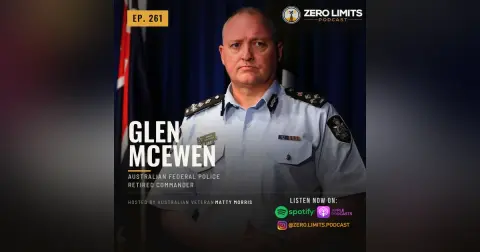
Ep.261 Glen McEwen retired Australian Federal Police (AFP) Commander
On today's Zero Limits Podcast Matt Morris chats with Glen McEwen retired Australian Federal Police (AFP) Commander. Glen McEwen OAM is a retired Australian Federal Police Commander whose 35-year career spanned criminal investigations, covert operations and international policing. His service placed him at the centre of major international emergencies, including the response to the 2002 Bali bombings, for which he received the Medal of the Order of Australia in 2003. In 2018, Glen served as A...

 Apple Podcasts

 Spotify
On today's Zero Limits Podcast Matt Morris chats with Glen McEwen retired Australian Federal Police (AFP) Commander.
Glen McEwen OAM is a retired Australian Federal Police Commander whose 35-year career spanned criminal investigations, covert operations and international policing.
His service placed him at the centre of major international emergencies, including the response to the 2002 Bali bombings, for which he received the Medal of the Order of Australia in 2003.
In 2018, Glen served as AFP mission commander during Thailand’s Tham Luang cave rescue, later receiving a royal honour from the Kingdom of Thailand. The following year, he deployed to Colombo to establish AFP assistance to Sri Lankan police following the Easter Sunday terrorist attacks.
From countering criminal networks across Asia to leading teams through crisis, Glen brings decades of experience in leadership, investigation and making decisions under pressure.
Website - www.zerolimitspodcast.com
Instagram - https://www.instagram.com/zero.limits.podcast/?hl=en
Host - Matty Morris
www.instagram.com/matty.m.morris
For the new Zero Limits Pre workout and creatine supplements head to link below
Instagram - https://www.instagram.com/zero.limits.supplements/
Zero Limits Supplements - www.zerolimitssupplements.com
Sponsors
Instagram - https://www.instagram.com/vetcomp_claims/
Vet Comp - https://www.vetcomp.com.au/
DVA claims experts, dedicated to helping veterans navigate the claims process with guidance and support.
Instagram - @3zeroscoffee
3 Zeros Coffee - www.3zeroscoffee.com.au
10% Discount Code - 3ZLimits
Instagram - @getsome_au
GetSome Jocko Fuel - www.getsome.com.au
10% Discount ...
It's time for the Zero Limits Podcast, hosted by Australian veterans. Coming with high-charging humans with hectic stories from around the world, we'll give you the motivation to take on whatever life throws at you in the beginning to complete any goal you set your money to. Let's go.
SPEAKER_02We've been chatting for a couple of weeks now. Uh he has got a new book that is coming out soon, Crime, Chaos, and Controversy. His name is uh Glenn McEwan, and like I said, 35 years, but this takes us back. I think it's going to be a really good one because it speaks about the AFP in a different light. Now, I just spoke about this offline with Glenn. A lot of people maybe see, especially if you're an ACT, obviously you see the policing side of the AFP. You hear bits and pieces about the AFP and, you know, them jumping on uh, you know, the commission to come out and talking and doing their things as they do as political, I guess they they become political bloody leaders at that stage. But the overseas stuff, and this guy spent a lot of time overseas, you know, pretty much cutting the head off the snake before it got to Australia, which we'll definitely talk about. It's time here in Bali, especially when the 2002 Bali bombings happening happened, multiple other scenarios, uh, which I'll let him talk about because I've got absolutely no idea. Glenmate, welcome.
SPEAKER_01How are you? Very well, Maddie. How are you?
SPEAKER_02Yeah, good, mate. Appreciate you uh wanting to come in and share your story. Like I said, you've got a book coming out, which is going to be really I've just got myself a copy and I'm gonna get cracking in. I'd you know, travel overseas a fair bit like you've done. Yeah. And uh mate, so I'll I'll have a read. But like I said, one of the biggest things about the AFP is a lot of people don't understand exactly the full extent of what the AFP does. More specifically, the overseas stuff. You know, I was lucky enough to obviously see the AFP in Afghan, which again, who who would have thought the AFP was in Afghanistan? Yeah, that's true. Well, they were. Uh Solomon Islands, Timor, you know, the military side. So I understand, you know, those uh I think they call them International Deployment Group. Was that back then? Or something like that, whatever they were called back then. So it's gonna be really good just to expand on your knowledge, not to mention like you reached that dizzy height of commander, so you you know you're at that top of you know the upper echelon level, yeah, equivalent to you know the brigadier, you know, style one star in the military. So you understand the political side of the AFP, but then you also understand the the lower levels and watching it all come apart. Yeah, get amongst it, yeah, get amongst it as well, mate.
SPEAKER_01Yeah, yeah.
SPEAKER_02So mate, quickly talk to me about the book.
SPEAKER_01The book, okay, Crying, Chaos, and Controversy. Yeah, it's a an insight of um my time uh within the AFP. Uh I joined in 1987 and retired in uh 2002, so it gives a real insight into uh what you can do uh within the AFP and in a local, national, and international context. Um steps you through uh, you know, my time being uh involved in covert operations, in criminal investigations, in um uh diplomatic manoeuvring and uh political way of saying things. Yeah, yeah. And uh in the role of a commander.
SPEAKER_02Yeah. And with that you spent uh tons of time, like tons of years overseas.
SPEAKER_01I have, yeah. Yeah.
SPEAKER_02So majority of your career overseas?
SPEAKER_01Uh there's a balance, yeah. Uh you know, I I did two tours um within the diplomatic ranks uh in Indonesia 25 years ago, and then later on 2017 to uh 2020 in Asia based in Beijing, and then uh through criminal investigation, covert deployments uh off and on uh abroad and then domestically.
SPEAKER_02How does it go working in places like Beijing?
SPEAKER_01Oh no.
SPEAKER_02When we know that their their eyes are on us as well.
SPEAKER_01Yeah, well, that's that uh diplomatic manoeuvring uh then and dealing with the geopolitics. The one thing uh where it is quite useful is particularly with policing, we all have the same um approach. Yeah, we're there to protect the community. So it's different to military and it's different to politics. So we we were all working for the same end game. Uh so it's just you know jostling around the political masters, which is the challenge, but our sort of end game's the same.
SPEAKER_02It's uh interesting place, uh Beijing.
SPEAKER_01It is indeed. Um and but you know, when you're looking at uh trying to put context around, you know, working with the Chinese, um, you know, like the the the big challenge is trying to, you know, uh work with that two-way street. You know, we're trying to get things out of them and they're trying to get things out of us. And I'm saying that in a good way, in a policing context, not in that, you know, the the the spy trade craft.
SPEAKER_02Yeah, yeah, yeah.
SPEAKER_01You know. Uh so we were working with them in counter-narcotics, and we were working with them around, you know, economic crime. Um virtual kidnappings is something that you know came up when I was there. So there are sort of uh mutually beneficial things that you know we were able to work together on. A few uh succulent Chinese meals? A few succulent Chinese meals. And that that gentleman just passed recently. Yeah. Yeah, that's a hell of a story. That was very good video.
SPEAKER_02Beijing just made me think that succulent Chinese meals. Mate, uh before we crack on with you know your younger life moving into the into the feds, just quickly, you know, we spoke about this offline, obviously. The AFP have, you know, over the last what, it's been 10, 11 months since Bondi. Yeah. See, the AFP, the Commission's been up there a fair bit on the news and inquiry, all that stuff's happening, and no one's everyone's it's like the Spider-Man meme where everyone's pointing at each other. The AFP's pointing at the News Airwise police, New South Wales police are pointing at Asia, no one is taking any responsibility. You know, run me through again. You're you're coming from that level of commander level, so you understand that like the political side. Run me through, you know, your thoughts on I guess more specifically, Bondi. Like how did this how does this happen? How does this happen?
SPEAKER_01Well, to be perfectly honest, I cannot tell you how this could have occurred without um anybody really being aware. And I say this quite clearly. We uh when I say we, they are operating in a joint space. It's called the joint counter-terrorism team. And this has been operating for ever s well wow, it would be operating for at least fifteen years. And that's joint AFP, New South Wales, and ASIO. And they work they co-located and they all receive the same information, the other the same intelligence. Uh so if there unless there's a huge intelligence gap, uh, which obviously there has been, um, they're all playing off the same sheet music. So they are obviously looking at other things. So I don't know how um if they were if their lens was looking at the same thing, they would have been aware. Now I'm not uh totally across what they were looking at. Obviously there's gaps there with um these two individuals because it's quite clear that that there was um they had access to guns. They were known some years prior, at least one of the individuals were. They had travelled overseas, which is a huge concern, particularly where they were. Uh so there's major gaps there. With what has occurred ever since now, October 7 only just occurred as in their three-year anniversary. Correct. Um the the rise in an anti-Semitism is uh through the roof. I just it's unspeakable and totally unbelievable that things like this were able to um get to a level and elevate without advanced nations such as Australia not even getting an inkling, particularly when you're looking at such a large festival and gathering, a mass gathering, and having such limited understanding of the the potential and not even addressing it in a security manner is uh is very concerning. And I I d I don't have the answer, Matt, why there was such an intelligence gap there. Um and there's a lot of commentary out there at the moment, and a lot of finger pointing as you've mentioned, and the so-called inquiry never even got to any sort of level of understanding of where, how, why, and even the name of the Royal Commission, anti-Semitism and Social Cohesion. I don't even know why the social cohesion element was even put in there, got to the ground roots of anything. The Assistant Commissioner of the AFP was on the stand for 34 minutes. Netball Australia, for whatever reason, fronted the Royal Commission and they were there longer. The what? Yes, Netball Australia were my understanding were there for thirty-seven minutes. Now I don't know how or what they contributed to. The AFP and New South Wales police commissioners didn't appear. The political masters did not appear. So what was the inquiry all about? We are not addressing these issues adequately at all. When we have looked at other failures in the political system over the years, there have been far greater and more in-depth inquiries, particularly when there's broadside shots at other political um uh parties involved, be it RoboDebt or um I think it was the Pink Bat that's issues, you know, way back when. Even with organized crime, you know, uh drug trafficking and and other police royal commissions, you know, there's been far greater um attempts to um, you know, probe into these issues. So this one has been absolutely completely baffling to me and has not satisfied society one iota, and it's really left the the the public um unprotected, in my view.
SPEAKER_02I I think why it has l left us unsatisfied is because the AFP Commissioner come out and still denied any Islamic terrorism. I think that's the biggest issue that we're we're seeing already. And we know that obviously that's above her level as well. That's coming from the top. Well that's that's a big thing. Like we gotta cook they gotta call it for what it is.
SPEAKER_01And that's very true. And uh even when I I was cooking a barbecue on that night um and said to my wife when I it came up on my phone, put on the you know, let's have a look at this and put it on the TV. And you know, not you know, being uh ethnic profiling at all, but you Brian Freddie could see what was unfolding. Um and for you know, Commissioner Barrett to come out and not actually um uh delineate or identify what was occurring was extremely surprising and and disappointing.
SPEAKER_02It is because that's that's what we we we wanted it we expected that from the AFP Commission. We know we weren't gonna get to get that from the Prime Minister, but the bosses of our policing organisations, we want them to come out and say, this is what's happened, this is what we're gonna do.
SPEAKER_01Well, that's true leadership.
SPEAKER_02Exactly right.
SPEAKER_01And you know, the operational arm of government should be you should expect that, and that should have been delivered absolutely uh by both commissioners uh because that's what is expected. And at the end of the day, when you look at the elements of the offence, um that will come out when this goes to court. Um so again, yeah, quite baffling, very disappointing. And previous commissioners, particularly in the within the AFP, uh Commissioner Kilty, when Barley the Bali bombing occurred, it was very clear what it was what it was.
SPEAKER_02Yeah. Which we'll talk about soon, because again, you were there.
SPEAKER_01Yeah, totally.
SPEAKER_02Yeah.
SPEAKER_01Um so there was no beating around the bush about what had occurred back in 2002. Um so unfortunately what had happened in 2005 wasn't um obviously as clear for the public record as it should have been.
SPEAKER_02Yeah, mate, it's just this political environment that we're in currently obviously is just it's it's madness. Pure, pure madness.
SPEAKER_01Trying to satisfy a particular um uh element or a particular uh group in society is uh yeah, it's it's uh it's mind-blowing.
SPEAKER_02It is, mate, it is. It's crazy because social cohesion uh I d again, like you said, I don't understand what what do you mean by social cohesion? Like the w the government put in sixty-six million dollars against Islamophobia. I was like, bro, like we wouldn't have Islamophobia if things weren't happening, you know? I I actually grew up in a is uh Islamic house. My mother's Muslim. Right. You know, so I understand that side, but well, I know that everyone's not like that. I so technically social cohesion is me living with my mother.
SPEAKER_01Yeah.
SPEAKER_02I'm I'm somewhat I don't believe in anything, atheist, some would say, maybe a little bit Christian, maybe might be coming. I don't know. The voices are there, but you know, I I just don't get it. I don't know it it is baffling, mate. Like it honestly just baffles me every single day when the government comes out or a commission or the New South Wales Police Commission and they or for example, New South Wales Premier Chris Mins, blaming guns straight up. Blame the blame the the citizen for law-abiding citizen with with firearms. What about your organization that gave them the firearms? Yeah, you know, the the firearm I I've got guns at home. They haven't killed anyone, they're sitting in my safe.
SPEAKER_01Yeah.
SPEAKER_02I'm still waiting for them to jump out and shoot someone, but they're not. You know, like it's you know what I mean? Like they're they're still there.
SPEAKER_01It's not the gunners.
SPEAKER_02I'll go home this afternoon, I guarantee they're still in the same spot.
SPEAKER_01They're very well behaved.
SPEAKER_02Yeah. Yeah, they've been told. Stay in there. Stay in there. Don't come out. Mate, it's it's crazy, but enough of the political stuff. Well, I'm sure we'll get back into it once. Yeah, once it'll come up. Once we reach that barley stuff as well. But uh mate, let's get back to those younger days, mate. Okay. Let's let's let's break it down. Where were where were you born? Uh life growing up.
SPEAKER_01Well, I was created. Yeah. Um yeah, Sydney born and bred. Uh born in um Annandale's Women Hospital in Sydney. Uh grew up um in two places. So in I was born in 1966, and uh early on uh went out to mum and dad bought a house in uh Lethbridge Park uh in Mount Druid in the uh in the west of Sydney um and uh attended uh Lethbridge Park uh primary school and uh which is a bit of a rough and tumble area of of Sydney. Um so we spent twelve years there. Uh and then um so yeah, that was the sort of lower socioeconomic area uh of Sydney. Um grew up some interesting people. Uh unfortunately, uh two of those people ended up being uh the murderers of uh Anita Cobbie.
SPEAKER_02No way, yeah, yeah. Um so Anita Cobby, that was the one on the train.
SPEAKER_01Yeah, she that was 1986. Um Anita was a a nurse who was travelling back home.
SPEAKER_02Deb Wallace was there.
SPEAKER_01Deb was uh Deb on the podcast. She spoke about it. She spoke about it. Yeah, Deb was the decoy.
SPEAKER_02Uh was uh Yeah, they dressed her up as like a bait. Pretty much. Yeah.
SPEAKER_01Yeah, she was uh yeah, she was uh to yeah to reenact the her work walking from the train station back home to um to see if they uh flush them out. Yeah, so which is crazy. Yeah, it was that's a wild concept, yeah. It was 986, yeah. Yeah, so dead was that. Um yeah, so that was John Travis and Mick Mick Murdoch, uh they were my neighbours. Um one lived next door and one was well behind us and Travis lived too down, uh went to school uh with them. Uh Murdoch was a couple of years younger, I was more friends with Darren than than Mick.
SPEAKER_02Um and it did you ever notice anything like that Oh yeah, Travis was nutbag.
SPEAKER_01Yeah, yeah, total nutbag. Uh he was even you know um he was even you know treating animals cruelly way when he was a kid. Yeah back then.
SPEAKER_02And sorry, just quickly, how does that you know, you join the feds, we'll just punch a four a little bit quickly, we'll go back. But uh obviously you apply for negative vetting, you know. I'm sure hey mate, you got anything to declare? Well, it turns out I was friends with you know what I mean? I'll I've had to do that the vetting stuff, and you've got to go right back and declare who you've been associated with and how's that come along?
SPEAKER_01Well, it's a yeah, it's an interesting yeah. Well, you just gotta tell them, don't you? Yeah, you you yeah, you can't change it, can you like at the end of the day? Um it was it was like writing a book doing those bloody things. Yeah, you know, like I've done a yeah those vetting it's a it's a yeah for anyone out there, yeah.
SPEAKER_02I'm sure you if anyone's out there like fucking they go right back, baby counts, everything, everything. I got grilled because I'm friends with bikeys.
SPEAKER_01Yeah.
SPEAKER_02Like I don't choose my friends, the people I grew up with, like it is what it is, you know.
SPEAKER_01Like you can't same example, right?
SPEAKER_02I think they're shit bags for what they do for their jobs, you know, but we're friends at the end of the day.
SPEAKER_01Yeah.
SPEAKER_02I can't change that.
SPEAKER_01And it well, they also um shape your life.
SPEAKER_02100%.
SPEAKER_01You know.
SPEAKER_02They showed me to go the the other direction. Correct. Yeah. So But now I'm starting to see, fuck, maybe maybe they're onto something.
SPEAKER_01As I say, they shape your life. Uh it doesn't mean it shapes it early, it could shape it later. Yeah, yeah. Um so yeah, so Travis Murdoch, um um, yeah, they were just two two people in in that s uh time in my life uh weren't sort of great. Well, they weren't any influence at all. Um but living in that part of the world, yeah, no, um started to influence my thinking about um why people work. And that you know, there was a couple of indicators to mum and dad that maybe this is not the greatest area to live. Um had a nice uh schoolyard stoush um in uh in sixth grade. Um just me and a mate. I can't even remember why we had a had a fight, but uh I was doing okay. And uh then all of a sudden his mate stepped in, so I was two against one and yeah, got the bejeeba smashed out of me and uh went home with a smashed nose, and uh mum wasn't uh overly proud. Um about dad? Uh dad. Yeah, I think he was quietly, but uh no, it was it was pretty pretty bashed up. I think they wanted to charge, you know, lay charges, and it was like, whoa, let's uh no. Yeah, we won't be doing that. And uh anyway, so it was time to move. Um So yeah, then we moved into Kellyville and uh my moral compass had to be recalibrated and uh they threw me into a Catholic school, not even bloody Catholic, and uh went to Oak Hill College and uh in Castle Hill um for years uh eight, nine, and ten, uh school and I didn't get along. Um and religion and I definitely didn't al get along. Um I don't I still don't get the uh the premise of things you prove or cannot prove. So I'm definitely on the uh the the nothing line, the atheist line. Um but talking about you know uh different people in your life, you know, I go to Oak Hill College and there were two guys in my class there. One ended up being a murderer and one ended up being a drug trafficker, you know. Um both did time, you know. One of those guys bludgeoned his girlfriend to death with a hammer. Schools are you going to refuse sex and dumped her in a dumpster in Kentucky? Jesus and the other guy trafficked heroin in and out of Thailand and he got he got done in Thailand, did years in Thailand and in the US for drugs. Um But I was always gonna be a copper.
SPEAKER_02And where does that come along?
SPEAKER_01Like have you got family history within defence or first responding or uh my uncle was a copper, uh, but he went in late in life. But I was from the time I was five years old, I was always interested in you know playing cops and robbers. Um I watched the police shows of the 70s, Matlock Police, Homicide, Division Four. Um I was always gonna be cop, played cops and robbers, always gonna be a cop. Tell my grandmother when I was five years old, um, I thought I was gonna lock her up or fine her for driving slow down George Street in Sydney, precocious little shit I was. Um yeah, so that was my life goal. And I mentioned earlier school didn't get school and I didn't get along. I barely had acceptable grades in year ten. And back then the pathway took to the police force was year twelve or year twelve equivalent trade. So Dad's network got me a trade at trade. Yeah, Cockatoo Island Dockyard um as electrical finamechanic.
SPEAKER_02What year did you leave? Year ten.
SPEAKER_01Year ten in nineteen eighty-two. So in nineteen eighty three.
SPEAKER_02Different times.
SPEAKER_01Yeah. Nineteen eighty-three. Um I embarked uh on my apprenticeship journey, uh, a Cockatoo Island Dockyard, for those who uh are uh unfamiliar. That's uh an island in the middle of Sydney Harbour. Um and back then it was a shipbuilding and submarine refitting. It was a private company but contracted to the Australian Navy. Uh so I did uh a first year in the trade school there, and then we did um submarine refitting, and I was involved with the generator refitting uh on submarine on HMAS Otway, Atama, and Onslow, um which was a hell of an experience. And then later in my apprenticeship um contributed to the uh engine room building of what became HMAS Success. And then I in 1985 I was involved with the sea trials of HMA's success, um, was the apprentice of the year, and I found my hook. So from being an average student, I became a high achieving apprentice, um, finished my apprenticeship with honours, um, and in 1986 I started uh my application journey of joining the cops.
SPEAKER_021986, mate, Halley's Comets swinging around the swinging around the orbit.
SPEAKER_01Interesting. Do you want to hear a quick story? Yeah, mate, yeah. Right, so in 1986 I applied to uh go on perfect match. And I got on perfect match, yeah.
SPEAKER_02Yeah.
SPEAKER_01Um so in April 1986, I was on Perfect Match, right? And I won. Right.
SPEAKER_02I've got to track this down.
SPEAKER_01So I won. And so I was the one who got picked. So the the girl Lara picked, and you know, I got picked, yeah. You know, and it's quite a very it's embarrassing watching it. But uh Have you got it? I've got it, yeah.
SPEAKER_02Um was it channel seven or channel nine? It was channel ten. Channel ten, right.
SPEAKER_01I'm gonna reach out to them into the archives. And um anyway, long story short, uh she picked me. At the time there's three million bloody people in Sydney, right? And my mother had a a shop um at the time, she was a small business owner, and Lara's mum had a cafe in the same bloody shopping centre. So the mums knew each other. Three million people in Sydney, anyway. Our go-away week uh weekend go away was at the Hawkesbury River on a skipper of clipper on the weekend of Haley's Comet.
SPEAKER_02Yeah, right.
SPEAKER_01Yeah, yeah, right.
SPEAKER_02Where'd where'd Lara go?
SPEAKER_01Uh don't know where Lara is. Lara's out there somewhere. Yeah, so there you go. Perfect match in Haley's Comet. I'll find it, Dave. Uh stay tuned, listener. There you go. Detective Matt.
SPEAKER_02Matt Morrison, but yeah, right, mate. So obviously you start that process of joining the Fed. Well, like again, why why did you land on the feds not?
SPEAKER_01I went for both. Oh, you did? Yep.
SPEAKER_02Yep.
SPEAKER_01Yep. I went for both.
SPEAKER_02New South Ass police?
SPEAKER_01Yes. Yep. Yep. And back then, um, it was you had to have be a certain height, and it was a height weight ratio. So you had to have 10% less than 10% body fat. Um, you know, you had to run jump fuck fight, you know. You see, you had to do all those the physical elements, you know, push-up, sit-ups, um, you know, uh chin-ups, swim. Um, so I got past all those gateways, and then I actually passed everything on Christmas Eve with the AFP. And I was more inclined to go to the AFP because it was smaller, and my calling, I was had such an interest in organised crime that all the books at home, Can of Worms by Evan Witten, uh Prince and the Premier. Uh I was I've read up on everything about Sydney's organised crime uh environment with George Freeman, Lenny McPherson, Stan Smith, Percy Glear, everything. Um so I accepted the AFP's offer, hoping that I'd get back to Sydney and get into organised crime because I knew New South Wales being a larger organisation that the stepping stone getting into such into criminal investigations would be a longer journey. So I rolled the dice uh and went to the feds. So I went in there um as a 20-year-old, young, dumb, and full of enthusiasm, uh in February of 1987. 22nd of February 1987 is when I went down to Canberra and joined the the academy or the college.
SPEAKER_02So you head down to Canberra, the Academy. How did you go? Or the college, like you said, um how'd you go?
SPEAKER_01Like Yeah. Yeah, no, back then it was 12 weeks. Twelve weeks. Twelve weeks. Um with the AFP you got paid straight up, which was good because New South Wales you have to pay your way.
SPEAKER_02Yeah.
SPEAKER_01Um they've only just changed that reason. They did, yeah. Yeah.
SPEAKER_02Yeah. It's come out of it crazy thing, it's come out of their budget. So once that budget or they get full strength police force again, they'll lose that. Yeah, so maybe anyway, interesting, interesting yeah, side note there.
SPEAKER_01Yeah, well, there you go. So anyway, we got paid. Uh for me it was a pay drop going from a yeah, tradey to uh the cops. Um, I think back then it was about I was earning like twenty-two, twenty-three thousand to seventeen. Yeah. Back in eighty-seven. Uh so yeah, so it was a twelve-week uh training course at that uh that point. Um so yeah, in Canberra, and uh just like any other academy process at that point, it was you know theory-based law, and then the practical side.
SPEAKER_02Um is it heavily male dominated?
SPEAKER_01Yeah, we had uh 22 in the class, it was 22 males and two ladies. Um we lost one bloke who was actually ex uh army, uh, and his saying was um what was it? Same same bullshit, different color uniform. Yeah. And he left. Yeah. Uh so we graduated with 21. Yeah. 21 of us. Um I got the the I came second overall, and I I got the most practical student award. Um so again, I found my calling, you know, I felt this is it, you know. Felt like a home. Yeah, yeah, yeah.
SPEAKER_02How did you find that whole college 12 weeks? Just loved it. Just absorbed all the information.
SPEAKER_01Yep. Yep. Um I was learning law. Um and I had the I was lucky I had a memory. I wouldn't say it was photographic, but I would just keep, you know, uh memorize it and keep, you know, repeating it, repeating it, repeating it, and I'd be able to just recall it when I was doing the exams because I was just immersed in um and being able to talk, you know, in the practical exercises and you know, act talk it through. Um yeah, maybe it's some sort of actor in me or something. I don't know. I think it's dealing with tradies, mate.
SPEAKER_02Yeah. There's a lot of talk and logic. A lot of going off and a lot of acting.
SPEAKER_01Yeah. Yeah, well, and there was painters and dockers on the dockyard and stuff. So you're dealing with, you know everyone. Yeah.
SPEAKER_02Yeah.
SPEAKER_01So I was able to, yeah, do that. So I had a had a ball and I you know, and back then it was you were either going to Sydney, Melbourne, or staying in Canberra. So I was I got chosen to go back to Sydney, which was what I wanted. And uh yeah, that's what happened.
SPEAKER_02Yeah, right. So it just break it down for me because I uh I'm only you know understanding, you know, from the feds have had on and how it works these days. Obviously you got the the federal agent, you got the ACT policing, and then uh the and then you got the PSOs as well. How was it back then?
SPEAKER_01Well, back then, yeah, no, it was It was just the one pathway. No, it was the two. It was uh into Canberra in uniform. Yep. Or it was we didn't have federal agents back then. It was just um going into Sydney as a probationary constable. Um and we rotated so we went back to Sydney and then we did another four-week local procedures course to do work through the Sydney environment. How because uh working in New South Wales was different to New South Wales law and yeah, different states have or territories have all their own little Yeah, idiosyncrasies, how to charge people um applying different procedures, really. Uh so we did that, and then we had to rotate through uh what was drug investigators or we had then, because the AFP back then was only 2,000 strong in totality.
SPEAKER_02Oh shit.
SPEAKER_01Yeah.
SPEAKER_02So quite small.
SPEAKER_01Yeah, and it was only eight years old because the amalgamation was on the nineteenth of October nineteen seventy-nine. So this is the twenty-seventh uh sorry, I graduated on the twenty-second of May nineteen eighty-seven, so it was only the week after that. So we're talking what, twenty-ninth of May thereabouts, right? Nineteen eighty-seven. So eight years thereabouts. So two thousand strong, uh finished logical procedures, and now we're rotating so uh until the end of the year we rotated through dr the parcels post area of the drug investigation uh division, which was small um importations in the mail system, and that was to familiarise yourself with you know, uh engaging people, working out mannerisms, taking statements, very few prosecutions because it was like cannabis resin in Christmas cards or birthday cards, yadda yadda yadda. Then there was uh going through what was called the crime division, which was frauds against the Commonwealth. Be it uh if you're unlucky, in my view, you got stuck with the bottom of the harbour tax scheme. Um, the long-term fraud, I dodged that bullet. Um I end up going to major crime, which was um longer medium-term fraud. That was okay, wasn't my calling. Um, and then there was uh intelligence, which was uh sifting through newspaper articles for politically uh motivated crime. That was uh like the Anadamagas and um uh some right wing um protest groups.
SPEAKER_02Romper stompa.
SPEAKER_01Yeah, that sort of stuff. Um then there was uh family law warrant executions and summons distribution and airport uh consulate static patrols, you know, sitting in a car, uh unused cars with flat tires and shit outside the Turkish consulate in Sydney, like a sitting duck. With flat tires, and then a small Sydney airport in 1987 where it took you like half an hour to walk around the terminal, uh though the rotation, and then you finished off uh doing your stage four investigators course, not the detective's course, investigators course. Um and then in 1988 you were deployed to your sort of permanent area, and that's when I was put into the drug targeting team in Sydney, which was the long-term uh drug investigation area.
SPEAKER_02Just break that down. So you finish the academy, then you go to this next bit of training, but it's kind of like on-the-job training. So you're and then you like you said, you're just filtering around to different units to get the feel of of everything that's going on within the And they get a feel of you. Yeah, of course, yeah.
SPEAKER_01Yeah.
SPEAKER_02And then from there, once you finish that what year of on the job probably About that ish.
SPEAKER_01So that was May into the end of the year, and then the stage four, and then probably into April. So yeah, probably just under a year of that with theory uh with your courses.
SPEAKER_02And then you get posted to a organise or a unit.
SPEAKER_01Yep.
SPEAKER_02And where did you go?
SPEAKER_01Drug targeting, which was long-term drug investigations.
SPEAKER_02Interesting. And where was this in Sydney? Sydney. Sydney, yeah, right. Obviously, Sydney was kind of like the hub.
SPEAKER_01It was the hub then, yeah. Yeah, well, still is, yeah. Still is, yeah. Yeah. So, yep, joined drug targeting, and that's where they I was given the nickname Astro.
SPEAKER_02Why is that?
SPEAKER_01Astro Boy, I was the youngest kid on the team.
SPEAKER_02Oh, yeah, yeah, yeah. So the When Astro Boy was on TV.
SPEAKER_01Reflective of the 1952 Japanese cartoon character. Yeah, yeah. And that carried through my whole career, and I'm uh known by that nationally, internationally. Astro. Astro.
SPEAKER_02Yeah, right. For the younger listeners out there, there was a really good cartoon, Japanese cartoon that was on, you know, back in the 90s, uh 80s and 90s, and I used to religiously watch it growing up and Astro Boy. I think it was a movie recently. Was there? Yeah. Yeah, right.
SPEAKER_01Yeah, his boots lit up. Yeah, big red boots through the sky.
SPEAKER_02Astro Boy, buddy. Takes me back. Mate, um, like you said, so at this new unit, what what what are you investigating? Like, are you is this big time international drug trading in?
SPEAKER_01Yes. Yeah, drug importation. Yes, yeah. So the first job, the first job actually was uh that I was um involved with there was a drug response job, meaning there so we had three drug investigation units at that point. There was drug targeting, which I was in the parcels post, which I mentioned, and then there was drug response. And drug response was the sort of the one you wanted to be in, because that was a short-term if something arrived and they needed short-term responses. Um so the big j the first big job I was involved with was actual drug response team uh investigation, and that was the first 50 kilo uh heroin importation job that had had arrived, and that was called Operation Clinker. And uh so they needed all hands on deck for that, so I was recruited into that job, and uh that was a massive job, and that came in from Hong Kong, and um that uh involved a massive surveillance uh operation. Um it became a controlled delivery, meaning that the actual heroin was substituted with an inert substance, but it was uh secreted back into uh the concealment that it was disguised in, and were it was to be delivered to where it was supposed to be as per requirements, and there was gonna be this big operation to deliver it, identify who the recipients were, take them down, uh, and then look at who organized it. And that was uh you know the plan. Uh so this went for a number of days, and as per usual, there's always this big long wait. Um so the bait, the trap's set, surveillance crews are out. I'm given uh the job um of being the uh the first responder with a bulletproof vest, with the old bulletproof vest with the with the um uh you know the big uh terror plates, those big plates where you sit in the car and they ride up. So you've got the plate up on your chin, and you're in the cars behind, you know, way behind the surveillance crews. And we're dry, you know, so we're waiting for the call, and then okay, jobs on, you know, they've they've made the arrangements, the the crooks are gone and said, okay, we want the delivery, you know. Uh and it was to an apartment block in our tarman, so right oh, so so they well, we didn't know that, sorry, I do apologise. So the guy is turned up, surveillance taking him away. So we're behind with the plate up on your chin, and we're in the cars and we're going, oh yeah, this is fantastic, blah, blah, blah. Yeah, well, this is great, you know, adrenaline's going, blah, blah, blah. The consignment is following the dude, blah, blah, blah. When we go to this apartment in Aunt Harmon, um, and it goes up into this apartment block. Old mate takes it bits and pieces up, and they don't know where the where the consignment's gone anyway. Back in 88, rudimentary compared to what the devices are now. Anyway, the the Phantoms, which is the police technical team, they've identified the unit. So it's time to, you know, retrieve the gear and lock the catches up, the r recipients. But no, no, we don't use the lifts because, you know, we've got to do it right. We've got to run up eight sets of stairs with these bulletproof vests, our six shots, because it's 1988, so we've got Smith and Wesson six shots, and we're sprinting up the stairs, as you do, kick the door in, sucking in housebricks to take down these guys. They're armed, we're armed. Anyway. No one lets a shot go, thank God. Anyway, we we we take these guys down, no problem. We retrieve their own. Job done. Bit dicey, yeah. My first first one. Astro boy, good on you. Yeah, great time. Anyway, now it's needle in the haystack time, because now we've got to find six Chinamen in Chinatown. Yeah. So when we're off looking for these uh these Chinamen who are the organizers, though they'd just flown in, these are the big guys who've flown in from Hong Kong, and uh we spent all night searching these guys. Searching for them. And this is where we found in high in uh in Chinatown in Sydney how the buildings are actually interconnected. Because you go through one one door, which you'd interconnect into another building, which you'd internect. Getting to another building with gambling dens and all these sorts of infrastructure settings within in across Chinatown. Anyway, long story short, this is where, which is in the book, we were searching restaurants, we were searching, you know. And it's pretty hard to with a photograph going around looking for old mate. I get it. Anyway, for some reason I looked in a free uh freezer for old mate. Anyway, this cat jumped out of this freezer. Scared the bejeebas out of me. You know what's going to end up with a cat if I didn't save him, you know. He's jumped out and he's off, so he was gonna be chicken chow min. Um, we found these Chinamen um in a gambling den in in Chinatown um uh very early on in the morning of that that day. And uh so yeah, uh very lucky.
SPEAKER_02But uh They were the big dog big dogs.
SPEAKER_01They were the big dogs, yeah. So we actually we got the you know the heroin was never hitting the streak because we got it anyway. Um but we got the catches and but also got the got the organizers. So that was the sort of our fur my first introduction to a shorter term job. Um but great fun uh running around.
SPEAKER_02Is there at that stage an international AFP presence?
SPEAKER_01Yeah.
SPEAKER_02So you're obviously working with the international guys that are over.
SPEAKER_01Yeah, so in 1988, I think we had uh Hong Kong. It was very very small international footprint, but definitely Hong Kong. I think Singapore was the first office the AFP opened overseas, so there would have been Singapore, Hong Kong at that point, um, maybe a couple of others, but definitely Hong Kong was open, yeah.
SPEAKER_02And just quickly, how does that work? So obviously these these guys are arrested here in Australia, they are they extradite back to No, we charged them here. They're charged here.
SPEAKER_01Yeah, yeah. And they were prosecuted here, and once they're prosecuted here, do their time, then they would have been deported.
SPEAKER_02Yep.
SPEAKER_01Yeah.
SPEAKER_02Mate, your first your first win. How do you feel off that? Knock off, have beer, yeah.
SPEAKER_01Absolutely, yeah. It was, you know, high five all around, you know, like yeah, no, good times. And that that's the other thing about you know th those sorts of times, you know. We were based we were based at uh Redfern TNT buildings. There were two towers at Redfern, uh, or still are, and ironically, New South Wales police are in uh one of those towers now. Uh, but we were in tower two, and Sir Peter Abels, who ran uh TNT, he was in tower one uh back then. And we used to have our bar in I think the ninth floor in TNT, and uh the blues that used to happen at happy hour on a Friday.
SPEAKER_02Against the New Sales Police?
SPEAKER_01No, just amongst themselves. Wow, you know, like anything in the eighties, just madness, you know. And it wouldn't matter if a if a call was coming in or not, you know, and it was women on women, blokes on blokes. Just amazing. So I only bring that up because you said you have a beer later, and it was like, yeah, you just never know what's gonna happen on those on those nights, just crazy shit. Work hard player. That's it, mate. Exactly right. And again, totally different times. Totally different times and eye openers and yeah. Yeah, totally different.
SPEAKER_02How long did you spend in that unit? Oh um a couple of years. And how active is it? How sort of how active is it?
SPEAKER_01Like are you constantly going from job to job or that's why we like working with the response team because that was a that's where the the churn was. Um and we had another 50 kilo import shortly thereafter, Operation Soy and the same similar situation. Uh but yeah, no, the churn upstairs in the targeting area wasn't because they were longer-term jobs. Um but when they came to resolution, you know, they were big. Uh we had one there, Operation Rattle in 1989, that's in the book. Uh we talk about that one. Um that was with Ian Lloyd uh Ian Hall Saxon, uh who ran uh the Frontier, he was one of the main uh promoters for the Frontier Touring Group, who brought out uh acts like Kiss and Bon Jovi. Still big Frontier Tour. Yeah, still, yeah. Um he uh brought in ten ton of hash on on a boat called the Rolling Thunder. Um and uh yeah, we did a job around that. Uh so they were longer term jobs, um, because you'd you know, we identified uh people who were selling Romeo brand hash over in Perth, and we rolled them, they became informants, brought them across to Sydney, and they tipped us into the Saxons, Ian and Lloyd, his brother, and so they're longer-term jobs to work up those those aspects to track back the organizers, and uh so those jobs take a lot longer than those short ones, such as those heroin imports that just drop and then drop and roll, and you start doing those jobs. So I was involved in both. So it sort of gave me uh exposure on on on both aspects, the short and long term. But I really did, and you'll see it in the book. There's um a job that I did for two and a half years called Operation Caribou, um, which really was in amongst uh entrenched Sydney organized crime group, um, and that was fascinating.
SPEAKER_02Yeah, so obviously those longer operations there, this is going deeper.
SPEAKER_01Yeah.
SPEAKER_02More undercover.
SPEAKER_01Yeah, and that's when I I moved out of um criminal investigations and went into the the covert world of physical surveillance.
SPEAKER_02Yeah, and I'm sure that was interesting. That was fantastic. Yeah. And we won't touch too much on it because obviously there's a lot in the book there that people need to get, get the book, yeah, and they can read about it. But obviously the covert side, you know, I've had a couple of cops on the New South Wales police officers that have been on spoken about their covert lives, uh Queensland cop covert life. And again, uh I had Keith Banks on actually, he's a Queensland ex-Qeensland cop band back back in the 80s where long blonde hair. Mate, there was times where he had to do drugs. Yeah, it was wild, and rolling around with guns in the back of his car and blah blah blah, and you know, full full undercover. Are you guys doing it's just again, total different times? It's it's the movie, Magnum PI.
SPEAKER_01Yeah, yeah. Yeah, yeah. You know, you gotta the full undercover guy is good, putting you know, take your hat off to him. Um the particularly back then. Oh uh Well even now, like the deep guys, you know, they're they're not they're rarely spoken of, um, but they're out there and they're doing a hell of a job. Um they're infiltrating, you know, deep, um and they're just doing shit that people are not aware of.
SPEAKER_02Yeah.
SPEAKER_01And their protection levels are so are such that you just hope that they're not required in court. You know, you you just got to build the strategy around that they're never exposed. Because one, they can be reused, but more importantly, they're not exposed that the crooks don't uh never know that they're actually were there.
SPEAKER_02Yeah.
SPEAKER_01Because you you build your strategy around the use of electronics and other technologies uh and frame the interdiction and resolution around not exposing them. The lazy way or that's a bit harsh of a term, not the lazy way. If they're the only way is to expose them to be able to do what you need to do to prosecute, then you do that. But if you can you do that, preserve it, yeah. Yeah, absolutely. Of course. Of course, yeah, mate, yeah. I've heard of that. But a lot of people haven't been able to do that.
SPEAKER_02Yeah, I've heard of stories, yeah, where guys are undercover for a year, two years, and they pretty much become criminals.
SPEAKER_01Yeah.
SPEAKER_02I think there's a guy in the US that was he was so entrenched that he almost flipped like he was like on the borderline going, you know what, that's actually not a bad life.
SPEAKER_01Yeah, well, Donnie Brasco.
SPEAKER_02Yeah, yeah.
SPEAKER_01You know, he yeah. He didn't want to come out. Oh, then you know, there's a lot because they're just immersed so deeply.
SPEAKER_02You get stuck in and build friendships as well with some of those. Yeah, well, that's it, yeah. I'd be a terrible undercover guy. I'd probably flip straight away. For all the right reasons, I'm sure, Matty. But uh so how long do you spend in oh and this is all in Sydney, you said?
SPEAKER_01Yeah, I spent 18 years in Sydney.
SPEAKER_0218 years, yeah, right. Moving forward, you know, we're we're coming up to early, you know, in the 90s period where you know, and you're loving the you're you're just loving it, you're lapping it up, loving the life. And you and you want more.
SPEAKER_01Yeah, you never want to go home.
SPEAKER_02So when does the international stuff kick off?
SPEAKER_01Uh just after the 2000 Olympics.
SPEAKER_02And obviously that would have been a big, big game changer as well, the 2000 Olympics, because again, this it was massive, obviously.
SPEAKER_01Nicki Webster's out there singing and Nikki was singing, Kathy was running. Yeah.
SPEAKER_02And it was a massive thing for Australia.
SPEAKER_01Yeah, the Thorby was swimming, yeah.
SPEAKER_02And y are you within that drug unit still?
SPEAKER_01No, I was uh acting superintendent intelligence uh for the games.
SPEAKER_02Alright. Let's just we'll bring it back. So you you're starting to climb that rank structure as well over.
SPEAKER_01Uh no, well, acting wise. Yep. Uh I was acting uh so I was a sergeant in 2000. I got promoted, got my third hook in January of 2000. Um Yep. So that I got promoted into the intelligence field team, which was uh managing informants and our undercover program, uh local under before the AFP had their national undercover program. Um so that was an extension. So going back, so I finished in the drug squad, joined the surveillance unit in so I did my detectives training in 1990 and then I went into surveillance in 91, joined Caribou for that as a surveillance operative in 92 and when when we locked them up in 94, I did the brief of evidence. That's um so I stepped out of the blue curtain um and did the brief of evidence for that investigation, which included a trip uh around the world to collect evidence, foreign um evidence. And then I went to the National Crime Authority in '96 to '98.
SPEAKER_02Just quickly back to that international tour around the world. That was my first. That's your kind of your first around the world type job, but that's where you start getting like, oh fuck yeah, this is I could get used to this.
SPEAKER_01Yeah. Yeah. Yeah, yeah, absolutely. Yeah. No.
SPEAKER_02And what are you doing? Like gathering um are you working with the feds that are already overseas and obviously the local.
SPEAKER_01Yeah, so with Operation Caribou, which culminated with the fifteen tons of hashish. Fifteen tons. Fifteen tons of hashish, um, which was we had a daughter ship go out, MV Poulson out of Bowen, to pick up five ton at a time. Picked up five tons of the within the Chesterfield Reef off the coast of New Caledonia, came back into the Mary River, uh up at Harvey Bay. The intention was to transfer that five ton onto a houseboat. The houseboat was to go up the Mary River, uh, offload that five ton onto a truck, that truck was to drive to Sydney. The the pulsan run aground, because with everything with organized crime, there's always a disorganised aspect, um, and that's where the Queensland Cert, who were monitoring the boat on our behalf, um, they come out of the water and guns at the ready, and there was three guys on the boat, and Graham Duke was on the boat, and he's looked around. It's a classic, classic line, Matt. He's looked around, you know. So the Black Pajam boys are come up onto the boat out of the water, and he's looked around with his hands up, looked at the hash, and said to the boys, can't say a seagull dropped it. Five ton on the deck. Um, so yeah, there was uh 15 tonnes. So it was a massive worldwide investigation. So the trip for to collect the foreign evidence was we went to the US into Europe into the Middle East to collect all the the evidence. So that's my mystery.
SPEAKER_02A few beers along the way?
SPEAKER_01A few beers. I went to Dubai in 1995.
SPEAKER_02How was that?
SPEAKER_01Desert, except a couple of buildings. Yeah, yeah.
SPEAKER_02Compared to what it is now?
SPEAKER_01Oh super city. Super city, man. Wow. Yeah. So yeah, then National Crime Authority um for two years, uh, investigating Southeast Organised Crime, and then returned to the AFP in ninety-eight, uh, back into and that was when the National Illicit Drug Strategy uh was announced by the Howard government, which was the first major influx of money into the AFP, and that's when the AFP started to grow.
SPEAKER_02I was just about to say that, so you would have started seeing the you know, like a like a tree growing.
SPEAKER_01Yes. Because again, you joined eight years after the organization was established pretty much, yeah. Amalgamation, yeah. Yeah, because it amalgamated the Commonwealth Police, the AC two police, and the federal uh the defunct uh Federal Narcotics Bureau. Yep. Yeah. So that was the first influx of money, and then the money just kept coming after that. So yeah.
SPEAKER_02So 2000, like you said, you're stepping up acting superintendent, you say, yep. 2000 Olympics come along and uh and that would have just made you guys busy or busy busy.
SPEAKER_01Oh yeah. Yeah. Yeah. Well I for me, I just I got stuck in an office.
SPEAKER_02Oh de ja.
SPEAKER_01Yeah, I didn't get out uh I just had to do intel briefings. Uh I still got my pass, my all access pass.
SPEAKER_02Um was there anything flagging around that period for the Olympics?
SPEAKER_01Nothing that really jumped out uh uh considering what happened in Munich. That's what I mean, yeah. You know, which was what 18 years before. Um no. It came and got it came and went without too much of uh of a concern, which was fantastic considering these days. Um and considering it was the the new millennium and we were supposed to have the Y2K button you know, in January the world was supposed to end.
SPEAKER_02Everyone's seen it the ATMs waiting for the cash to get spat out. Yeah, it never happened.
SPEAKER_01Never happened.
SPEAKER_02I was one of them, young kid. Come on, come on. Come on, come on.
SPEAKER_01Um so no, it was um luckily, but the interesting thing for me, um on the 4th of September, I was told I was going to Jakarta on and the games uh were just about to start. I know I only had eleven weeks, I know I had to be in country on the 2nd of December, so I had eleven weeks' notice to deal with the games, pack up my house and be in Jakarta.
SPEAKER_02Yeah, right. Maybe we'll talk about that in a sec. Um f funny you speak about the Munich thing. I actually was in I was in Munich 24 with an international touring artist. I was touring around tour touring around the world with and we're at that uh at the Olympic Stadium down the road, like literally where the Olympic village was as well. So jumped on a couple of scooters, rode down to that house, and you can check it out and stuff. It's tell you what, pretty crazy. And then uh actually just on there, I rode a scooter not far, probably about a kilometre from there, is where they filmed uh Willy Wonka. Oh yeah, yeah, the gates. Yeah, right. Pretty pretty cool. It's like a photo out from the Gene Wilder one, not yeah not the crazy Johnny Depp one. Mate, that's that's that's terrorism of movies, that's what that was. Freaky. Um busy time for the feds, obviously. 2000 Olympics. Actually, even 96 in the US is where Osama has his first crack at the World Trade Towers as well. So that's so there's the the inkling of international terrorism is starting to grow some legs in in somewhat way, without the world knowing to the extent of what it is, you know, post-2001, which you're in Jakarta at that stage. So from there, you like you said, you go to Jakarta, you get posted to Jakarta, and w what's his for? What's the operation? Yep. People smuggling.
SPEAKER_01Yeah. So uh at that point, Jakarta only had one uh AFP member uh attached to the embassy. And um with the the issue with both people in '99 um into two thousand, uh there was extra money. There was a number of uh funding measures announced by government, uh, of which one was to increase the Jakarta office with a an AFP member, of which uh Glenn was the sucker uh for that. Um initially I heard I was going to Thailand and uh I was told about Jakarta and almost drove off the harbour bridge when I was told because I was driving across the harbour bridge at the time. Um so yeah, so uh Jakarta for me um and we had a people smuggling strike team uh that was formed um prior to that, and they were building prosecutions uh against these organizers, and my role was to s uh support that, but my main role was to stop people smuggling, which is interesting. Glenn, one person, go to Indonesia and stop people, stop the boats. Uh so yeah, that was my role, and it was made very clear to me by my now deceased boss, um, and he said, That ship fight's all yours, mate.
SPEAKER_02So when you talk to people smuggling, you're talking about the stuff that was coming into Australia, loading up the boats that arrived from Indonesia who were arriving at Christmas Island and Ashmore.
SPEAKER_01Yeah, yeah. So in ninety nine there was about eight thousand people and a hundred and something boats arrived and uh that went into two thousand, and I arrived in into Jakarta on the second of December um of two thousand, and I was told there won't be a Christmas this year, um, because you know the political masters have said this was my so I'm coming in green, right? So one, I've never worked in an embassy before, and two, I've never experienced political interference like this ever. Um and I'm learning on the run, you know. And there was a new ambassador in at the uh at the embassy as well, Rick Smith, who's a great guy, fantastic, you know, very experienced ambassador. And uh Yeah. So I'm learning all these things and um and I'm learning about the the interagency rivalries and how uh uh other agencies keep running to their own political masters and trying to undercut with information. Like if if I got information and I tell a meeting and all of a sudden everyone knows about it. Uh it's not kept in-house and because everyone wanted to show that they knew about people's you know, it was such a political inflamed issue that it was just out of control about, you know, there was no um Chatham House rules.
SPEAKER_02Uh so Are you talking about Australia political, like uh intelligence services, etc.?
SPEAKER_01Yeah. So I I'm saying I would say uh we'd be in a meeting in the SCIF, um, or for those who aren't aware, uh like in a um protected environment within an embassy. Yeah. Uh so you're having a meeting, and I would come up with a piece of information about uh there's a boat leaving um tomorrow with you know a whole lot of passengers, um, and we're doing our best to stop it.
SPEAKER_02Uh all of a sudden it would be on the Minister of Immigration's desk, the Foreign Affairs Minister's desk, everyone's trying to everyone uh wants to brief the Prime Minister and Because at that stage Johnny Howard was pretty the we were pretty strong on the immigration at that stage, as well.
SPEAKER_01Oh, yeah.
SPEAKER_02No, at that point.
SPEAKER_01No, no. This was long before this. This is when the landing didn't know what to do with them. That's right, yeah. They temporary protection visas and they were being brought on shore. This you know, this is very early days. Yeah.
SPEAKER_02So I did the operation relax in 2004.
SPEAKER_01Oh, you did Relics. I did Relic4. So it yeah, we we can jump to Relics O one. That's where we started returning them.
SPEAKER_02Gotcha. Gotcha.
SPEAKER_01Yeah. So this is yeah, so anyway, we we had to sort it all out. So um so I had to come up with a a plan to stop the boats. So basically, what I did was recruit informants and infiltrate the the organizing groups. And over twelve months we did it and we broke the camel's back. Um and we locked up four organizers, and my informants become crown witnesses. And they gave evidence. And um yeah. And we stopped it for a number of years, and until Kevin O seven arrived and he welcomed them here. He welcomed them As they do.
SPEAKER_02And gave 'em a house and credit cards. Yeah. As they're doing now. Yeah. More the merry, as they say. Yeah.
SPEAKER_01So that was um Yeah, so that's in the book. Um the the journey, the journey on that. But uh yeah, that was good fun.
SPEAKER_02Like you said, like oh one. When did when did the relics kick off? It was oh one, yeah, because mine was eleven or twelve or something like that. I can't remember the number, but it was pretty low number.
SPEAKER_01Yeah. So we had uh right at the end of all that. Um after Civ X, which was October 2001, where 353 people died, where the boat sank. Um, I'd received the first intel on that. Um and anyway, so the the boat sank, and that's when government decided we need a whole a complete whole of government, you know, we need everybody involved, and that's when relics came in.
SPEAKER_02And you need more support, AFP support, Eden, Chicarta?
SPEAKER_01No, no, it was about returning sending them back, yeah. We can't have this them just bobbing up and down, and so we're gonna have to have a return policy. That's where in November into December four were returned, and I had my guys, as in Indonesian National Police in Roty Island take the receipt of you guys or the military would take they'd arrive and we'd return into Roddy Island my counterparts, we'd pick 'em up in Rhode Island, take 'em back to Kopang. Now, since the smugglers would spend all their money, these guys that have no passports, no money, it basically broke the black market because the smugglers wouldn't engage them. These guys had no way of getting anything, so the market fell because the the economy had broken. So relics worked. It didn't, yeah.
SPEAKER_02Yeah, it definitely did. Definitely did when we got the 50 cows out and sunk their boats. With them off obviously there was no one on the boats. Just to clear that one out for them.
SPEAKER_01Yeah, but yeah. I'm glad you did. But yeah, you know, and sometimes, you know, hard power's got to work.
SPEAKER_02It worked in there. Hard hands. And it stopped through it. There was a period, like you said, there was a period of time like three, four, five, zero, six before Kevin O seven come on board. It stopped. Like there was maybe one boat every six months or something. Whereas there was multiple at one stage. Yeah. Because even the illegal fishing was a big target as well.
SPEAKER_01Yeah. Yeah. Because the message you got out there.
SPEAKER_02It did. You come here, we're just going to put you straight on a plane, you're going straight back to wherever you come from.
SPEAKER_01Correct.
SPEAKER_02There was no if, buts, what.
SPEAKER_01And the and the and the economy had broken, the smugglers had done the runner because you had four boatloads of very angry people.
SPEAKER_02Yeah, yeah, exactly. Now you quickly spoke about October 2001. Slide back just a month. September.
SPEAKER_01Yeah.
SPEAKER_02Absolute game changer. September 11th, 2001, game changer around the world. What happens for you guys? Like are you guys you know, within the AFP? Because now this becomes on the AFP radar, which, you know, in turn the Defense Force deploys overseas to Afghanistan. How does this guy how does this work for you guys?
SPEAKER_01Well, on the night of s uh 9-11, I was uh on the west coast of Jaffa on a People Smuggling Crusade, anti-People Smuggling Crusade. I was sitting in a bar um watching it, uh knowing the world has changed. So actually rang one of my uh informants, code named Camel, who is Iraqi, and basically said have you watched it? Yes. You know what's happening. Yes. The world has changed.
unknownYes.
SPEAKER_01So returned to uh Jakarta and uh we were we didn't change our perspective on anything, government shrugged it off and we just continued doing what we were there to do. Where it changed for us was when they entered into Afghanistan and when that happened, that's when since we were in the largest Muslim country in the world, yeah, uh that's when government took notice, and that's when we moved out of the embassy, we changed number plates, and I still had to continue my anti-people smuggling activities, but just with different number plates as I travelled around Indonesia. So I my the expect the expectation of government was for me to continue what I was doing. But just differently, covertly. With different discreetly, yeah. With different I don't know, with a different colour shirt.
SPEAKER_02Was there intelligence that came through to suggest that obviously i again a a year later to the date the the the Islamic change happened or you know the the targeting change for them like pretty much any white guy was targeted and obviously you being a federal police officer. Again, we know that criminals know they know. Like I'm sure someone in Jakarta at that stage is like, we know exactly who this Glenn McEwan is.
SPEAKER_01Well they knew of me anyway. Um Mr. Glenn from the Australian Embassy had got around to the organizers was g was there to stop people smoking. Yeah. Um that that was given up early.
SPEAKER_02Which would have made you a target.
SPEAKER_01Yep.
SPEAKER_02Yeah.
SPEAKER_01Uh so I had to change my posture and be a lot more careful of how I was doing conducting my business because that would have been a nice little prize for him. Um so I still had to I still had to d do what I was expected to do, but no one gave a shit because it was number one priority government. Yeah. Um so no one You're just a number. Yeah.
unknownYeah.
SPEAKER_01No one even asked me about any of that shit. I understood and I just had to do what I had to do. And I just did it a little bit differently, a little bit more quietly. Change your hairstyle. Yeah. Not much there. Even back then. Yeah. Uh it's crazy times when you look back. But again, I suppose, you know, you're a bit younger, you're a little bit more um ten foot tall and bullproof. Bulletproof, yeah. And that was before the shit year of 2002, before my world fell apart. But yeah, it's um I yeah, I just did things a little bit differently. Uh, but yeah, no, any any of us were sort of on edge, you know, operating in that environment because I were very angry people.
SPEAKER_02Of course.
SPEAKER_01Very angry.
SPEAKER_02Moving forward, year later down the track, mate. So within that year gap, you're still just doing your thing, stopping the boats.
SPEAKER_01Yeah.
SPEAKER_02Working with uh, you know, the the organizations out there. Uh obviously, again, like Relex is kicked off. So are you working with defence as well?
SPEAKER_01Is that is that something Yeah, we yeah. Yes. Yeah. Um it Yes. Uh I was working with um with Defense. Um because Jakarta's got their uh defense. Yeah, they've got a big component up there. Uh there was only two of us and a lot of a lot of you guys. Yeah. Typical army.
SPEAKER_02400 generals we've got.
SPEAKER_01Yeah, yeah. And um which you know, they were great generally. Um I butted head was heads with one uh particular Navy guy.
SPEAKER_02Um Navy, no, of course.
SPEAKER_01Yeah. And uh he was trying to tell me um what I should be doing in in my environment. Um uh so we didn't uh get along that well, and uh we had some enthusiastic discussions. And uh anyway, yeah, no, but but that adds colour to the um the experience. Um but in the end we all did what we had to do and uh it worked. And it worked. Yeah, absolutely. Um yeah, and I've got to be to be perfectly honest, I s I suppose it was a bit of arrogance on my part that what are you doing coming into my world sort of thing, where I should have just been grateful and a bit more open-minded. Um it's all part of growing. You know, at the end of the day, they were just acting on their own waters.
SPEAKER_02Yeah, especially when the relic stuff was kicking off and they were boarding vessels, you know, the intelligence gathering on those vessels, I'm sure, will slowly come back to you eventually.
SPEAKER_01Yeah, that's right. No, and it was just a couple of things locally you wanted to do, and it's like, mate, it's not even on water. What are you thinking?
SPEAKER_02That's it, yeah. Relax, Navy guy.
SPEAKER_01That's where my weird sense of humour was coming in, just thinking, mate, it's not even on water.
SPEAKER_02Just don't even get back in the bathtub. So, like I said, mate, a year later, this is where it just completely the ball game, and like you said, you you had the intelligence slowly coming in, but you also had that inclination of changing your ways of moving around, and you just uh it's it's almost like you feel it happening in the obviously the atmospherics around Jakarta's changed. Uh Jamar Islamir's starting to get a bit more vocal on you know again, it we're looking at a time where social media, not social media, uh YouTube, or not YouTube, was YouTube in then, or there was a bit it was MySpace, it was Myspace, there was MS and chat, so obviously all that's getting intercepted and blah blah blah. So, like I said, there's more things happening in the world, but a year later, mate, run me through this because this is where it absolutely changes massive part of Australian history.
SPEAKER_01Well, there's a lot that happened to me personally prior to all that. Um so 2002 was for me a year of resilience and um personal tragedy. Um it started off in February of 2002 there was a um uh Channel 9 expose on the Sunday program uh about people smuggling. Uh and particularly about one of my informants um where there was all this this expose was around this particular person where the allegations were that he was a people smuggler, uh and this person was organizing ventures and whatever. Which he wasn't. Um he was working for me, providing me intelligence of which we were acting upon to do certain things. And uh he was um making that known, but channel nine doing what you know better investig investigative journalism do, they flipped it. But the AFP denied what basically I was doing. So I felt betrayed by the organization. Um and then I got a internal investigation against me on the claims made by Channel 9, yada yada yada.
SPEAKER_02So they're thinking you're connected with this guy.
SPEAKER_01Yeah, well the basic yeah, uh so Channel 9's saying this guy is people smoking. You're the ringleader. And I'm yeah, so they're actually Oh shit.
SPEAKER_02Yeah, they're that's defamation.
SPEAKER_01They're they're having a crack. So the the organization, without even consulting you, they just gone boom. Yeah. Right. So I'm like, yeah, good on you. So and then um uh what then my f uh I was out in the wilderness out um in Lombok um and I knew my father was uh battling cancer, and my mother called me and suggest I come home. Um and had to go back by Jakarta. And I missed my dad's passing by three hours because I was in the air. Um and then I lived in denial, and I left my family, my um my then wife and my young child back here and I went back to Jakarta and just immersed myself in work. I just lived in denial, just and then I got a call out. The informant of mine was having a heart attack. The same dude who was accused, yep. Yep, part of that bloody expose. Um and he was having a heart attack, and so I had this plain God moment where I thought I'd go out and make sure he was okay. Um so I call my work partner, who uh he was on a short-term deployment at that time, he wasn't permanent deployment, he wasn't on a permanent deployment, and um said, mate, I'm gonna come and collect you. Caswari's having a heart attack. Um I said, I'll be there as quick as I can. I called my now wife, uh, Christine, who is a uh a former uh Army Reservist medic, um and she didn't answer. So I went, right, without Australian help, I jumped in my car and headed off to pick up Mick and went through an intersection in Jakarta and just white light. Um I got skittled by a two-ton Pantech as I went through the intersection through a green light. And um left me with three crushed vertebrae, four broken ribs, um concussion, contusions, blah blah blah. Had to learn to walk again. Um then my marriage broke up. Uh went back to work early, blah, blah, blah, blah, blah. And then Bali happened.
SPEAKER_02So early 2002, you're involved with this vehicle accident?
SPEAKER_01So dad died in April 2021. 10th of May was a motor vehicle accident. Then had to do the rehabilitation, went back to work, and then 12th of October, Bali happened. And I was there on the night. I arrived in Bali on um on the afternoon of 12th of October. Oh shit. Because I was trying to um repatriate Camel out because he um because we'd locked up a uh a people smuggler in Thailand, and he knew well he was about to find out that Camel was a witness against him. So we were extracting Camel out, and we had two AFB guys coming across to take him out of Bali and secure him in Australia. And Mick, who was now Mick Kelsey, who was picking me up, who I was picking up before I got Skittled, um, he was now my L-O, my permanent guy. He was in Bali on a drug investigation. We were planning a tracking device on a drug vessel. And the two guys who were coming over, the four of us, we put Camel in a in a hotel um in CUDA, and the four of us were going to go to Paddy's bar on that Saturday night. But they just stepped off a plane and said, No, it was my old boss who's now dead, um, and his mate, and they said, No, too, too tired to go to Paddy's, we'll just have a drink here, just around the corner, 400 metres away from Paddy's. Yeah. And that's why we were there on the night.
SPEAKER_02Now let's let's let's go through it. Let's go through. So you're sitting there 400 metres away?
SPEAKER_01Yep.
SPEAKER_02On demands or having a beer.
SPEAKER_01Having a beer, we had a feed, we're talking about our security plan to extract camel, which was going to occur on the Monday. Um, so obviously it went boom. Lights go out.
SPEAKER_02You heard it, you felt it.
SPEAKER_01Heard it, felt it. Um Lee and George, they go to bed. They didn't re understand the magnitude, of course. Mick and I, obviously we're m more attuned. Um so we we stepped out and we thought it was more down towards the beach, and our hotel was down that way, so we went down towards our hotel. And then when we got to our hotel, which was down on the beach, then we could see the inferno. So then we ran down along the beach and come up Jalan Poppy's Lane Doo. And then by chance that came as we were running, people coming towards us covered in blood, what we could see, what we thought was blood, because pitch dark. We'd run. And as we were getting five, we could see damage 500 metres as we were closing into we knew it was gonna come out of Jelan Legion, but as we were approaching Jelan Legion, we could see the damage to vehicle uh to buildings was getting increasingly worse as we were, you know, approaching the inferno. And then we arrived right outside Paddy's bar because that's where the intersection of Jelan Leggean and Jelan Poppy's Lane Door is. So, you know, we arrived there and right in the middle of ground zero, um, you know, is your pandemonium chaos. Um do a quick assessment, you know, mix helping where he can. Um I call in to my assistant commissioner. Uh that's uh, you know, once I had a quick scan, helped someone, quick scan, call in. Try not to overplay my hand knowing 9-11's only you know just over 12 months uh ago. Um call in and you know explain there's been an explosion or explosions. Um I think I said it was like potentially gas. I didn't want to overplay and say what it was. I just said with certainty I can say it's gonna be mass casualties, Australians included, where we are, in the middle of the night club hub of CUDA. Um obviously I'll give you more as I know, but that's really the thumbnail at this point in time. Um so that was so I've let Australia know. So we help people where we can, left the dead where they were. Uh you know, there's still fire everywhere. So then we start walking up Jelan Liggeon, uh there's a huge crater. Um and there's only so much you can do. The way I don't know if you've been to um CUDA. So Jelan Liggeon um at that point is all one way traffic. So as you're walking, well, the way we were walking, the traffic is towards us. So we're walking towards the traffic, which obviously is all standard. Still, and you know, um once we got beyond the crater, so Paddy's Bar and Sari Club is like twenty minute twenty meters diagonally across from each other. So what had happened is Iqbol, the solo suicide bomber had gone into Paddy's, ignited, and the idea was to take out as many as they could in there, but who was left would run out into the force of the major bomb that was in the van, which was 500 kilograms, that was parked outside the Sari Club, and that detonated within moments of Igbol igniting, detonating. So he he detonated, the survivors ran out, and then the second detonated for mass casual mass of mass uh sorry for the mass uh for mass effect. So that had occurred. We arrived like uh twenty minutes after. So it was really truly well and truly a light. So we then walked along Jelan Liggy and past the crater and then into the remaining traffic that was at a standstill of course. What I couldn't understand is beyond the blast, the immediate blast zone were car the tr taxis and stuff was skeletons in cars with the skin stripped and smoke coming off the tops of heads. And people were coming up to me asking me to use their mobile my mobile phone. They assumed I was Australian. These people were Australian, particularly a a lady from Perth who couldn't contact her 18-year-old daughter or husband because they went to the Sari Club to celebrate her 80th birthday. And due to the traffic congestion, the emergency services couldn't come in with their vehicles. It was a clusterfug. And at that point, that's when you know we're still trying to help people and putting them on motorbikes, and they were going, I knew they were going to Sanglar Hospital. At that point, I made the decision. There's only so much we could do on the ground. People were getting help, Ambos were coming, or the ambulance officers were coming in, they were getting vehicles out of the way, and Ambos were slowly getting in, fire assistance were coming in, coppers were trying to do what they could, and Mick and I were only two people. So I made the call that I will call the consul general and put Australia first because this is big. I rang the consul general, he happened to be metres in front of me. So we we grouped up and we decided we're we were there now probably an hour, maybe a bit longer, that we would regroup at the consul consulate. Uh and at that point I was making call. We knew there was ADF at a rugby tournament, and we knew the deputy ambassador was also at this rugby tournament. And we regrouped regrouped at the consulate, and we requested the ADF members to go to Sanglar Hospital and identify Australians and what though what their injuries were. The uh deputy ambassador looked after government relations and media, and Mick and I started manning the phones. This was after 1 a.m. Manning the phones and start the missing persons. At first light, that's when Mick and I excused ourselves and went back and started the police response. We went back, and that's where all that was cordoned off was the the crater. It wasn't covered for any uh preservation, and the whole area was just contaminated. Sari Club people was still all over the crime scenes, lifting corrugated iron, which was still white hot, looking for people, calling out people's names, sucking on tubes, calling out people. Same in patties. So the first thing that needed to be done was to get that crime scene secured. I was engaging obviously the AFP, giving them an update what's going on. At that point, or just before then, um, I was informed that we had three uh three guys, uh two guys and one lady from East Timor who were on vac mm on R and R from Timor that I wasn't aware of. Um so it was Nikki Hay, Tim Fisher. Oh God, can't believe I've forgotten. Um and I got the two guys who had gone to bed earlier up and they tasked with looking um for those guys. Uh and ended up that Nikki was quite seriously injured. Um she's okay now, but she was seriously injured. And so my task was uh to meet with the Indonesian National Police, the local commander who was a one star, uh Budi Sediawan. And I met with him and his commanders, and we had a quite enthusiastic conversation about securing the crime scene as a as a priority. Now, normally, you need to be culturally sensitive and you know respect that you're a guest in their country. It got to a point where I had to be quite rigorous in my discussion and force the issue, and cultural sensitivities went out the door because we had to because he wasn't listening or understanding or caring. Um, long story short, um we reached an agreement, one that we'd join uh we'd enter into a joint investigation. Um we identified the capability gaps, uh, and he agreed to secure the crime scenes. Not only the crater, but everything. Um but I knew it had come at a cost at some point because you don't cross that divide without it because he's lost face in front of his commanders with me being as vigorous as I was. Um, but it had to be done. Uh and that's without that platform being secured, we wouldn't had an investigation. Um so there was a lot happening in that first you know, few hours. Um and behind the scenes, Commissioner Kiltey had already, you know, been doing what he was doing with identifying a police for commander, which was an assistant commissioner Graham Ashton. Um he'd already been calling his commissioners around Australia, waiting for what was required. And you know, we had a hundred Australian police in 24 hours on the ground in Bali. Um the next step. So that was a strategic, you know, um, communicating to Australia, provide, you know, uh giving the opportunity to for the AFP to um inform government, uh contribute to government thinking, develop the response plan. Tactically was identifying the capability gaps, securing the scr the crime scenes. Now operationally it was about getting the the coppers on the ground, but now I had to not only brief them but give them a you know a quick thumbnail sketch, pulling back now on cultural sensitivity. Now we had to re-engage cultural sensitivity about managing expectation, you know, you know, preserving face, letting you know, we're guests in their country. Everything I'd just blown blown out of the water, now we're gonna have to reinstitute it with these guys because you're gonna have to be working. This is gonna be a very long investigation. You guys have to build rapport. Yeah. I blew it out of the water here, but you guys are gonna do it. You know, I did it for my reasons. We you know, now you guys gotta do that. So managing it, you know, drop your expectation level to 25%. You know, don't use your left hand. You know, use your right hand, sit on your left hand, you know, don't show the sole of your feet, you know, all those Islamic, you know, taboo um things. Um so yeah. So with the so on the 14th of October, Prime Minister Howard arrived with his entourage, President Megawadi arrived with her entourage, um, the crime scene is secured with Bremob, which is the paramilitary, the sort of um special operations equivalent to uh for the the IMP. Um I'm locked out of the crime scene, that's my punishment. Um but yeah, uh at least and then Commissioner Kilte um asked me or directed me to return to Jakarta to uh formulate the strategic the overarching agreement um to allow this to occur, and that was a document that's stood for many, many years. Um but I was quite miffed that I was being taken off the the job, um which was another learning, you know, like being a young, you know, a young um a young guy uh who thought he owned this job because I I was there, I lived it, I breathed it. You know, these guys are coming in, what are you doing? And um I didn't understand at that point the strategic importance of of going in and but it was just as important as the securing the crime scene as getting this document done. Yeah. So it was a lot of learnings. Uh that year was very difficult.
SPEAKER_02Um So two things, mate. Yeah, two things I want to touch on just quickly. You obviously respond uh during the night when uh just after it happened. Yeah. You know, an hour or so just after 40 to an hour after it happened.
SPEAKER_01Uh 20 minutes.
SPEAKER_02Twenty minutes, sorry. Twenty.
unknownYeah.
SPEAKER_02Next morning, like you said, you go back. You get you know, obviously daylight and you can see the full extent of the damage. Yeah. And like you said, there was vehicles with bodies in them. And uh what are we talking?
SPEAKER_01How many so how many injuries and 202 people died, 88 were Australians.
SPEAKER_02And when that crime scene, uh the whole area is preserved, are we talking these bodies are still in place just uh and also bodies were found and vehicles were found up in other body uh you know, a block away and the actual um uh the actual vehicle that had you know I mentioned there was a crater.
SPEAKER_01The vehicle that had the explosives in it was found on top of a building. That's where they got the VIN number from. So there was only the crater, there was not nothing of the vehicle that weren't because that went sky eye.
SPEAKER_02Second question, when does it become apparent that this wasn't a gas explosion? This is now a terrorism incident. And when does obviously, you know, you speak about the AP Commission, it comes out and finally goes, This is terrorism, Islamic terrorism. Jamay Islamia.
SPEAKER_01Oh th well, to me it was that day. For you, but officially. Um I couldn't tell you, man. I would imagine it was within 24 hours, and the reason I couldn't tell you is because I wasn't anywhere near a television. Um and I don't think I've even seen any news reports within twenty-four hours of that. But knowing Mr. Kilty as I do, I'm sure he was out there within twenty-four hours because I've heard people recently in commentary um speak about it. Speak about it, yeah. Because of the recent um non-commentary.
SPEAKER_02They didn't blame social cohesion back then. Correct. Figures. Yeah. Yeah, right. Yeah, that's so you spend a year after that still working parts of it?
SPEAKER_01No. Um due to a number of factors, I resigned my commission in Jakarta in December of 2002 and I come back home.
SPEAKER_02Why is that?
SPEAKER_01Uh it was all I felt the world was Personally, um it was all it was a big year. This cup was full. The cup was full. There was a lot of internal commentary. Um people you know perceptions become reality in my in that organization. Um people were having comments that they didn't deserve to to be making. And I just had enough of I don't know, I just had enough. And just thought considering what had happened at the beginning of the year where I didn't feel supported. Um I just thought, no, I just I I flippantly said, well, if you want me to come home, I will. And my direct boss at the time said, Well, yeah. And I I I didn't expect that answer. I thought, well, fuck you. Um so I did. And yeah, so I suppose it was a little bit, well, I take my bat and ball and go home, I suppose. Um so I did, but I could feel myself entering into a very dark spot anyway, and 2003 was that. I um I did but again, you know, I I didn't end up coming back to Sydney. Um I did initially, and then I was asked to go to Canberra to help with people smuggling prosecution. So what do I do? I go to Canberra to help with a job, even though the job fucked me. But unfortunately, then I went into I was a functioning alcoholic.
SPEAKER_02Yeah. I went into the So you start drinking.
SPEAKER_01Yeah. Yep. Or continued. Yeah, yeah. Yeah. I went into that spiral dark spot. And, you know, I had the birth of my second child in January of 2003. So we separated when she was pregnant. Um being, you know, I wanted to be the best father I could be, but they were too young to be with me, both of them. Um so yeah, I went to Canberra and um and it's in the book. I'm very open in the book. Went into a very, you know, dark spot and I was that guy, you know, that people talk about in the corridor. Um mental health wasn't a thing back then, it was taper co uh, you know, take a cup of concrete and the fuck up. And um so I was functioning, I did it, and then I had a good hard look at myself one day and said, It's gonna eat you up, or you're just gonna beat it, and uh so I become a phoenix. And I rose from the ashes and how long was that?
SPEAKER_02What was that time period?
SPEAKER_01Probably uh only uh only. It's 2003, and then um got my shit together.
SPEAKER_02So a good year of just being sad sack. Yeah. Yeah, drinking yourself away. Yeah. And then Any of that tie back to your time in in in Bali?
SPEAKER_01Oh yeah.
SPEAKER_02Mentally?
SPEAKER_01Yeah.
SPEAKER_02Yeah.
SPEAKER_01My dad's passing. Just accumulation. It was accumulation because I I continually had back pain, I still do today. I deal with it a lot better because I had two and a half years of psychotherapy um recently. Um but I I was burying it, but I was reliving it. I I'd had ten years of um every night at 2.18 a.m. I'd wake up because that was the time I got hit by the truck. Um so every time I'd wince with pain with my back, it'd remind me of dad passing, um the car accident, and Bali. So just everything, yeah, just life in general. Yep. Um but then yeah, I'd then successfully, successfully, buried it uh, in my view, um until for 20 years. And then I obviously got my shit together, got promoted to superintendent in 2005. Yeah, yeah. And then promoted to commander in 2000 January 2009.
SPEAKER_02Yep. So uh promoted to commander of what unit is this?
SPEAKER_01Uh Aviation initially in 2009. Yeah.
SPEAKER_02So it's been a couple of years of the aviation what's his what's his involve?
SPEAKER_01That was the security of uh uh well I was yeah, aviation uh so for me back then there was air security officers, so the air marshals.
SPEAKER_02Um yeah, yep. Yeah, post 911, obviously.
SPEAKER_01Interesting bunch. Um you can imagine.
SPEAKER_02Um That was a big thing back then, was it obviously post-9-11?
SPEAKER_01Yeah, it was.
SPEAKER_02Yeah. Yeah, yeah. Kind of fizzled out.
SPEAKER_01Yeah. Yeah. But I had them at their height. Yeah, yeah, yeah, yeah. Yeah.
SPEAKER_02And so it was pr pretty much one air marshal on a plane, he was just he or cheap. One. Well, it was multiples, yeah. Yeah. And they just um act as a normal passenger and Well Is that is that what's the guy?
SPEAKER_01Is it like I know they're still there, so I can't go into the methodology but I can pick 'em.
SPEAKER_02Yeah.
SPEAKER_01Of course, yeah. Um But they're yeah, but I tried to adjust their methodology and they were very rigid. You know, they were all about protecting the cockpit door. And I said, get that. But I'd also like you to be my eyes when you around the airport as well. No. No, no, we're only there to No.
SPEAKER_02Wouldn't you want to stop them at the airport rather than I would like you to be my airport rather than have them on a fucking plane.
SPEAKER_01Yeah. And they were very, very rigid, yeah, unfortunately. Which obviously the AFP.
SPEAKER_02Yeah, the AFP at that stage, uh have they got the PSOs in the airports at that stage?
SPEAKER_01No, they came in well so that it was 2009, we amalgamated. During my time we didn't. They did, but not until we had fact. Yeah, we had the all-in model. So we hadn't there was a number of iterations. So 2006, there was the hybrid model with State Police and the the AFP, and then we had the all-in model. We then there was the PSOs. So there was a number of different iterations ever since the wheeler review. Yeah. And then we had APS before that. So there's been a number of changes over the over the time. Um but yeah, no, the air security officer program was very interesting. Very interesting. Um but yeah, I also had National Canine were fantastic. The canines are are brilliant. Um this is for the airports? Uh yeah, but they're also used off airport. Yep. Particularly the cash dog and now the technology dog, you know, and all the drug dogs are used. Yeah, yeah. And explosive dogs now. Yeah, they're they're all they're all used off airport. Yep. The funny story about the cash dog, um, and I forget, oh what was the name? Anyway, so the cash dog. So as the name suggests, they sniff cash, right? And a number of different currencies.
SPEAKER_02Stands like the ATO.
SPEAKER_01Yes, very much so like the ATO. They should have bought it at toe. Um But th this particular dog, beautiful dog. Uh so it's first run out on and at Melbourne International Terminal or Melbourne Airport Terminal, right? Because they're connected, right? Anyway, so as you know, the way they give their indicator, they sit. So it's out doing its walk, and the first thing it does is sits next to an ATM.
SPEAKER_02He got it.
unknownYeah.
SPEAKER_01I thought it was very funny. We need to tweak that probably a little bit. But yeah.
SPEAKER_02That's it.
SPEAKER_01But now they've got technology for you know USBs. Yeah. You know, which is great for child exploitation stuff.
SPEAKER_02Which we'll talk about just coming up because this is where Yeah, you move from the Commander of Aviation operations to commander of cybercrime. Which this well, you spend three years there. Run me through this, because this includes all that rock spider stuff.
SPEAKER_01Yeah. Yeah. So well there's there was two. We had two sort of main focuses in cybercrime. So it was really anything online. So cybercrime was um really crimes against the computer. Uh was looking at more of the high-end stuff. So uh anything around where a computer would be attacking financial institutions, critical infrastructure. You know, we weren't looking at the lower-end romantic scams.
SPEAKER_02Yep, yep.
SPEAKER_01Those sorts of things. The high end. The high-end hackers. China. China. Um Russia.
SPEAKER_02Yeah, yeah.
SPEAKER_01They were big, yeah. Still up. But remembering not state actors, we're looking at non-state actors. Gotcha. State actors is for for others. Um but when you're looking at non-state actors, yeah, you could be looking at those nationalities. Um Eastern Europeans, Romanians, they're big in that world. Um but then you've got you know the child exploitation side, which has exponentially grown since my time. Uh but yeah, we were looking at um referrals or pieces of information into the AFP that we uh well they they receive from various sources, particularly from uh the National Missing and Exploiter Exploited Children's Agency in America, who uh are partnered up with all the major social media platforms. They they f all go into this particular organization, a non a not-for-profit organization, and then they filter it out to across the world. Um instead of having all these disparate, you know, social platform media platforms coming into each agency around the world, it's just a lot more coordinated. Um a lot of pieces of information are fed into the AFP and then they spread it out across the state agencies as well. Um Yeah. What can I say about that? You know, yeah, how prominent is it back then?
SPEAKER_02And we're looking, this is 2009, so this is the early stages of social media is coming up, YouTube, all these things are starting to cyber's starting to be able to get a lot of people. Well, it's quite established, but it's growing.
SPEAKER_01Yeah. It's getting more prominent and deeper. Uh I suppose Surface Web had been around. Um where I when I came in, the deeper web. The dark web the dark and the deep web had had become prominent. So it was more the where we were dealing with um groups where it was harder to to get in um or infiltrate or lurk. Um not participate, but to lurk, but some of those platforms, you know, where people were required to stay in some of these high-end or bloody low end really, but the like for the for the conversation, the high-end, really disgusting um uh groups, people to stay a member need to have fresh images every month. And you know, you've got to remember every image is a crime scene. People seem it's lost in translation. Uh when people are looking at this shit need to remember that every image is a crime scene. And every image is abuse, and every image is very offending. And you know, people when you talk to these offenders, they don't you know, they just say, Oh, I'm just looking at photos, I'm just looking at images. Well, you know, without the demand, there's no supply. You know. Um and it's not child child pornography because the term pornography suggests there's an element of voluntariness. No. It's child sexual abuse material. You know, and I don't know if you're aware, but this appetite for child sex has been around as long as life itself. It is such a disturbing societal issue. You know, 85% of offenders are known by a family member. And, you know, I used to when when I used to do press conferences, I was always my my state counterparts, and I never did this, but my state counterparts used to always mention, oh, we we locked up two scout leaders, a priest, the baker, and a candlestick maker, right? I would never ever pigeonhole. My my strong message was it takes all walks of life. You never know. You know, it could be your next door neighbor, it could be the person standing next to you. We've seen it. Football ex-football players.
SPEAKER_02You know, Brad Finch. Absolutely. You know, there's these fucking spider monkeys are out there.
SPEAKER_01Yeah. You just can't pigeonhole it to an occupation. It's not always the Boy Scout message.
SPEAKER_02How busy like how busy was this back then? Extreme back then. Extreme.
SPEAKER_01That's back then. And you know, and it's very it's emotionally charged, and the burnout rate's high, and I was I was very big on trying to encourage people to go into these areas. And the catch cry from my my crew was I'm a parent now, I can't do it. And I I would be saying, Well, with all due respect, that should be strengthening your resolve, not weakening it. You know, we need more people, we don't need less, because we can't expect this core people, this group of people, to continue to do it. Now we need to rotate people in and out because otherwise these people are gonna burn out. Who's gonna do it? Yeah, I understand it's awful work, but this is where I implemented um you know strategies around time off breaks, you know, ensuring, you know, you this is where academia comes in and psychologic psychological um initiatives about cleansing. You know, you come to work, you you have a shower before you leave, you change clothes, you change your, you know, your mindset, your atmosphere, your so you're not taking that shit home, you know? Just little things to to break that.
SPEAKER_02How can you not though? Like, like you said, with those images and videos, it is evidence. So, you know, I've had guys on from the past, you know, from the New South Wales Child Abuse Squad or had a bloke from the US that was uh part of uh Homeland Security and that was part of his job, and he said every single second, every every minute has to be watched for evidence. Yeah. Every video every image has to be seen, like it ha it has to be seen by people.
SPEAKER_01And that's gotta change. It has to, mate. It's gotta change.
SPEAKER_02And uh surely if you see one fucking minute, not even one minute, like five seconds is a fuck enough. Like you don't have to watch every I don't know.
SPEAKER_01That's but what really gets me, judges won't review it. Uh yes. So why is it good enough for the coppers to view it, but the judges won't? Which is wild.
SPEAKER_02They're the ones who should be seeing it so they understand what they're going to be implementing.
SPEAKER_01In relation to sentencing, right? And understanding the evidence before them. And that's the conundrum that needs to be addressed. And if it's good enough for you know Yeah. You're right, mate. And and this idea that the coppers need to sit down and view it all and write descriptive statements because the judge won't view it, but he'll read a descriptive statement is ridiculous. Because a picture paints a thousand words. And yeah.
SPEAKER_02Exactly right.
SPEAKER_01You can't tell me the mental health of a copper is any less than a mental health of a judge. And the person who's disconnected to the society is the beak.
SPEAKER_02Yeah.
SPEAKER_01The bike on the bench. And that just goes to show, oh, you know, it's hey, I'm I'm more important. That's bullshit. Um, so yeah, no, there's anomalies in the justice system that needs to be.
SPEAKER_02Yeah, yeah, exactly right. And and the the fact is it could be the judge could go, no, I trust that cop. I trust that cop. Fuck this guy, he's getting 20 years. And that's the other thing. That's how it should be, though. Well, they don't.
SPEAKER_01They go and and I'm glad you brought that point up because this is an anomaly that drives me insane. Why, when we look at drug offences, particularly drug trafficking or drug importations, why do they look at maximum penalties straight up when child sexual offenders they look at minimum terms straight up?
SPEAKER_02It's crazy, isn't it?
SPEAKER_01It's wrong. Totally wrong. So you look at a drug trafficker, say old mate brings in ten kilos of um cocaine, he looks at life straight up. Mandatory. Never hits the streets, he's hurt nobody because he got done at the airport. But his intention's there. Get it, sweet. Dead to rights. But someone who has offended against a child generally doesn't look at the maximum term that's available straight up.
SPEAKER_02No. And they're protected in prison. Yeah, it gets his yeah. They're protected, the names are the names are generally suppressed.
SPEAKER_01But yeah, but he won't be put he won't be giving you his 20 years straight up.
SPEAKER_02No chance. Where's the We've seen it? We've seen it multiple times in recent recent yeah.
SPEAKER_01And I've seen some of the people that my folk are locked up get suspended sentences, slaps on the wrist. Like the disparity is disgusting, and society is over it. 100%. The protection of our future is our children, it's paramount. What are we missing? So when we talk about earlier social cohesion, it's actually put in the wrong context.
SPEAKER_02Yeah, yeah, exactly.
SPEAKER_01Yeah.
SPEAKER_02It's in the wrong context.
SPEAKER_01Yeah, yeah.
SPEAKER_02No, I get it, mate. It's funny because you know, when you rocked up this morning, I had a uh a friend cop here, and this was spoken about the exact same thing. This person has been through the same issue multiple times with judges where they haven't viewed a certain thing. They're like, Why aren't you watching this? They're like, Oh, we don't need to watch this. No, you do need to watch it because now you understand what this piece of shit has done. Yeah. Yeah, totally. Yeah, I don't get it, mate. Well, I've spoken about it multiple times about the justice system. It's not just. We know that for a fact. And people on bail, I think there's a stabbing the other day. The person was on bail, no fucking surprise. It's mate. But again, like the stuff against children. What is going on?
SPEAKER_01And you know, the politicians first thing, oh, we'll review that we'll change legislation. Stop wasting your time changing legislation. The legislation's there. It's the people invoking the legislation that's missing the point because they're out of touch. And it's disturbing.
SPEAKER_02Yeah. Like I said, mate, new I had uh John Breton, and I always bring John Brett up. It's a great podcast. New South Wales uh Child Abuse Squad, he was stabbed by a a pedo.
SPEAKER_01Right.
SPEAKER_02They shot him dead though, which was fucking that was the best part. Right. I was happy about that part. But that's the ultimate result that should be done to these pricks. But you know, we know that's never gonna happen unless you're in the United States somewhere. But like you said, it's just it's it's madness how, like you said, a uh a drug trafficking get up, you know, 30 years prison. Someone touches kids or does that stuff, cyber stuff with kids in maybe five years, maybe, if they're lucky, and then they're out and no one knows who they are. Yeah. It should be again, it should be like the US where they've got those websites where it shows you where they live. Yeah. Shows you where they live because they should be fearing the rest of their lives that you walk past the wrong person and they're gonna smack you or stab you.
SPEAKER_01Which definitely needs to be a bit more um visibility.
SPEAKER_02Of course. Glenn McEwan for uh Prime Minister. First first rule. I tell you what, my first rule isn't it's exactly that. Like I said, mate, you spend three years at this cyber uh operations. And again, you're at this commander stage, so you're how do I put this? Do you become you become a slut where you move from units to units type thing, and obviously they need a commander for a specific unit. So from there you move into another unit and move on to a different branch of AFP policing.
SPEAKER_01Yeah.
SPEAKER_02Which was uh victim-based crime.
SPEAKER_01Yeah. I created that.
SPEAKER_02Oh, did you?
SPEAKER_01Yeah.
SPEAKER_02Yeah.
SPEAKER_01Yeah, because um what I found was you know majority of the AFP's work was around crimes against the Commonwealth, and there was no coordinated or specialized group that concentrated on crimes against a person. So what I wanted to do, which I did, was create one command that focused purely on harm against a person. So I put together the the team, uh, so it was child protection, human trafficking, people smuggling, um, and others uh into the into the one unit. Um I wanted to call it something other than victim-based crime, but that's what I had on the paper when I put the uh strategy together. Um and I said I'll come up with a a better term in the paper, and the Deputy Commissioner said, no, that'll do. Um anyway, so that's and my my idea was to backend it with the training, uh, all dealing with the human element, uh, and having these people rotate through all these commands um and actually make it attractive and grow. And they disbanded it after I left. I don't know why. But um it lasted a couple of years, um and then it then it didn't.
SPEAKER_02Yeah.
SPEAKER_01Um so I don't know, but the I had it all worked out, had it all mapped out. Um and uh Yeah. Once I once I left, um, once Astro left the building, because after that I went to went to Beijing and um yeah, then I found out I'd yeah. Yeah, shut up shopping and uh all those areas still exist. So to me it still makes sense to have it all under the one command and let them grow and you know put put all the training in there and back end it right and have your own sort of but anyway, it is what it is, mate. But yeah, no, victim-based crime um uh a breathe for a little bit.
SPEAKER_02It's it's just on that uh on your on your boss I just love that that Aussie expression, no, that'll do. You know what I mean? Yeah. No, that'll do.
SPEAKER_01Yeah, that'll do.
SPEAKER_02That'll do.
SPEAKER_01But then it didn't.
SPEAKER_02Yeah, and then it didn't. From there, like you said, you spoke about uh Beijing, mate. You've got the the craving for a succulent Chinese meal. So you thought you decide how does this come along? Like where where does this deployment come along?
SPEAKER_01Well, it's just advertise.
SPEAKER_02Um you gotta apply for it.
SPEAKER_01Yeah. Yeah. Um so that had been around um at the commander level. Initially it was Commander China, um, and then it became Commander. So I was the second Commander Asia. There was a guy before me. Uh so yeah, so based in Beijing, and Commander Asia looked after the geographical area of Asia in the A in the AFP context. So geographically it looked after an area to the west to Afghanistan and Kazakhstan, to the north to Russia, south to uh Malaysia, to the west uh to the east of to Japan and Taiwan, but based out of Beijing. And I had eleven uh different offices in consulates and embassies across there. So that included Beijing, Guangzhou, Hong Kong, I've got to think about this. Um Phnom Penh, Hanoi, Ho Chi Minh City, Bangkok, uh Yangong in Myanmar across to Colombo, Sri Lanka, Delhi is Lamabad where of mine is. This is a big footprint. Hong Kong. I said Hong Kong, didn't I? Yeah, yeah, big footprint. Yeah.
SPEAKER_02And just for the listener, I think this is where a lot of people think that Afghanistan is the Middle East. It is not.
SPEAKER_01No.
SPEAKER_02It's in Asia.
SPEAKER_01Yes.
SPEAKER_02Yeah, a lot of people get that confused.
SPEAKER_01They do.
SPEAKER_02Yeah. But like you said, that footprint is that big. And there's two commanders, eleven countries.
SPEAKER_01One commander.
SPEAKER_02One commander.
SPEAKER_01Yep. The other commanders in Jakarta looking after Southeast Asia. Yep. And then we had a commander in London looking after Europe. And your mainland. On mainland, yeah. Yeah.
SPEAKER_02Wow. So that's a massive Yeah. So your email is just full, inboxes full.
SPEAKER_01Yeah, it was pretty busy. So I had about I had a third. Yeah, a third of the AFP's international.
SPEAKER_02And what's your role as the commander for that for that region?
SPEAKER_01Uh basically looking after a the AFP resources that are deployed in Asia.
SPEAKER_02Which has grown exponentially since you were there last, obviously, in Indonesia, Jakarta. Yeah. One one guy in Jakarta, now you've got eleven countries with you know head officers in each of these locations. And what like again, i th is this targeting everything. This is cybercrime, this is terrorism, this is drugs. Drugs. Everything. Everything. Everything. Yeah. Yeah, yeah. So busy. Just busy.
SPEAKER_01It's busy. And uh, you know, um Australia, the the community would be unaware in the mainstream that, you know, the AFP is out in investigating. Investigating that, or working alongside um our international partners, yeah. So every day uh they're out there doing something. You know, it might be different what's happening in Myanmar, like the counter production of crystal meth methamphetamine in Myanmar, um and they'd be doing uh say an e economic crime job in in Beijing. Um and something different in Islamabad. So yeah, that's all it's all different.
SPEAKER_02And what at what stage does you know say a a big job come to you and then you need to filter it back to your boss back in Australia? The Tom Rong Cave Rescue?
SPEAKER_01Yep.
SPEAKER_02Oh yeah, yeah. What year was that in?
SPEAKER_012018?
SPEAKER_02That's right, yeah.
SPEAKER_01Yeah.
SPEAKER_02So the 14 boys. Thirteen? Thirteen boys. Yeah. Soccer soccer team got stuck in the cave. Let's go through that quickly, yeah. That's that's interesting.
SPEAKER_01So I got a call. Um I was sitting at my desk in Beijing. Uh, got a call when it was a search uh search requirement. So the Royal Thai Navy See the AFP is a partner of choice uh across uh a lot of the jurisdictions um for because we're we're seen as you know one police uh are quite a close-knit family, but it was interesting the Navy had came to us um and they asked us did we have a uh a dive capability specializing in swift water and close quarter? Um so my guys rang me, asked me, so then I rang the commander of specialist response group saying hey, some kids kids trapped in a cave. Um we don't know where they are. Uh do we have this? You know, that we've been asked, do we have a uh this capability? They came back and said, Yeah, we do. Okay. How many you got? Oh, we got six.
unknownRight. Okay.
SPEAKER_01So then I went to the deputy and said, Okay, this is what's been asked of us. Um what do you think? I'll take it upstairs. Then it became a whole of government thing. Um, and of course, when it becomes whole of government, it becomes a bit convoluted. Um so basically that was a Friday. Uh on the Saturday, the six divers um with a D FAT, the Department of Foreign Affairs trade representative. Um they're on a C-17 off to Chiangrai.
SPEAKER_02Yeah, right.
SPEAKER_01Uh because the Thai said, Thank you very much. We'll take your um take your offer of uh divers because that was a search for what they required at at that stage. They had um two British divers. Um I don't know how that they came about, but the two British divers had previously mapped out the Tomlong Cave system.
SPEAKER_02They were professional cave divers. Yeah. Yeah.
SPEAKER_01And they'd already mapped it out, so they had a they were familiar with the layout. So they were they started looking. So we had the Thai Navy SEALs, the Australian component, and Durka Durka Durka, the US from Okinawa were on their way and they said a hundred.
SPEAKER_02America.
SPEAKER_01But they didn't have rules of engagement.
SPEAKER_02Yeah.
SPEAKER_01Right? So they didn't know what they could do, but they sent a hundred. Um so they they had this argument about can they go in the cave? Can't they go in the cave? How far can they go in the cave? I don't know. We went on command. Why are you here? Sort of thing. America. Uh and then Chinese had a private dive team. Happened to be somewhere, and they they were there. So the search component, so that's how we got involved, it was just a phone call. Um and so I was already committed to take a Chinese delegation to Brisbane, and so I was being uh kept informed about the search component. And at that this point, we just didn't know because the the kids, for those who aren't aware, the Tomlong Cave system is 10 kilometers long. It's up near the Thai Myanmar border. Uh and this soccer team goes in when someone hits 16, they go to this cave and they go only go into there's different chambers. Um and chamber three is called Padia Beach, and it's not that far into the cave system. But the cave, even walking through it, is twists and turns, and it's quite difficult to walk through, let alone when it's flooded. And the kids have gone in, left their bikes out the front, and they went in with their assistant coach, who's 25, and signed his name in the on the wall. Anyway, this monsoon rains arrived that that day and um the entrance point. So it was pushing him into the cave. Um and hit with such force that just drove him further and further into the cave. They had nowhere to go other than into the cave. They couldn't come out because that's the entrance of the water. Um so the call went out, and that's when the AFP were called, and uh the English divers needed assistance of people to to move the equipment and air cylinders further into the cave, and also water pumps or water pipes, so the pumps could try to you know get water out to keep the the levels reasonably low to give the boys a chance and also give the divers some ability to manoeuvre. And anyway, the boys were found 1.2 kilometers into the cave in cave in chamber nine. Um and it was a long, exhaustive, you know, search component of ten days, and the divers who searched every cavern and then popped their heads up, you know, and twenty-six yeah, video on YouTube, yeah.
SPEAKER_02Looking back at them. Mate, those divers, those two British divers, mate. That's I think that there's a 3D animation of what they were doing. Jesus Christ. Yeah. That's balls of steel. Oh, it's balls of steel. Because one navy steel diver duh.
SPEAKER_01Yeah, Petty Officer Gunan. Yeah.
SPEAKER_02Um Tie diver He lost his guide rope and got disorientated.
SPEAKER_01Because uh, you know, it's pitch dark, it's like coffee, yeah. You know, it's cold, it's it's uh the water's swift and you don't know up, down, left, or right. Yeah. So the British divers are laying guide ropes as well as they're as they're moving through. And um, you know, and our guys are helping moving I estimated 20 tons of equipment these guys were moving through these caves. And then that's that's the search component. Then they got then they got the research. Recovery, yeah. Yeah. You know, so yeah, no, that uh and then I flew in once once it became a rescue component with uh Dr. Harris and Craig Challenge and and you know and as we know Harry Harris came up with the um the only workable solution to get him out. Um remarkable. You know, they looked at once the kids were found, you know, they had ten days without fresh air, sanitation, water, food. How these kids held on, you know. Um and watching the water rise and just stop at the ledge.
SPEAKER_02Yeah.
SPEAKER_01You know, although above them was 800 meters to a kilometre of granite. Um you know, they looked at trying to drill and that was out. You know, there was very when I got there, there were still conversations, you know, about leaving them there until November for the dry season.
SPEAKER_02Um Jesus Christ. And just ferry them supplies.
SPEAKER_01Yeah. Um then Harrow and then Harry turned up and um he he arrived on the Saturday um and then went in. So I arrived on the Saturday morning, he arrived on the Saturday afternoon, we had a chat, and then he's he went up and we all you know, we sat down, we're talking scenarios, and I'm just sitting there listening, and you know, because he's a he's a medical profession, professional, um, that word, anesthesist, anesthesist. Yeah. And um, you know, and then he he did the the next morning, he went in and it took him at that time, I think it was like six hours to get there on his first journey to get there. He spent 38 minutes with them. And it took him another five hours to come out, right? And um and he's come back and he's like, well they seem to be in good health. Um I think the only way we can do it is sedate them. So I require, you know, X amount of four uh ketamine for 45 kilometers uh forty-five kilomet uh kilograms and so many of it fifty-five kilograms, and we'll do the oral sedation and you know, uh you know, we'll drop them in the water, then we'll then we'll sedate them and restrain them. You know, they're gonna have their masks on. And the the biggest danger with it was them awakening during the transport hours.
SPEAKER_02Freaking out.
SPEAKER_01Yeah.
SPEAKER_02Yeah.
SPEAKER_01That's why they had to be restrained. Because if they freaked out, the first thing they'll do is rip their mask off and then probably have a go at the diver, right? So not only danger to themselves, the danger to the diver. So that's why they, you know, had to restrain them and carry them out like luggage. And, you know, there was parts of the the journey where they had to be carried physically without the water assistance, you know, and through the journey. And then so we so Harry had to show them how to do intravenous muscular injection using a um a water bottle. Um showing these divers had never done them before, right? Because Harry wasn't carrying them out, he was there to administer the the medication, and the European divers were carrying them out. And then chamber three, the resuscitation was going to occur with the Americans once they got clearance of how far they could get in. And the Australians were in chamber two, and they will be transported from chamber three to chamber two, where the Australians and the Chinese were. And the Australians, the AFP guys, and one ADF who flew in on the Saturday, uh, a Navy guy, contribute to the whole of government. That time. They uh constructed a uh flying fox mechanism. So instead of transferring over the rocks and shit, they just like a flying fox wisdom down to chamber one because it was a tie rescue, so the Thai guys for the world to see could carry them out. Yeah, yeah, yeah.
SPEAKER_02Which is awesome. Yeah, of course, yeah.
SPEAKER_01Yeah. So the first guy, so after all the planning and what happened behind the scenes, we did rehearsals and um and it was all very quick. So the rehearsals were done. So the next day, and I had a conversation with Harry, there was a lot going on in his mind, and he's like, you know, the world's on his shoulders, you appreciate, because everyone has gone, right? Oh, that's the only possible and viable option is to do what you've come up with, Harry. So he's like, and he didn't he was we had a combo, and he's if we lose one, I'm out. I couldn't bear it.
unknownYeah.
SPEAKER_01So we you know talked about the positives and you know, focus on the you know, throw it out the universe sort of thing, and you've got this, and we'll cross that bridge if we need to, sort of thing. So the first day was supposed to be one out, regroup, you know, debrief, and the next day go again. Go again. So the first day we get the call, okay, chamber three, first one's here. I can't waken him. I can't wake it, wake the patient. Oh, I thought we lost him. Anyway, it's felt like hours, but it must have been like minutes. And we're up we're up top, of course. Oh my god, oh god, we've lost him. Anyway, then we get the we get the the call back that no no he's come out, he's come out. That's great. Then he's whizzed across, boom, you know, the flying fox and he's come out. And we thought that's the day done, right? And the next we hear number two's here. What? Number two? Anyway, they got four out that day. So during the debrief, we're wondering what's happened with what happened at number one? Well, what had happened? Since the divers were given extra injections in case they awakened, right? So Jason, the European guy who had the first one, the first patient started and wake. So Jason whacked him twice, not once. He's given him just to make sure he wouldn't wake up. So he's had three. He's been whacked three. He had one oral sedation, one when he went under, and then two more on the way. So he's been dosed right up. That's why he couldn't.
SPEAKER_02So yeah, so um be a wild place to be in a K hole.
SPEAKER_01So he got a lot. He got a lot. Anyway, the he um he got uh he got out and and then and then um when I spoke to um Harry afterwards, he goes, you know what happened? I said, what? He goes, the coach jumped the queue. I said, what? Because the idea was the coach was to be last. The ties were furious. You know the ties blame the coach. If there was a scapegoat, it was the coach. Oh, of course. Right.
SPEAKER_02He shouldn't have taken me in there.
SPEAKER_01Yeah. And he was supposed to be last. Anyway, he jumped the queue. And since they're all little, Harry uh Harry didn't know. So anyway, he only noticed when he, you know, next. So old mates jumped last one on the first day, slipped into the water and he noticed a wedding ring. He's like, it's too late now. He he's gone, okay, off you go. He goes, Glenn, the coach jumped the queue. So anyway, there was four the first night, uh, the day, the there was four the second day, and the five the last day.
SPEAKER_02Successful.
SPEAKER_01Oh, totally. That's crazy. But there was a sad end tale to all this. A couple of years ago, the captain died of suicide.
SPEAKER_02Oh, did he?
SPEAKER_01Yeah. Portland. Yeah, on a soccer scholarship. Yeah. So, you know, carry trauma all your life.
SPEAKER_02Yeah. You don't get over it. Oh, mate, ten days down there. Stark, cold. As a 13-year-old.
SPEAKER_01Yep.
SPEAKER_02All right, mate. Couldn't think of anything worse.
SPEAKER_01No.
SPEAKER_02So you spend that three years in Beijing. Yeah. You're up coming up to 32, 33 years on the job. How's everything going, mate? Yeah, still loving it.
SPEAKER_01I was. I I really enjoyed Beijing. Um, and I did ask for a fourth year.
SPEAKER_02And your family over there with you, sorry?
SPEAKER_01Yeah. My wife was with me. Yep. Yep. She had a ball. Um the kids, uh, my my children came over. Um Chrissy's kids came over, or the daughter came over with the grandkids. Um I asked for a fourth year. Um reasons unbeknown, no. Now I think three years is too short at that level. I think they should do five because one, that's great, but from a work perspective, that's when you're building your relationships, exactly, and yeah, you know, to drive strategy and it takes five years. Three years, you're not you're just treading water. Anyway, I didn't win that. But it really worked out for me because I got out two days before COVID.
SPEAKER_02Oh unbeknownst to me, right?
SPEAKER_01So shit's happening in Wuhan. We didn't know. So I got out on the 19th of January, and I said to the the guy who was coming in behind me, why don't we do this in February? But no, no, no, mate, I want to get there as soon as I can. Oh, okay. Well, okay. Anyway, so he got stuck. He got stuck in Beijing for forever. He didn't have the time of his life like I did. I went everywhere, I you know, created coalitions, I you know, we did great jobs in Me and Ma. We yeah, I just had a really fantastic time, made a hell of a difference and stuff. Um, but coming back, uh, in my view, the most strategic position, commander position in the AFP back to I went to Adelaide, um, back to a small office, it's yeah, it's it's a real reverse culture change. Um, because you're going from where you are attacking things at the high strategic level, particularly in the counter crystal methamphetamine arena, where I'm talking to a deputy prime minister about a chemical moratorium, you know, stopping chemicals from China into Myanmar, because without chemicals, you can't create crystal methamphetamine, right? Into the militia state. And then coming to Adelaide, which is demand driven, is chalk and cheese, right? Yeah. And and then I get my knee done, a knee replacement, and then it looks like I don't have a job. It's in the book how all of a sudden I'm getting an offer to retire out of nowhere. Um it's like, thanks, Glenn, but your time's done. Um and then I get uh I had my knee done, and then I had um then I got posted to Brisbane and and then all of a sudden I yeah, the psychiatrist said, No, you're cooked. You're done. Um you're gonna be medic medically retired, and then I'm here I am, four years, four and a half years later.
SPEAKER_02So it kind of ended on outside of your terms. Like you were you kind of wanted to stay on, and and again, Australia's in just COVID's we're probably better off staying in China. It was probably better off in Wuhan than coming back to Australia because we went into meltdown here.
SPEAKER_01Yeah, absolute meltdown. Yeah, well, I I experienced that being locked out of South Australia. So I ran Adelaide office for seven weeks from Cloundra.
SPEAKER_02Oh, did you?
SPEAKER_01I couldn't get back to South Australia. Yeah, yeah, absolutely. But at least we weren't in Melbourne.
SPEAKER_02Yeah, geez. Two and a half years, that's ridiculous. Didn't we get fooled? Didn't we get fooled? Yes.
SPEAKER_01Totally. But no, it was great. Yeah. Like, yeah, I it didn't end the way I wanted, uh, but that's nice, I'm better for it, you know, and and then I I had to make the decision that I had to get better. You know, like I started I had a I started to be Jekyll and Hyde and and then I went into two and a half years of psychotherapy. Um, you know, and that was brutal. It's in the book as well. You know, the book I made very it wasn't all beer and skittles. I had to be honest and demonstrate that there is a cost to living the life I did. Of course. Um and you know, and going through cognitive behavior therapy, well, that's a walk in the park, but that EMDR, that eye movement desensitization reprocessing, that is brutal. You know, when the psychologist said, I've Got a uh break you to fix you. Yeah, yeah. Just Rhode June. Break you to fix you. And she did.
SPEAKER_02But thirty-five years, thirty-five years, four months on the job, mate. Institutionalised into a way of thinking. It's like the defense force, any any other organization. You are a product of your environment, so you're stuck within those worlds. At least when you're a civic, you can do what the fuck you want when you want. Don't have to shave, don't have to haircut it. If you don't want to go to work the next day, you don't fucking have to go to work. You know what I mean? Like you kind of got freedom, but when you're in the institution, especially once you start reaching that level like you did, you just get stuck within those circles and you hang out with the same people, and there's a lot of mental health issues that come out of it, like regardless. And not to mention all the jobs that have come across your table, well, cybercrime, all that stuff, and the barley, you know, all this stuff accumulates. And at the end of the day, it's probably a good time. Maybe maybe it was just I don't God's God's plan.
SPEAKER_01Oh, totally. Yeah, and I and I I always intended to retire around that time anyway, uh, because I I was very much the advocate for fresh thinking. You know, let the younger people come in at sort of my level and higher to keep refreshing um the thinking. But now perhaps that idea, some older heads probably would be good. Yeah. Some experienced heads. Yeah.
SPEAKER_02Umes with yeah, with balls to say things too. That's one of the biggest things that I think.
SPEAKER_01That separation of powers needs to be reinstituted.
SPEAKER_02So I I think that's what a lot of these organizations lack currently is someone to step up against the ministers and the government and say, listen here, sit in your place, I'm the police commissioner, I'll tell you how things work. You stick to policy. Yeah. That's what we're lacking.
SPEAKER_01And you would have seen it. There has been an overreach. Yeah.
SPEAKER_02You would have seen it throughout, you know.
SPEAKER_01Oh, mate, you'd you wouldn't believe what I've seen, particularly when I was in Jakarta with the political smuggling. Yeah, when we have the ministers come over. You know, we had um uh the three ministers, I remember it vividly. It was uh Minister Reith, um Ruddick, and uh I'll say vividly and I get a mental blank. Um Rudd. And Downer. Oh, yep. Oh, and they were fingerpoint you talk about culturally insensitive, they were finger pointing at the Indonesians telling them to stop the boats, you know. And we'd have to you know do the cleanup, sweep up the mess after they'd leave, and you know, just the overreach because they were panicking and you know, and they were just going, well, they don't want to stay in Indonesia, they just want to go to Australia. You know, and they didn't have people smuggling laws because it was about the brotherhood. And they just missed the whole point, you know, and and sounds like politicians. Well, yeah, but now but now it's 180 degrees different. Yeah. You know, like at least in hindsight, you go, actually, that wasn't a bad approach.
SPEAKER_02Yeah, yeah, yeah, exactly.
SPEAKER_01Exactly. You know, back then I was mortified. I'm going, what the hell? And now you go, bring that back.
SPEAKER_02Yeah, I think there's a fine balance there. It's just a balance.
SPEAKER_01Yeah. But yeah, no, polite political overreaches and and you know, when you think about it, you think these guys are just elected officials, right? Who before they were politicians, what were they?
SPEAKER_02Oh, but that's it. Well, we look at the New South Wales police minister, she was a librarian. Now she's the boss of police and counterterrorism in New South Wales makes zero sense.
SPEAKER_01But all due to respect to them and they're learning on the run, but generally, in our former lives, we've gone through generally the life through the ranks and the life and understood and lived the bottom levels of everything. Yeah, yeah. And you get people who just elected and all of a sudden they know everything.
SPEAKER_02Look at ABO. Yeah. He thinks he's he he plays on that to house a card, doesn't he? Oh, I was a houser. Well, that's the reason why we're fucking broke. Because you're a you were a houser. You don't know how to how to manage money. It figures.
SPEAKER_01Oh, but he's managed his own money pretty well.
SPEAKER_02Yeah, well, they all do. They all do. They sell up before all they bring in these new laws, don't they? There's a word for that in uh yeah, yeah, inside a train. That's yeah, that's fraud. Hopefully, there's a unit out there investigating the government. They need to. But, you know, they change their position. Mate, 35 years, uh 35 years, four months on the job. Here we are. That you know, you get out in May 2022, you're retired. Yeah. As you said, you're still going through, you know, your mental health issues, and you know, I wouldn't say issues, you're maintaining, you're maintaining your life now, living living a free life now. Now you can do what you want, when you want. Well couple of beers here and there.
SPEAKER_01Yes, yes, absolutely. Until my wife says no. But yes. No, my uh my wife, Chrissy, she's the balance, and uh I need that, that's for sure.
SPEAKER_02Yeah, mate, they always are. They always are, they do call them for a ball and chain for a reason, which is a good thing because we do need them.
SPEAKER_01Yeah, yeah, that's true. We do, but otherwise we uh I'd be off the rails. Oh, yeah. Yeah, it's good.
SPEAKER_02I'd be off the rails, yeah. Mate, um uh again, really appreciate you coming on. Uh a couple of final questions to tie off the podcast, mate. But again, 35 years on the job, you've done everything. And to reach that commander level and still come out swinging at the end of it, mate. And to to share your story now in the book, uh, which comes out very soon. I think by the time this podcast comes out, we'll be a similar time this book drops crime and chaos and controversy from global crime syndicates to terror attacks, you know, which you definitely uh dealt with. When is this Big Sky Publishing?
SPEAKER_01Yeah. Publisher. Yep, 27th of October.
SPEAKER_02Where's it going to be available? Everywhere.
SPEAKER_01Everywhere. Audio book as well.
SPEAKER_02Who's reading that?
SPEAKER_01Uh a guy called Daniel Doherty.
SPEAKER_02Yeah, right.
SPEAKER_01Yeah. Yep. So um it'll be out uh as they say, all books, uh all good book stores. Oh yeah. Yeah, big W at the airport.
SPEAKER_02Picked it up.
SPEAKER_01Yes, uh hopefully, yeah.
SPEAKER_02Yeah, for the air marshals out there, pick one of the airports, yeah.
SPEAKER_01My very good friends, yes. Um for the AFP guys walking through uh doing their uh patrols, yeah. Um yeah, it's uh I as I say, you know, like at the end of the day, there's a couple of things there. It's my story, uh, but also it's a story of the AFP. Um but or you know, but more importantly, it's about what people, if they were to join the AFP, you know, what they could actually experience.
SPEAKER_02And what you can dip your toes into. Yeah. Which is or throw yourself right into. Yeah, yeah, exactly right. Exactly right. Mate's uh a couple final questions. First question what advice can you give to someone to keep on keeping on complaining, any goal they set their mind to and just to crush it in life?
SPEAKER_01Recognize your mental health. Um don't do what I do uh because it takes a lot longer to bring it to the surface when you do seek help. And there's you know, mental health is a big thing. Recognize these days as well, the supports there, you know, falling from hero zero uh is a hard crash, um, and it's even harder to come back from. Uh so that'd be my number one. And then uh the more the people recognise it, I'm actually gonna take um it as I am becoming an advocate for it now for the police for to um for a mental health card um similar to what DVA have for the defence. Um and so that's gonna be my platform from now on, is is that.
SPEAKER_02Pushing it.
SPEAKER_01Pushing it, you know, for government to recognise it.
SPEAKER_02How they don't have uh, you know, a DVA style for first responders has got me absolutely beat. You know, I I feel so, you know, and I've got again multiple friends in within the police system and dealing with private insurance companies and it doesn't make sense, mate.
SPEAKER_01Well, my PTSD is recognized by Comcare, but their system is still geared for physical injuries, not making harm.
SPEAKER_02Of course.
SPEAKER_01And so it's like smashing a round peg into a square hole. Um even you know, it's just their forms. Um, even their assessment to for any anything is yeah, uh like getting a knee replacement, bang. Done. Easy. Head? Wow, it does your head to get your head addressed.
SPEAKER_02Yeah, which is crazy because the DVA system is pretty good, I think, with with mental health and well just template it. That's what I mean. Don't reinvent the wheel. Just r give D V A a call. Hey guys, uh we're the same it's Commonwealth, yeah.
SPEAKER_01That's it. Well, and it should be state as well, you know. Like it should be shape. And and the state, I'm sure the state system would be totally different again. Yeah, but yeah, that that'd be my advice. Um, look after you, because if you can't look after you, you can't look after anybody else.
SPEAKER_02Yeah.
SPEAKER_01And I did it the wrong way and the long way.
SPEAKER_02Yeah, mate, uh second question uh what scares you most in life?
SPEAKER_01My wife? Beyond that um where society is leading us.
SPEAKER_02That's a good one. Because we're we're on a slippery, slippery slope right now. Very and if this Labour government stays in, tell you what, m may as well move back to Beijing. I think it'd be better. Bit of communism.
SPEAKER_01Well, it's not bad. And it's in the book um about you know about China. Um there's good and bad bad parts of everything. Um a hybrid model probably wouldn't be a bad thing.
SPEAKER_02Yeah.
SPEAKER_01Um when you need to control 1400 million people.
SPEAKER_02I like the Singapore model.
SPEAKER_01Yeah, it works. Damn straight.
SPEAKER_02It works. But that that's a good one, mate. I don't no one's ever said that, but that it is correct. Where are we going? Where are we going right now? Cost of living?
SPEAKER_03Yeah.
SPEAKER_02Crime? Yeah. I think Melbourne just put out some crime stats the other day saying that their crime rate has gone down. Where are they looking? Well, they looked at a 22, 2022 period where it was exponentially higher than the average. So now they're just going off the off the highest point, not the average.
SPEAKER_01They just spin everything.
SPEAKER_02That's the political pat political plainness, which is what they do. And unfortunately, people believe it. Well, they do. A lot of people don't dig deep enough deep enough into it unless they hear a podcast or Big Chockey or Sam Bamford talk about, or any other political commentators on social media, but like you said, they that this is real. This is where the sli slippery slope can continue to happen.
SPEAKER_01Yeah, and people have given up on listening to news.
SPEAKER_02Oh mate, I I couldn't tell you. It's funny because growing up, you know, especially me growing up, I'm sure you're the same, you know. You'd always you'd get up and it'd be like 6 p.m. and you want to watch The Simpsons or whatever, mum's watching the news. The news is like, oh fuck. Watching the news, but news was news back then.
SPEAKER_01Well Brian Henderson, mate. You'd always believe Brian Henderson in Sydney.
SPEAKER_02Yeah.
SPEAKER_01Channel 9.
SPEAKER_02Yeah, channel nine.
SPEAKER_01Well, Carrie Packer was around then. He always made it it was true. Yeah. Things have changed.
SPEAKER_02But like I said, yeah, mate, a lot of people don't follow the news too much anymore, and it's all social media and the real news and podcasts like this share the truth from again the troops on the ground. But no, mate, that was a good one. Uh third question tell us something about you that people don't know. Guilty obsession.
SPEAKER_01Well, I can't say perfect match, I came out earlier.
SPEAKER_02I'm gonna find that.
SPEAKER_01Young strapping Glenn. Oh, it was just all the questions.
SPEAKER_02I remember that TV show too.
SPEAKER_01Well, it was 986. You get you wait till you see the attire. The leather tie, the salmon shirt, the grey coat the grey coat. Yeah. Jesus. And my hair with a bloody mid part. Oh, it's disgusting.
SPEAKER_02I've got a few connects at Channel Town Two. Um, sorry, what was the question? Uh guilty obsession. She'd go to maybe like a food, suckling Chinese meal.
SPEAKER_01Suckling Chinese meal.
SPEAKER_03Um Guilty Obsession.
SPEAKER_01I might I'm sure my wife would be able to tell you straight up.
SPEAKER_03Oh, yeah.
SPEAKER_01Um the GGs. Horses.
SPEAKER_02Oh, you're right. You're on.
SPEAKER_01You like yeah, but not big, but yeah, yeah. I've always had an interest in horses, yeah.
SPEAKER_02Especially in Beijing. They love there.
SPEAKER_01No, gambling's out. Is it? Yeah, it's funny. But see, mainland.
SPEAKER_02Yeah.
unknownYeah.
SPEAKER_02But if you go to Macau, Macau, it's they go the casino.
SPEAKER_01Hong Kong. Yeah.
SPEAKER_02Or Hong Kong races, yeah.
SPEAKER_01Yeah. But even the mainland, see, yeah. Uh that's where Gr Crown Casino got in trouble when they went harp h um when they went whale hunting. Yes. For the big punters. Yeah. But in mainland it's taboo. Yeah.
SPEAKER_02Interesting. But you like the horses, mate. Have you got one?
SPEAKER_01Uh I was in a syndicate for uh a year or so, but yeah, no. Did no. Yeah. Uh one of those things.
SPEAKER_02Yeah. I've got 10% in one, and mate, tell you what, you straight off to the glue factory soon.
SPEAKER_01Yeah. Yeah. You remember Macquay B. Deba?
SPEAKER_02Mm.
SPEAKER_01That was a syndicate horse.
SPEAKER_02Oh, was it?
SPEAKER_01Three Melbourne Cups. She was a syndicate horse. Wow. Yeah. It's all it takes, mate.
SPEAKER_02Just yeah, I love the ponies as well.
SPEAKER_01I think such a good uh We got a great track up at Cloundra. It's beautiful.
SPEAKER_02There's a trot track up there, there isn't there.
SPEAKER_01There is a lot of this one is just the one Kabulsha, yeah. It's a short No Cloundra.
SPEAKER_02A Cloundra.
SPEAKER_01Yeah, not Kabulha, not cabinet. Yeah, it's a bit further up.
SPEAKER_02Yeah. Yeah, nice. Um Alright mate, I'll have to text you some tips, mate. Here and I I'm always every Saturday.
SPEAKER_01You here?
SPEAKER_02I'll get up. I'll get up at home, I'll get up early and watch uh race channel and get all the tips and hands. Yeah, you really study it. Yeah, mate, yeah, yeah. Get punting for the afternoon.
SPEAKER_01Do you remember the jockey tapes in the 90s? It's in the book as part of that organized crime job.
SPEAKER_02Yeah, it's probably a bit young.
SPEAKER_01Uh yeah. That was Yeah, jockey tapes. Look it up. Yeah, right. Yeah, that was race fixing.
SPEAKER_02Oh, was that? Yeah. I guarantee there still is. Man, I guarantee it. My old man is a jockey. Guarantee it, yeah. Same as the dish lickers, mate. There's still Oh the poor dish lickers. I had one of those too. Head to the glue factory. Mate, um fourth question, movie TV show. What are you what's what are you watching?
SPEAKER_01Mobland.
SPEAKER_02Oh yeah.
SPEAKER_01Awesome. Landman, Mobland. Lioness.
SPEAKER_02Oh yeah, that's new. Yep. Yeah. Apparently that's pretty. I haven't seen it yet.
SPEAKER_01Oh, great. Apparently it's pretty good. Yeah.
SPEAKER_02Do you ever watch any of these movies or TVs? She goes, that's not how it's done. That's not how we do it.
SPEAKER_01Yeah.
SPEAKER_02That's not how covert's done. Yeah. Yeah. I do it with military ones. Look how he's holding that rifle. It's terrible. Um music mate, cruising down the freeway country. What are you what's your what's your go to? Who's your artist?
SPEAKER_01Um uh well, I'm actually all over the shop with it. Luke Combs, um, Garth Brooks. Yes.
SPEAKER_02Yeah. Keith Urban.
SPEAKER_01Like Keith. Yeah. Yep. Aussie. I've been to the States, went to the CMA in Nashville. Oh, yeah. Nashville's awesome.
SPEAKER_02It is. I've been there a few times, yeah.
SPEAKER_01I've only been there the once, but I'd love to go back. Yeah. Yeah. That main street where it's just Oh, but uh yeah, yeah.
SPEAKER_02Um just bars and the life is it's it's crazy. Yeah. Yeah, right. Yeah, I do like a bit of country, like a bit of old school country, slim dusty, or you know. Yeah, a bit old slim. I used to love that stuff. Mate, um, for whatever reason people want to get in contact with you, how can they find you? Social media or yes.
SPEAKER_01Um I'm on uh LinkedIn, I'm on Insta. Crime, Chaos, and Controversy on Facebook.
SPEAKER_02Oh, there's a Facebook page. Yep. Okay, perfect. I'll tag all that in and share it all. Wonderful, thank you. Um all right, mate. Well, again, appreciate you coming in the studio. No, thank you.
SPEAKER_01Thanks so much for inviting me on.
SPEAKER_02I think you're going straight from here to more media stuff.
SPEAKER_01Yes, yes. So I've got uh next week. Um got a couple of other media appointments. So gearing up. Um I've got a uh we've got a book launch on the 14th of November up uh up at uh Redcliffe on Bridgeman Whale Watching is hosting me on the on their vessel iSpy as Dockside.
SPEAKER_02Yeah.
SPEAKER_01Doing a sunset sort of book launch there, uh that which is good. It's open open to the public, but you need to book. Um so yeah, uh it's also on uh Crying Chaos and Controversy on Instagram on the uh on the page there.
SPEAKER_02Yeah.
SPEAKER_01So looking forward to to getting it out there. Yeah, yeah, for sure.
SPEAKER_02For sure, for sure. I think it's gonna be it'd be a really good read, especially all that barley stuff, mate. It's again it's Australian history, but again, like you said, it's the whole this is what the Australian Federal Police has done, not just what you see in Canberra.
SPEAKER_01No, that's right. Well, barley, it's a 24th anniversary on Monday. Yeah, long this coming Monday, yeah.
SPEAKER_02Mate, appreciate you, and uh we'll stay in contact. Yeah, absolutely. We'll text along with the the horses. We'll give you some tips, mate. Thank you. Thanks, Matty. Thanks, mate. Bye bye.